
NCs Program Improvement Plan Child Welfare Modified Manual
- Slides: 18
NC’s Program Improvement Plan: Child Welfare Modified Manual North Carolina Department of Health and Human Services Division of Social Services | Child Welfare Section
Goals of the Modified Manual To achieve: SAFETY, PERMANENCY AND WELL-BEING Improved consistency of performance through: • Clear, concise and cogent information • Definition of policy and guidance • Improved usability • Additional protocol (to address gaps)
Rationale for Modification of Manual • Failure to meet OSRI outcomes Repeat maltreatment in cases Interviews with children did not obtain sufficient information for case decision making • PIP Goal 1: Strategy • • • Current policy manual insufficient: • • • Lack of clarity as to requirements vs. recommended practices Significant information not provided in previous manual when themes from OSRI, Program Monitoring and Fatality Reviews were considered Information was redundant and at times conflicted
Concerns • Conflicts with MRS • Overly prescriptive • Impact on workload • Redundancies/Clarity still an issue • Does not align with NCFAST • Concern about magnitude of change and notice
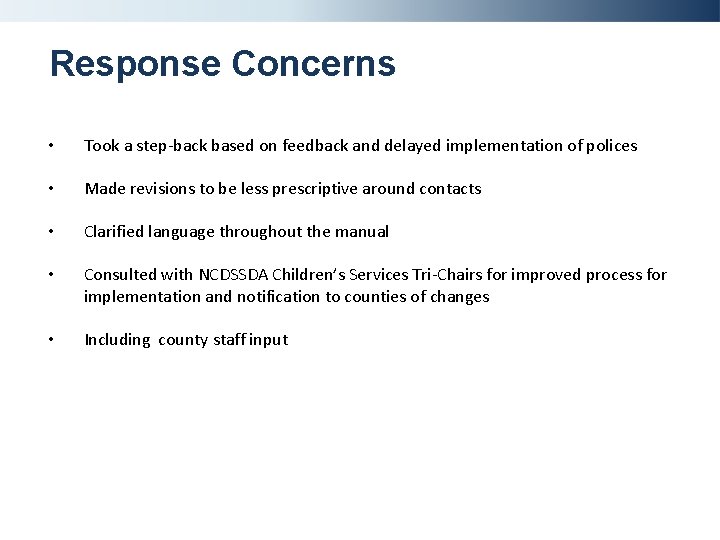
Response Concerns • Took a step-back based on feedback and delayed implementation of polices • Made revisions to be less prescriptive around contacts • Clarified language throughout the manual • Consulted with NCDSSDA Children’s Services Tri-Chairs for improved process for implementation and notification to counties of changes • Including county staff input
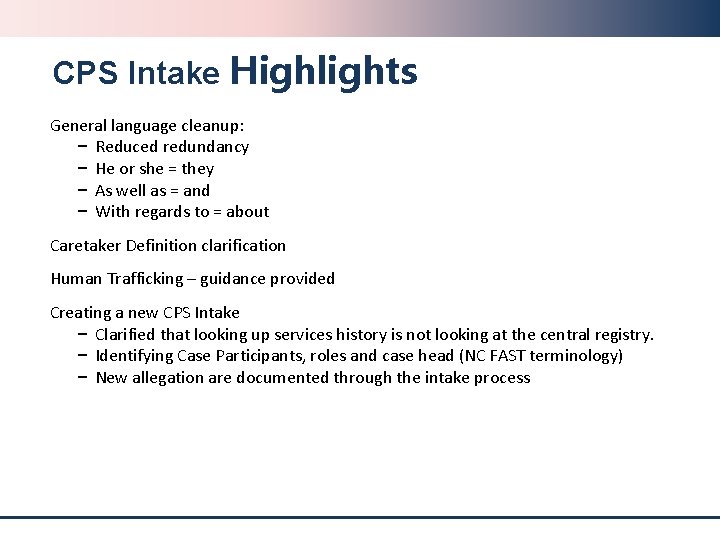
CPS Intake Highlights General language cleanup: − Reduced redundancy − He or she = they − As well as = and − With regards to = about Caretaker Definition clarification Human Trafficking – guidance provided Creating a new CPS Intake − Clarified that looking up services history is not looking at the central registry. − Identifying Case Participants, roles and case head (NC FAST terminology) − New allegation are documented through the intake process
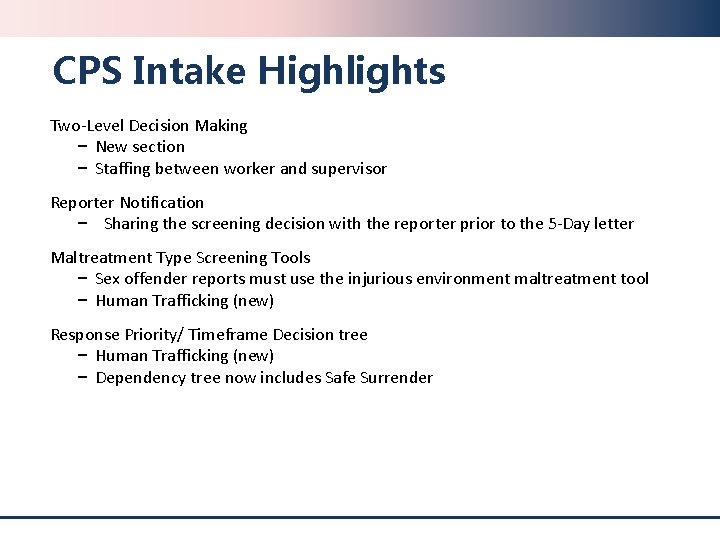
CPS Intake Highlights Two-Level Decision Making − New section − Staffing between worker and supervisor Reporter Notification − Sharing the screening decision with the reporter prior to the 5 -Day letter Maltreatment Type Screening Tools − Sex offender reports must use the injurious environment maltreatment tool − Human Trafficking (new) Response Priority/ Timeframe Decision tree − Human Trafficking (new) − Dependency tree now includes Safe Surrender
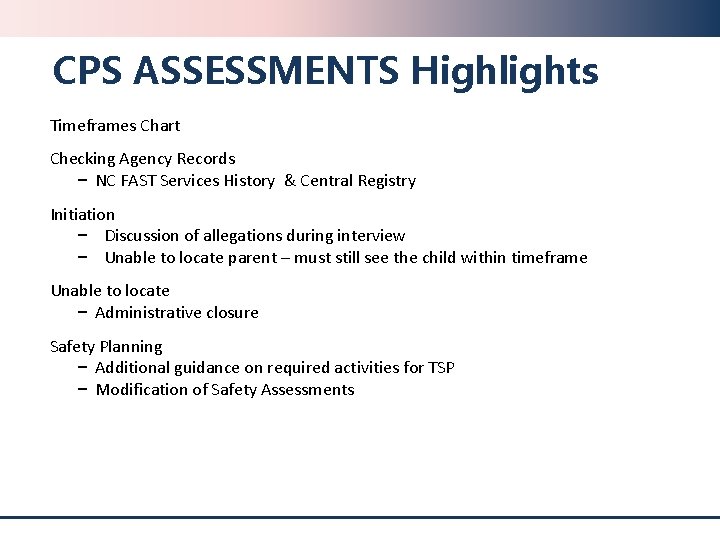
CPS ASSESSMENTS Highlights Timeframes Chart Checking Agency Records − NC FAST Services History & Central Registry Initiation − Discussion of allegations during interview − Unable to locate parent – must still see the child within timeframe Unable to locate − Administrative closure Safety Planning − Additional guidance on required activities for TSP − Modification of Safety Assessments
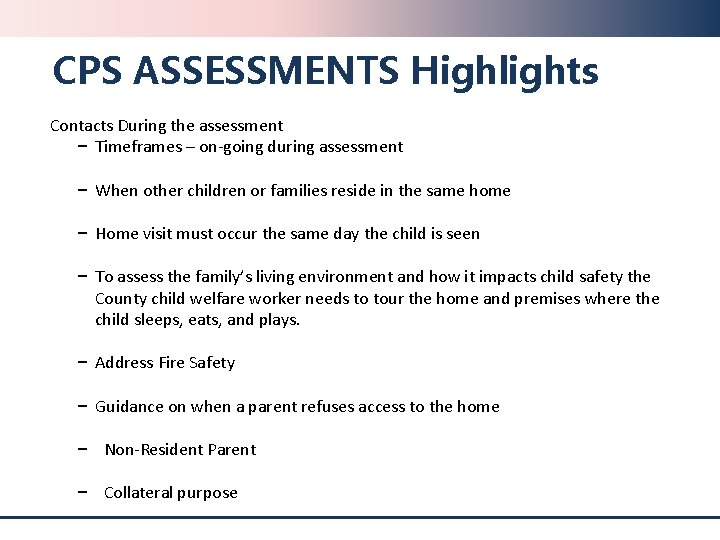
CPS ASSESSMENTS Highlights Contacts During the assessment − Timeframes – on-going during assessment − When other children or families reside in the same home − Home visit must occur the same day the child is seen − To assess the family’s living environment and how it impacts child safety the County child welfare worker needs to tour the home and premises where the child sleeps, eats, and plays. − Address Fire Safety − Guidance on when a parent refuses access to the home − Non-Resident Parent − Collateral purpose
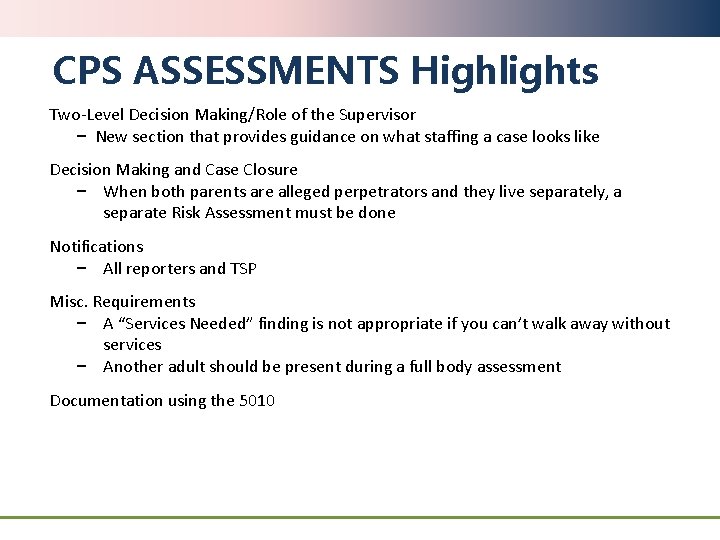
CPS ASSESSMENTS Highlights Two-Level Decision Making/Role of the Supervisor − New section that provides guidance on what staffing a case looks like Decision Making and Case Closure − When both parents are alleged perpetrators and they live separately, a separate Risk Assessment must be done Notifications − All reporters and TSP Misc. Requirements − A “Services Needed” finding is not appropriate if you can’t walk away without services − Another adult should be present during a full body assessment Documentation using the 5010
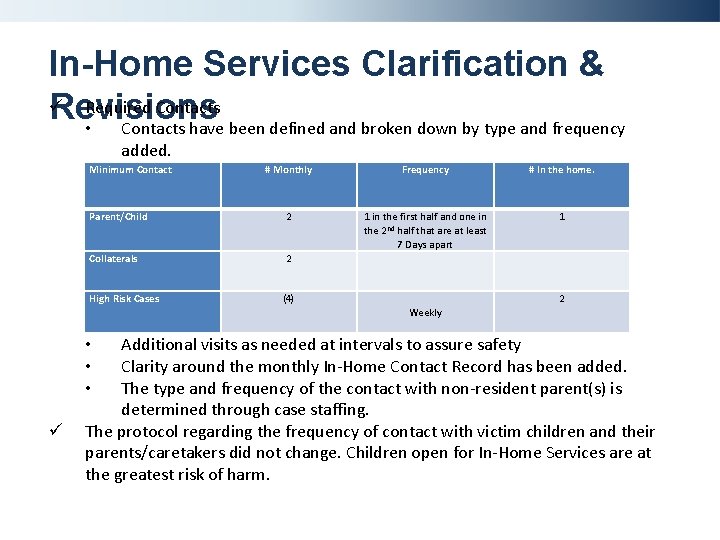
In-Home Services Clarification & ü Required Contacts Revisions • Contacts have been defined and broken down by type and frequency added. Minimum Contact # Monthly Frequency # In the home. Parent/Child 2 1 in the first half and one in the 2 nd half that are at least 7 Days apart 1 Collaterals 2 High Risk Cases (4) 2 Weekly Additional visits as needed at intervals to assure safety Clarity around the monthly In-Home Contact Record has been added. The type and frequency of the contact with non-resident parent(s) is determined through case staffing. The protocol regarding the frequency of contact with victim children and their parents/caretakers did not change. Children open for In-Home Services are at the greatest risk of harm. • • • ü
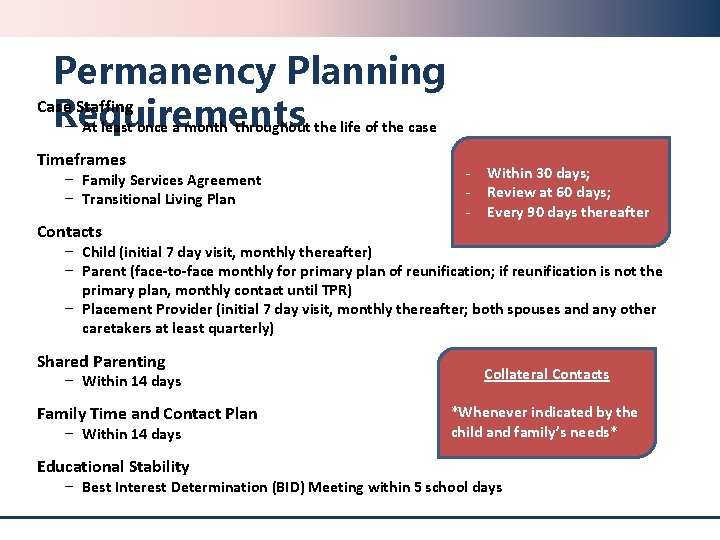
Permanency Planning Case Staffing Requirements − At least once a month throughout the life of the case Timeframes − Family Services Agreement − Transitional Living Plan Contacts - Within 30 days; Review at 60 days; Every 90 days thereafter − Child (initial 7 day visit, monthly thereafter) − Parent (face-to-face monthly for primary plan of reunification; if reunification is not the primary plan, monthly contact until TPR) − Placement Provider (initial 7 day visit, monthly thereafter; both spouses and any other caretakers at least quarterly) Shared Parenting − Within 14 days Family Time and Contact Plan − Within 14 days Educational Stability Collateral Contacts *Whenever indicated by the child and family’s needs* − Best Interest Determination (BID) Meeting within 5 school days
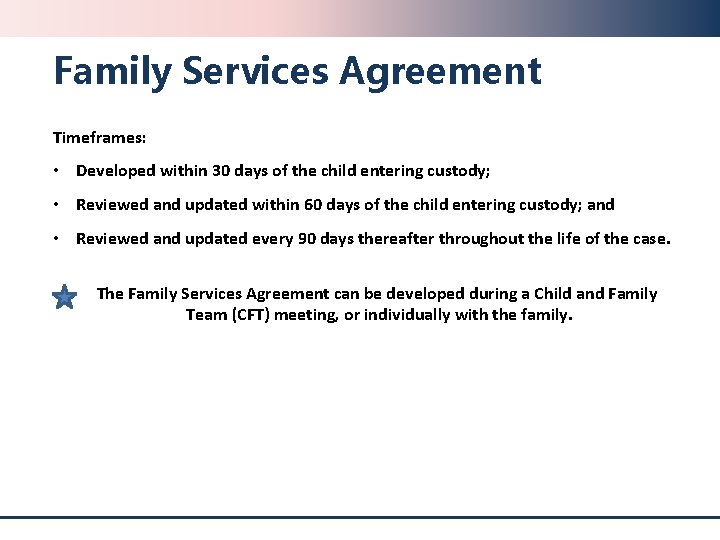
Family Services Agreement Timeframes: • Developed within 30 days of the child entering custody; • Reviewed and updated within 60 days of the child entering custody; and • Reviewed and updated every 90 days thereafter throughout the life of the case. The Family Services Agreement can be developed during a Child and Family Team (CFT) meeting, or individually with the family.
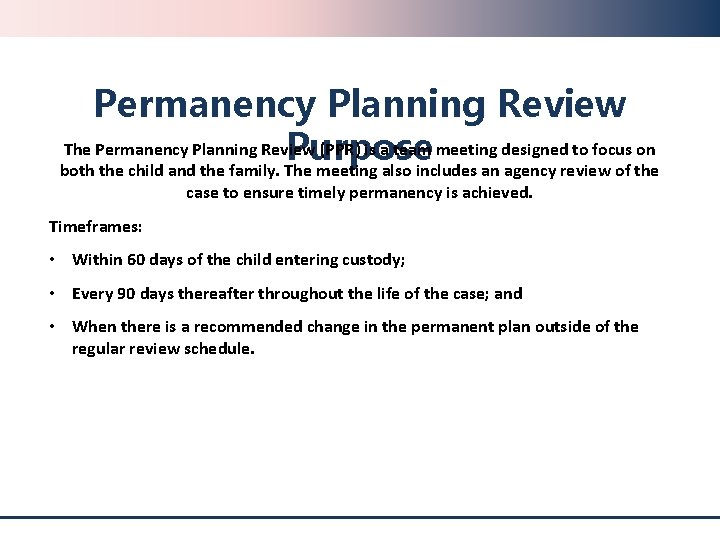
Permanency Planning Review The Permanency Planning Review (PPR) is a team meeting designed to focus on Purpose both the child and the family. The meeting also includes an agency review of the case to ensure timely permanency is achieved. Timeframes: • Within 60 days of the child entering custody; • Every 90 days thereafter throughout the life of the case; and • When there is a recommended change in the permanent plan outside of the regular review schedule.
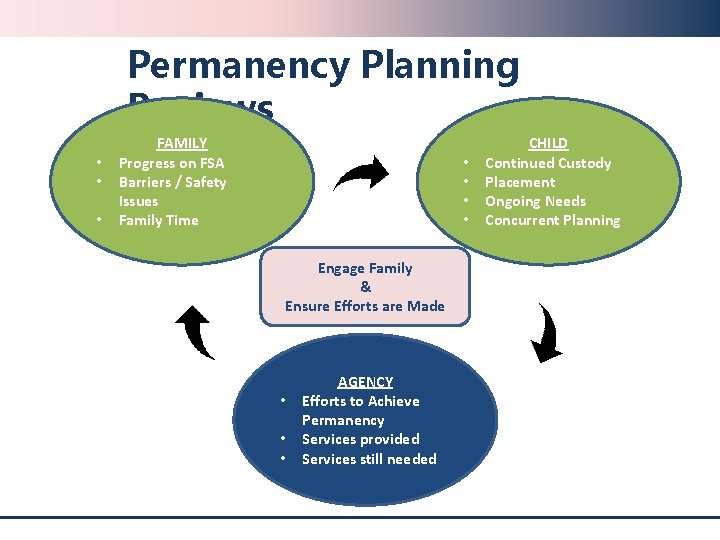
Permanency Planning Reviews • • • FAMILY Progress on FSA Barriers / Safety Issues Family Time • • Engage Family & Ensure Efforts are Made • • • AGENCY Efforts to Achieve Permanency Services provided Services still needed CHILD Continued Custody Placement Ongoing Needs Concurrent Planning
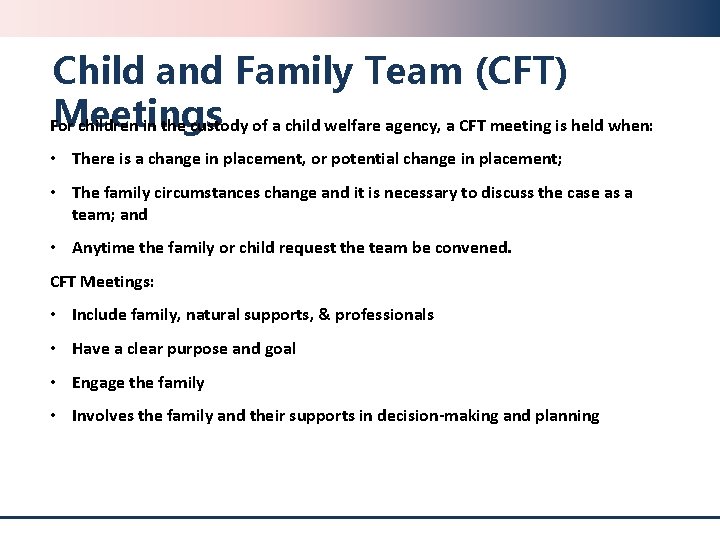
Child and Family Team (CFT) Meetings For children in the custody of a child welfare agency, a CFT meeting is held when: • There is a change in placement, or potential change in placement; • The family circumstances change and it is necessary to discuss the case as a team; and • Anytime the family or child request the team be convened. CFT Meetings: • Include family, natural supports, & professionals • Have a clear purpose and goal • Engage the family • Involves the family and their supports in decision-making and planning
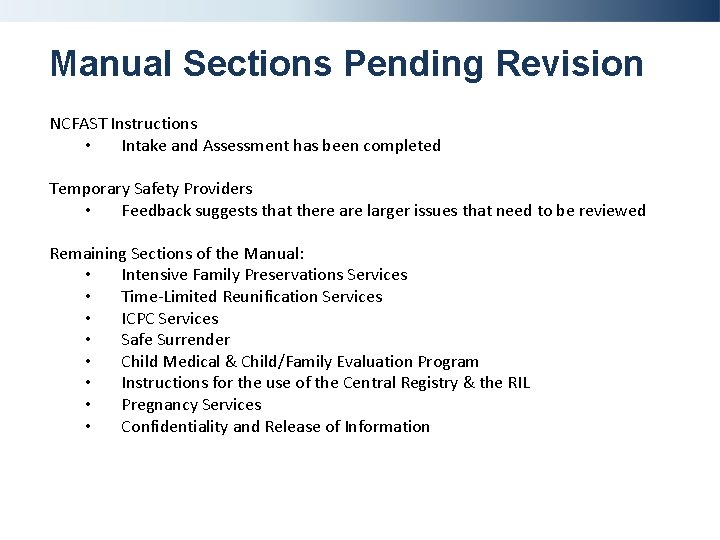
Manual Sections Pending Revision NCFAST Instructions • Intake and Assessment has been completed Temporary Safety Providers • Feedback suggests that there are larger issues that need to be reviewed Remaining Sections of the Manual: • Intensive Family Preservations Services • Time-Limited Reunification Services • ICPC Services • Safe Surrender • Child Medical & Child/Family Evaluation Program • Instructions for the use of the Central Registry & the RIL • Pregnancy Services • Confidentiality and Release of Information
Links to Modified Manual TA Gateway https: //nccwta. org/index. php? /Knowledgebase/Article/View/2/0/nc-child-welfaremanual DHHS On-Line Manual https: //www 2. ncdhhs. gov/info/olm/manuals/dss/ Questions about the manual: Terri Reichert (919) 527 -7295 Terri. Reichert@dhhs. nc. gov Erin Baluyot (919) 527 -6369 Erin. baluyot@dhhs. nc. gov Emi Wyble (919) 527 -7258 Emi. Wyble@dhhs. nc. gov