
NCore Goals and Implementation Challenges Overview of NCore
- Slides: 18
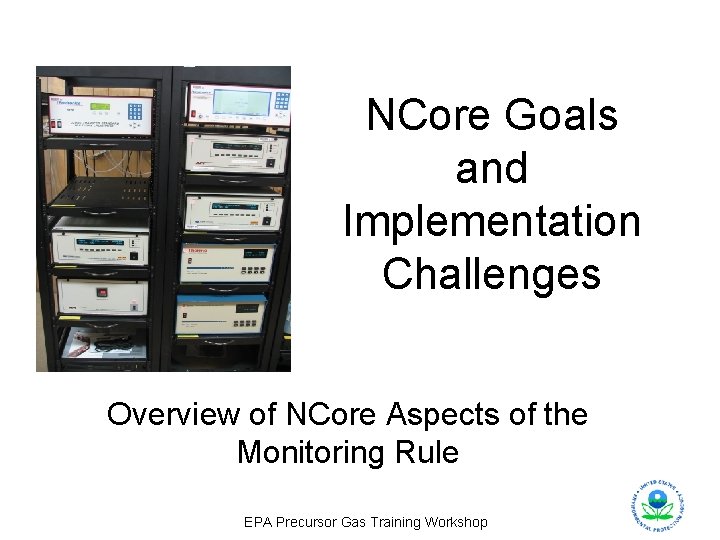
NCore Goals and Implementation Challenges Overview of NCore Aspects of the Monitoring Rule EPA Precursor Gas Training Workshop
Goals of the Today’s Workshop • NCore monitoring rule requirements. • NCore monitoring objectives and network design implications • Meeting the data quality objectives. • Technological and procedural requirements. • Challenges of NCore-type site operations. • Follow-up issues. NCore EPA Precursor Gas Training Workshop
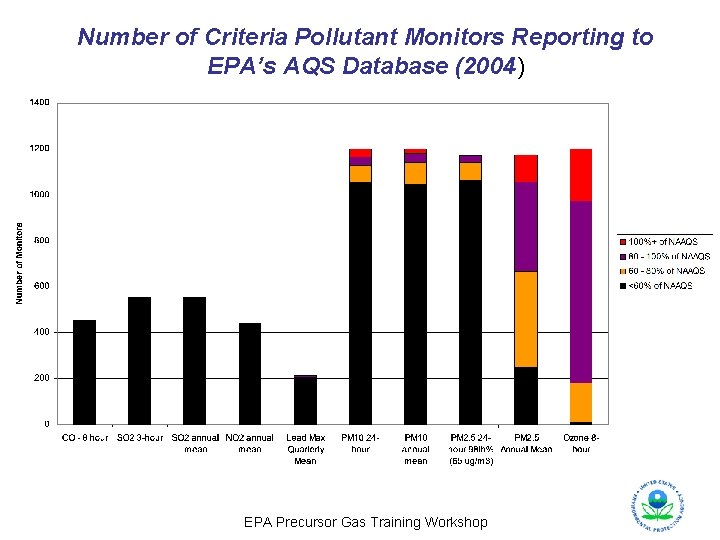
Number of Criteria Pollutant Monitors Reporting to EPA’s AQS Database (2004) EPA Precursor Gas Training Workshop
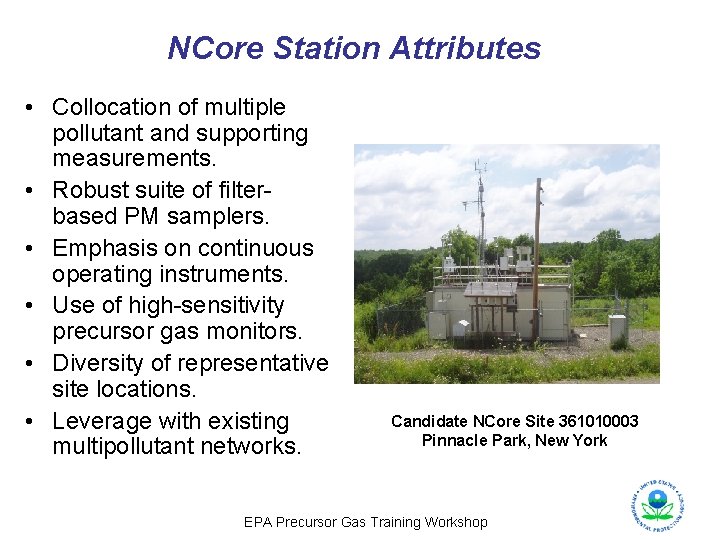
NCore Station Attributes • Collocation of multiple pollutant and supporting measurements. • Robust suite of filterbased PM samplers. • Emphasis on continuous operating instruments. • Use of high-sensitivity precursor gas monitors. • Diversity of representative site locations. • Leverage with existing multipollutant networks. Candidate NCore Site 361010003 Pinnacle Park, New York EPA Precursor Gas Training Workshop
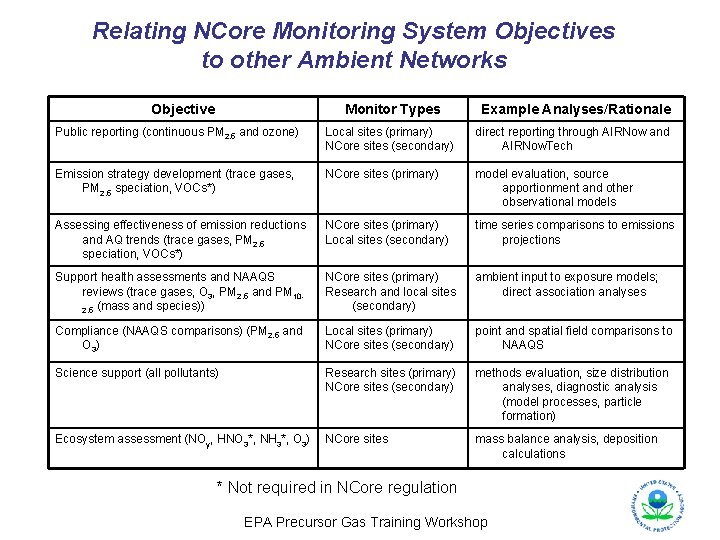
Relating NCore Monitoring System Objectives to other Ambient Networks Objective Monitor Types Example Analyses/Rationale Public reporting (continuous PM 2. 5 and ozone) Local sites (primary) NCore sites (secondary) direct reporting through AIRNow and AIRNow. Tech Emission strategy development (trace gases, PM 2. 5 speciation, VOCs*) NCore sites (primary) model evaluation, source apportionment and other observational models Assessing effectiveness of emission reductions and AQ trends (trace gases, PM 2. 5 speciation, VOCs*) NCore sites (primary) Local sites (secondary) time series comparisons to emissions projections Support health assessments and NAAQS reviews (trace gases, O 3, PM 2. 5 and PM 102. 5 (mass and species)) NCore sites (primary) Research and local sites (secondary) ambient input to exposure models; direct association analyses Compliance (NAAQS comparisons) (PM 2. 5 and O 3) Local sites (primary) NCore sites (secondary) point and spatial field comparisons to NAAQS Science support (all pollutants) Research sites (primary) NCore sites (secondary) methods evaluation, size distribution analyses, diagnostic analysis (model processes, particle formation) Ecosystem assessment (NOy, HNO 3*, NH 3*, O 3) NCore sites mass balance analysis, deposition calculations * Not required in NCore regulation EPA Precursor Gas Training Workshop
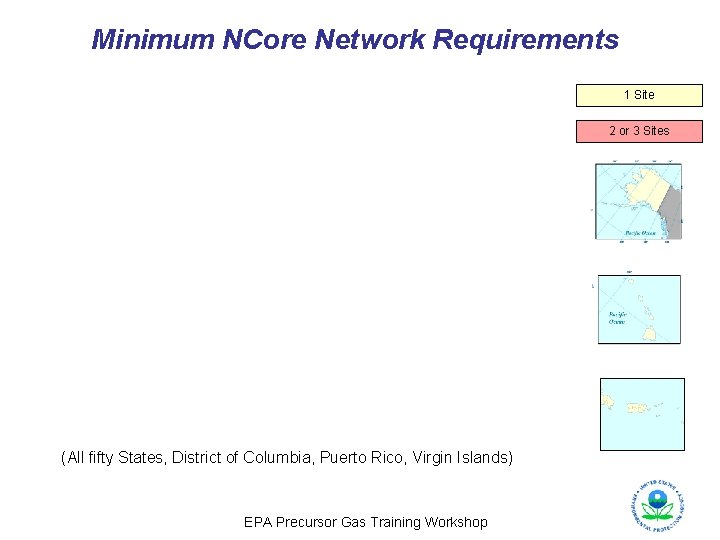
Minimum NCore Network Requirements 1 Site 2 or 3 Sites (All fifty States, District of Columbia, Puerto Rico, Virgin Islands) EPA Precursor Gas Training Workshop
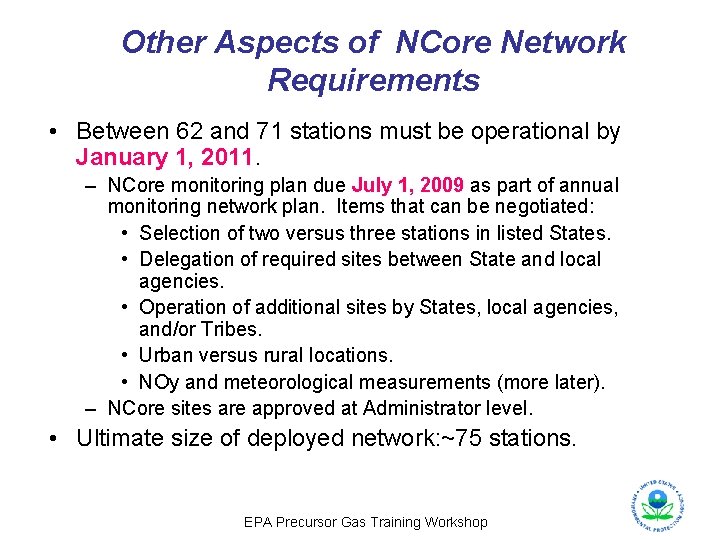
Other Aspects of NCore Network Requirements • Between 62 and 71 stations must be operational by January 1, 2011. – NCore monitoring plan due July 1, 2009 as part of annual monitoring network plan. Items that can be negotiated: • Selection of two versus three stations in listed States. • Delegation of required sites between State and local agencies. • Operation of additional sites by States, local agencies, and/or Tribes. • Urban versus rural locations. • NOy and meteorological measurements (more later). – NCore sites are approved at Administrator level. • Ultimate size of deployed network: ~75 stations. EPA Precursor Gas Training Workshop
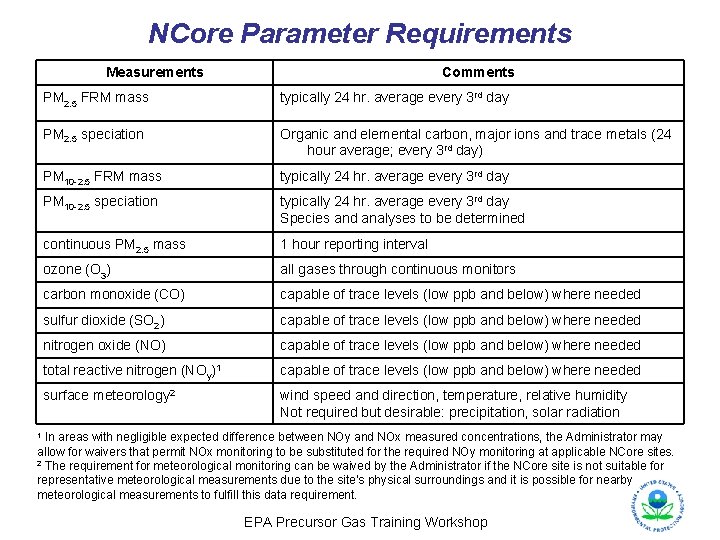
NCore Parameter Requirements Measurements Comments PM 2. 5 FRM mass typically 24 hr. average every 3 rd day PM 2. 5 speciation Organic and elemental carbon, major ions and trace metals (24 hour average; every 3 rd day) PM 10 -2. 5 FRM mass typically 24 hr. average every 3 rd day PM 10 -2. 5 speciation typically 24 hr. average every 3 rd day Species and analyses to be determined continuous PM 2. 5 mass 1 hour reporting interval ozone (O 3) all gases through continuous monitors carbon monoxide (CO) capable of trace levels (low ppb and below) where needed sulfur dioxide (SO 2) capable of trace levels (low ppb and below) where needed nitrogen oxide (NO) capable of trace levels (low ppb and below) where needed total reactive nitrogen (NOy)1 capable of trace levels (low ppb and below) where needed surface meteorology 2 wind speed and direction, temperature, relative humidity Not required but desirable: precipitation, solar radiation In areas with negligible expected difference between NOy and NOx measured concentrations, the Administrator may allow for waivers that permit NOx monitoring to be substituted for the required NOy monitoring at applicable NCore sites. 2 The requirement for meteorological monitoring can be waived by the Administrator if the NCore site is not suitable for representative meteorological measurements due to the site’s physical surroundings and it is possible for nearby meteorological measurements to fulfill this data requirement. 1 EPA Precursor Gas Training Workshop
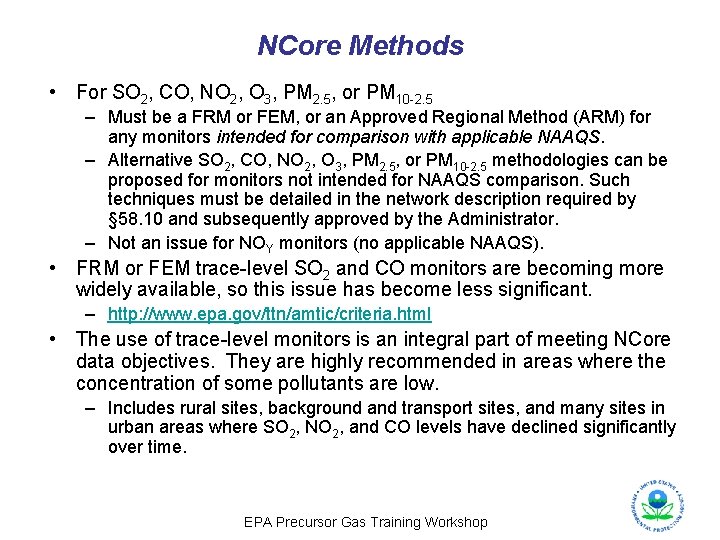
NCore Methods • For SO 2, CO, NO 2, O 3, PM 2. 5, or PM 10 -2. 5 – Must be a FRM or FEM, or an Approved Regional Method (ARM) for any monitors intended for comparison with applicable NAAQS. – Alternative SO 2, CO, NO 2, O 3, PM 2. 5, or PM 10 -2. 5 methodologies can be proposed for monitors not intended for NAAQS comparison. Such techniques must be detailed in the network description required by § 58. 10 and subsequently approved by the Administrator. – Not an issue for NOY monitors (no applicable NAAQS). • FRM or FEM trace-level SO 2 and CO monitors are becoming more widely available, so this issue has become less significant. – http: //www. epa. gov/ttn/amtic/criteria. html • The use of trace-level monitors is an integral part of meeting NCore data objectives. They are highly recommended in areas where the concentration of some pollutants are low. – Includes rural sites, background and transport sites, and many sites in urban areas where SO 2, NO 2, and CO levels have declined significantly over time. EPA Precursor Gas Training Workshop
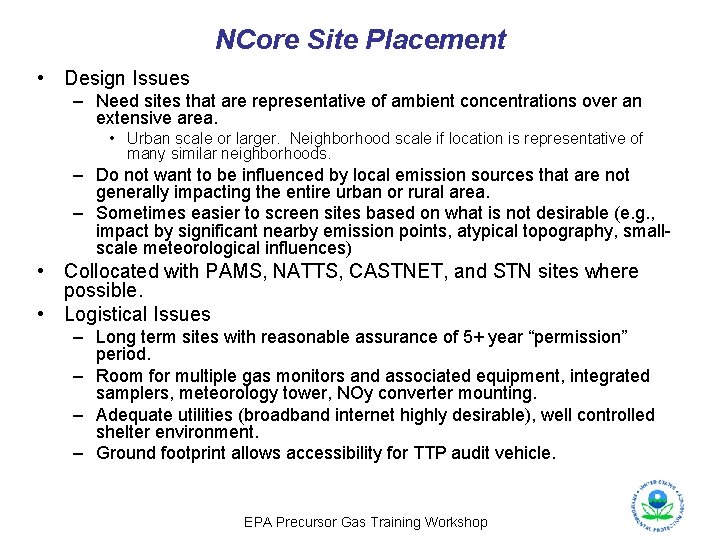
NCore Site Placement • Design Issues – Need sites that are representative of ambient concentrations over an extensive area. • Urban scale or larger. Neighborhood scale if location is representative of many similar neighborhoods. – Do not want to be influenced by local emission sources that are not generally impacting the entire urban or rural area. – Sometimes easier to screen sites based on what is not desirable (e. g. , impact by significant nearby emission points, atypical topography, smallscale meteorological influences) • Collocated with PAMS, NATTS, CASTNET, and STN sites where possible. • Logistical Issues – Long term sites with reasonable assurance of 5+ year “permission” period. – Room for multiple gas monitors and associated equipment, integrated samplers, meteorology tower, NOy converter mounting. – Adequate utilities (broadband internet highly desirable), well controlled shelter environment. – Ground footprint allows accessibility for TTP audit vehicle. EPA Precursor Gas Training Workshop
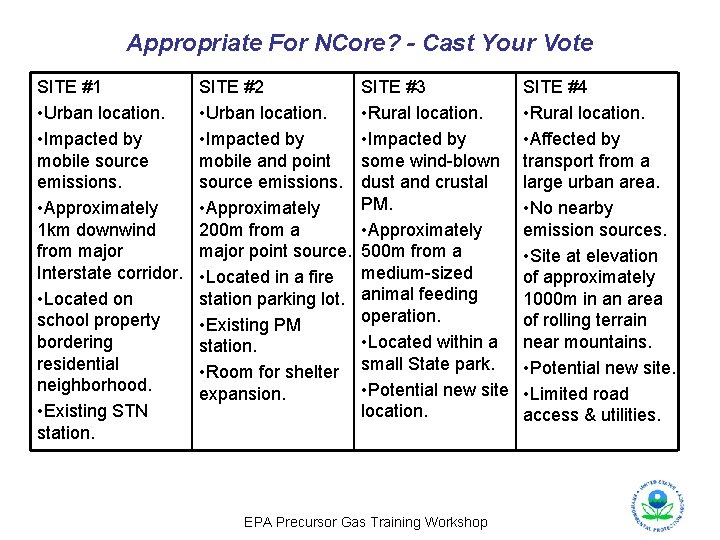
Appropriate For NCore? - Cast Your Vote SITE #1 • Urban location. • Impacted by mobile source emissions. • Approximately 1 km downwind from major Interstate corridor. • Located on school property bordering residential neighborhood. • Existing STN station. SITE #2 • Urban location. • Impacted by mobile and point source emissions. • Approximately 200 m from a major point source. • Located in a fire station parking lot. • Existing PM station. • Room for shelter expansion. SITE #3 • Rural location. • Impacted by some wind-blown dust and crustal PM. • Approximately 500 m from a medium-sized animal feeding operation. • Located within a small State park. • Potential new site location. EPA Precursor Gas Training Workshop SITE #4 • Rural location. • Affected by transport from a large urban area. • No nearby emission sources. • Site at elevation of approximately 1000 m in an area of rolling terrain near mountains. • Potential new site. • Limited road access & utilities.
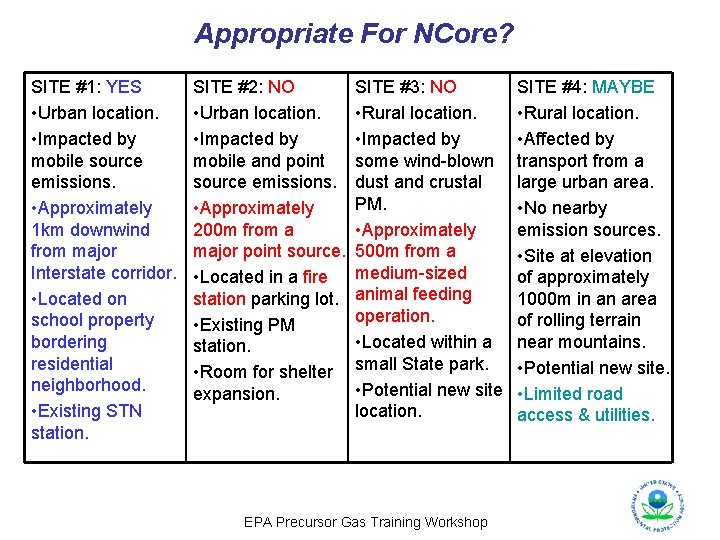
Appropriate For NCore? SITE #1: YES • Urban location. • Impacted by mobile source emissions. • Approximately 1 km downwind from major Interstate corridor. • Located on school property bordering residential neighborhood. • Existing STN station. SITE #2: NO • Urban location. • Impacted by mobile and point source emissions. • Approximately 200 m from a major point source. • Located in a fire station parking lot. • Existing PM station. • Room for shelter expansion. SITE #3: NO • Rural location. • Impacted by some wind-blown dust and crustal PM. • Approximately 500 m from a medium-sized animal feeding operation. • Located within a small State park. • Potential new site location. EPA Precursor Gas Training Workshop SITE #4: MAYBE • Rural location. • Affected by transport from a large urban area. • No nearby emission sources. • Site at elevation of approximately 1000 m in an area of rolling terrain near mountains. • Potential new site. • Limited road access & utilities.
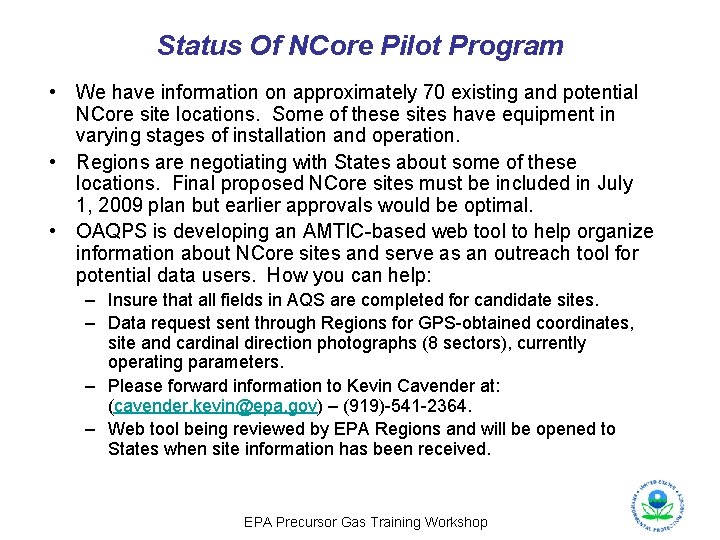
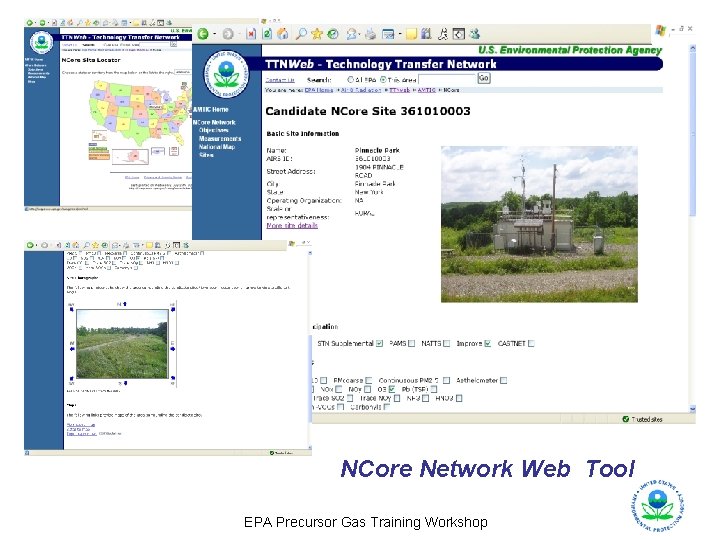
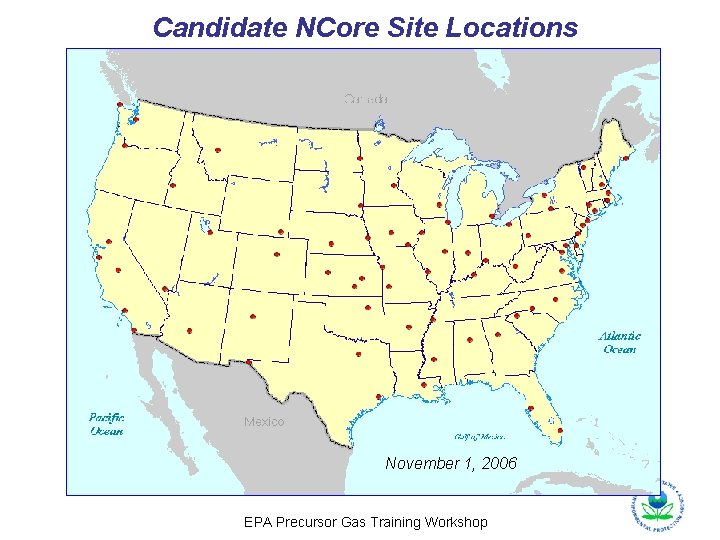
Status Of NCore Pilot Program • We have information on approximately 70 existing and potential NCore site locations. Some of these sites have equipment in varying stages of installation and operation. • Regions are negotiating with States about some of these locations. Final proposed NCore sites must be included in July 1, 2009 plan but earlier approvals would be optimal. • OAQPS is developing an AMTIC-based web tool to help organize information about NCore sites and serve as an outreach tool for potential data users. How you can help: – Insure that all fields in AQS are completed for candidate sites. – Data request sent through Regions for GPS-obtained coordinates, site and cardinal direction photographs (8 sectors), currently operating parameters. – Please forward information to Kevin Cavender at: (cavender. kevin@epa. gov) – (919)-541 -2364. – Web tool being reviewed by EPA Regions and will be opened to States when site information has been received. EPA Precursor Gas Training Workshop
NCore Network Web Tool EPA Precursor Gas Training Workshop
Candidate NCore Site Locations November 1, 2006 EPA Precursor Gas Training Workshop
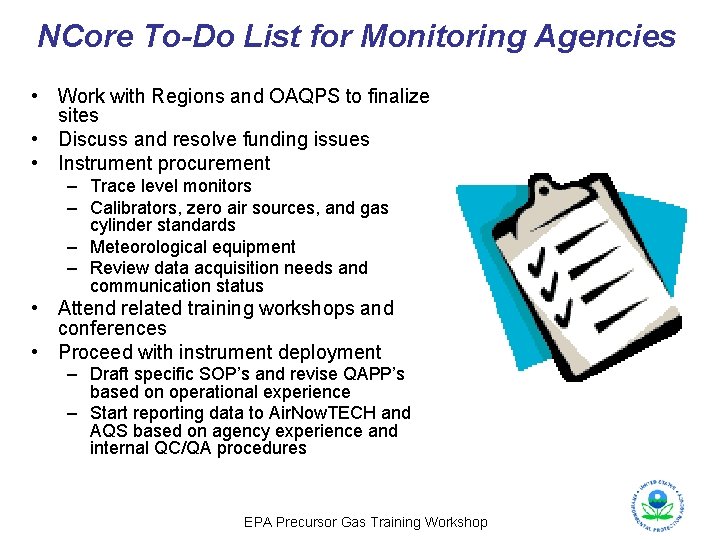
NCore To-Do List for Monitoring Agencies • Work with Regions and OAQPS to finalize sites • Discuss and resolve funding issues • Instrument procurement – Trace level monitors – Calibrators, zero air sources, and gas cylinder standards – Meteorological equipment – Review data acquisition needs and communication status • Attend related training workshops and conferences • Proceed with instrument deployment – Draft specific SOP’s and revise QAPP’s based on operational experience – Start reporting data to Air. Now. TECH and AQS based on agency experience and internal QC/QA procedures EPA Precursor Gas Training Workshop
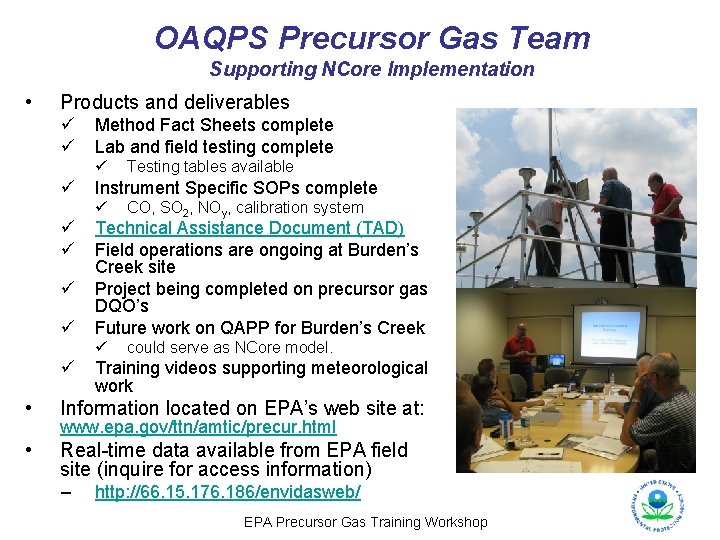
OAQPS Precursor Gas Team Supporting NCore Implementation • Products and deliverables ü ü Method Fact Sheets complete Lab and field testing complete ü ü Instrument Specific SOPs complete ü ü ü CO, SO 2, NOy, calibration system Technical Assistance Document (TAD) Field operations are ongoing at Burden’s Creek site Project being completed on precursor gas DQO’s Future work on QAPP for Burden’s Creek ü ü Testing tables available could serve as NCore model. Training videos supporting meteorological work • Information located on EPA’s web site at: • Real-time data available from EPA field site (inquire for access information) www. epa. gov/ttn/amtic/precur. html – http: //66. 15. 176. 186/envidasweb/ EPA Precursor Gas Training Workshop
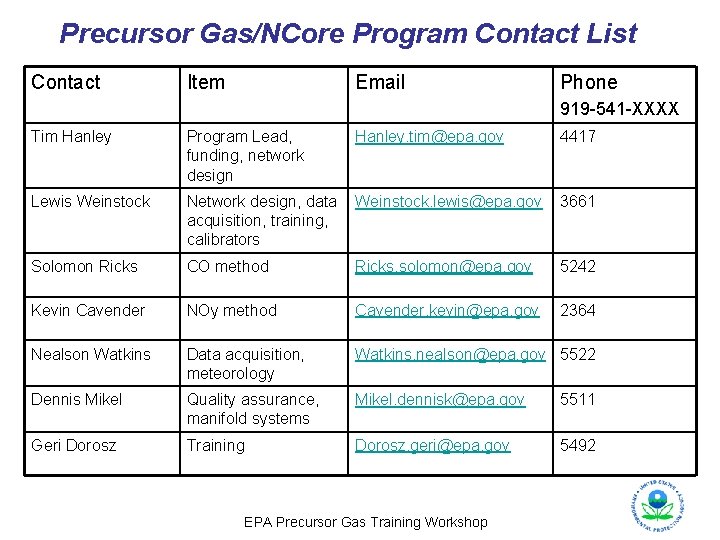
Precursor Gas/NCore Program Contact List Contact Item Email Phone 919 -541 -XXXX Tim Hanley Program Lead, funding, network design Hanley. tim@epa. gov 4417 Lewis Weinstock Network design, data acquisition, training, calibrators Weinstock. lewis@epa. gov 3661 Solomon Ricks CO method Ricks. solomon@epa. gov 5242 Kevin Cavender NOy method Cavender. kevin@epa. gov 2364 Nealson Watkins Data acquisition, meteorology Watkins. nealson@epa. gov 5522 Dennis Mikel Quality assurance, manifold systems Mikel. dennisk@epa. gov 5511 Geri Dorosz Training Dorosz. geri@epa. gov 5492 EPA Precursor Gas Training Workshop