
NCLEX questions Parkinsons Disease PD June 2 2017

- Slides: 24
NCLEX questions Parkinson’s Disease (PD) June 2, 2017
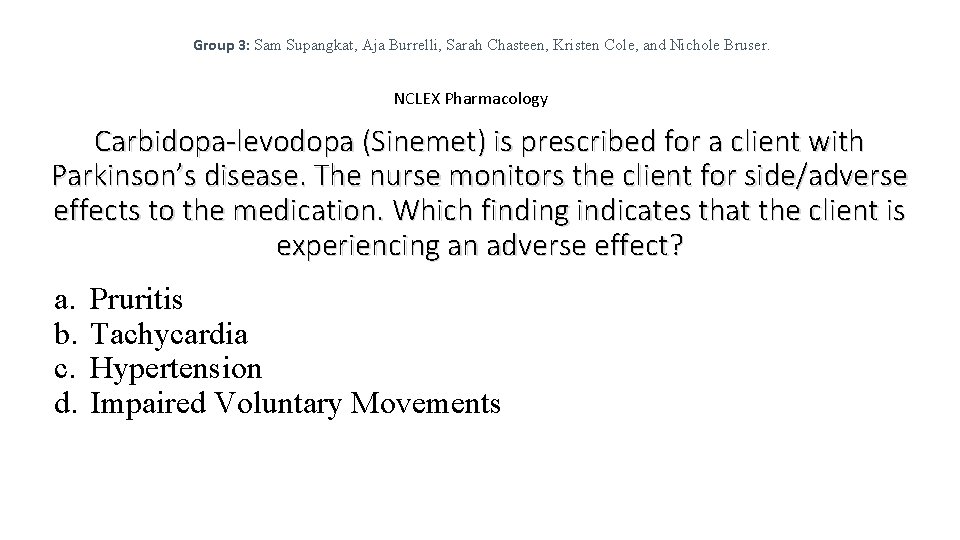
Group 3: Sam Supangkat, Aja Burrelli, Sarah Chasteen, Kristen Cole, and Nichole Bruser. NCLEX Pharmacology Carbidopa-levodopa (Sinemet) is prescribed for a client with Parkinson’s disease. The nurse monitors the client for side/adverse effects to the medication. Which finding indicates that the client is experiencing an adverse effect? a. b. c. d. Pruritis Tachycardia Hypertension Impaired Voluntary Movements
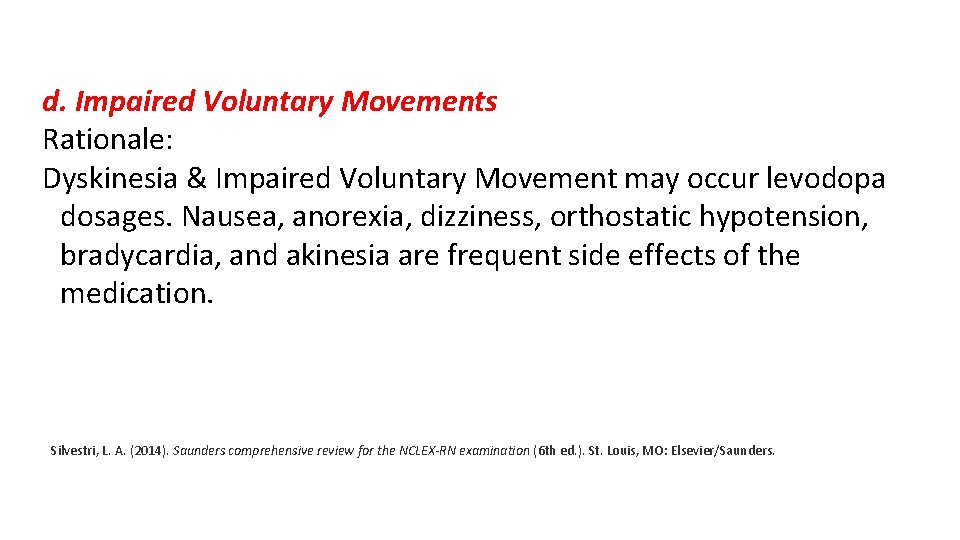
d. Impaired Voluntary Movements Rationale: Dyskinesia & Impaired Voluntary Movement may occur levodopa dosages. Nausea, anorexia, dizziness, orthostatic hypotension, bradycardia, and akinesia are frequent side effects of the medication. Silvestri, L. A. (2014). Saunders comprehensive review for the NCLEX-RN examination (6 th ed. ). St. Louis, MO: Elsevier/Saunders.
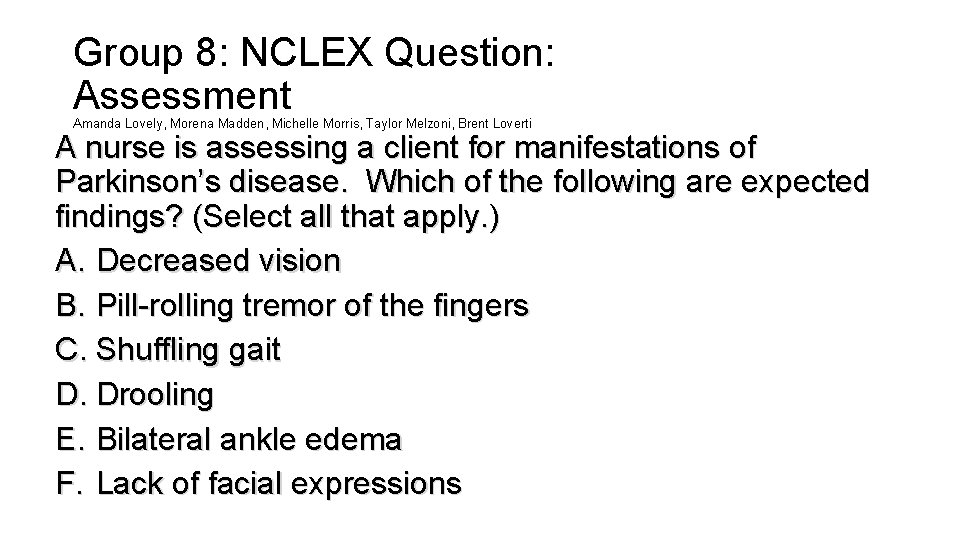
Group 8: NCLEX Question: Assessment Amanda Lovely, Morena Madden, Michelle Morris, Taylor Melzoni, Brent Loverti A nurse is assessing a client for manifestations of Parkinson’s disease. Which of the following are expected findings? (Select all that apply. ) A. Decreased vision B. Pill-rolling tremor of the fingers C. Shuffling gait D. Drooling E. Bilateral ankle edema F. Lack of facial expressions
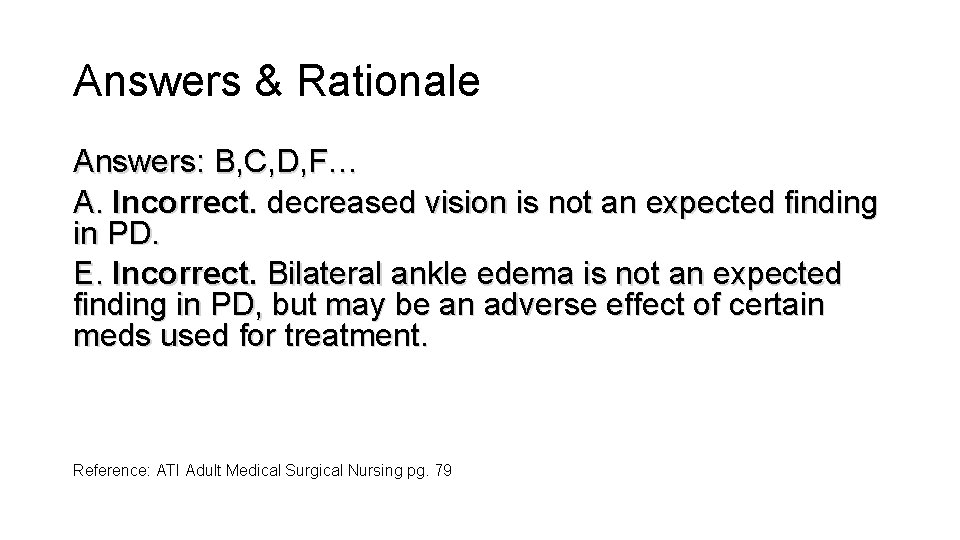
Answers & Rationale Answers: B, C, D, F… A. Incorrect. decreased vision is not an expected finding in PD. E. Incorrect. Bilateral ankle edema is not an expected finding in PD, but may be an adverse effect of certain meds used for treatment. Reference: ATI Adult Medical Surgical Nursing pg. 79
Group 1 Question What is a preventable complication related to Parkinson’s disease?
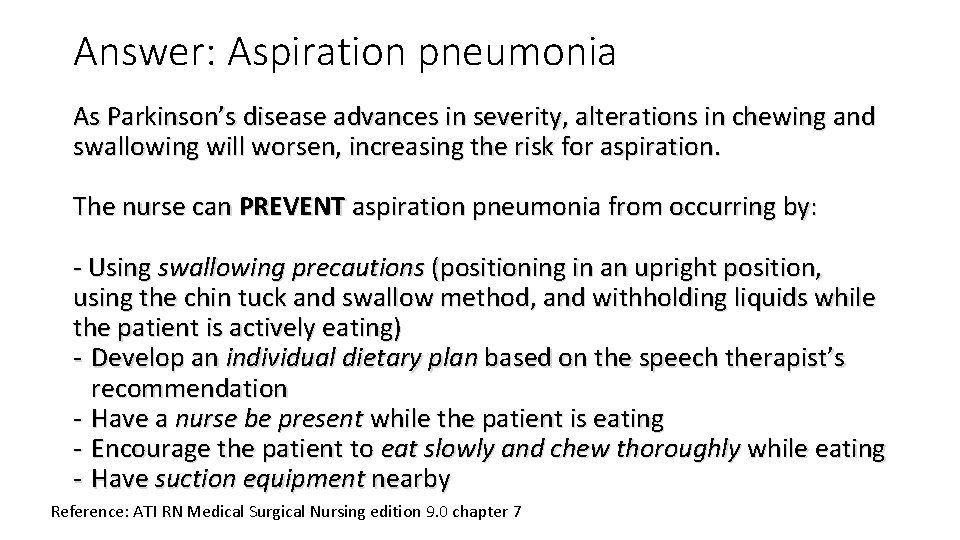
Answer: Aspiration pneumonia As Parkinson’s disease advances in severity, alterations in chewing and swallowing will worsen, increasing the risk for aspiration. The nurse can PREVENT aspiration pneumonia from occurring by: - Using swallowing precautions (positioning in an upright position, using the chin tuck and swallow method, and withholding liquids while the patient is actively eating) - Develop an individual dietary plan based on the speech therapist’s recommendation - Have a nurse be present while the patient is eating - Encourage the patient to eat slowly and chew thoroughly while eating - Have suction equipment nearby Reference: ATI RN Medical Surgical Nursing edition 9. 0 chapter 7
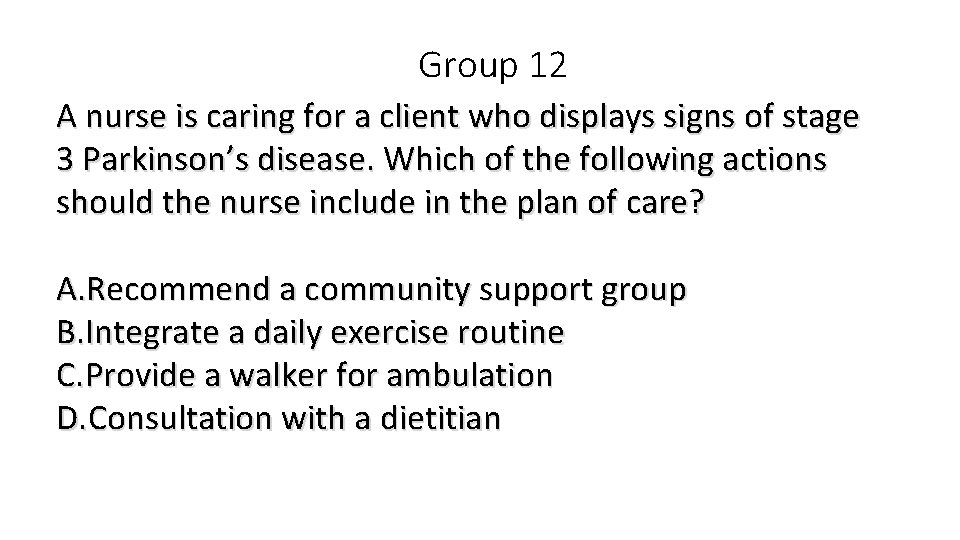
Group 12 A nurse is caring for a client who displays signs of stage 3 Parkinson’s disease. Which of the following actions should the nurse include in the plan of care? A. Recommend a community support group B. Integrate a daily exercise routine C. Provide a walker for ambulation D. Consultation with a dietitian
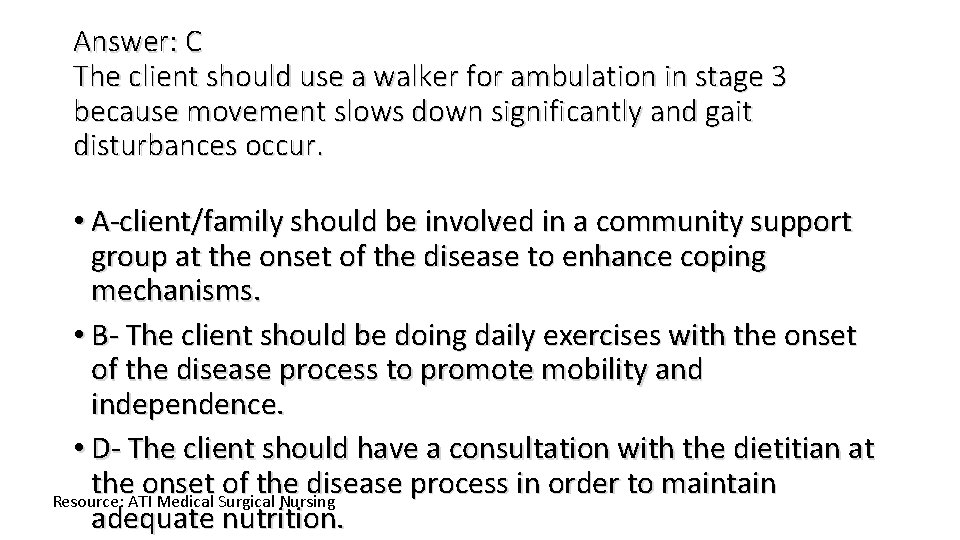
Answer: C The client should use a walker for ambulation in stage 3 because movement slows down significantly and gait disturbances occur. • A-client/family should be involved in a community support group at the onset of the disease to enhance coping mechanisms. • B- The client should be doing daily exercises with the onset of the disease process to promote mobility and independence. • D- The client should have a consultation with the dietitian at the onset of the disease process in order to maintain Resource: ATI Medical Surgical Nursing adequate nutrition.
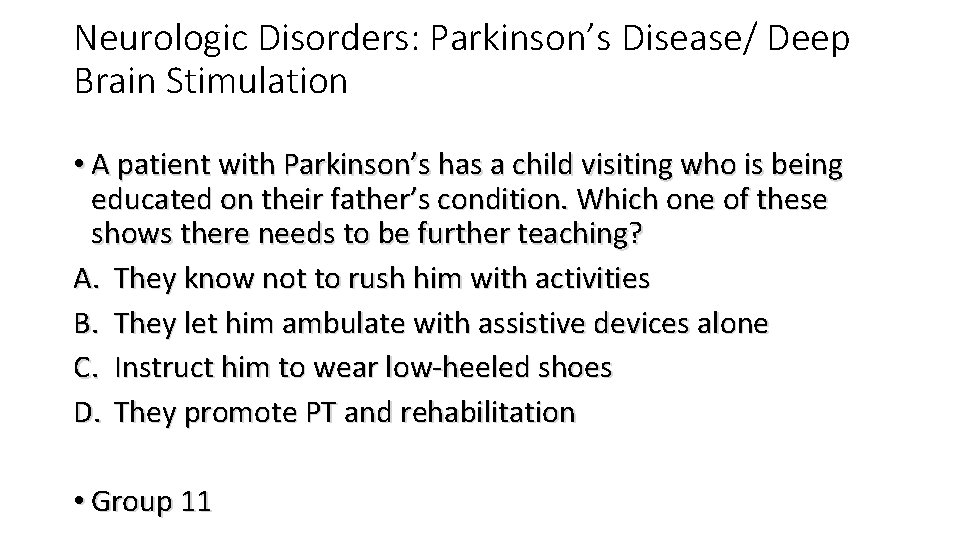
Neurologic Disorders: Parkinson’s Disease/ Deep Brain Stimulation • A patient with Parkinson’s has a child visiting who is being educated on their father’s condition. Which one of these shows there needs to be further teaching? A. They know not to rush him with activities B. They let him ambulate with assistive devices alone C. Instruct him to wear low-heeled shoes D. They promote PT and rehabilitation • Group 11
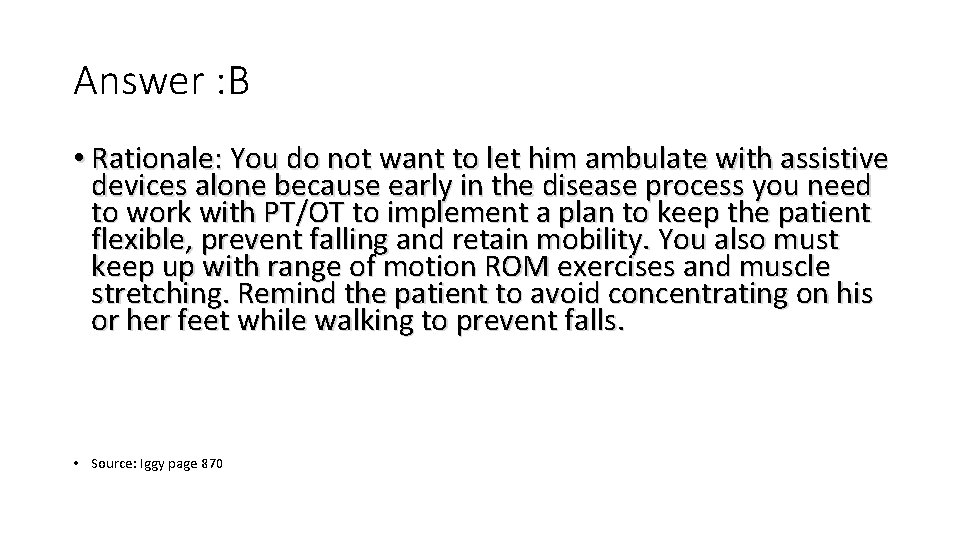
Answer : B • Rationale: You do not want to let him ambulate with assistive devices alone because early in the disease process you need to work with PT/OT to implement a plan to keep the patient flexible, prevent falling and retain mobility. You also must keep up with range of motion ROM exercises and muscle stretching. Remind the patient to avoid concentrating on his or her feet while walking to prevent falls. • Source: Iggy page 870
Group 5 Discussion Question: Neurosensation: Parkinson’s disease/Deep brain Stim. Nclex style Question: select all that apply 6 -2 -17
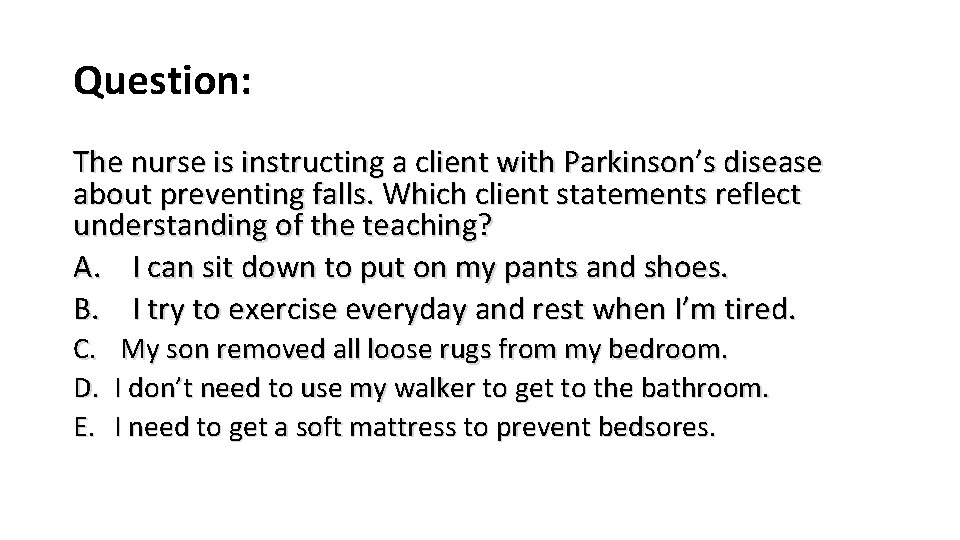
Question: The nurse is instructing a client with Parkinson’s disease about preventing falls. Which client statements reflect understanding of the teaching? A. I can sit down to put on my pants and shoes. B. I try to exercise everyday and rest when I’m tired. C. D. E. My son removed all loose rugs from my bedroom. I don’t need to use my walker to get to the bathroom. I need to get a soft mattress to prevent bedsores.
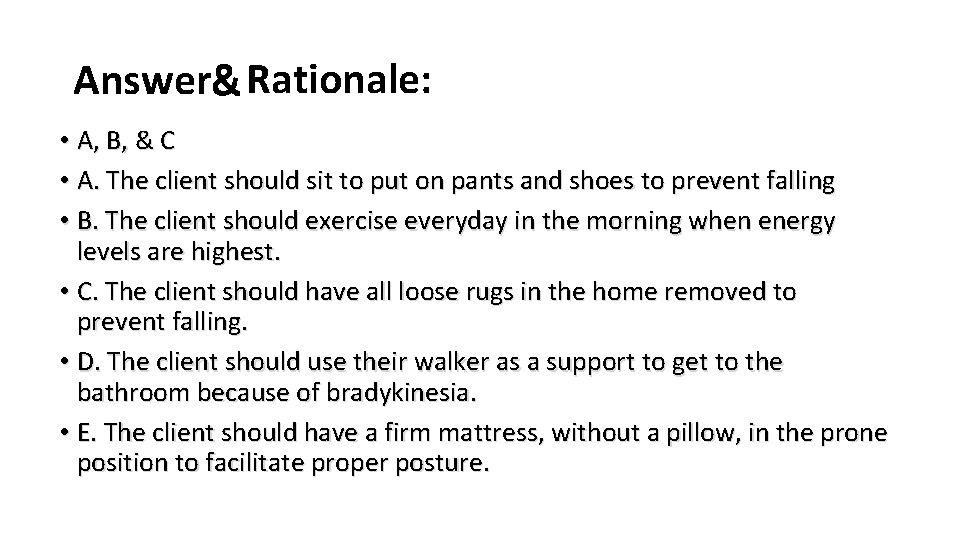
Answer& Rationale: • A, B, & C • A. The client should sit to put on pants and shoes to prevent falling • B. The client should exercise everyday in the morning when energy levels are highest. • C. The client should have all loose rugs in the home removed to prevent falling. • D. The client should use their walker as a support to get to the bathroom because of bradykinesia. • E. The client should have a firm mattress, without a pillow, in the prone position to facilitate proper posture.
Group 9 Stacy Gay, Michaella Mc. Clain, Leah Minneman, Alayna Moore, & Eric Packard What nursing diagnoses are associated with Parkinson’s Disease?
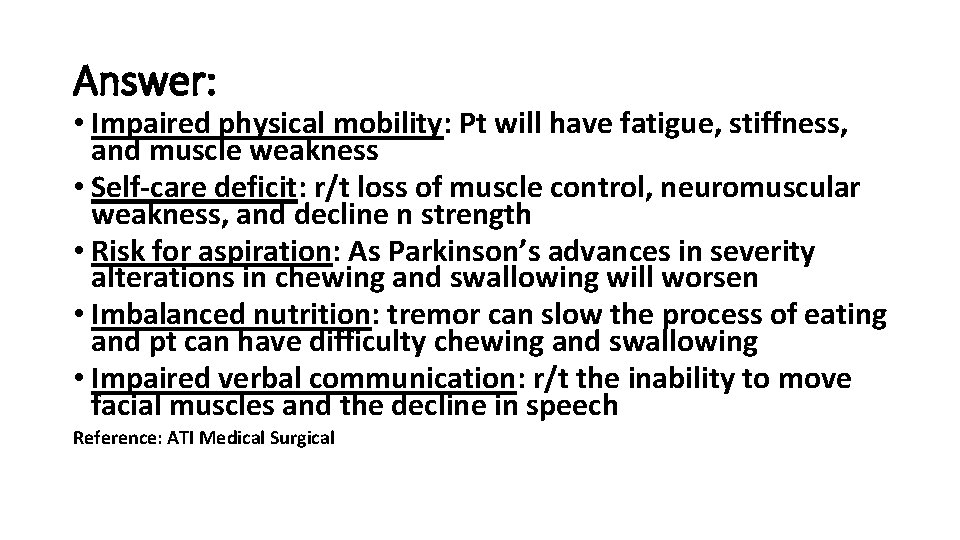
Answer: • Impaired physical mobility: Pt will have fatigue, stiffness, and muscle weakness • Self-care deficit: r/t loss of muscle control, neuromuscular weakness, and decline n strength • Risk for aspiration: As Parkinson’s advances in severity alterations in chewing and swallowing will worsen • Imbalanced nutrition: tremor can slow the process of eating and pt can have difficulty chewing and swallowing • Impaired verbal communication: r/t the inability to move facial muscles and the decline in speech Reference: ATI Medical Surgical
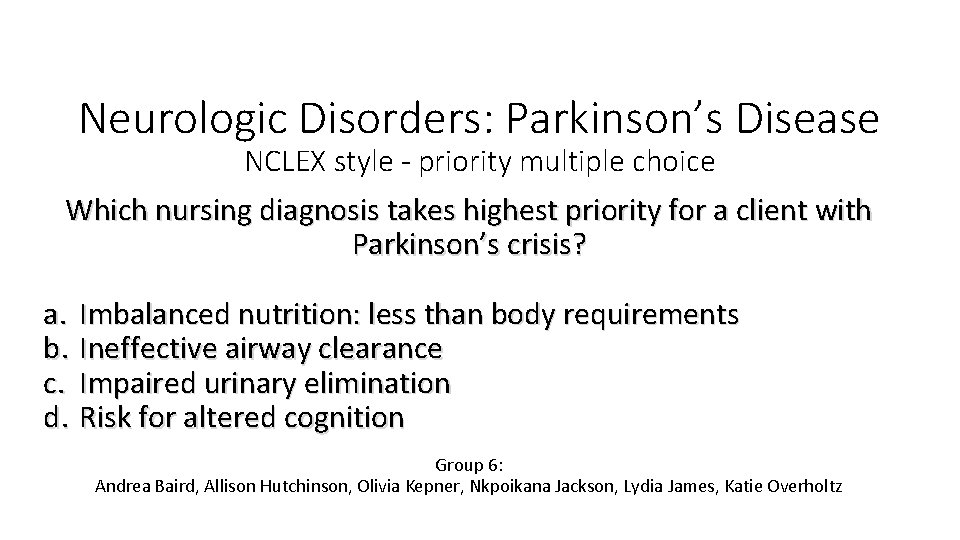
Neurologic Disorders: Parkinson’s Disease NCLEX style - priority multiple choice Which nursing diagnosis takes highest priority for a client with Parkinson’s crisis? a. Imbalanced nutrition: less than body requirements b. Ineffective airway clearance c. Impaired urinary elimination d. Risk for altered cognition Group 6: Andrea Baird, Allison Hutchinson, Olivia Kepner, Nkpoikana Jackson, Lydia James, Katie Overholtz
Correct Answer: B In parkinson’s crisis, dopamine related symptoms are severely exacerbated, virtually immobilizing the client. A client confined to bed during such a crisis is at risk for aspiration and pneumonia. Also, excessive drooling increases risk of airway obstruction. Because of these concerns, the nursing diagnosis of ineffective airway clearance takes highest priority. Although the other options are appropriate, they are not immediately life threatening. Source: NCLEX practice questions online generator
Group 4 Lydia Henderson, Jeri Downey, Cecelia Gates, Megan Davis, Christine Duritsch, Inez Hutauruk A nurse is reinforcing teaching with a client who has Parkinson’s disease and has received a prescription for bromocriptine (Parlodel). Which of the following instructions should the nurse include in the teaching? A. Rise slowly when standing B. Increase carbohydrate intake C. Limit exposure to heat D. Report any skin discoloration
Answer: A • Rationale: Orthostatic hypotension is a common side effect of this medication. Rising slowly will decrease dizziness and lightheadedness, preventing the risk of a potential fall. The patient should increase their fiber to prevent constipation, not carbohydrates. They should limit their exposure to cold, not heat, due to the side effect of Raynaud’s phenomenon. Skin discoloration is not a side effect of this medication. • Source: ATI Adult Med-Surg
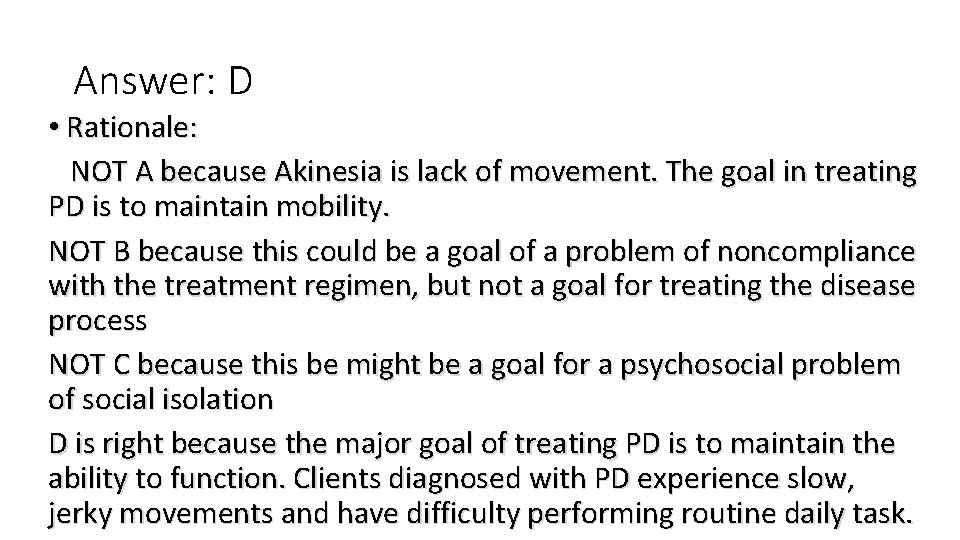
The Nurse is planning care for a client diagnosed with Parkinson’s Disease. Which would be a therapeutic goal of treatment of the disease process? A) The client will experience period of akinesia throughout the day B) the client will take the prescribed medications correctly C) The client will be able to enjoy a family outing with spouse D) the client will be able to carry out activities of daily living Group 13: Amber, Abby, Bethany, Matt, Daynse
Answer: D • Rationale: NOT A because Akinesia is lack of movement. The goal in treating PD is to maintain mobility. NOT B because this could be a goal of a problem of noncompliance with the treatment regimen, but not a goal for treating the disease process NOT C because this be might be a goal for a psychosocial problem of social isolation D is right because the major goal of treating PD is to maintain the ability to function. Clients diagnosed with PD experience slow, jerky movements and have difficulty performing routine daily task.
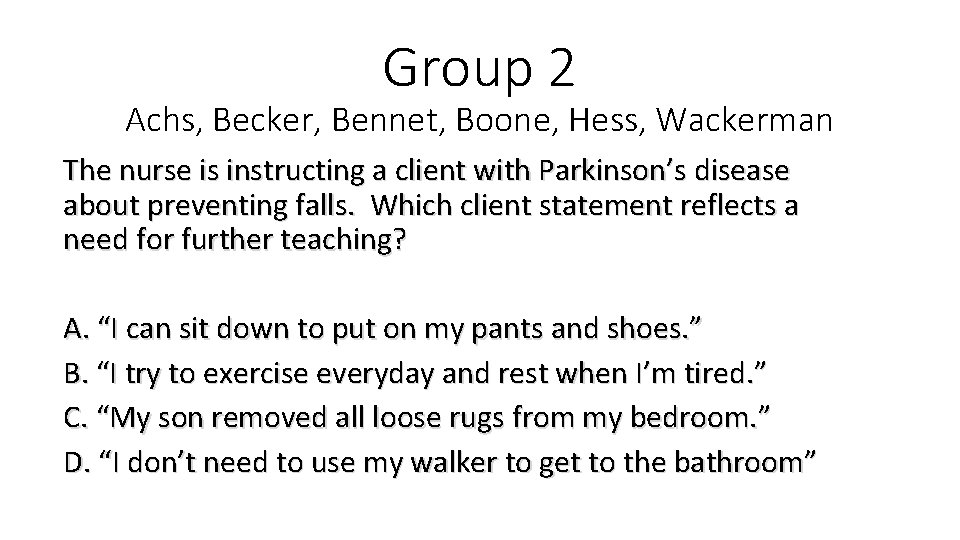
Group 2 Achs, Becker, Bennet, Boone, Hess, Wackerman The nurse is instructing a client with Parkinson’s disease about preventing falls. Which client statement reflects a need for further teaching? A. “I can sit down to put on my pants and shoes. ” B. “I try to exercise everyday and rest when I’m tired. ” C. “My son removed all loose rugs from my bedroom. ” D. “I don’t need to use my walker to get to the bathroom”
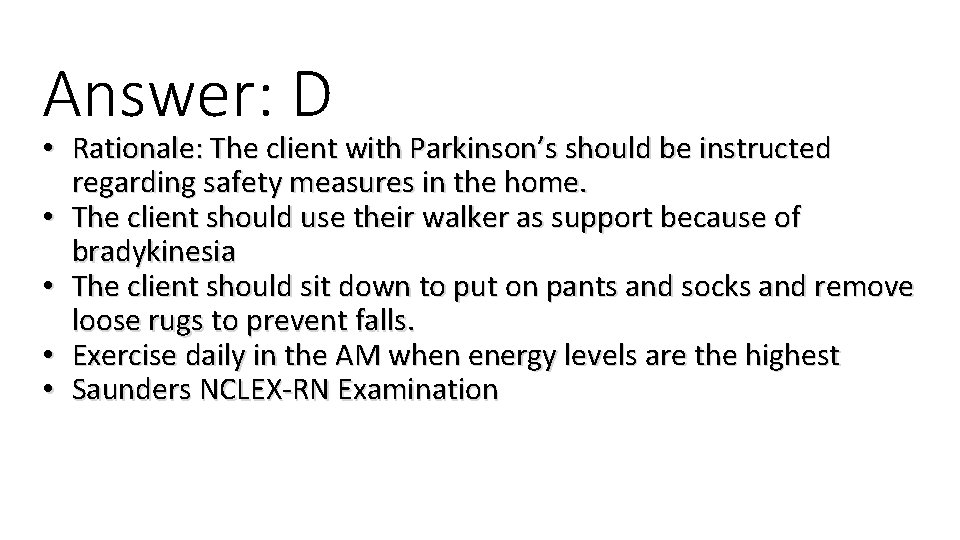
Answer: D • Rationale: The client with Parkinson’s should be instructed regarding safety measures in the home. • The client should use their walker as support because of bradykinesia • The client should sit down to put on pants and socks and remove loose rugs to prevent falls. • Exercise daily in the AM when energy levels are the highest • Saunders NCLEX-RN Examination