
NCEA Review Briefing on Changes to NCEA Insert
NCEA Review Briefing on Changes to NCEA Insert group name
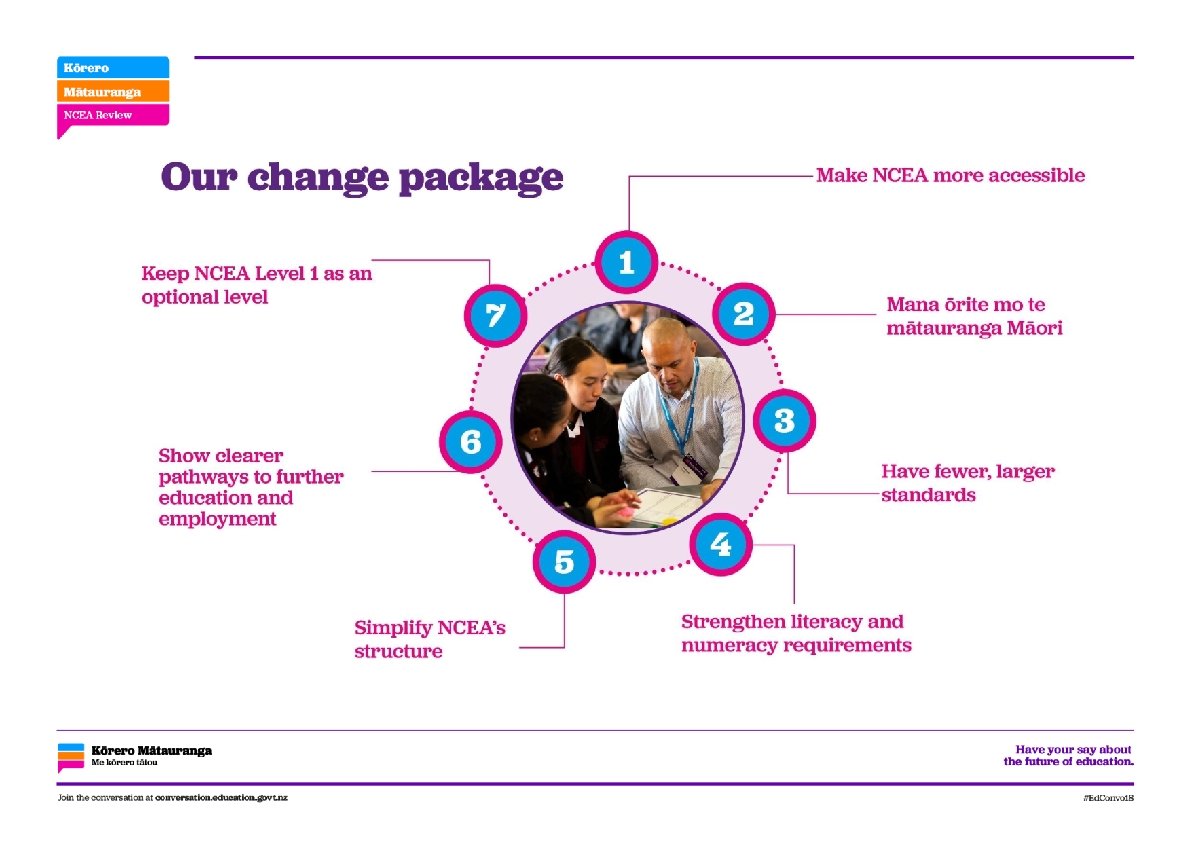
What’s happened so far The National Certificates of Educational Achievement (NCEA) like all qualifications listed on the New Zealand Qualifications Framework, requires a regulatory review every five years. Last year, we asked all New Zealanders to share their views and experiences of NCEA – the challenges, the successes, what they like, and what we can do better. We wanted to make sure that everyone’s voice had been heard. The feedback we received from across the country was phenomenal. With New Zealand’s help, we discovered definite areas where NCEA could be strengthened. We also heard a diverse range of ideas what a more robust and cohesive NCEA might look like. Using what we’ve heard, along with data and evidence, the Ministerial and Professional Advisory Groups and the Ministry of Education have come up with a set of changes for NCEA. Over the next few months, we will be working with the education sector and other key stakeholders to determine what would be required to successfully implement the changes, and how we should design the detail of the changes to make them work in practice.
Principles of the NCEA Review All of the changes to NCEA, which Cabinet have agreed in principle, were tested against these five guiding principles to ensure they will deliver the desired outcomes: • • • Wellbeing Coherence Pathways Equity and inclusion Credibility
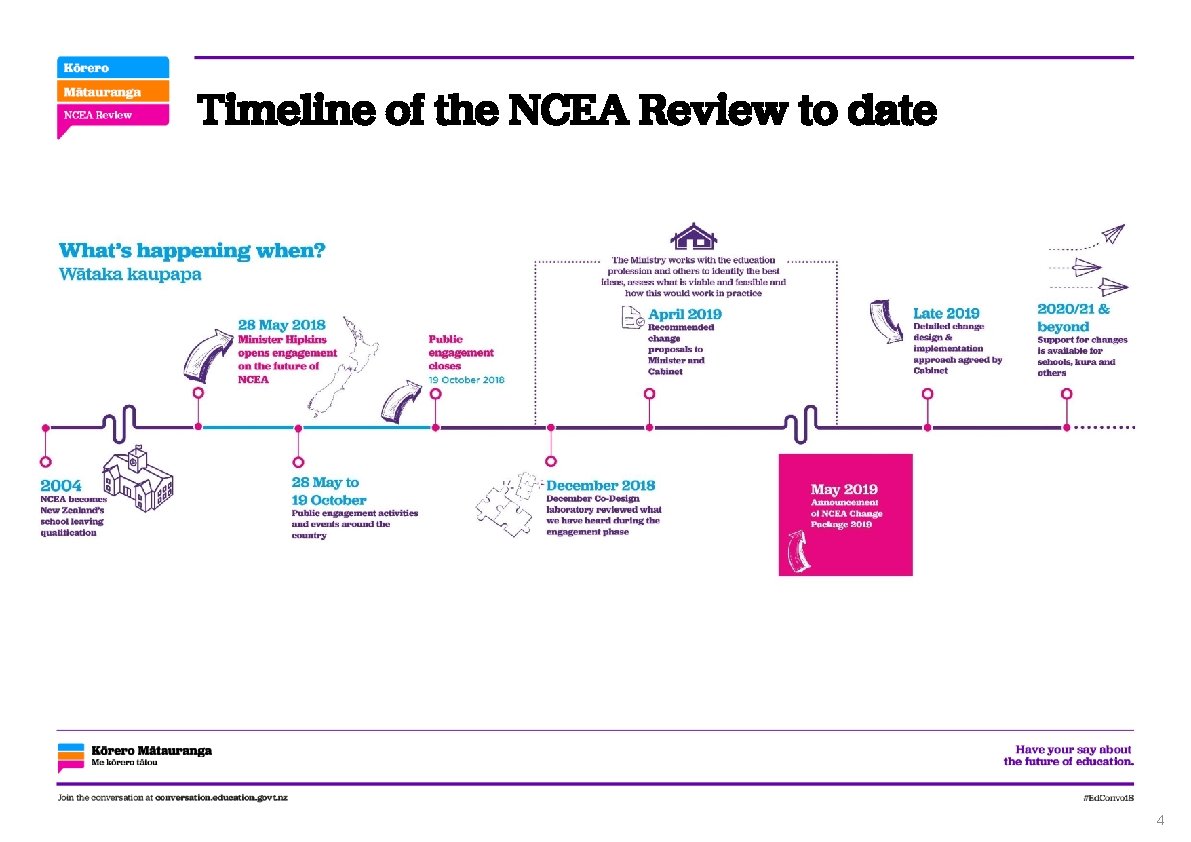
Timeline of the NCEA Review to date 4
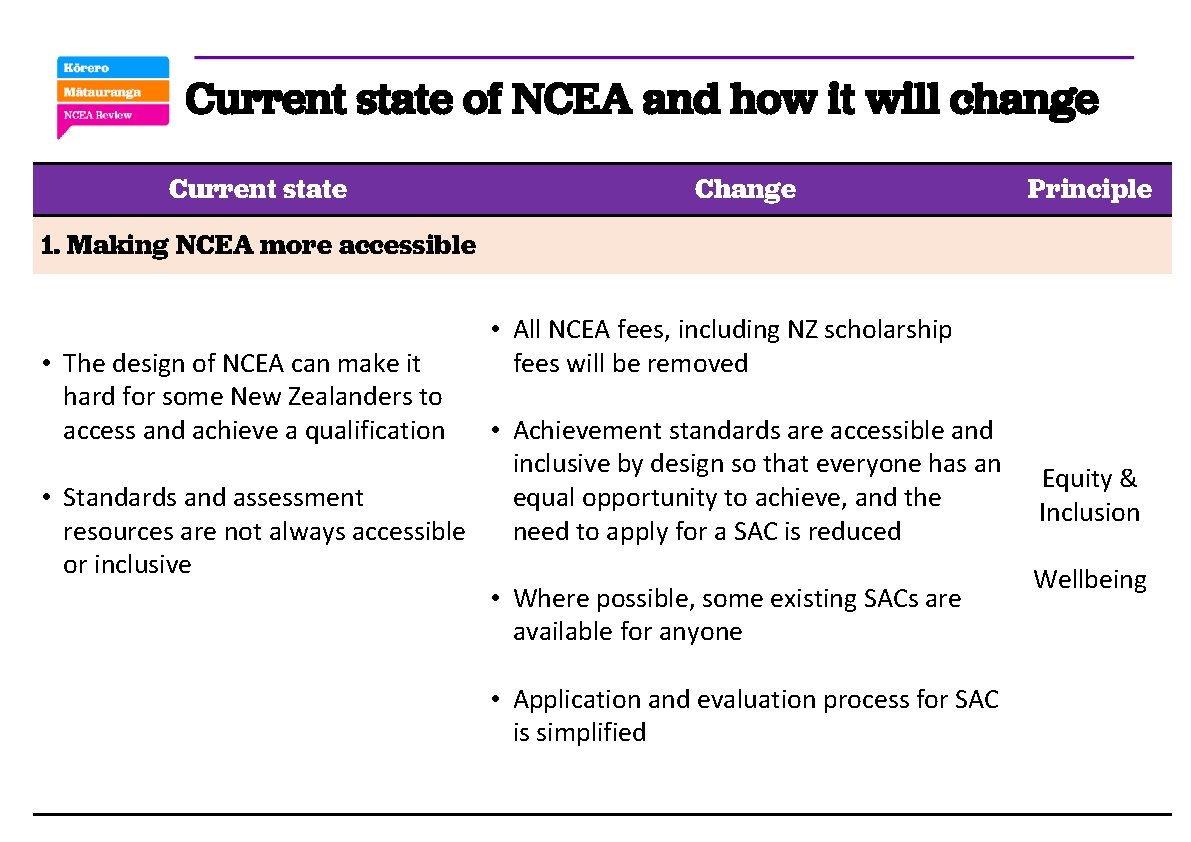
Current state of NCEA and how it will change Current state Change Principle 1. Making NCEA more accessible • The design of NCEA can make it hard for some New Zealanders to access and achieve a qualification • All NCEA fees, including NZ scholarship fees will be removed • Achievement standards are accessible and inclusive by design so that everyone has an • Standards and assessment equal opportunity to achieve, and the resources are not always accessible need to apply for a SAC is reduced or inclusive • Where possible, some existing SACs are available for anyone • Application and evaluation process for SAC is simplified Equity & Inclusion Wellbeing
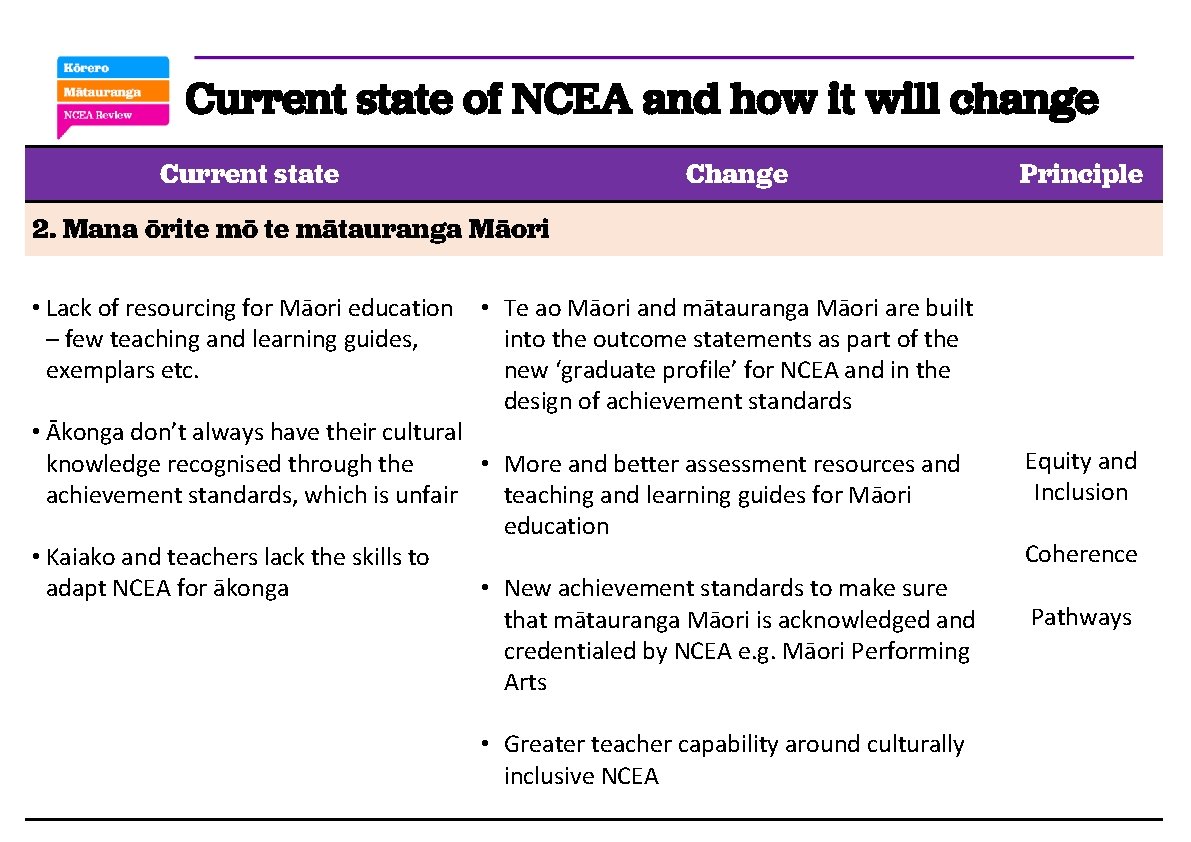
Current state of NCEA and how it will change Current state Change Principle 2. Mana ōrite mō te mātauranga Māori • Lack of resourcing for Māori education – few teaching and learning guides, exemplars etc. • Te ao Māori and mātauranga Māori are built into the outcome statements as part of the new ‘graduate profile’ for NCEA and in the design of achievement standards • Ākonga don’t always have their cultural knowledge recognised through the • More and better assessment resources and achievement standards, which is unfair teaching and learning guides for Māori education • Kaiako and teachers lack the skills to adapt NCEA for ākonga • New achievement standards to make sure that mātauranga Māori is acknowledged and credentialed by NCEA e. g. Māori Performing Arts • Greater teacher capability around culturally inclusive NCEA Equity and Inclusion Coherence Pathways
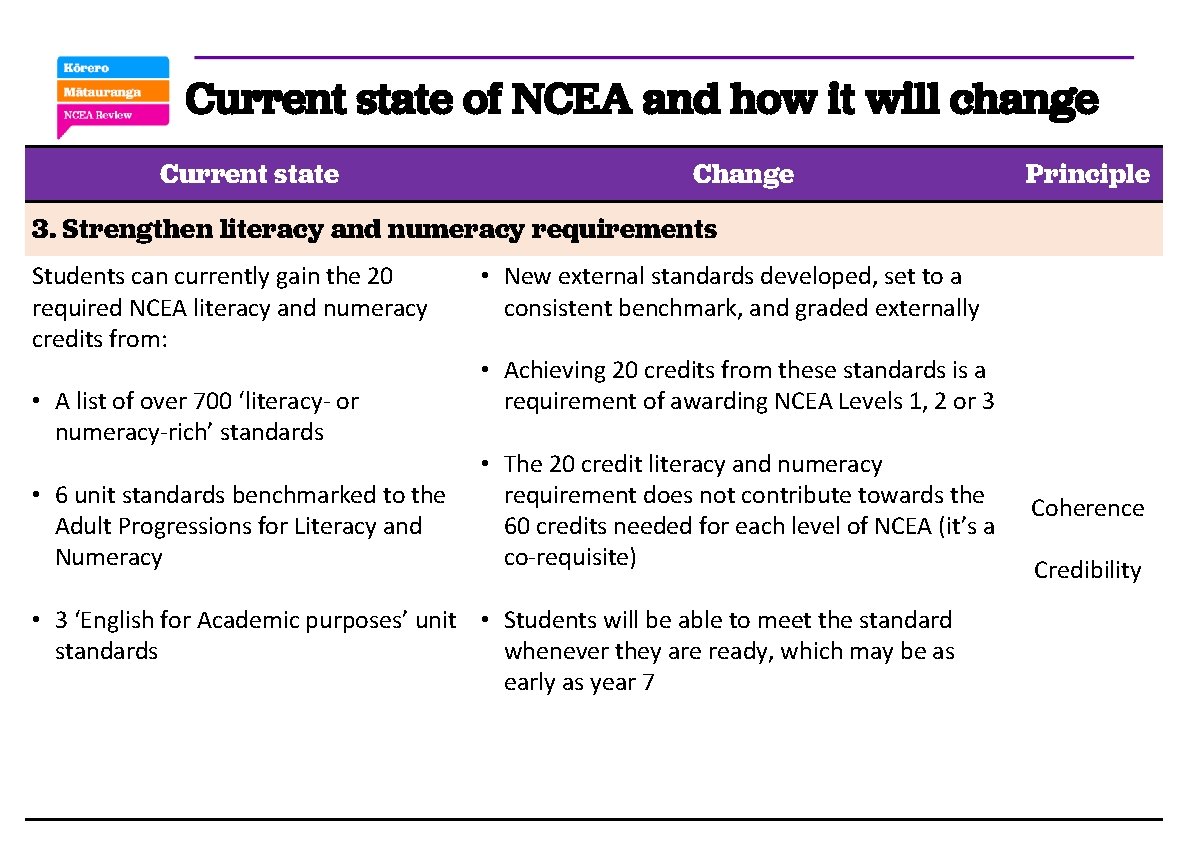
Current state of NCEA and how it will change Current state Change Principle 3. Strengthen literacy and numeracy requirements Students can currently gain the 20 required NCEA literacy and numeracy credits from: • A list of over 700 ‘literacy- or numeracy-rich’ standards • 6 unit standards benchmarked to the Adult Progressions for Literacy and Numeracy • New external standards developed, set to a consistent benchmark, and graded externally • Achieving 20 credits from these standards is a requirement of awarding NCEA Levels 1, 2 or 3 • The 20 credit literacy and numeracy requirement does not contribute towards the 60 credits needed for each level of NCEA (it’s a co-requisite) • 3 ‘English for Academic purposes’ unit • Students will be able to meet the standards whenever they are ready, which may be as early as year 7 Coherence Credibility
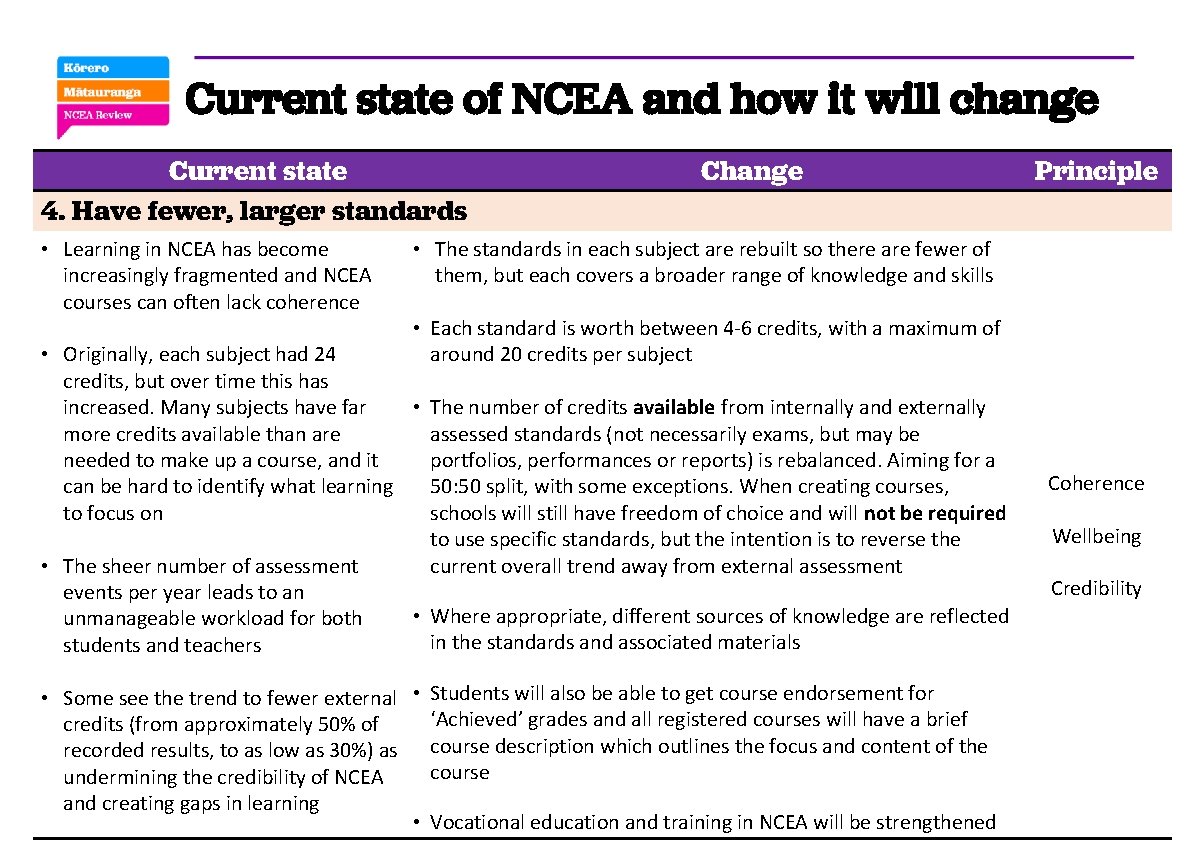
Current state of NCEA and how it will change Current state 4. Have fewer, larger standards • Learning in NCEA has become increasingly fragmented and NCEA courses can often lack coherence Change Principle • The standards in each subject are rebuilt so there are fewer of them, but each covers a broader range of knowledge and skills • Each standard is worth between 4 -6 credits, with a maximum of around 20 credits per subject • Originally, each subject had 24 credits, but over time this has increased. Many subjects have far • The number of credits available from internally and externally more credits available than are assessed standards (not necessarily exams, but may be needed to make up a course, and it portfolios, performances or reports) is rebalanced. Aiming for a can be hard to identify what learning 50: 50 split, with some exceptions. When creating courses, to focus on schools will still have freedom of choice and will not be required to use specific standards, but the intention is to reverse the • The sheer number of assessment current overall trend away from external assessment events per year leads to an • Where appropriate, different sources of knowledge are reflected unmanageable workload for both in the standards and associated materials students and teachers • Some see the trend to fewer external • Students will also be able to get course endorsement for ‘Achieved’ grades and all registered courses will have a brief credits (from approximately 50% of recorded results, to as low as 30%) as course description which outlines the focus and content of the course undermining the credibility of NCEA and creating gaps in learning • Vocational education and training in NCEA will be strengthened Coherence Wellbeing Credibility
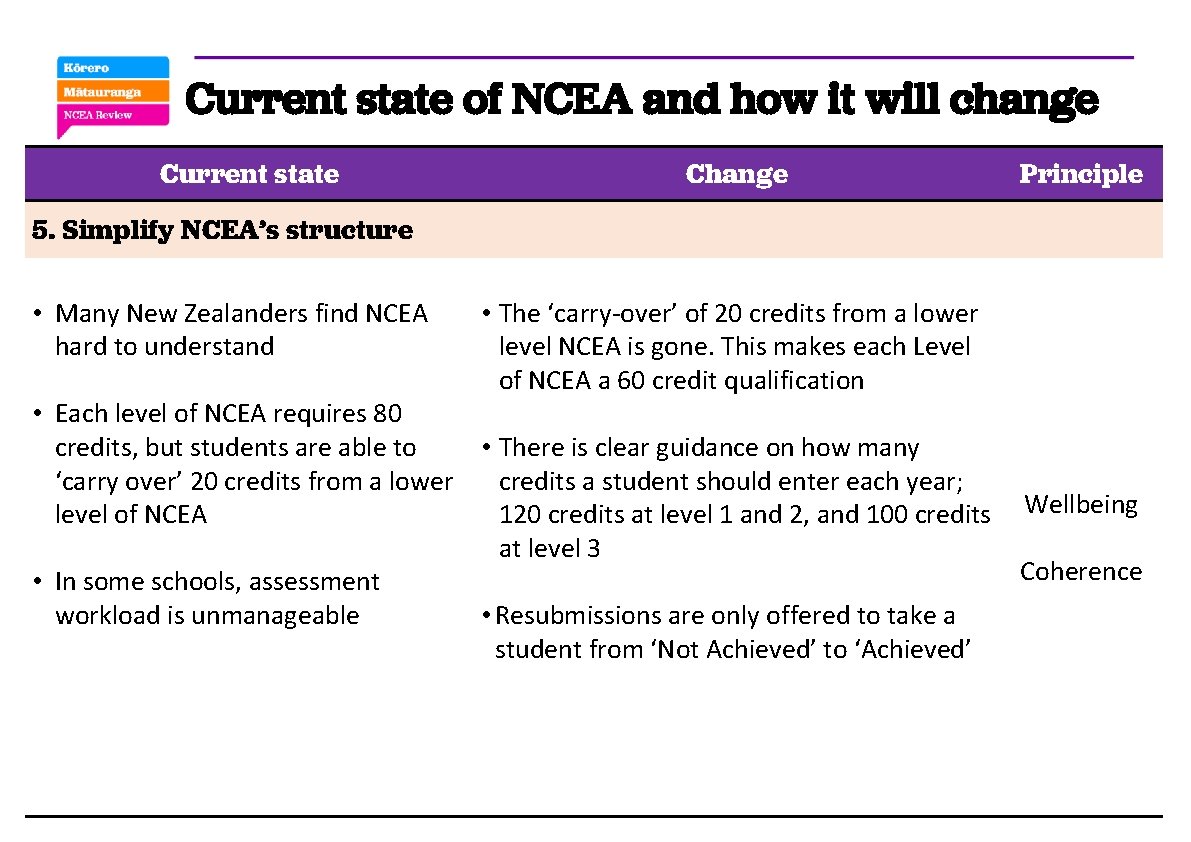
Current state of NCEA and how it will change Current state Change Principle 5. Simplify NCEA’s structure • Many New Zealanders find NCEA hard to understand • The ‘carry-over’ of 20 credits from a lower level NCEA is gone. This makes each Level of NCEA a 60 credit qualification • Each level of NCEA requires 80 credits, but students are able to • There is clear guidance on how many ‘carry over’ 20 credits from a lower credits a student should enter each year; level of NCEA 120 credits at level 1 and 2, and 100 credits at level 3 • In some schools, assessment workload is unmanageable • Resubmissions are only offered to take a student from ‘Not Achieved’ to ‘Achieved’ Wellbeing Coherence
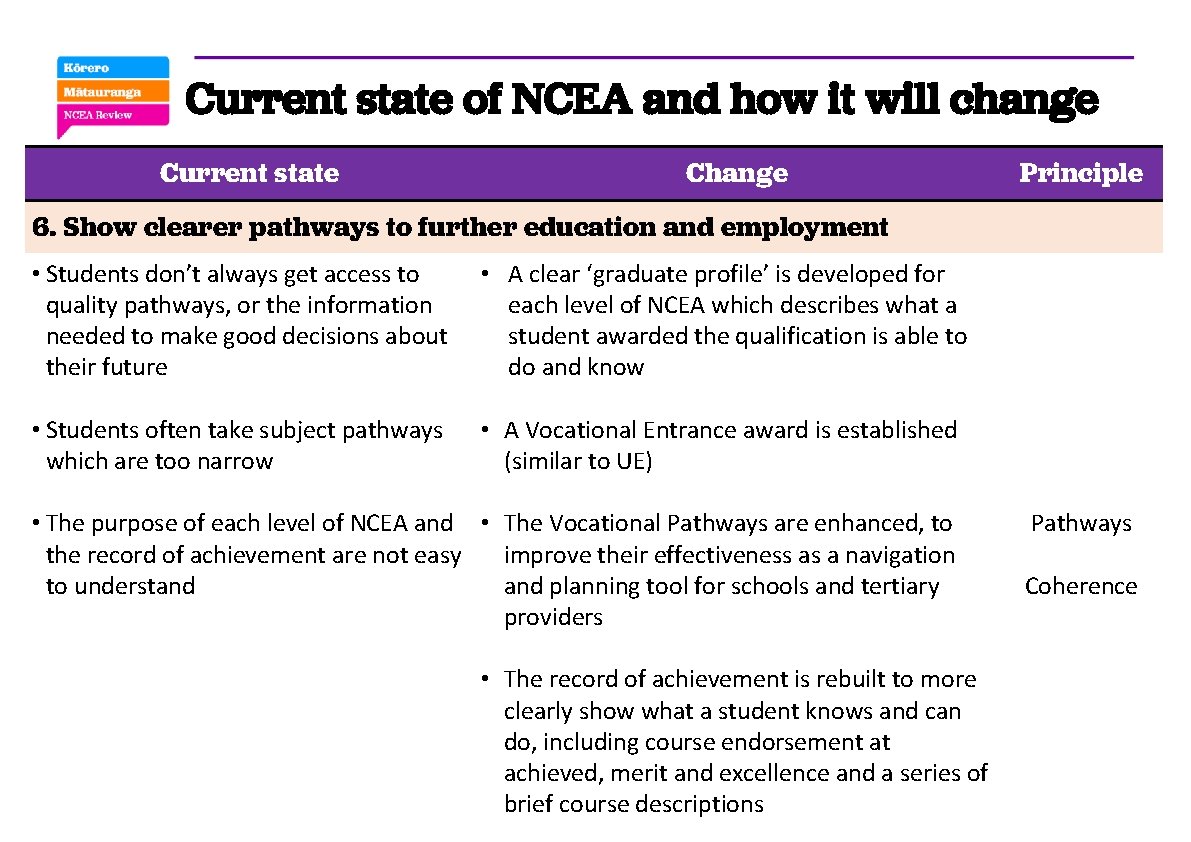
Current state of NCEA and how it will change Current state Change Principle 6. Show clearer pathways to further education and employment • Students don’t always get access to quality pathways, or the information needed to make good decisions about their future • A clear ‘graduate profile’ is developed for each level of NCEA which describes what a student awarded the qualification is able to do and know • Students often take subject pathways which are too narrow • A Vocational Entrance award is established (similar to UE) • The purpose of each level of NCEA and • The Vocational Pathways are enhanced, to the record of achievement are not easy improve their effectiveness as a navigation to understand planning tool for schools and tertiary providers • The record of achievement is rebuilt to more clearly show what a student knows and can do, including course endorsement at achieved, merit and excellence and a series of brief course descriptions Pathways Coherence
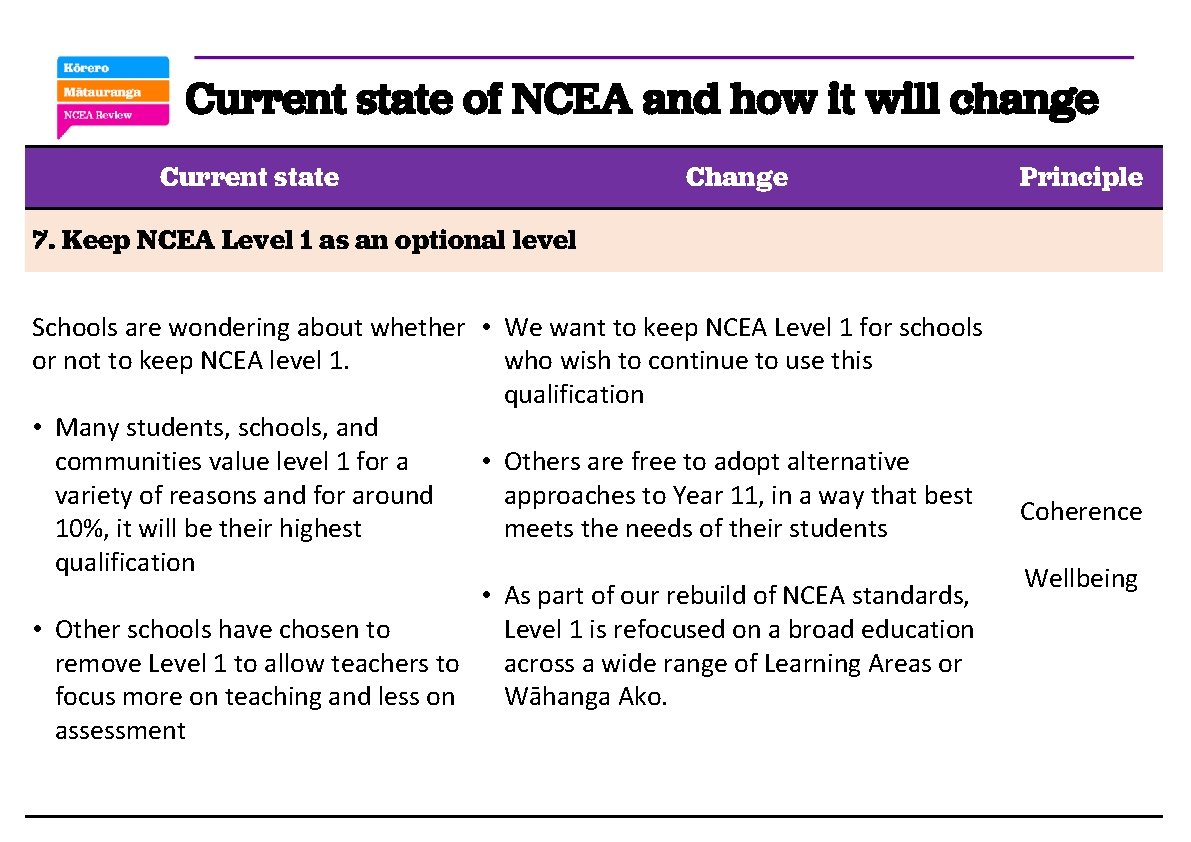
Current state of NCEA and how it will change Current state Change Principle 7. Keep NCEA Level 1 as an optional level Schools are wondering about whether • We want to keep NCEA Level 1 for schools or not to keep NCEA level 1. who wish to continue to use this qualification • Many students, schools, and communities value level 1 for a • Others are free to adopt alternative variety of reasons and for around approaches to Year 11, in a way that best 10%, it will be their highest meets the needs of their students qualification • As part of our rebuild of NCEA standards, • Other schools have chosen to Level 1 is refocused on a broad education remove Level 1 to allow teachers to across a wide range of Learning Areas or focus more on teaching and less on Wāhanga Ako. assessment Coherence Wellbeing
The next phase – design & implementation The Ministry will work with the education sector and other key stakeholder groups to determine what would be required to successfully implement the changes, and how we should design the detail of the changes to make them work in practice. This will also help us understand the impacts of change on individuals, schools, whānau and communities. We need to understand what this looks like in your school and wider community.
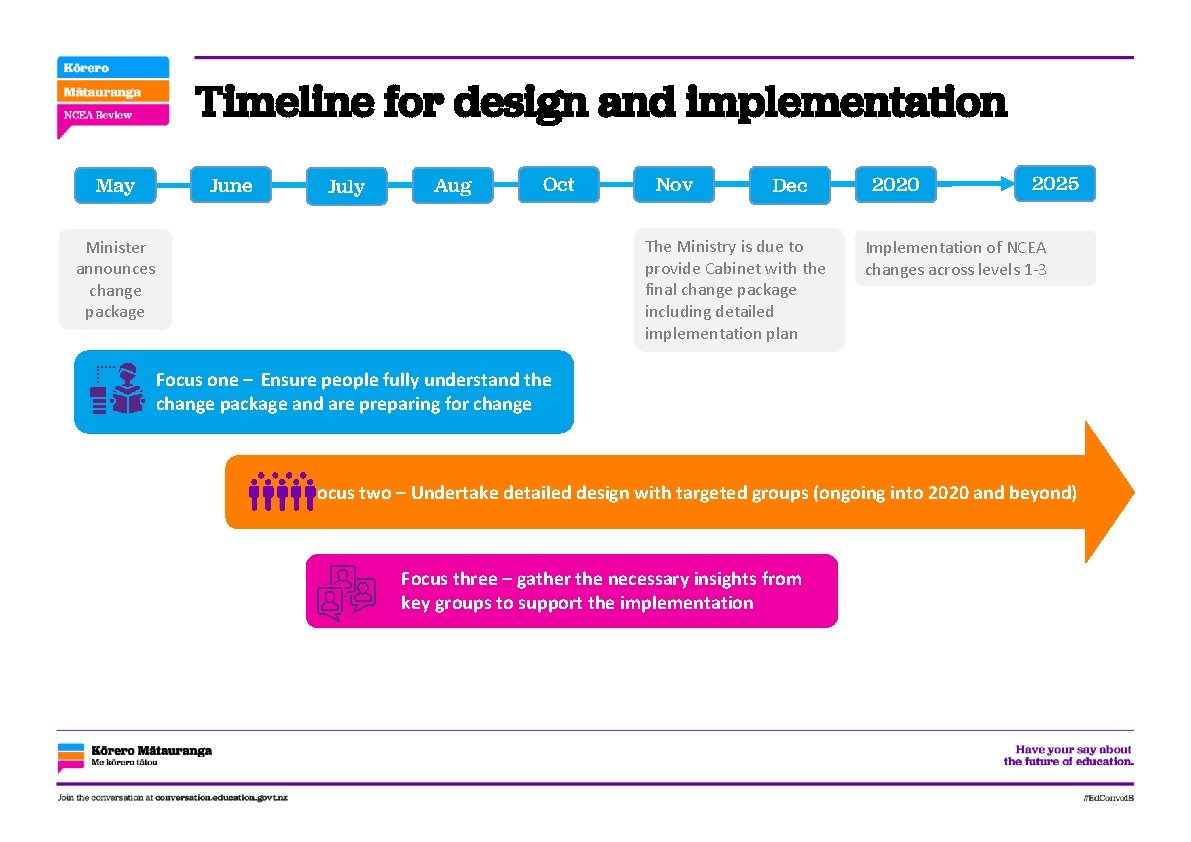
Timeline for design and implementation May June July Aug Oct Nov Dec The Ministry is due to provide Cabinet with the final change package including detailed implementation plan Minister announces change package 2020 2025 Implementation of NCEA changes across levels 1 -3 Focus one – Ensure people fully understand the change package and are preparing for change Focus two – Undertake detailed design with targeted groups (ongoing into 2020 and beyond) Focus three – gather the necessary insights from key groups to support the implementation
Lead your own conversations Your feedback will help us design the changes to NCEA so they work in practice. Please email your feedback to us at: NCEA. Review@education. govt. nz or mail them to: NCEA Review Team, Ministry of Education, Mātauranga House, 33 Bowen Street, Wellington 6011 For further information on the NCEA Change Package visit conversation. education. govt. nz/ncea If you would like to provide further feedback, or to request further support from the Ministry, please email: NCEA. Review@education. govt. nz
Review of Achievement Standards Introduction
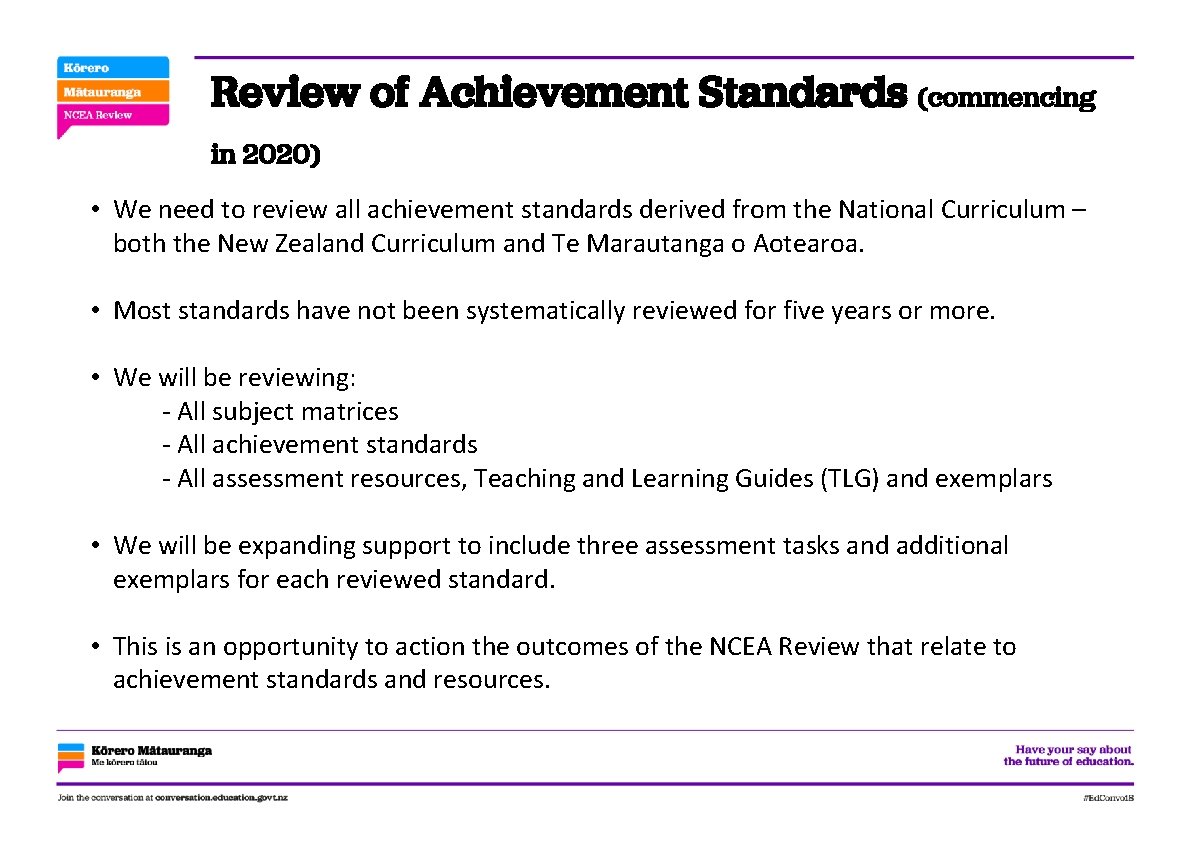
Review of Achievement Standards (commencing in 2020) • We need to review all achievement standards derived from the National Curriculum – both the New Zealand Curriculum and Te Marautanga o Aotearoa. • Most standards have not been systematically reviewed for five years or more. • We will be reviewing: - All subject matrices - All achievement standards - All assessment resources, Teaching and Learning Guides (TLG) and exemplars • We will be expanding support to include three assessment tasks and additional exemplars for each reviewed standard. • This is an opportunity to action the outcomes of the NCEA Review that relate to achievement standards and resources.
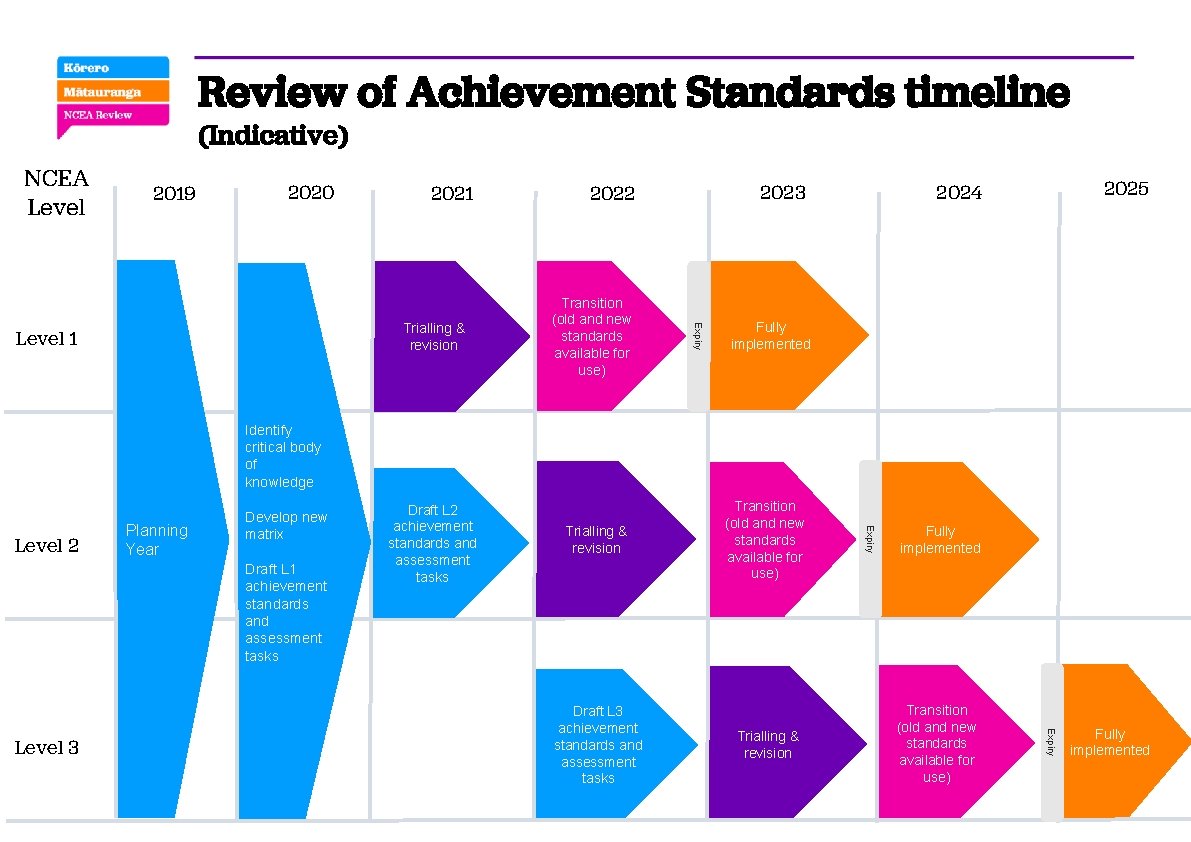
Review of Achievement Standards timeline (Indicative) NCEA Level 2019 2020 2021 Level 1 Transition (old and new standards available for use) Expiry Trialling & revision 2023 2022 2025 2024 Fully implemented Identify critical body of knowledge Draft L 1 achievement standards and assessment tasks Trialling & revision Draft L 3 achievement standards and assessment tasks Transition (old and new standards available for use) Trialling & revision Fully implemented Transition (old and new standards available for use) Expiry Level 3 Draft L 2 achievement standards and assessment tasks Expiry Level 2 Planning Year Develop new matrix Fully implemented
- Slides: 18