
NCC A Performancebased Code Insert Corporate logo here
NCC: A Performance-based Code Insert Corporate logo here © Commonwealth of Australia and the States and Territories of Australia 2020, published by the Australian Building Codes Board.
Table of contents Introduction • How it works. • What you will learn. Contents • Overview of the NCC as a performance-based code. • Language used in the Performance Requirements of the NCC. • Performance Solutions and Assessment Methods. Summary
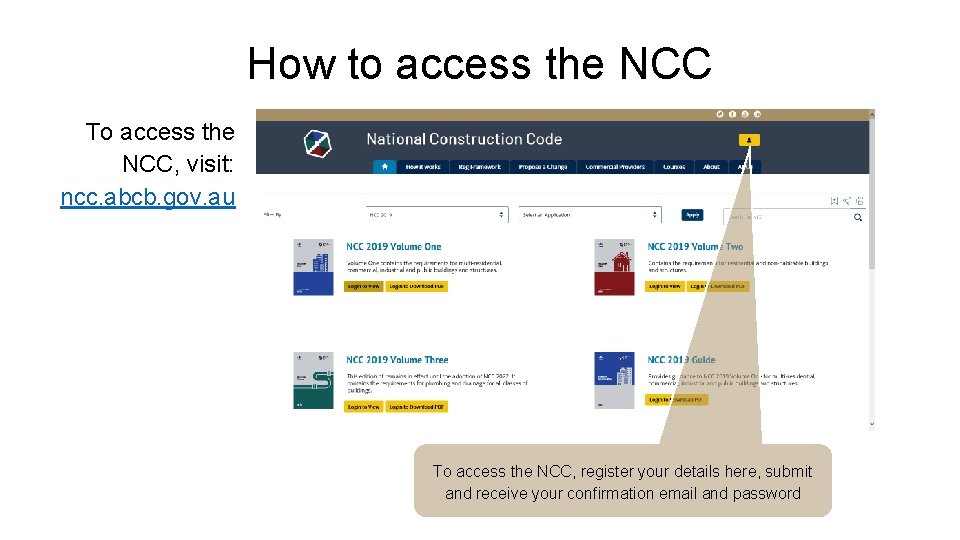
How to access the NCC To access the NCC, visit: ncc. abcb. gov. au To access the NCC, register your details here, submit and receive your confirmation email and password
What you will learn Aims and objectives To provide you with a basic understanding of the Performance-based NCC with an emphasis on: • The structure of the NCC. • The language used in the NCC Performance Requirements. • The use of Assessment Methods. Who this material is for • All building and plumbing professionals.
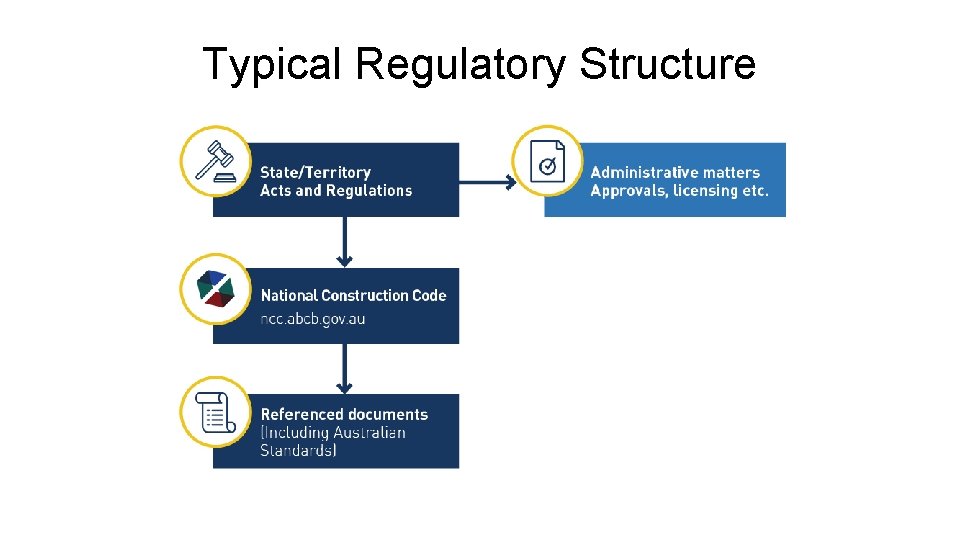
Typical Regulatory Structure
Overview of the NCC The role of the NCC is to provide: • nationally consistent minimum necessary standards; and • a technical base for the design and construction of buildings and certain structures. The goal of the NCC is to achieve minimum necessary standards relevant to: • safety (including structural safety and safety from fire); and • health, accessibility, amenity and sustainability.
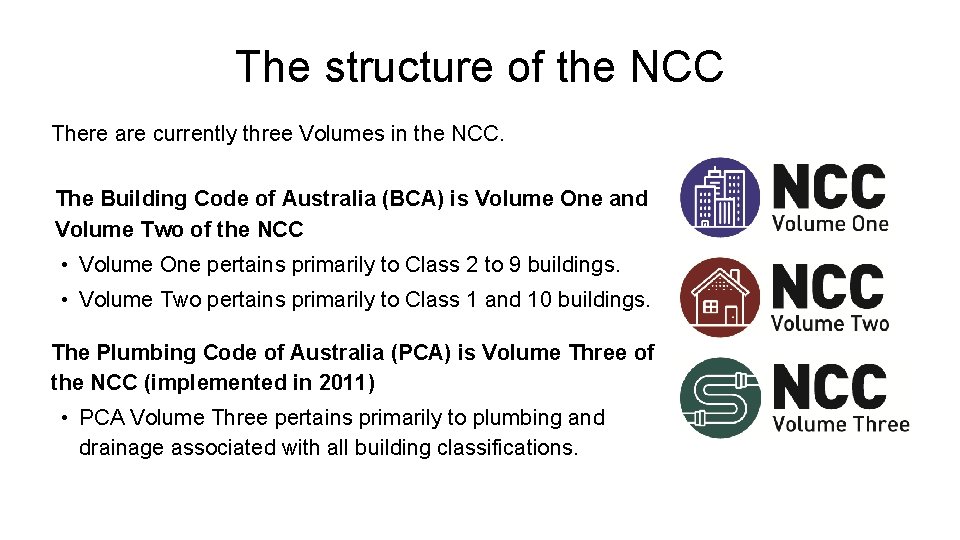
The structure of the NCC There are currently three Volumes in the NCC. The Building Code of Australia (BCA) is Volume One and Volume Two of the NCC • Volume One pertains primarily to Class 2 to 9 buildings. • Volume Two pertains primarily to Class 1 and 10 buildings. The Plumbing Code of Australia (PCA) is Volume Three of the NCC (implemented in 2011) • PCA Volume Three pertains primarily to plumbing and drainage associated with all building classifications.
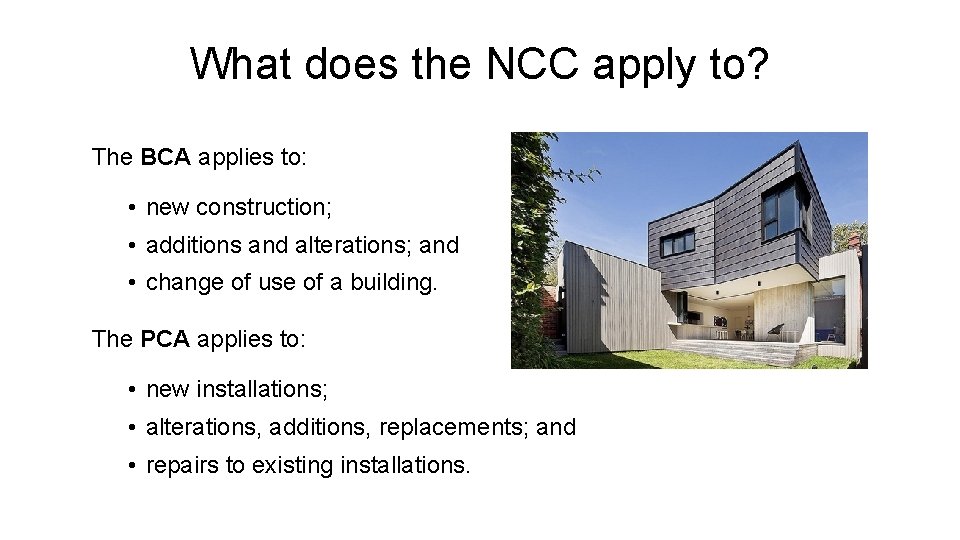
What does the NCC apply to? The BCA applies to: • new construction; • additions and alterations; and • change of use of a building. The PCA applies to: • new installations; • alterations, additions, replacements; and • repairs to existing installations.
Overview of the Governing Requirements The Governing Requirements provide the rules and instructions for using and complying with the NCC. They include provisions for: • interpreting and applying the NCC; • complying with the NCC; • how the NCC is applied in States and Territories; • applying referenced documents; • documenting the suitability of the design, construction and or use of materials to comply with the NCC; and • classifying buildings by characteristics and intended use.
Complying with the NCC • The NCC is a performance-based code; this means it provides options and flexibility when developing compliance solutions. • These solutions are used to achieve compliance with the Performance Requirements. • The ABCB has a You. Tube clip called “NCC: a Performance-based Code”, explaining the NCC as a performance-based code, which may also be helpful.

Performance-based codes
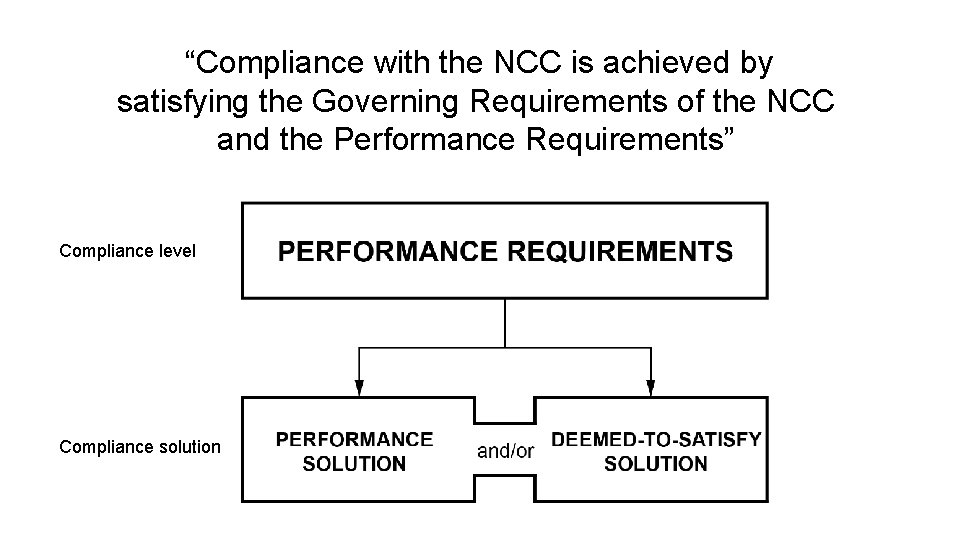
“Compliance NCC is achieved by Characteristics ofwith thethe. NCC satisfying the Governing Requirements of the NCC and the Performance Requirements” Compliance level Compliance solution
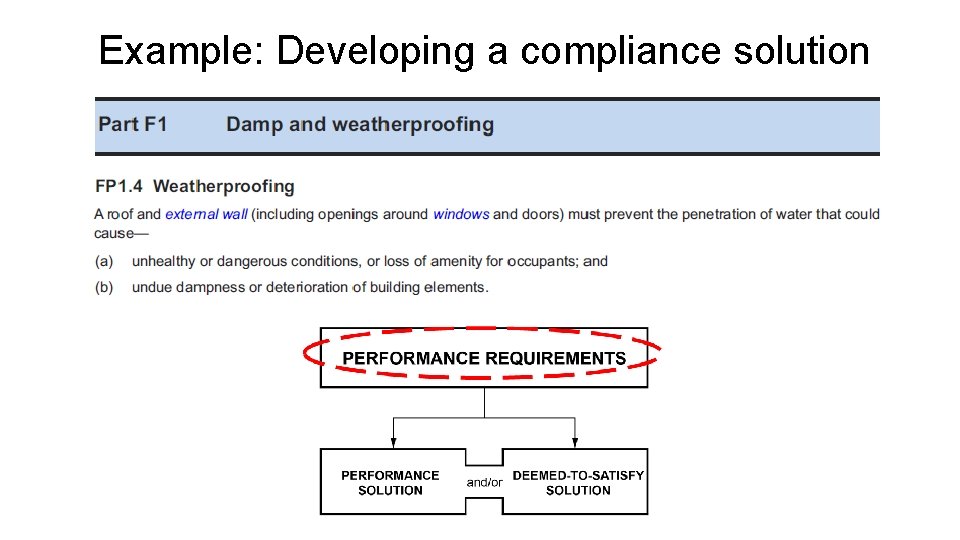
Example: Developing a compliance solution
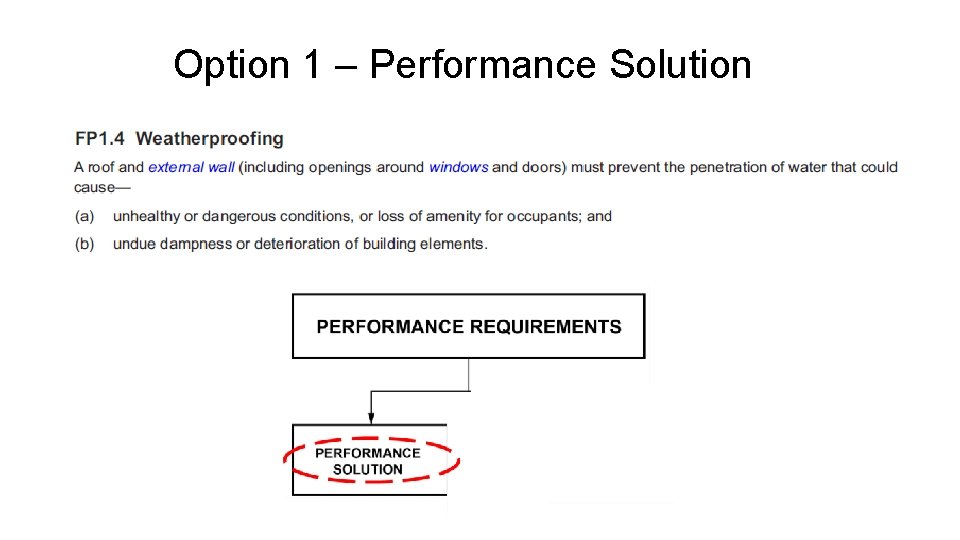
Option 1 – Performance Solution
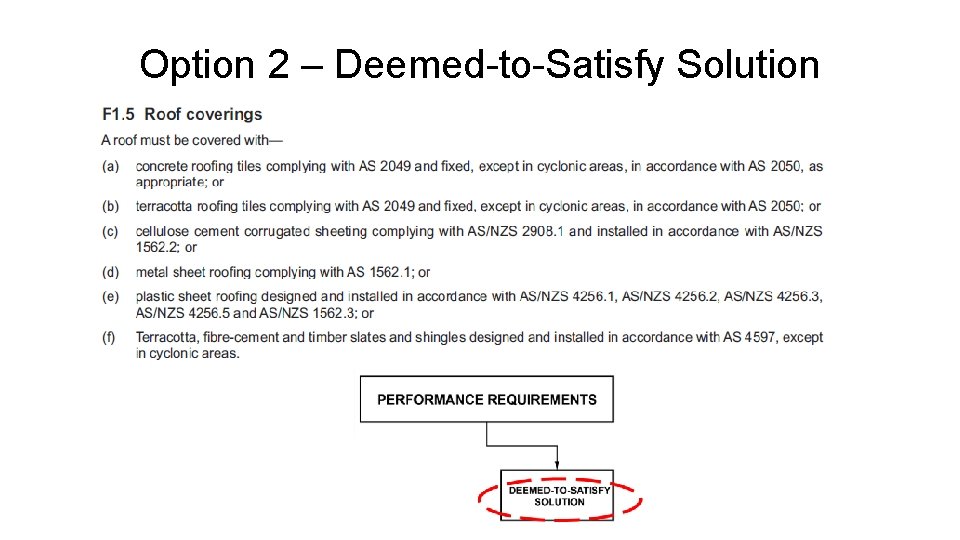
Option 2 – Deemed-to-Satisfy Solution
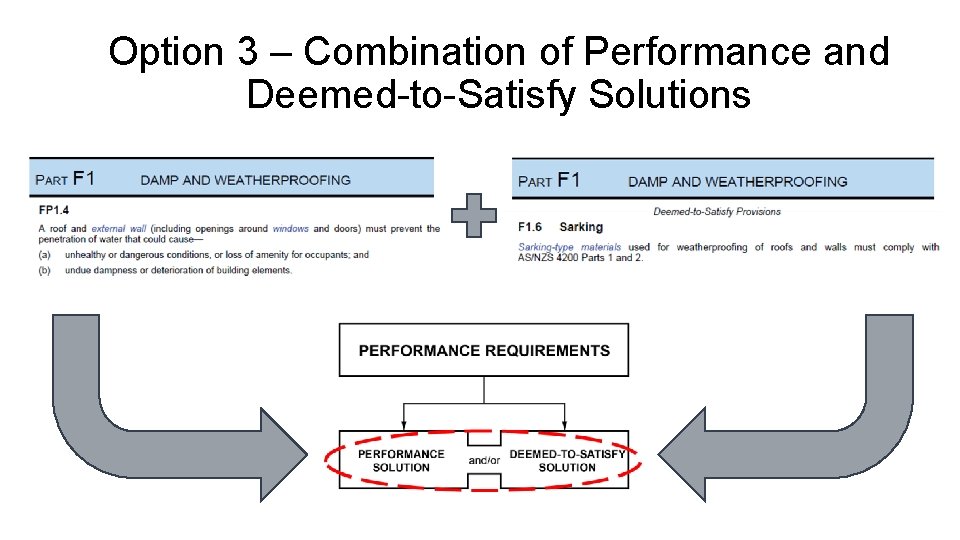
Option 3 – Combination of Performance and Deemed-to-Satisfy Solutions
An overview of Performance Requirements • Language used in the Performance Requirements of the NCC. • What is required when formulating Performance Solutions?
An overview of Performance Requirements A Performance Requirement is: “A requirement which states the level of performance which a compliance solution must meet. ” The NCC contains both qualitative and quantitative Performance Requirements.
Qualitative Performance Requirements • Qualitative Performance Requirements prescribe attributes or ‘qualities’ to achieve a certain level of performance. • Performance Requirement FP 2. 5 is an example.
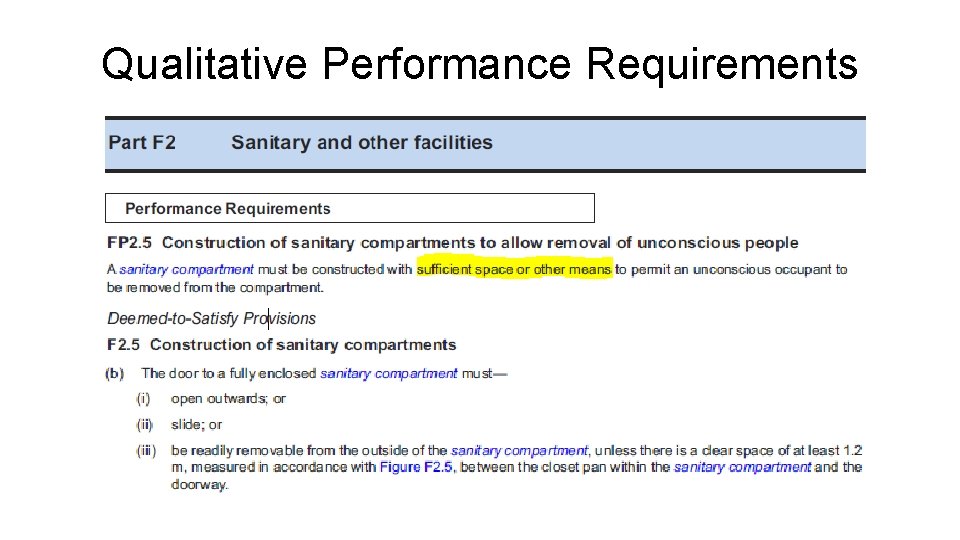
Qualitative Performance Requirements
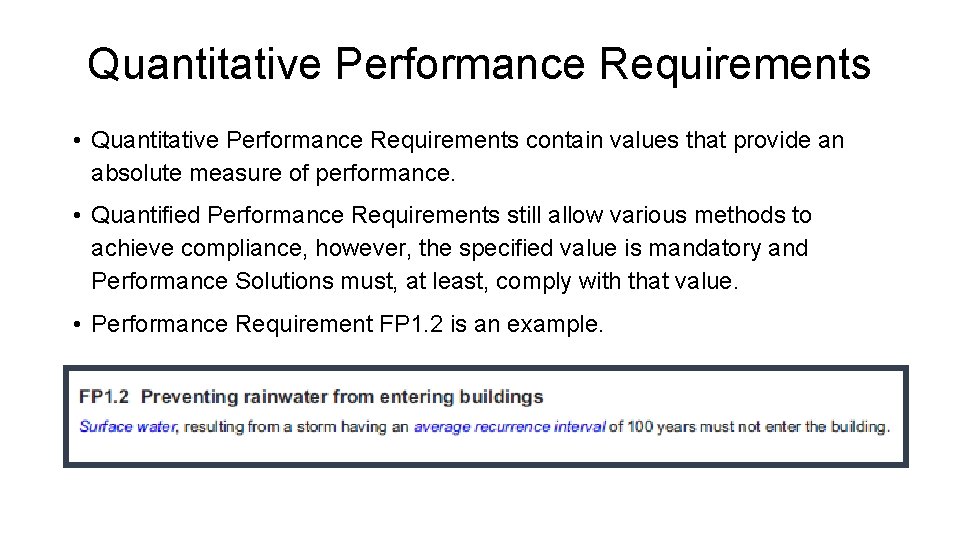
Quantitative Performance Requirements • Quantitative Performance Requirements contain values that provide an absolute measure of performance. • Quantified Performance Requirements still allow various methods to achieve compliance, however, the specified value is mandatory and Performance Solutions must, at least, comply with that value. • Performance Requirement FP 1. 2 is an example.
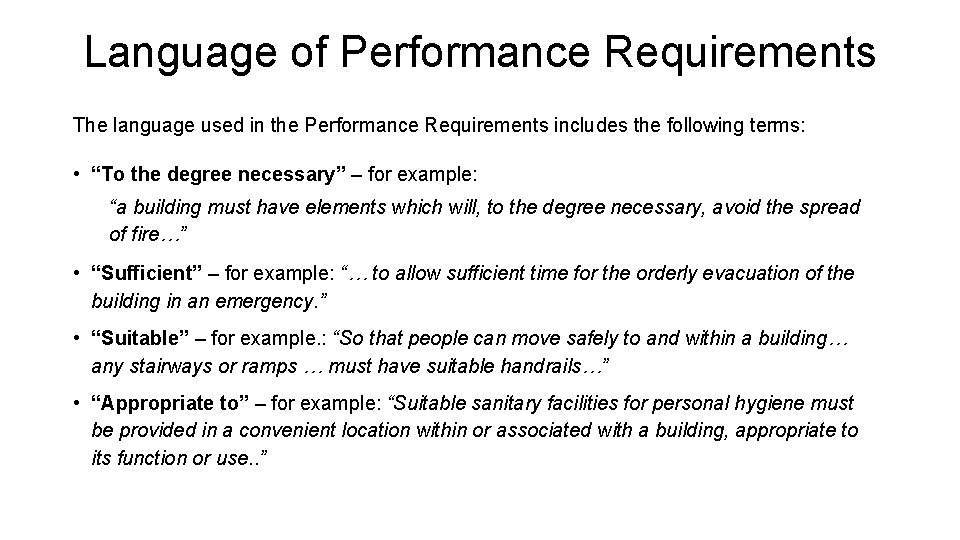
Language of Performance Requirements The language used in the Performance Requirements includes the following terms: • “To the degree necessary” – for example: “a building must have elements which will, to the degree necessary, avoid the spread of fire…” • “Sufficient” – for example: “… to allow sufficient time for the orderly evacuation of the building in an emergency. ” • “Suitable” – for example. : “So that people can move safely to and within a building… any stairways or ramps … must have suitable handrails…” • “Appropriate to” – for example: “Suitable sanitary facilities for personal hygiene must be provided in a convenient location within or associated with a building, appropriate to its function or use. . ”
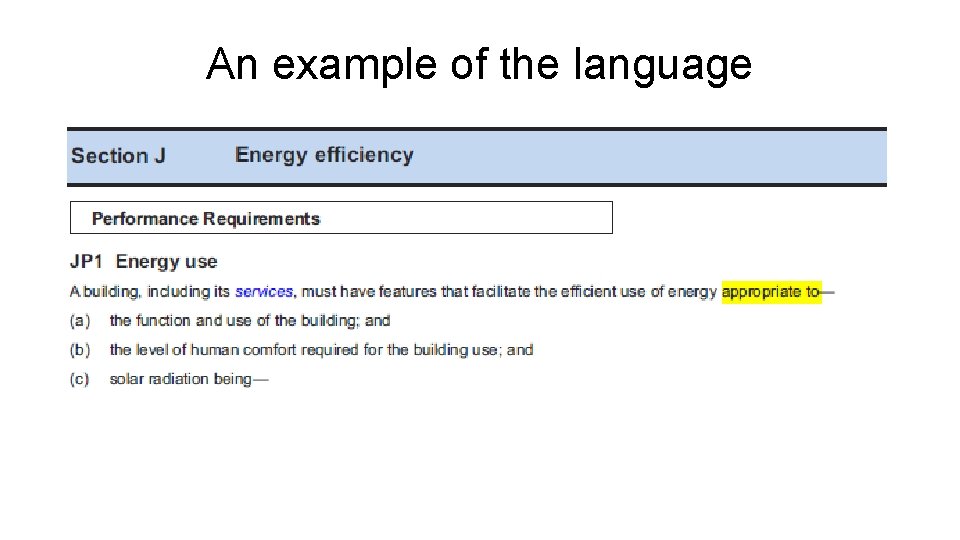
An example of the language
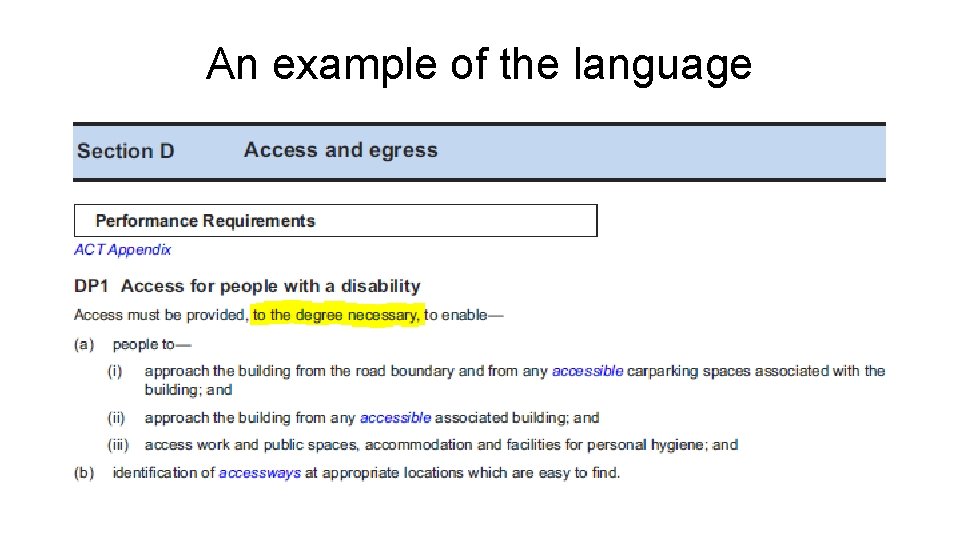
An example of the language
Identifying the relevant Performance Requirements • When formulating a Performance Solution, ensuring that all relevant Performance Requirements are identified is critical. • Volume One Part A 2 must be used to identify the relevant Performance Requirements. • It is beneficial for designers to discuss the application of Part A 2 with the Approval Authority prior to proceeding with detailed development of a Performance Solution.
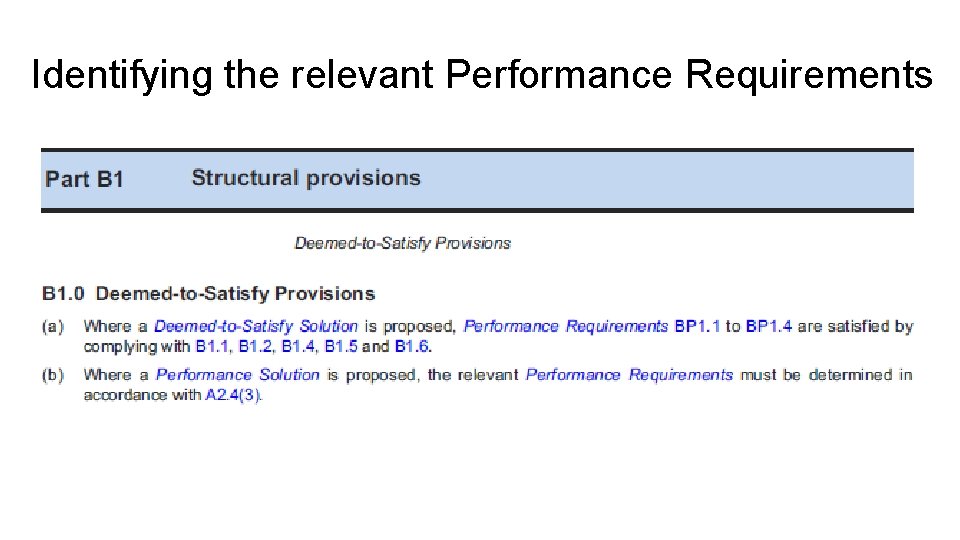
Identifying the relevant Performance Requirements
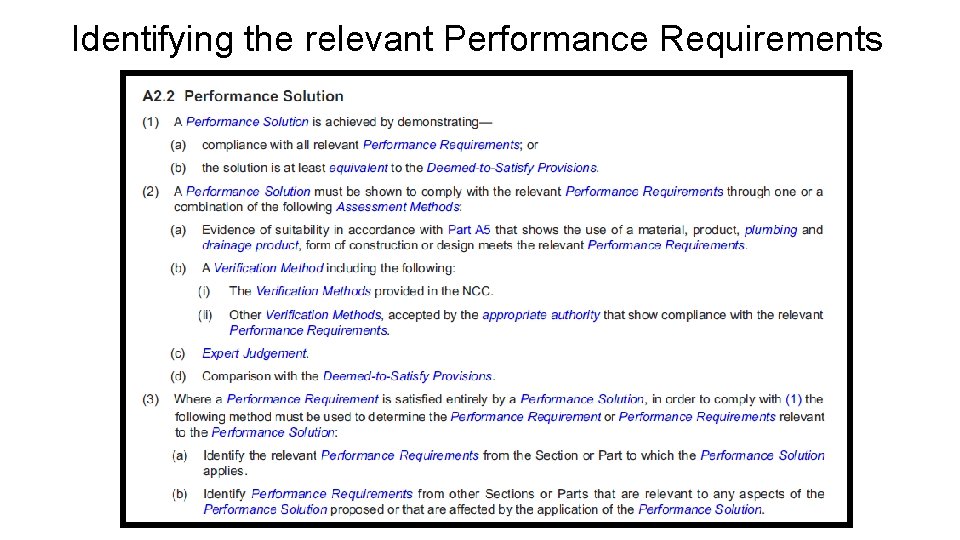
Identifying the relevant Performance Requirements
Identifying the relevant Performance Requirements The Guide to NCC Volume One can also provide valuable assistance in identifying the relevant Performance Requirements when formulating Performance Solutions. In particular, the Guide provides clarification of the intent of the Performance Requirements.
Assessing Performance Solutions • NCC Provision A 2. 2 states that Performance Solutions will only comply with the NCC when the Assessment Methods used demonstrate compliance with Performance Requirements. • NCC Provision A 2. 2(2) describes the four Assessment Methods that can be used to demonstrate compliance. • Designers should discuss which Assessment Method should be used with the Approval Authority prior to proceeding with the detailed development of a Performance Solution. • A DTS Solution can also demonstrate compliance with the DTS Provisions through the use of Assessment Methods. Refer to A 2. 3 for further details.
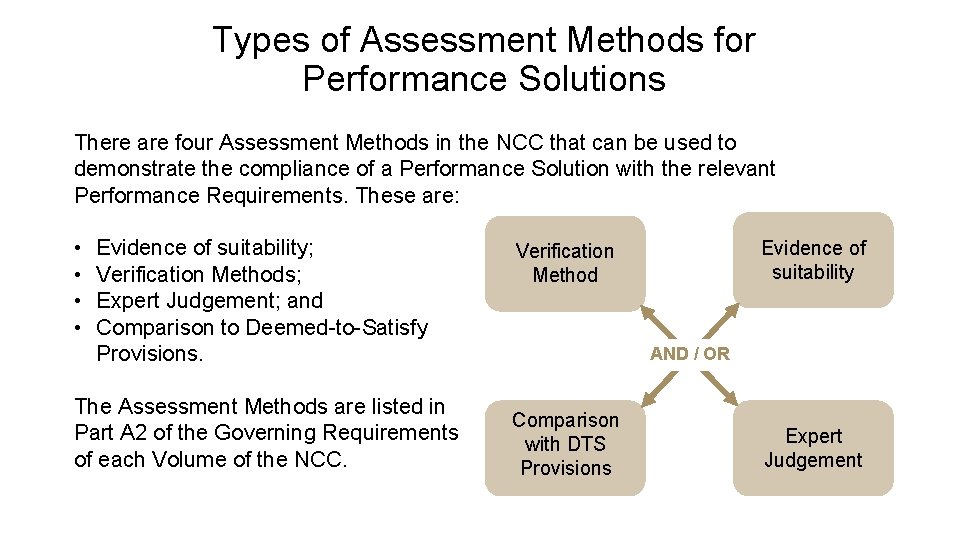
Types of Assessment Methods for Performance Solutions There are four Assessment Methods in the NCC that can be used to demonstrate the compliance of a Performance Solution with the relevant Performance Requirements. These are: • • Evidence of suitability; Verification Methods; Expert Judgement; and Comparison to Deemed-to-Satisfy Provisions. The Assessment Methods are listed in Part A 2 of the Governing Requirements of each Volume of the NCC. Evidence of suitability Verification Method AND / OR Comparison with DTS Provisions Expert Judgement
Assessment Methods: Evidence of suitability • Evidence of suitability – introduced in Part A 2 in all Volumes – documentary evidence. • Part A 5 describes the documentary evidence requirements across all Volumes. • Recognised expert. • Professional engineer. • Certification mark. • Other documentary evidence. • Used for both Performance Solutions and DTS Solutions.
Evidence of suitability for Volume Three • Part A 2. 2 introduces evidence of suitability requirements for Volume Three. Part A 5. 3 describes these requirements in more detail. • A key difference to Volumes One and Two is the mandatory Water. Mark Certification Scheme. • Products subject to the Scheme must have a ‘Watermark Licence’. • Other materials and products - recognised expert or report from a Registered Testing Authority. • Report from a professional engineer. • Other documentary evidence. • Used for both Performance Solutions and DTS Solutions.
Assessment Methods: Verification Methods • Verification Method (VM) – a defined term in the NCC. • It is defined as: • a test, inspection, calculation, or other method that determines whether a Performance Solution complies with the relevant Performance Requirements. • A practitioner can use a VM within the NCC, or a VM which is not in the NCC. • Used for Performance Solutions.
Assessment Methods: Expert Judgement • This is a broad definition and should be applied judiciously. • The expert needs to have a demonstrated knowledge of the technical issues involved, supported by peer recognition. • Used for Performance Solutions and DTS Solutions.
Assessment Methods: Comparison with Deemed-to-Satisfy Provisions • A Performance Solution may be compared to a current Deemed-to-Satisfy Provision to highlight how it will achieve compliance with the Performance Requirements. • Used for Performance Solutions.
Conclusion Upon completion, you will have gained a basic understanding of the performance-based NCC with an emphasis on: • the structure of the NCC; • the language used in the Performance Requirements; and • the use of Assessment Methods.
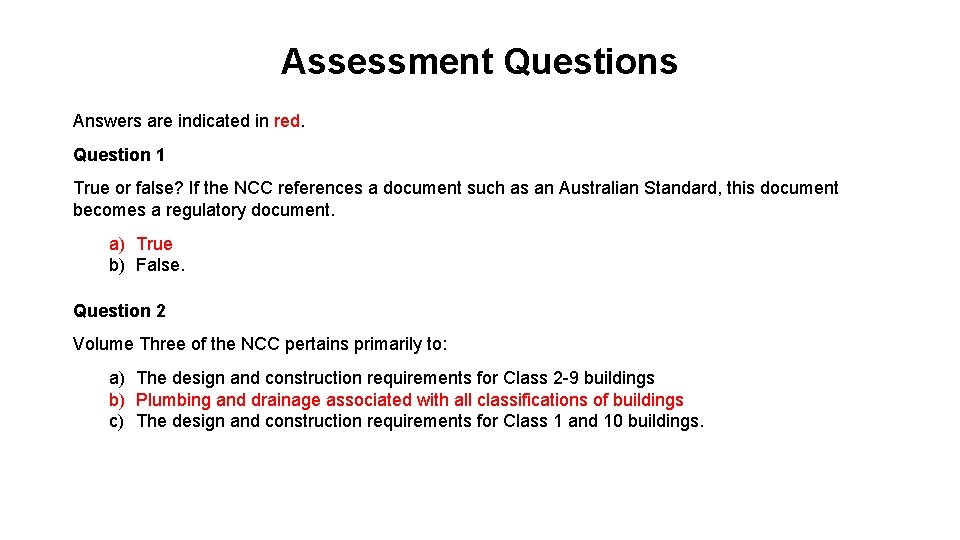
Assessment Questions Answers are indicated in red. Question 1 True or false? If the NCC references a document such as an Australian Standard, this document becomes a regulatory document. a) True b) False. Question 2 Volume Three of the NCC pertains primarily to: a) The design and construction requirements for Class 2 -9 buildings b) Plumbing and drainage associated with all classifications of buildings c) The design and construction requirements for Class 1 and 10 buildings.
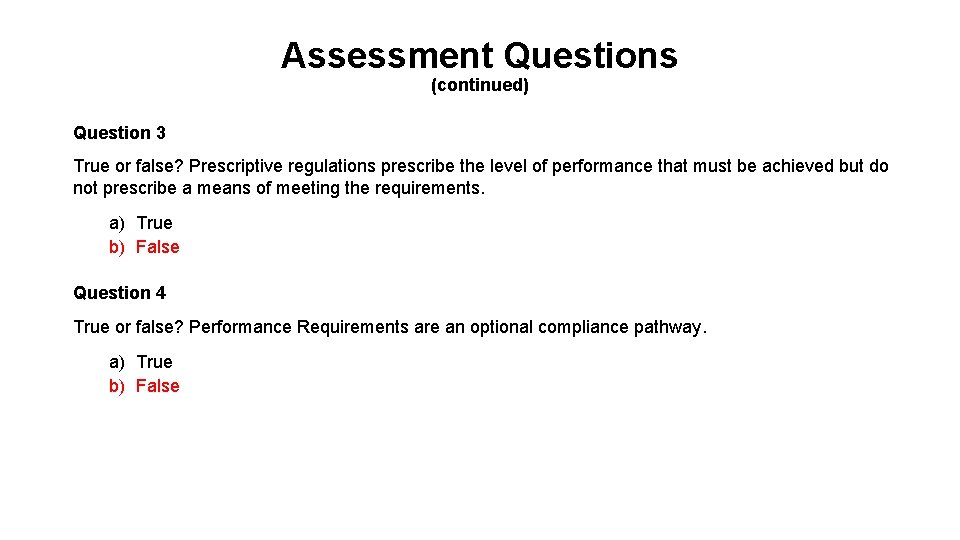
Assessment Questions (continued) Question 3 True or false? Prescriptive regulations prescribe the level of performance that must be achieved but do not prescribe a means of meeting the requirements. a) True b) False Question 4 True or false? Performance Requirements are an optional compliance pathway. a) True b) False
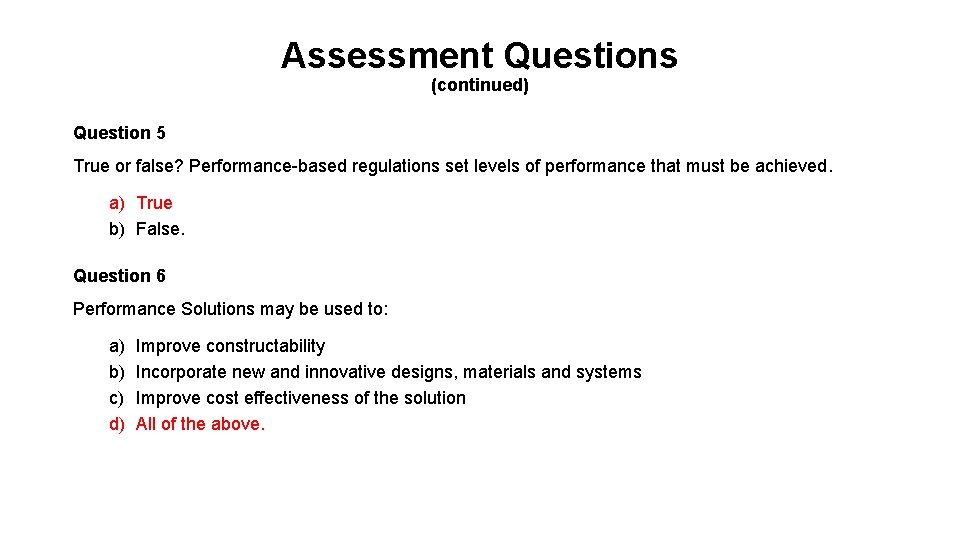
Assessment Questions (continued) Question 5 True or false? Performance-based regulations set levels of performance that must be achieved. a) True b) False. Question 6 Performance Solutions may be used to: a) b) c) d) Improve constructability Incorporate new and innovative designs, materials and systems Improve cost effectiveness of the solution All of the above.
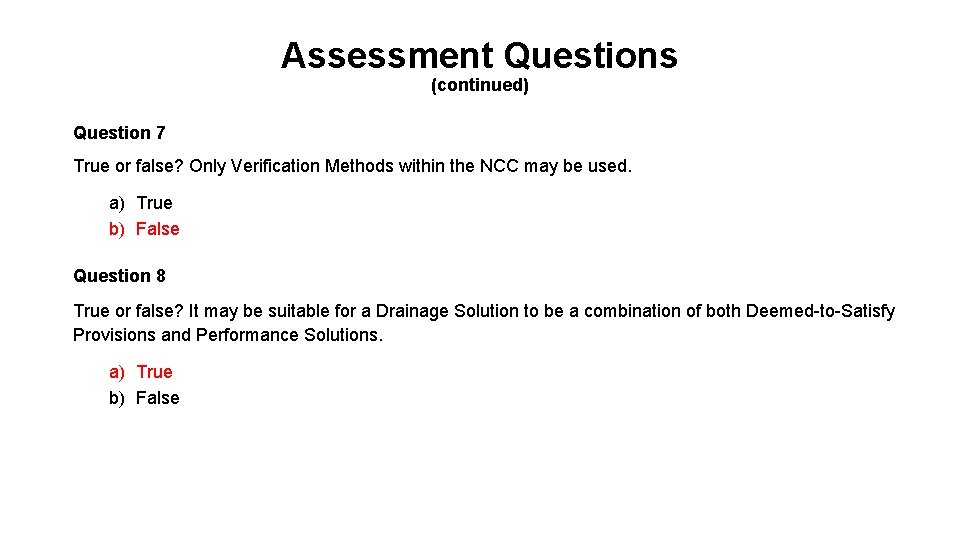
Assessment Questions (continued) Question 7 True or false? Only Verification Methods within the NCC may be used. a) True b) False Question 8 True or false? It may be suitable for a Drainage Solution to be a combination of both Deemed-to-Satisfy Provisions and Performance Solutions. a) True b) False
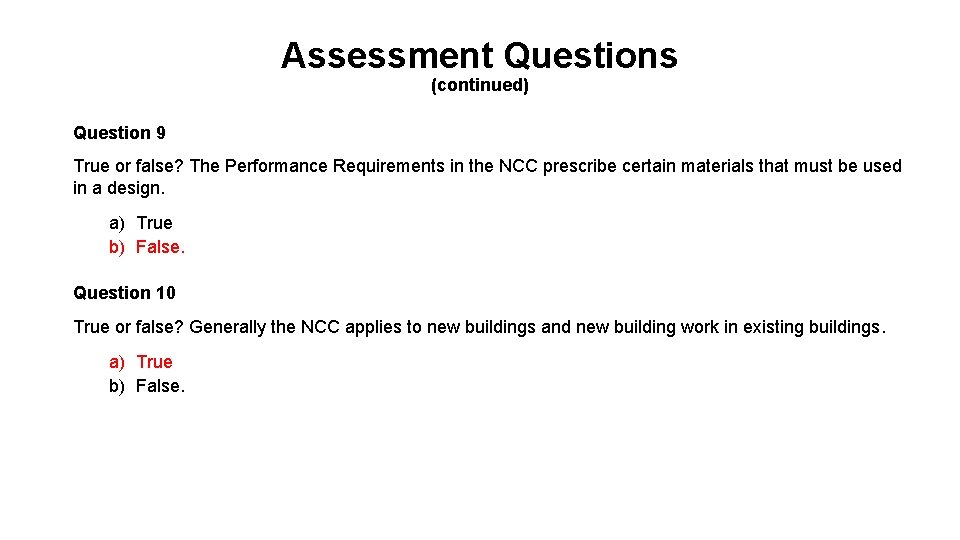
Assessment Questions (continued) Question 9 True or false? The Performance Requirements in the NCC prescribe certain materials that must be used in a design. a) True b) False. Question 10 True or false? Generally the NCC applies to new buildings and new building work in existing buildings. a) True b) False.
Assessment Questions (continued) Question 11 True or false? Qualitative Performance Requirements prescribe certain attributes or qualities to achieve a certain level of performance. a) True b) False. Question 12 True or false? Quantified Performance Requirements contain values that provide an absolute measure which a Performance Solution must at least comply with. a) True b) False.
Copyright, Attribution & Disclaimer Copyright © Commonwealth of Australia and the States and Territories of Australia 2020, published by the Australian Building Codes Board. The material in this publication is licensed under a Creative Commons Attribution— 4. 0 International licence, with the exception of: any third party material, any trademarks, and any images or photographs. More information on this CC BY licence is set out at the Creative Commons Website. Enquiries about this publication can be sent to: Australian Building Codes Board , GPO Box 2013, CANBERRA ACT 2601. Phone: 1300 134 631, Email: ncc@abcb. gov. au www. abcb. gov. au. Attribution Use of all or part of this publication must include the following attribution: © Commonwealth of Australia and the States and Territories 2020, published by the Australian Building Codes Board. Disclaimer By accessing or using this publication, you agree to the following: While care has been taken in the preparation of this publication, it may not be complete or up-to-date. You can ensure that you are using a complete and upto-date version by checking the Australian Building Codes Board website (www. abcb. gov. au). The Australian Building Codes Board, the Commonwealth of Australia and States and Territories of Australia do not accept any liability, including liability for negligence, for any loss (howsoever caused), damage, injury, expense or cost incurred by any person as a result of accessing, using or relying upon this publication, to the maximum extent permitted by law. No representation or warranty is made or given as to the currency, accuracy, reliability, merchantability, fitness for any purpose or completeness of this publication or any information which may appear on any linked websites, or in other linked information sources, and all such representations and warranties are excluded to the extent permitted by law. This publication is not legal or professional advice. Persons rely upon this publication entirely at their own risk and must take responsibility for assessing the relevance and accuracy of the information in relation to their particular circumstances.
- Slides: 43