
NCAA NAIA Eligibility Informational Meeting Disclaimer This presentation
NCAA & NAIA Eligibility Informational Meeting
Disclaimer: This presentation is simply an overview of policies and procedures. Parents should visit websites and read all sections carefully, especially the Guides for Student Athletes, in order to fully understand all academic eligibility requirements. This presentation will not cover Recruiting rules/policies. Please see the Dean of Students and/or Head Coach for that information.
Information and Resources for College-Bound Student. Athletes and Parents VAST number of websites found on Guidance Website, “N” page http: //www. etown. kyschools. us/1/Conten t 2/206
What is the NCAA? Web Site: www. ncaa. org 1, 000 + total schools – 351 schools in Division I – 308 schools in Division II – 443 schools in Division III
What is the NAIA? National Association of Intercollegiate Athletics – 250 Colleges and Universities divided into two Divisions: Division II – Web Site: www. naia. org
Differences between NCAA & NAIA NCAA : Division 1 – typically the largest universities with world class facilities attracting top athletes Division 2 – smaller than D 1 and students usually finance with a combination of athletic and educational scholarships
Differences between NCAA & NAIA Division 3 – The smallest NCAA institutions – NOT allowed to offer Athletic Scholarships. Do not have to register for clearinghouse. NAIA – Division 1 is comparable to NCAA D 2 Less complex rules for admission
Differences between NCAA & NAIA (con’t) Generally speaking, NAIA institutions: Are primarily private and/or religious based Emphasize a liberal arts curriculum Have enrollments under 2, 000 students Provide for a greater sense of community/belonging Offer fewer graduate programs Have higher graduation rates for athletes than NCAA D 1 or D 2
NAIA Eligibility
NAIA Guide for the College. Bound Student-Athlete https: //play. mynaia. org/media/1091/naia _guide_college_bound_student. pdf
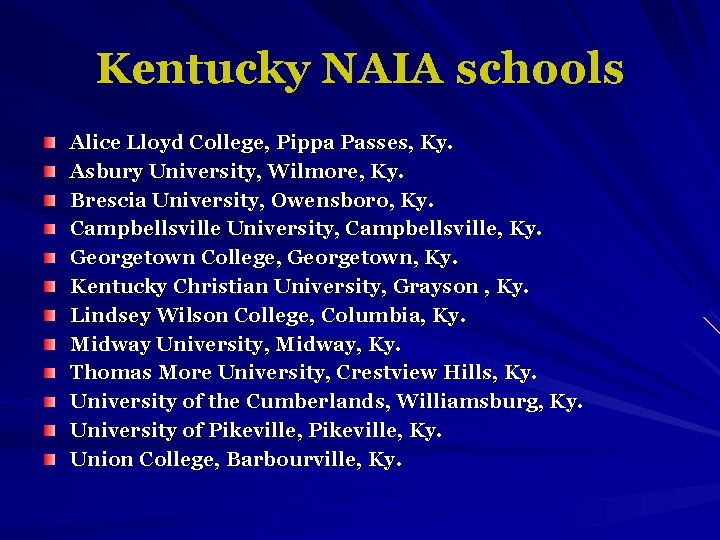
Kentucky NAIA schools Alice Lloyd College, Pippa Passes, Ky. Asbury University, Wilmore, Ky. Brescia University, Owensboro, Ky. Campbellsville University, Campbellsville, Ky. Georgetown College, Georgetown, Ky. Kentucky Christian University, Grayson , Ky. Lindsey Wilson College, Columbia, Ky. Midway University, Midway, Ky. Thomas More University, Crestview Hills, Ky. University of the Cumberlands, Williamsburg, Ky. University of Pikeville, Ky. Union College, Barbourville, Ky.
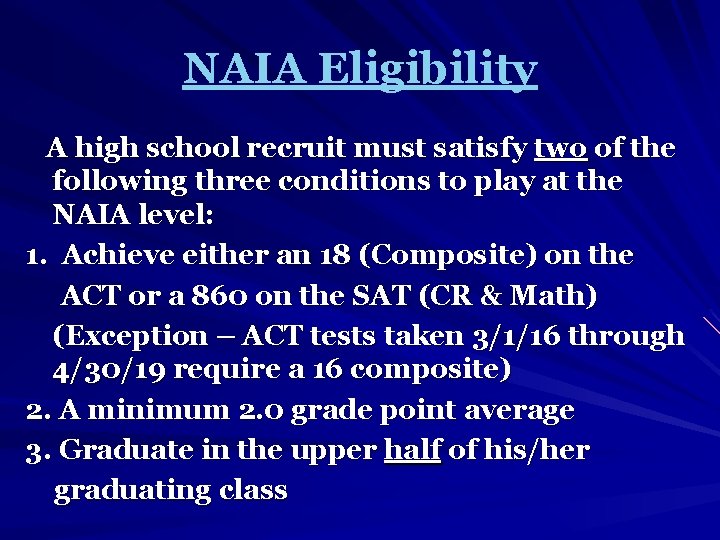
NAIA Eligibility A high school recruit must satisfy two of the following three conditions to play at the NAIA level: 1. Achieve either an 18 (Composite) on the ACT or a 860 on the SAT (CR & Math) (Exception – ACT tests taken 3/1/16 through 4/30/19 require a 16 composite) 2. A minimum 2. 0 grade point average 3. Graduate in the upper half of his/her graduating class
Must register with NAIA Eligibility Center Every student who plays in the NAIA for the first time must have their eligibility determined through the NAIA Eligibility Center. Visit http: //www. playnaia. org/. Read and follow ALL directions!!! Register to take the ACT, SAT or both and use the NAIA Eligibility Center code “ 9876” as a score recipient. Pay the $90 fee (or indicate qualification for a fee waiver). Cards accepted: Visa, Mastercard and Discover. Send your official transcript through Parchment. To find NAIA, select Academic Destinations, Missouri, NAIA Eligbility Center
Registration fee waivers are offered based on need and are available when a student currently qualifies for a waiver of SAT or ACT testing fees or for a free or reduced school lunch program. Fee waivers for high school students are verified through the student’s high school counselor. Do not submit a credit card payment if you are eligible to receive a fee waiver. No refunds are issued for credit card payments made prior to receipt of a fee waiver confirmation.

NAIA https: //play. mynaia. org/media/1142/naia _ec_presentation_11 -202018_newtechlaunch. pdf
NCAA Eligibility
What is the NCAA Eligibility Center? The NCAA Eligibility Center is an organization that works with the NCAA to determine a student’s eligibility for athletics participation in his or her first year of college enrollment.
The center is not the NCAA, but an organization that performs academic evaluations for the NCAA. Students who want to participate in college sports during their first year of enrollment in college must register with the center. www. eligibilitycenter. org Divisions I and II may offer athletic scholarships, while Division III colleges and universities may not.
Eligibility Center Responsibilities The NCAA Eligibility Center is responsible for determining the eligibility of every college-bound student-athlete in NCAA Divisions I and II using the following two areas: Academic Certification. – Does the college-bound student-athlete meet the legislated minimum academic requirements? Amateurism Certification. – Has the college-bound student-athlete jeopardized his or her amateur status?
Initial. Eligibility Overview
2019 -20 Guide for the College. Bound Student-Athlete http: //www. ncaapublications. com/produc tdownloads/CBSA 19. pdf
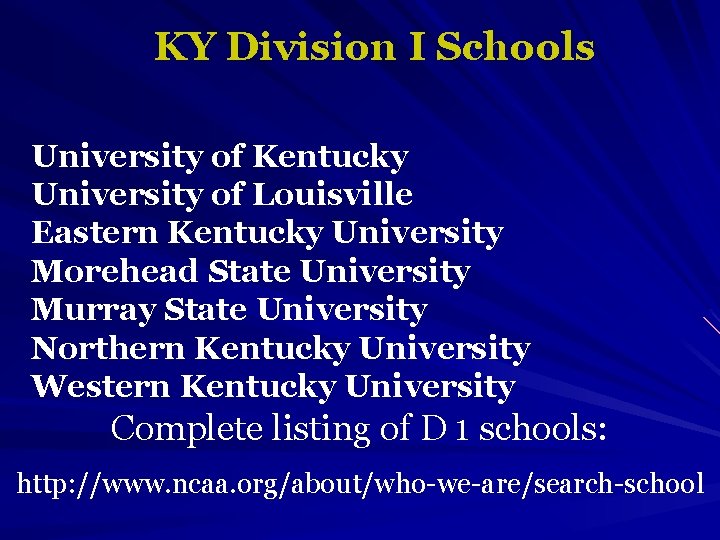
KY Division I Schools University of Kentucky University of Louisville Eastern Kentucky University Morehead State University Murray State University Northern Kentucky University Western Kentucky University Complete listing of D 1 schools: http: //www. ncaa. org/about/who-we-are/search-school
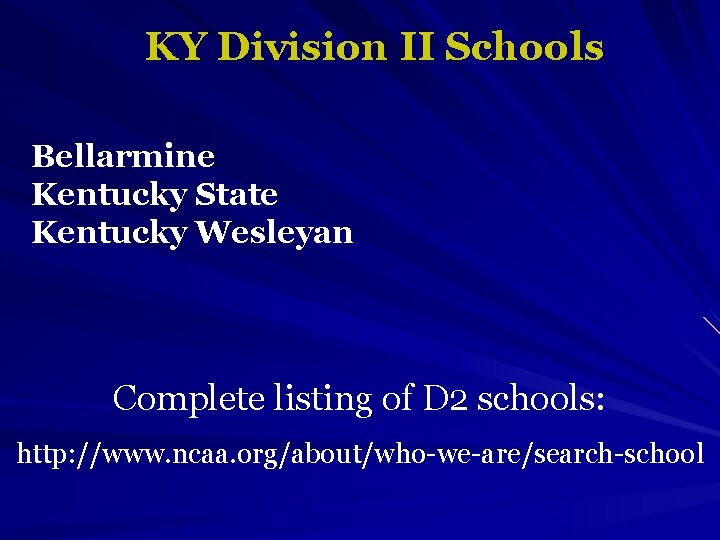
KY Division II Schools Bellarmine Kentucky State Kentucky Wesleyan Complete listing of D 2 schools: http: //www. ncaa. org/about/who-we-are/search-school
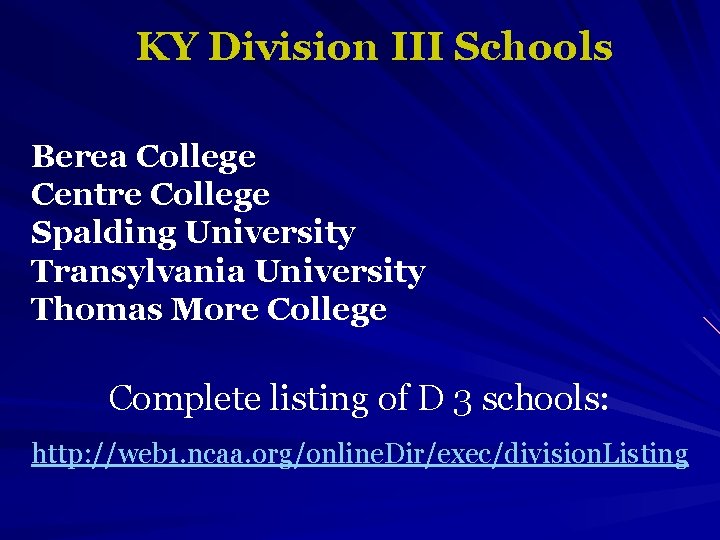
KY Division III Schools Berea College Centre College Spalding University Transylvania University Thomas More College Complete listing of D 3 schools: http: //web 1. ncaa. org/online. Dir/exec/division. Listing
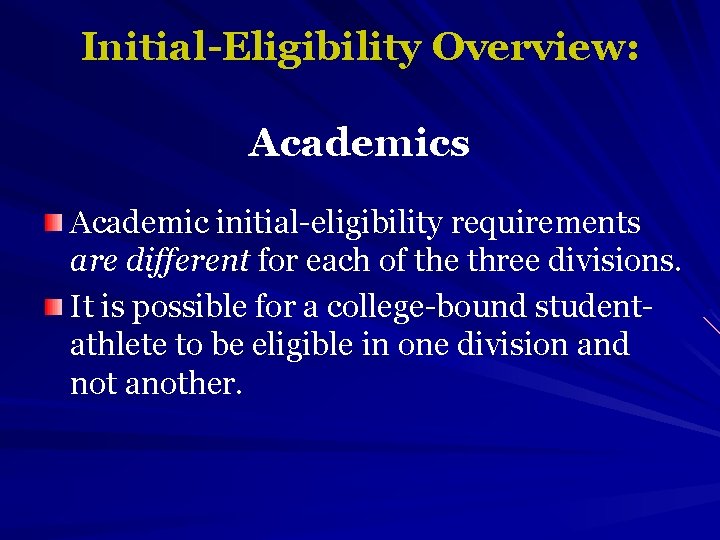
Initial-Eligibility Overview: Academics Academic initial-eligibility requirements are different for each of the three divisions. It is possible for a college-bound studentathlete to be eligible in one division and not another.
DIVISION I Requirements
Academic Eligibility Requirements Division I http: //www. ncaapublications. com/productdownloads/ EB 18. pdf
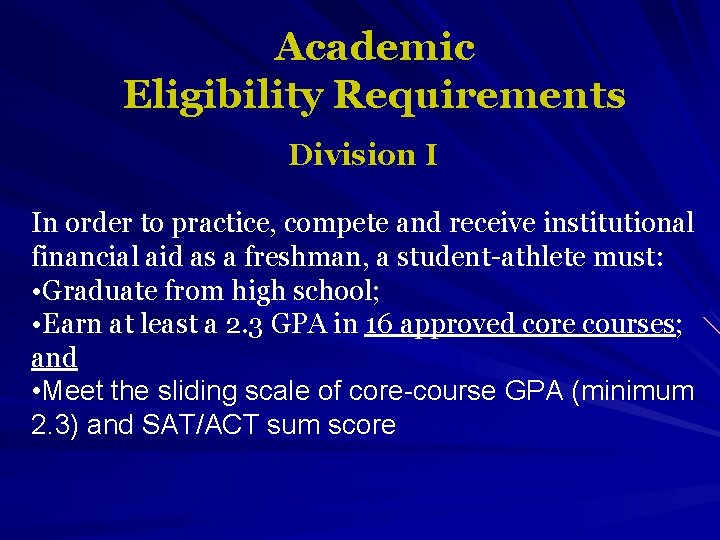
Academic Eligibility Requirements Division I In order to practice, compete and receive institutional financial aid as a freshman, a student-athlete must: • Graduate from high school; • Earn at least a 2. 3 GPA in 16 approved core courses; and • Meet the sliding scale of core-course GPA (minimum 2. 3) and SAT/ACT sum score
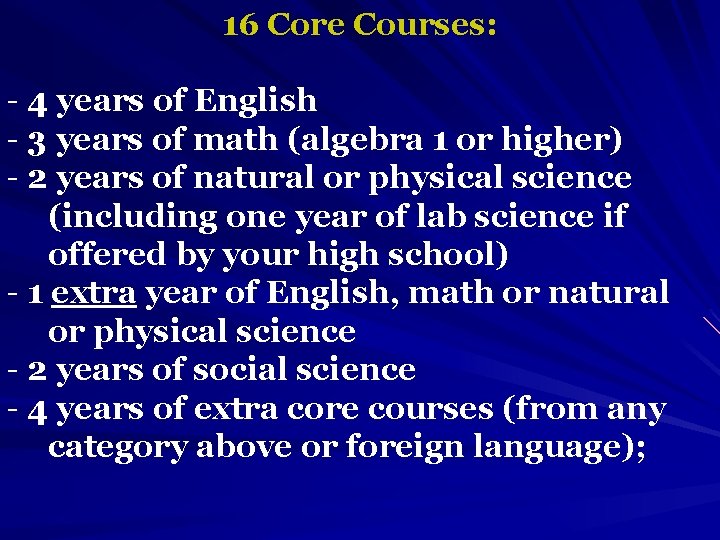
16 Core Courses: - 4 years of English - 3 years of math (algebra 1 or higher) - 2 years of natural or physical science (including one year of lab science if offered by your high school) - 1 extra year of English, math or natural or physical science - 2 years of social science - 4 years of extra core courses (from any category above or foreign language);
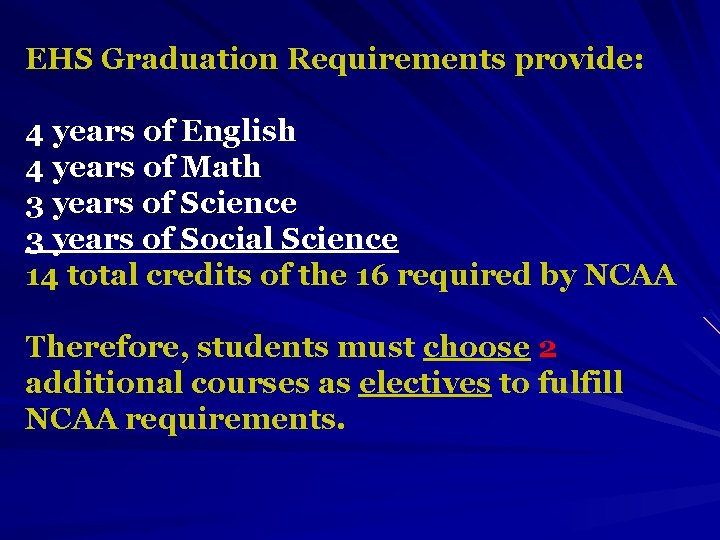
EHS Graduation Requirements provide: 4 years of English 4 years of Math 3 years of Science 3 years of Social Science 14 total credits of the 16 required by NCAA Therefore, students must choose 2 additional courses as electives to fulfill NCAA requirements.
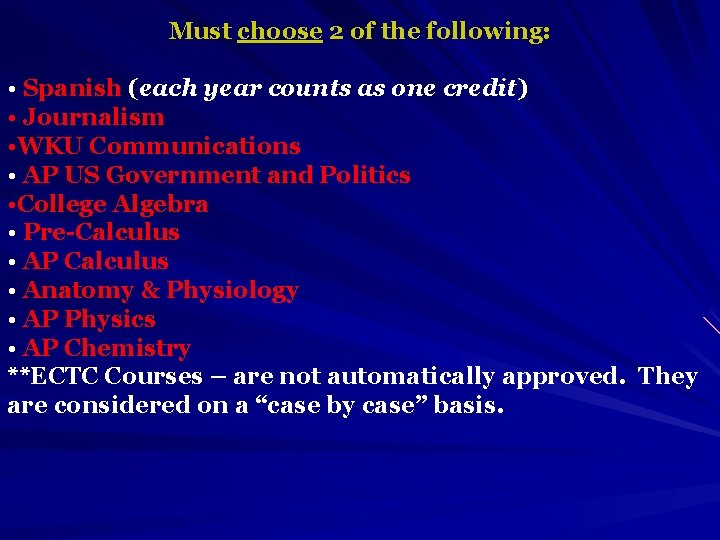
Must choose 2 of the following: • Spanish (each year counts as one credit) • Journalism • WKU Communications • AP US Government and Politics • College Algebra • Pre-Calculus • AP Calculus • Anatomy & Physiology • AP Physics • AP Chemistry **ECTC Courses – are not automatically approved. They are considered on a “case by case” basis.
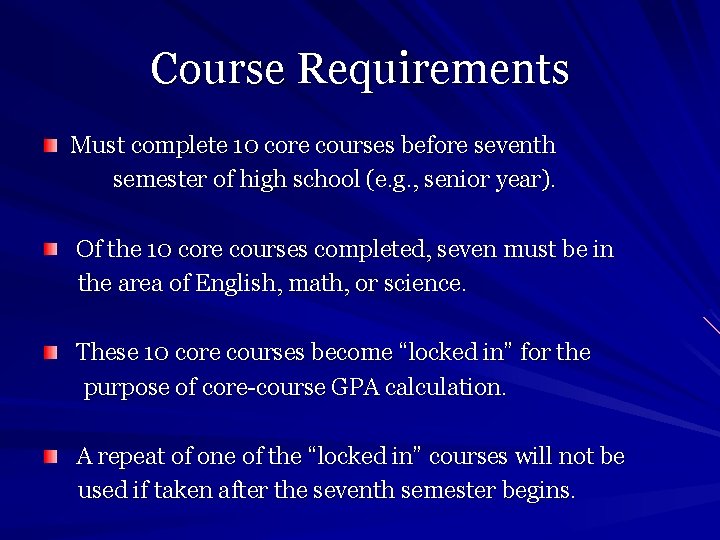
Course Requirements Must complete 10 core courses before seventh semester of high school (e. g. , senior year). Of the 10 core courses completed, seven must be in the area of English, math, or science. These 10 core courses become “locked in” for the purpose of core-course GPA calculation. A repeat of one of the “locked in” courses will not be used if taken after the seventh semester begins.
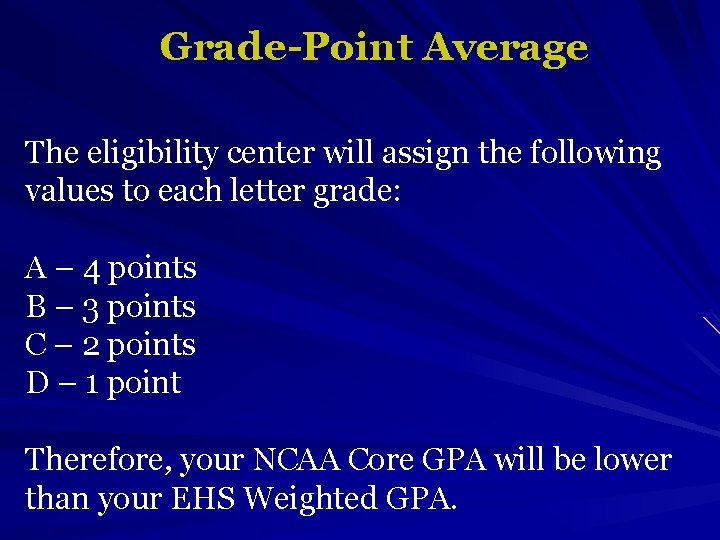
Grade-Point Average The eligibility center will assign the following values to each letter grade: A – 4 points B – 3 points C – 2 points D – 1 point Therefore, your NCAA Core GPA will be lower than your EHS Weighted GPA.
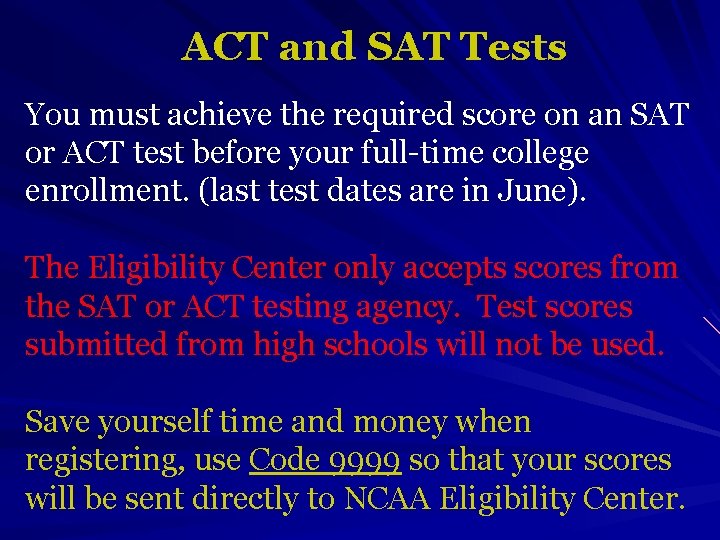
ACT and SAT Tests You must achieve the required score on an SAT or ACT test before your full-time college enrollment. (last test dates are in June). The Eligibility Center only accepts scores from the SAT or ACT testing agency. Test scores submitted from high schools will not be used. Save yourself time and money when registering, use Code 9999 so that your scores will be sent directly to NCAA Eligibility Center.
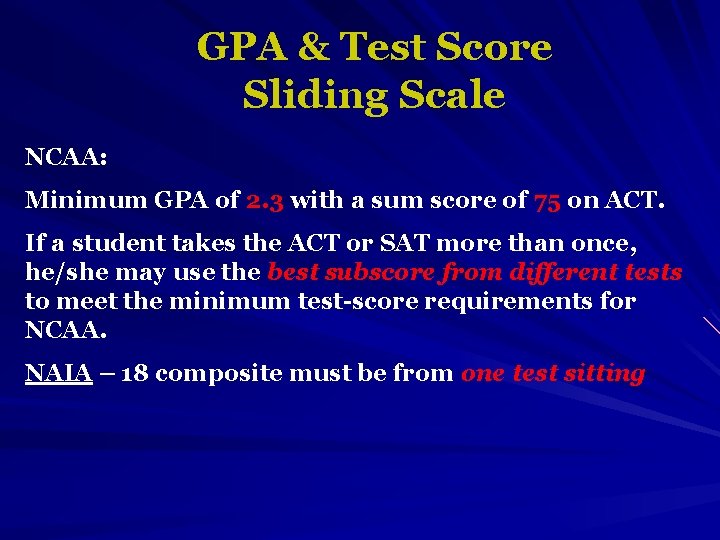
GPA & Test Score Sliding Scale NCAA: Minimum GPA of 2. 3 with a sum score of 75 on ACT. If a student takes the ACT or SAT more than once, he/she may use the best subscore from different tests to meet the minimum test-score requirements for NCAA. NAIA – 18 composite must be from one test sitting
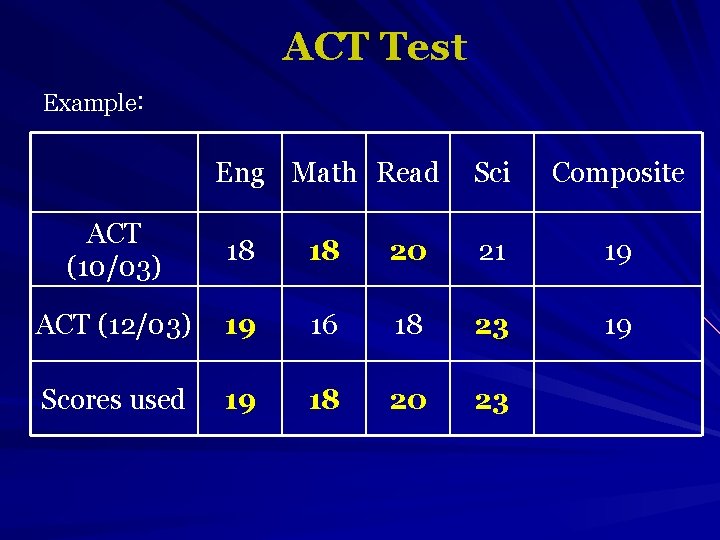
ACT Test Example: Eng Math Read Sci Composite ACT (10/03) 18 18 20 21 19 ACT (12/03) 19 16 18 23 19 Scores used 19 18 20 23
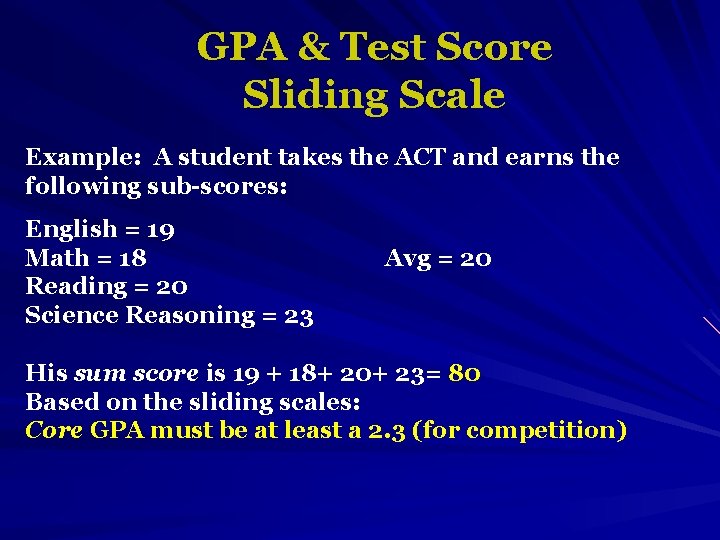
GPA & Test Score Sliding Scale Example: A student takes the ACT and earns the following sub-scores: English = 19 Math = 18 Reading = 20 Science Reasoning = 23 Avg = 20 His sum score is 19 + 18+ 20+ 23= 80 Based on the sliding scales: Core GPA must be at least a 2. 3 (for competition)
Three possible Academic Outcomes 1. Full qualifier = competition, athletics aid (scholarship), and practice the first year. 2. Academic redshirt = athletics aid the first year, practice in first regular academic term, but may NOT compete during first year 3. Nonqualifier = no athletics aid, practice or competition the first year.
Academic Redshirt 16 Core Courses (same distribution) Minimum GPA of 2. 0 – 2. 299 in 16 core courses Minimum ACT/SAT sum score using sliding scale
Academic Redshirt Student-athletes who fail to meet the required 10 core courses prior to the start of the seventh semester (seven of which must be in English, math, or natural or physical science), will be allowed to retake core courses in the seventh or eighth semester, which will be used in their academic certification for the purpose of meeting the academic redshirt requirements.
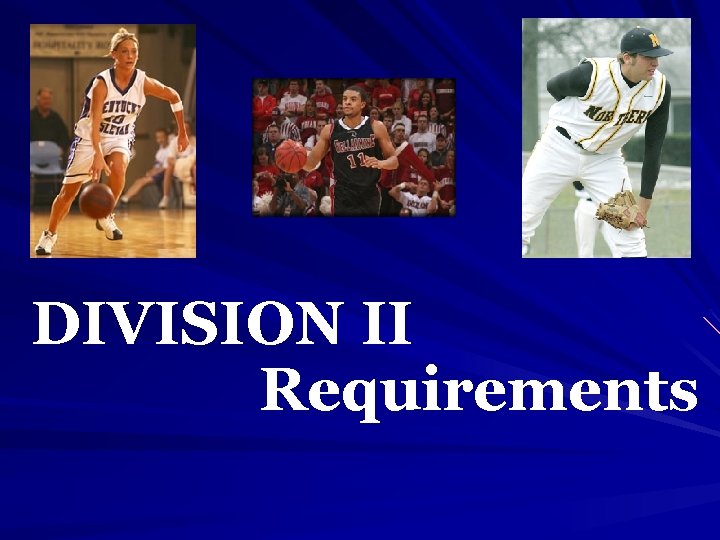
DIVISION II Requirements
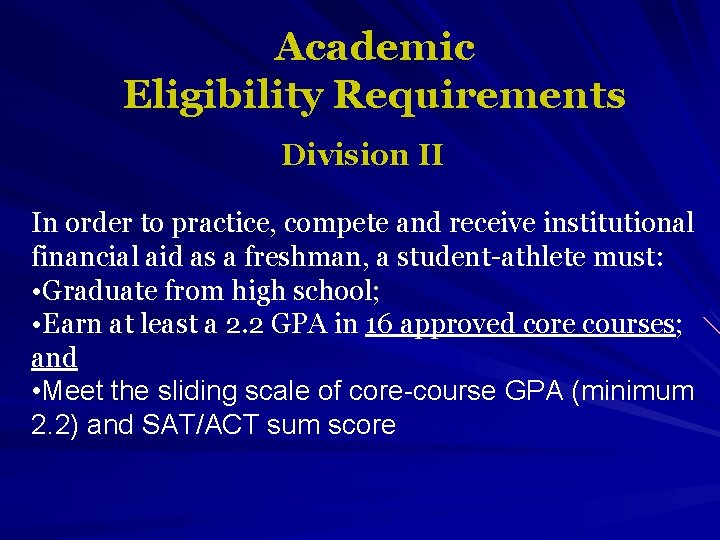
Academic Eligibility Requirements Division II In order to practice, compete and receive institutional financial aid as a freshman, a student-athlete must: • Graduate from high school; • Earn at least a 2. 2 GPA in 16 approved core courses; and • Meet the sliding scale of core-course GPA (minimum 2. 2) and SAT/ACT sum score
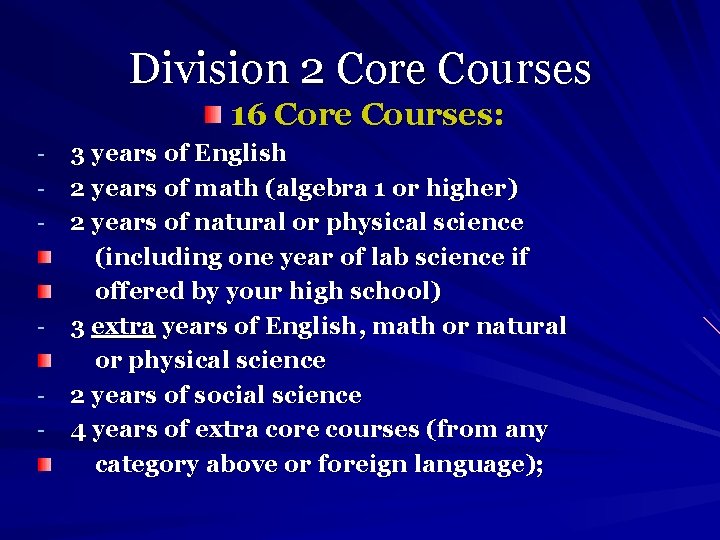
Division 2 Core Courses 16 Core Courses: - 3 years of English - 2 years of math (algebra 1 or higher) - 2 years of natural or physical science (including one year of lab science if offered by your high school) - 3 extra years of English, math or natural or physical science - 2 years of social science - 4 years of extra core courses (from any category above or foreign language);
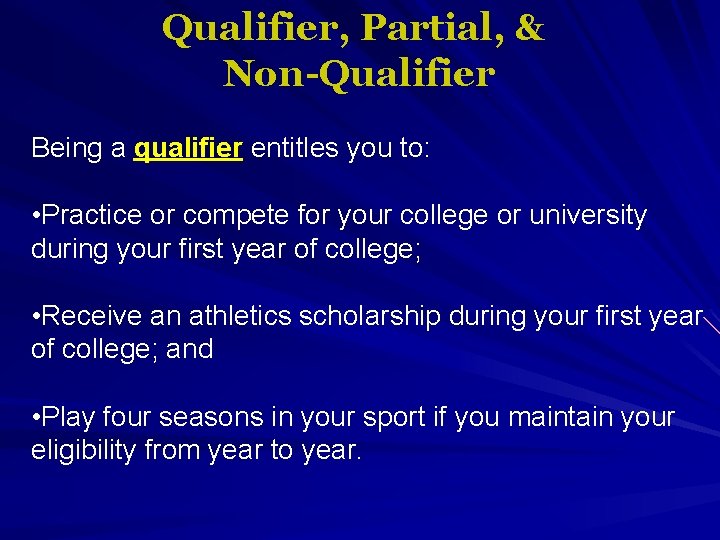
Qualifier, Partial, & Non-Qualifier Being a qualifier entitles you to: • Practice or compete for your college or university during your first year of college; • Receive an athletics scholarship during your first year of college; and • Play four seasons in your sport if you maintain your eligibility from year to year.
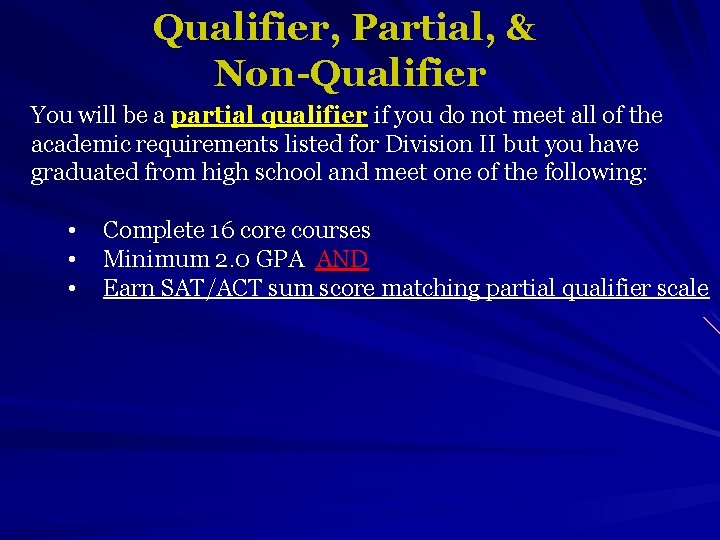
Qualifier, Partial, & Non-Qualifier You will be a partial qualifier if you do not meet all of the academic requirements listed for Division II but you have graduated from high school and meet one of the following: • • • Complete 16 core courses Minimum 2. 0 GPA AND Earn SAT/ACT sum score matching partial qualifier scale
As a partial qualifier, you: • Can practice with your team at its home facility during your first year of college; • Can receive an athletics scholarship during your first year of college; • Cannot compete during your first year of college; and • Can play four seasons in your sport as long as you maintain your eligibility from year to year.
You will be a nonqualifier if you did not graduate from high school, or, if you graduated and are missing both the core-course GPA and the required ACT or SAT scores. As a nonqualifier, you: • Cannot practice or compete for your college or university during your first year of college; • Cannot receive an athletics scholarship during your first year of college, although you may receive needbased financial aid; and • Can play four seasons in your sport as long as you maintain your eligibility from year to year.
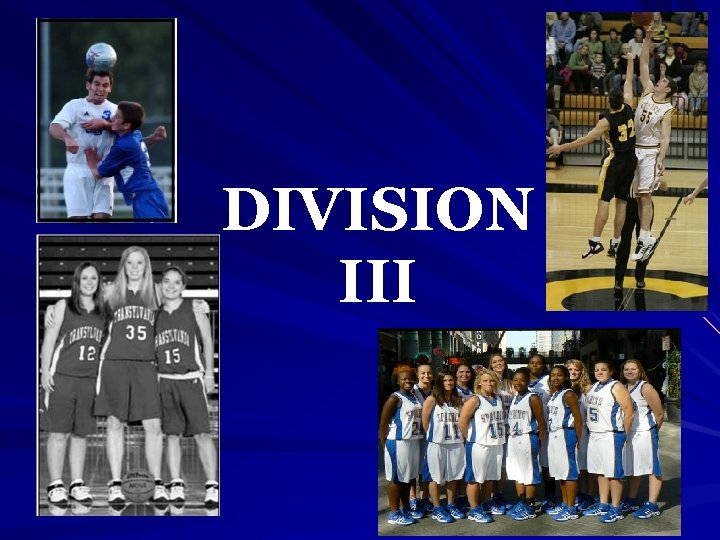
DIVISION III
Academic Eligibility Requirements Division III Unlike Divisions I and II, there is no uniform set of eligibility requirements for Division III schools. Therefore, registration with the Eligibility Center is not required. • Eligibility for admission, financial aid, practice and competition is determined by the institution.
Amateurism Eligibility Requirements
Amateurism Eligibility Requirements If you plan to participate in intercollegiate athletics at an NCAA Division I or II institution, you must have both your academic and amateurism status certified by the Eligibility Center before representing the institution in competition.
Amateurism Eligibility Requirements The Eligibility Center encourages you to update your athletics participation information often, especially if you participate in events outside your normal high school season. • Make sure that you are protecting your amateurism • Stay college eligible –always ask before you act! • NCAA amateurism certification Web site: http: //www. ncaa. org/student-athletes/future/amateurism
AMATEURISM In general, amateurism requirements do not allow: – Contracts with professional teams. – Salary for participating in athletics. – Prize money above actual and necessary expenses. – Play with professionals. – Tryouts, practice or competition with a professional team. – Benefits from an agent or prospective agent. – Agreement to be represented by an agent. – Delayed initial full-time collegiate enrollment to participate in organized sports competition.
Steps You Must Take to Participate in NCAA Division I or II Athletics
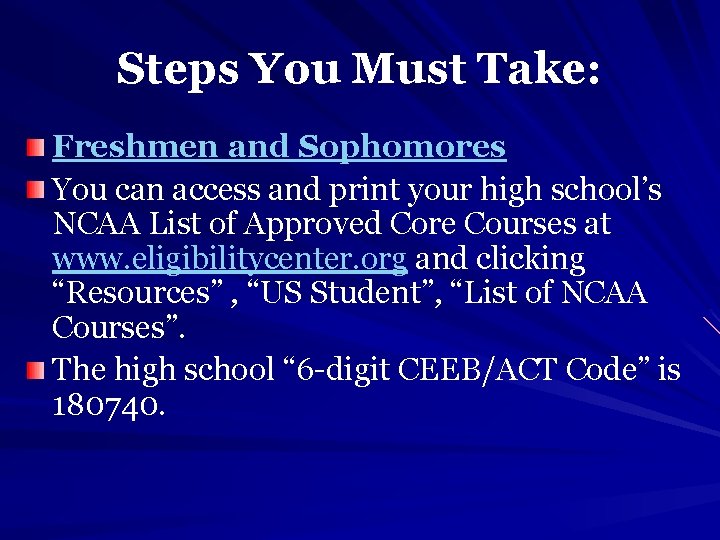
Steps You Must Take: Freshmen and Sophomores You can access and print your high school’s NCAA List of Approved Core Courses at www. eligibilitycenter. org and clicking “Resources” , “US Student”, “List of NCAA Courses”. The high school “ 6 -digit CEEB/ACT Code” is 180740.
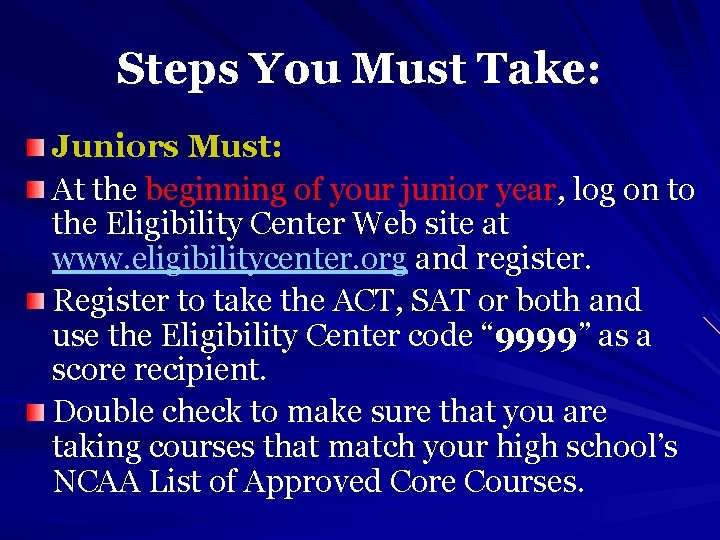
Steps You Must Take: Juniors Must: At the beginning of your junior year, log on to the Eligibility Center Web site at www. eligibilitycenter. org and register. Register to take the ACT, SAT or both and use the Eligibility Center code “ 9999” as a score recipient. Double check to make sure that you are taking courses that match your high school’s NCAA List of Approved Core Courses.

Steps You Must Take: Begin your amateurism questionnaire. Pay the $90 fee. The Eligibility Center accepts Visa, Master. Card, Discover and American Express. If you are a U. S. resident, you can choose to pay by electronic check. Some individuals may qualify to apply for a fee waiver.
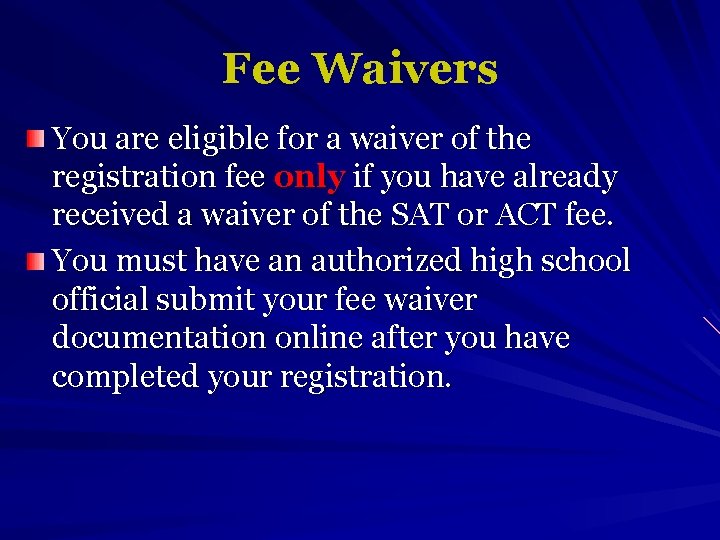
Fee Waivers You are eligible for a waiver of the registration fee only if you have already received a waiver of the SAT or ACT fee. You must have an authorized high school official submit your fee waiver documentation online after you have completed your registration.
Steps You Must Take: Request that your high school guidance counselor send an official transcript to the Eligibility Center after completing your junior year. Prior to registration for your senior year, check with your guidance counselor and the Eligibility Center to determine the number of core courses that need to be completed your senior year.
Steps You Must Take: Seniors Must: You may take the SAT and/or ACT as often as you feel necessary. The Eligibility Center will use the best scores from each section of the SAT or ACT to determine your best cumulative score. Check to make sure that you are taking courses that match your high school’s NCAA List of Approved Core Courses. Review your amateurism questionnaire responses and request final amateurism certification beginning April 1 (for fall enrollees) or October 1 (for spring enrollees).
Steps You Must Take: Continue to earn the best grades possible. Graduate on time (in eight academic semesters). After graduation, ask your high school guidance counselor to send your final transcript to the Eligibility Center with proof of graduation.
Filling out the Worksheet • The worksheet is provided to assist in monitoring the progress in meeting NCAA initial-eligibility standards. The Eligibility Center will determine the official status after graduation. • Remember to check the high school’s list of approved courses for the classes taken. • Use the following scale: A = 4 quality points; B = 3 quality points; C = 2 quality points; D = 1 quality points
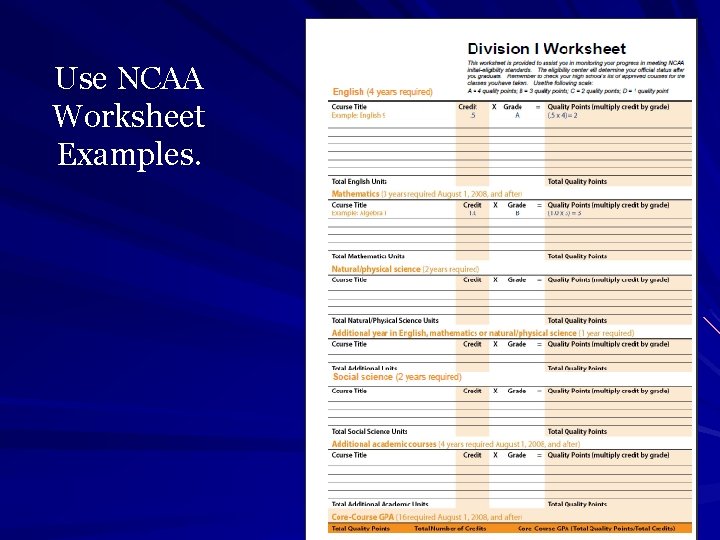
Use NCAA Worksheet Examples.
Remember, meeting the NCAA academic rules does not guarantee your admission into a college. You must still apply for admission.
Financial Aid • There are no four-year athletics scholarships. • All athletics scholarships awarded by NCAA institutions are limited to one year and are renewable each academic year and may be reduced or withdrawn. • Athletics scholarships may be renewed each academic year for a maximum of five years within a six-year period of continuous college attendance. • Athletics scholarships are awarded in a variety of amounts, ranging from full scholarships (including tuition fees, room, board and books) to partial scholarships (e. g. , books only).
Questions? ? ?
Questions? ? ? The Eligibility Center has created a high school direct phone line. Please contact the Eligibility Center with your questions at 877/622 -2321.
Questions Q: If I transferred from another school, how are my “Core Courses” defined? A: You will use the List of Approved Courses and Grading scale from each school attended in calculating “Core GPA”. You will need original transcripts from each school, also.
Questions Q: If I am taking a class at ECTC, does it count toward my “Core GPA? ” A: Yes, if it is in the area of English, Math, Science, or Social Science. You will need to provide the NCAA with your ECTC Transcript in addition to the EHS transcript.
Questions Q: I took Algebra 1 and Spanish 1 in the 8 th grade. Do they count as a Core Courses for me? A: YES – A high school course taken in the eighth grade may be used if the course is on the high school transcript with a grade and credit and if the course is on the high school's NCAA List of Approved Core Courses. .

Resources Go to www. eligibilitycenter. org From the home page, click on “Resources. ”
- Slides: 71