
NC LLRF CDR RFQ BUNCHER AND DTL January
NC LLRF CDR RFQ, BUNCHER AND DTL January 15, 2019, ESS, Lund Pedro J. González Miguel Alarcón www. essbilbao. org
Outline • • • LLRF Specifications General View High Level LLRF Architecture Software Algorithms Cavities – RFQ – Buncher (and Test Bench) – DTL • Test and Validation P. Gonzalez & M. Alarcon NC LLRF CDR, ESS, Lund, January 2019 2
![LLRF Specifications • Extract from Lund University report [LLRF System for ESS linac] •](http://slidetodoc.com/presentation_image_h2/5c01ca2aff17bfbe4f36c25ae861c98a/image-3.jpg "LLRF Specifications • Extract from Lund University report [LLRF System for ESS linac] •")
LLRF Specifications • Extract from Lund University report [LLRF System for ESS linac] • LLRF Requirements – Maintain amplitude and phase stability of the cavity field – Maintain the cavity tuned Cavity Phase stability (RMS for one pulse) Amplitude stability Phase excursion Amplitude excursion (RMS for one (Peak, first 10 us) pulse) RFQ 0. 2 deg. 0. 2 % 1. 0 deg. 1. 0 % Buncher 0. 2 deg. 0. 2 % 1. 0 deg. 1. 0 % DTL 0. 2 deg. 0. 2 % 1. 0 deg. 1. 0 % Spoke 0. 1 deg. 0. 1 % 0. 5 deg. 0. 5 % P. Gonzalez & M. Alarcon NC LLRF CDR, ESS, Lund, January 2019 3
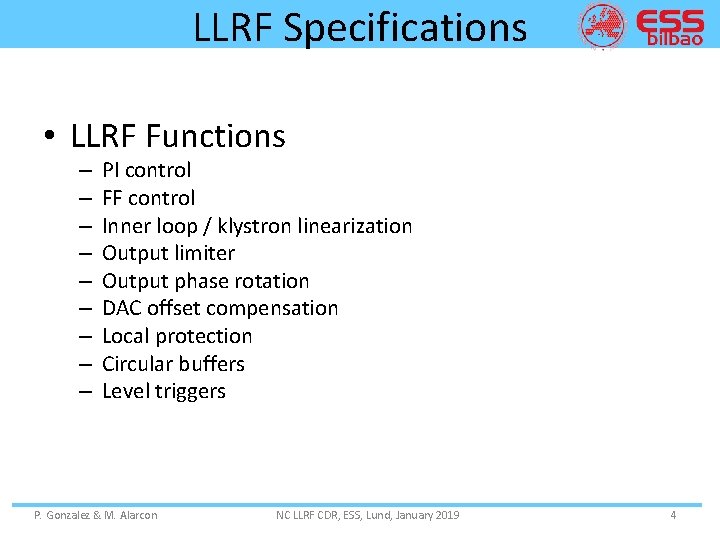
LLRF Specifications • LLRF Functions – – – – – PI control FF control Inner loop / klystron linearization Output limiter Output phase rotation DAC offset compensation Local protection Circular buffers Level triggers P. Gonzalez & M. Alarcon NC LLRF CDR, ESS, Lund, January 2019 4
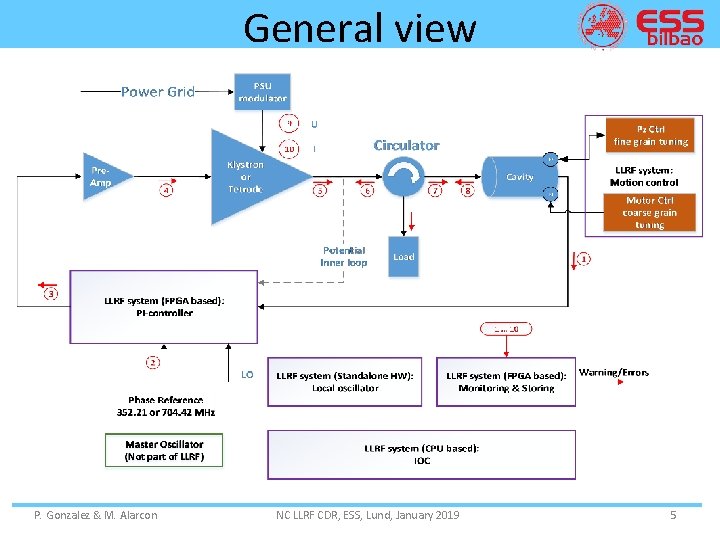
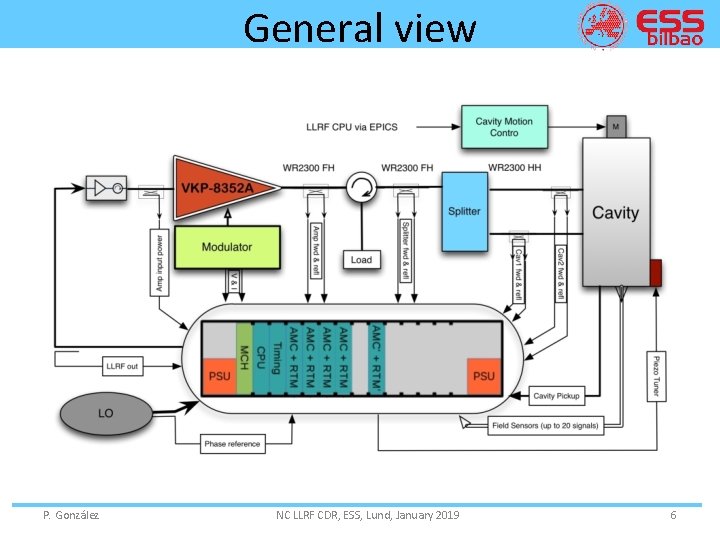
General view P. Gonzalez & M. Alarcon NC LLRF CDR, ESS, Lund, January 2019 5
General view P. González NC LLRF CDR, ESS, Lund, January 2019 6
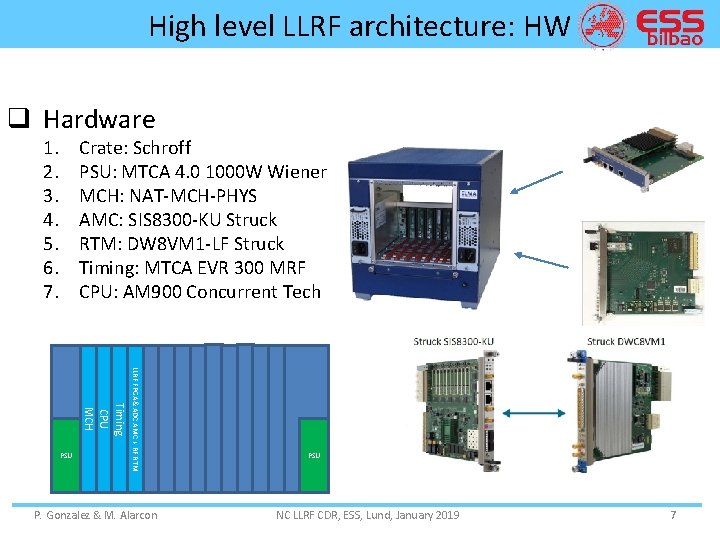
High level LLRF architecture: HW q Hardware 1. 2. 3. 4. 5. 6. 7. Crate: Schroff PSU: MTCA 4. 0 1000 W Wiener MCH: NAT-MCH-PHYS AMC: SIS 8300 -KU Struck RTM: DW 8 VM 1 -LF Struck Timing: MTCA EVR 300 MRF CPU: AM 900 Concurrent Tech LLRF FPGA& ADC AMC + RF RTM Timing CPU MCH PSU P. Gonzalez & M. Alarcon PSU NC LLRF CDR, ESS, Lund, January 2019 7
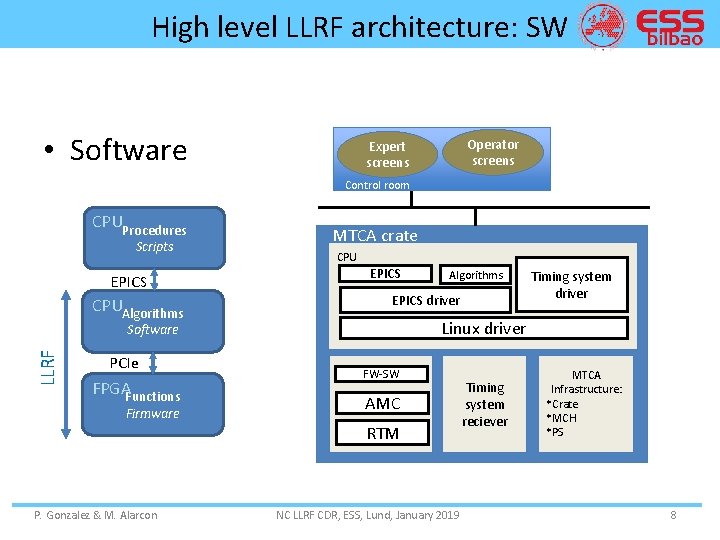
High level LLRF architecture: SW • Software Operator screens Expert screens Control room CPUProcedures Scripts EPICS CPUAlgorithms MTCA crate CPU EPICS driver LLRF FPGAFunctions Firmware FW-SW AMC RTM P. Gonzalez & M. Alarcon Timing system driver Linux driver Software PCIe Algorithms NC LLRF CDR, ESS, Lund, January 2019 Timing system reciever MTCA Infrastructure: *Crate *MCH *PS 8
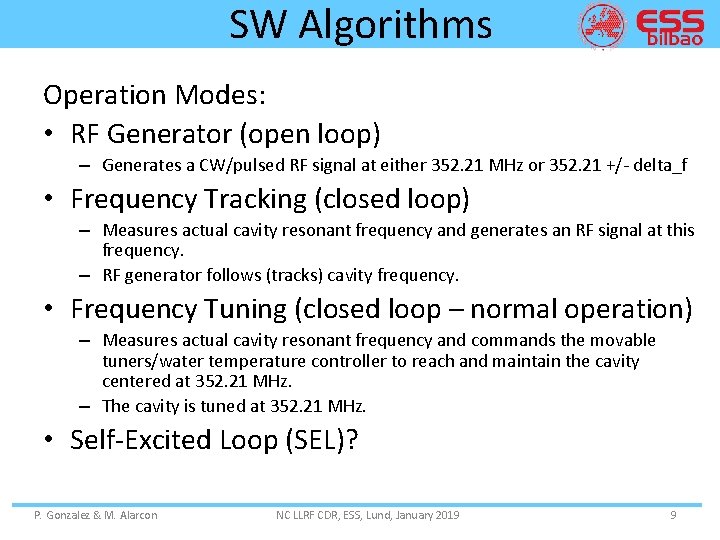
SW Algorithms Operation Modes: • RF Generator (open loop) – Generates a CW/pulsed RF signal at either 352. 21 MHz or 352. 21 +/- delta_f • Frequency Tracking (closed loop) – Measures actual cavity resonant frequency and generates an RF signal at this frequency. – RF generator follows (tracks) cavity frequency. • Frequency Tuning (closed loop – normal operation) – Measures actual cavity resonant frequency and commands the movable tuners/water temperature controller to reach and maintain the cavity centered at 352. 21 MHz. – The cavity is tuned at 352. 21 MHz. • Self-Excited Loop (SEL)? P. Gonzalez & M. Alarcon NC LLRF CDR, ESS, Lund, January 2019 9
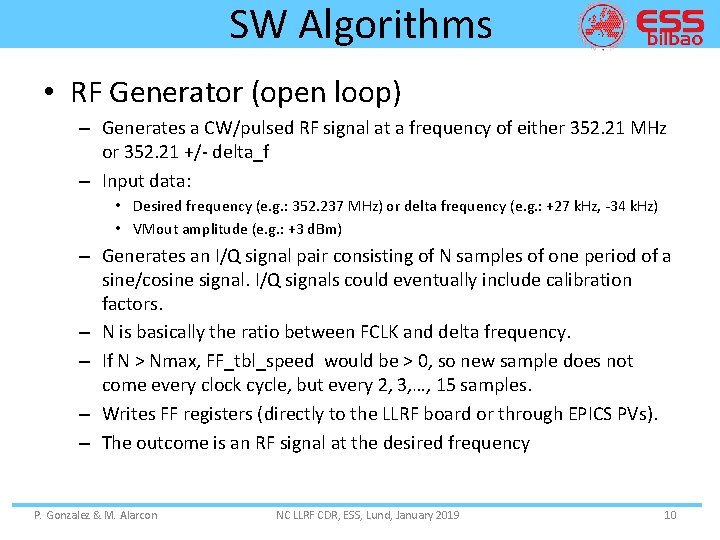
SW Algorithms • RF Generator (open loop) – Generates a CW/pulsed RF signal at a frequency of either 352. 21 MHz or 352. 21 +/- delta_f – Input data: • Desired frequency (e. g. : 352. 237 MHz) or delta frequency (e. g. : +27 k. Hz, -34 k. Hz) • VMout amplitude (e. g. : +3 d. Bm) – Generates an I/Q signal pair consisting of N samples of one period of a sine/cosine signal. I/Q signals could eventually include calibration factors. – N is basically the ratio between FCLK and delta frequency. – If N > Nmax, FF_tbl_speed would be > 0, so new sample does not come every clock cycle, but every 2, 3, …, 15 samples. – Writes FF registers (directly to the LLRF board or through EPICS PVs). – The outcome is an RF signal at the desired frequency P. Gonzalez & M. Alarcon NC LLRF CDR, ESS, Lund, January 2019 10
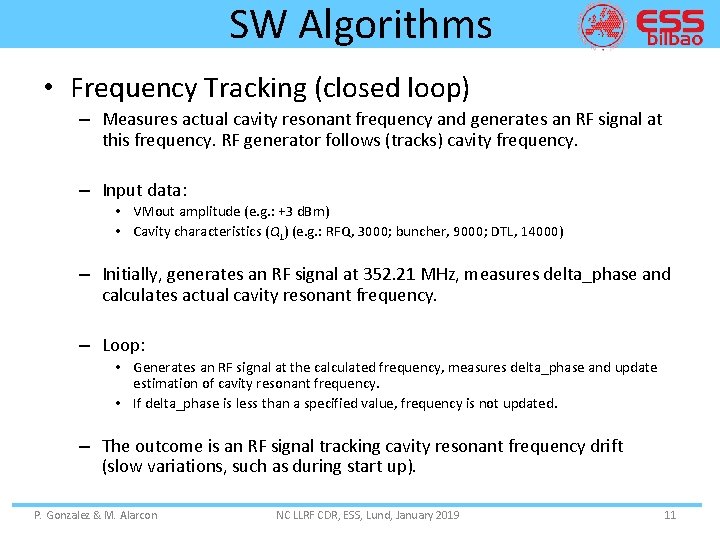
SW Algorithms • Frequency Tracking (closed loop) – Measures actual cavity resonant frequency and generates an RF signal at this frequency. RF generator follows (tracks) cavity frequency. – Input data: • VMout amplitude (e. g. : +3 d. Bm) • Cavity characteristics (QL) (e. g. : RFQ, 3000; buncher, 9000; DTL, 14000) – Initially, generates an RF signal at 352. 21 MHz, measures delta_phase and calculates actual cavity resonant frequency. – Loop: • Generates an RF signal at the calculated frequency, measures delta_phase and update estimation of cavity resonant frequency. • If delta_phase is less than a specified value, frequency is not updated. – The outcome is an RF signal tracking cavity resonant frequency drift (slow variations, such as during start up). P. Gonzalez & M. Alarcon NC LLRF CDR, ESS, Lund, January 2019 11
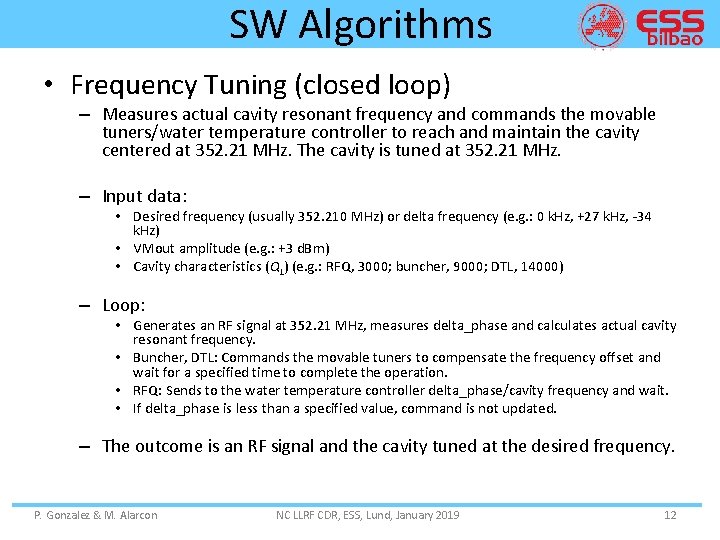
SW Algorithms • Frequency Tuning (closed loop) – Measures actual cavity resonant frequency and commands the movable tuners/water temperature controller to reach and maintain the cavity centered at 352. 21 MHz. The cavity is tuned at 352. 21 MHz. – Input data: • Desired frequency (usually 352. 210 MHz) or delta frequency (e. g. : 0 k. Hz, +27 k. Hz, -34 k. Hz) • VMout amplitude (e. g. : +3 d. Bm) • Cavity characteristics (QL) (e. g. : RFQ, 3000; buncher, 9000; DTL, 14000) – Loop: • Generates an RF signal at 352. 21 MHz, measures delta_phase and calculates actual cavity resonant frequency. • Buncher, DTL: Commands the movable tuners to compensate the frequency offset and wait for a specified time to complete the operation. • RFQ: Sends to the water temperature controller delta_phase/cavity frequency and wait. • If delta_phase is less than a specified value, command is not updated. – The outcome is an RF signal and the cavity tuned at the desired frequency. P. Gonzalez & M. Alarcon NC LLRF CDR, ESS, Lund, January 2019 12
SW Algorithms Other SW Tools: • Q factor measurement • Dynamic QL factor measurement … P. Gonzalez & M. Alarcon NC LLRF CDR, ESS, Lund, January 2019 13
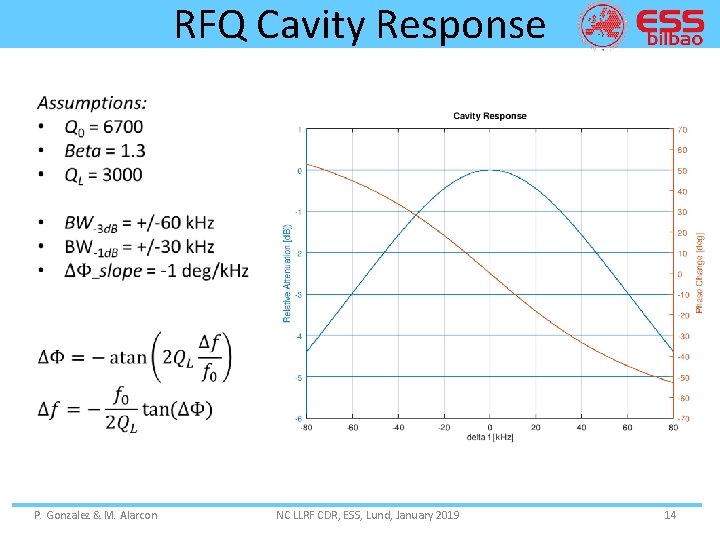
RFQ Cavity Response • P. Gonzalez & M. Alarcon NC LLRF CDR, ESS, Lund, January 2019 14
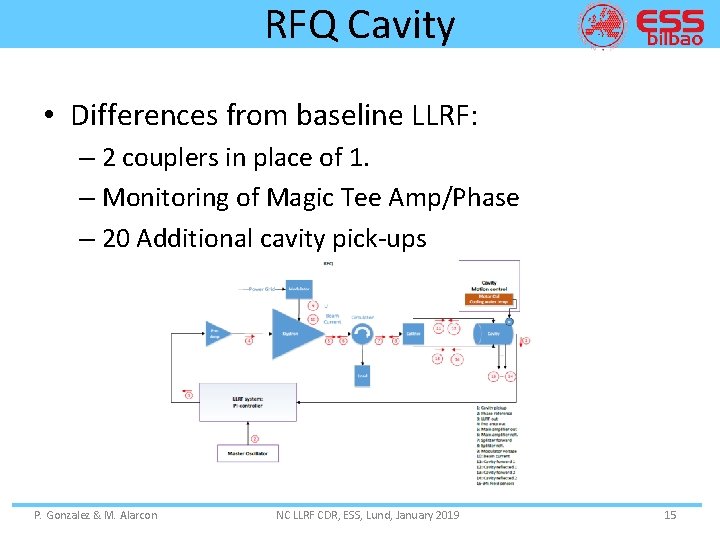
RFQ Cavity • Differences from baseline LLRF: – 2 couplers in place of 1. – Monitoring of Magic Tee Amp/Phase – 20 Additional cavity pick-ups P. Gonzalez & M. Alarcon NC LLRF CDR, ESS, Lund, January 2019 15
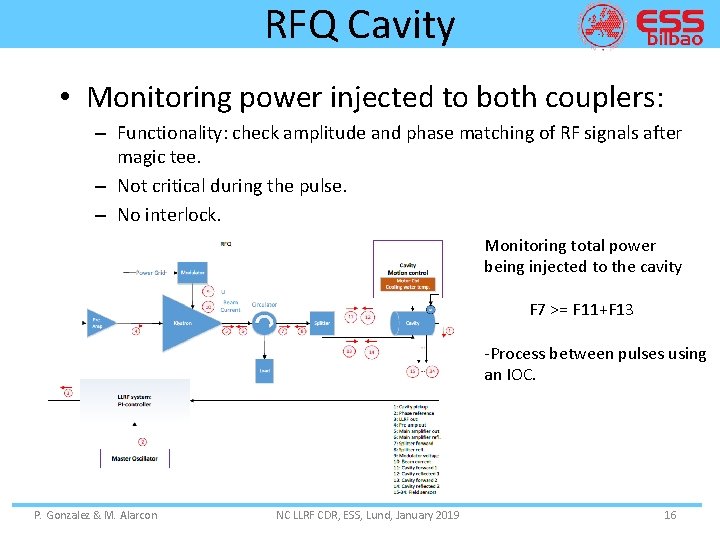
RFQ Cavity • Monitoring power injected to both couplers: – Functionality: check amplitude and phase matching of RF signals after magic tee. – Not critical during the pulse. – No interlock. Monitoring total power being injected to the cavity F 7 >= F 11+F 13 -Process between pulses using an IOC. P. Gonzalez & M. Alarcon NC LLRF CDR, ESS, Lund, January 2019 16
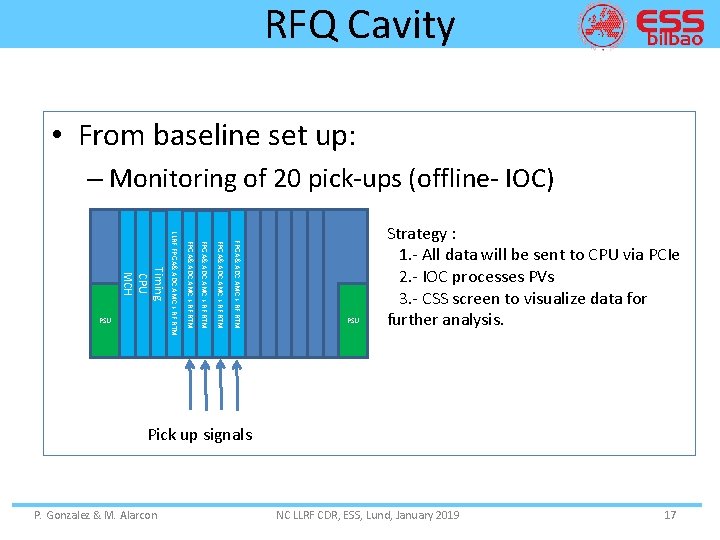
RFQ Cavity • From baseline set up: – Monitoring of 20 pick-ups (offline- IOC) FPGA& ADC AMC + RF RTM LLRF FPGA& ADC AMC + RF RTM Timing CPU MCH PSU Strategy : 1. - All data will be sent to CPU via PCIe 2. - IOC processes PVs 3. - CSS screen to visualize data for further analysis. Pick up signals P. Gonzalez & M. Alarcon NC LLRF CDR, ESS, Lund, January 2019 17
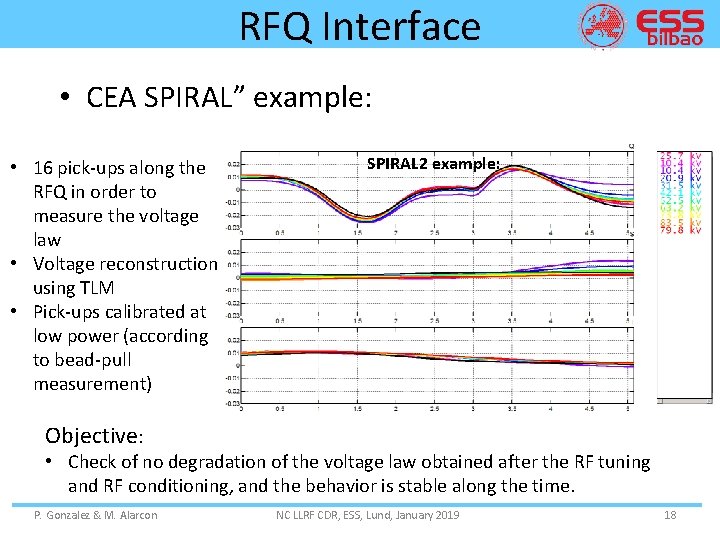
RFQ Interface • CEA SPIRAL” example: • 16 pick-ups along the RFQ in order to measure the voltage law • Voltage reconstruction using TLM • Pick-ups calibrated at low power (according to bead-pull measurement) SPIRAL 2 example: Objective: • Check of no degradation of the voltage law obtained after the RF tuning and RF conditioning, and the behavior is stable along the time. P. Gonzalez & M. Alarcon NC LLRF CDR, ESS, Lund, January 2019 18
RFQ Interface • RFQ tuning method: – Water temperature control. – The heater controlled via a PLC) is able to bring the whole RFQ loop from 25 to 30°C in less than an hour. – LLRF is not required for the warm-up procedure of RFQ and do not need to run in "frequency tracking" mode. – But still, frequency tracking mode would be interesting for CEA. • RFQ RF conditioning procedure (according to CEA report ESS 0314310) in brief: – First, only water is running. – The water temperature controller will heat the water up to the correct value. – Then, LLRF starts slowly (with low duty cycle), heating the cavity, until the right frequency is reached. P. Gonzalez & M. Alarcon NC LLRF CDR, ESS, Lund, January 2019 19
RFQ Interface • Basic functionalities (Functions/Algorithms, by Bilbao): – Regulation of the cavity voltage (amplitude and phase). – Power control in open loop (regulation of forward power). – Send detuning information to the skid (value of phase between forward power and cavity voltage, validity of this information, skid operation mode (temperature control or frequency control). • Complex functionalities (Procedures/Scripts, by CEA/WP 3): – Automatic conditioning of the RFQ with frequency tracking mode: • When the RF power increases, the produced heating leads to a cavity deformation, so a frequency detuning. The cooling system is not enough fast to maintain the frequency of the cavity. The LLRF must track this detuning and change the RF frequency of the RF source in order to follow the cavity frequency. – Automatic startup in case of sparks (detection of sparks, RF stop and restart in less than 1 s (TBC) in order to avoid strong detuning. – Automatic startup. P. Gonzalez & M. Alarcon NC LLRF CDR, ESS, Lund, January 2019 20
RFQ Interface Automatic startup example: • Set the temperature of the water circuits at 30°C (TBC). Water circuits are in temperature mode. • Increase of RF power to the nominal value (RFQ at the nominal voltage but not at the nominal frequency). • Adjust the temperature of the vane circuit in order to tune the cavity to the nominal frequency. • Vane water circuit is set in frequency mode. P. Gonzalez & M. Alarcon NC LLRF CDR, ESS, Lund, January 2019 21
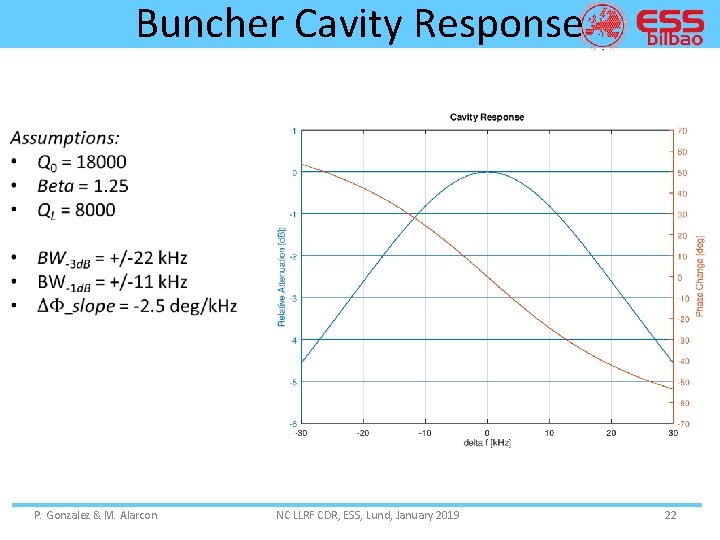
Buncher Cavity Response • P. Gonzalez & M. Alarcon NC LLRF CDR, ESS, Lund, January 2019 22
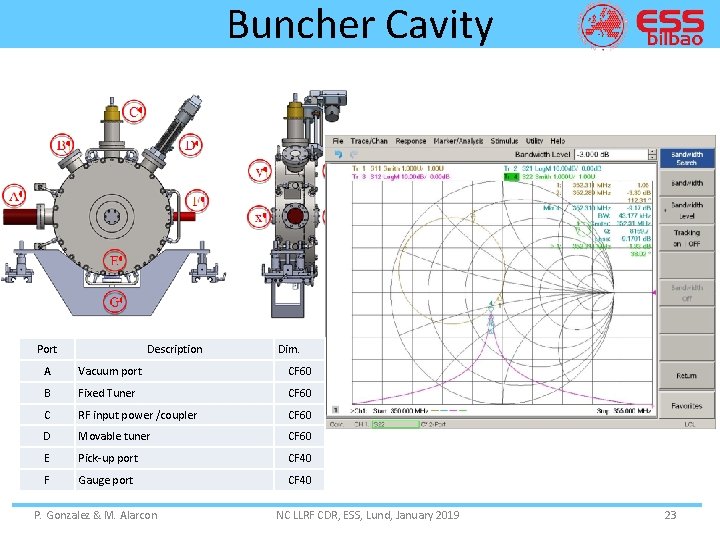
Buncher Cavity Port Description Dim. A Vacuum port CF 60 B Fixed Tuner CF 60 C RF input power /coupler CF 60 D Movable tuner CF 60 E Pick-up port CF 40 F Gauge port CF 40 P. Gonzalez & M. Alarcon NC LLRF CDR, ESS, Lund, January 2019 23
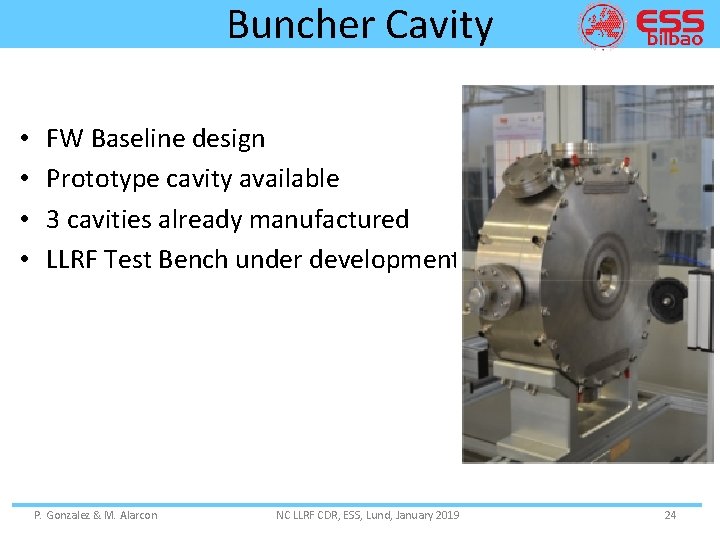
Buncher Cavity • • FW Baseline design Prototype cavity available 3 cavities already manufactured LLRF Test Bench under development P. Gonzalez & M. Alarcon NC LLRF CDR, ESS, Lund, January 2019 24
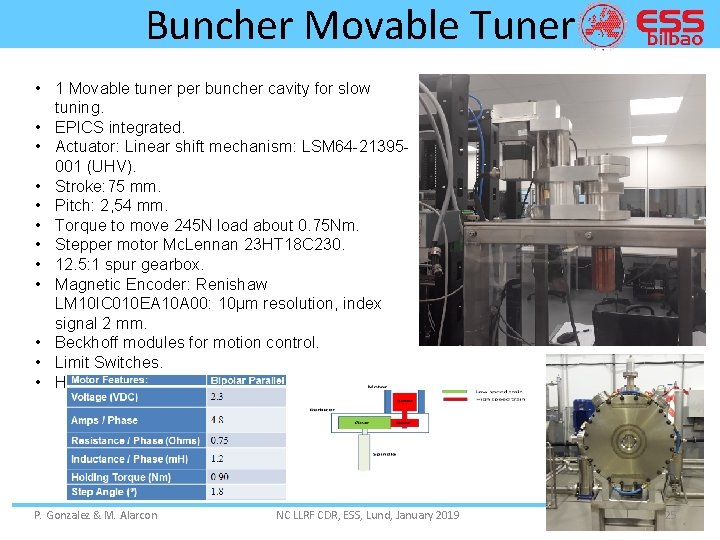
Buncher Movable Tuner • 1 Movable tuner per buncher cavity for slow tuning. • EPICS integrated. • Actuator: Linear shift mechanism: LSM 64 -21395001 (UHV). • Stroke: 75 mm. • Pitch: 2, 54 mm. • Torque to move 245 N load about 0. 75 Nm. • Stepper motor Mc. Lennan 23 HT 18 C 230. • 12. 5: 1 spur gearbox. • Magnetic Encoder: Renishaw LM 10 IC 010 EA 10 A 00: 10µm resolution, index signal 2 mm. • Beckhoff modules for motion control. • Limit Switches. • Home Sensor. P. Gonzalez & M. Alarcon NC LLRF CDR, ESS, Lund, January 2019 25
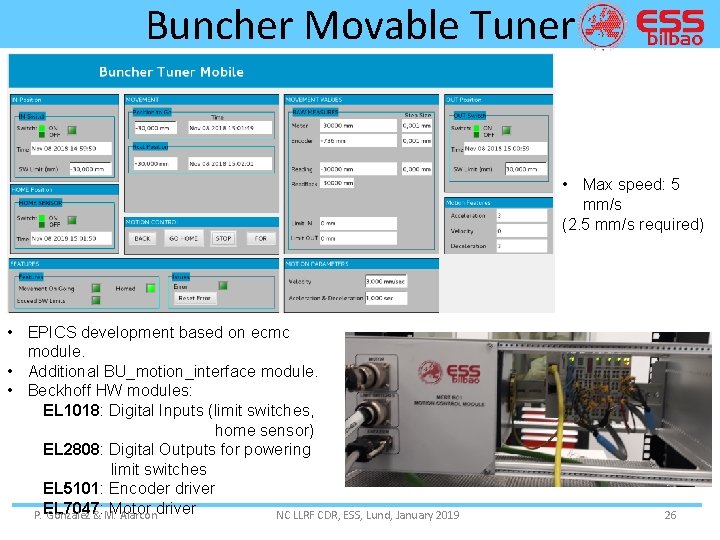
Buncher Movable Tuner • Max speed: 5 mm/s (2. 5 mm/s required) • EPICS development based on ecmc module. • Additional BU_motion_interface module. • Beckhoff HW modules: EL 1018: Digital Inputs (limit switches, home sensor) EL 2808: Digital Outputs for powering limit switches EL 5101: Encoder driver Motor P. EL 7047: Gonzalez & M. Alarcondriver NC LLRF CDR, ESS, Lund, January 2019 26
Buncher Interface Buncher cavity RF start up procedure Preliminary Operations • Nominal water temperature: 25ºC • Water Delta Temperature: <1ºC at nominal RF power • Tuner sensitivity: 16 k. Hz/mm Startup procedure 1. 2. 3. 4. 5. 6. 7. Movable tuner fixed at “hot position” Start RF power in frequency tracking mode Start with low power level but nominal duty cycle Reach nominal power level in some steps Check frequency error If error is below ##Hz (to be agreed), frequency tuning ON -> movable tuner active LLRF ON (feedback on field level) P. Gonzalez & M. Alarcon NC LLRF CDR, ESS, Lund, January 2019 27
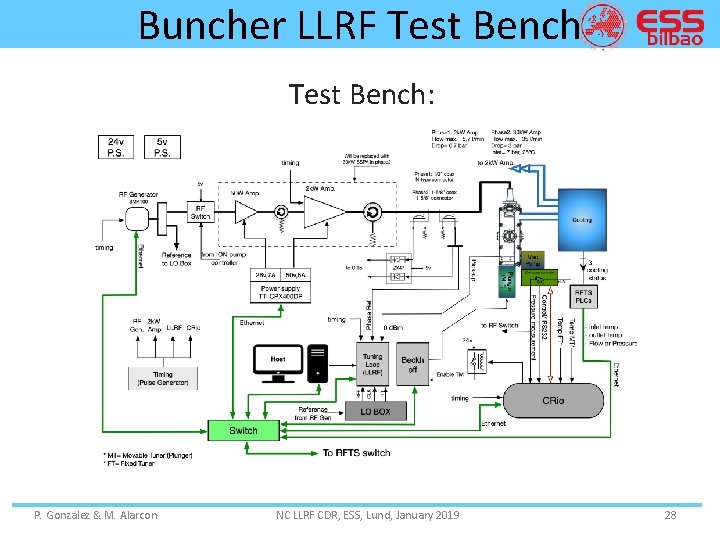
Buncher LLRF Test Bench: P. Gonzalez & M. Alarcon NC LLRF CDR, ESS, Lund, January 2019 28
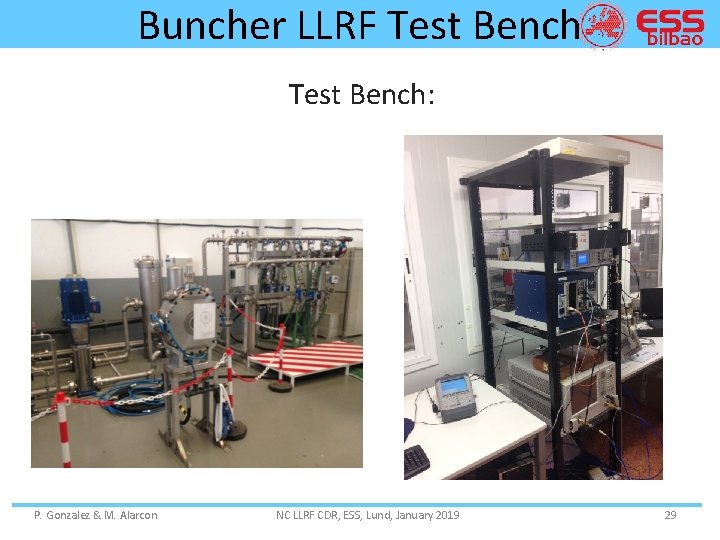
Buncher LLRF Test Bench: P. Gonzalez & M. Alarcon NC LLRF CDR, ESS, Lund, January 2019 29
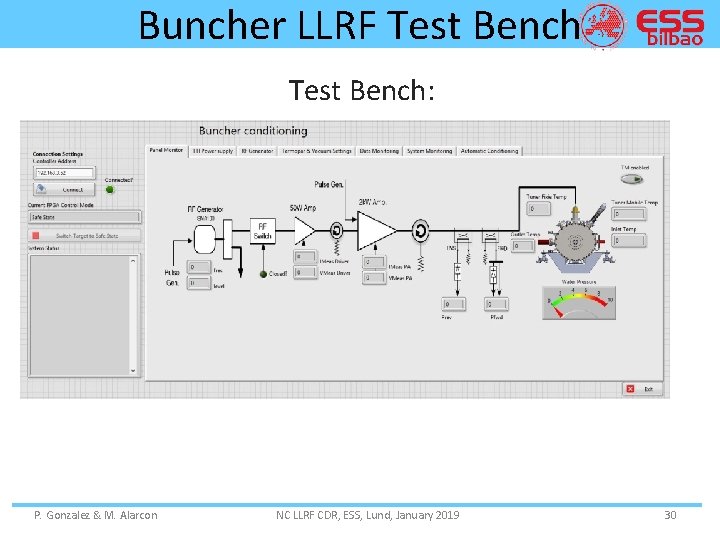
Buncher LLRF Test Bench: P. Gonzalez & M. Alarcon NC LLRF CDR, ESS, Lund, January 2019 30
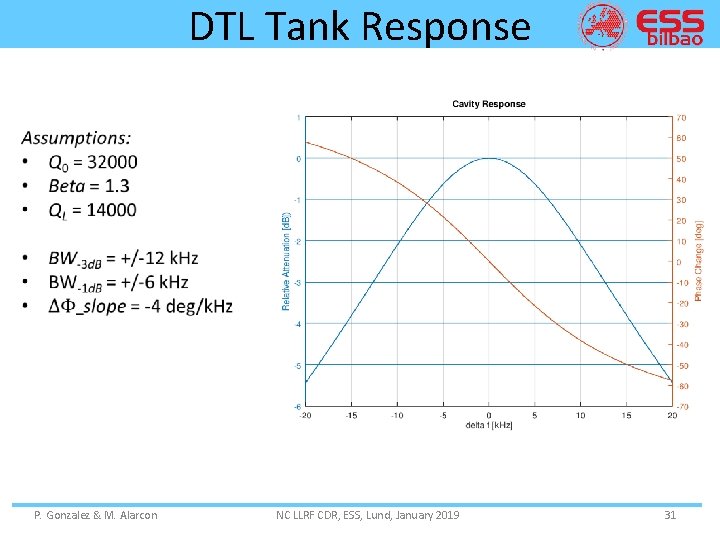
DTL Tank Response • P. Gonzalez & M. Alarcon NC LLRF CDR, ESS, Lund, January 2019 31
DTL Cavity • Differences from baseline LLRF: – 2 couplers in place of 1 – Monitoring of Magic Tee Amp/Phase – 9 cavity pick-ups calculate main mode P. Gonzalez & M. Alarcon NC LLRF CDR, ESS, Lund, January 2019 32
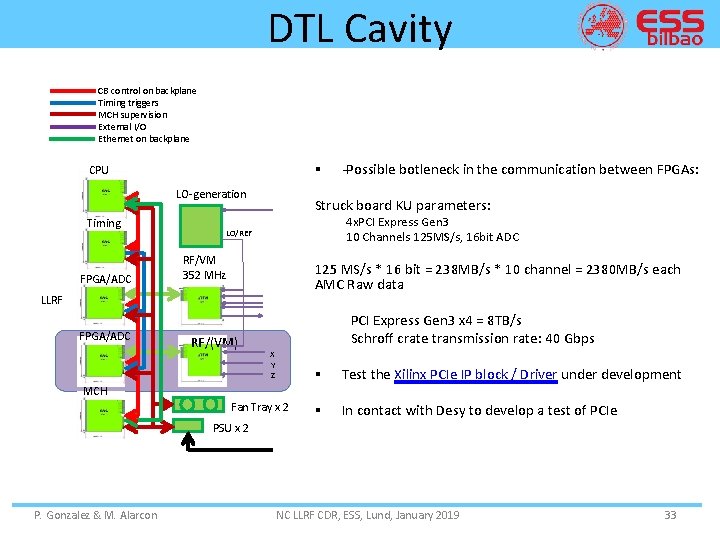
DTL Cavity CB control on backplane Timing triggers MCH supervision External I/O Ethernet on backplane § CPU LO-generation Timing FPGA/ADC Struck board KU parameters: 4 x. PCI Express Gen 3 10 Channels 125 MS/s, 16 bit ADC LO/REF RF/VM 352 MHz 125 MS/s * 16 bit = 238 MB/s * 10 channel = 2380 MB/s each AMC Raw data LLRF FPGA/ADC -Possible botleneck in the communication between FPGAs: RF/(VM) PCI Express Gen 3 x 4 = 8 TB/s Schroff crate transmission rate: 40 Gbps X Y Z § Test the Xilinx PCIe IP block / Driver under development § In contact with Desy to develop a test of PCIe MCH Fan Tray x 2 PSU x 2 P. Gonzalez & M. Alarcon NC LLRF CDR, ESS, Lund, January 2019 33
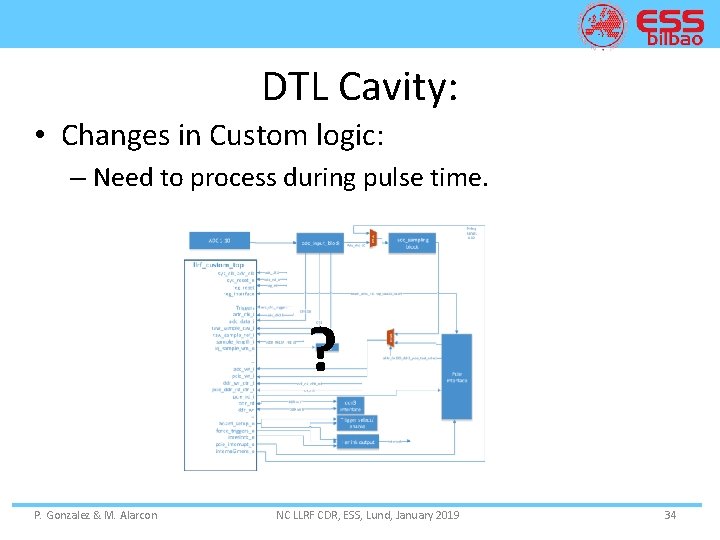
DTL Cavity: • Changes in Custom logic: – Need to process during pulse time. ? P. Gonzalez & M. Alarcon NC LLRF CDR, ESS, Lund, January 2019 34
DTL Interface DTL RF start up procedure (according to INFN reports ESS-0177688 -start up and ESS-0177689 conditioning) Preliminary Operations • Avg. Temperature sensitivity: -7 k. Hz/ºC • Avg. RF Power effect: -20 k. Hz • Design Frequency at 30ºC Startup procedure 1. Movable tuners fixed at “hot position” (see point 6), frequency feedback OFF 2. Water Temperature feedback ON 3. Start RF power in frequency track mode to warm-up the cooling water 4. Start with low power level but nominal duty cycle 5. Reach nominal power level in some steps (10 see J-Parc procedure) 6. Reach the optimum water temperature 7. Check frequency error 8. If error is below ##Hz (to be agreed), frequency feedback ON -> movable tuners active 9. LLRF ON (feedback on field level) LLRF - DTL warm up procedure in brief • LLRF starts in frequency tracking mode and steps frequency up/down to follow cavity resonance (minimize the reflected cavity power, maximize field pickup power or measure frequency from cavity field decay slope). • When the frequency offset is below a limit, frequency is set to 352. 21, and cavity phase offset is measured for the movable tuners. • When tuners in position control feedback is closed to run LLRF in normal operation. P. Gonzalez & M. Alarcon NC LLRF CDR, ESS, Lund, January 2019 35
Test and Validation • MTCA modules’ performance (RTM, AMC, etc. ) • LLRF rack integration • System performance – At Low Power • Test Bench using the prototype buncher in Bilbao – With High Power, Without Beam • In Bilbao (if 1 st SSPA is available in time) or in Lund – With Beam • In Lund P. Gonzalez & M. Alarcon NC LLRF CDR, ESS, Lund, January 2019 36
Thank you P. González NC LLRF CDR, ESS, Lund, January 2019 37
- Slides: 37