
NBS for Galactosemia by LCMSMS Hilde Laeremans Ph
NBS for Galactosemia by LCMSMS • Hilde Laeremans, Ph. D • Hong Vien Van Thi, Ir • Prof. Philippe Goyens, MD, Ph. D • ABSCIEX
GALACTOSEMIA: THE DISEASE - Phenotypic characteristics vary widely according to the defective enzyme - Autosomal recessive - Prevalence: 1/30. 000 -60. 000 - Single enzyme defect - Caused by deficiency of one of the following enzymes: • Galactose-1 -phosphate uridyl transferase (GALT) • Uridine diphosphate (UDP)-galactose-4 -epimersae (GALE) • Galactokinase (GALK) - Classic and mild galactosemia (Duarte variant) ( Jensen UG 2001, Ko DH 2010 and Ko DH 2011)

GALACTOSEMIA: THE PATHWAY
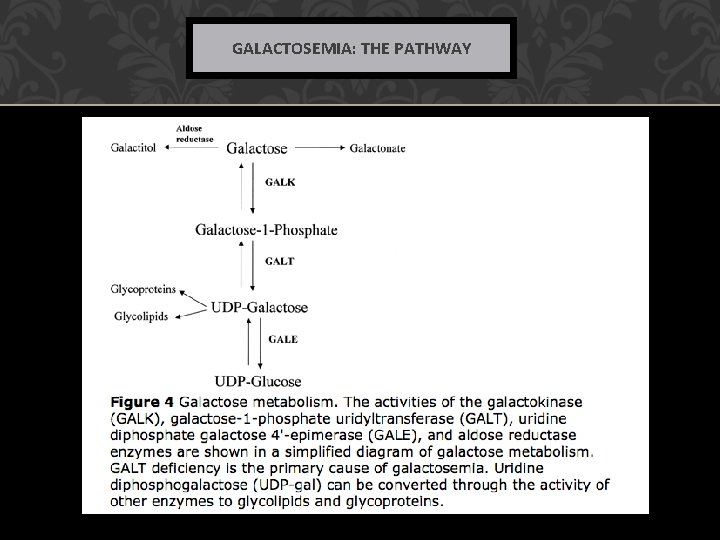
GALACTOSEMIA: THE PATHWAY

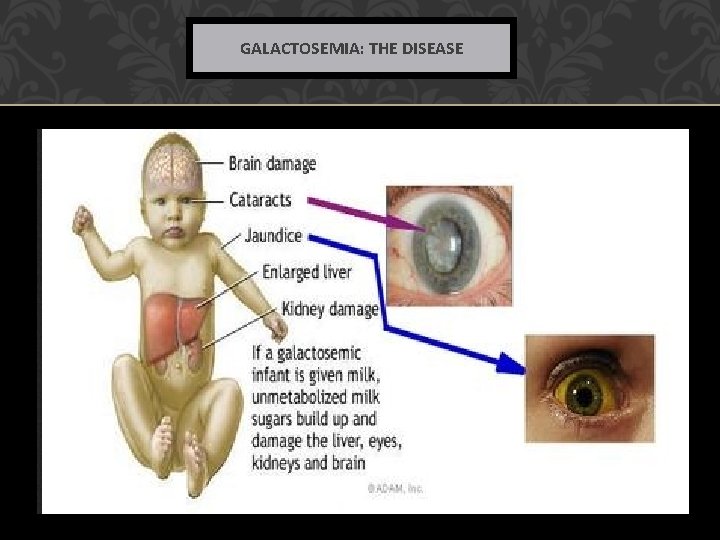
GALACTOSEMIA: THE DISEASE A) Classic (GALT-GALE) - Deficiencies in the enzyme cause: Accumulation of galactose in the blood and urine High intracellular levels of galactose-1 -phosphate Toxic for several tissues (liver, brain and renal tubules) - Described by Von Reuss as early as 1908 - Clinical symptoms: • Failure to thrive • Vomiting • Diarrhea • Jaundice • Lethargy ( Jensen UG 2001, Ko DH 2010 and Ko DH 2011)
GALACTOSEMIA: THE DISEASE
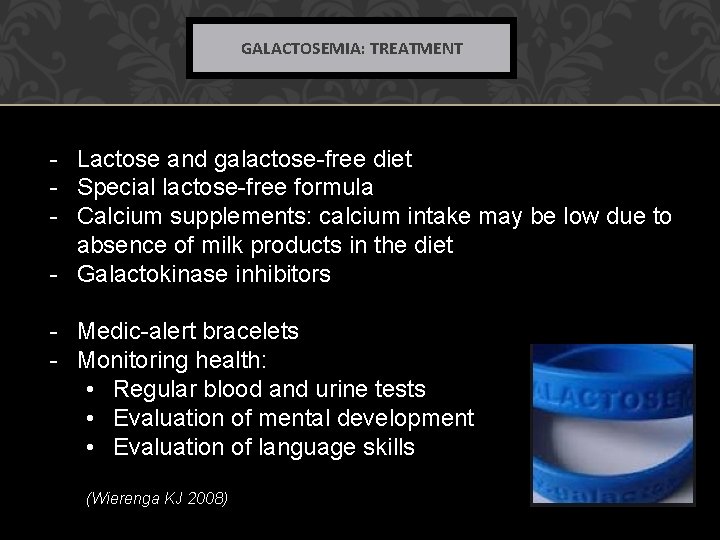
GALACTOSEMIA: TREATMENT - Lactose and galactose-free diet - Special lactose-free formula - Calcium supplements: calcium intake may be low due to absence of milk products in the diet - Galactokinase inhibitors - Medic-alert bracelets - Monitoring health: • Regular blood and urine tests • Evaluation of mental development • Evaluation of language skills (Wierenga KJ 2008)
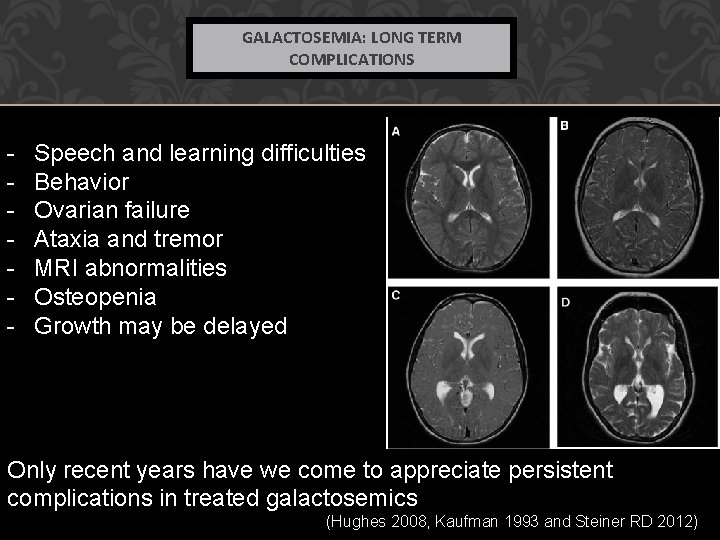
GALACTOSEMIA: LONG TERM COMPLICATIONS - Speech and learning difficulties Behavior Ovarian failure Ataxia and tremor MRI abnormalities Osteopenia Growth may be delayed Only recent years have we come to appreciate persistent complications in treated galactosemics (Hughes 2008, Kaufman 1993 and Steiner RD 2012)

GALACTOSEMIA: THE DISEASE B) Mild (GALK) - Clinical symptoms: • Early and severe cataracts • • Mild mental retardation Ataxia Delays in growth Speech problems or delays ( Jensen UG 2001, Ko DH 2010 and Ko DH 2011)
GALACTOSEMIA: THE TESTS AND THEIR PITFALLS 1. Paigen test: - Microbiologic test using E. coli or E. coli in combination with a bacteriophage to test for elevated blood galactose content (only positive after milk ingestion) - Measurement of galactose accumulation - Qualitative method and relies on visual interpretation - Pitfalls: use of antibiotics (false positive - high recall rate) (Fujimoto A 2000)
GALACTOSEMIA: THE TESTS AND THEIR PITFALLS 2. Beutler test: - Developed in 1966 - Qualitative and relies on visual interpretation methylene blue - Assessment of GALT activity - Takes into consideration: humidity, duration between sampling and testing, and anemia - This test has been modified and improved: - NADPH fluorescence (Beutler enzyme spot test) - Quantitative method with fluorescence detector Influence of quenching by hemoglobin prevented by acetone and methanol - Pitfalls: heat inactivation, transfusion and G 6 PD deficiency, carriers, variants and early tests (Beutler 1966 and Fujimoto A. 2000)

GALACTOSEMIA: THE TESTS AND THEIR PITFALLS 3. Hill test: - fluorometric assay for galactose, normally used with Beutler, only positive after milk ingestion - Measures accumulation of galactose - Pitfalls: beware of non-lactose diet, carriers, variants and early test (Steiner MD 2012)

GALACTOSEMIA: TEST WITH LCMSMS 1. UPLC-MSMS - Method in negative mode with high strength silica T 3 column - Scan for activity of the three known enzymes (GALT, GALE and GALK) - Before adjustment to hemoglobin concentrations relative high inter-assay imprecisions - Pitfall: high coast in comparison to ‘traditional’ screening (10 dollar) Better suited for second-tier testing (Ko DH 2010)
GALACTOSEMIA: TEST WITH LCMSMS - Test method can be adapted for ‘regular’ LCMSMS with suitable column - Use short column to reduce time - All types of galactosemia can be detected (Ko DH 2010)
GALACTOSEMIA: TEST WITH LCMSMS 2. Liquid/gas chromatography-tandem mass spectronomy - Stable isotope detection: (13 C 6)-Gal-1 -P, (13 C 6)-Glu-1 -P en (13 C 6)-UDPGal - Simplifies reagent requirements - More specific than classical assays due to high resolution - Hetero- and homozygotes are detectable and can be distinguished - Pitfall: erythrocytes have to be lysed not visible on dried blood spots - Can be used for test on urine ( Li Y 2010, Chen J 2002, Gangemi G 2012 and Ko DH 2010)
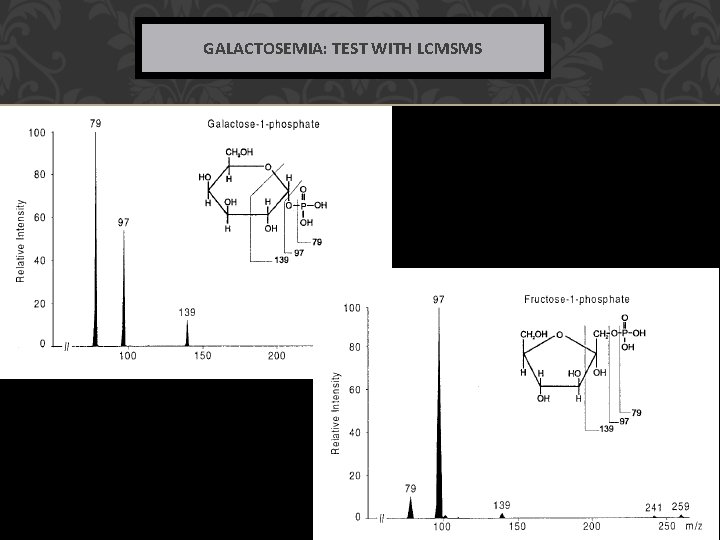
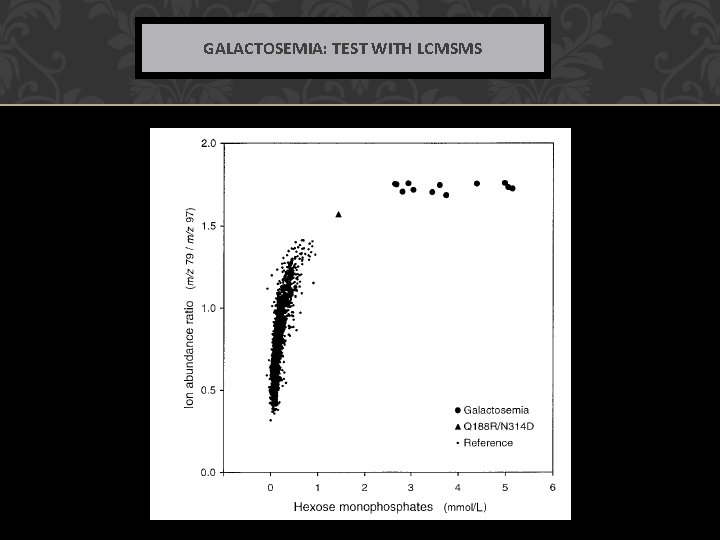
GALACTOSEMIA: TEST WITH LCMSMS 3. Neonatal screening on DBS - Test on filter paper days 4 -8 days after sampling - Test can be performed even 10 years after sampling when stored at -20°C - Total hexose monophosphates were used as markers of Gal-1 -P - Sample preparation: - 150μl of extraction liquid - Evaporation under stream of nitrogen gas - Redissolved in water-acetonitril (1: 1) (Jensen 2001)
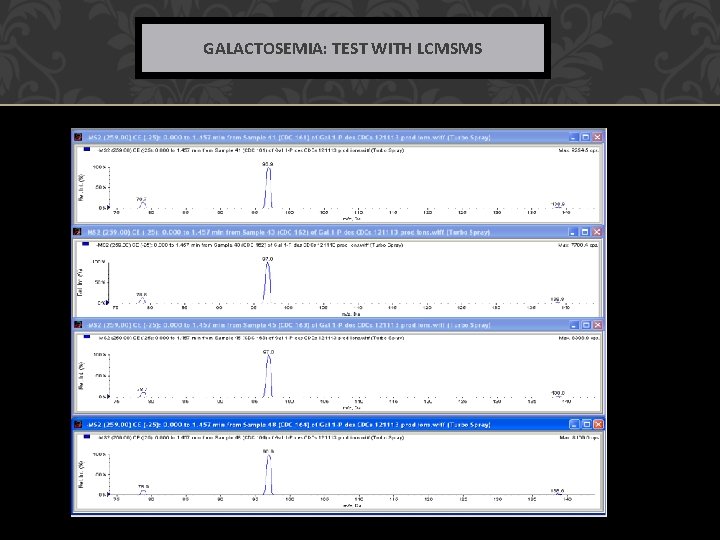
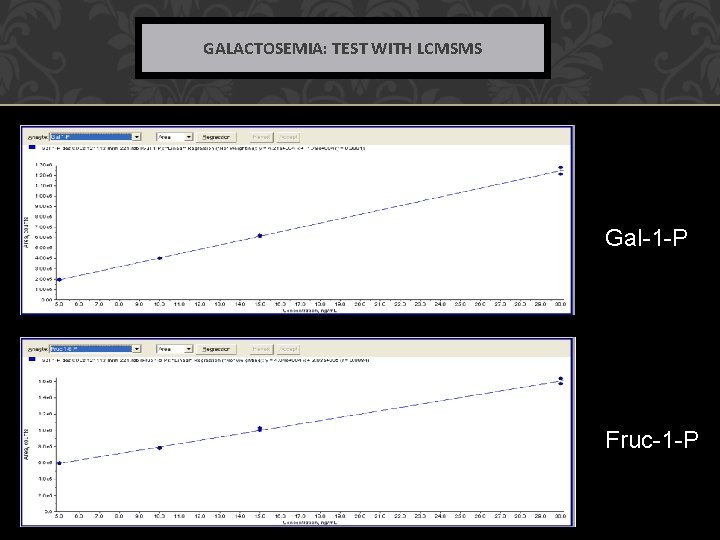
GALACTOSEMIA: TEST WITH LCMSMS - MSMS: - Negative ion mode electro-spray - Mobile phase: acetonitril-water (1: 1) - Sample-to-sample cycle time 1, 5 min - m/z transitions: 259 97 and 259 79 - Detection limit of 1 mmol/L - Sensitivity and specificity of 100% - Sensitive to heat and humidity false positives - Internal standards: peripheral blood enriched with Gal-1 -P - Able to detect galactose-4 -epimerase deficiency (Jensen 2001)
GALACTOSEMIA: TEST WITH LCMSMS
GALACTOSEMIA: TEST WITH LCMSMS
GALACTOSEMIA: TEST WITH LCMSMS
GALACTOSEMIA: TEST WITH LCMSMS Gal-1 -P Fruc-1 -P
CONCLUSIONS - Many test are available but every test has his pitfalls - Easy and fast testing for classic galactosemia without column - Other types of galactosemia can be tested with a short column LC/MSMS method Short time More specific Relative low cost

GALACTOSEMIA: THE TESTS Tests include: • • Blood culture for bacteria infection (E. coli sepsis) Enzyme activity in the red blood cells Galactidol in the urine Prenatal diagnosis by directly measuring the enzyme galactose-1 -phosphate uridyl transferase • Erythrocyte galactose-1 -phosphate measurement by GC-MS • Breath test • Tubular function (Pubmed Health 2011)
GALACTOSEMIA: THE TESTS AND THEIR PITFALLS 4. Florida test: - A simplified ‘breath’ test Quantification of body oxidation of 13 C D-galactose to 13 CO 2 Increase of TBGO to CO 2 Less than 2% of 13 C = galactosemia - Age specific normal data - No blood is necessary - Can be performed by nurse before baby leaves - Pitfalls: gas isotope ratio mass spectrometer is expensive and alternative technologies are low in sensitivity (Barbouth DS 2007)
- Slides: 25