
NBEE 4140 Neurophysics Teachers Ari Koskelainen and Risto
NBE-E 4140 Neurophysics Teachers: Ari Koskelainen and Risto Ilmoniemi Place: Seminar room F 336, Rakentajanaukio 2 C, 3 rd floor (Health Technology House)
Learning outcomes After the course, the student • • can tell about physics of the neuron on the molecular dynamics and membrane level can characterize the principles of molecular function of electrical activity of a neuron can describe basic mechanisms of synaptic transmission and plasticity knows the physical basis of several neuron/molecular level measurement technologies can critically read advanced literature and find out where the border between the known and the unknown can differentiate between important and less important research questions can make a research plan to expand our knowledge at the border of the unknown 30. 11. 2020 2
Themes Degenerative brain diseases 1) Alzheimer’s disease 2) Age-related macular degeneration (AMD) 3) Your choice of topic 30. 11. 2020 3
Organization of the course • The course consists of team work. • Teams will consist of 4 -5 members. • Each team will focus on one theme and will act as opponents for another team on some other theme. • You can find themes and the tasks for the teams in Materials under the title "Course content”. • The detailed schedule will be agreed on in the first session. 30. 11. 2020 4
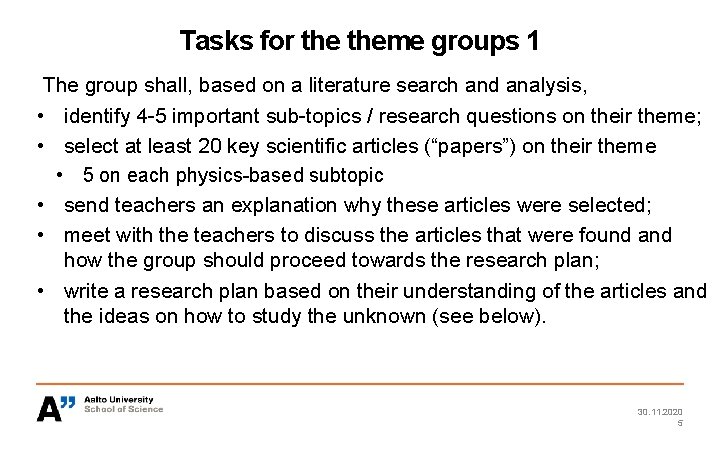
Tasks for theme groups 1 The group shall, based on a literature search and analysis, • identify 4 -5 important sub-topics / research questions on their theme; • select at least 20 key scientific articles (“papers”) on their theme • 5 on each physics-based subtopic • send teachers an explanation why these articles were selected; • meet with the teachers to discuss the articles that were found and how the group should proceed towards the research plan; • write a research plan based on their understanding of the articles and the ideas on how to study the unknown (see below). 30. 11. 2020 5
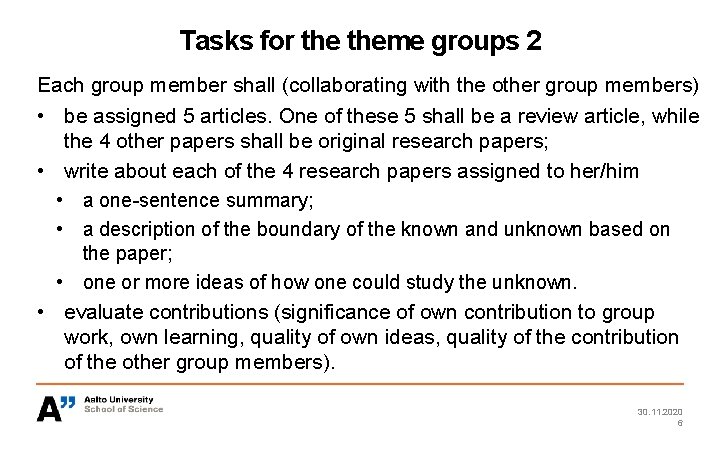
Tasks for theme groups 2 Each group member shall (collaborating with the other group members) • be assigned 5 articles. One of these 5 shall be a review article, while the 4 other papers shall be original research papers; • write about each of the 4 research papers assigned to her/him • a one-sentence summary; • a description of the boundary of the known and unknown based on the paper; • one or more ideas of how one could study the unknown. • evaluate contributions (significance of own contribution to group work, own learning, quality of own ideas, quality of the contribution of the other group members). 30. 11. 2020 6
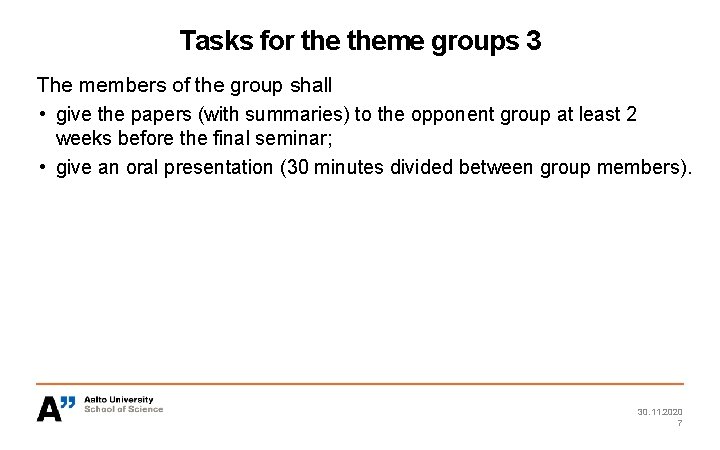
Tasks for theme groups 3 The members of the group shall • give the papers (with summaries) to the opponent group at least 2 weeks before the final seminar; • give an oral presentation (30 minutes divided between group members). 30. 11. 2020 7
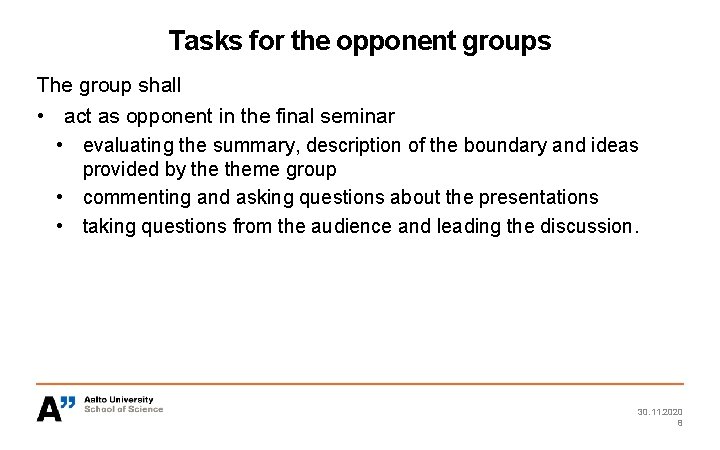
Tasks for the opponent groups The group shall • act as opponent in the final seminar • evaluating the summary, description of the boundary and ideas provided by theme group • commenting and asking questions about the presentations • taking questions from the audience and leading the discussion. 30. 11. 2020 8
Evaluation and grading • Final grading: 1– 5 for passed course • Evaluation: • Self-evaluation (1– 5; describe each point with 1– 3 sentences) • • • significance of own contribution to group work, own learning, quality of own ideas. • Team member evaluation (1– 5) • quality and quantity of the contribution of the other group members • The content and quality of the written or oral presentations will be evaluated by the teachers. 30. 11. 2020 9
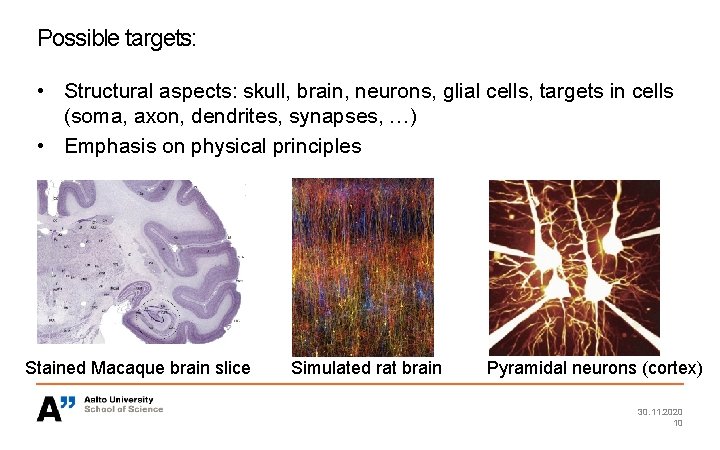
Possible targets: • Structural aspects: skull, brain, neurons, glial cells, targets in cells (soma, axon, dendrites, synapses, …) • Emphasis on physical principles Stained Macaque brain slice Simulated rat brain Pyramidal neurons (cortex) 30. 11. 2020 10
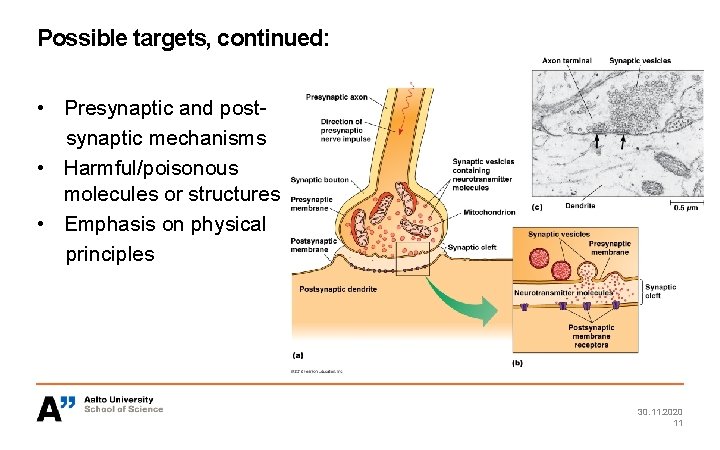
Possible targets, continued: • Presynaptic and postsynaptic mechanisms • Harmful/poisonous molecules or structures • Emphasis on physical principles 30. 11. 2020 11
Schedule 1 • Thursday, February 27 • Theme groups are formed • Themes are selected • Literature survey will be started (use, e. g. , Google, Pub. Med, aalto. finna. fi) • Thursday, March 12 • Brainstorming on research questions (teachers will be helping) • in theme groups • You will get instructions for the research plan • You shall make proposals for sub-topics / research questions • • will be discussed analyzed with the teachers individual sub-topics / research questions will be decided 30. 11. 2020 12
Schedule 2 • March 26 • You shall make preliminary proposals on articles to be focused on • will be discussed analyzed with the teachers • April 2 • You shall make proposals and give reasons for the choice of the 20 (5 person) articles • • will be discussed analyzed with the teachers articles will be decided • April 9 • Analysis of research ideas and discussions with teachers • From April 2 to 29 • Team work on the topics • When needed, you can be in contact with the teachers by e-mail 30. 11. 2020 13
Schedule 3 • Wednesday, April 29 • How to give scientific presentations • You shall have a draft on your research plan • • should be sent to the teachers latest on Friday, April 24 by 16: 00 will be discussed analyzed with the teachers • Thursday, May 7 • Possibility for meeting with teachers • Thursday, May 14 • Oral presentations + discussions led by opponents 30. 11. 2020 14
Groups 1. Alzheimer’s disease Tiu Aarnio, Berenice Nicolau, Sindhu Balanisamy, Luis Inaristi 2. AMD Santeri Pöllänen, Mika Merano, Emilia Vilo, Ester Schulman 30. 11. 2020 15
Search articles on your theme https: //scholar. google. fi/ https: //www. ncbi. nlm. nih. gov/pubmed/ You can find full papers at https: //aalto. finna. fi/ –First sign in, then insert the name of the journal, go to the appropriate volume, issue, and article 30. 11. 2020 16
- Slides: 16