
NAVIGATION TRAINING Section 6 Navigational Aids Table of
NAVIGATION TRAINING Section 6 Navigational Aids
Table of Contents • Section 1 • Section 2 • Section 3 • Section 4 • Section 5 • Section 6 • Section 7 • Section 8 • Section 9 • Section 10 • Section 11 Types of Navigation Terrestial Coordinates Charts Compass Nautical Publications Navigational Aids Buoyage Position Lines and Fixes Tides Currents Weather
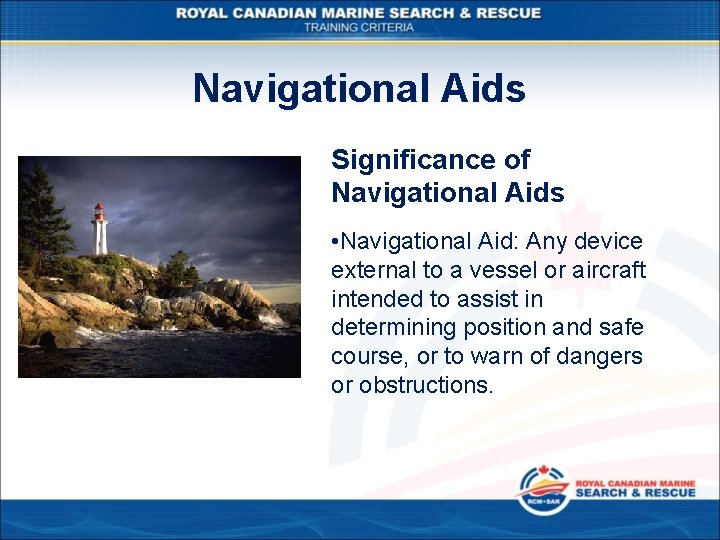
Navigational Aids Significance of Navigational Aids • Navigational Aid: Any device external to a vessel or aircraft intended to assist in determining position and safe course, or to warn of dangers or obstructions.

Navigational Aids Navigational aids will include: Lighthouses Transit Marks Leading Lines Buoyage Beacons & Day Marks Identifiable charted object
Navigational Aids Positive Identification of Navigation Aids DAYTIME • Location • Shape • Colour Scheme • Auxiliary features • Special Markings NIGHT • Phase characteristic • Period & Colour
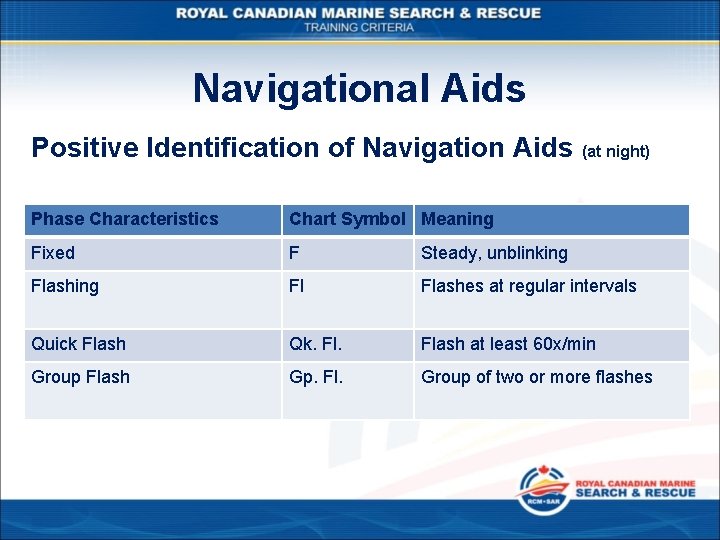
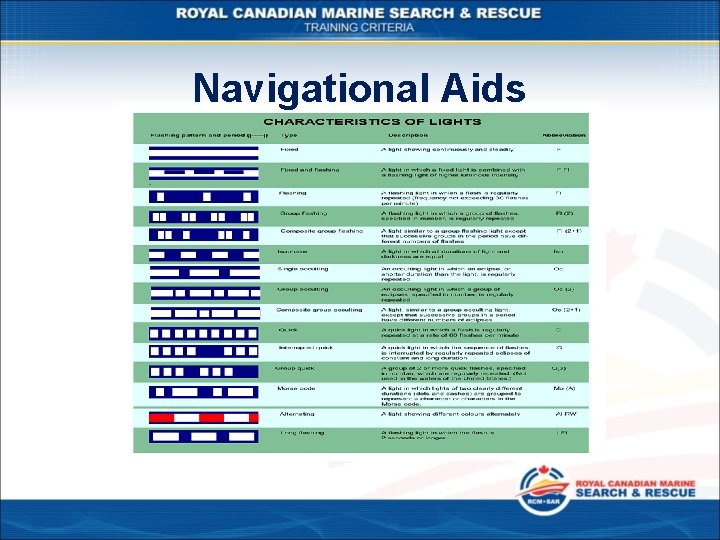
Navigational Aids Positive Identification of Navigation Aids (at night) Phase Characteristics Chart Symbol Meaning Fixed F Steady, unblinking Flashing Fl Flashes at regular intervals Quick Flash Qk. Fl. Flash at least 60 x/min Group Flash Gp. Fl. Group of two or more flashes
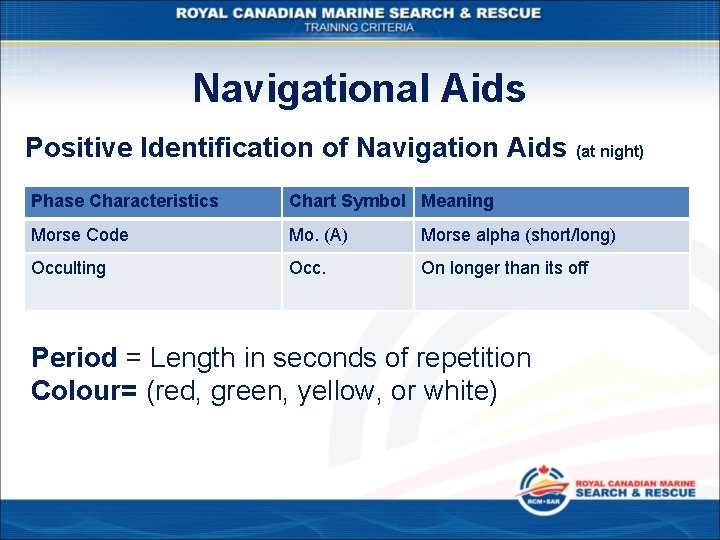
Navigational Aids Positive Identification of Navigation Aids (at night) Phase Characteristics Chart Symbol Meaning Morse Code Mo. (A) Morse alpha (short/long) Occulting Occ. On longer than its off Period = Length in seconds of repetition Colour= (red, green, yellow, or white)
Navigational Aids
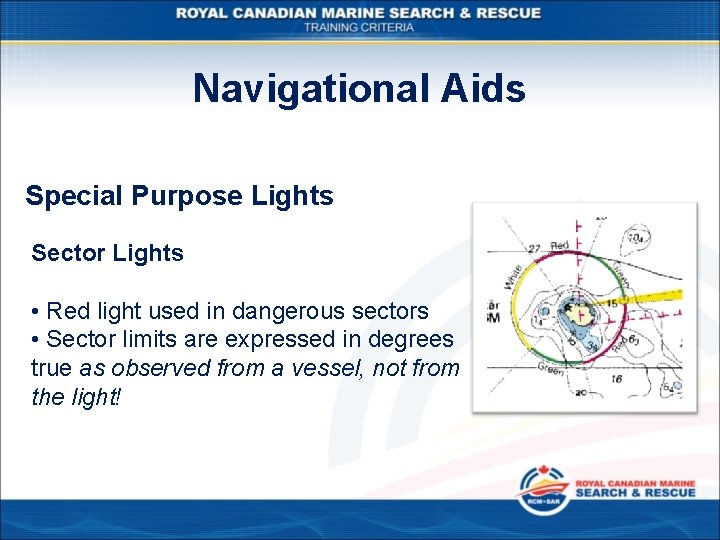
Navigational Aids Special Purpose Lights Sector Lights • Red light used in dangerous sectors • Sector limits are expressed in degrees true as observed from a vessel, not from the light!
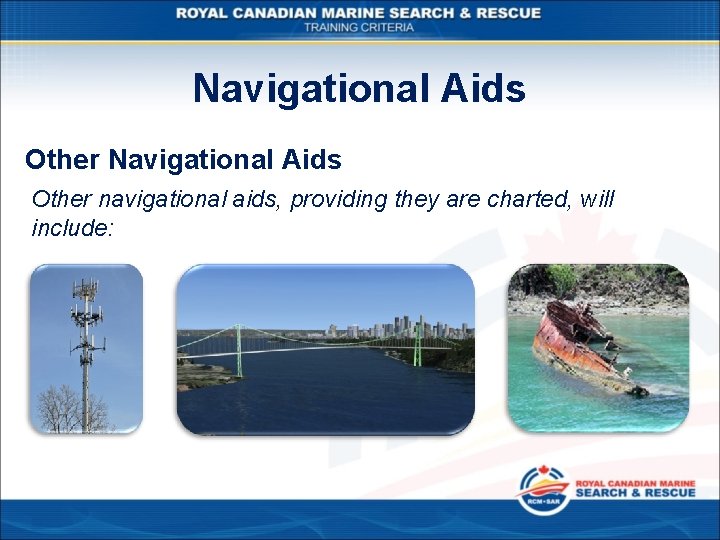
Navigational Aids Other navigational aids, providing they are charted, will include:
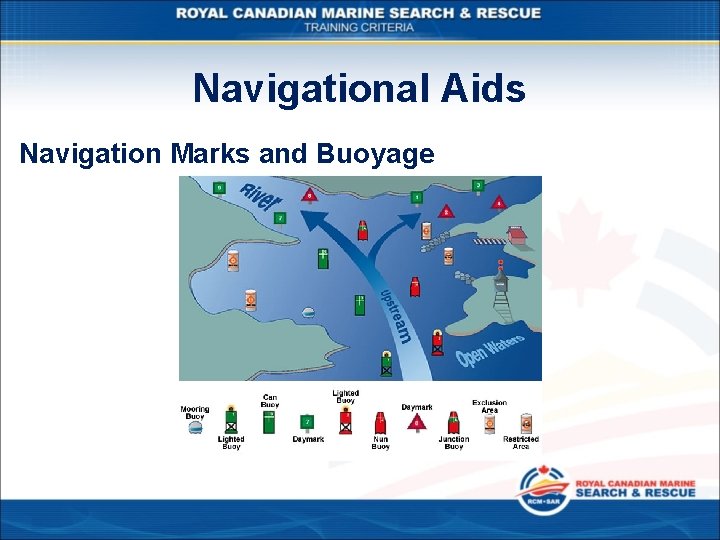
Navigational Aids Navigation Marks and Buoyage
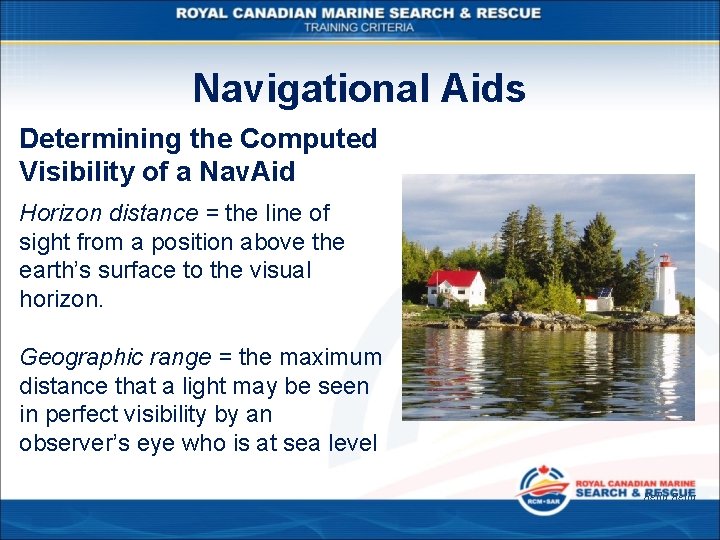
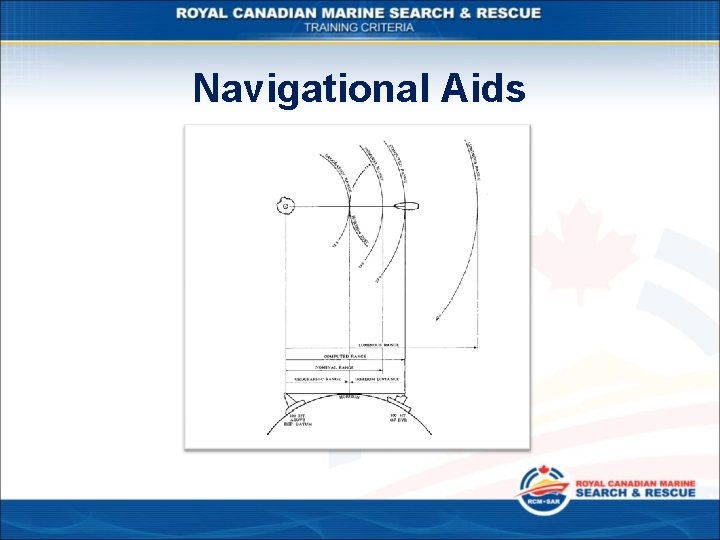
Navigational Aids Determining the Computed Visibility of a Nav. Aid Horizon distance = the line of sight from a position above the earth’s surface to the visual horizon. Geographic range = the maximum distance that a light may be seen in perfect visibility by an observer’s eye who is at sea level Bella
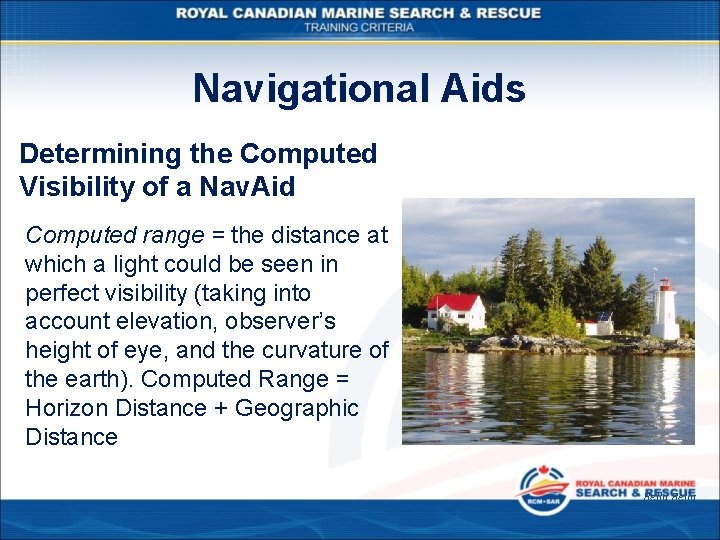
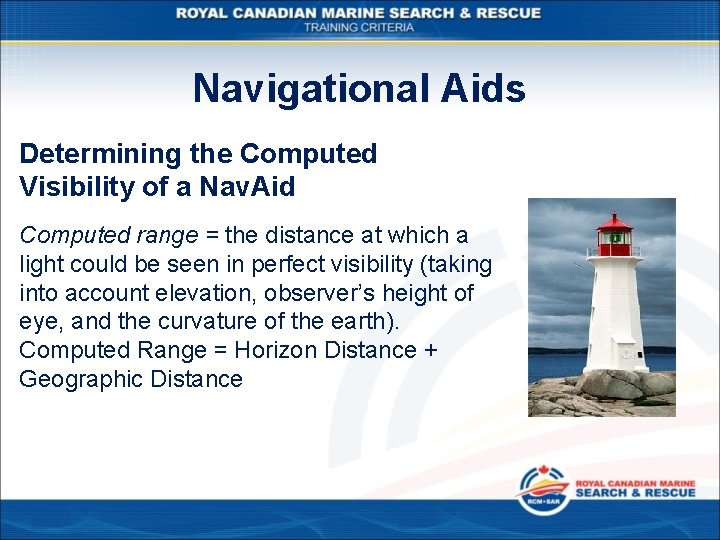
Navigational Aids Determining the Computed Visibility of a Nav. Aid Computed range = the distance at which a light could be seen in perfect visibility (taking into account elevation, observer’s height of eye, and the curvature of the earth). Computed Range = Horizon Distance + Geographic Distance Bella
Navigational Aids Determining the Computed Visibility of a Nav. Aid Computed range = the distance at which a light could be seen in perfect visibility (taking into account elevation, observer’s height of eye, and the curvature of the earth). Computed Range = Horizon Distance + Geographic Distance
Navigational Aids Determining the Computed Visibility of a Nav. Aid Computed visibility = The maximum distance at which a light can be seen in the current meteorological conditions. Luminous range = the maximum distance at which a light may be seen under the current meteorological conditions. Nominal range = a special case of the luminous range. It is the distance a light could be seen in “clear” weather. Also called the charted range.
Navigational Aids
- Slides: 16