
Navigation and route planning Types of maps Orienteering

- Slides: 17
Navigation and route planning
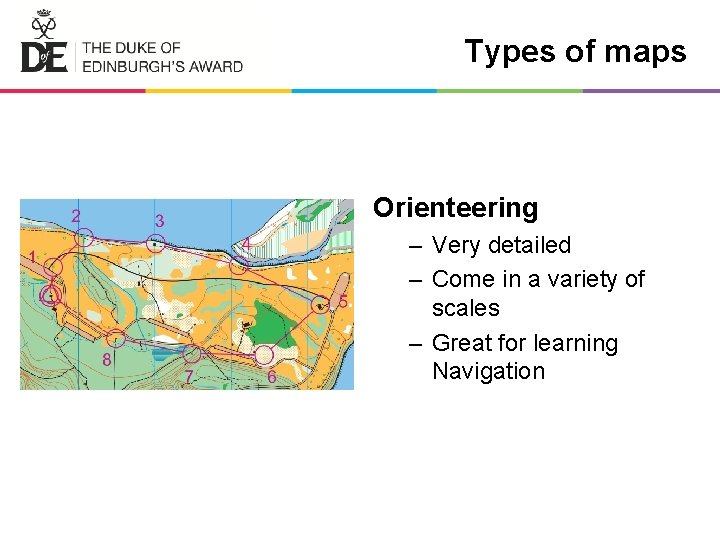
Types of maps Orienteering – Very detailed – Come in a variety of scales – Great for learning Navigation
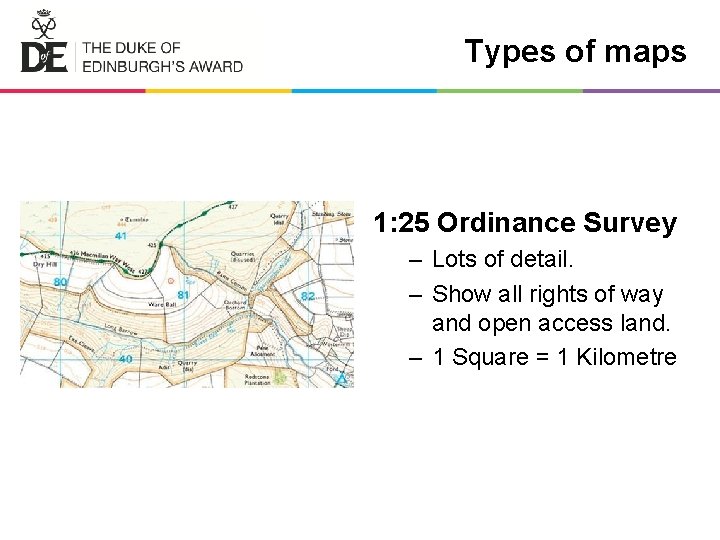
Types of maps 1: 25 Ordinance Survey – Lots of detail. – Show all rights of way and open access land. – 1 Square = 1 Kilometre
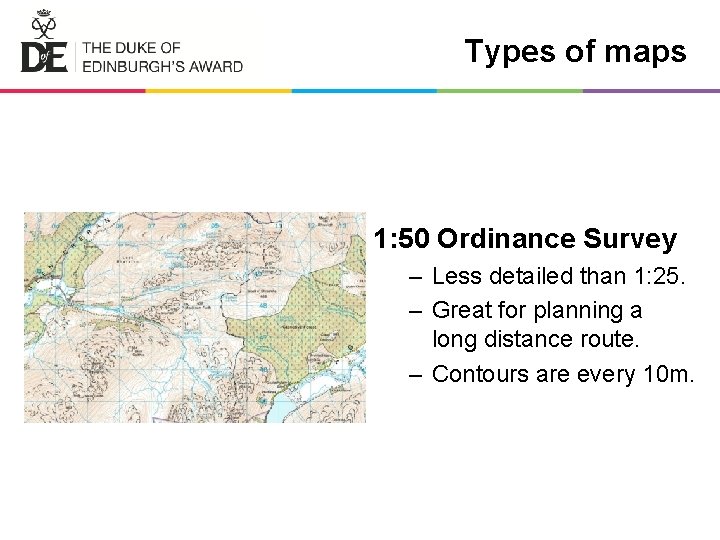
Types of maps 1: 50 Ordinance Survey – Less detailed than 1: 25. – Great for planning a long distance route. – Contours are every 10 m.
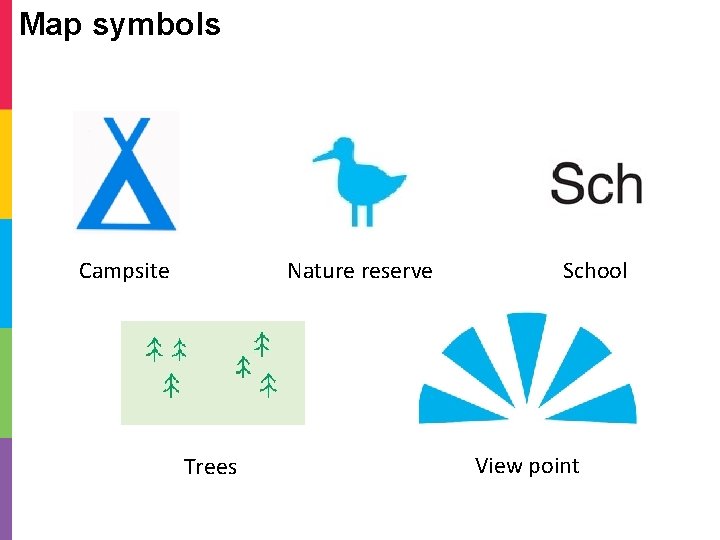
Map symbols Campsite Nature reserve Trees School View point
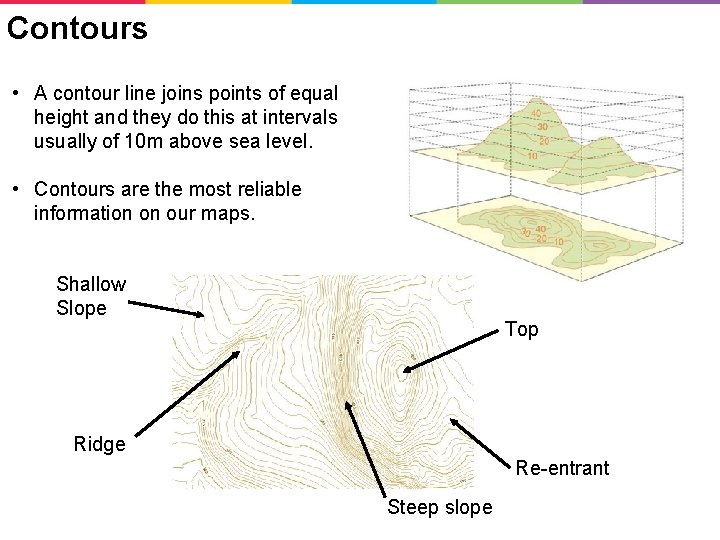
Contours • A contour line joins points of equal height and they do this at intervals usually of 10 m above sea level. • Contours are the most reliable information on our maps. Shallow Slope Top Ridge Re-entrant Steep slope
The 5 Ds • • • Destination – “Where am I going? ” Direction – “Which way am I going? ” Distance – “How far is it? ” Duration - “How long is it going to take me? ” Details – “What am I going to see along the way? ” • Remembering and using these questions can help you plan your route and prevent you from getting lost on your expedition.
Compass Romer scales Orienting arrow Orienting lines Compass needle Compass housing Direction of travel arrow Magnifier Baseplate
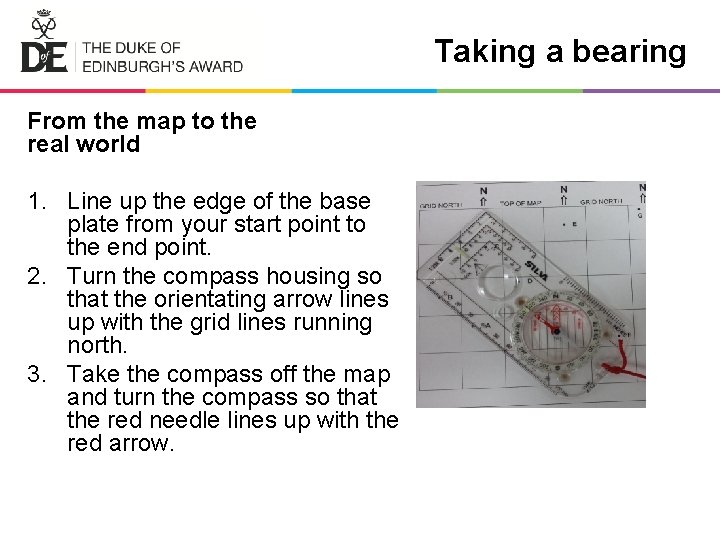
Taking a bearing From the map to the real world 1. Line up the edge of the base plate from your start point to the end point. 2. Turn the compass housing so that the orientating arrow lines up with the grid lines running north. 3. Take the compass off the map and turn the compass so that the red needle lines up with the red arrow.
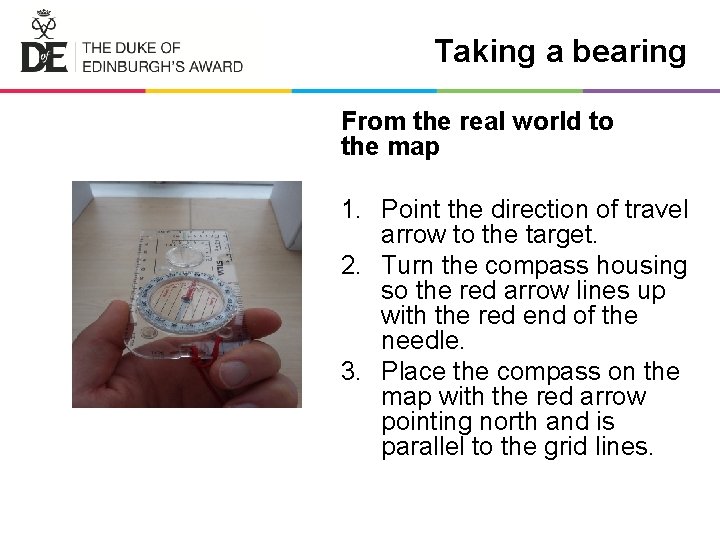
Taking a bearing From the real world to the map 1. Point the direction of travel arrow to the target. 2. Turn the compass housing so the red arrow lines up with the red end of the needle. 3. Place the compass on the map with the red arrow pointing north and is parallel to the grid lines.
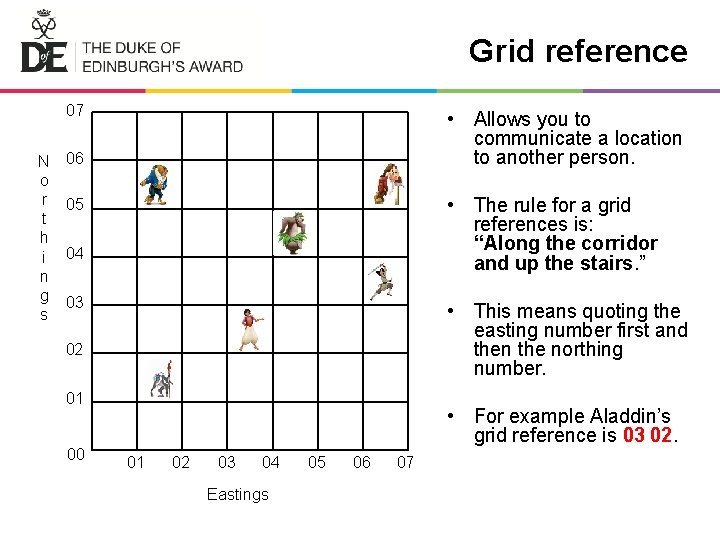
Grid reference 07 • Allows you to communicate a location to another person. N 06 o r 05 t h i 04 n g 03 s • The rule for a grid references is: “Along the corridor and up the stairs. ” • This means quoting the easting number first and then the northing number. 02 01 00 • For example Aladdin’s grid reference is 03 02. 01 02 03 04 Eastings 05 06 07
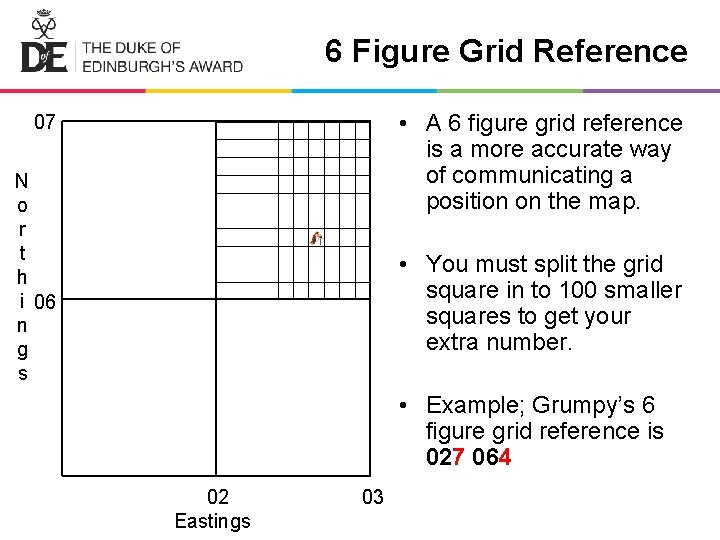
6 Figure Grid Reference • A 6 figure grid reference is a more accurate way of communicating a position on the map. 07 N o r t h i 06 n g s • You must split the grid square in to 100 smaller squares to get your extra number. • Example; Grumpy’s 6 figure grid reference is 027 064 02 Eastings 03
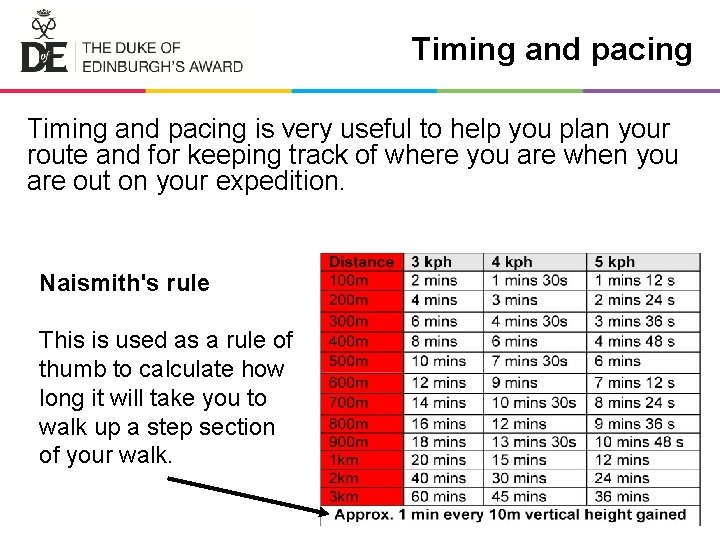
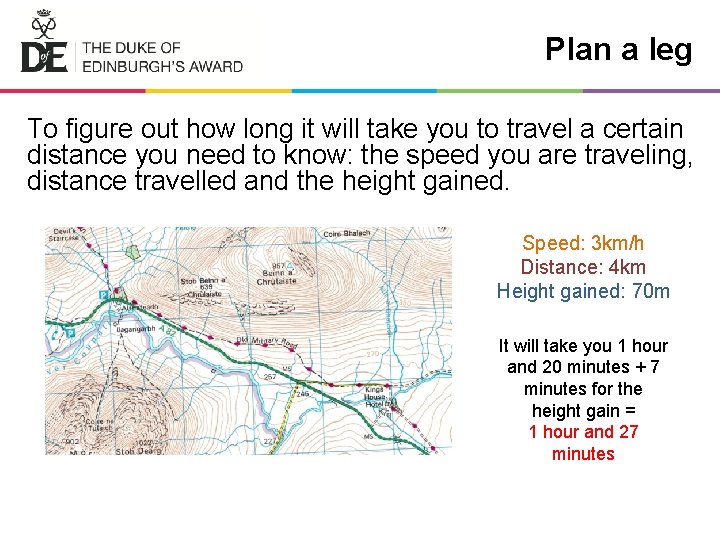
Timing and pacing is very useful to help you plan your route and for keeping track of where you are when you are out on your expedition. Naismith's rule This is used as a rule of thumb to calculate how long it will take you to walk up a step section of your walk.
Plan a leg To figure out how long it will take you to travel a certain distance you need to know: the speed you are traveling, distance travelled and the height gained. Speed: 3 km/h Distance: 4 km Height gained: 70 m It will take you 1 hour and 20 minutes + 7 minutes for the height gain = 1 hour and 27 minutes
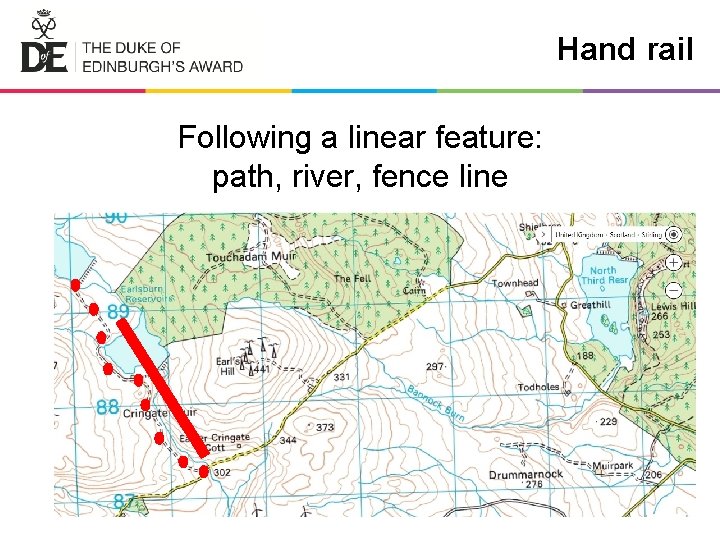
Hand rail Following a linear feature: path, river, fence line
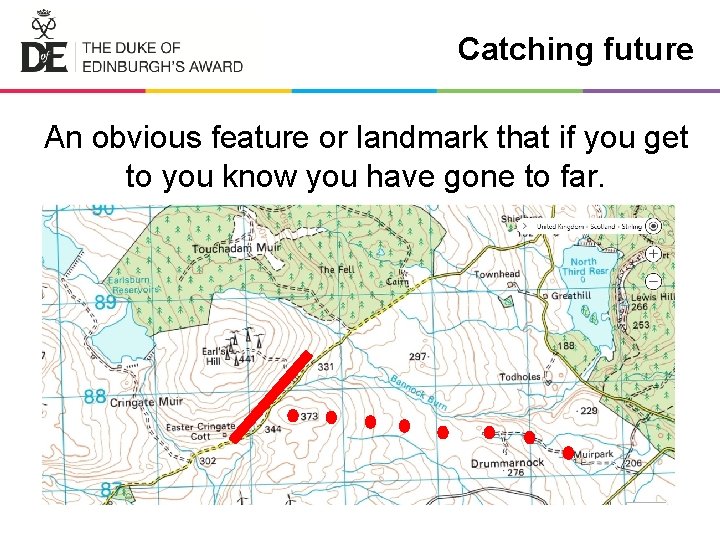
Catching future An obvious feature or landmark that if you get to you know you have gone to far.
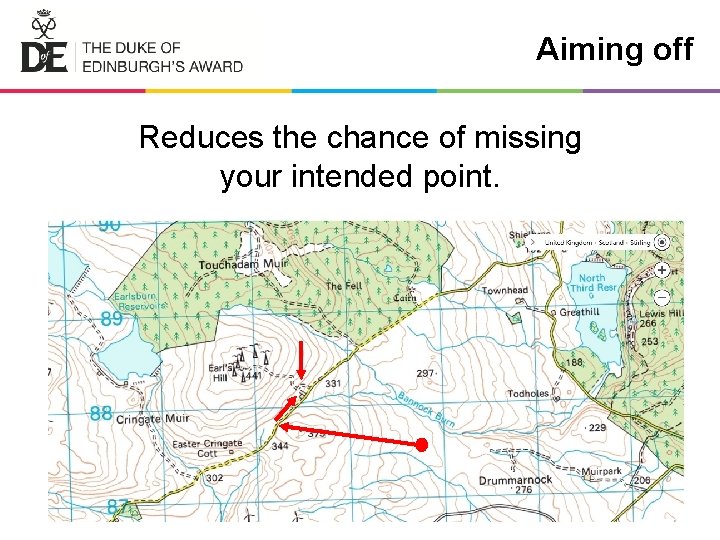
Aiming off Reduces the chance of missing your intended point.