
Navigating the Export Licensing Process Establishing an Export
Navigating the Export Licensing Process & Establishing an Export Management & Compliance Program Presented by Robert Stackpole Sr. International Trade Specialist
Questions • • Who What Where For What Use

Where Are You Exporting? Determine Whether your Product Requires a License for the Destination • Compare Reason for a License to the Country Commercial Chart • If an ‘X’ Appears in Country’s Column for your Product, then a license is Required
What are you exporting • Determine Jurisdiction • Determine if Product/Service is on the USML or the CCL • Determine Exemptions/Exceptions
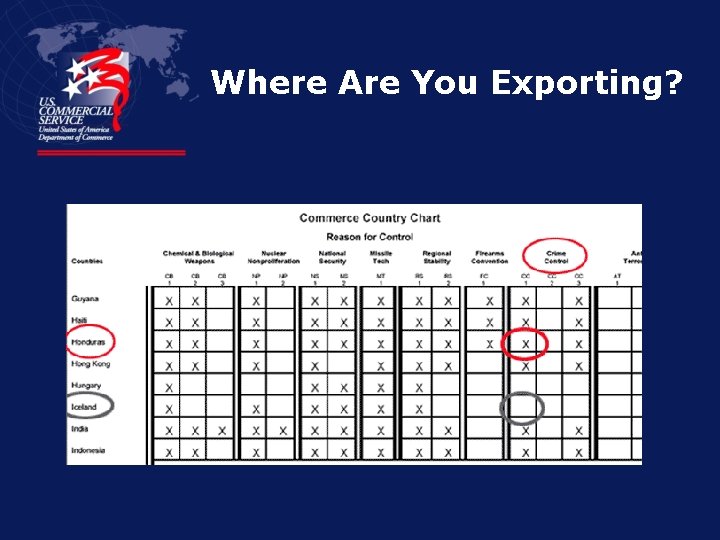
Where Are You Exporting?

To Whom Are You Exporting? Certain individuals and organizations are prohibited from receiving U. S. exports, and others may only receive goods if they have been licensed. See “Lists to Check” on BIS Website • • Entity List Specially Designated Nationals Denied Persons Unverified
What is the End Use? Some end-uses are prohibited while others may require a license. • EXAMPLE: You may not export to certain entities involved in the proliferation of weapons of mass destruction (e. g. , nuclear, biological, chemical) and the missiles to deliver them, without specific authorization, no matter what your item is.
Regulations EAR & ITAR • US Department of State-Military • Law- AECA • Directorate of Defense Trade Controls (DDTC) • International Traffic in Arms Regulations-ITAR • - US Munitions List- USML • US Department of Commerce • Law- EAA (IEEPA) • Bureau of Industry and Security (BIS) • Export Administration Regulations- EAR • - Commerce Control List- CCL

U. S. Munitions List • I. Firearms, Close Assault Weapons and Combat Shotguns • II. Guns and Armament • III. Ammunition /Ordnance • IV. Launch Vehicles, Missiles, Rockets, Torpedoes, Bombs and Mines • V. Explosives and Energetic Materials, Propellants, Incendiary Agents • VI. Vessels of War and Special Naval Equipment • VII. Tanks and Military Vehicles • VIII. Aircraft and Associated Equipment • IX. Military Training and Equipment
U. S. Munitions List • XII. Fire Control, Range Finder, Optical and Guidance and Control Equipment • XIII. Auxiliary Military Equipment • XIV. Toxicological Agents, Including Chemical and Biological and Equipment • XV. Spacecraft Systems and Associated Equipment • XVI. Nuclear Weapons, Design and Testing Related Items • XVII. Classified Articles, Technical Data and Defense Services Not Otherwise Enumerated • XVIII. Directed Energy Weapons • XIX. [Reserved] • XX. Submersible Vessels, Oceanographic and Associated Equipment • XXI. Miscellaneous Articles

NEXT STEP for ITAR 1. Register with the Directorate of Defense Trade Controlshttp: //www. pmddtc. state. gov/ 2. Submit for License through D-TRADE 3. Request Official Commodity Jurisdiction Request if not sure 4. Cost- $2250 for First Tier

Commodity Jurisdiction Request • The Answer is Binding • Decision will be: ITAR or EAR controlled or Split Decision • A bad request will equal bad answer: RWA or Wrong Determination • KEY- Prove item was not designed specifically for military use and has predominant civil use • Applying for ITAR export license does not prejudice CJ determination • If you disagree with the results: Appeal or Request Reconsideration

Mitigate Your Risk Implement an Export Compliance & Management Program (EMCP)
Export Management & Compliance Program • An EMCP is a program that helps ensure that each export is treated consistently and in compliance with U. S. export regulations. • The key is to tailor an EMCP to individual company operations and activities.
Export Management Compliance Program • Comply with all Regulatory Requirements for Exporting • Corporate Commitment and Policy for Export Compliance • Identification of Responsible Parties within Company • Understanding and Awareness of Regulations and Training • Identification and Tracking of controlled data and goods
Why an EMCP? • Provides structure & organization for the processing of export transactions. • Protects employees from inadvertently violating U. S. export law. • Protects your company against export control violations through implementing an ongoing compliance program.
WARNING!
WARNING! • The establishment of an EMCP, in and of itself, will NOT relieve an exporter of criminal and administrative liability under the law if violation occurs. • Companies and/or employees who act contrary to the Export Administration Regulations could lose their export privileges, be fined, or even be criminally
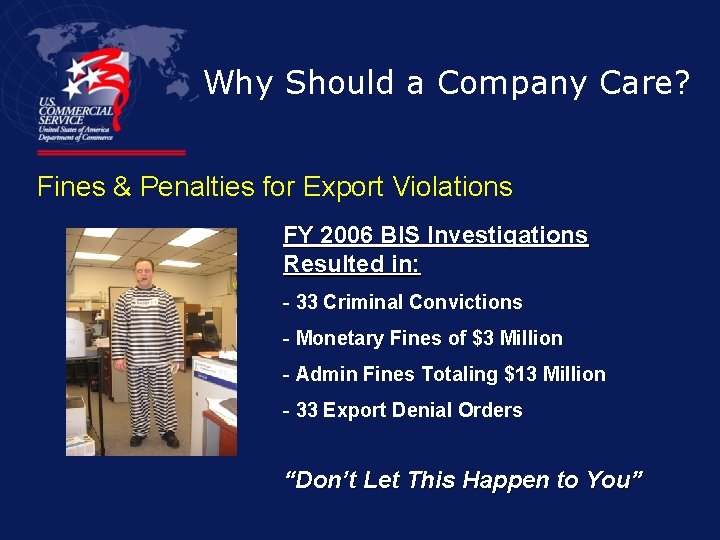
Why Should a Company Care? Fines & Penalties for Export Violations FY 2006 BIS Investigations Resulted in: - 33 Criminal Convictions - Monetary Fines of $3 Million - Admin Fines Totaling $13 Million - 33 Export Denial Orders “Don’t Let This Happen to You”

So I need an EMCP… How do I Start? Basic EMCP Structure has Three Components: Component 1: Administrative (6 Elements) Component 2: Order Processing (1 Element) Component 3: Screening (8 Elements)
Component 1: Administrative Elements ü Management Commitment ü Responsible Officials ü Record Keeping ü Training ü Internal Reviews ü Notification
Component 2: Order Processing Create a comprehensive chart depicting the order process flow in your company. 1) Describe your company’s order processing system from start to end. 2) Identify where export compliance vulnerabilities might occur. 3) Implement systems to prevent violations.
Component 3: Screening Elements ü Denied Persons Screen ü Product/Licensing Screen ü Diversion Risk Screen ü Nuclear Screen ü Missile Screen ü Chemicals & Biological Weapons Screen ü Anti Boycott Screen ü Informed Letter / Entity List Screen
EMCP Best Practices • Up to this point we’ve seen the recommended EMCP guidelines from the Bureau of Industry & Security. • In addition to those guidelines several EMCP Best Practices were highlighted in the 2000 Nunn-Wolfowitz Report…
Example: Compliance Manual Table of Contents • • Management & Compliance Policies Classification Order Processing Screening Accountability International Traffic in Arms Regulations Glossary
EMCP Common Problems • Identifying Improper Jurisdiction of Items; • Lacking Ownership of Responsibility by all Employees; – This is not just the Export Manager’s responsibility • License Management; – Distribution of license; Proviso Management; Submission of document to USG; Management of Scope of License; Review of Parties against Denied Parties Lists; Expiration of Licenses; etc… • Improper use of Exemptions;
EMCP Online Resources • BIS: Export Management System Guidelines – http: //www. bis. doc. gov/Export. Management. Systems/EMSGuidelin es. html • DDTC: Guidelines for Exporters Registered w/ State – http: //www. pmdtc. org/docs/Compliance_Programs. pdf • Nunn-Wolfowitz Report (EMCP Best Practices) – http: //www. kslaw. com/library/pdf/nunnwolfowitz. pdf

Thank You! Robert Stackpole Senior International Trade Specialist Phone: 205 -731 -1333 Robert. Stackpole@trade. gov
- Slides: 28