
Navigating the emergency department Supported by PURPOSE Patients
Navigating the emergency department Supported by
PURPOSE Patients with bleeding disorders often have to visit the emergency department. This module will help you prepare for these visits by planning ahead and by being informed about how emergency departments function.
NAVIGATING THE EMERGENCY DEPARTMENT 1. WHEN TO GO to the emergency department 2. PREPARE in advance 3. WHO’S WHO at the emergency department 4. AFTER A VISIT to the emergency
WHEN TO GO TO THE EMERGENCY DEPARTMENT IF YOU OR YOUR CHILD: § might have a head, neck or abdominal bleed (even without prior injury); § feels a lack of sensation in an arm or leg § has had an accident with trauma; § is experiencing uncontrollable vaginal bleeding; § experiences an uncontrollable nose bleed (more than 30 minutes); § passes blood in the stool or vomits blood; § has any kind of unusual bleeding, such as in the groin; § is not on home infusion and you suspect a bleed; § is on home infusion but you can’t access a vein. WHEN TO GO
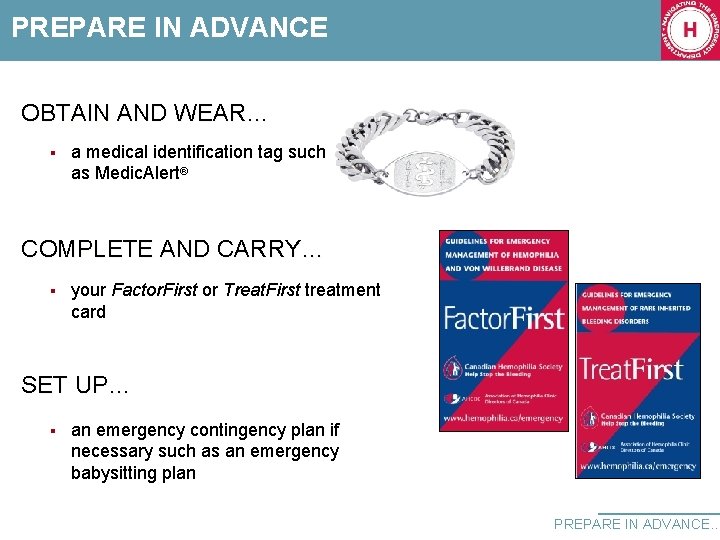
PREPARE IN ADVANCE OBTAIN AND WEAR… § a medical identification tag such as Medic. Alert® COMPLETE AND CARRY… § your Factor. First or Treat. First treatment card SET UP… § an emergency contingency plan if necessary such as an emergency babysitting plan BENEFITS… PREPARE IN ADVANCE…
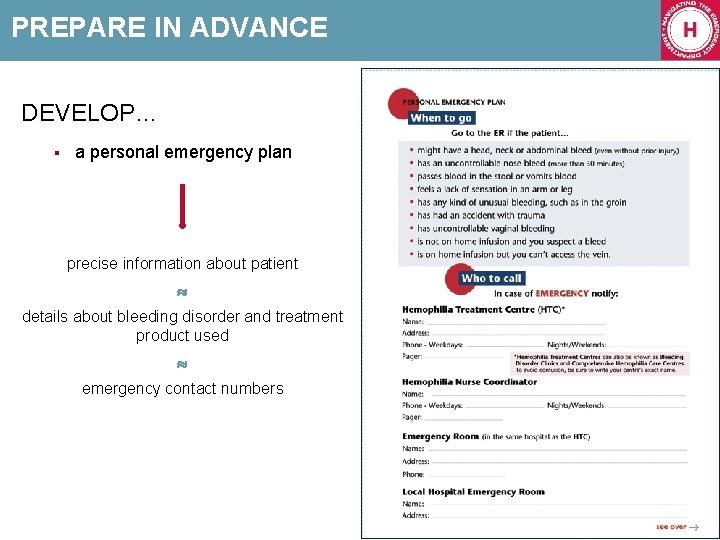
PREPARE IN ADVANCE DEVELOP… § a personal emergency plan precise information about patient details about bleeding disorder and treatment product used emergency contact numbers BENEFITS… PREPARE IN ADVANCE…
PREPARE IN ADVANCE OBTAIN… § a copy of your CHARMS individual treatment protocol form which contains all the information regarding the management of your bleeding disorder. AND… BE KNOWLEDGEABLE! Take control of your bleeding disorder. Know more about your personal care than anyone. BENEFITS… PREPARE IN ADVANCE…
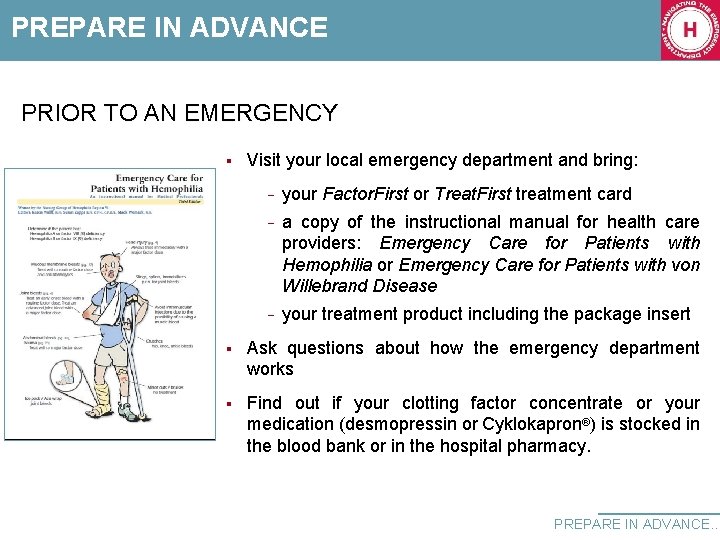
PREPARE IN ADVANCE PRIOR TO AN EMERGENCY § Visit your local emergency department and bring: − your Factor. First or Treat. First treatment card − a copy of the instructional manual for health care providers: Emergency Care for Patients with Hemophilia or Emergency Care for Patients with von Willebrand Disease − your treatment product including the package insert § Ask questions about how the emergency department works § Find out if your clotting factor concentrate or your medication (desmopressin or Cyklokapron®) is stocked in the blood bank or in the hospital pharmacy. BENEFITS… PREPARE IN ADVANCE…

PREPARE IN ADVANCE EMERGENCY PACK § A copy of your personal emergency plan § An empty Ziploc® bag for your treatment product. Just before leaving the house, pop in the product along with a flexible ice pack. § Another Ziploc bag with supplies for infusion (tourniquet, my emergency pack gloves, alcohol wipes, syringe, butterfly needle, saline, Emla cream, gauze dressings, adhesive tape & bandages, and, if your child has a port, port needles and betadine and haparin) § An entertainment pouch (books, video games, crayons) § A utility pouch (money, pen, notebook) § A first-aid pouch (tissues, acetaminophen, thermometer, adhesive bandages, instant cold pack, alcohol swabs, antibacterial wet wipes or hand washing lotion) § A clean towel BENEFITS… PREPARE IN ADVANCE…
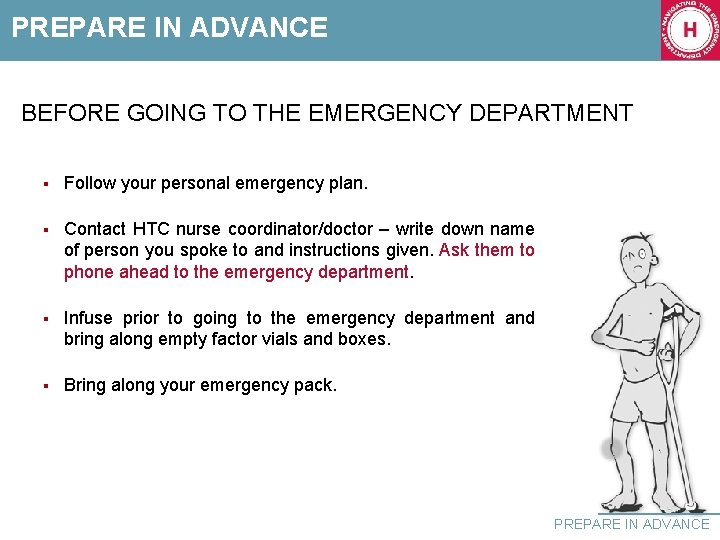
PREPARE IN ADVANCE BEFORE GOING TO THE EMERGENCY DEPARTMENT § Follow your personal emergency plan. § Contact HTC nurse coordinator/doctor – write down name of person you spoke to and instructions given. Ask them to phone ahead to the emergency department. § Infuse prior to going to the emergency department and bring along empty factor vials and boxes. § Bring along your emergency pack. BENEFITS… PREPARE IN ADVANCE
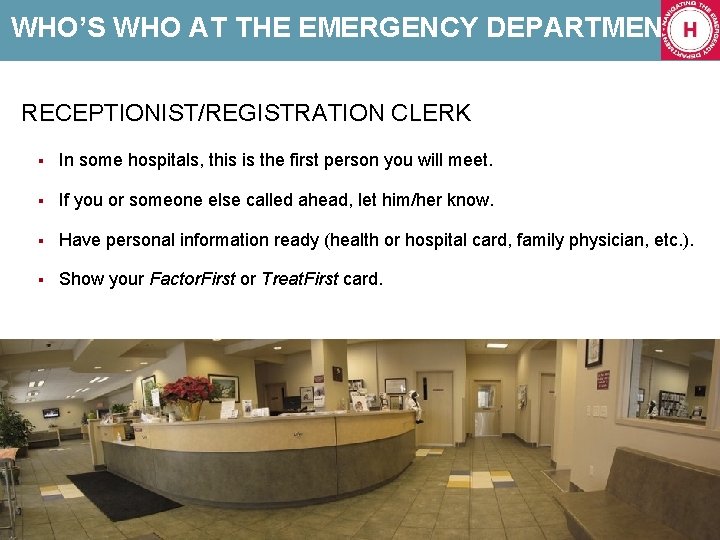
WHO’S WHO AT THE EMERGENCY DEPARTMENT RECEPTIONIST/REGISTRATION CLERK § In some hospitals, this is the first person you will meet. § If you or someone else called ahead, let him/her know. § Have personal information ready (health or hospital card, family physician, etc. ). § Show your Factor. First or Treat. First card. BENEFITS… WHO’S WHO…
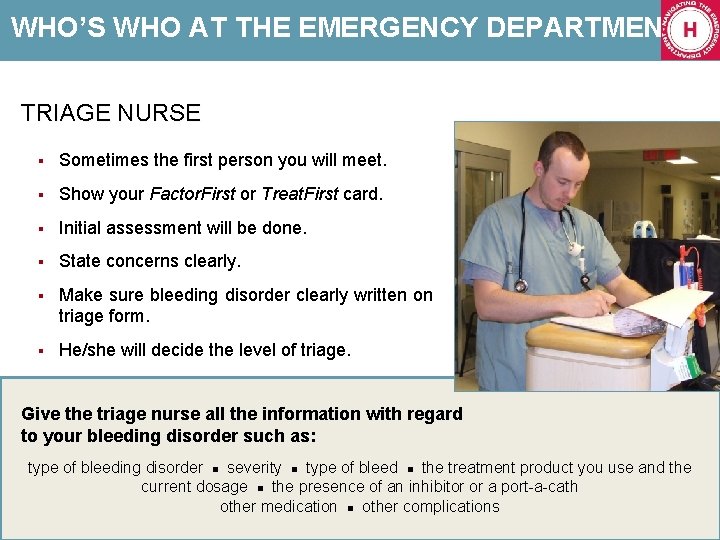
WHO’S WHO AT THE EMERGENCY DEPARTMENT TRIAGE NURSE § Sometimes the first person you will meet. § Show your Factor. First or Treat. First card. § Initial assessment will be done. § State concerns clearly. § Make sure bleeding disorder clearly written on triage form. § He/she will decide the level of triage. Give the triage nurse all the information with regard to your bleeding disorder such as: type of bleeding disorder severity type of bleed the treatment product you use and the current dosage the presence of an inhibitor or a port-a-cath other medication other complications BENEFITS… WHO’S WHO…
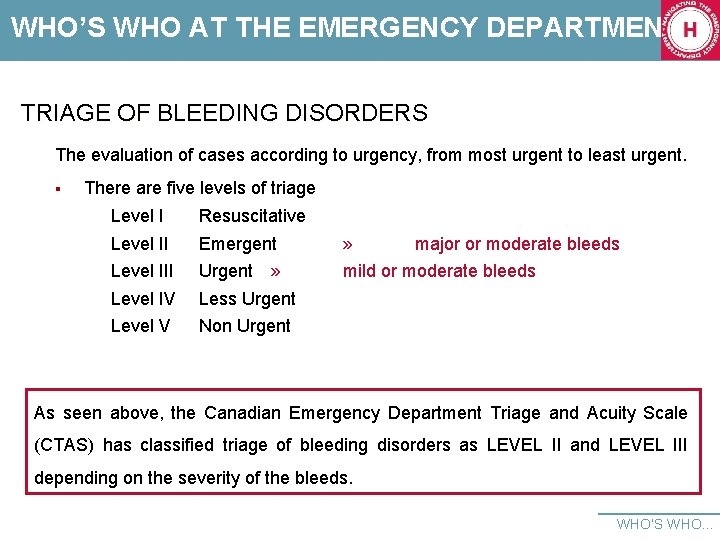
WHO’S WHO AT THE EMERGENCY DEPARTMENT TRIAGE OF BLEEDING DISORDERS The evaluation of cases according to urgency, from most urgent to least urgent. § There are five levels of triage Level I Resuscitative Level II Emergent » Level III Urgent » mild or moderate bleeds Level IV Less Urgent Level V Non Urgent major or moderate bleeds As seen above, the Canadian Emergency Department Triage and Acuity Scale (CTAS) has classified triage of bleeding disorders as LEVEL II and LEVEL III depending on the severity of the bleeds. BENEFITS… WHO’S WHO…
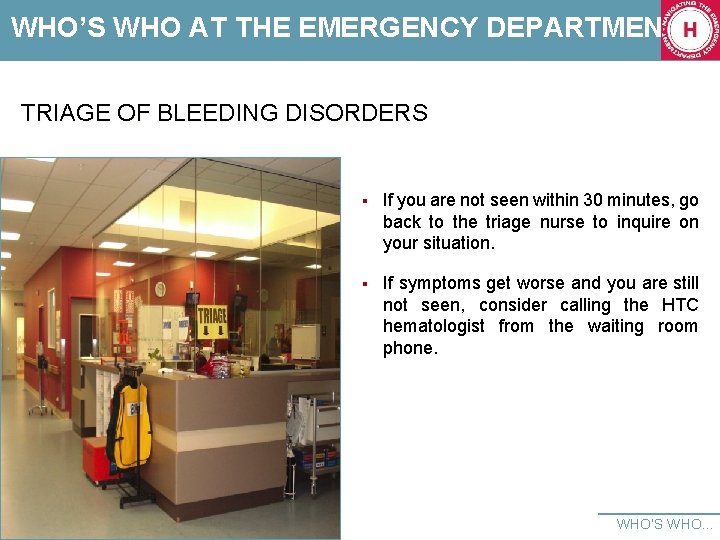
WHO’S WHO AT THE EMERGENCY DEPARTMENT TRIAGE OF BLEEDING DISORDERS § If you are not seen within 30 minutes, go back to the triage nurse to inquire on your situation. § If symptoms get worse and you are still not seen, consider calling the HTC hematologist from the waiting room phone. BENEFITS… WHO’S WHO…
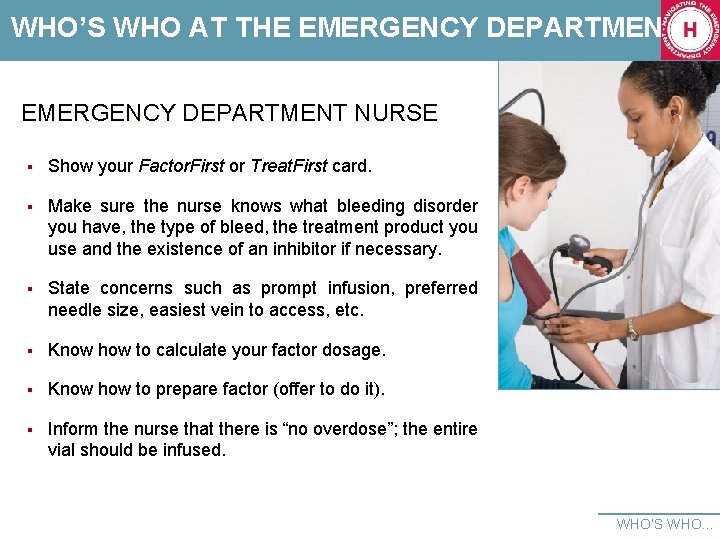
WHO’S WHO AT THE EMERGENCY DEPARTMENT NURSE § Show your Factor. First or Treat. First card. § Make sure the nurse knows what bleeding disorder you have, the type of bleed, the treatment product you use and the existence of an inhibitor if necessary. § State concerns such as prompt infusion, preferred needle size, easiest vein to access, etc. § Know how to calculate your factor dosage. § Know how to prepare factor (offer to do it). § Inform the nurse that there is “no overdose”; the entire vial should be infused. BENEFITS… WHO’S WHO…
WHO’S WHO AT THE EMERGENCY DEPARTMENT DOCTOR § Show your Factor. First or Treat. First card. § Make sure the doctor knows what bleeding disorder you have, the type of bleed, the treatment product you use and the existence of an inhibitor if necessary. § If HTC nurse or hematologist called ahead, let doctor know. § Make sure you understand the treatment ordered. § If you feel you are not getting the proper care, phone your HTC. § It is your right to question/refuse treatment. BENEFITS… WHO’S WHO
THE EMERGENCY DEPARTMENT TIPS FOR SUCCEEDING AT THE EMERGENCY DEPARTMENT § Stay calm § Listen § Speak up! Be assertive! § Be knowledgeable about your bleeding disorder § Repeat yourself, if necessary § Be polite and courteous § Focus on the problem, not the people § Use “I-statement” not “you-statements” § Be prepared for difficult situations § Phone your HTC again, if necessary § Know your rights as a patient! helpful tips EMERGENCY DEPARTEMENT SUCCESS BENEFITS…
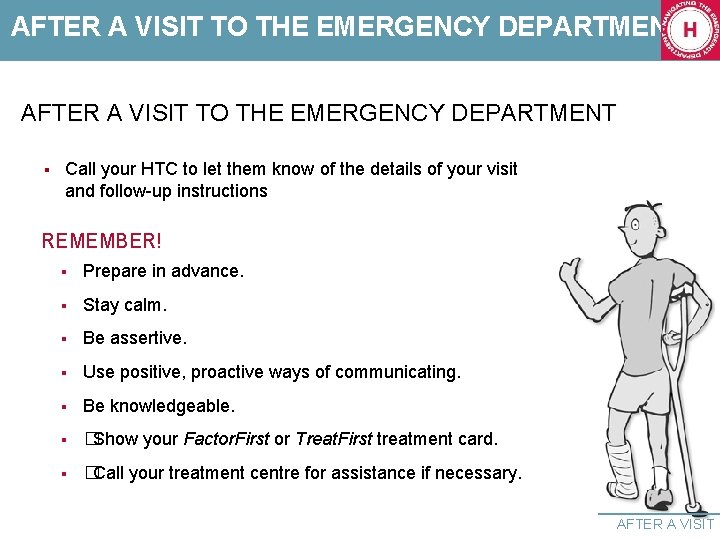
AFTER A VISIT TO THE EMERGENCY DEPARTMENT § Call your HTC to let them know of the details of your visit and follow-up instructions REMEMBER! § Prepare in advance. § Stay calm. § Be assertive. § Use positive, proactive ways of communicating. § Be knowledgeable. § �Show your Factor. First or Treat. First treatment card. § �Call your treatment centre for assistance if necessary. BENEFITS… AFTER A VISIT
ACKNOWLEDGEMENTS The CHS would like to acknowledge those people who contributed to the development of Navigating the emergency department. DORINE BELLIVEAU, RN Moncton Children’s Hospital, Moncton, NB CLARE CECCHINI National Program Manager, Canadian Hemophilia Society (retired) WADE KEAN, MD Boudreau-Ouest, NB DAVID PAGE National Executive Director, Canadian Hemophilia Society SHERRY PURCELL, RN Kingston General Hospital, Kingston, ON
Navigating the emergency department Bon Voyage! Travelling with a bleeding disorder Charting your course Home care: The road to independence Destination fitness Roadmap for managing pain Supported by
- Slides: 20