
Navigating Online Class Behavior and Academic Integrity Susan
Navigating Online Class Behavior and Academic Integrity Susan Bastian, Online Instructional Designer & Team Lead, College of Online Education Marshall Lancey, Associate Director of Community Standards and Conduct July 30, 2018
Agenda for this Session • Online Class Behavior • What disruptive behavior looks like in an online course • Aligning behaviors with the code of conduct • Behavior referral process and form • Academic Integrity • What is plagiarism and why does it happen? • How to prevent plagiarism online • Cheating vs. Plagiarism • How to detect cheating and plagiarism online • Academic Integrity referral process and forms • Questions • Helpful links
Online Class Behavior
What is disruptive behavior in an online class? • Inappropriate commentary or participation • Inappropriate can be defined as anything that disrupts learning • Includes harassment, particularly of a protected class (gender, sexuality, race, etc…) • Can happen in: • • Discussion forums Assignments Emails Phone call/Zoom session • Failure to comply with expectations outlined in syllabus
Potential Violations of the Code of Conduct • 1 d: Disorderly conduct • 2 c: Physical, verbal, nonverbal, written, electronic or technological harassment of another person, including harassment on social networking sites and other online forums • 7 a: Failure to comply with a university representative • 9 f: Behavior that would offend or frighten
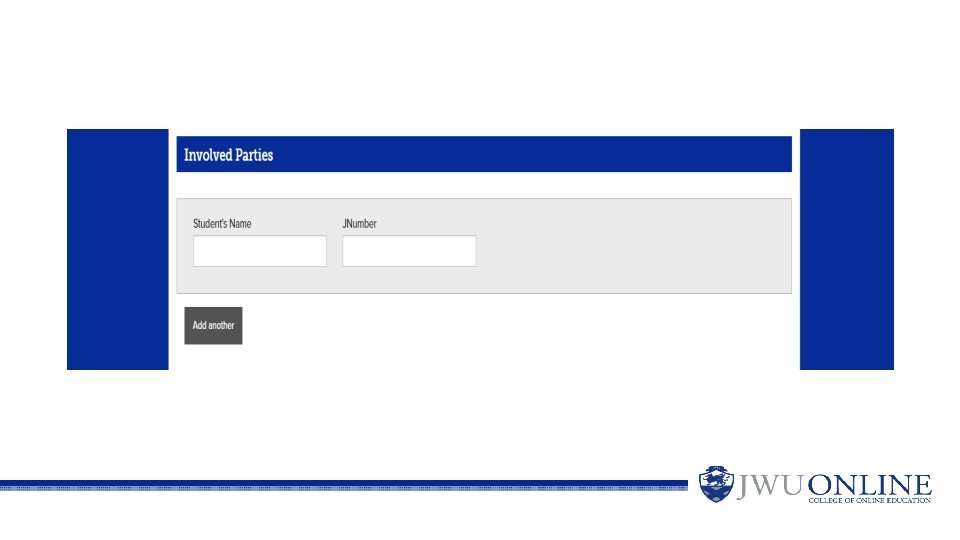
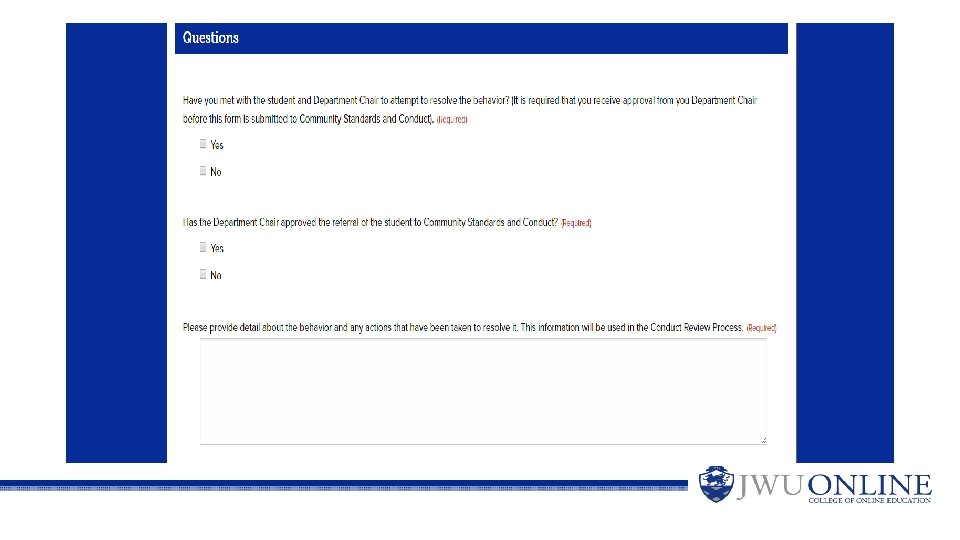
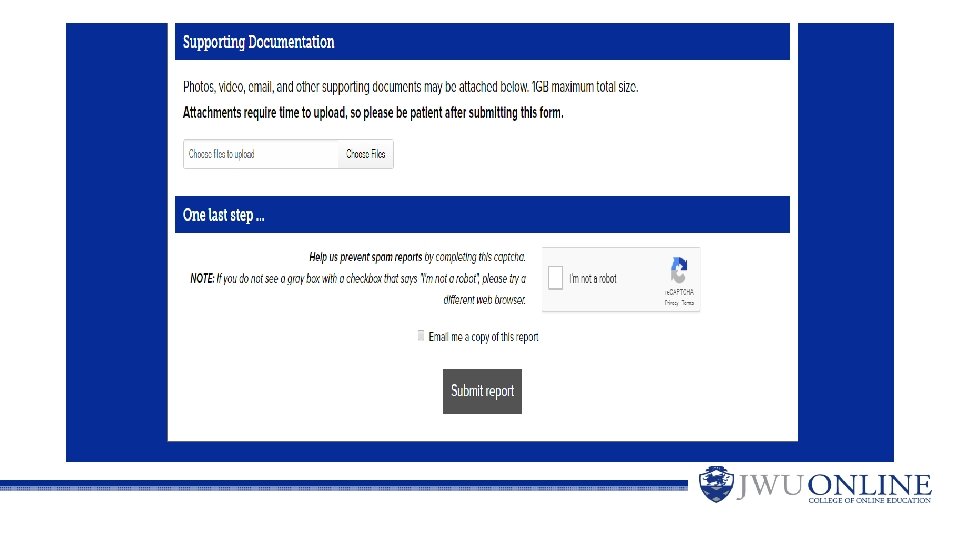
Classroom Behavior Referral Form May be used to refer students to Community Standards and Conduct for disruptive behavior when attempts by the faculty members and Department Chair to resolve the behavior have been unsuccessful. If you ever witness threatening behavior, immediately report this behavior to Campus Safety & Security.
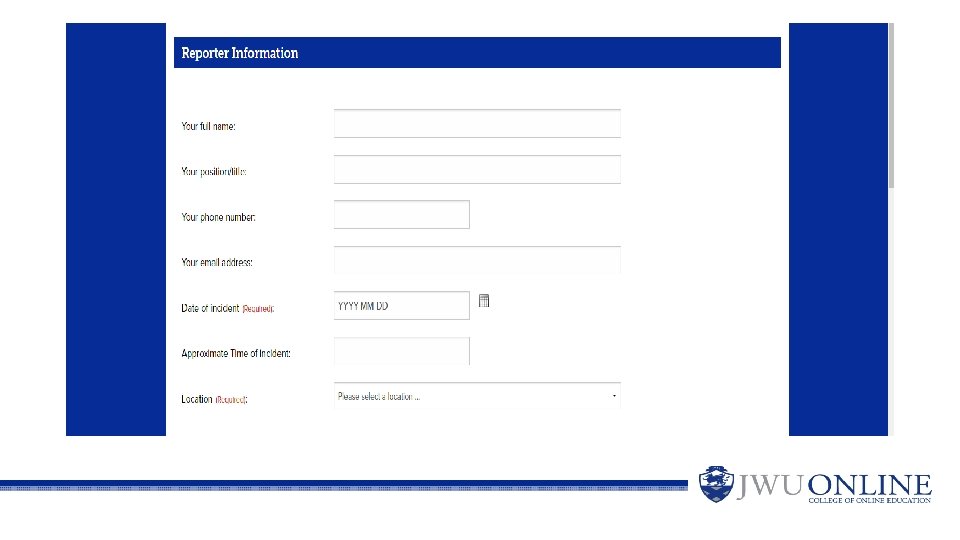
Classroom Behavior Referral Form • Reporter Information • Involved Parties • Questions • Supporting Documentation • “One Last Step”
Comments, Questions, Concerns
Academic Integrity
What is Plagiarism? When a writer deliberately uses someone else’s language, ideas, or other original (not common‐knowledge) material without acknowledging its source. Misuse of sources: carelessly or inadequately citing ideas and words borrowed from another source. Council of Writing Program Administrators (2003). Defining and avoiding plagiarism: The WPA statement on best practices. Retrieved from http: //wpacouncil. org
How prevalent is plagiarism? • Of 421 undergraduates surveyed at a public university: • 61% reported they had plagiarized content from an academic source • 39% reported they had plagiarized content from internet sources • 18% reported they had allowed other students to plagiarize from their work Hard, S. , Conway, J. , and Moran, A. (2006). Faculty and college student beliefs about the frequency of student academic misconduct, The Journal of Postsecondary Education, 77(6), 1058‐ 1080. • However, more recent studies indicate that the prevalence of plagiarism in online courses is actually less than in face to face courses. • In fact, one study showed “increased understanding and reduced occurrence of several forms of plagiarism, with no upward trend in verbatim copying or ghostwriting”. Curtis, G. J. & Vardanega, L. (2016). Is plagiarism changing over time? A 10‐year time‐lag study with three points of measurement, Higher Education Research & Development, 35: 6, 1167‐ 1179, DOI: 10. 1080/07294360. 2016. 1161602
Why do students plagiarize? • They do not see plagiarism as a big deal • They panic • The assignment is not meaningful to them • They do not understand what you mean by plagiarism • Cultural differences may impact this • They need to develop foundational academic skills • Patchwriting: restating a phrase, clause, or one or more sentences while staying close to the language or syntax of the source Jamieson, S. & Howard, R. M. (2011). Unraveling the citation trail. Retrieved from http: //www. projectinfolit. org
Preventing Plagiarism Online • Teach your students what plagiarism means and why it matters • The library has created a module that can be added to courses. • There is a quiz option as well. • Contact your Instructional Designer and Instructional Technologist to request it be added to your course. • Remind students about the academic integrity policy. • There is a link to the policy in every syllabus. • Consider adding a reminder about the importance of academic integrity to assignments.
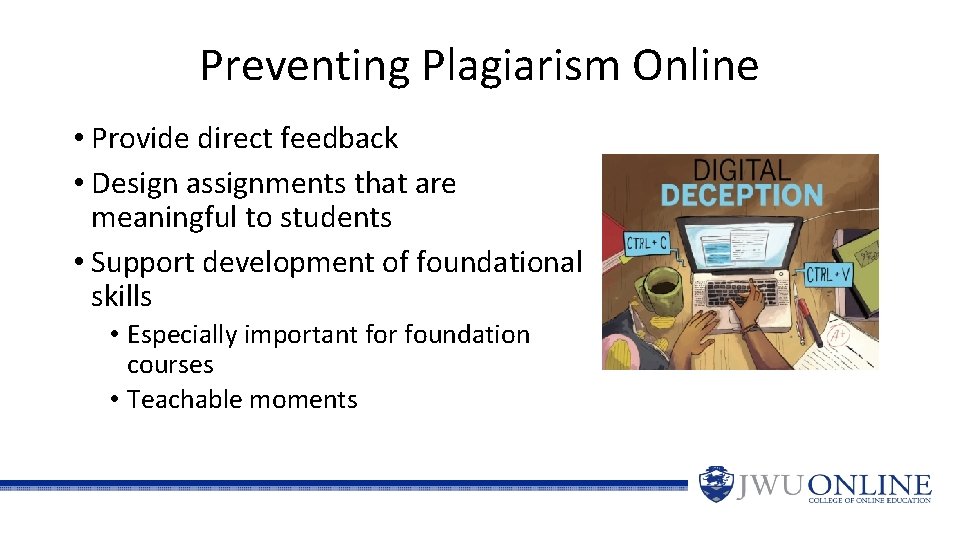
Preventing Plagiarism Online • Provide direct feedback • Design assignments that are meaningful to students • Support development of foundational skills • Especially important for foundation courses • Teachable moments
Is it Plagiarism or Cheating? Plagiarism: • May be unintentional • Often occurs because students do not understand content or what plagiarism is Cheating: • Always intentional • Occurs because students don’t understand what to do or do not want to put in the work to do it themselves
Cheating in Online Classes Can be harder to detect in an online class. Assume all online assessments are open‐book, open‐Internet. • Consider using a question bank to pull random questions from • Create assessments that require application of knowledge Websites like Course. Hero sell test answers and student papers. • These are not detectable by Turnitin • Very difficult to detect
How can we detect plagiarism or cheating? • Look for red flags • A paper looks different from how the student normally writes. • Discrepancies between discussion posts and formal papers. • Writing includes comments outside the scope of the course or week. • Google suspicious phrases • Use Turnitin • Remember that Turnitin will not detect papers purchased by pay‐ for‐papers sites. • Other ideas?
Student Conduct Process Overview • Report drawn by CS&S or Residence Life • Student Conduct meets with students to determine Responsible/Not Responsible • Educational Conversations, Administrative and Panel Hearings • If student is found responsible, subsequent educational sanctions applied
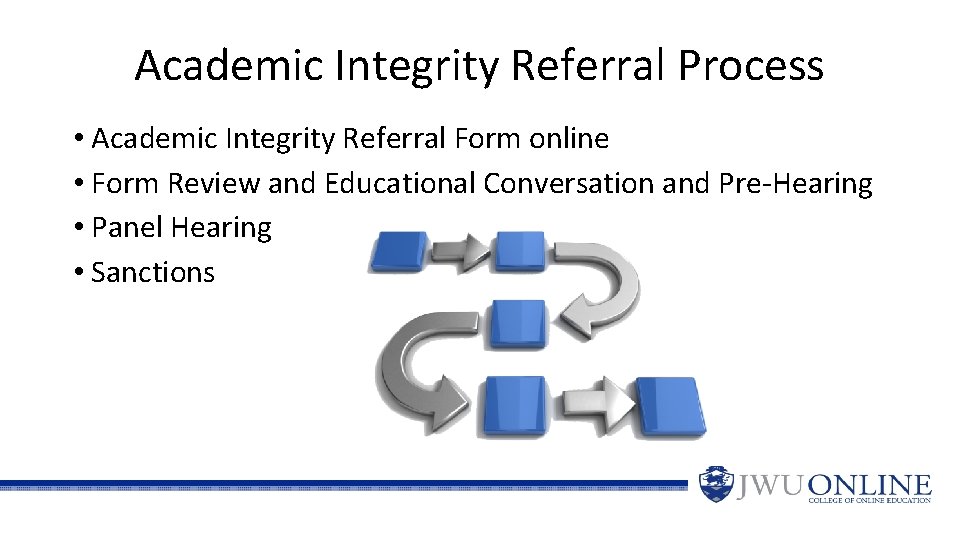
Academic Integrity Referral Process • Academic Integrity Referral Form online • Form Review and Educational Conversation and Pre‐Hearing • Panel Hearing • Sanctions
Academic Integrity Referral Form • Background Information • Involved Parties • Questions • Supporting Documentation • Select Copy Recipients • “One Last Step…”
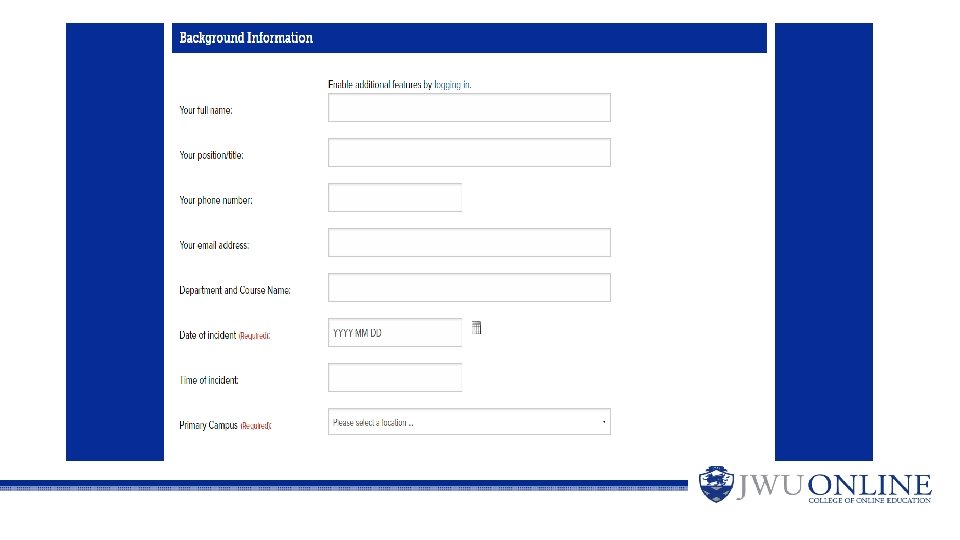
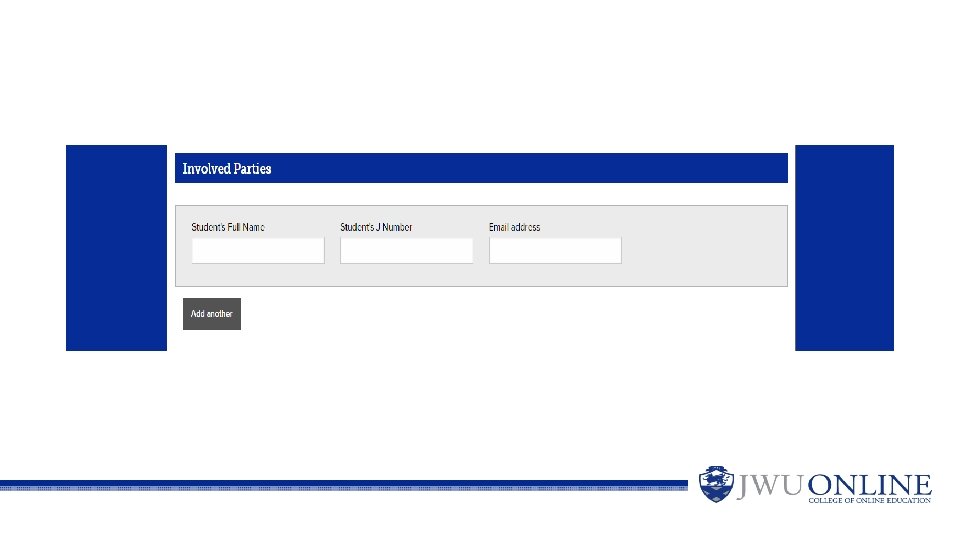
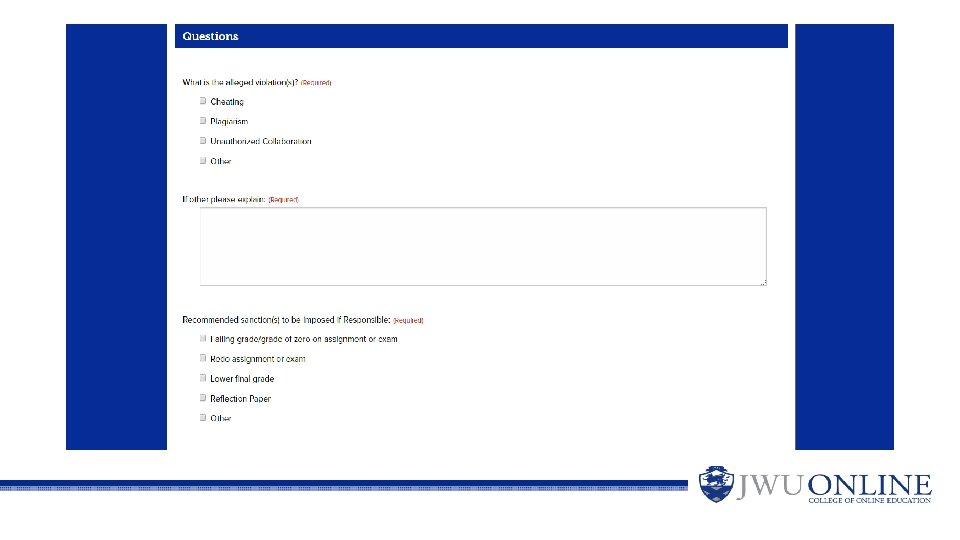
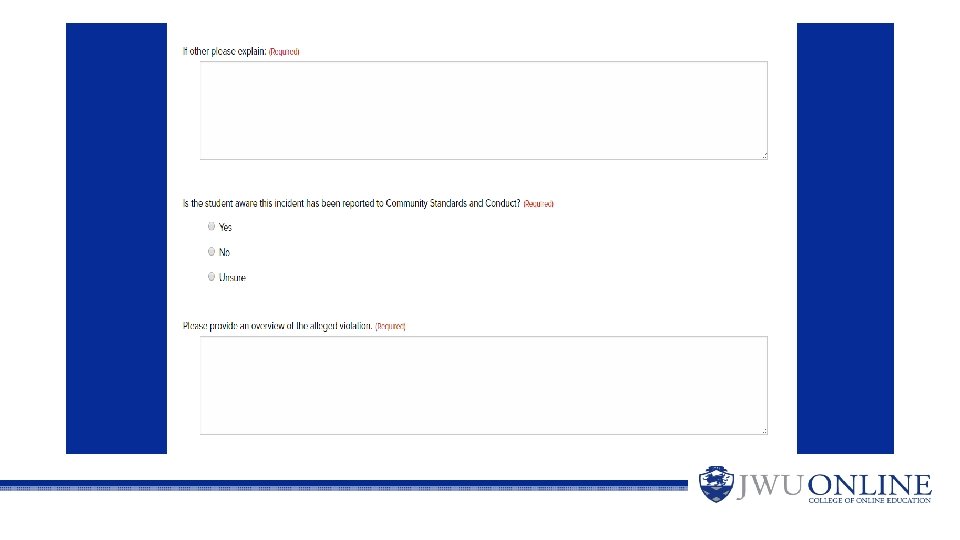
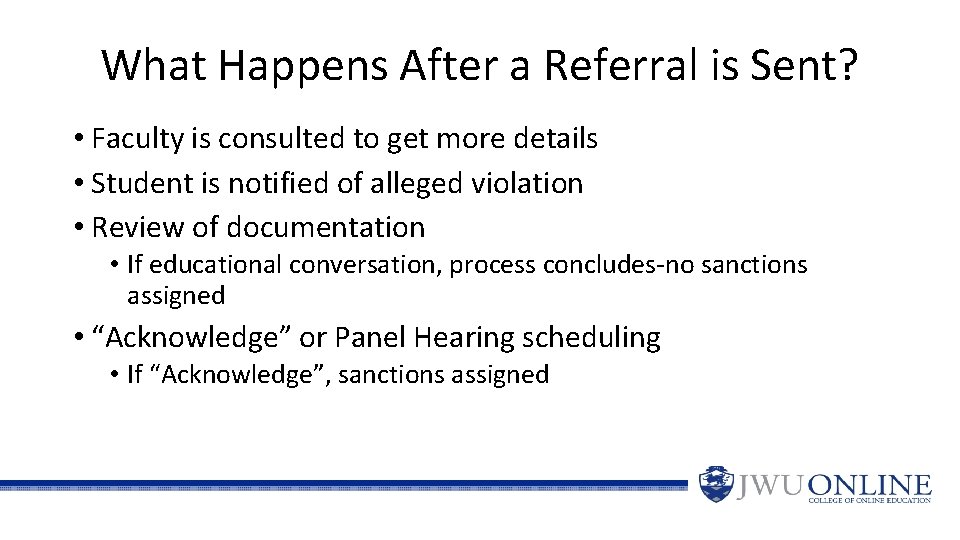
What Happens After a Referral is Sent? • Faculty is consulted to get more details • Student is notified of alleged violation • Review of documentation • If educational conversation, process concludes‐no sanctions assigned • “Acknowledge” or Panel Hearing scheduling • If “Acknowledge”, sanctions assigned
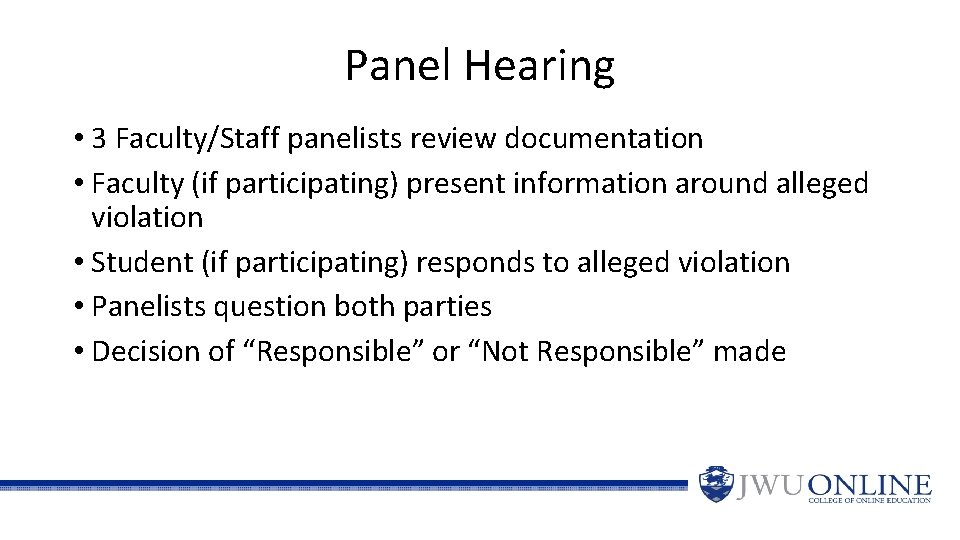
Panel Hearing • 3 Faculty/Staff panelists review documentation • Faculty (if participating) present information around alleged violation • Student (if participating) responds to alleged violation • Panelists question both parties • Decision of “Responsible” or “Not Responsible” made
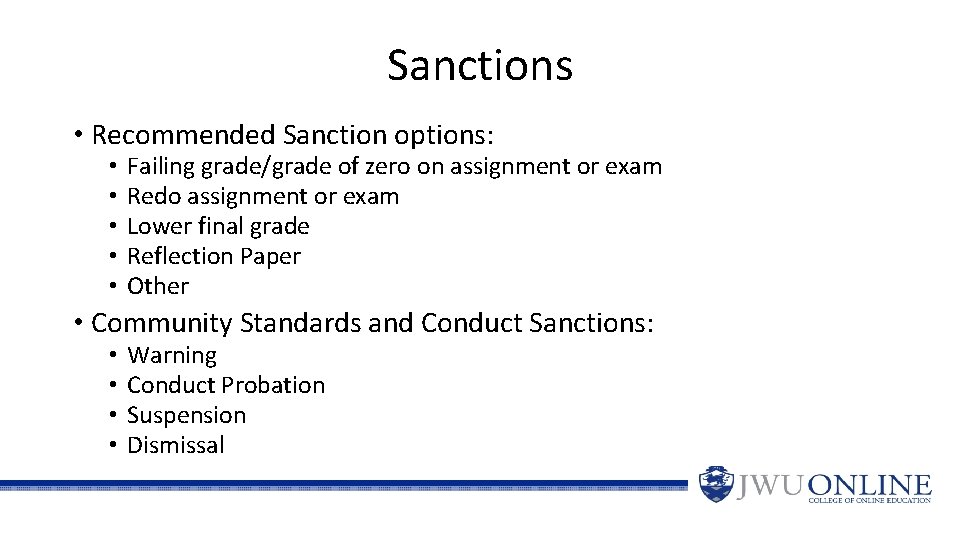
Sanctions • Recommended Sanction options: • • • Failing grade/grade of zero on assignment or exam Redo assignment or exam Lower final grade Reflection Paper Other • Community Standards and Conduct Sanctions: • • Warning Conduct Probation Suspension Dismissal
Comments, Questions, Concerns
Useful Links • JWU Library Plagiarism Resources • JWU Student Code of Conduct • Classroom Behavior Referral Form • Academic Integrity Referral Form
- Slides: 34