
NavierStokes We All Know What Happens When You

![Finding m l At this step only integrate once to isolate [dw/dx]wall](https://slidetodoc.com/presentation_image/0ef4a4c7c1afe2504a6820fecd6a4e87/image-13.jpg "Finding m l At this step only integrate once to isolate [dw/dx]wall")


- Slides: 16
Navier-Stokes: We All Know What Happens When You Assume Stephen Mc. Mullan 1 -18 -07 BIEN 301
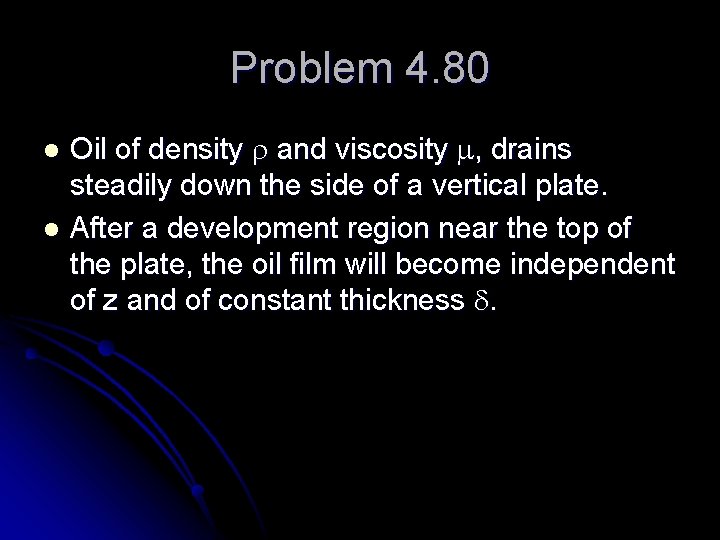
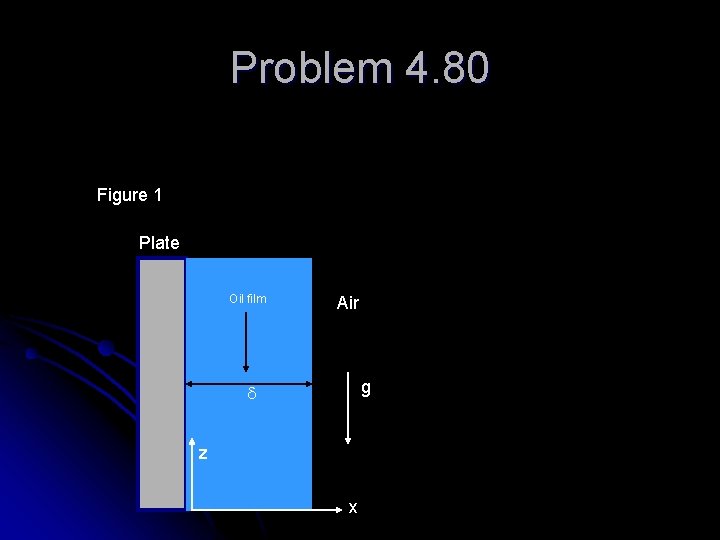
Problem 4. 80 Oil of density r and viscosity m, drains steadily down the side of a vertical plate. l After a development region near the top of the plate, the oil film will become independent of z and of constant thickness d. l
Problem 4. 80 Figure 1 Plate Oil film Air g d z x
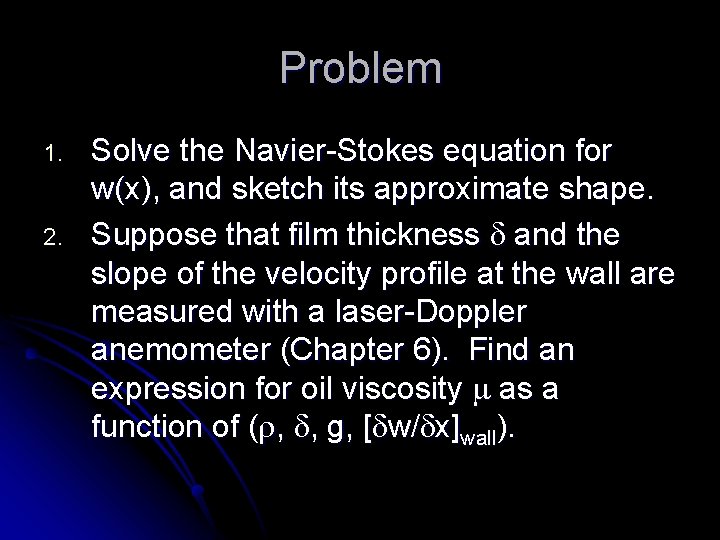
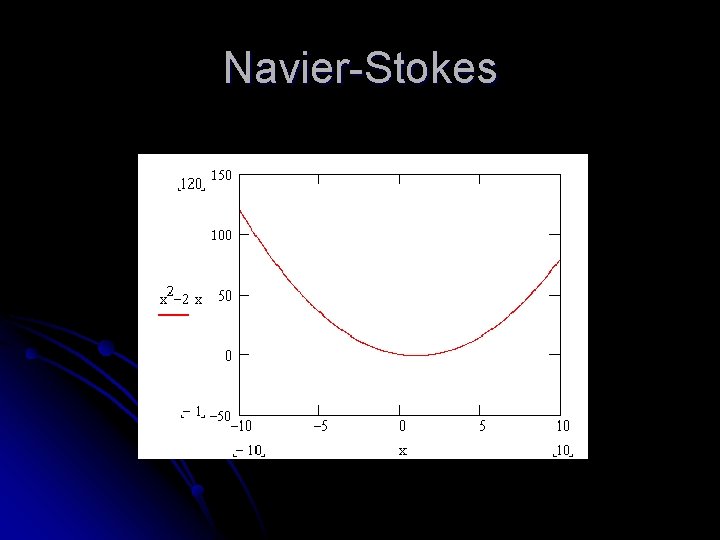
Problem 1. 2. Solve the Navier-Stokes equation for w(x), and sketch its approximate shape. Suppose that film thickness d and the slope of the velocity profile at the wall are measured with a laser-Doppler anemometer (Chapter 6). Find an expression for oil viscosity m as a function of (r, d, g, [dw/dx]wall).
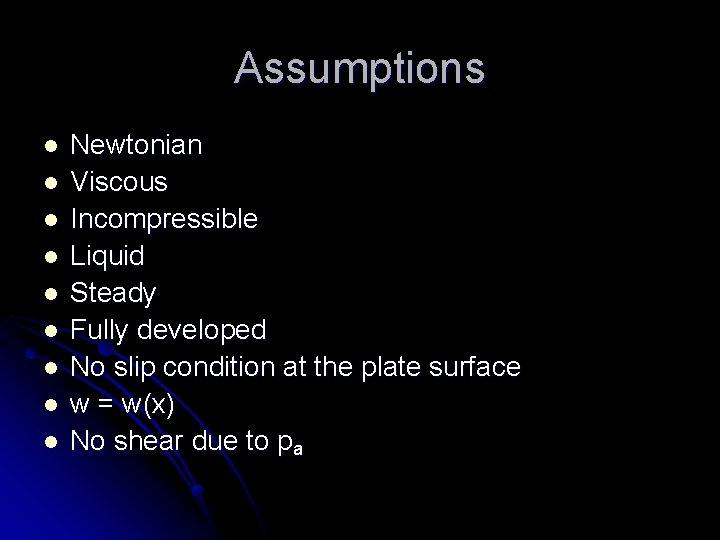
Assumptions l l l l l Newtonian Viscous Incompressible Liquid Steady Fully developed No slip condition at the plate surface w = w(x) No shear due to pa
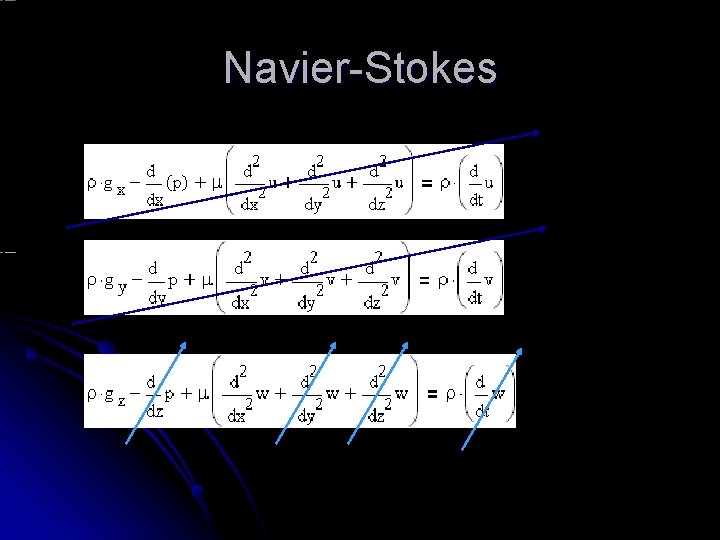
Navier-Stokes
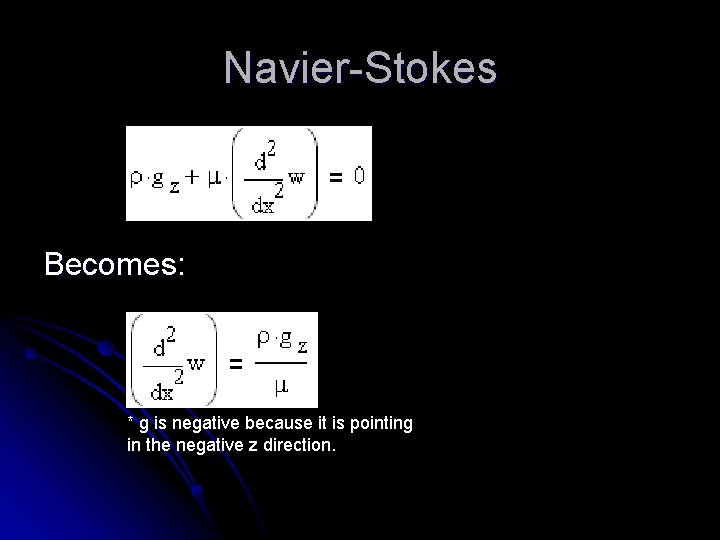
Navier-Stokes Becomes: * g is negative because it is pointing in the negative z direction.
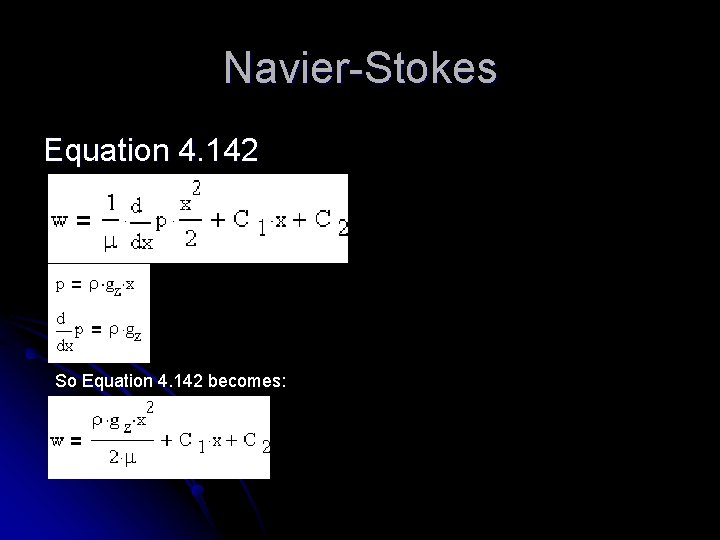
Navier-Stokes Equation 4. 142 So Equation 4. 142 becomes:
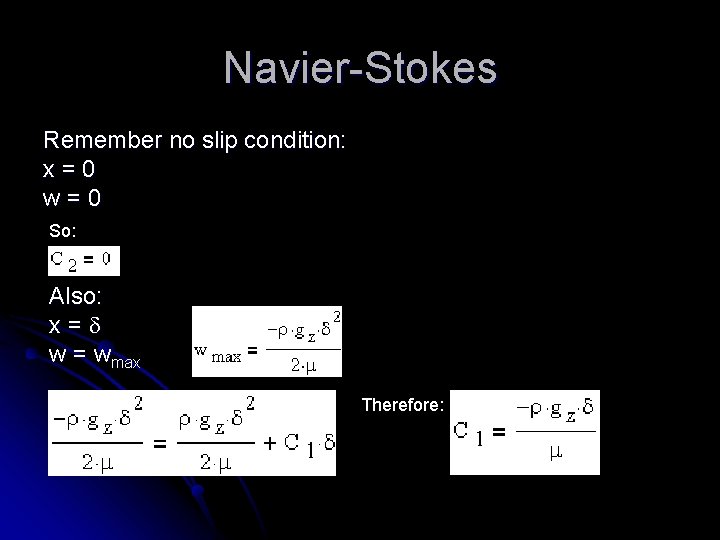
Navier-Stokes Remember no slip condition: x=0 w=0 So: Also: x=d w = wmax Therefore:
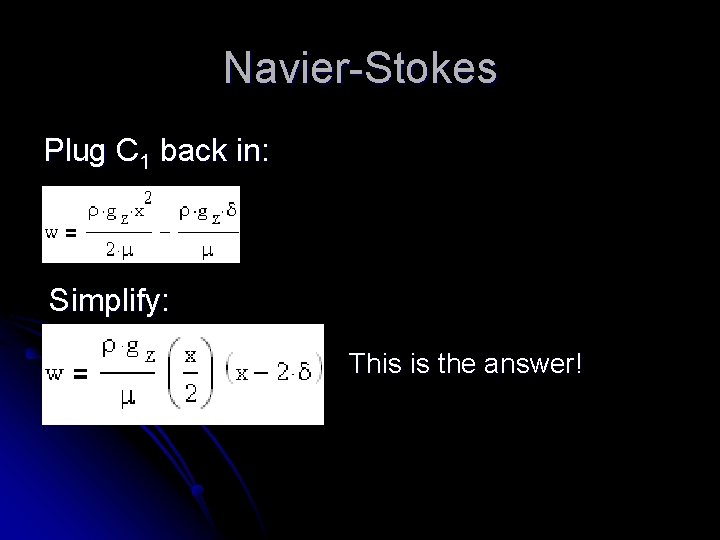
Navier-Stokes Plug C 1 back in: Simplify: This is the answer!
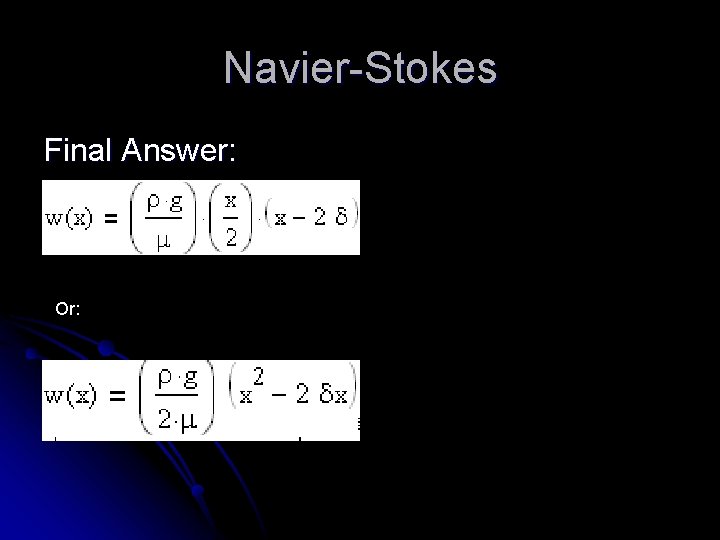
Navier-Stokes Final Answer: Or:
Navier-Stokes
Finding m l At this step only integrate once to isolate [dw/dx]wall
Finding m l Rearrange for m This is the answer!
BME Application l Design of an artificial vessel l Femoral Artery l Gravity l Pumping l Motion l Understand natural velocity profile to match the
Questions?