
NAU Gore Capstone Team Ashley Blood Nick Green

NAU Gore Capstone Team Ashley Blood, Nick Green, Jenny Lawson, Cameron Lissarrague
Background WHAT ARE STENTS USED FOR? ● ● Expanding narrow or clogged arteries Restoring blood to obstructed artery TYPES OF STENTS ● ● Coronary Vascular Intracranial Esophageal Nick 2
GOAL STATEMENT Design and develop an automatic stent crimping device that utilizes an iris design with a radial force output. Nick 3
SOTA LITERATURE RESEARCH Topics ▰ Purpose of crimping ▰ Stent dimensions ▰ Pre-existing designs Nick 4

Purpose of crimping Stent crimping onto balloon catheters is necessary for the successful deployment of balloon-expandable stents [1]. Fig. 1: Preoperative process for preparing catheter [2] Cameron 5
![Stent Dimensions Table 1: Stent Dimensions Coronary stents Length: 8 to 38 mm [3]](http://slidetodoc.com/presentation_image_h2/0a75b97e9b1843e0b671c1c4385877ec/image-6.jpg "Stent Dimensions Table 1: Stent Dimensions Coronary stents Length: 8 to 38 mm [3]")
Stent Dimensions Table 1: Stent Dimensions Coronary stents Length: 8 to 38 mm [3] Diameter: 2. 5 to 4. 0 mm [3] Intracranial Stents Length: 8 to 28 mm [4] Diameter 2 to 4 mm [4] Vascular Stent Length: 20 to 100 mm [5] Diameter: 5 to 9 mm [5] Esophageal stent Length: 10 to 15 cm [6] Diameter: 12 to 16 mm [6] Cameron 6
![PRE-EXISTING DESIGNS Fig. 2: Parts of Apparatus [7] 28 - rotating apparatus 22 -](http://slidetodoc.com/presentation_image_h2/0a75b97e9b1843e0b671c1c4385877ec/image-7.jpg "PRE-EXISTING DESIGNS Fig. 2: Parts of Apparatus [7] 28 - rotating apparatus 22 -")
PRE-EXISTING DESIGNS Fig. 2: Parts of Apparatus [7] 28 - rotating apparatus 22 - bearing 24 -linear bearing (moves blades inward or outward) 29 - pneumatic drive Ashley 7
![Fig. 3: Stent Crimper Apparatus [8] 34 - stationary mount 28 -rotating collar 24](http://slidetodoc.com/presentation_image_h2/0a75b97e9b1843e0b671c1c4385877ec/image-8.jpg "Fig. 3: Stent Crimper Apparatus [8] 34 - stationary mount 28 -rotating collar 24")
Fig. 3: Stent Crimper Apparatus [8] 34 - stationary mount 28 -rotating collar 24 - pivot pins Ashley 8
![PRE-EXISTING DESIGNS- IRIS Fig. 4: Camera Irises [9] Fig. 5: Crimping Iris [7] Ashley](http://slidetodoc.com/presentation_image_h2/0a75b97e9b1843e0b671c1c4385877ec/image-9.jpg "PRE-EXISTING DESIGNS- IRIS Fig. 4: Camera Irises [9] Fig. 5: Crimping Iris [7] Ashley")
PRE-EXISTING DESIGNS- IRIS Fig. 4: Camera Irises [9] Fig. 5: Crimping Iris [7] Ashley 9
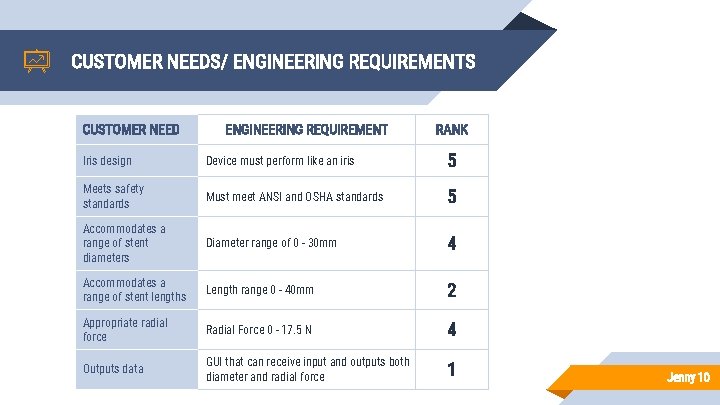
CUSTOMER NEEDS/ ENGINEERING REQUIREMENTS CUSTOMER NEED ENGINEERING REQUIREMENT RANK Iris design Device must perform like an iris 5 Meets safety standards Must meet ANSI and OSHA standards 5 Accommodates a range of stent diameters Diameter range of 0 - 30 mm 4 Accommodates a range of stent lengths Length range 0 - 40 mm 2 Appropriate radial force Radial Force 0 - 17. 5 N 4 Outputs data GUI that can receive input and outputs both diameter and radial force 1 Jenny 10
CONCLUSION ● ● Why are stents important? Team goal ○ Design and develop an automatic stent crimping device that utilizes an iris design with a radial force output. SOTA Literature Review ○ Purpose of crimping stents ○ Stent dimensions ○ Pre-existing Designs Customer needs and Engineering requirements Jenny 11
![REFERENCES [1] S. Zhao, L. Gu, and S. R. Froemming, “On the importance of](http://slidetodoc.com/presentation_image_h2/0a75b97e9b1843e0b671c1c4385877ec/image-12.jpg "REFERENCES [1] S. Zhao, L. Gu, and S. R. Froemming, “On the importance of")
REFERENCES [1] S. Zhao, L. Gu, and S. R. Froemming, “On the importance of modeling stent procedure for predicting arterial mechanics, ” J. Biomech. Eng. , vol. 134, no. 12, pp. 2– 7, 2012. [2] M. A. Geith, K. Swidergal, B. Hochholdinger, T. G. Schratzenstaller, M. Wagner, and G. A. Holzapfel, “On the importance of modeling balloon folding, pleating, and stent crimping: An FE study comparing experimental inflation tests, ” Int. j. numer. method. biomed. eng. , vol. 35, no. 11, pp. 1– 19, 2019. [3] K. Anders, “Coronary artery stents, ” Card. CT, Second Ed. , vol. 284, no. 14, pp. 199– 224, 2014. [4] S. Hähnel et al. , “Small-vessel stents for intracranial angioplasty: In vitro comparison of different stent designs and sizes by using CT angiography, ” Am. J. Neuroradiol. , vol. 24, no. 8, pp. 1512– 1516, 2003. [5] V. Stent, “Zilver Vascular Stent, ” Biomed. Saf. Stand. , vol. 46, no. 6, p. 45, 2016. [6] P. Hindy, J. Hong, Y. Lam-Tsai, and F. Gress, “A comprehensive review of esophageal stents, ” Clin. Adv. Hematol. Oncol. , vol. 10, no. 8, pp. 526– 534, 2012. 12
![[7] M. Austin, “Apparatus for Contracting, Loading, or Crimping Self-expanding and Balloon Expandable Stent](http://slidetodoc.com/presentation_image_h2/0a75b97e9b1843e0b671c1c4385877ec/image-13.jpg "[7] M. Austin, “Apparatus for Contracting, Loading, or Crimping Self-expanding and Balloon Expandable Stent")
[7] M. Austin, “Apparatus for Contracting, Loading, or Crimping Self-expanding and Balloon Expandable Stent Devices, ” 6, 915, 560 B 2, 2005. [8] M. Edin, “Stent Crimper, ” 7, 143, 625 B 2, 2005. [9] Asbemaister and 10 products, “Camera Aperture Model, ” Camera iris aperture 3 D model - Turbo. Squid 1325444, 09 -Sep-2018. [Online]. Available: https: //www. turbosquid. com/3 d-models/camera-iris-aperture-3 d -model-1325444. [Accessed: 04 -Feb-2020]. 13

Any questions? 14
- Slides: 14