
Nature Run Diagnostics Thomas Jung ECMWF Another Nature


- Slides: 26
“Nature Run” Diagnostics Thomas Jung ECMWF
Another “Nature Run” • A large set of seasonal TL 511 L 91 integrations has been carried out for many summers and winters: – NDJFM 1990 -2005 – JJASON 1990 -2005 • Data have been archived on PL and SFC levels only (6 -hourly) • Advantage: We get an idea of the climate of IFS cycle 31 R 1 at TL 511 used to carry out the “Nature Run”
Extratropical Cyclones
Vorticity Histograms: Extratropical Cyclone Tracks ERA-40 EC-T 511
Maximum Vorticity Histograms: Extratropical Cyclone Tracks ERA-40 EC-T 511
Number of Extratropical Cyclones ERA 40 EC-T 511 - ERA 40 Life time: 2 days or longer; Minimum migration: 1000 km
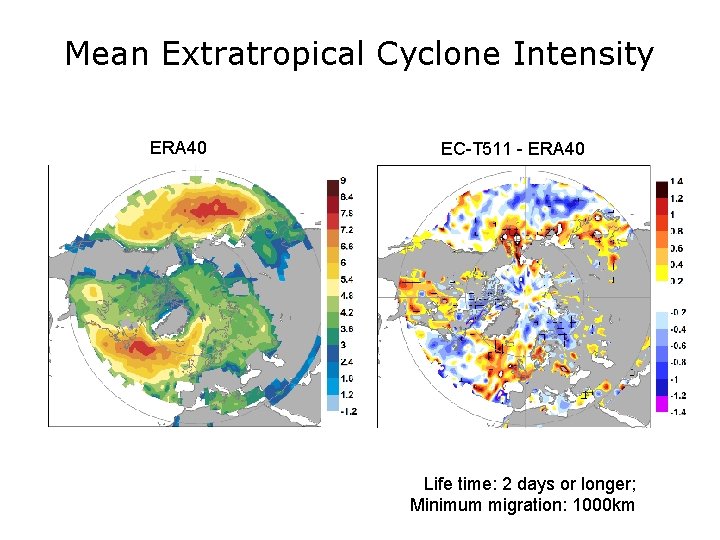
Mean Extratropical Cyclone Intensity ERA 40 EC-T 511 - ERA 40 Life time: 2 days or longer; Minimum migration: 1000 km
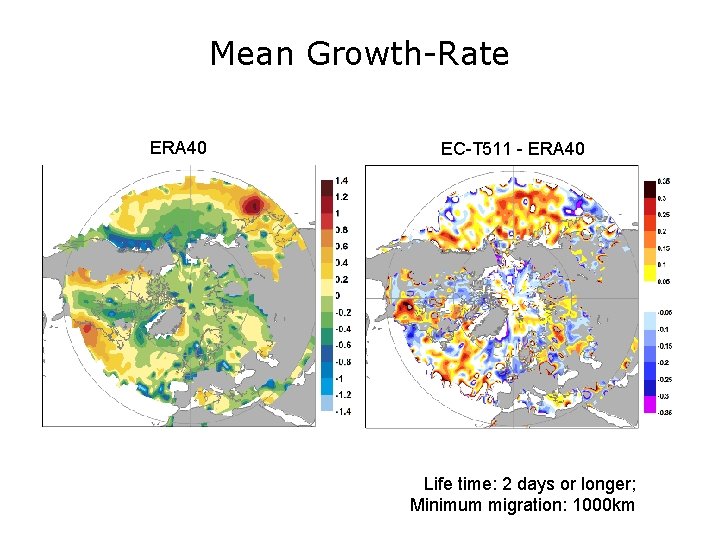
Mean Growth-Rate ERA 40 EC-T 511 - ERA 40 Life time: 2 days or longer; Minimum migration: 1000 km
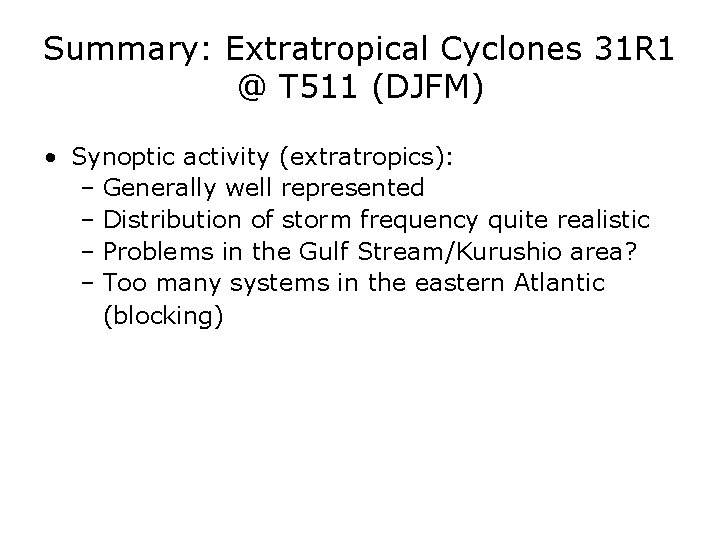
Summary: Extratropical Cyclones 31 R 1 @ T 511 (DJFM) • Synoptic activity (extratropics): – Generally well represented – Distribution of storm frequency quite realistic – Problems in the Gulf Stream/Kurushio area? – Too many systems in the eastern Atlantic (blocking)
Tropical Cyclones & African Summer Monsoon in T 511 Run
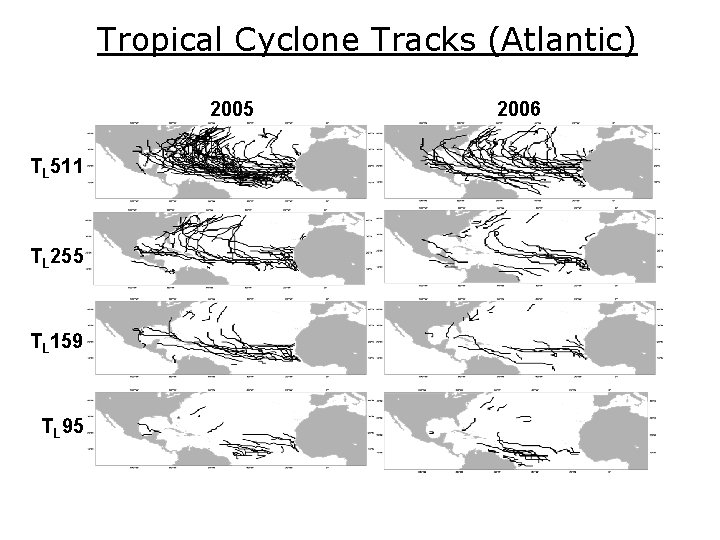
Tropical Cyclone Tracks (Atlantic) 2005 TL 511 TL 255 TL 159 TL 95 2006
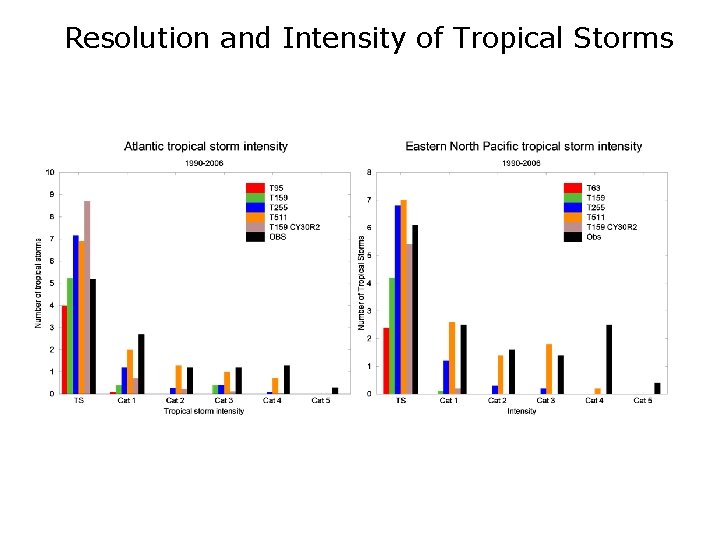
Resolution and Intensity of Tropical Storms
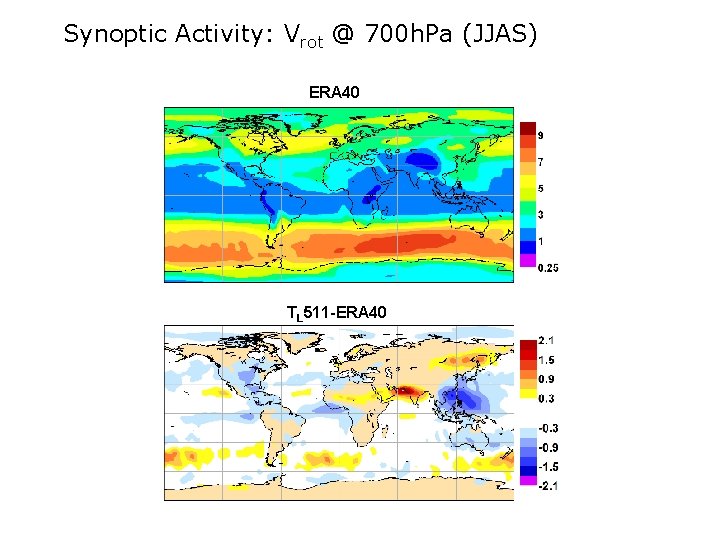
Synoptic Activity: Vrot @ 700 h. Pa (JJAS) ERA 40 TL 511 -ERA 40
Zonal Mean Zonal Wind: AEJ Area
200 h. Pa Velocity Potential ERA 40 T 511 - ERA 40
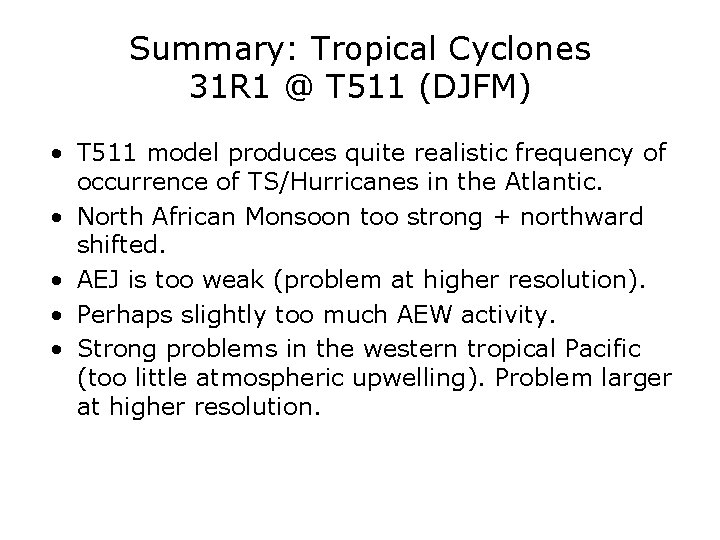
Summary: Tropical Cyclones 31 R 1 @ T 511 (DJFM) • T 511 model produces quite realistic frequency of occurrence of TS/Hurricanes in the Atlantic. • North African Monsoon too strong + northward shifted. • AEJ is too weak (problem at higher resolution). • Perhaps slightly too much AEW activity. • Strong problems in the western tropical Pacific (too little atmospheric upwelling). Problem larger at higher resolution.
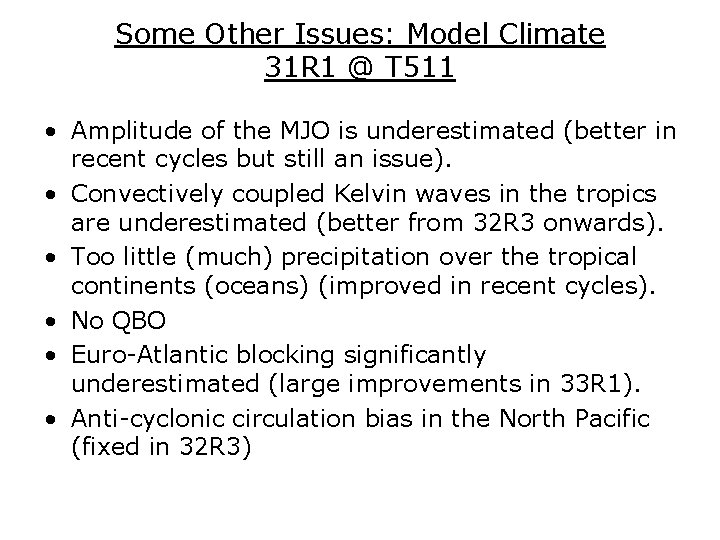
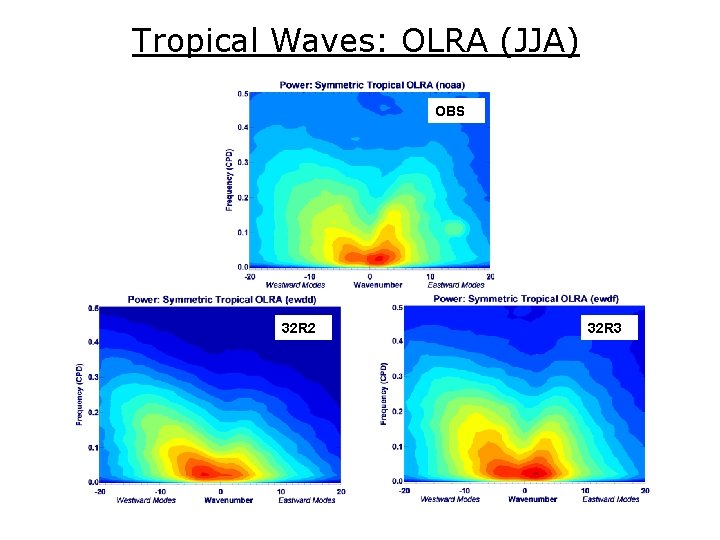
Some Other Issues: Model Climate 31 R 1 @ T 511 • Amplitude of the MJO is underestimated (better in recent cycles but still an issue). • Convectively coupled Kelvin waves in the tropics are underestimated (better from 32 R 3 onwards). • Too little (much) precipitation over the tropical continents (oceans) (improved in recent cycles). • No QBO • Euro-Atlantic blocking significantly underestimated (large improvements in 33 R 1). • Anti-cyclonic circulation bias in the North Pacific (fixed in 32 R 3)
Tropical Cyclones: 32 R 3 vs 32 R 2
Tropical Waves: OLRA (JJA) OBS 32 R 2 32 R 3
Tropical Cyclones Frequencies (Annual Mean) Note: TL 159 L 91
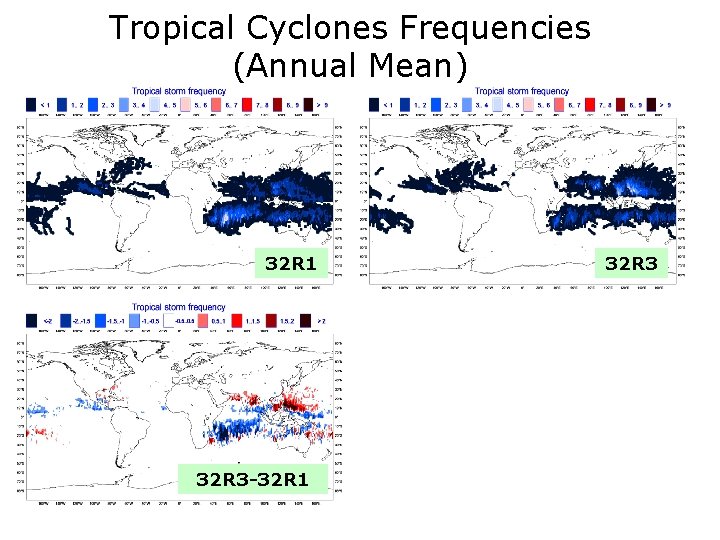
Tropical Cyclones Frequencies (Annual Mean) 32 R 1 32 R 3 -32 R 1 32 R 3
Tropical Cyclones in Recent Model Cycles • Generally there is an increase in the number/intensity of tropical cyclones/hurricanes. • Particularly lower resolution versions perform better than older cycles (e. g. , US landfall). • Large increases in the western tropical Pacific (partly due changes in the large-scale atmospheric circulation). Too large?
Tropical Cyclone Forecasts: T 799 vs T 511
Forecasts of Katrina for Monday 29 Aug. 12 UTC T 511 T 799 t+36 t+72 Observed SLP: 922 h. Pa
Forecasts of Rita for Saturday 24 Sep. 12 UTC T 511 T 799 t+36 t+72 Observed SLP: 930 h. Pa
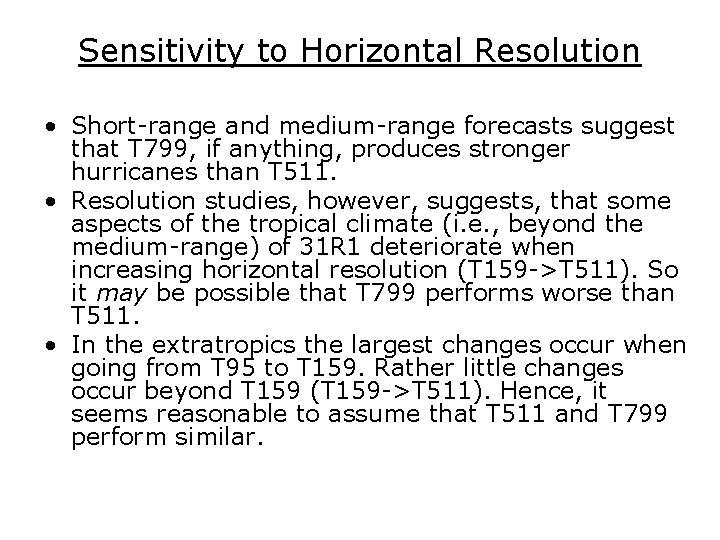
Sensitivity to Horizontal Resolution • Short-range and medium-range forecasts suggest that T 799, if anything, produces stronger hurricanes than T 511. • Resolution studies, however, suggests, that some aspects of the tropical climate (i. e. , beyond the medium-range) of 31 R 1 deteriorate when increasing horizontal resolution (T 159 ->T 511). So it may be possible that T 799 performs worse than T 511. • In the extratropics the largest changes occur when going from T 95 to T 159. Rather little changes occur beyond T 159 (T 159 ->T 511). Hence, it seems reasonable to assume that T 511 and T 799 perform similar.