
Nature offers us a variety of energy sources
- Slides: 40
Nature offers us a variety of energy sources • We use energy in our homes, machinery, and vehicles and to provide comfort and conveniences • Most of our energy comes from the sun • Solar, wind, hydroelectric, photosynthesis, biomass • Fossil fuels = highly combustible substances from the remains of organisms from past geologic ages • Immense amounts of energy reside in an atom’s bonds • nuclear power
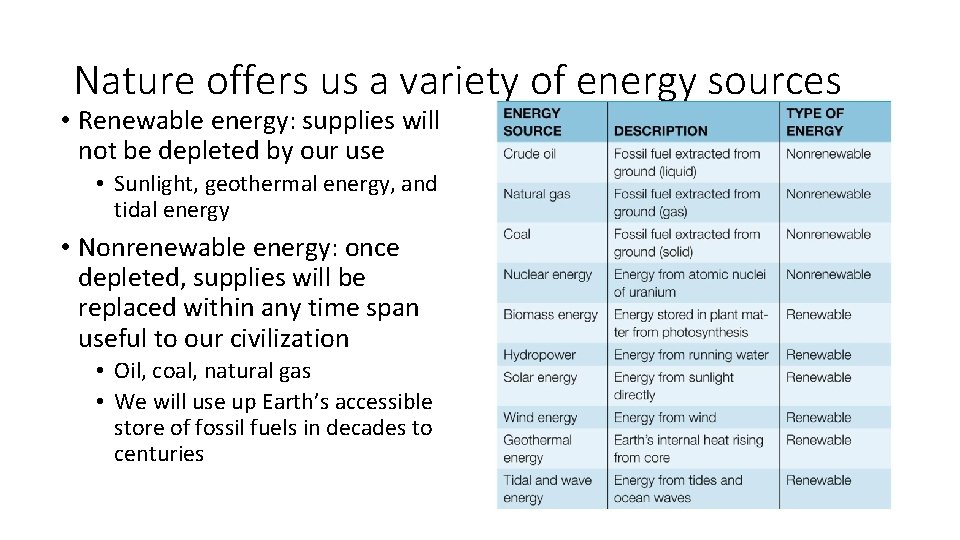
Nature offers us a variety of energy sources • Renewable energy: supplies will not be depleted by our use • Sunlight, geothermal energy, and tidal energy • Nonrenewable energy: once depleted, supplies will be replaced within any time span useful to our civilization • Oil, coal, natural gas • We will use up Earth’s accessible store of fossil fuels in decades to centuries
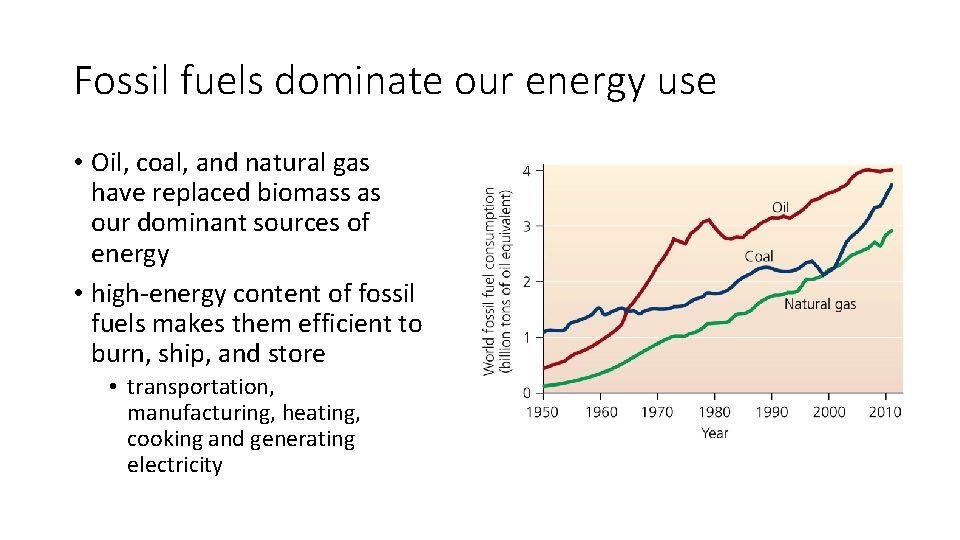
Fossil fuels dominate our energy use • Oil, coal, and natural gas have replaced biomass as our dominant sources of energy • high-energy content of fossil fuels makes them efficient to burn, ship, and store • transportation, manufacturing, heating, cooking and generating electricity
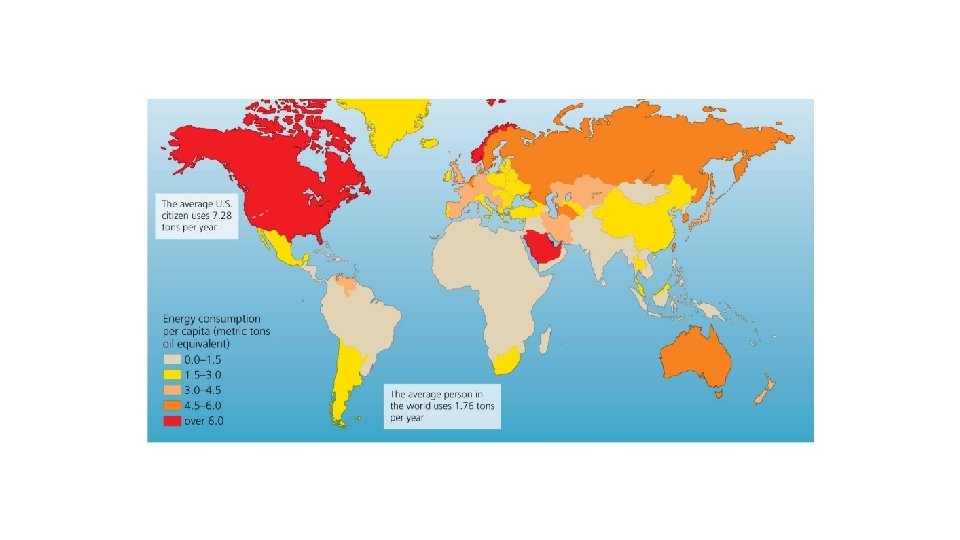
Fossil fuels dominate our energy use • Developing nations use a greater portion of their energy for subsistence activities • Agriculture, food preparation, and home heating • Less for transportation • manual or animal energy, not fossil fuels • Industrialized nations rely more on technology and equipment so use more fossil fuels • Fossil fuels = 82% of the U. S. energy demand
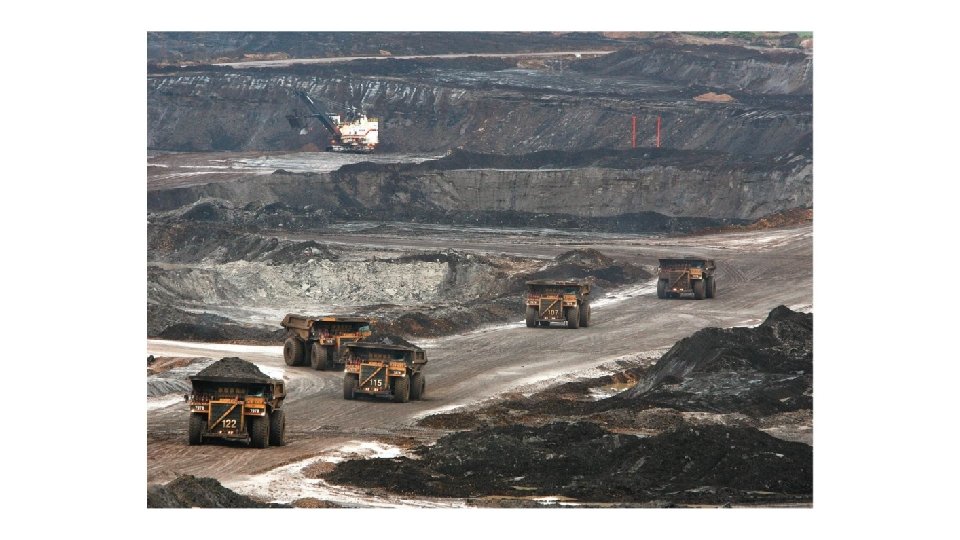
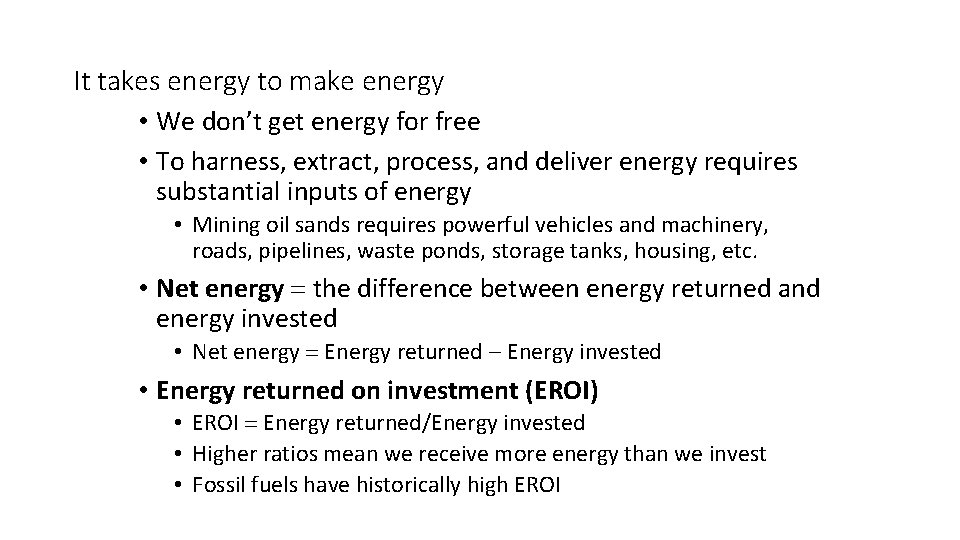
It takes energy to make energy • We don’t get energy for free • To harness, extract, process, and deliver energy requires substantial inputs of energy • Mining oil sands requires powerful vehicles and machinery, roads, pipelines, waste ponds, storage tanks, housing, etc. • Net energy = the difference between energy returned and energy invested • Net energy = Energy returned - Energy invested • Energy returned on investment (EROI) • EROI = Energy returned/Energy invested • Higher ratios mean we receive more energy than we invest • Fossil fuels have historically high EROI
Future for energy? • The astonishing advances of the 20 th century were powered by abundant fossil fuels • Over time we depleted the easy-to-reach sources • EROIs rose, and fuel became more expensive • new technologies to reach new fossil fuel deposits and get more fuel from old ones • We have included new, poorer quality sources such as oil sands and shale oil
• An alternate strategy to finding more fossil fuels is to switch to clean and renewable energy sources • The switch has begun, but fossil fuels still dominate
Fossil fuels are formed from ancient organic matter • Fossil fuels we use today were formed from organisms that lived 100– 500 million years ago • chemical energy in their tissues was concentrated as the hydrocarbons were altered and compressed • Aerobic decomposition = organic material is broken down and recycled in the presence of air
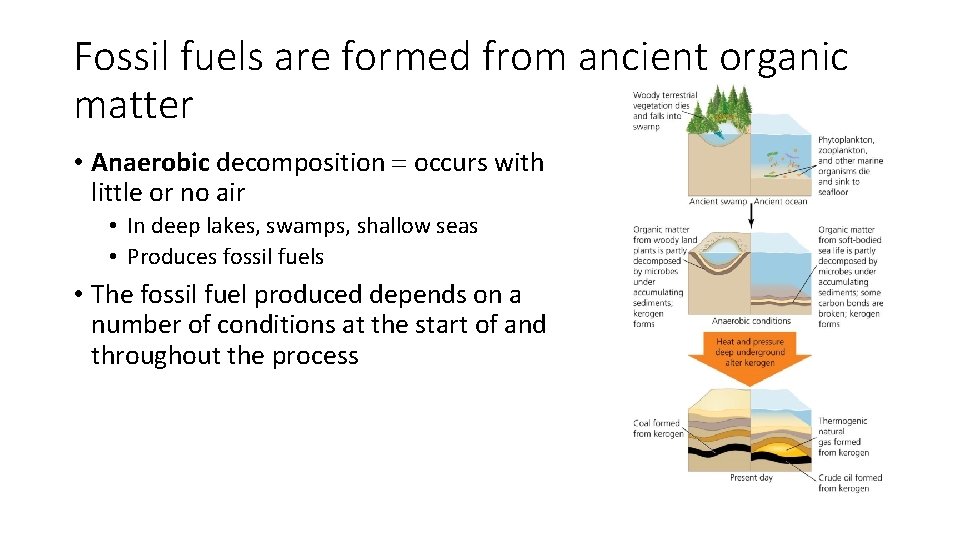
Fossil fuels are formed from ancient organic matter • Anaerobic decomposition = occurs with little or no air • In deep lakes, swamps, shallow seas • Produces fossil fuels • The fossil fuel produced depends on a number of conditions at the start of and throughout the process
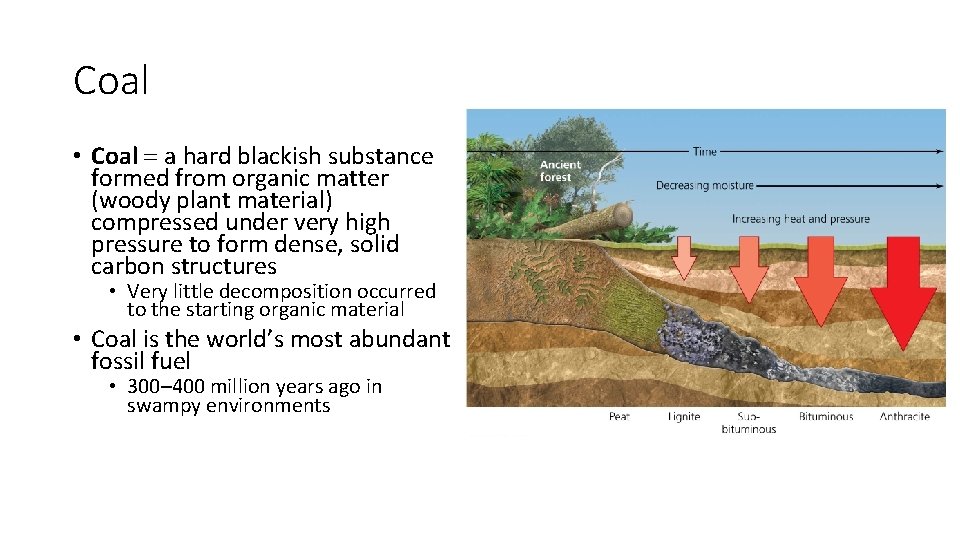
Coal • Coal = a hard blackish substance formed from organic matter (woody plant material) compressed under very high pressure to form dense, solid carbon structures • Very little decomposition occurred to the starting organic material • Coal is the world’s most abundant fossil fuel • 300– 400 million years ago in swampy environments
Coal • Coal varies from deposit to deposit in water and carbon content and its amount of potential energy • Peat = organic material that is broken down anaerobically • It is wet, near the surface, and not well compressed • Additional pressure, heat, and time turn peat into coal
Oil and natural gas • Crude oil (petroleum) = a sludgelike liquid mixture of hundreds of different types of hydrocarbon molecules • Natural gas = methane (CH 4) and other volatile hydrocarbons • Formed when dead organic material was buried in marine sediments and transformed by time, heat, and pressure • Organic matter is turned into kerogen, source material for both crude oil and natural gas • kerogen is 1. 5– 3 km (1– 2 mi) below the surface, it becomes crude oil • below 3 km, it becomes natural gas
Oil sands and Oil shale • Oil sands (tar sands) = sand clay deposits with 1%– 20% bitumen = a form of petroleum rich in carbon, poor in hydrogen • Comes from crude oil deposits that have been degraded and chemically altered by water and bacteria • Oil shale = sedimentary rock filled with kerogen • Can be processes to produce shale oil = a liquid form of petroleum • Forms when kerogen was not buried deeply enough or was not subject to enough heat and pressure
Methane hydrate • Methane hydrate (methane clathrate or methane ice) = molecules of methane in a crystal lattice of ice molecules • Occurs in sediments in the Arctic and the ocean floor
We mine and drill for fossil fuels • Fossil fuels of each type occur in isolated deposits • Oil and natural gas collect in porous rock under impermeable layers • Geologists drill cores and survey the ground air to predict where fossil fuels may lie • Exploratory drilling = drilling small, deep holes to determine whether extraction should be done • Oil is under pressure and often rises to the surface • Drilling reduces pressure, and oil becomes harder to extract
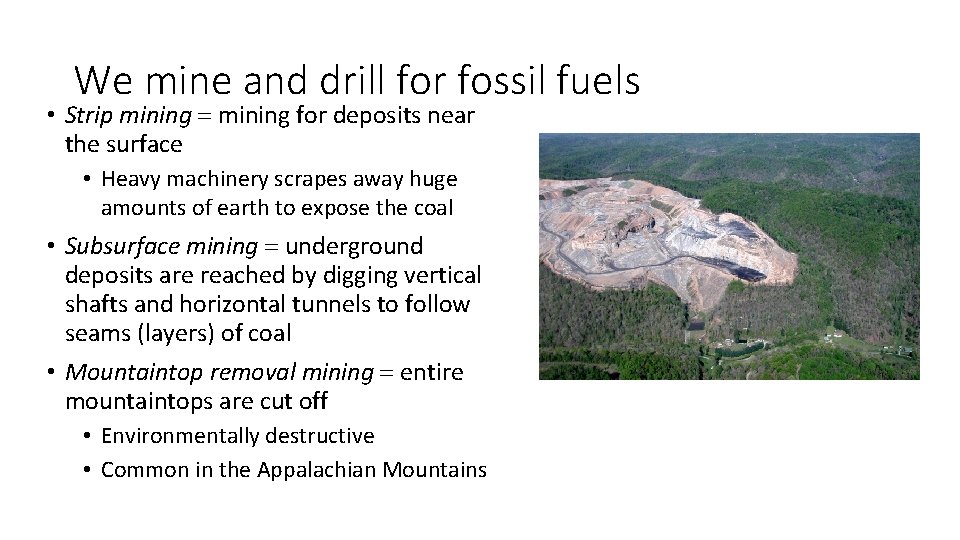
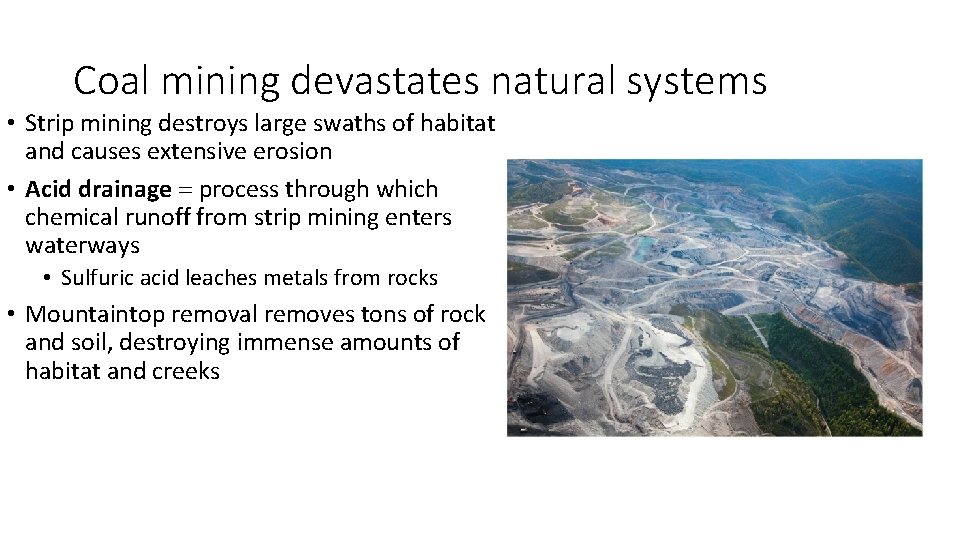
We mine and drill for fossil fuels • Strip mining = mining for deposits near the surface • Heavy machinery scrapes away huge amounts of earth to expose the coal • Subsurface mining = underground deposits are reached by digging vertical shafts and horizontal tunnels to follow seams (layers) of coal • Mountaintop removal mining = entire mountaintops are cut off • Environmentally destructive • Common in the Appalachian Mountains
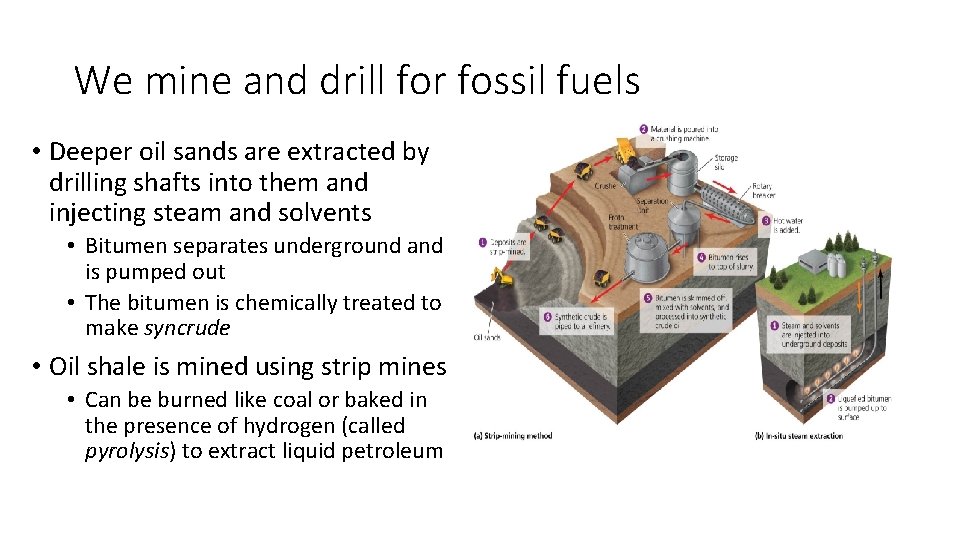
We mine and drill for fossil fuels • Oil sands are extracted using 2 methods • For surface deposits, a process like strip mining is used • Collected sands are mixed with hot water to separate out the bitumen • Produces three times as much polluted water as oil
We mine and drill for fossil fuels • Deeper oil sands are extracted by drilling shafts into them and injecting steam and solvents • Bitumen separates underground and is pumped out • The bitumen is chemically treated to make syncrude • Oil shale is mined using strip mines • Can be burned like coal or baked in the presence of hydrogen (called pyrolysis) to extract liquid petroleum
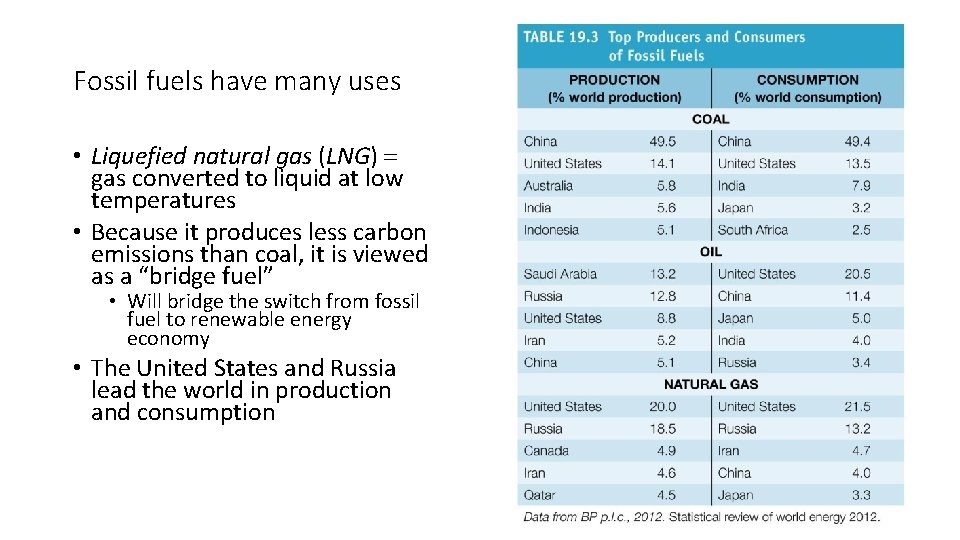
Fossil fuels have many uses • Cultures have used coal for centuries • Ancient China, Roman Empire, the Hopi Nation • Coal helped drive the Industrial Revolution • It fueled furnaces to produce steam • Coal is used to generate electricity • It converts water to steam, which turns a turbine • China is the primary producer and consumer of coal • provides 40% of the United States’ electrical generating capacity
Fossil fuels have many uses • Natural gas is versatile and clean-burning • Emits half as much CO 2 as coal, two-thirds as much as oil per unit energy produced • It is used to generate electricity, heat homes, and cook
Fossil fuels have many uses • Liquefied natural gas (LNG) = gas converted to liquid at low temperatures • Because it produces less carbon emissions than coal, it is viewed as a “bridge fuel” • Will bridge the switch from fossil fuel to renewable energy economy • The United States and Russia lead the world in production and consumption
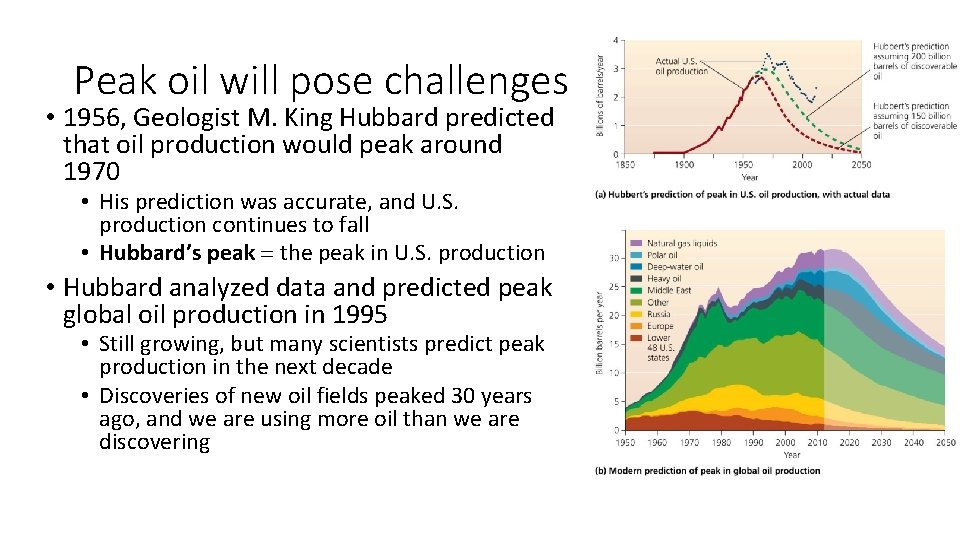
Peak oil will pose challenges • 1956, Geologist M. King Hubbard predicted that oil production would peak around 1970 • His prediction was accurate, and U. S. production continues to fall • Hubbard’s peak = the peak in U. S. production • Hubbard analyzed data and predicted peak global oil production in 1995 • Still growing, but many scientists predict peak production in the next decade • Discoveries of new oil fields peaked 30 years ago, and we are using more oil than we are discovering
Peak oil will pose challenges • Each discovery of new oil sources delays the peak by increasing proven reserves • Exploiting Canada’s oil sands increased global proven reserves • Some count on continuous new sources • Predicting an exact date for peak oil is hard • Companies and governments do not disclose their amount of oil supply • Disagreement among geologists about reserves • The U. S. Geological Survey estimated twice the proven oil reserves as earlier estimates
Peak oil will pose challenges • Peak production will occur • Our lives will be profoundly affected • “The long emergency”: lacking cheap oil to transport goods, our economies collapse and become localized • Large cities could not be supported without urban agriculture • Fewer petroleum-based fertilizers and pesticides would mean increase in hunger • Suburbs will be hit hard due to reliance on cars
Peak oil will pose challenges • More optimistic observers argue that as supplies dwindle, conservation and alternative energies will kick in • We will be saved from major disruptions
Or we might end up with “too much” fossil fuel energy? • Efforts are being made to develop alternative energy • We are also reaching farther fossil fuels • A number of approaches are being used to extract more fossil fuels • • • Secondary extraction from existing wells Hydraulic fracturing for oil and shale gas Offshore drilling in increasingly deep waters Moving into ice-free waters of the Arctic Exploiting “unconventional” fossil fuel sources
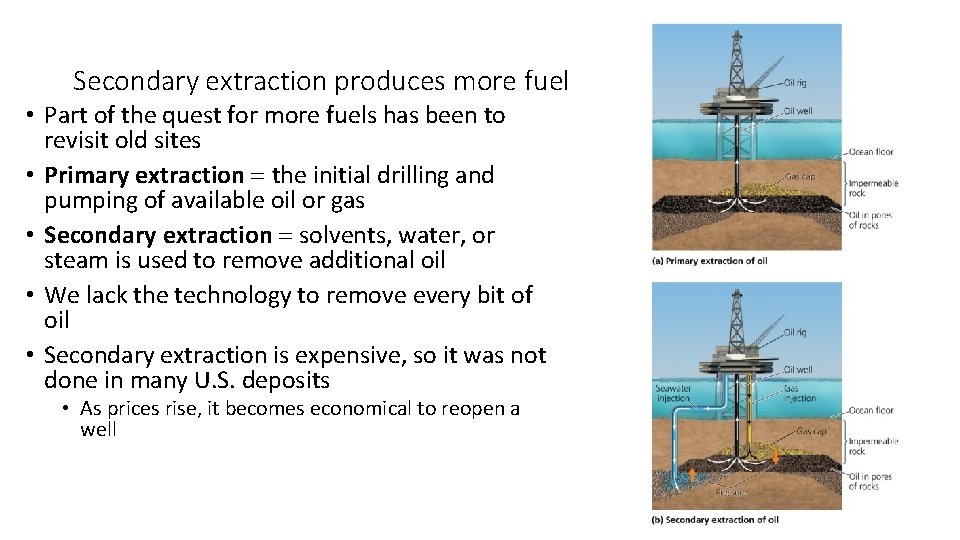
Secondary extraction produces more fuel • Part of the quest for more fuels has been to revisit old sites • Primary extraction = the initial drilling and pumping of available oil or gas • Secondary extraction = solvents, water, or steam is used to remove additional oil • We lack the technology to remove every bit of oil • Secondary extraction is expensive, so it was not done in many U. S. deposits • As prices rise, it becomes economical to reopen a well
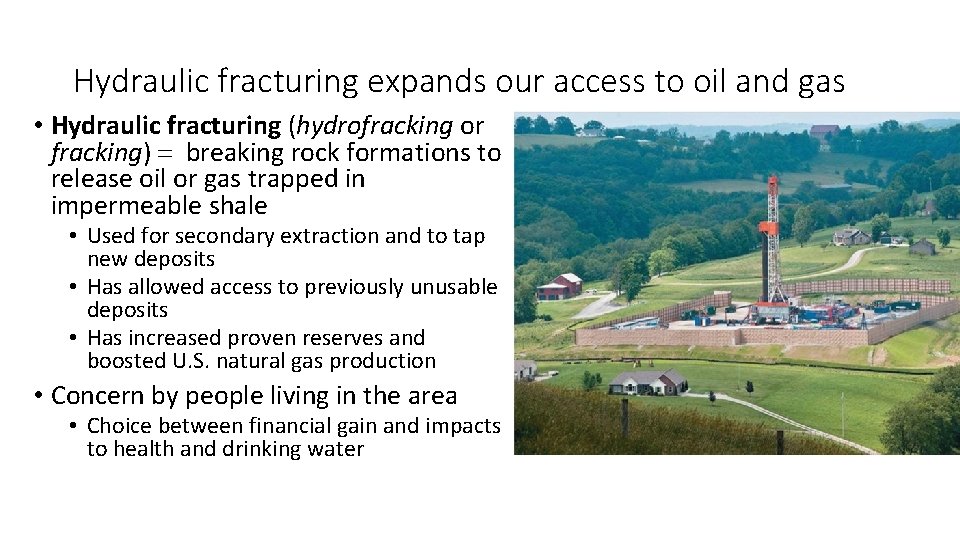
Hydraulic fracturing expands our access to oil and gas • Hydraulic fracturing (hydrofracking or fracking) = breaking rock formations to release oil or gas trapped in impermeable shale • Used for secondary extraction and to tap new deposits • Has allowed access to previously unusable deposits • Has increased proven reserves and boosted U. S. natural gas production • Concern by people living in the area • Choice between financial gain and impacts to health and drinking water
We are drilling farther and farther offshore • Drilling platforms must withstand wind, waves, and currents • Produce 35% of the oil and 10% of the natural gas extracted in the United States
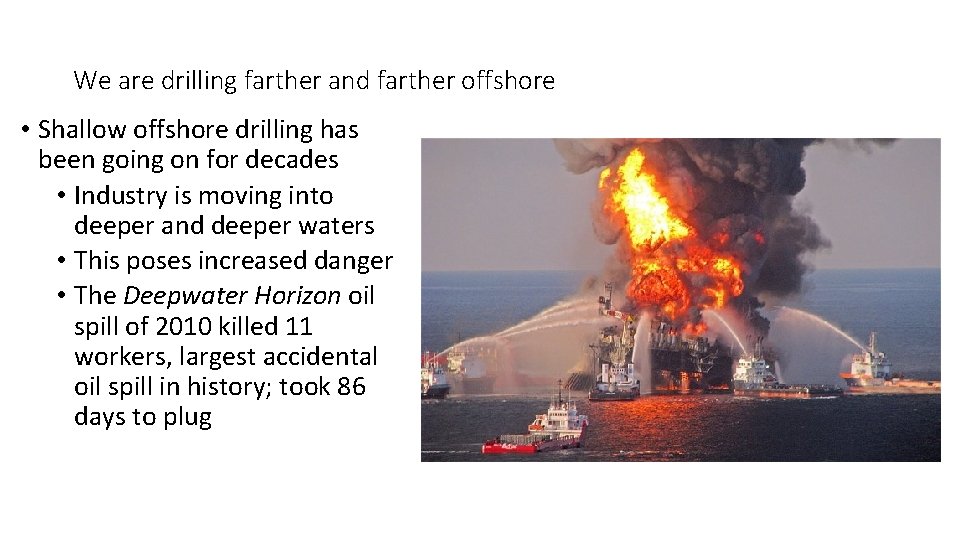
We are drilling farther and farther offshore • Shallow offshore drilling has been going on for decades • Industry is moving into deeper and deeper waters • This poses increased danger • The Deepwater Horizon oil spill of 2010 killed 11 workers, largest accidental oil spill in history; took 86 days to plug
We are exploiting new fossil fuel sources • Oil sands in Canada and Venezuela are already increasing available oil • Known deposits of oil shale may contain more oil than all conventional crude in the world • Most will not be easy to extract
We are exploiting new fossil fuel sources • We are just figuring out how to extract methane hydrates • There may be immense amounts • Do not know if extraction is safe or could cause a massive gas release • Collectively, their net energy values are low because they are expensive to extract and process
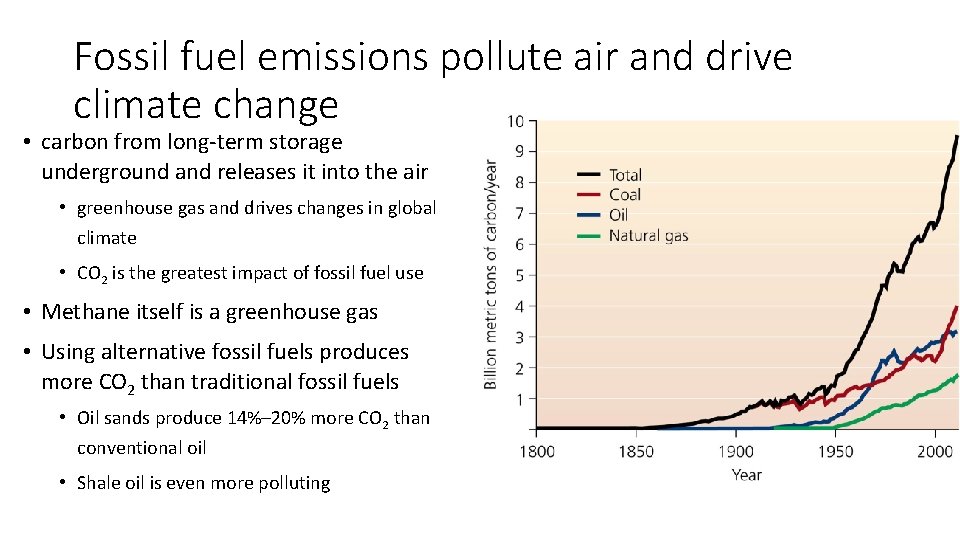
Fossil fuel emissions pollute air and drive climate change • carbon from long-term storage underground and releases it into the air • greenhouse gas and drives changes in global climate • CO 2 is the greatest impact of fossil fuel use • Methane itself is a greenhouse gas • Using alternative fossil fuels produces more CO 2 than traditional fossil fuels • Oil sands produce 14%– 20% more CO 2 than conventional oil • Shale oil is even more polluting
Fossil fuel emissions pollute air and drive climate change • Emissions cause severe health problems • Burning coal high in mercury releases it into the environment • Bioaccumulates, poisoning animals and posing a threat to humans • Pollutants are produced by burning gasoline or evaporate from crude oil • Irritate nose, throat, lungs; can cause cancer • Burning oil and coal produces sulfur dioxide and nitrogen oxides • Contribute to smog formation and acid deposition
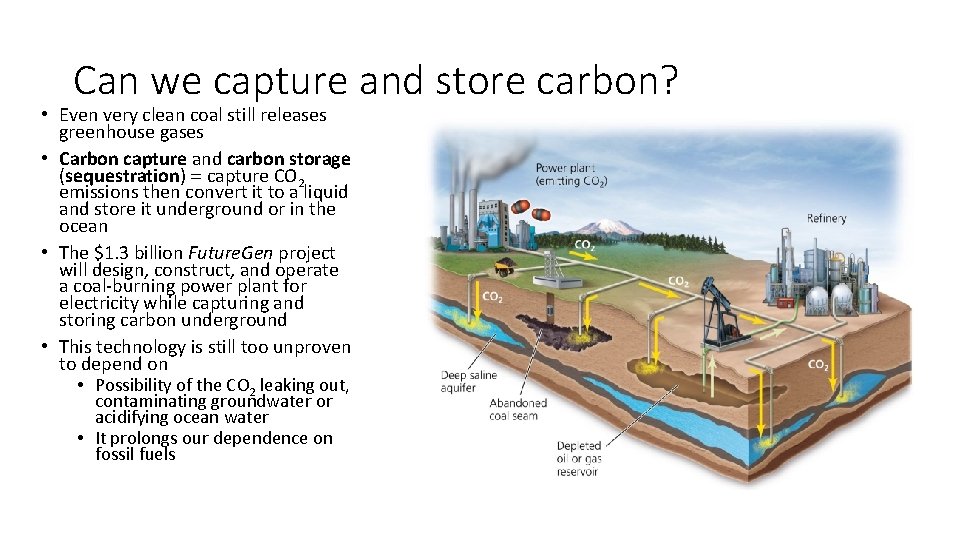
Can we capture and store carbon? • Even very clean coal still releases greenhouse gases • Carbon capture and carbon storage (sequestration) = capture CO 2 emissions then convert it to a liquid and store it underground or in the ocean • The $1. 3 billion Future. Gen project will design, construct, and operate a coal-burning power plant for electricity while capturing and storing carbon underground • This technology is still too unproven to depend on • Possibility of the CO 2 leaking out, contaminating groundwater or acidifying ocean water • It prolongs our dependence on fossil fuels
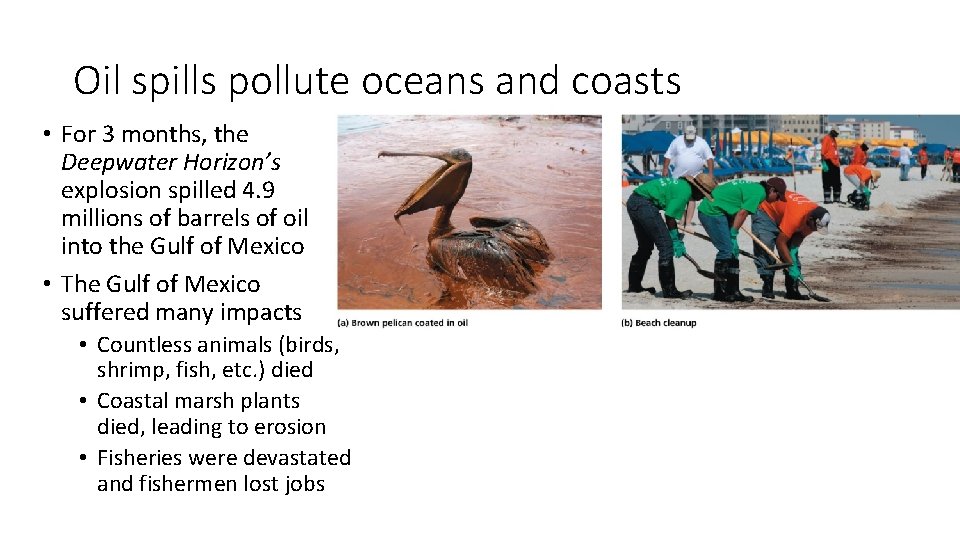
Oil spills pollute oceans and coasts • For 3 months, the Deepwater Horizon’s explosion spilled 4. 9 millions of barrels of oil into the Gulf of Mexico • The Gulf of Mexico suffered many impacts • Countless animals (birds, shrimp, fish, etc. ) died • Coastal marsh plants died, leading to erosion • Fisheries were devastated and fishermen lost jobs
Hydrofracking poses new concerns • Methane and drilling chemicals escape into the air, causing unhealthy conditions • Immense amounts of wastewater are produced • Water may contain salts, radioactive compounds, and toxic substances • Often sent to sewage treatment plants that are not designed to treat these pollutants
Coal mining devastates natural systems • Strip mining destroys large swaths of habitat and causes extensive erosion • Acid drainage = process through which chemical runoff from strip mining enters waterways • Sulfuric acid leaches metals from rocks • Mountaintop removal removes tons of rock and soil, destroying immense amounts of habitat and creeks