
Nature of Science Metric System International System of
- Slides: 25
Nature of Science Metric System. International System of Units
Learning Targets: ➢ Use appropriate tools and equipment for measuring ➢ Use the metric system for measuring ➢ Use the “ladder method” and dimensional analysis to convert values between metric and English units
The Metric System ● ● Standardized system of measurement used by all scientists worldwide. Based on units of 10 ● Similar to our monetary system: 10 cents = dime 100 cents = dollar 10 dimes = dollar
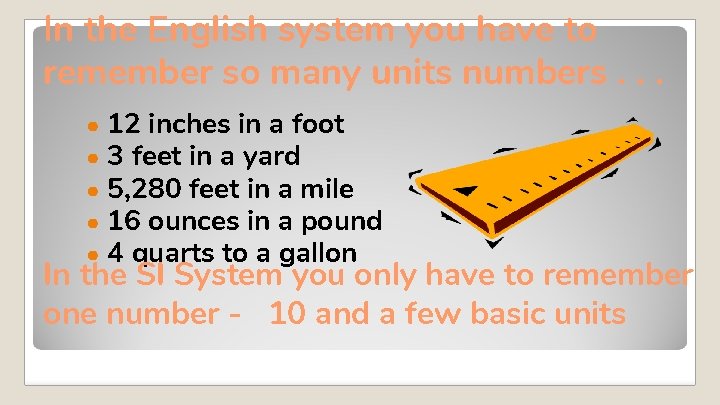
In the English system you have to remember so many units numbers. . . ● ● ● 12 inches in a foot 3 feet in a yard 5, 280 feet in a mile 16 ounces in a pound 4 quarts to a gallon In the SI System you only have to remember one number - 10 and a few basic units
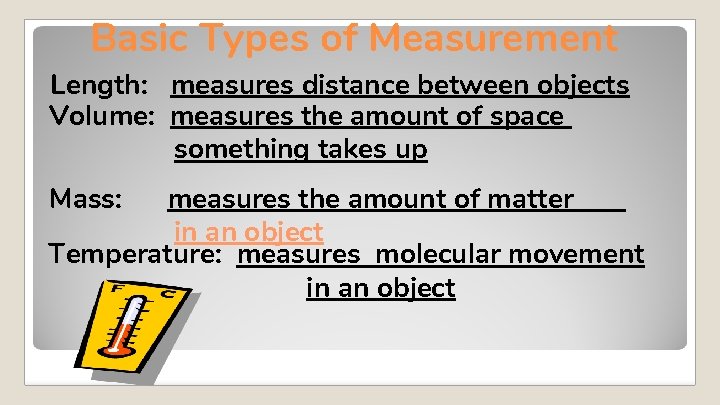
Basic Types of Measurement Length: measures distance between objects Volume: measures the amount of space something takes up Mass: measures the amount of matter in an object Temperature: measures molecular movement in an object
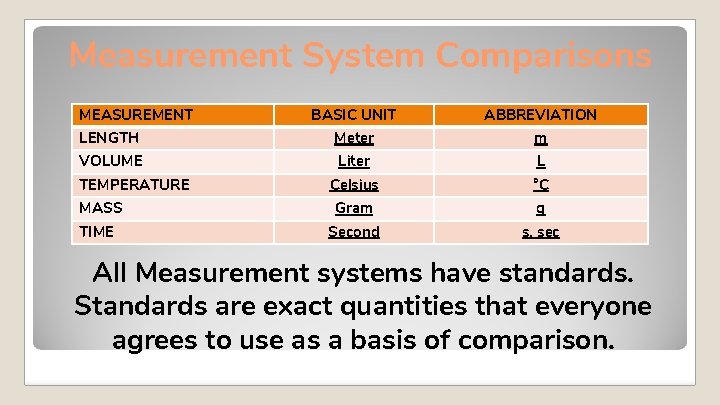
Measurement System Comparisons MEASUREMENT BASIC UNIT ABBREVIATION LENGTH Meter m VOLUME Liter L Celsius °C MASS Gram g TIME Second s, sec TEMPERATURE All Measurement systems have standards. Standards are exact quantities that everyone agrees to use as a basis of comparison.
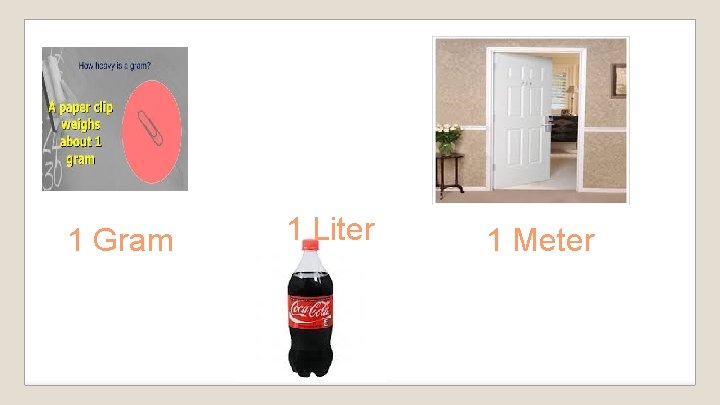
1 Gram 1 Liter 1 Meter
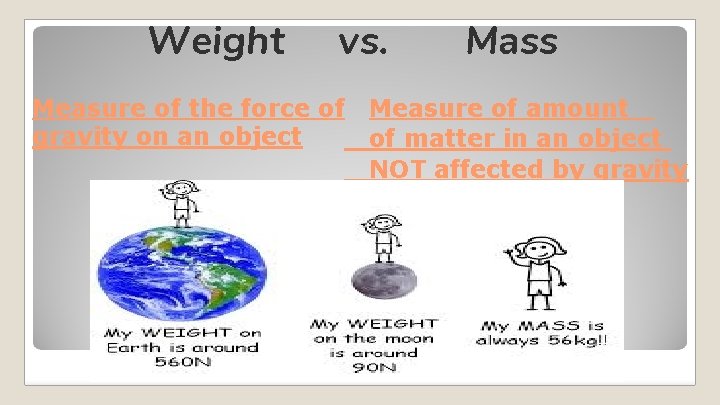
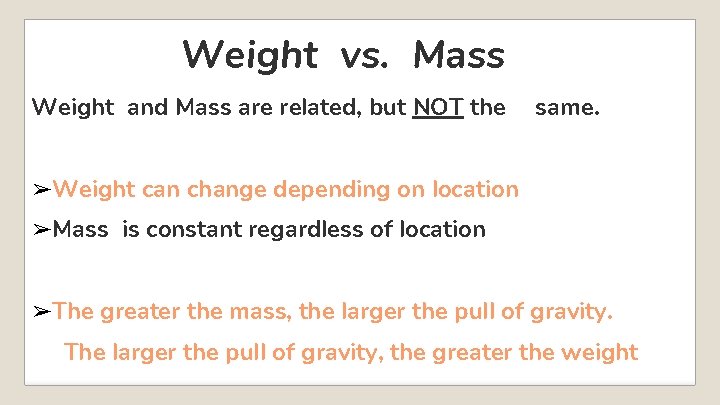
Weight vs. Measure of the force of gravity on an object Mass Measure of amount of matter in an object NOT affected by gravity
Weight vs. Mass Weight and Mass are related, but NOT the same. ➢Weight can change depending on location ➢Mass is constant regardless of location ➢The greater the mass, the larger the pull of gravity. The larger the pull of gravity, the greater the weight
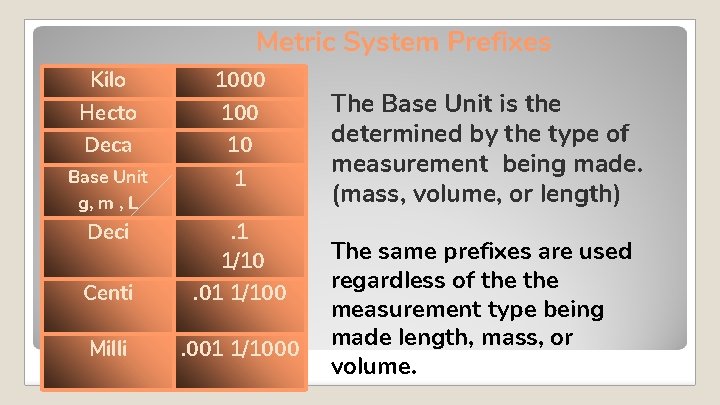
Metric System Prefixes Kilo 1000 Hecto Deca 100 10 Base Unit g, m , L 1 Deci . 1 1/10 Centi . 01 1/100 Milli . 001 1/1000 The Base Unit is the determined by the type of measurement being made. (mass, volume, or length) The same prefixes are used regardless of the measurement type being made length, mass, or volume.
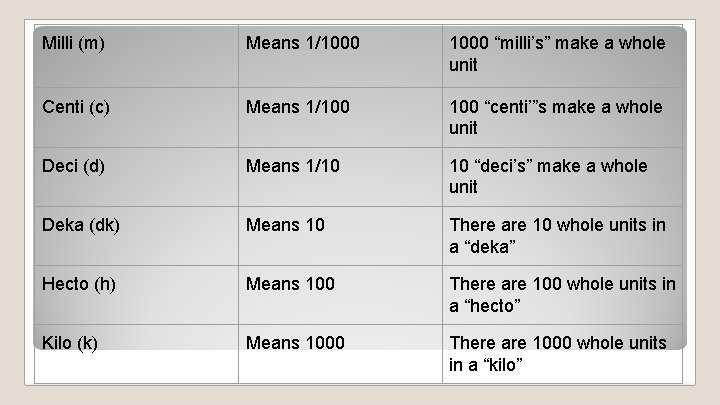
Milli (m) Means 1/1000 “milli’s” make a whole unit Centi (c) Means 1/100 “centi’”s make a whole unit Deci (d) Means 1/10 10 “deci’s” make a whole unit Deka (dk) Means 10 There are 10 whole units in a “deka” Hecto (h) Means 100 There are 100 whole units in a “hecto” Kilo (k) Means 1000 There are 1000 whole units in a “kilo”
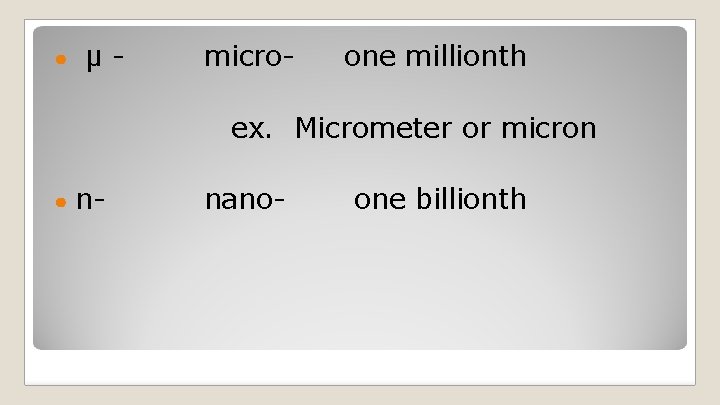
● µ- micro- one millionth ex. Micrometer or micron ● n- nano- one billionth
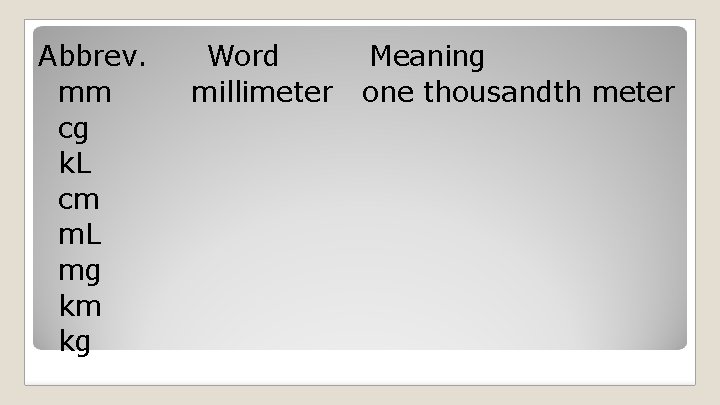
Abbrev. mm cg k. L cm m. L mg km kg Word millimeter Meaning one thousandth meter
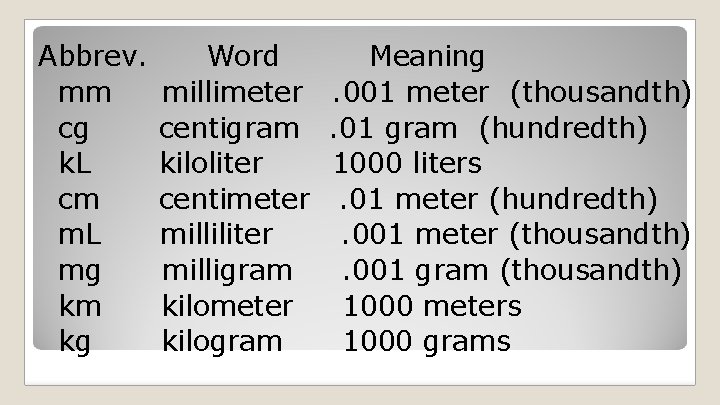
Abbrev. mm cg k. L cm m. L mg km kg Word Meaning millimeter. 001 meter (thousandth) centigram. 01 gram (hundredth) kiloliter 1000 liters centimeter. 01 meter (hundredth) milliliter. 001 meter (thousandth) milligram. 001 gram (thousandth) kilometer 1000 meters kilogram 1000 grams
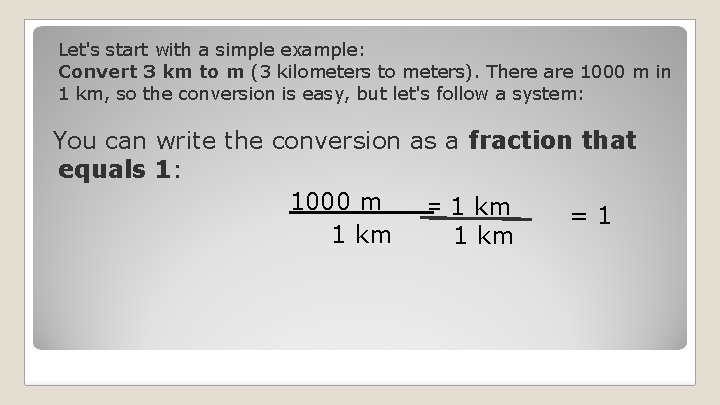
Let's start with a simple example: Convert 3 km to m (3 kilometers to meters). There are 1000 m in 1 km, so the conversion is easy, but let's follow a system: You can write the conversion as a fraction that equals 1: 1000 m = 1 km =1 1 km
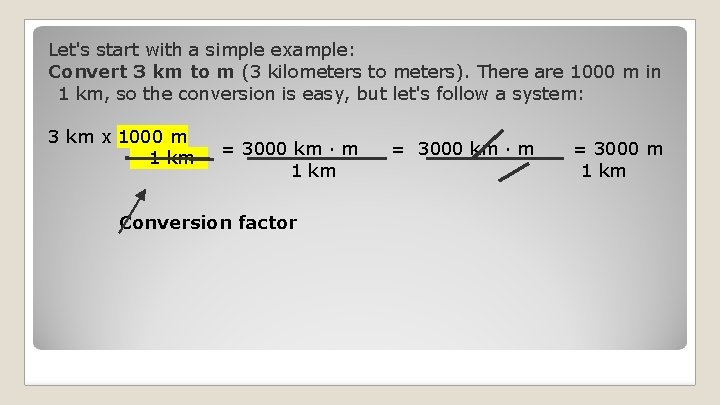
Let's start with a simple example: Convert 3 km to m (3 kilometers to meters). There are 1000 m in 1 km, so the conversion is easy, but let's follow a system: 3 km x 1000 m 1 km = 3000 km · m 1 km Conversion factor = 3000 km · m = 3000 m 1 km
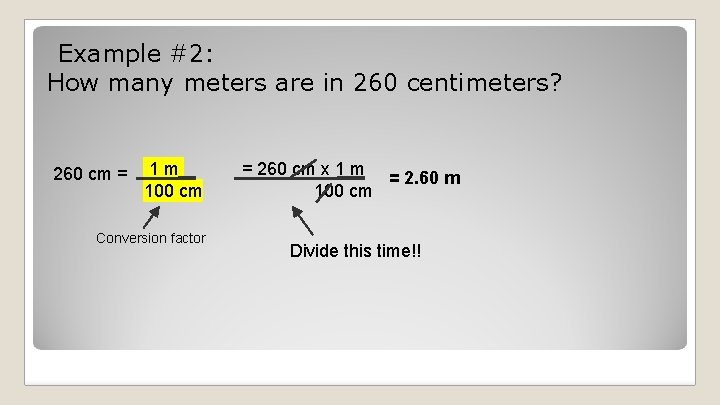
Example #2: How many meters are in 260 centimeters? 260 cm = 1 m 100 cm Conversion factor = 260 cm x 1 m = 2. 60 m 100 cm Divide this time!!
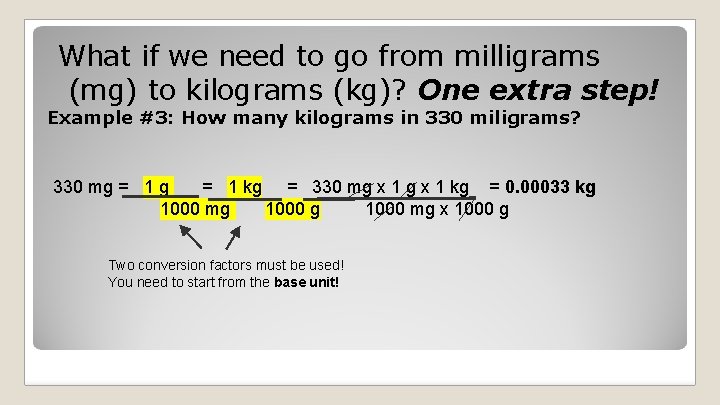
What if we need to go from milligrams (mg) to kilograms (kg)? One extra step! Example #3: How many kilograms in 330 miligrams? 330 mg = 1 kg = 330 mg x 1 kg = 0. 00033 kg 1000 mg x 1000 g Two conversion factors must be used! You need to start from the base unit!
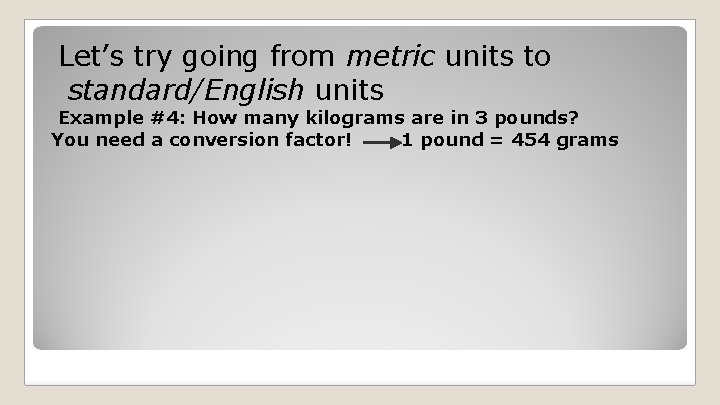
Let’s try going from metric units to standard/English units Example #4: How many kilograms are in 3 pounds? You need a conversion factor! 1 pound = 454 grams
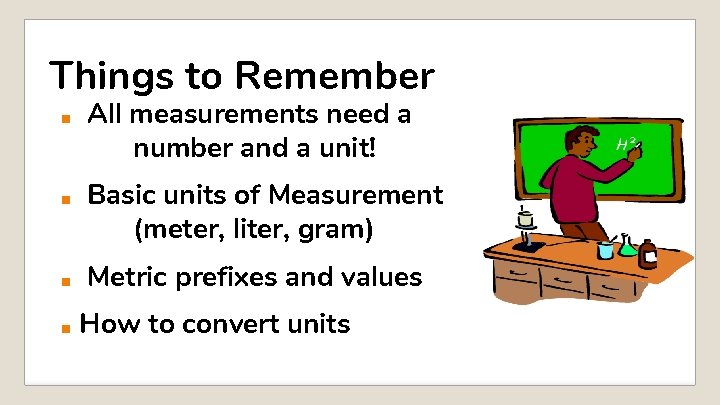
Things to Remember ■ ■ All measurements need a number and a unit! Basic units of Measurement (meter, liter, gram) Metric prefixes and values How to convert units
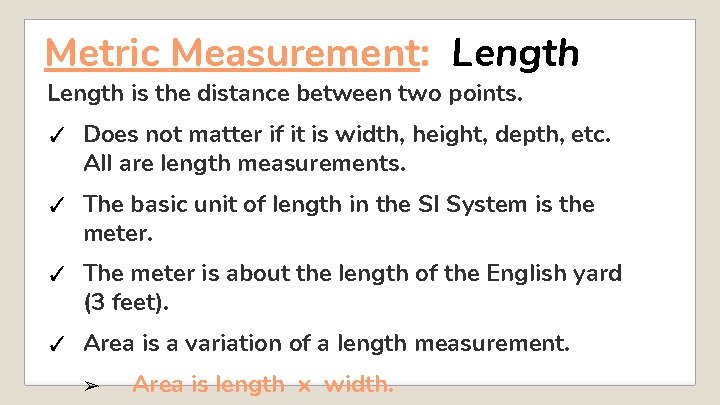
Metric Measurement: Length is the distance between two points. ✓ Does not matter if it is width, height, depth, etc. All are length measurements. ✓ The basic unit of length in the SI System is the meter. ✓ The meter is about the length of the English yard (3 feet). ✓ Area is a variation of a length measurement. ➢ Area is length x width.
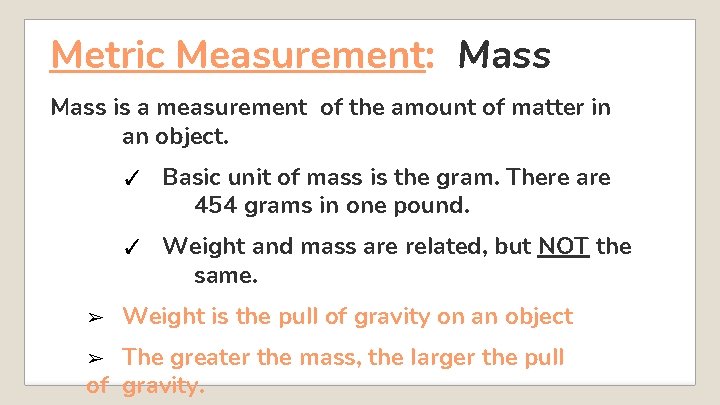
Metric Measurement: Mass is a measurement of the amount of matter in an object. ✓ Basic unit of mass is the gram. There are 454 grams in one pound. ✓ Weight and mass are related, but NOT the same. ➢ Weight is the pull of gravity on an object The greater the mass, the larger the pull of gravity. ➢
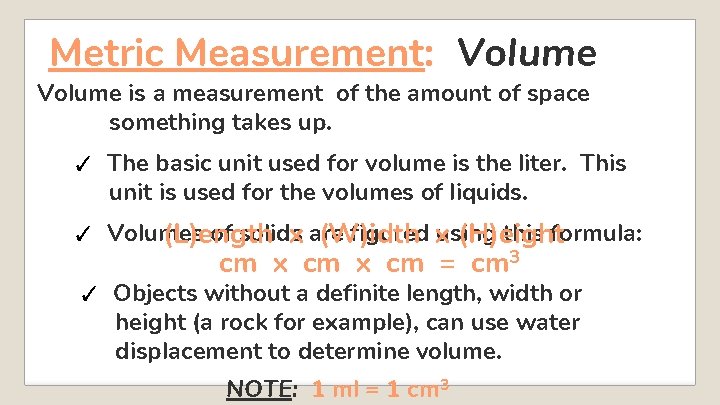
Metric Measurement: Volume is a measurement of the amount of space something takes up. ✓ The basic unit used for volume is the liter. This unit is used for the volumes of liquids. ✓ Volumes of solids figured x using this formula: (L)ength x are (W)idth (H)eight cm x cm = cm 3 ✓ Objects without a definite length, width or height (a rock for example), can use water displacement to determine volume. NOTE: 1 ml = 1 cm 3
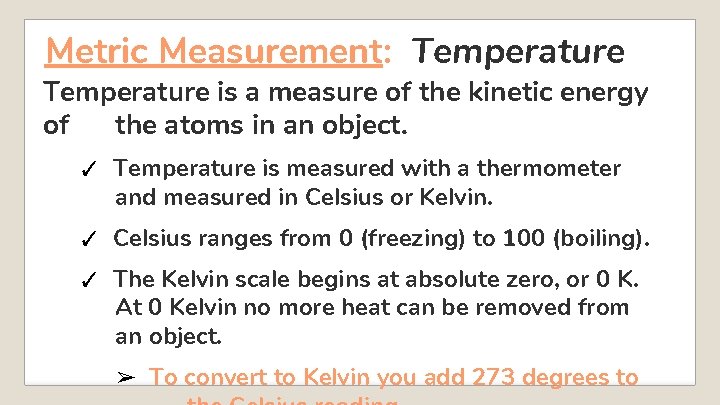
Metric Measurement: Temperature is a measure of the kinetic energy of the atoms in an object. ✓ Temperature is measured with a thermometer and measured in Celsius or Kelvin. ✓ Celsius ranges from 0 (freezing) to 100 (boiling). ✓ The Kelvin scale begins at absolute zero, or 0 K. At 0 Kelvin no more heat can be removed from an object. ➢ To convert to Kelvin you add 273 degrees to
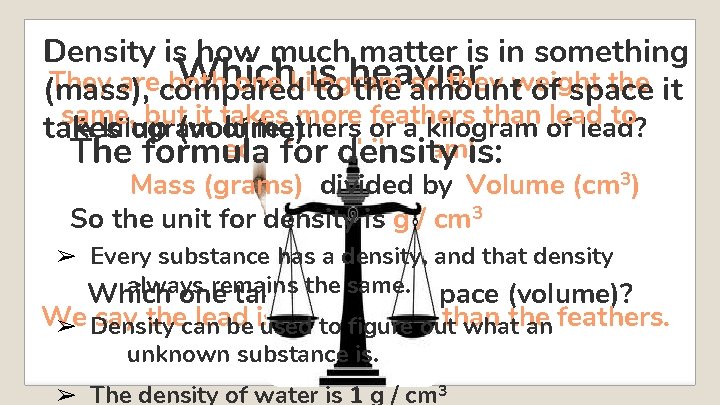
Density is how much matter is in something Which is heavier. . . They are both one kilogram so they weight the it (mass), compared to the amount of space same, but it takes more or feathers than of lead to A kilogram of feathers a kilogram lead? takes up (volume). equalfor onedensity kilogram!is: The formula Mass (grams) divided by Volume (cm 3) So the unit for density is g / cm 3 ➢ Every substance has a density, and that density always remains Which one takes the up same. more space (volume)? We say thecan lead more dense than ➢ Density be is used to figure out whatthe an feathers. unknown substance is. ➢ The density of water is 1 g / cm 3