
NATURE OF CLASSROOM DISCOURSE Priyabrata Paul B Ed
NATURE OF CLASSROOM DISCOURSE Priyabrata Paul B. Ed 1 st semester Roll No. 28 University of BT and Evening College
Discourse is a general term used for example of language use, i. e. language which has been produced as a result of an act of communication. Discourse therefore deals with both oral and written communication and the study of spoken and written discourse is known as 'discourse analysis'.
Language in Classroom The term classroom language is usually taken to mean the language used by the teacher and children doing educational activities in school. It is more usually used to refer to the spoken language of the classroom rather than to what is read or written.
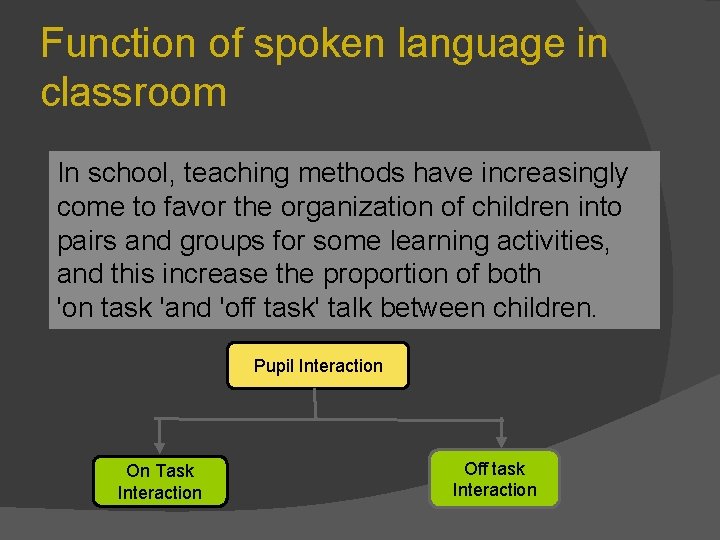
Function of spoken language in classroom In school, teaching methods have increasingly come to favor the organization of children into pairs and groups for some learning activities, and this increase the proportion of both 'on task 'and 'off task' talk between children. Pupil Interaction On Task Interaction Off task Interaction
� Off task take the important role for developing the working relationship of a pair of group. � Encourage children to share knowledge with their peers and to develop their oral communication skill. � The function of talk for teacher take main tool of control the behavior of children.
Classroom Interaction is not only the talking or communicating with the students and teacher. When a learner reads a text silently he is interacting with the text. Interaction helps learning when there is a change from language as "knowledge" to language as "skill".
Types of Classroom Interaction � Collaborative learning(������ ) � Discussion & Debates(������ � ����� ) � Conversation with learners(������� ) � Loud Reading(����� ��� ) � Story telling(����� ) � Role play(������ )
Modes of Interaction (a) Pair work: This involves the interaction of one learner with another. (b) Group work: This involves the interaction of several learners as a group. (c) Individual work: This involves the interaction of a learner with a text, either reading or writing a text. (d) Lecture: This involves the interaction of the teacher with whole class. (e) Whole class discussion: This involves the whole class interaction with the teacher.
Jill & Charles Hadfield's pattern of interaction in classroom 1. Teacher to students (T->Ss): This interaction pattern is common at the beginning of a class or an activity, when the teacher is eliciting, explaining, or giving instructions. 2. Teacher to students (T->Ss) and Students to Teacher (Ss->T): It is appropriate for learners to interact with the teacher either individually or as a whole class in a ‘question and answer’ activity or in a drill. 3. Half class to half class (Ss->Ss): Interact with each other in dialogue practice, a team game. These activities give everyone the chance to contribute and these activities are full of fun for the students.
conti. . . 4. Student to class (S->Ss): When class has been working in groups, one learner from each group can ‘report back’ to the rest of the class. 5. Student to Student (open pairs) (S->S): One student interacting with another, with the rest of the class listening. 6. Individual work(S): Learners may work individually in writing activities or they may need individual planning time before a speaking activity.
The structure of Classroom Language The spoken language of classroom has some interesting and distinctive discourse features. (They can be called ‘discourse features’) Consider, for example, the following piece of classroom talk: Teacher: Where is Kolkata? Pupil: In India. Teacher: Well, yes, in West Bengal. Teacher ‘initiates’ and exchange with a pupil, the pupil ‘responds’ and the teacher then provides ‘evaluative feedback’ on that response. This three part sequence of ‘Initiation-Response-Feedback’ (usually summarized by researchers as IRF or IRE)

Objective of classroom interaction � It brings clarity and distinctiveness in the speech. � Learner can identify their learning method and strategies. � A healthy communication is developed among the learners. � Interaction gives the learners the chance of thinking a new. � It clears all hesitations and what-to-do and what-not-to-do conditions.
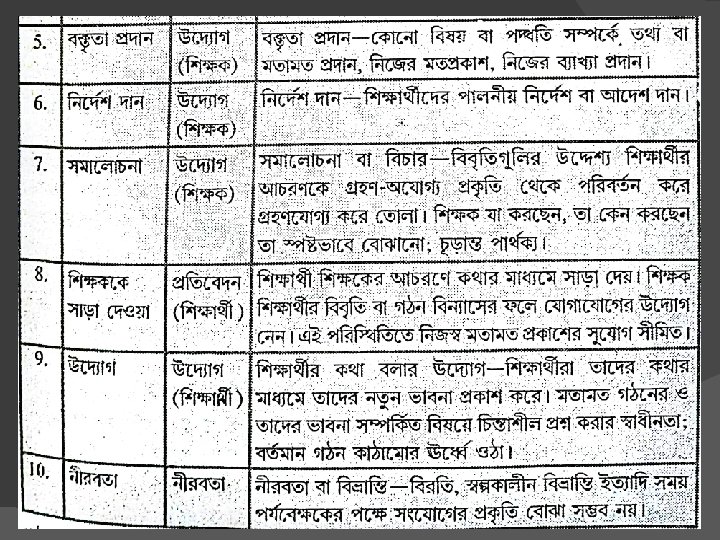
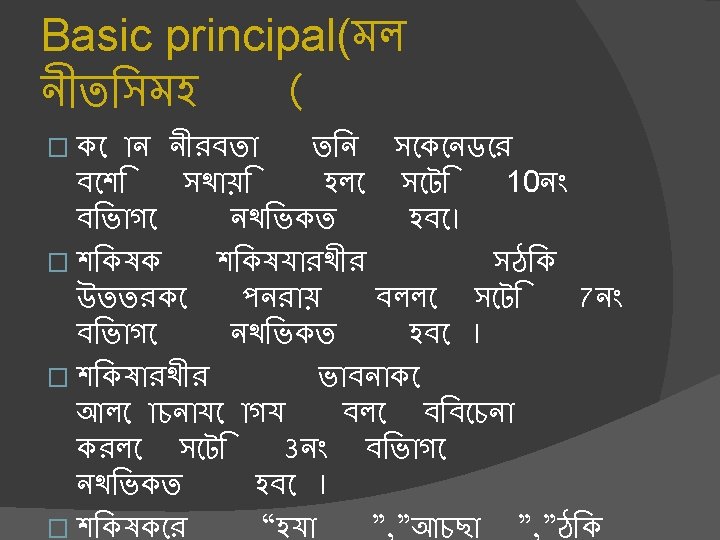
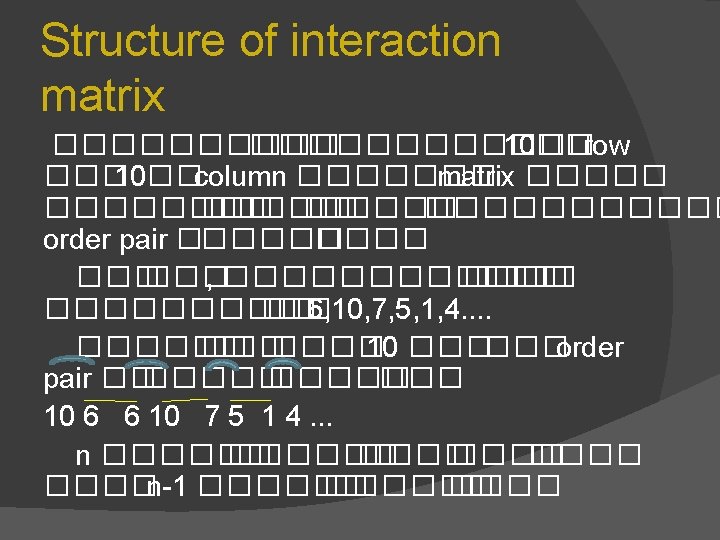
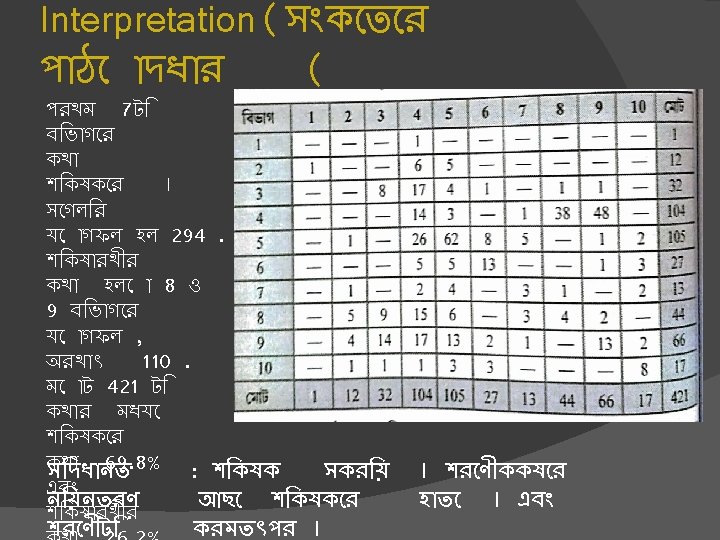
Two-third rule Flanders(1970) revealed a characteristic of classroom talk, it known as “two-third rule”. It has been observed that : (a)For about two-thirds of the time someone is talking. (b) about two-thirds of this talk is the teacher’s. (c) about two-thirds of the teacher’s talk consists of lecturing or asking questions.
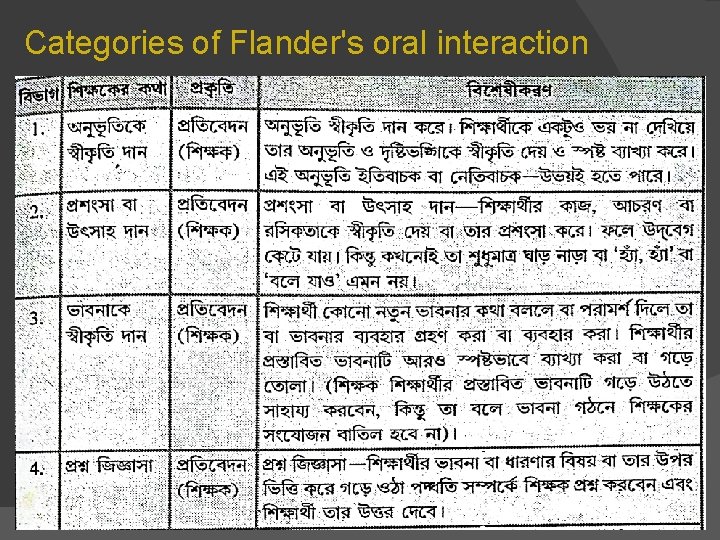
Categories of Flander's oral interaction
Role of teacher � � � A teacher keeps the learning atmosphere smooth and congenial. During the interaction teacher note down the reaction of students. A teacher can encourage every student to participate in the interaction with some innovative idea, plan & strategies. A teacher can improve the speech difficulties of a student. During the interaction teacher plays the pivotal role. He is a guide, listener and good observer.

THANK YOU
- Slides: 21