
NATURE NURTURE HUMAN DIVERSITY Chapter 4 BEHAVIOR GENETICS
NATURE, NURTURE, HUMAN DIVERSITY Chapter 4
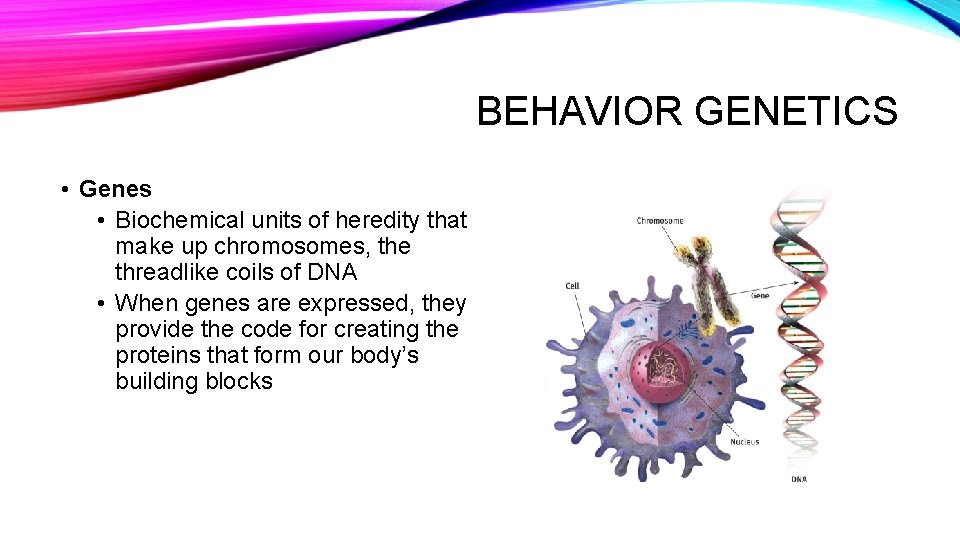
BEHAVIOR GENETICS • Genes • Biochemical units of heredity that make up chromosomes, the threadlike coils of DNA • When genes are expressed, they provide the code for creating the proteins that form our body’s building blocks
BEHAVIOR GENETICS • The human genome is the shared genetic profile that distinguishes humans from other species, consisting at an individual level of all the genetic material in an organism’s chromosomes. • The human genome includes 46 chromosomes in 23 matched sets; each chromosome has the same gene locations. • This includes the X and Y chromosomes, not a matched set in males, who are missing some genes on the Y. • A biological parent donates half his/her set of chromosomes to his/her offspring. • We received half a set of chromosomes from each biological parent.
BEHAVIOR GENETICS • Behavior genetics • Study of the relative power and limits of genetic and environmental influences on behavior • Environment • Every nongenetic influence, from prenatal nutrition to the people and things around us • Chromosomes • Threadlike structures made of DNA molecules that contain the genes • DNA (deoxyribonucleic acid) • Complex molecule containing the genetic information that makes up the chromosomes
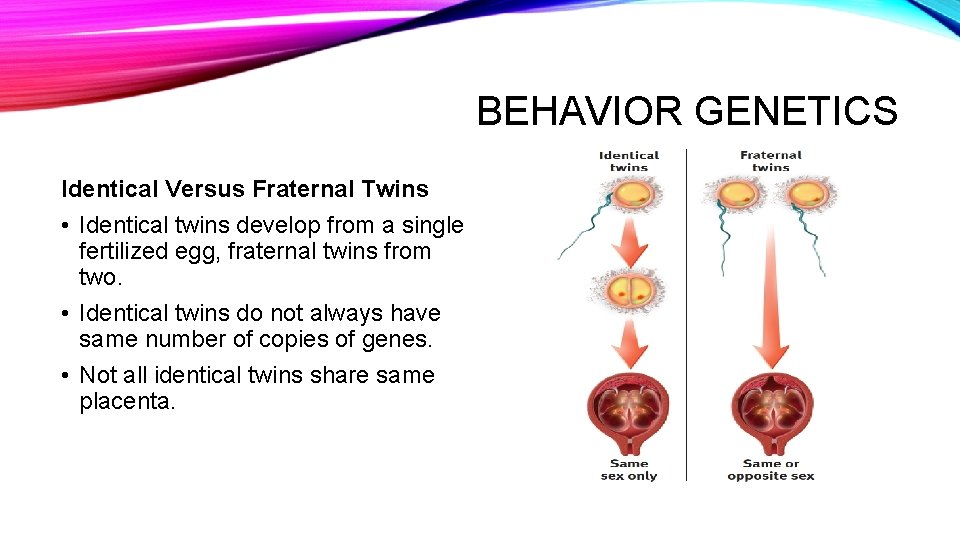
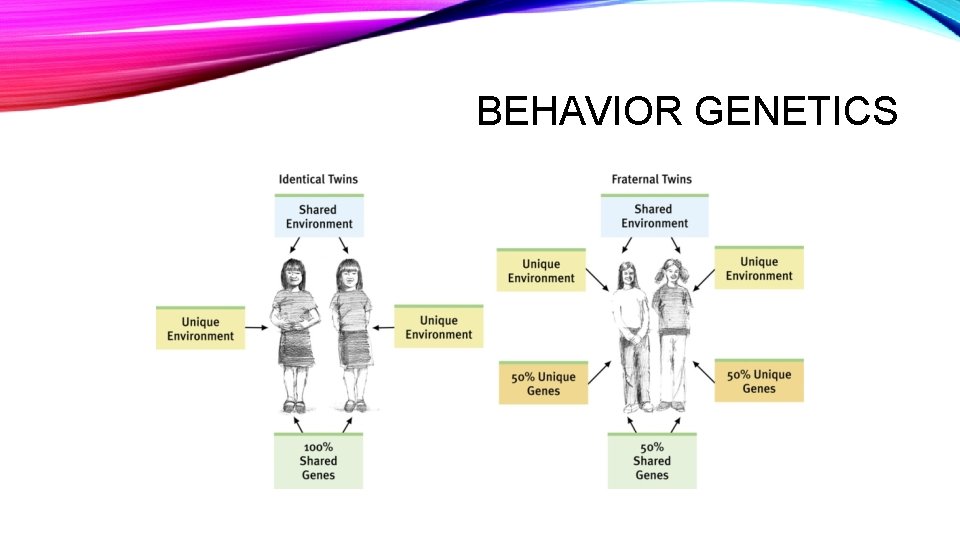
BEHAVIOR GENETICS Identical Versus Fraternal Twins • Identical twins develop from a single fertilized egg, fraternal twins from two. • Identical twins do not always have same number of copies of genes. • Not all identical twins share same placenta.
BEHAVIOR GENETICS
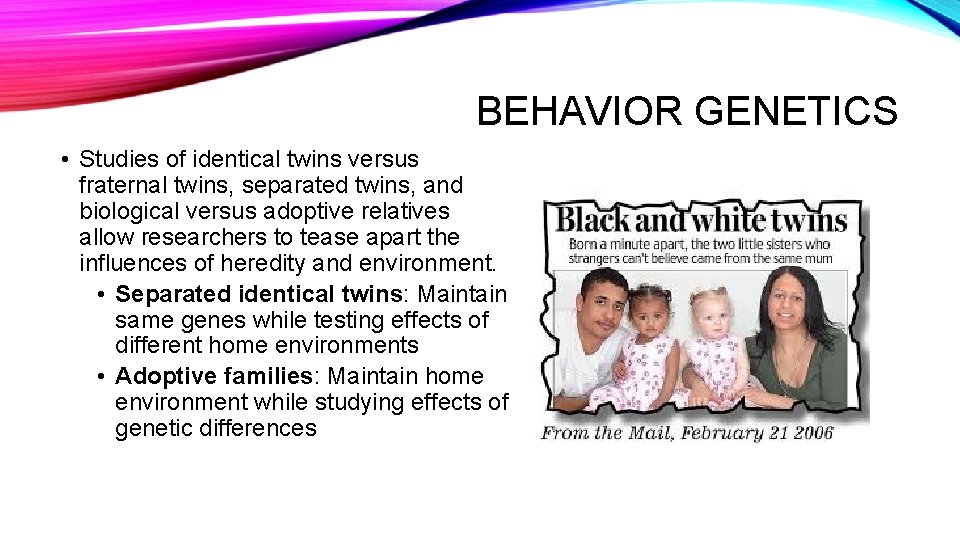
BEHAVIOR GENETICS • Studies of identical twins versus fraternal twins, separated twins, and biological versus adoptive relatives allow researchers to tease apart the influences of heredity and environment. • Separated identical twins: Maintain same genes while testing effects of different home environments • Adoptive families: Maintain home environment while studying effects of genetic differences
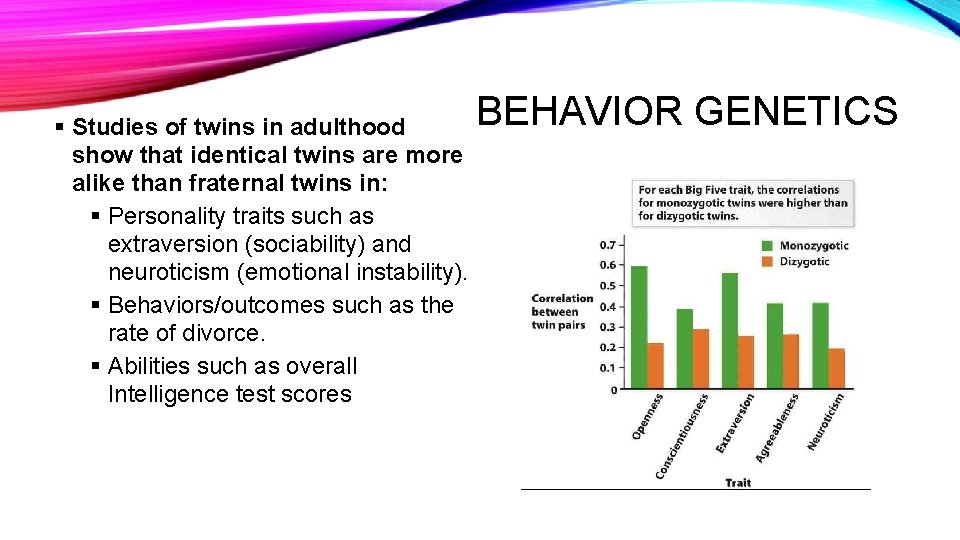
§ Studies of twins in adulthood show that identical twins are more alike than fraternal twins in: § Personality traits such as extraversion (sociability) and neuroticism (emotional instability). § Behaviors/outcomes such as the rate of divorce. § Abilities such as overall Intelligence test scores BEHAVIOR GENETICS
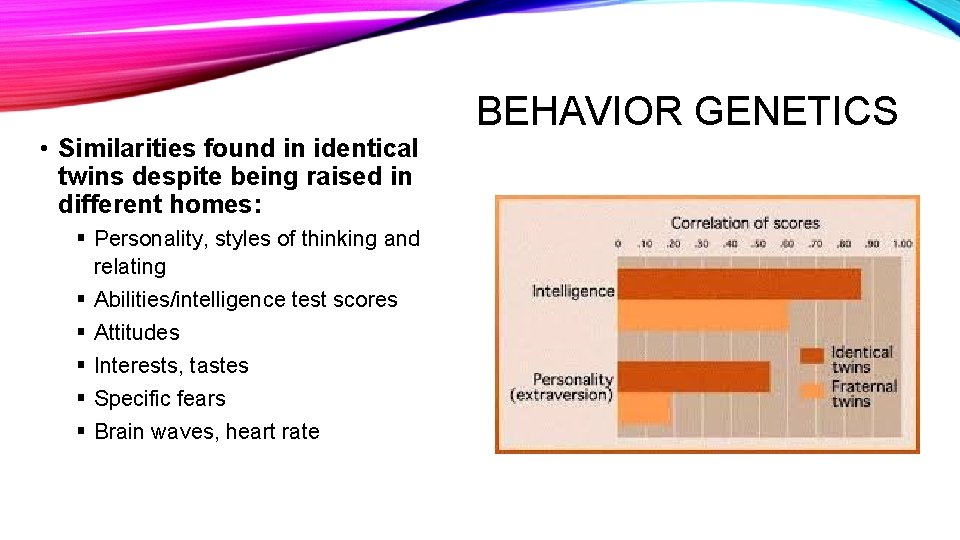
BEHAVIOR GENETICS • Similarities found in identical twins despite being raised in different homes: § Personality, styles of thinking and relating § Abilities/intelligence test scores § Attitudes § Interests, tastes § Specific fears § Brain waves, heart rate
BEHAVIOR GENETICS • Studies conducted with adopted children for whom the biological relatives are known • Adopted children seem to be more similar to their genetic relatives than their environmental/nurture relatives • Given the evidence of genetic impact human outcomes, does parenting/nurture make any difference? Despite the strong impact of genetics on personality, parenting has an influence on: § Religious beliefs § Values § Manners § Attitudes § Politics § Habits
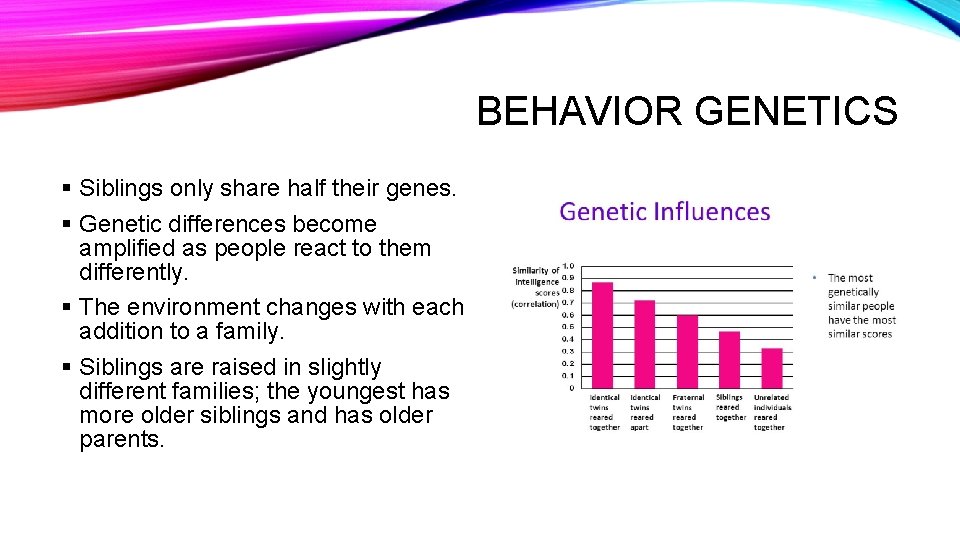
BEHAVIOR GENETICS § Siblings only share half their genes. § Genetic differences become amplified as people react to them differently. § The environment changes with each addition to a family. § Siblings are raised in slightly different families; the youngest has more older siblings and has older parents.

BEHAVIOR GENETICS • Temperament • Person’s characteristic emotional reactivity and intensity; apparent from first weeks of life and generally persist into adulthood • Genetic effect appears in physiological differences such as heart rate and nervous system reactivity
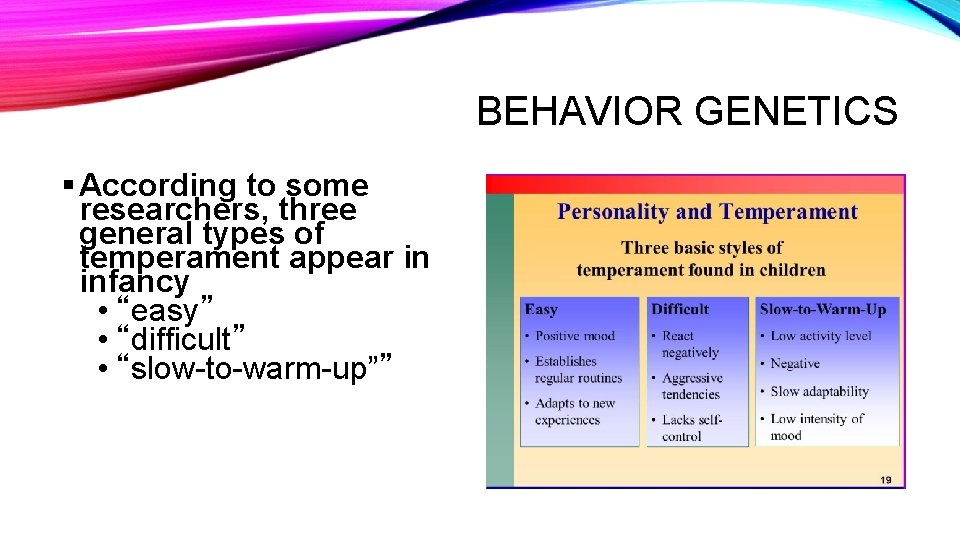
BEHAVIOR GENETICS § According to some researchers, three general types of temperament appear in infancy • “easy” • “difficult” • “slow-to-warm-up””
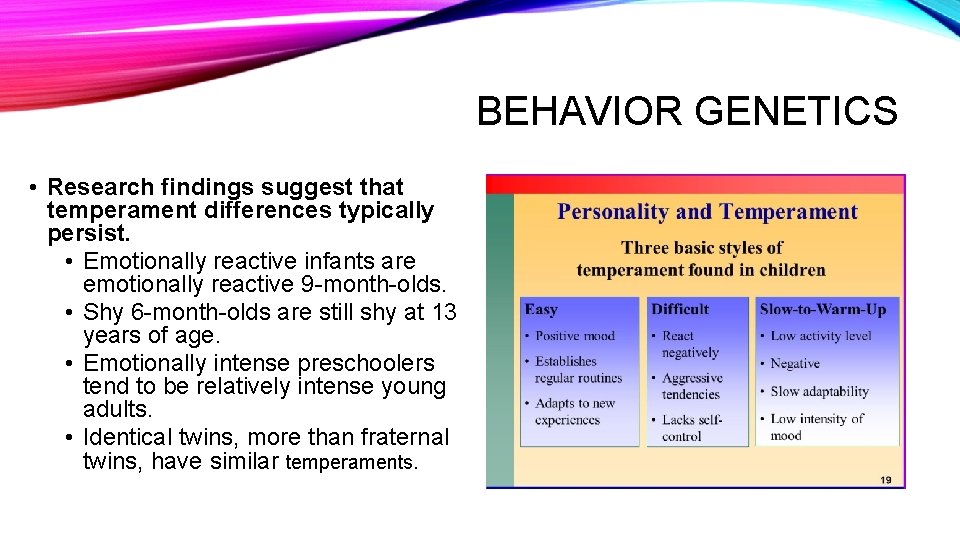
BEHAVIOR GENETICS • Research findings suggest that temperament differences typically persist. • Emotionally reactive infants are emotionally reactive 9 -month-olds. • Shy 6 -month-olds are still shy at 13 years of age. • Emotionally intense preschoolers tend to be relatively intense young adults. • Identical twins, more than fraternal twins, have similar temperaments.
BEHAVIOR GENETICS • Heritability is the proportion of variation among individuals that can be attributed to genes. • The heritability of a trait may vary, depending on the range of populations and environments studied. • When you see a variation of some trait within a population, the heritability of that trait is the amount of variation in the population that is explained by genetic factors. § This does not reveal the proportion that genes contribute to the trait for any one person.
BEHAVIOR GENETICS § Molecular genetics is the study of the molecular structure and function of genes. § Finding some of many genes that together contribute complex traits § Revealing at-risk populations for diseases § Epigenetics studies molecular mechanism by which environments can trigger or block genetic expression § Epigenetic marks from experiences § Environmental factors
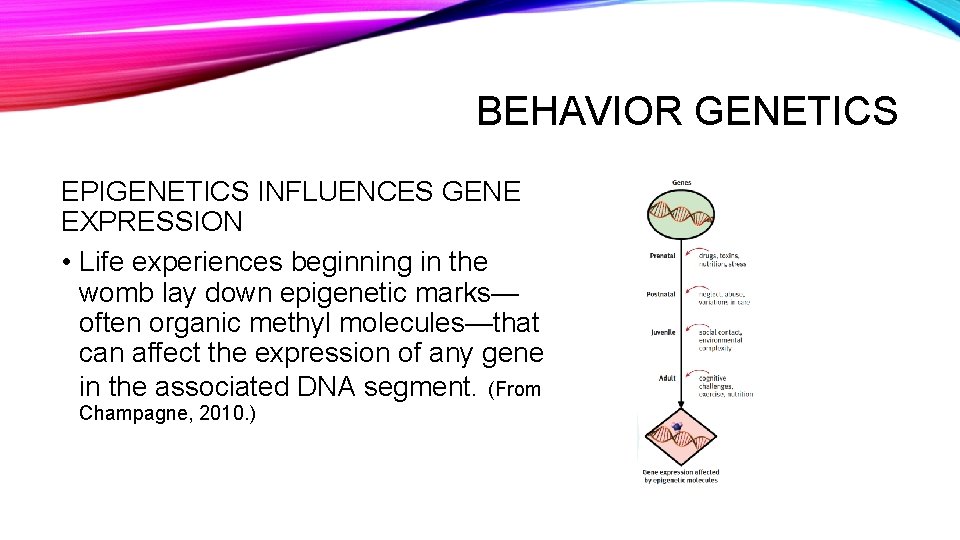
BEHAVIOR GENETICS EPIGENETICS INFLUENCES GENE EXPRESSION • Life experiences beginning in the womb lay down epigenetic marks— often organic methyl molecules—that can affect the expression of any gene in the associated DNA segment. (From Champagne, 2010. )
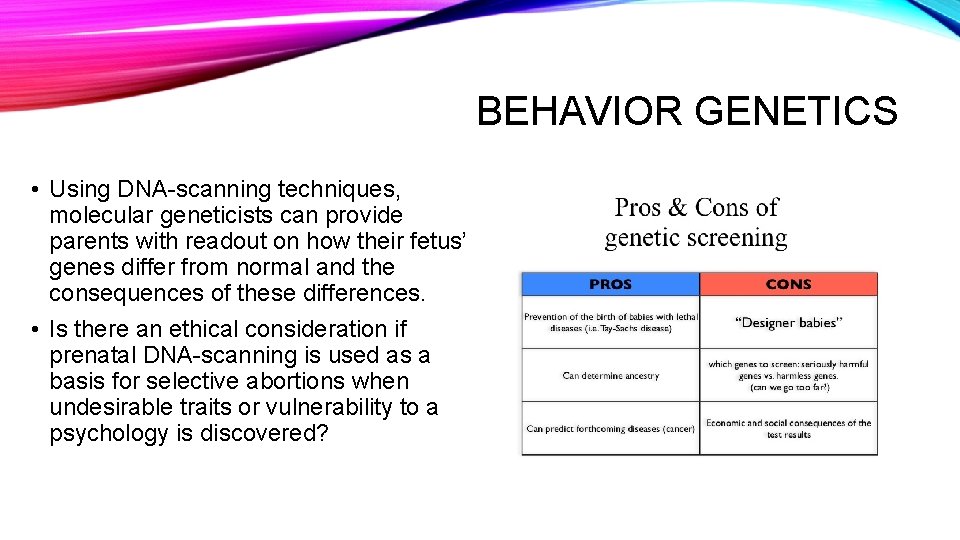
BEHAVIOR GENETICS • Using DNA-scanning techniques, molecular geneticists can provide parents with readout on how their fetus’ genes differ from normal and the consequences of these differences. • Is there an ethical consideration if prenatal DNA-scanning is used as a basis for selective abortions when undesirable traits or vulnerability to a psychology is discovered?
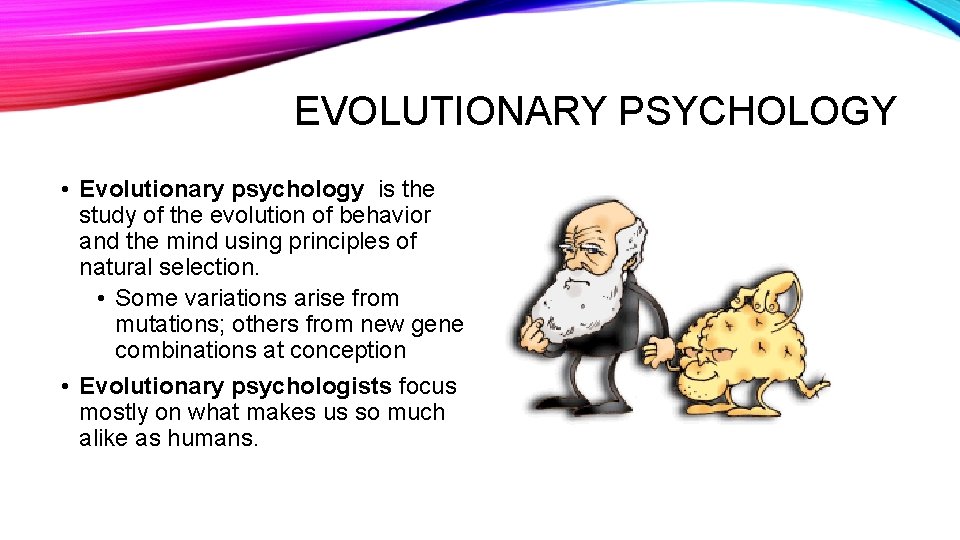
EVOLUTIONARY PSYCHOLOGY • Evolutionary psychology is the study of the evolution of behavior and the mind using principles of natural selection. • Some variations arise from mutations; others from new gene combinations at conception • Evolutionary psychologists focus mostly on what makes us so much alike as humans.
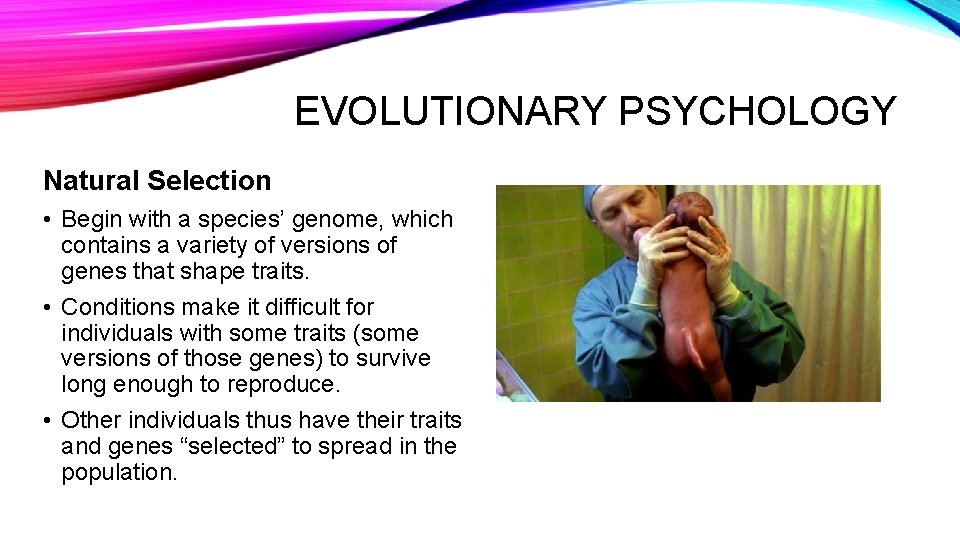
EVOLUTIONARY PSYCHOLOGY Natural Selection • Begin with a species’ genome, which contains a variety of versions of genes that shape traits. • Conditions make it difficult for individuals with some traits (some versions of those genes) to survive long enough to reproduce. • Other individuals thus have their traits and genes “selected” to spread in the population.
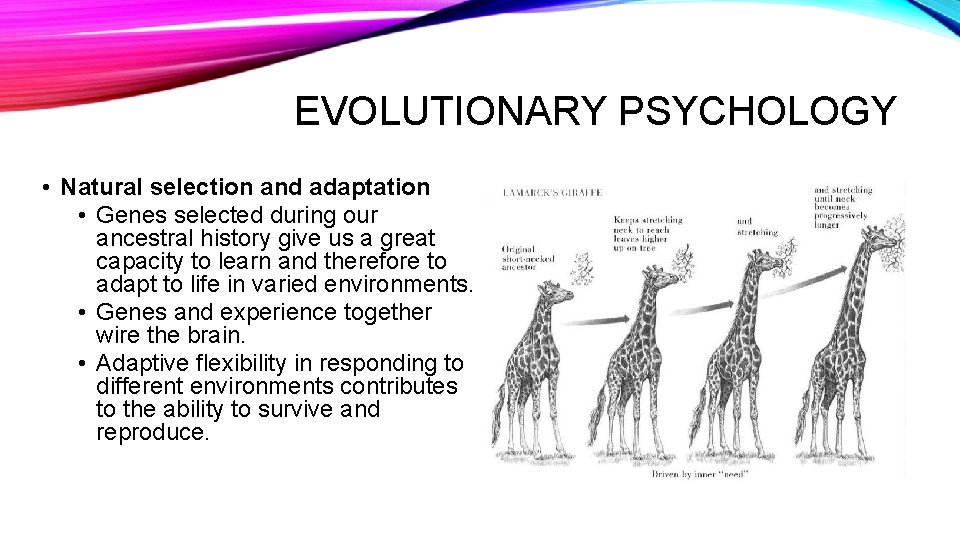
EVOLUTIONARY PSYCHOLOGY • Natural selection and adaptation • Genes selected during our ancestral history give us a great capacity to learn and therefore to adapt to life in varied environments. • Genes and experience together wire the brain. • Adaptive flexibility in responding to different environments contributes to the ability to survive and reproduce.
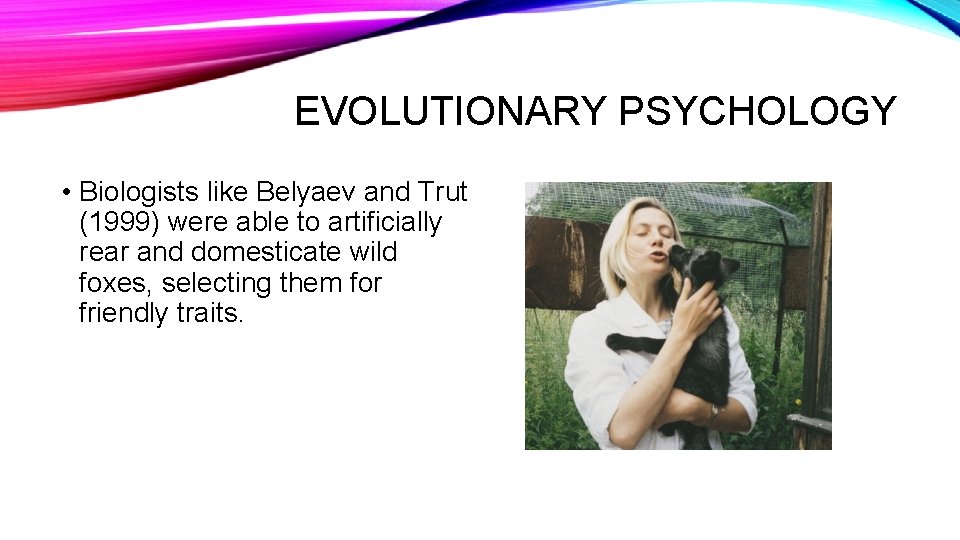
EVOLUTIONARY PSYCHOLOGY • Biologists like Belyaev and Trut (1999) were able to artificially rear and domesticate wild foxes, selecting them for friendly traits.
EVOLUTIONARY PSYCHOLOGY • Humans share a common genetic profile or genome. • A “universal moral grammar” is shared across cultural differences. • Yet, some parts of our prehistoric genetic legacy may be mismatched with our contemporary lifestyle. In what ways might this be problematic?
EVOLUTIONARY PSYCHOLOGY • Cross-culturally, men think • more than women about • sex, and men are more likely to think that casual sex is acceptable. • Why might natural selection have resulted in greater male promiscuity? Explanation from evolutionary psychology Men who had the trait of promiscuity were more likely to have their genes continue, and even spread, in the next generation. There is little cost to spreading extra genes. • For women, a trait of promiscuity would not greatly increase the number of babies, and it would have greater survival costs. Pregnancy was often life -threatening.
EVOLUTIONARY PSYCHOLOGY • Men prefer women with signs of future fertility (narrow waist and fuller figure; age of peak fertility). Women prefer men with loyal behavior and physical/social power and resources. • Why might natural selection have resulted in mating preferences? • Explanation from evolutionary psychology • Male choices optimized the chance of producing offspring. • Female choices seek to ensure offspring survival. • Men chose widely; women chose wisely!
EVOLUTIONARY PSYCHOLOGY • Most psychologists agree that natural selection prepares humans for survival and reproduction • Critics of evolutionary psychology research • Often start with effect and work backward • More immediate explanations for results better understood by social learning theory than decisions made by very distant ancestors • Social consequences of explanation are problematic • Some traits and behaviors are difficult to explain by natural selection
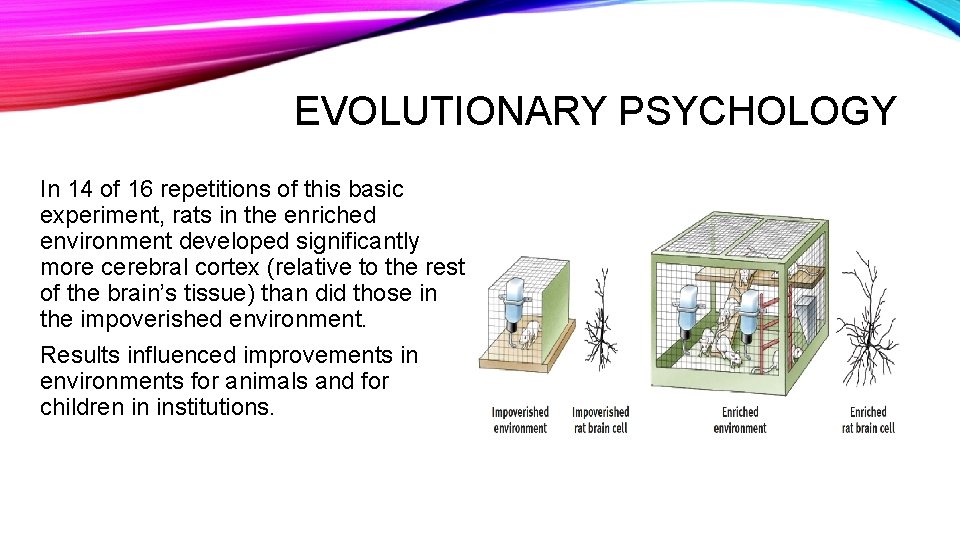
EVOLUTIONARY PSYCHOLOGY In 14 of 16 repetitions of this basic experiment, rats in the enriched environment developed significantly more cerebral cortex (relative to the rest of the brain’s tissue) than did those in the impoverished environment. Results influenced improvements in environments for animals and for children in institutions.
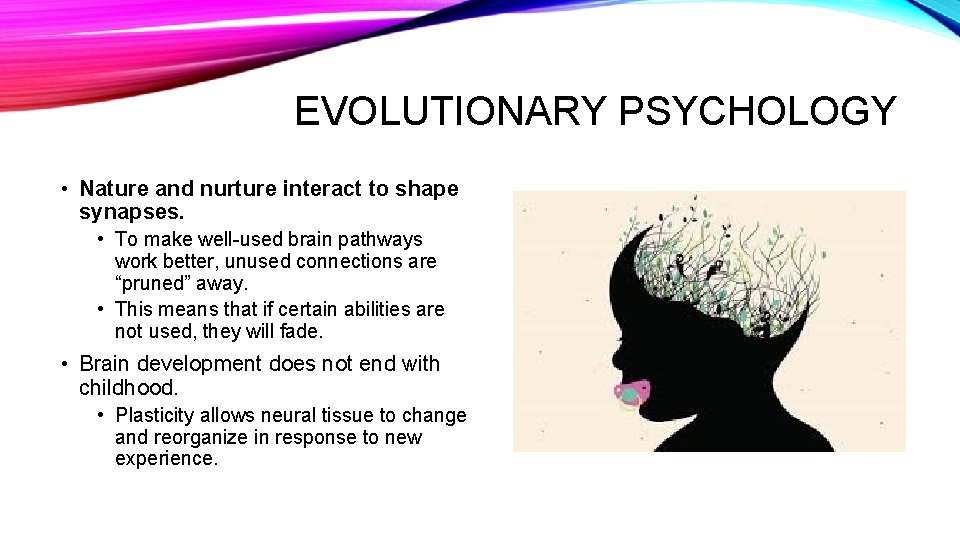
EVOLUTIONARY PSYCHOLOGY • Nature and nurture interact to shape synapses. • To make well-used brain pathways work better, unused connections are “pruned” away. • This means that if certain abilities are not used, they will fade. • Brain development does not end with childhood. • Plasticity allows neural tissue to change and reorganize in response to new experience.
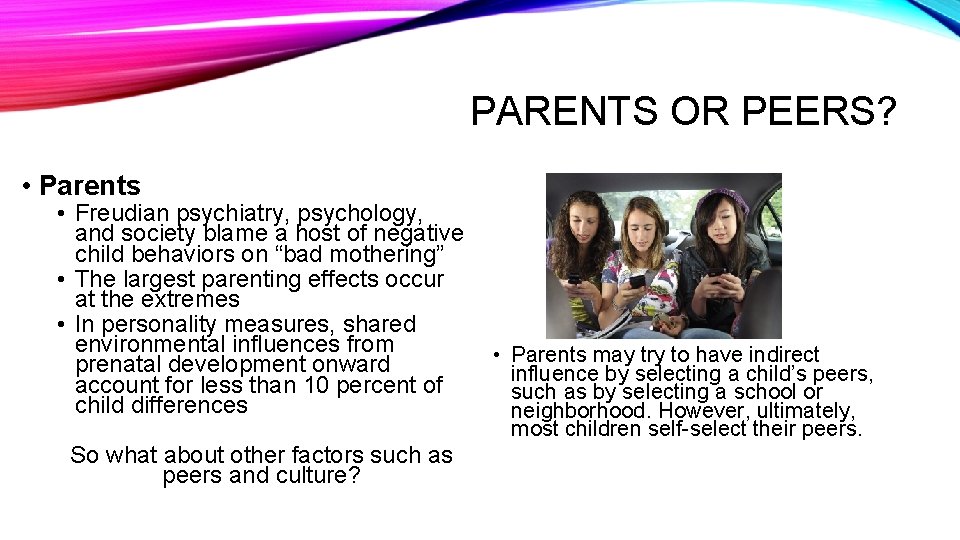
PARENTS OR PEERS? • Parents • Freudian psychiatry, psychology, and society blame a host of negative child behaviors on “bad mothering” • The largest parenting effects occur at the extremes • In personality measures, shared environmental influences from prenatal development onward account for less than 10 percent of child differences So what about other factors such as peers and culture? • Parents may try to have indirect influence by selecting a child’s peers, such as by selecting a school or neighborhood. However, ultimately, most children self-select their peers.
PARENTS OR PEERS § The degree of peer influence is hard to trace. § Apparent conformity could be a selection effect. § Interaction with peers can teach new social skills. § Gardner (1998) concluded parents and peers are complementary.
PARENTS OR PEERS Parents have more influence on: • Education and career path • Cooperation • Self-discipline • Responsibility • Charitableness • Religion • Interaction style with authority figures Peers have more influence on: • Learning cooperation skills • Learning the path to popularity • Choice of music and other recreation • Choice of clothing and other cultural choices • Good and bad habits
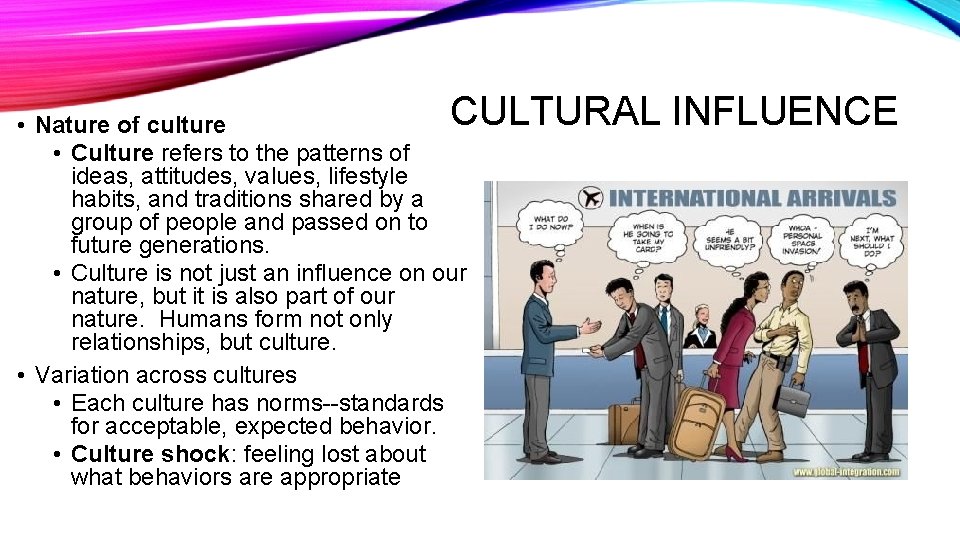
CULTURAL INFLUENCE • Nature of culture • Culture refers to the patterns of ideas, attitudes, values, lifestyle habits, and traditions shared by a group of people and passed on to future generations. • Culture is not just an influence on our nature, but it is also part of our nature. Humans form not only relationships, but culture. • Variation across cultures • Each culture has norms--standards for acceptable, expected behavior. • Culture shock: feeling lost about what behaviors are appropriate
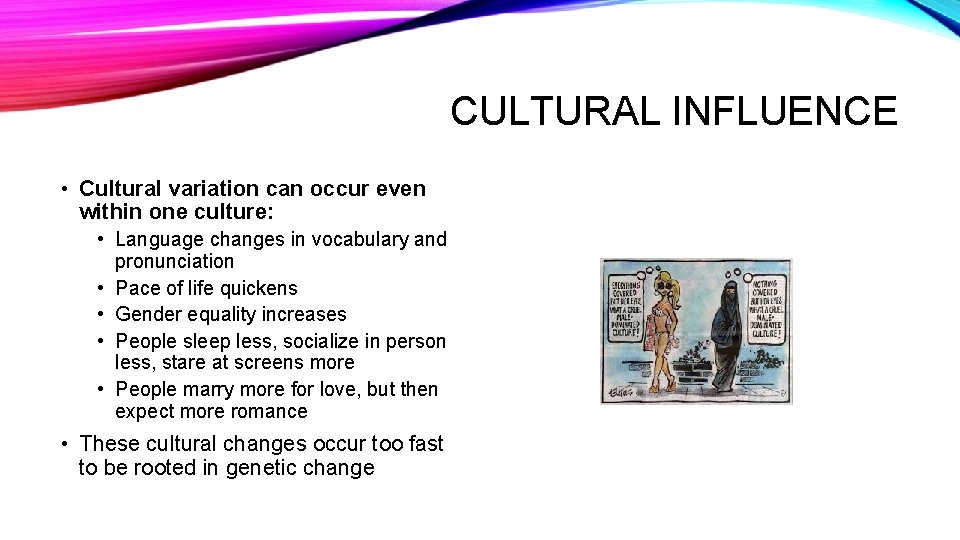
CULTURAL INFLUENCE • Cultural variation can occur even within one culture: • Language changes in vocabulary and pronunciation • Pace of life quickens • Gender equality increases • People sleep less, socialize in person less, stare at screens more • People marry more for love, but then expect more romance • These cultural changes occur too fast to be rooted in genetic change
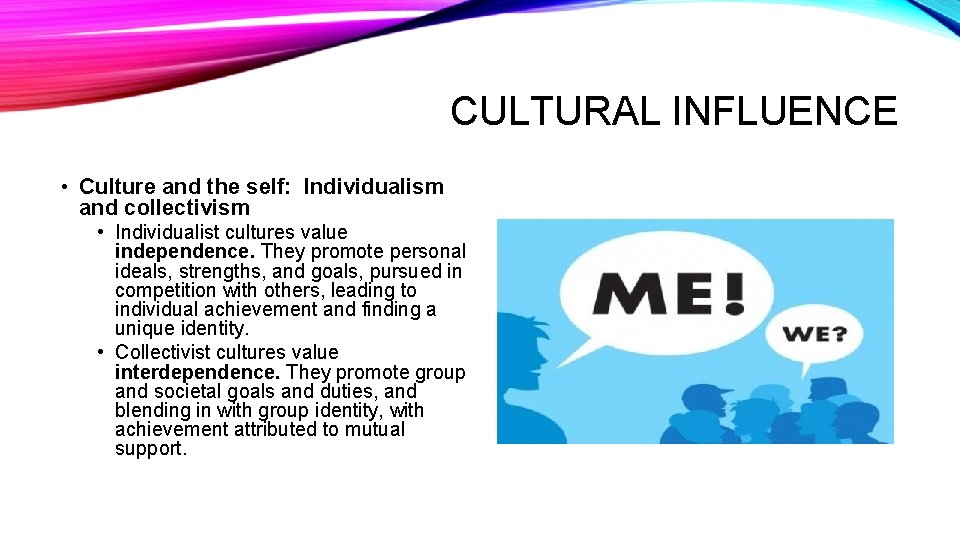
CULTURAL INFLUENCE • Culture and the self: Individualism and collectivism • Individualist cultures value independence. They promote personal ideals, strengths, and goals, pursued in competition with others, leading to individual achievement and finding a unique identity. • Collectivist cultures value interdependence. They promote group and societal goals and duties, and blending in with group identity, with achievement attributed to mutual support.
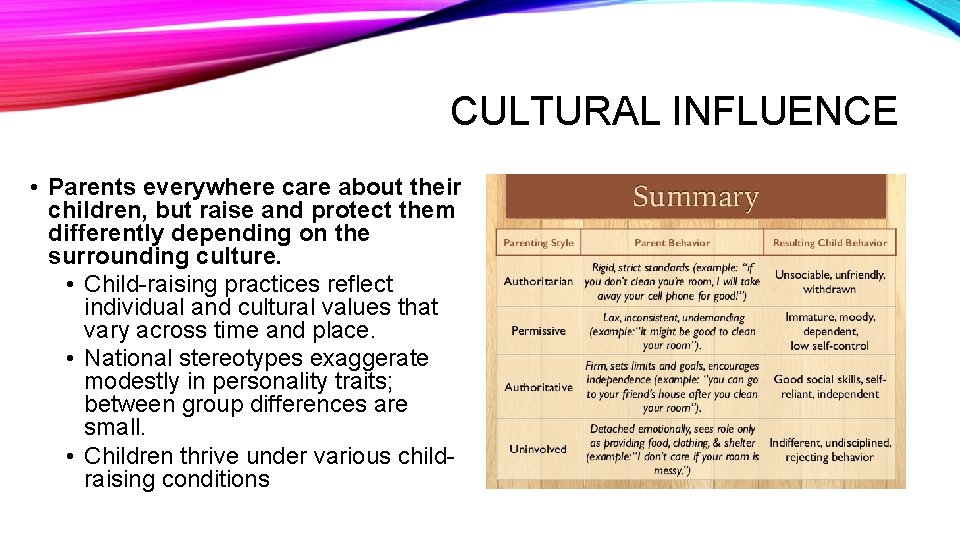
CULTURAL INFLUENCE • Parents everywhere care about their children, but raise and protect them differently depending on the surrounding culture. • Child-raising practices reflect individual and cultural values that vary across time and place. • National stereotypes exaggerate modestly in personality traits; between group differences are small. • Children thrive under various childraising conditions
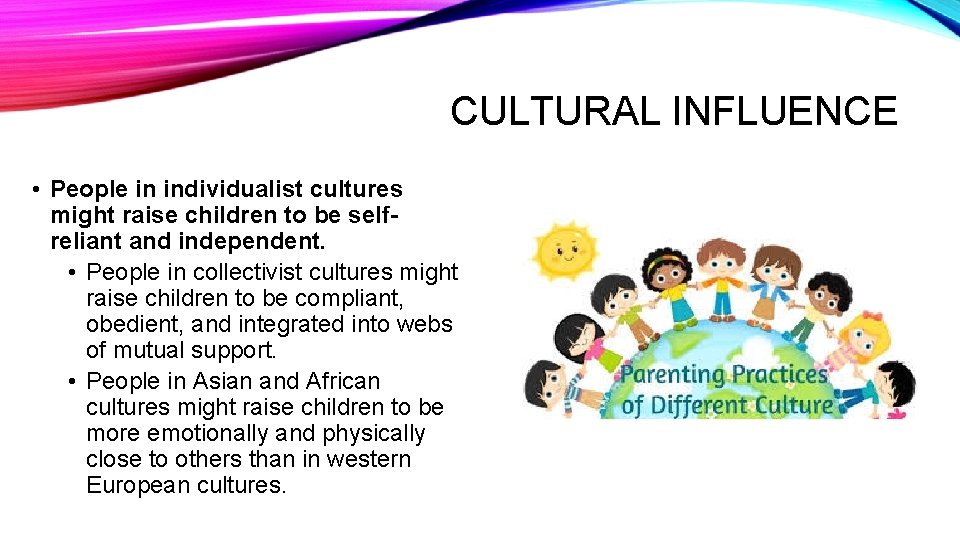
CULTURAL INFLUENCE • People in individualist cultures might raise children to be selfreliant and independent. • People in collectivist cultures might raise children to be compliant, obedient, and integrated into webs of mutual support. • People in Asian and African cultures might raise children to be more emotionally and physically close to others than in western European cultures.
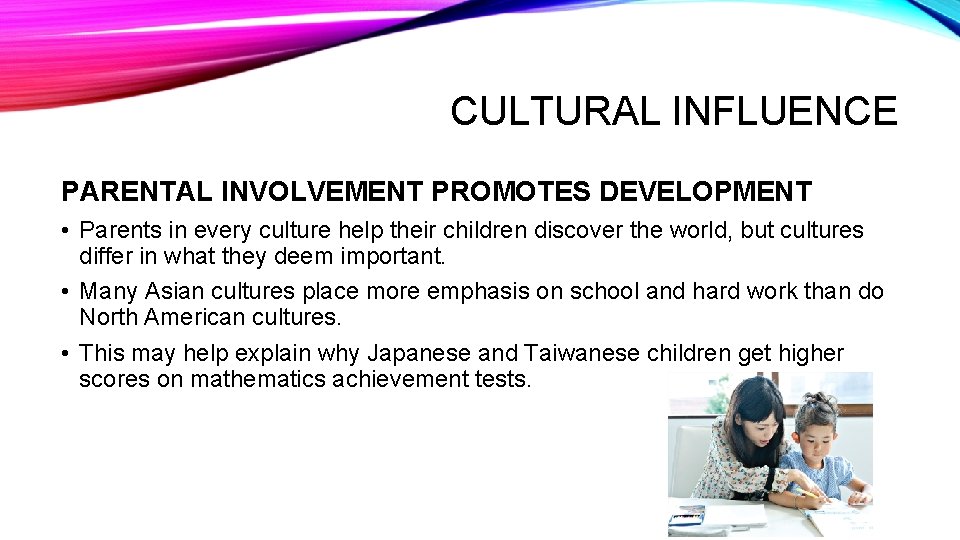
CULTURAL INFLUENCE PARENTAL INVOLVEMENT PROMOTES DEVELOPMENT • Parents in every culture help their children discover the world, but cultures differ in what they deem important. • Many Asian cultures place more emphasis on school and hard work than do North American cultures. • This may help explain why Japanese and Taiwanese children get higher scores on mathematics achievement tests.
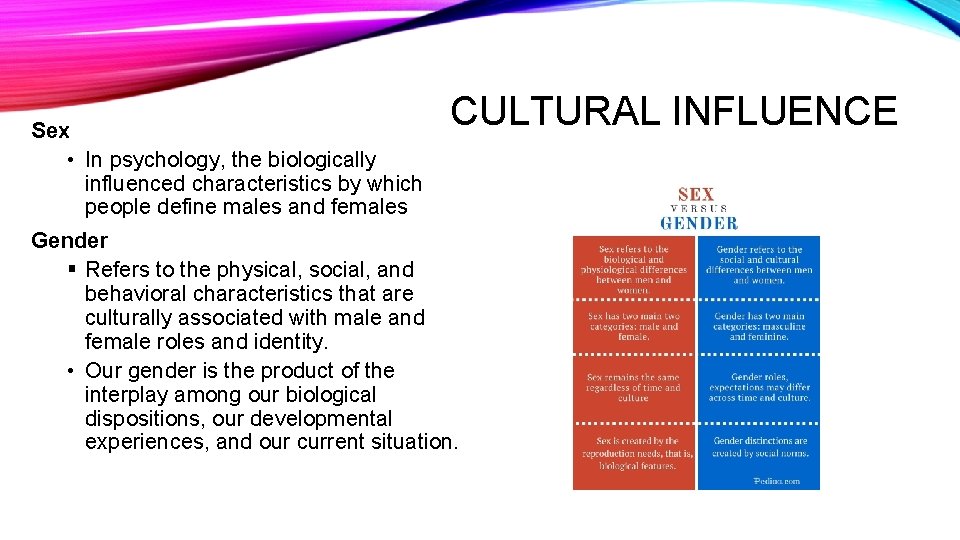
Sex • In psychology, the biologically influenced characteristics by which people define males and females CULTURAL INFLUENCE Gender § Refers to the physical, social, and behavioral characteristics that are culturally associated with male and female roles and identity. • Our gender is the product of the interplay among our biological dispositions, our developmental experiences, and our current situation.
CULTURAL INFLUENCE Male differences on average • Men are 4 times more likely to die by suicide or develop alcohol dependence. • Men are more likely to have childhood diagnosis of autism spectrum disorder, color-blindness, or ADHD. • Men are more at risk for antisocial personality disorder. Female differences on average • Women enter puberty sooner and live about 5 years longer. • Women carry 70 percent more fat, 20 percent less muscle, and are 5 inches shorter. • Women have twice the risk of developing depression and 10 times the risk of developing an eating disorder.
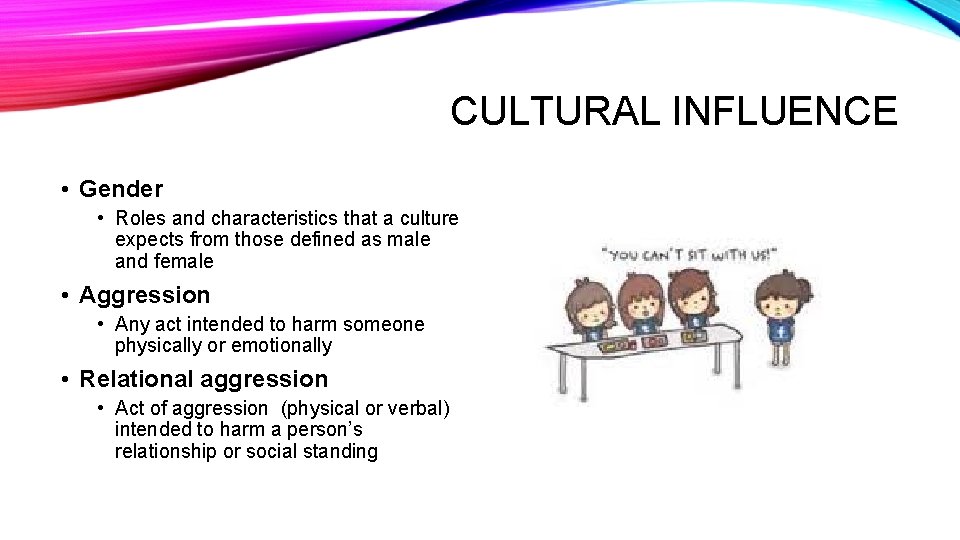
CULTURAL INFLUENCE • Gender • Roles and characteristics that a culture expects from those defined as male and female • Aggression • Any act intended to harm someone physically or emotionally • Relational aggression • Act of aggression (physical or verbal) intended to harm a person’s relationship or social standing
CULTURAL INFLUENCE Gender and aggression • Minor physical aggression: Men and women equal • Extreme violent acts: Men commit more than women • Relational aggression: Women more likely than men • Interaction style: Men offer opinions; women offer support.
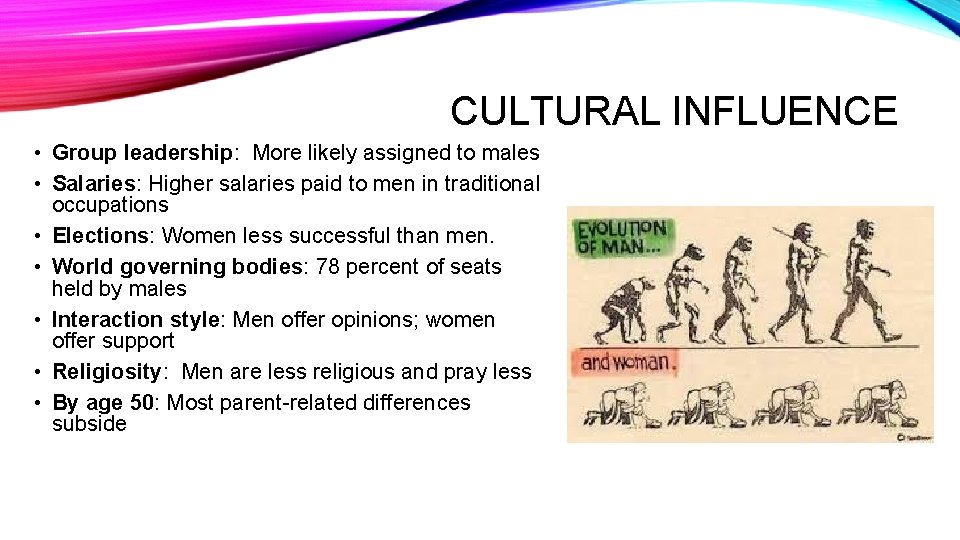
CULTURAL INFLUENCE • Group leadership: More likely assigned to males • Salaries: Higher salaries paid to men in traditional occupations • Elections: Women less successful than men. • World governing bodies: 78 percent of seats held by males • Interaction style: Men offer opinions; women offer support • Religiosity: Men are less religious and pray less • By age 50: Most parent-related differences subside
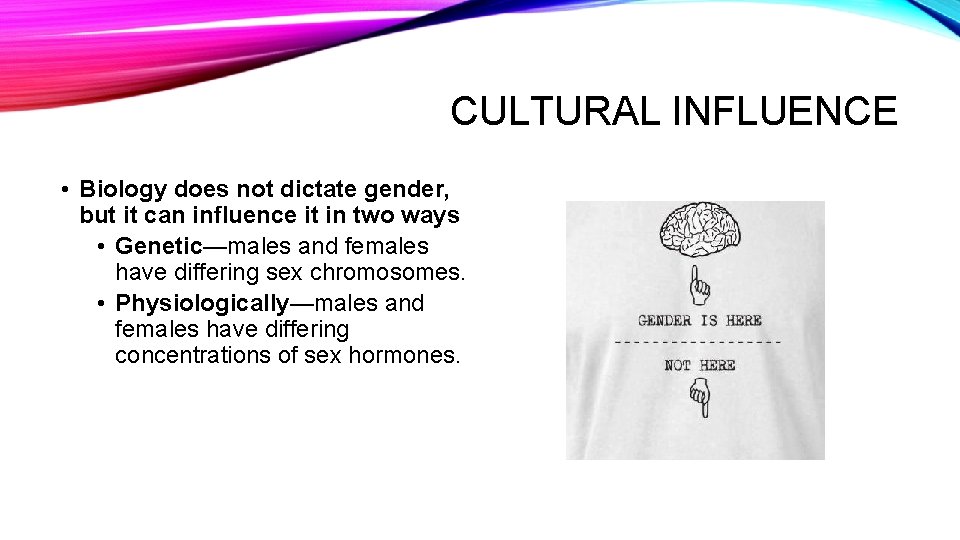
CULTURAL INFLUENCE • Biology does not dictate gender, but it can influence it in two ways • Genetic—males and females have differing sex chromosomes. • Physiologically—males and females have differing concentrations of sex hormones.
CULTURAL INFLUENCE • Prenatal sexual development • Contribution to 23 rd chromosome pair: Mother=X; father = X or Y • Around 7 th week: Y chromosome engages testes to develop and produce testosterone • Between 4 th and 6 th month: Sex hormones in fetal brain support female or male wiring • X chromosome • Sex chromosome found in both men and women • Y chromosome • Sex chromosome found only in males • Testosterone • Most important, the additional testosterone in males stimulates the growth of the male sex organs in the fetus and the development of the male sex characteristics during puberty. • Estrogens • Sex hormones that contribute to female sex characteristics and are secreted in greater amounts by females than by males
CULTURAL INFLUENCE • Adolescent sexual development: Puberty • Boys and girls enter puberty and mature sexually • Pronounced physical differences emerge • Surge of hormones triggers a two -year period of rapid physical development. • Primary and secondary sex characteristics develop dramatically • Primary sex characteristics • Body structures (ovaries, testes, and external genitalia) that make sexual reproduction possible • Secondary sex characteristics • Nonreproductive sexual traits, such as female breasts and hips, male voice quality, and body hair • Spermarche • First ejaculation • Menarche • First menstrual period
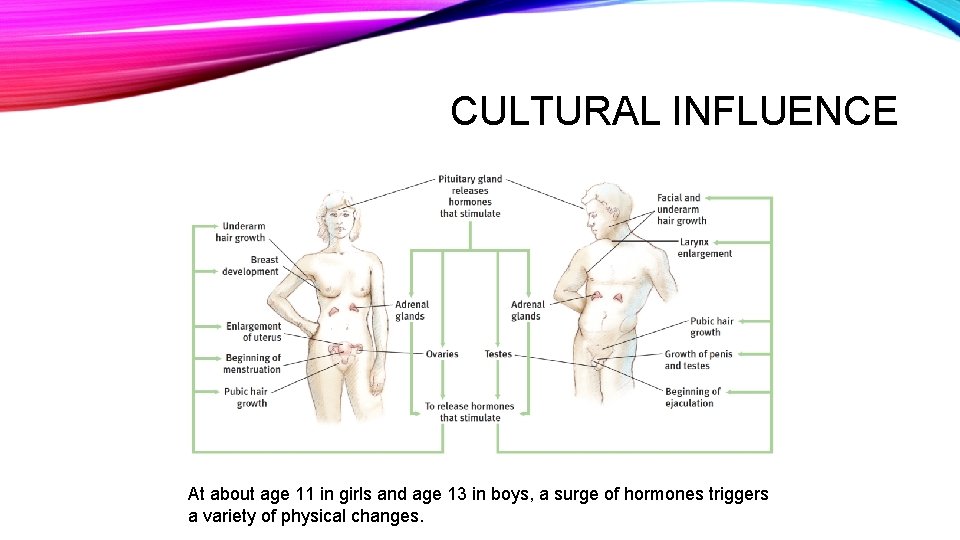
CULTURAL INFLUENCE At about age 11 in girls and age 13 in boys, a surge of hormones triggers a variety of physical changes.
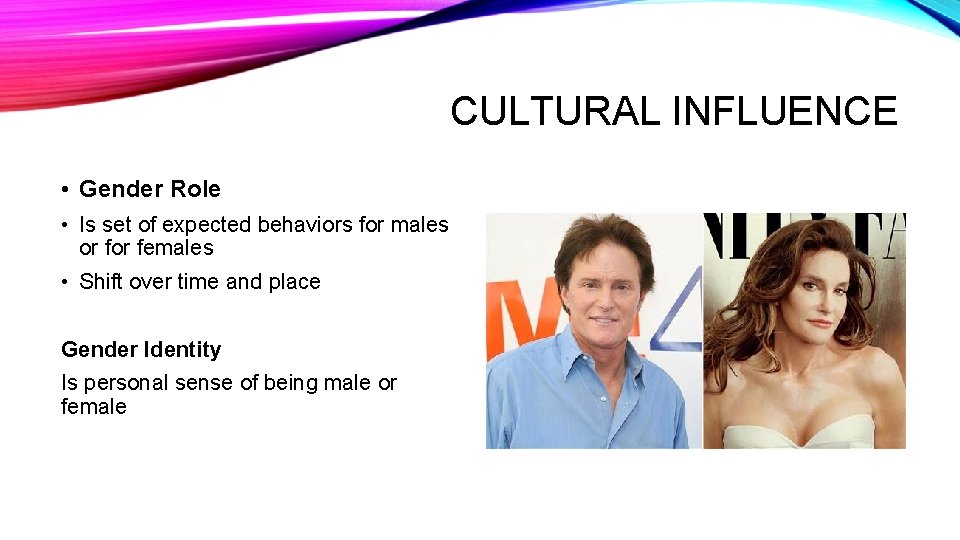
CULTURAL INFLUENCE • Gender Role • Is set of expected behaviors for males or females • Shift over time and place Gender Identity Is personal sense of being male or female
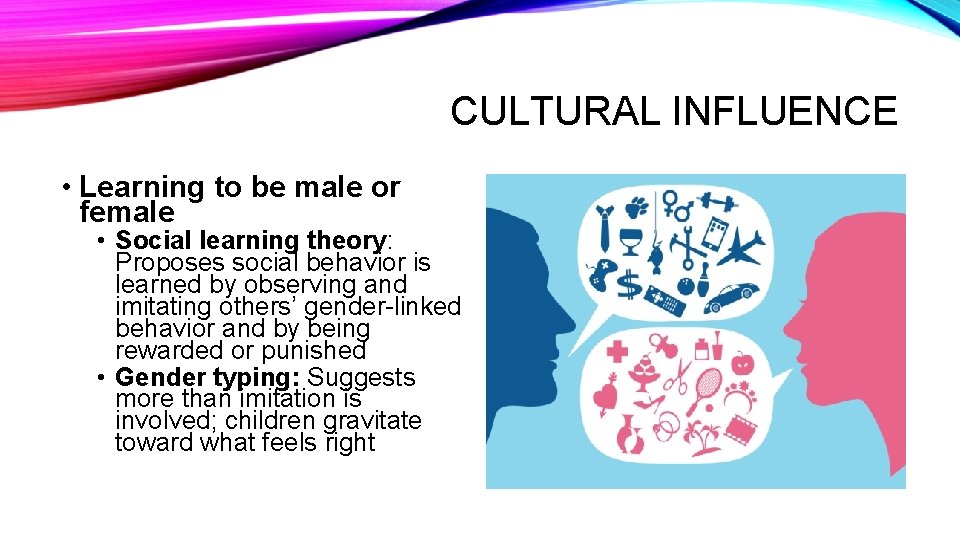
CULTURAL INFLUENCE • Learning to be male or female • Social learning theory: Proposes social behavior is learned by observing and imitating others’ gender-linked behavior and by being rewarded or punished • Gender typing: Suggests more than imitation is involved; children gravitate toward what feels right
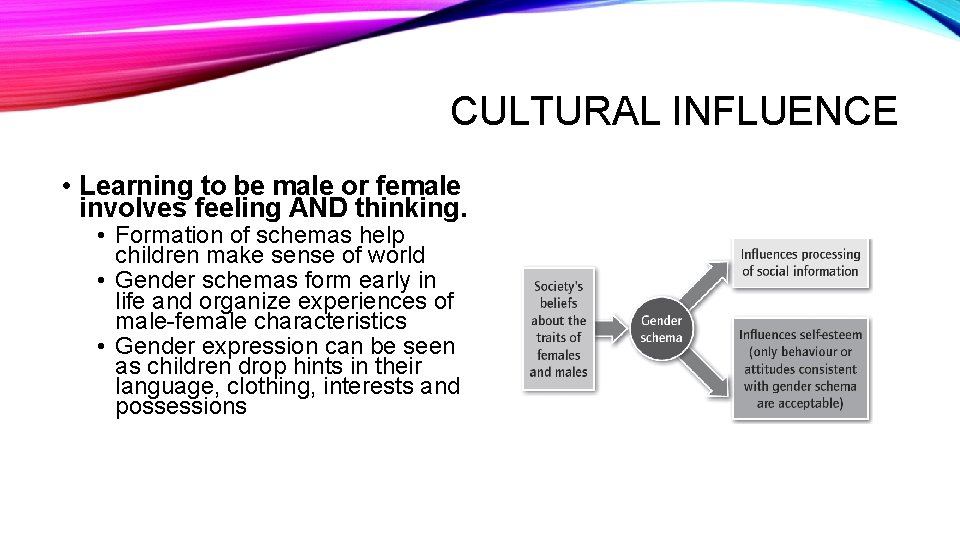
CULTURAL INFLUENCE • Learning to be male or female involves feeling AND thinking. • Formation of schemas help children make sense of world • Gender schemas form early in life and organize experiences of male-female characteristics • Gender expression can be seen as children drop hints in their language, clothing, interests and possessions

CULTURAL INFLUENCE • Androgyny • Displaying both traditional masculine and feminine psychological characteristics • Transgender • Umbrella term describing people whose gender identity or expression differs from that associated with their birth sex
CULTURAL INFLUENCE • Nature and nurture interact within an open system • Biopsychosocial approach considers all the factors that influence our individual development • Biological factors (including evolution, genes, hormones, and brains) • Psychological factors (including our experiences, beliefs, feelings, and expectations) • Social-cultural factors (including parental and peer influences, cultural individualism or collectivism, and gender norms)
- Slides: 51