
NATURE CONSERVATION 7 Wonders of Nature Amazon Rainforest
- Slides: 59
NATURE CONSERVATION
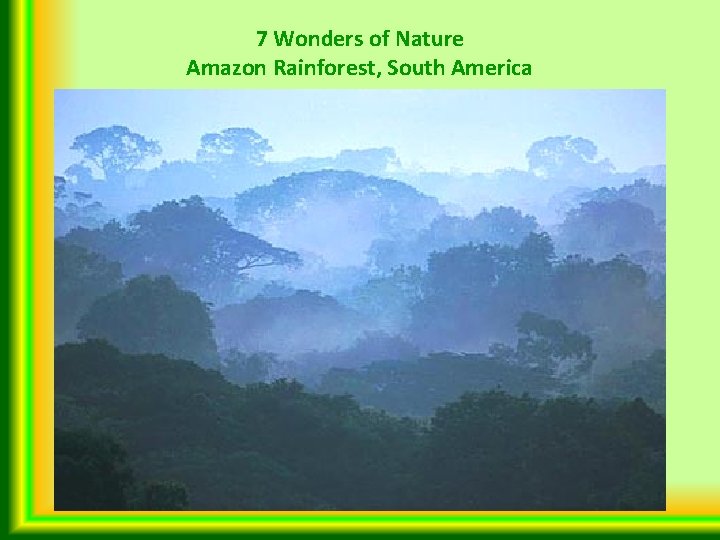
7 Wonders of Nature Amazon Rainforest, South America
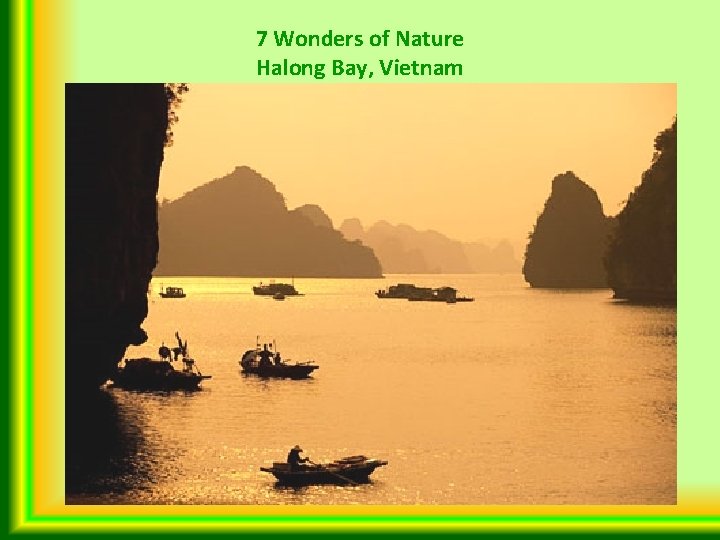
7 Wonders of Nature Halong Bay, Vietnam
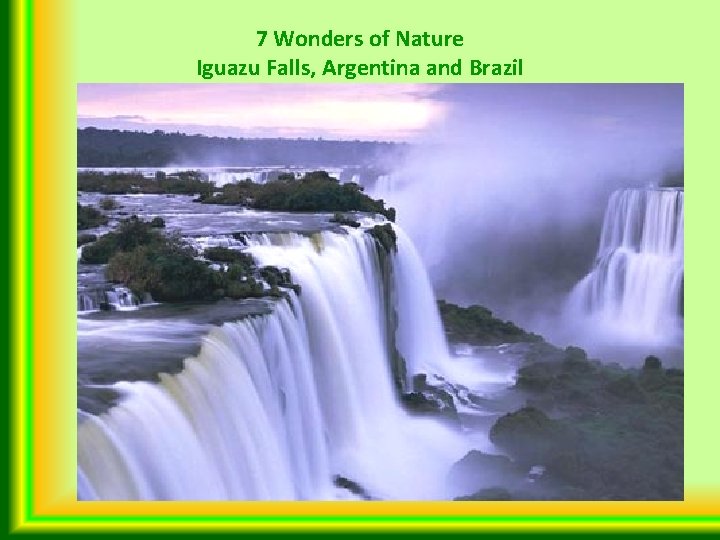
7 Wonders of Nature Iguazu Falls, Argentina and Brazil
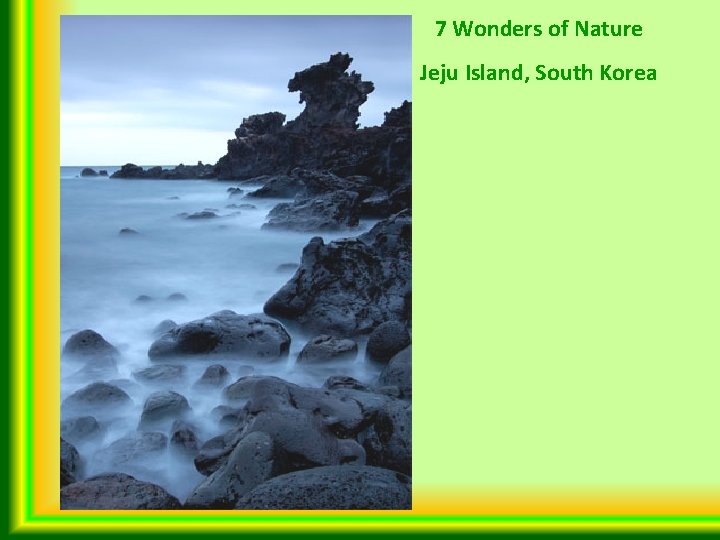
7 Wonders of Nature Jeju Island, South Korea
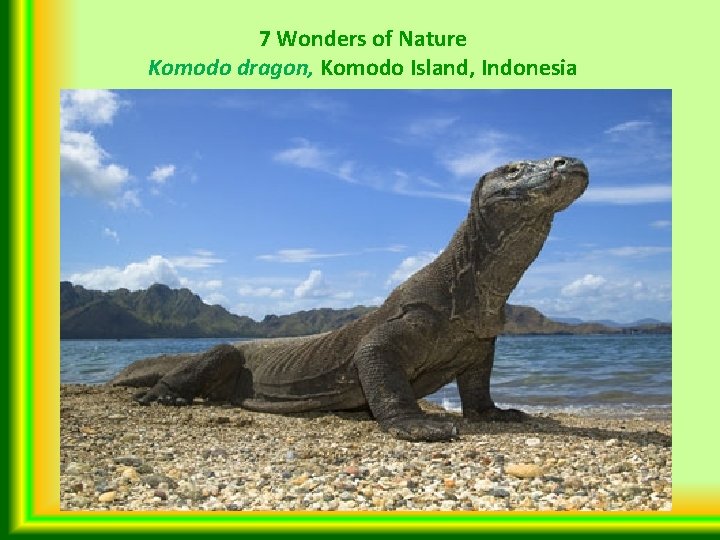
7 Wonders of Nature Komodo dragon, Komodo Island, Indonesia
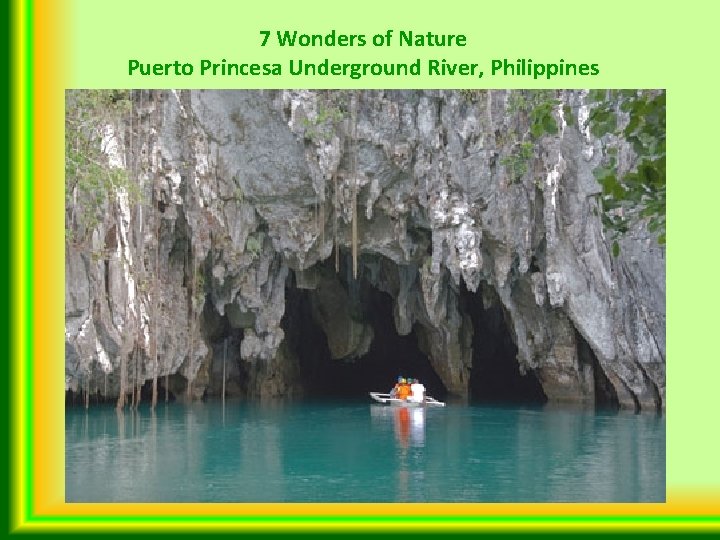
7 Wonders of Nature Puerto Princesa Underground River, Philippines
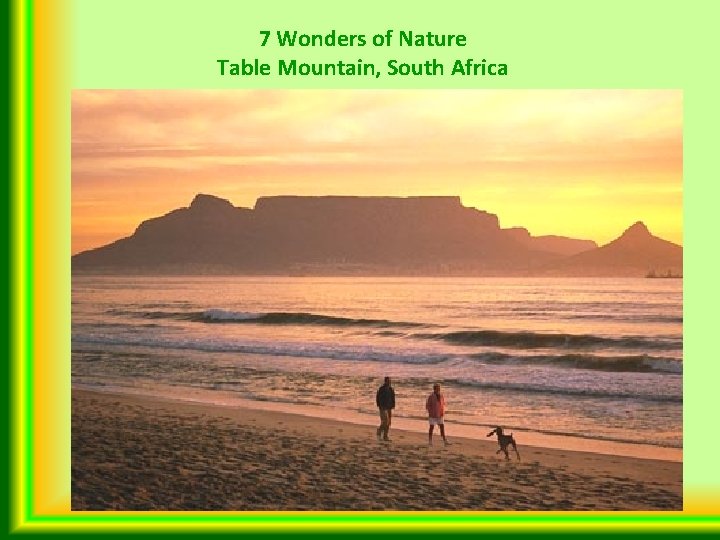
7 Wonders of Nature Table Mountain, South Africa
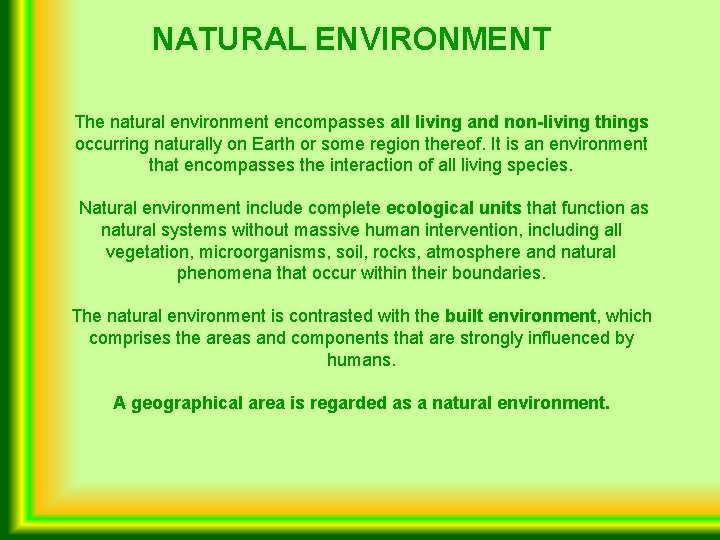
NATURAL ENVIRONMENT The natural environment encompasses all living and non-living things occurring naturally on Earth or some region thereof. It is an environment that encompasses the interaction of all living species. Natural environment include complete ecological units that function as natural systems without massive human intervention, including all vegetation, microorganisms, soil, rocks, atmosphere and natural phenomena that occur within their boundaries. The natural environment is contrasted with the built environment, which comprises the areas and components that are strongly influenced by humans. A geographical area is regarded as a natural environment.
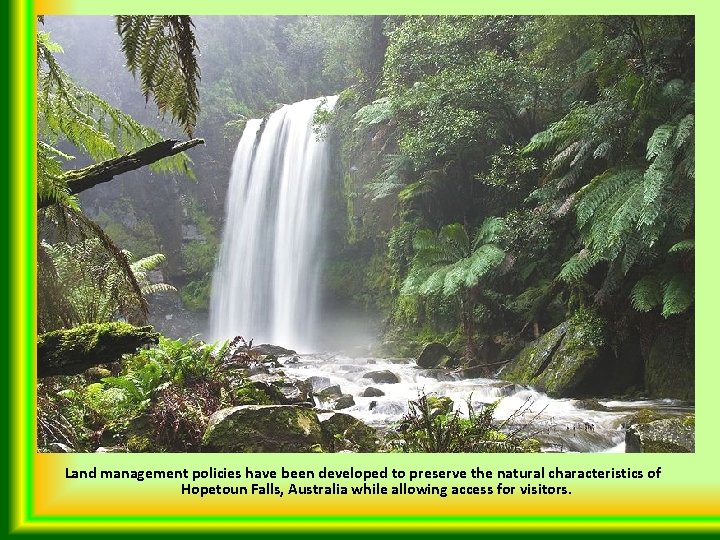
Land management policies have been developed to preserve the natural characteristics of Hopetoun Falls, Australia while allowing access for visitors.
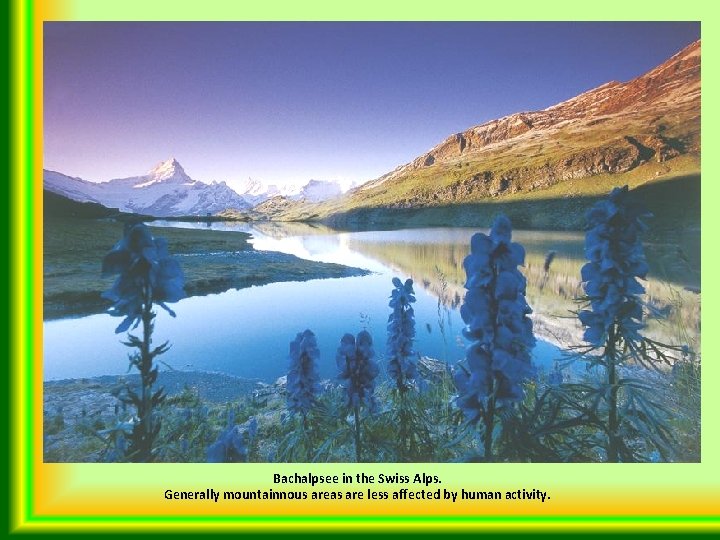
Bachalpsee in the Swiss Alps. Generally mountainnous areas are less affected by human activity.
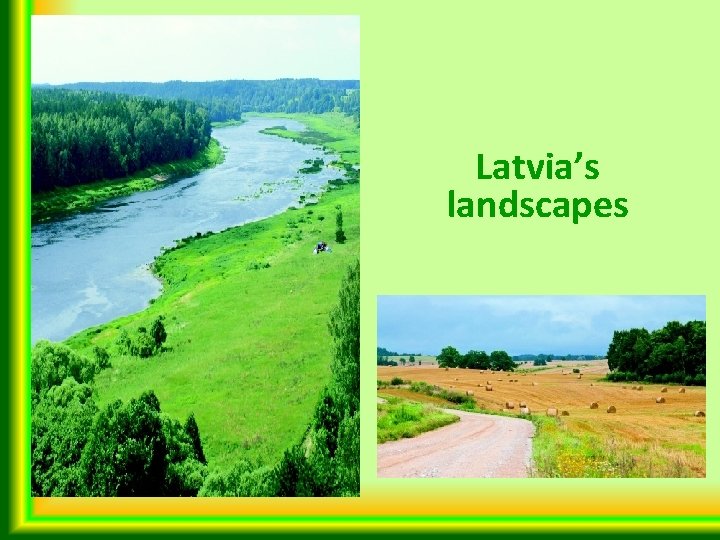
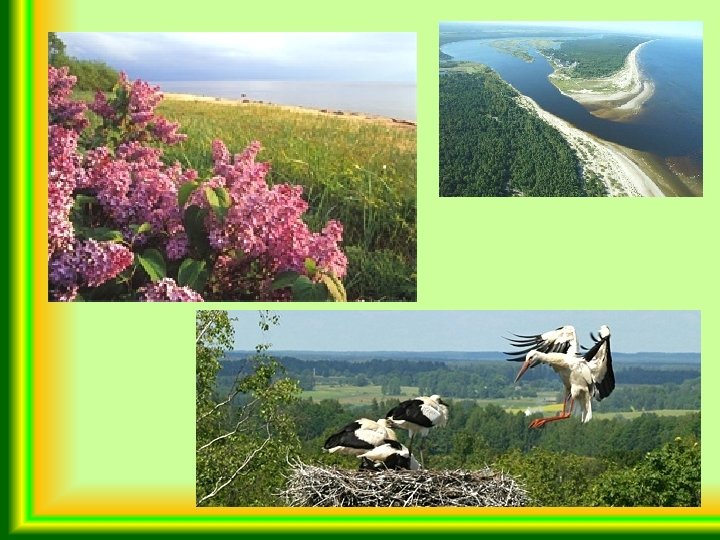
Latvia’s landscapes
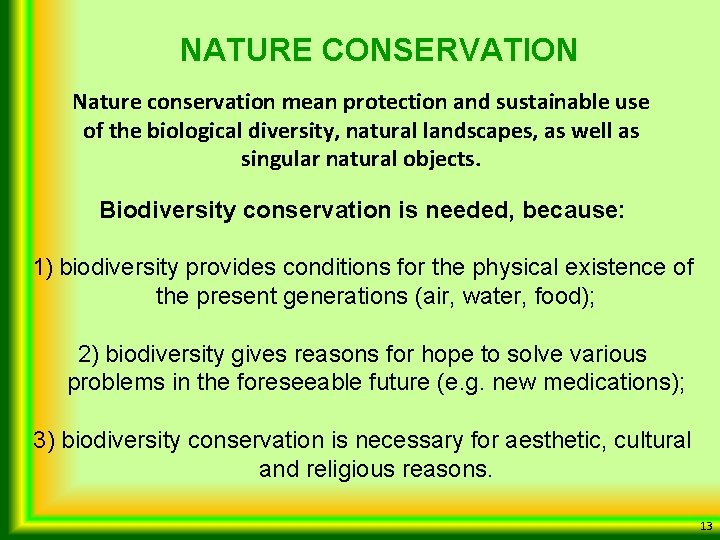
NATURE CONSERVATION Nature conservation mean protection and sustainable use of the biological diversity, natural landscapes, as well as singular natural objects. Biodiversity conservation is needed, because: 1) biodiversity provides conditions for the physical existence of the present generations (air, water, food); 2) biodiversity gives reasons for hope to solve various problems in the foreseeable future (e. g. new medications); 3) biodiversity conservation is necessary for aesthetic, cultural and religious reasons. 13
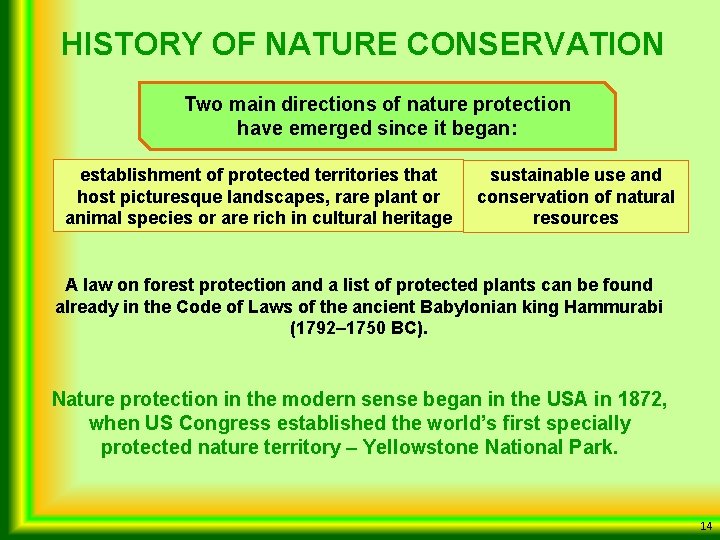
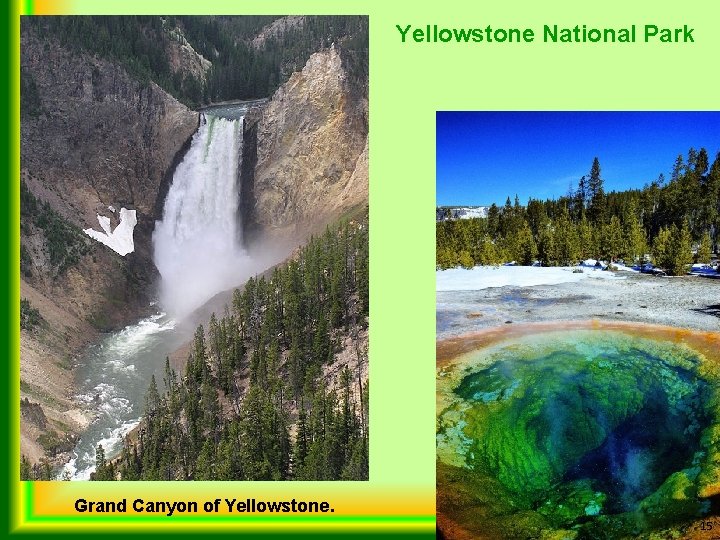
HISTORY OF NATURE CONSERVATION Two main directions of nature protection have emerged since it began: establishment of protected territories that host picturesque landscapes, rare plant or animal species or are rich in cultural heritage sustainable use and conservation of natural resources A law on forest protection and a list of protected plants can be found already in the Code of Laws of the ancient Babylonian king Hammurabi (1792– 1750 BC). Nature protection in the modern sense began in the USA in 1872, when US Congress established the world’s first specially protected nature territory – Yellowstone National Park. 14
Yellowstone National Park Grand Canyon of Yellowstone. 15
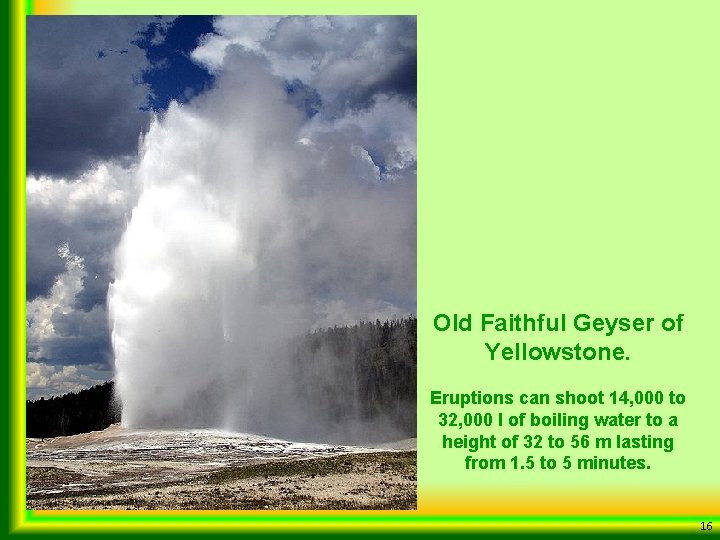
Old Faithful Geyser of Yellowstone. Eruptions can shoot 14, 000 to 32, 000 l of boiling water to a height of 32 to 56 m lasting from 1. 5 to 5 minutes. 16
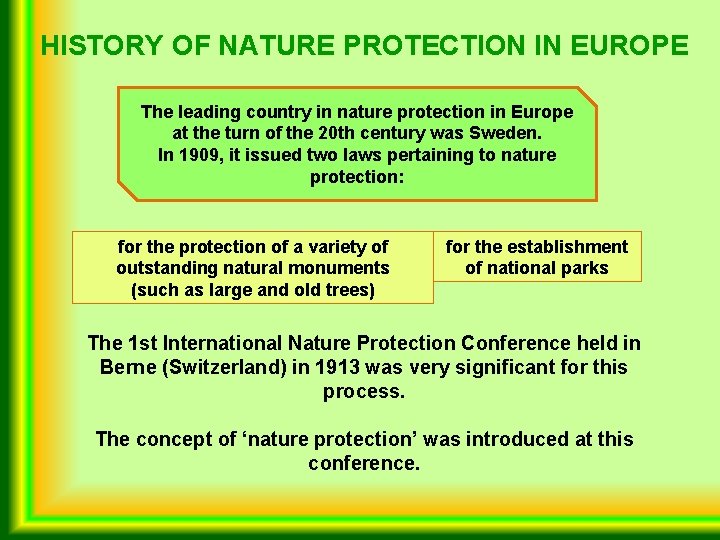
HISTORY OF NATURE PROTECTION IN EUROPE The leading country in nature protection in Europe at the turn of the 20 th century was Sweden. In 1909, it issued two laws pertaining to nature protection: for the protection of a variety of outstanding natural monuments (such as large and old trees) for the establishment of national parks The 1 st International Nature Protection Conference held in Berne (Switzerland) in 1913 was very significant for this process. The concept of ‘nature protection’ was introduced at this conference.
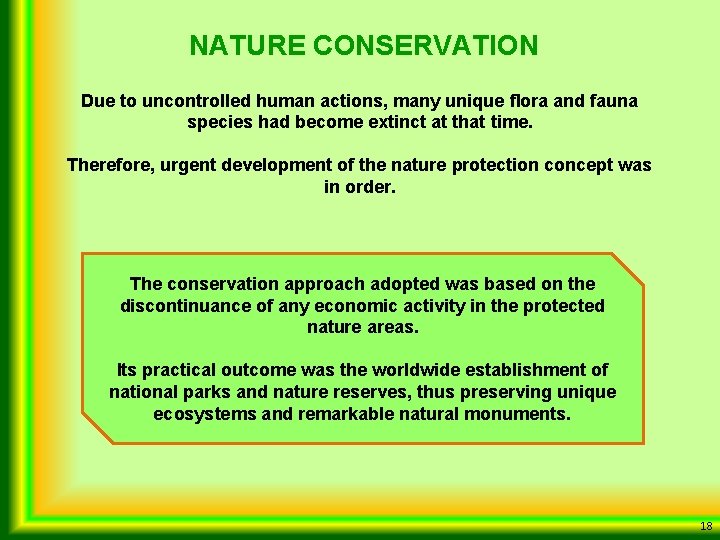
NATURE CONSERVATION Due to uncontrolled human actions, many unique flora and fauna species had become extinct at that time. Therefore, urgent development of the nature protection concept was in order. The conservation approach adopted was based on the discontinuance of any economic activity in the protected nature areas. Its practical outcome was the worldwide establishment of national parks and nature reserves, thus preserving unique ecosystems and remarkable natural monuments. 18
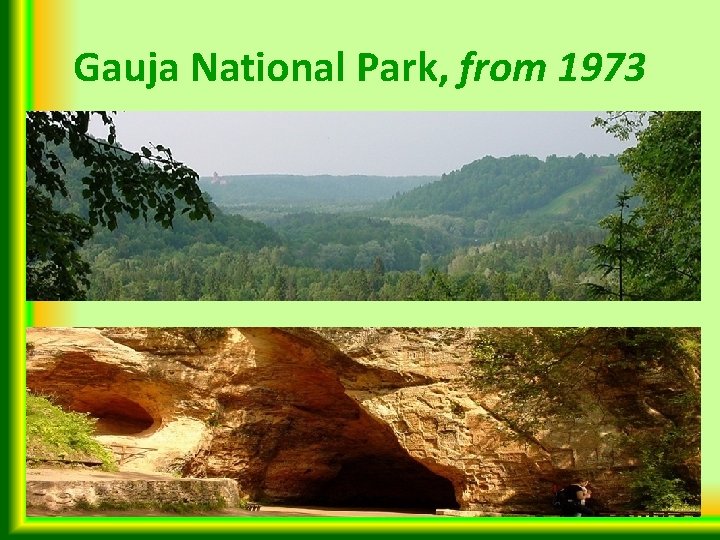
Gauja National Park, from 1973
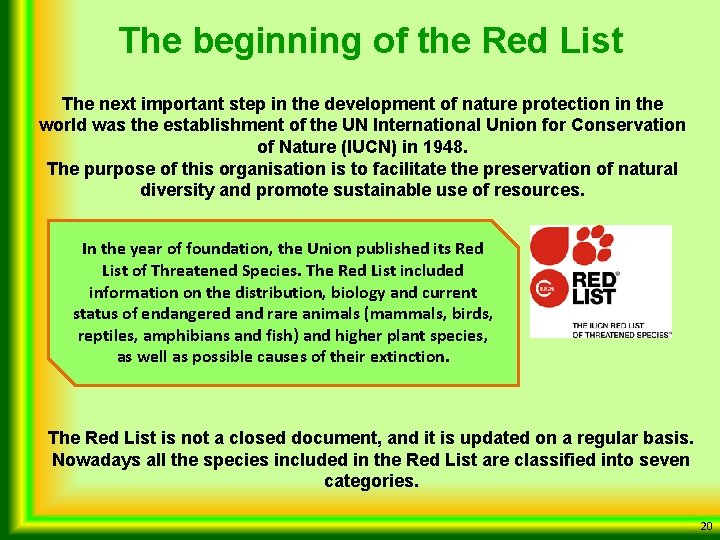
The beginning of the Red List The next important step in the development of nature protection in the world was the establishment of the UN International Union for Conservation of Nature (IUCN) in 1948. The purpose of this organisation is to facilitate the preservation of natural diversity and promote sustainable use of resources. In the year of foundation, the Union published its Red List of Threatened Species. The Red List included information on the distribution, biology and current status of endangered and rare animals (mammals, birds, reptiles, amphibians and fish) and higher plant species, as well as possible causes of their extinction. The Red List is not a closed document, and it is updated on a regular basis. Nowadays all the species included in the Red List are classified into seven categories. 20
International Union for Conservation of Nature IUCN helps the world find pragmatic solutions to our most pressing environment and development challenges. It supports scientific research, manages field projects all over the world and brings governments, non-government organizations, United Nations agencies, companies and local communities together to develop and implement policy, laws and best practice. IUCN is the world’s oldest and largest global environmental network - a democratic membership union with more than 1, 000 government and NGO member organizations, and almost 11, 000 volunteer scientists in more than 160 countries. IUCN’s work is supported by more than 1, 000 professional staff in 60 offices and hundreds of partners in public, NGO and private sectors around the world. The Union’s headquarters are located in Gland, near Geneva, Switzerland. Founded in 1948 as the world’s first global environmental organization. Thousands of field projects and activities around the world. Official Observer Status at the United Nations General Assembly.
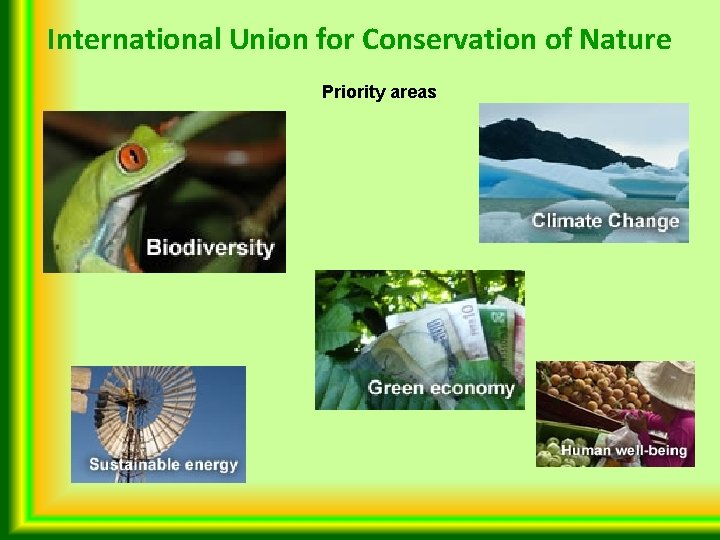
International Union for Conservation of Nature Priority areas
HISTORY OF NATURE PROTECTION IN LATVIA There are longstanding traditions of nature protection in the Baltic Sea Region. For ancient peoples, nature protection was the way of living, while nature itself was an object of worship. Folk songs, legends and widely occurring sacred springs, groves and trees speak volumes for this attitude towards nature. Hunting and fruit-tree protection laws were adopted in the part of Latvia under Swedish governance in the 17 th century. In the 16– 17 th century, owing to the influence of German forestry schools, there were strict hunting and tree-felling regulations in Latvia. In the first half of the 19 th century, under the rule of tsarist Russia, intensive tree logging took place along the coast of the Baltic Sea. As a result, shifting dunes formed, which buried the coastal villages. Hence, the tsarist Russian government issued a decree establishing a protective belt that was on average about 320 metres wide. In particularly dangerous places, this protective belt was as wide as 510 metres, in some places reaching even 2 versts (2. 13 km). This decree may be considered the first legislative measure towards environmental protection in the Baltic Region. 23
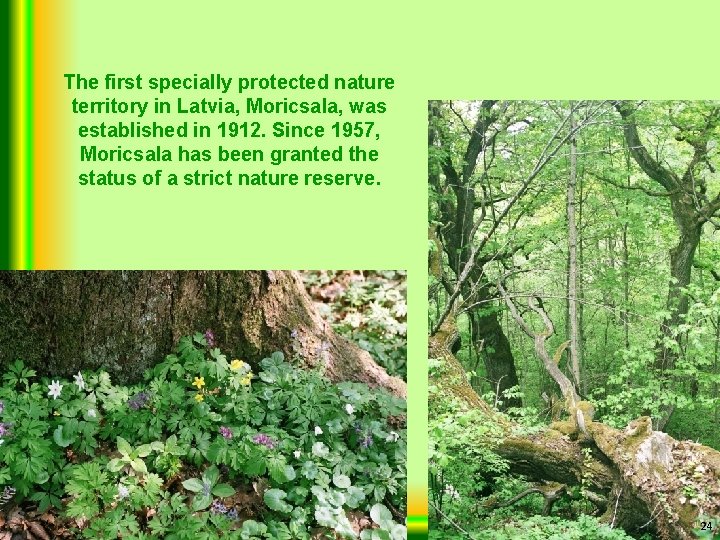
The first specially protected nature territory in Latvia, Moricsala, was established in 1912. Since 1957, Moricsala has been granted the status of a strict nature reserve. 24
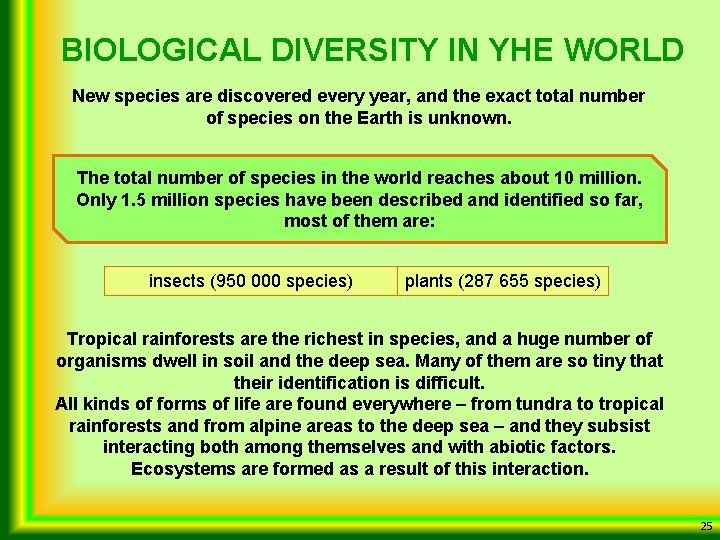
BIOLOGICAL DIVERSITY IN YHE WORLD New species are discovered every year, and the exact total number of species on the Earth is unknown. The total number of species in the world reaches about 10 million. Only 1. 5 million species have been described and identified so far, most of them are: insects (950 000 species) plants (287 655 species) Tropical rainforests are the richest in species, and a huge number of organisms dwell in soil and the deep sea. Many of them are so tiny that their identification is difficult. All kinds of forms of life are found everywhere – from tundra to tropical rainforests and from alpine areas to the deep sea – and they subsist interacting both among themselves and with abiotic factors. Ecosystems are formed as a result of this interaction. 25
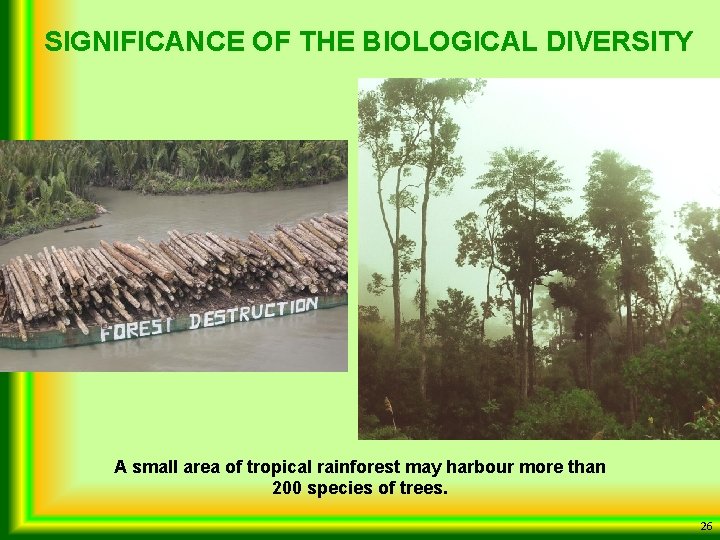
SIGNIFICANCE OF THE BIOLOGICAL DIVERSITY A small area of tropical rainforest may harbour more than 200 species of trees. 26
LOSS OF BIODIVERSITY Loss of biodiversity - the variety of animals, plants, their habitats and their genes - on which so much of human life depends, is one of the world’s most pressing crises. It is estimated that the current species extinction rate is between 1, 000 and 10, 000 times higher than it would naturally be. The main drivers of this loss are converting natural areas to farming and urban development, introducing invasive alien species, polluting or over-exploiting resources including water and soils and harvesting wild plants and animals at unsustainable levels.
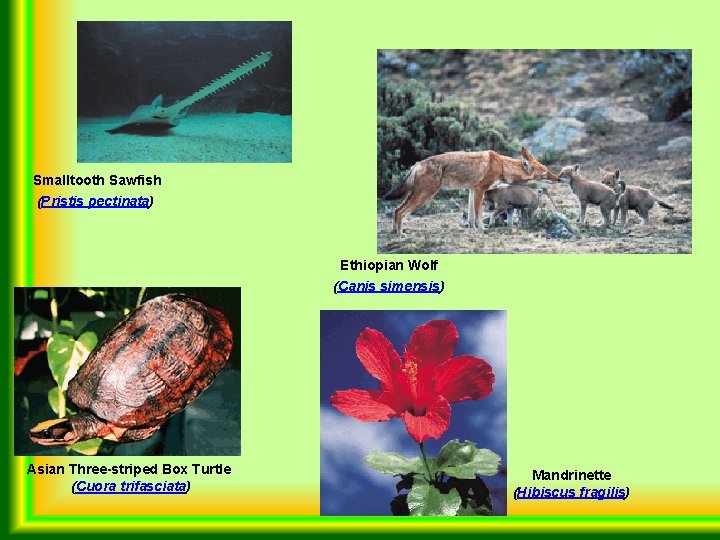
Smalltooth Sawfish (Pristis pectinata) Ethiopian Wolf (Canis simensis) Asian Three-striped Box Turtle (Cuora trifasciata) Mandrinette (Hibiscus fragilis)
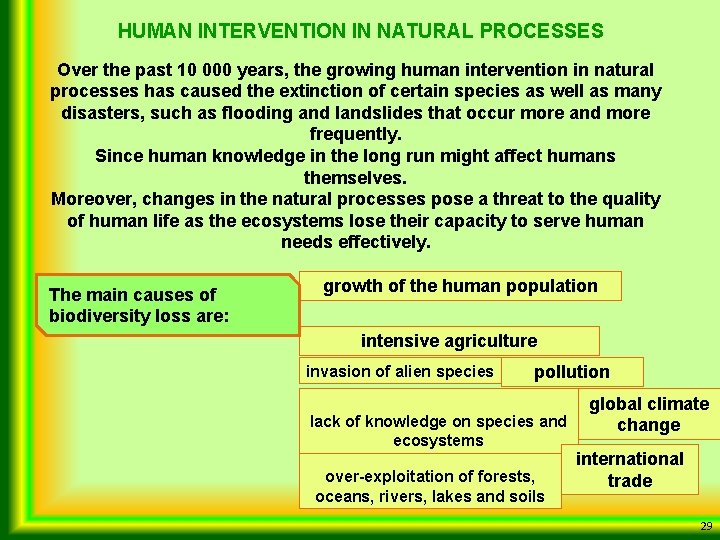
HUMAN INTERVENTION IN NATURAL PROCESSES Over the past 10 000 years, the growing human intervention in natural processes has caused the extinction of certain species as well as many disasters, such as flooding and landslides that occur more and more frequently. Since human knowledge in the long run might affect humans themselves. Moreover, changes in the natural processes pose a threat to the quality of human life as the ecosystems lose their capacity to serve human needs effectively. The main causes of biodiversity loss are: growth of the human population intensive agriculture invasion of alien species pollution lack of knowledge on species and ecosystems over-exploitation of forests, oceans, rivers, lakes and soils global climate change international trade 29
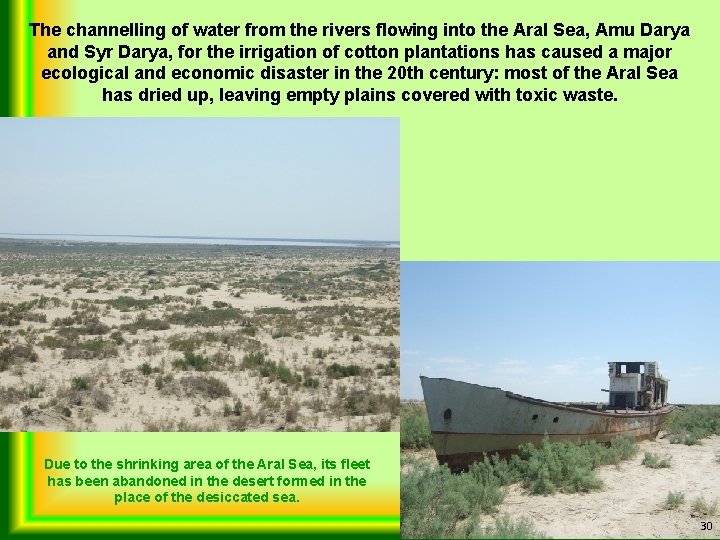
The channelling of water from the rivers flowing into the Aral Sea, Amu Darya and Syr Darya, for the irrigation of cotton plantations has caused a major ecological and economic disaster in the 20 th century: most of the Aral Sea has dried up, leaving empty plains covered with toxic waste. Due to the shrinking area of the Aral Sea, its fleet has been abandoned in the desert formed in the place of the desiccated sea. 30
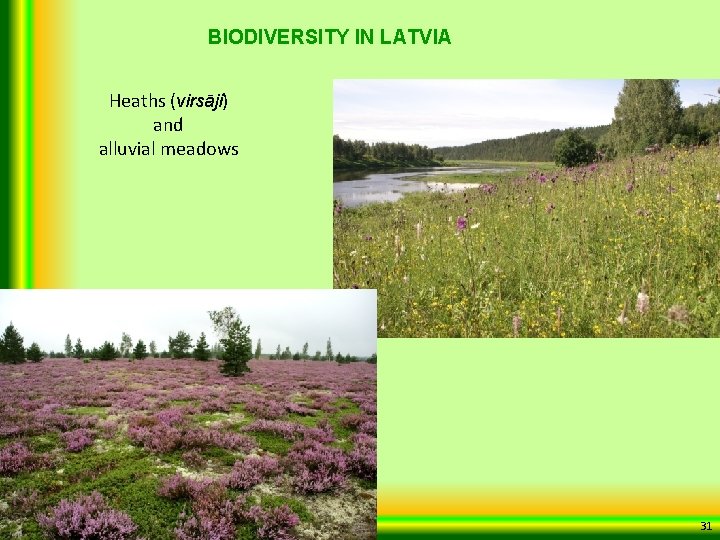
BIODIVERSITY IN LATVIA Heaths (virsāji) and alluvial meadows 31
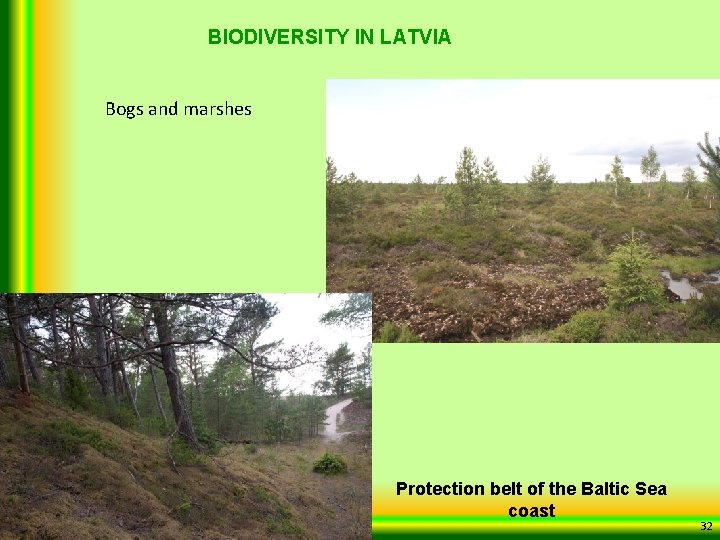
BIODIVERSITY IN LATVIA Bogs and marshes Protection belt of the Baltic Sea coast 32
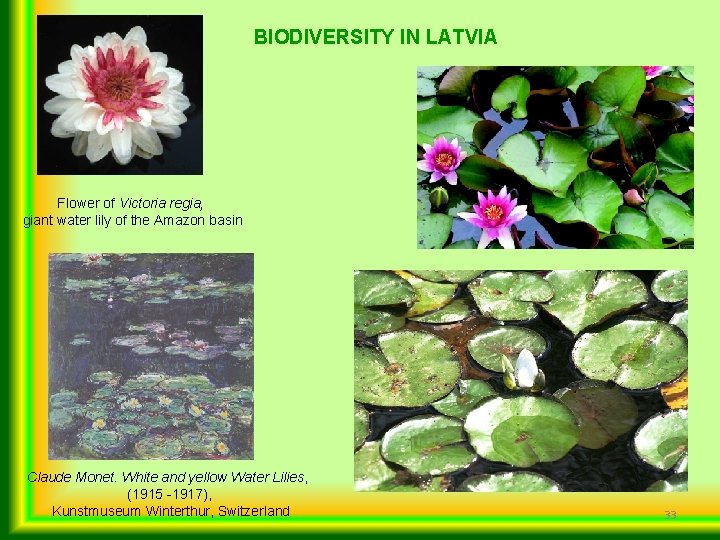
BIODIVERSITY IN LATVIA Flower of Victoria regia, giant water lily of the Amazon basin Claude Monet. White and yellow Water Lilies, (1915 -1917), Kunstmuseum Winterthur, Switzerland 33
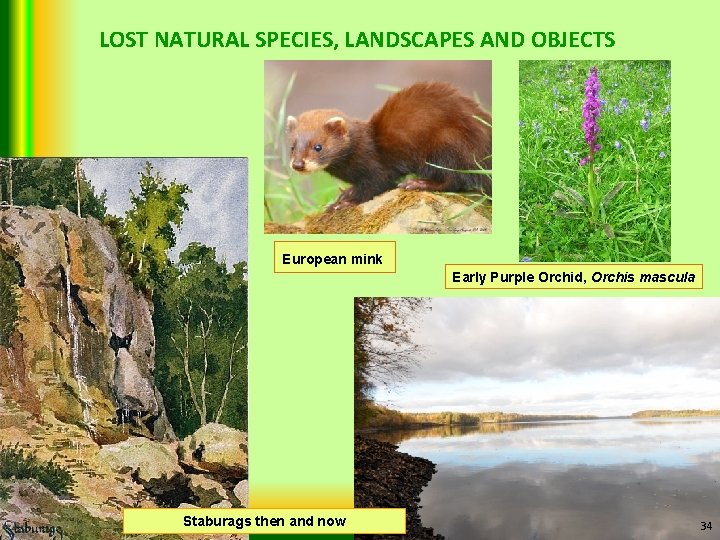
LOST NATURAL SPECIES, LANDSCAPES AND OBJECTS European mink Staburags then and now Early Purple Orchid, Orchis mascula 34
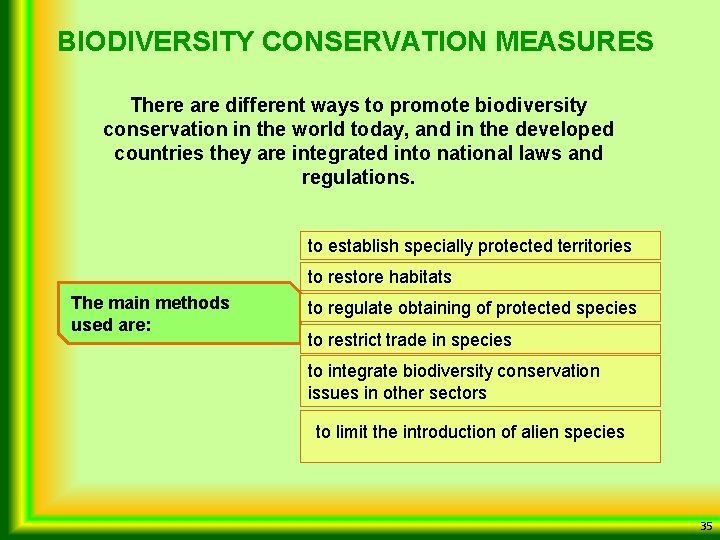
BIODIVERSITY CONSERVATION MEASURES There are different ways to promote biodiversity conservation in the world today, and in the developed countries they are integrated into national laws and regulations. to establish specially protected territories to restore habitats The main methods used are: to regulate obtaining of protected species to restrict trade in species to integrate biodiversity conservation issues in other sectors to limit the introduction of alien species 35
SPECIALLY PROTECTED NATURE TERRITORIES Specially protected nature territories are established in accordance with national laws and fall into several categories which differ in the aim of their establishment, area size, degree of protection, activities permitted or prohibited, the expected management and the purpose of protection. Generally the law provides for special state protection of rarities and unique features as well as typical natural ecosystems and characteristic landscapes: strict nature reserves, national parks, biosphere reserves, nature parks, marine protected areas, protected landscape areas, nature monuments. In Latvia are 691 specially protected nature territories. . 36
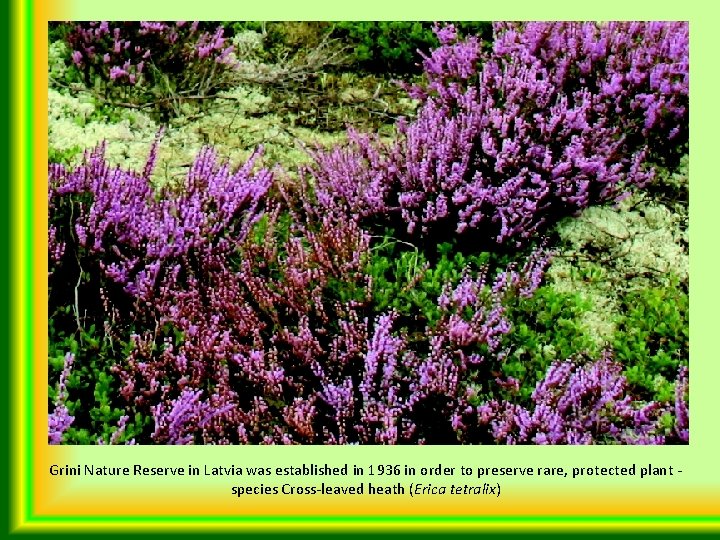
Grini Nature Reserve in Latvia was established in 1936 in order to preserve rare, protected plant - species Cross-leaved heath (Erica tetralix)
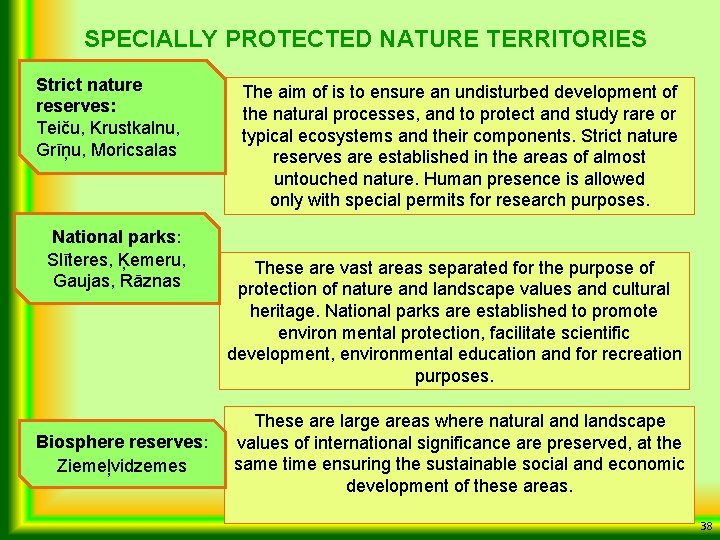
SPECIALLY PROTECTED NATURE TERRITORIES Strict nature reserves: Teiču, Krustkalnu, Grīņu, Moricsalas National parks: Slīteres, Ķemeru, Gaujas, Rāznas Biosphere reserves: Ziemeļvidzemes The aim of is to ensure an undisturbed development of the natural processes, and to protect and study rare or typical ecosystems and their components. Strict nature reserves are established in the areas of almost untouched nature. Human presence is allowed only with special permits for research purposes. These are vast areas separated for the purpose of protection of nature and landscape values and cultural heritage. National parks are established to promote environ mental protection, facilitate scientific development, environmental education and for recreation purposes. These are large areas where natural and landscape values of international significance are preserved, at the same time ensuring the sustainable social and economic development of these areas. 38
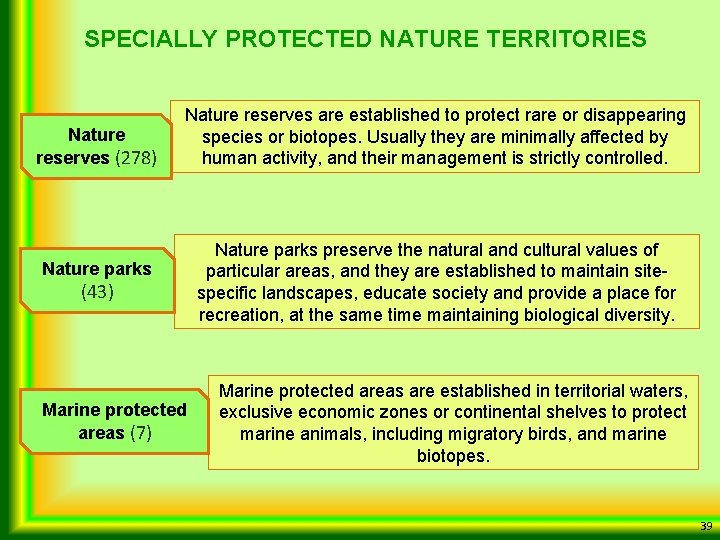
SPECIALLY PROTECTED NATURE TERRITORIES Nature reserves (278) Nature reserves are established to protect rare or disappearing species or biotopes. Usually they are minimally affected by human activity, and their management is strictly controlled. Nature parks (43) Marine protected areas (7) Nature parks preserve the natural and cultural values of particular areas, and they are established to maintain sitespecific landscapes, educate society and provide a place for recreation, at the same time maintaining biological diversity. Marine protected areas are established in territorial waters, exclusive economic zones or continental shelves to protect marine animals, including migratory birds, and marine biotopes. 39
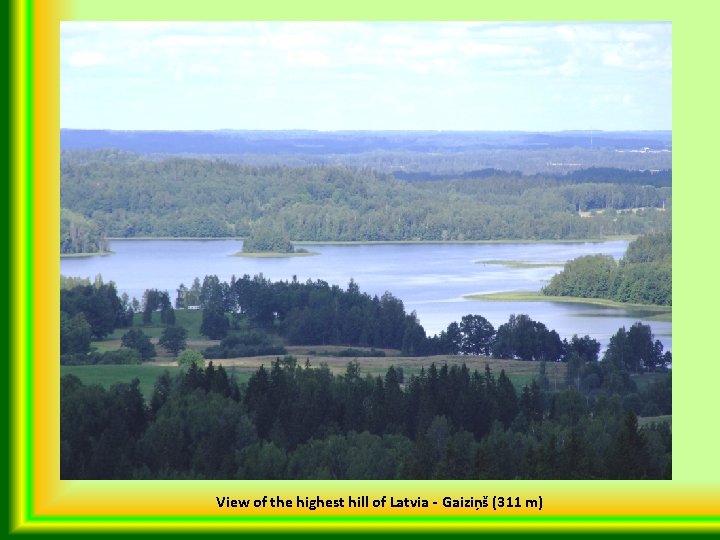
View of the highest hill of Latvia - Gaiziņš (311 m)
SPECIALLY PROTECTED NATURE TERRITORIES Protected landscape areas (9) Nature monuments Protected landscape areas are large territories with particularly beautiful and diverse natural landscapes. Nature monuments are subdivided into: protected trees, dendrological plantations (89), alleys (51), geological and geomorphological formations (206). Specially protected nature territories on borders and nature monuments at the place have a special sign. 41
MICRO-RESERVES To favour protection of dispersed species, several measures can be taken. In Latvia, in accordance with the Law on the Conservation of Species and Biotopes of Latvia, micro-reserves can be created to protect specially protected species or biotopes. A micro-reserve can be created according to the following criteria: no more than ten habitats of the individuals of the respective species or specially protected biotopes are found in the country’s territory from ten to fifty habitats of the individuals of the respective species or specially protected biotopes are found in the country’s territory or their number is rapidly decreasing, which may cause the extinction of this species 42
Nature Conservation Agency The Nature Conservation Agency ensures implementation of unified nature protection policy in Latvia. Main functions of Nature Conservation Agency: - management of all protected areas in Latvia; - nature protection planning management and promotion of the plans; - scientifical research management in protected areas; - carry out the cooperation with local authorities, tourism entrepreneurs, nongovernmental organisations and education institutions to promote nature conservation; - carry out the functions of supervision of „The Convention on International Trade in Endangered Species of Wild Fauna and Flora” (CITES) including issuing the permission for importing and exporting protected animal and plant species. In accordance with laws and regulations issues, suspends or cancels following licences: - licences to introduce species of animals uncharacteristic for Latvia; - licences for reintroduction of extinct animal populations; - licences for obtaining non-game animal and bird individuals; - other licences fixed in laws and regulations; - educate and inform the society about nature conservation. Nature Conservation Agency has 4 structural units: Pieriga, Vidzeme, Kurzeme and Latgale Regional Administration.
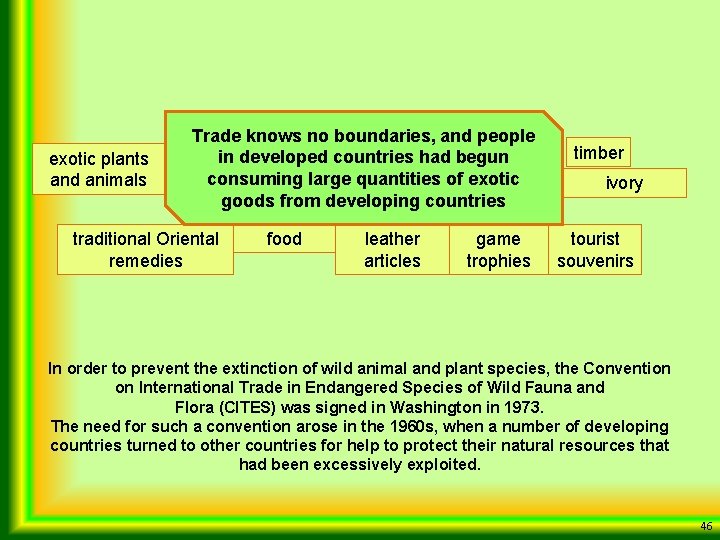
exotic plants and animals Trade knows no boundaries, and people in developed countries had begun consuming large quantities of exotic goods from developing countries traditional Oriental remedies food leather articles game trophies timber ivory tourist souvenirs In order to prevent the extinction of wild animal and plant species, the Convention on International Trade in Endangered Species of Wild Fauna and Flora (CITES) was signed in Washington in 1973. The need for such a convention arose in the 1960 s, when a number of developing countries turned to other countries for help to protect their natural resources that had been excessively exploited. 46
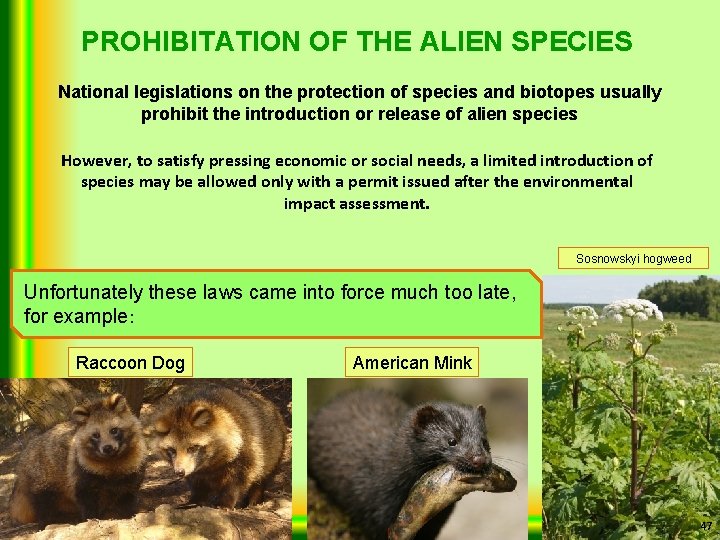
PROHIBITATION OF THE ALIEN SPECIES National legislations on the protection of species and biotopes usually prohibit the introduction or release of alien species However, to satisfy pressing economic or social needs, a limited introduction of species may be allowed only with a permit issued after the environmental impact assessment. Sosnowskyi hogweed Unfortunately these laws came into force much too late, for example: Raccoon Dog American Mink 47
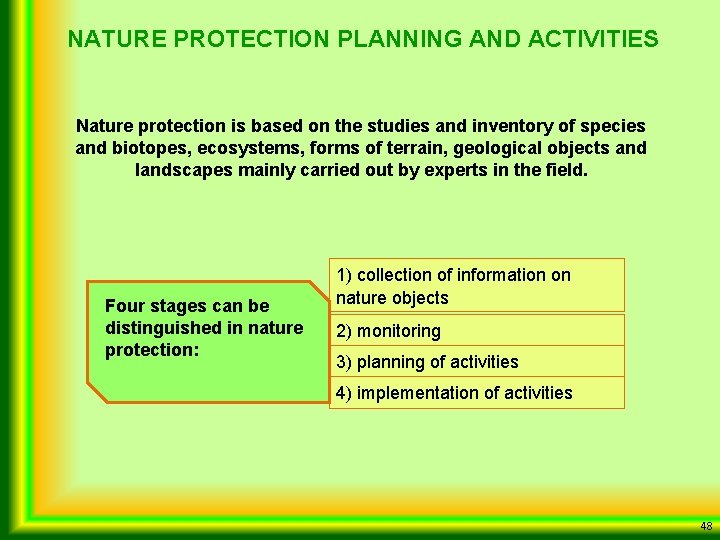
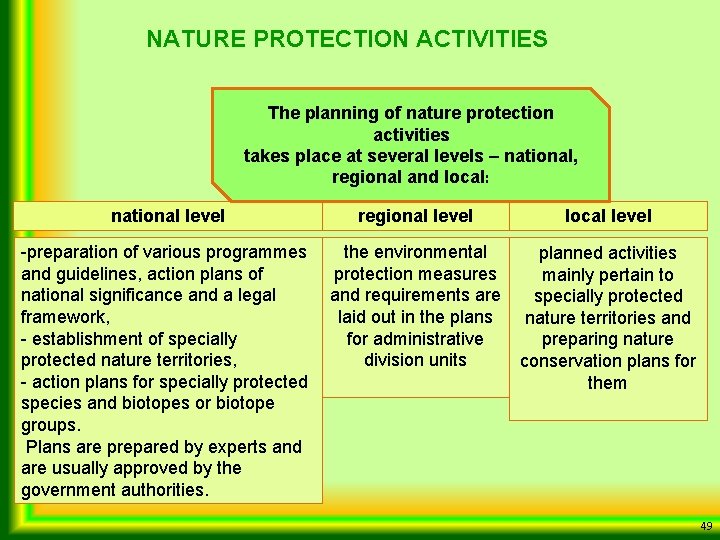
NATURE PROTECTION PLANNING AND ACTIVITIES Nature protection is based on the studies and inventory of species and biotopes, ecosystems, forms of terrain, geological objects and landscapes mainly carried out by experts in the field. Four stages can be distinguished in nature protection: 1) collection of information on nature objects 2) monitoring 3) planning of activities 4) implementation of activities 48
NATURE PROTECTION ACTIVITIES The planning of nature protection activities takes place at several levels – national, regional and local: national level regional level local level -preparation of various programmes and guidelines, action plans of national significance and a legal framework, - establishment of specially protected nature territories, - action plans for specially protected species and biotopes or biotope groups. Plans are prepared by experts and are usually approved by the government authorities. the environmental protection measures and requirements are laid out in the plans for administrative division units planned activities mainly pertain to specially protected nature territories and preparing nature conservation plans for them 49
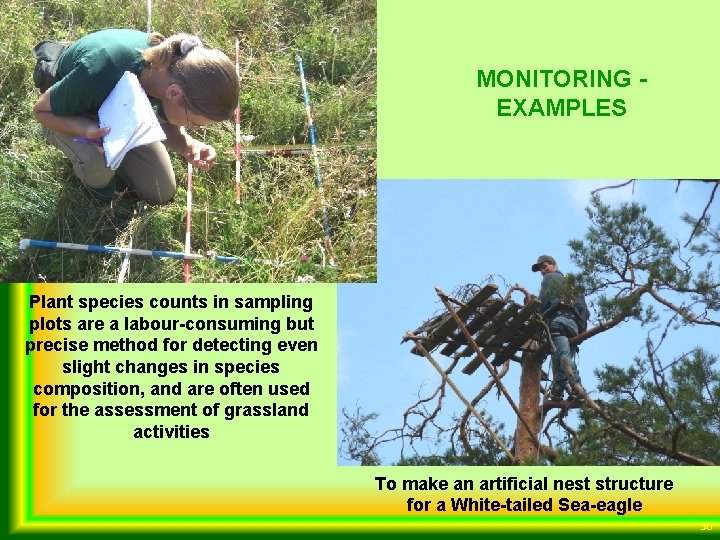
MONITORING EXAMPLES Plant species counts in sampling plots are a labour-consuming but precise method for detecting even slight changes in species composition, and are often used for the assessment of grassland activities To make an artificial nest structure for a White-tailed Sea-eagle 50
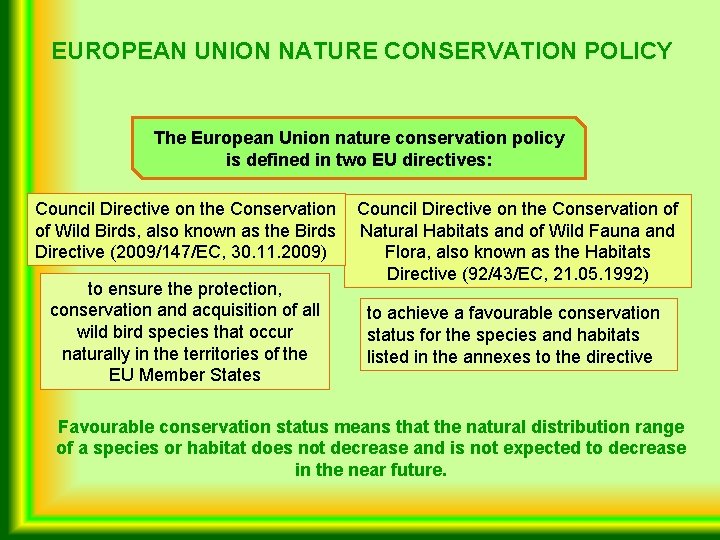
EUROPEAN UNION NATURE CONSERVATION POLICY The European Union nature conservation policy is defined in two EU directives: Council Directive on the Conservation of Wild Birds, also known as the Birds Directive (2009/147/EC, 30. 11. 2009) to ensure the protection, conservation and acquisition of all wild bird species that occur naturally in the territories of the EU Member States Council Directive on the Conservation of Natural Habitats and of Wild Fauna and Flora, also known as the Habitats Directive (92/43/EC, 21. 05. 1992) to achieve a favourable conservation status for the species and habitats listed in the annexes to the directive Favourable conservation status means that the natural distribution range of a species or habitat does not decrease and is not expected to decrease in the near future.
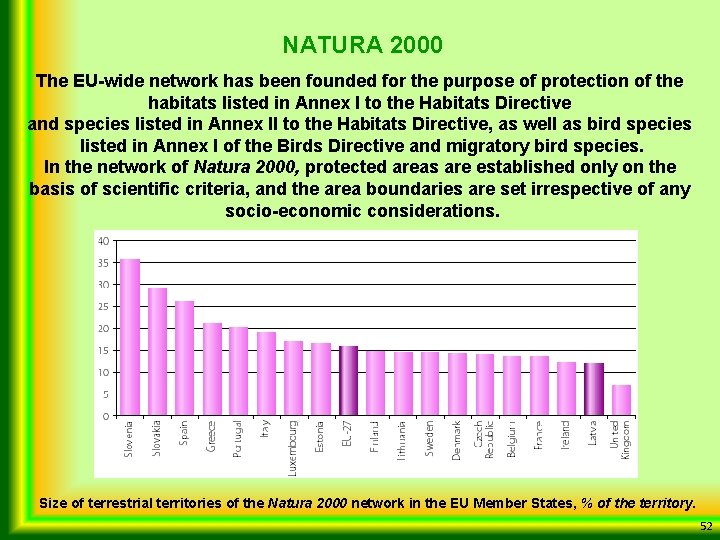
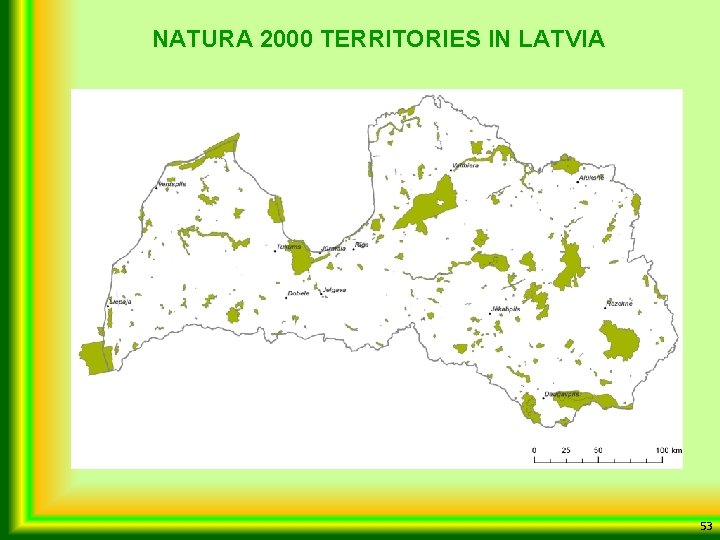
NATURA 2000 The EU-wide network has been founded for the purpose of protection of the habitats listed in Annex I to the Habitats Directive and species listed in Annex II to the Habitats Directive, as well as bird species listed in Annex I of the Birds Directive and migratory bird species. In the network of Natura 2000, protected areas are established only on the basis of scientific criteria, and the area boundaries are set irrespective of any socio-economic considerations. Size of terrestrial territories of the Natura 2000 network in the EU Member States, % of the territory. 52
NATURA 2000 TERRITORIES IN LATVIA 53
INTERNATIONAL COOPERATION IN NATURE PROTECTION Globalisation affects both economics and environmental protection, as the correlation between the consumer markets of developed countries and preservation of natural diversity in Asian, African and South American countries has proven. The economic development gap between developed and developing countries has affected many inter national negotiations in the area of environment and nature. Today international cooperation takes place at the level of ratification of International treaties and implementation of international projects. International nature protection organisations, such as the International Union for Conservation of Nature (IUCN), World Wide Fund for Nature (WWF), Wetlands International and others, founded and located in developed countries, invest heavily in the implementation of various nature protection projects in developing countries. 54
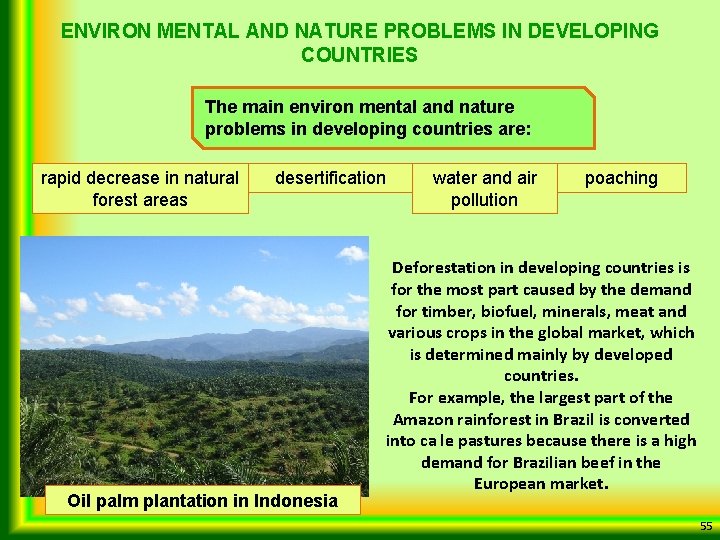
ENVIRON MENTAL AND NATURE PROBLEMS IN DEVELOPING COUNTRIES The main environ mental and nature problems in developing countries are: rapid decrease in natural forest areas desertification Oil palm plantation in Indonesia water and air pollution poaching Deforestation in developing countries is for the most part caused by the demand for timber, biofuel, minerals, meat and various crops in the global market, which is determined mainly by developed countries. For example, the largest part of the Amazon rainforest in Brazil is converted into ca le pastures because there is a high demand for Brazilian beef in the European market. 55
NATURE AND ENVIRONMENTAL PROTECTION CONVENTIONS The EU countries have ratified all major nature and environmental protection conventions, including the six UN environmental protection conventions: The Ramsar Convention on Wetlands of International Importance, especially as Waterfowl Habitat The Convention on World Heritage The Convention on International Trade in Endangered Species of Wild Fauna and Flora The Berne Convention on European Wildlife and Natural Habitats Convention on the Conservation of Migratory Species of Wild Animals Convention on Biological Diversity 56
ROLE OF NON-GOVERNMENTAL ORGANISATIONS During the last decades, the number of NGOs aimed at protecting the environment has increased dramatically both in the EU and worldwide, and their role have been expanding. Nature foundation of Latvia was founded in 1990 for preservation of biological diversity in the country The World Wide Fund Ornithological society of for Nature (WWF) was Latvia was founded in 1985 founded in 1961 in for preservation of wild order to build a future birds diversity in the country in which humans and nature live in harmony 57
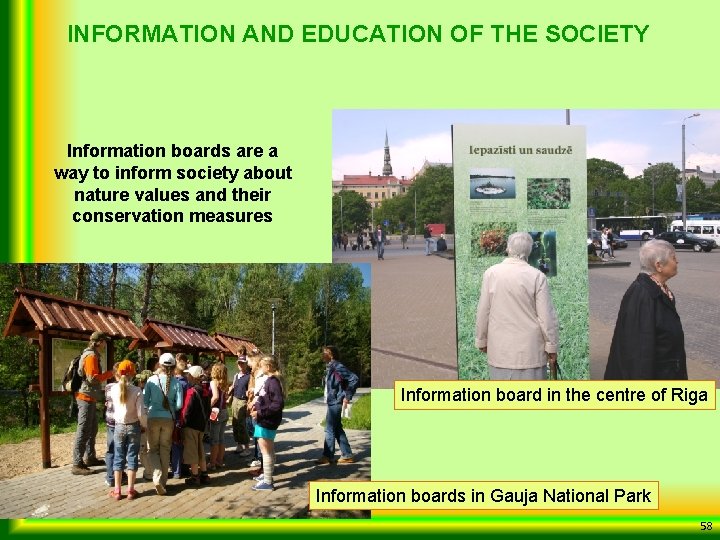
INFORMATION AND EDUCATION OF THE SOCIETY Information boards are a way to inform society about nature values and their conservation measures Information board in the centre of Riga Information boards in Gauja National Park 58
THANK YOU FOR ATTENTION !