
NATURE AND SCOPE OF THE PUBLIC RESPONSIBILITY FOR

NATURE AND SCOPE OF THE PUBLIC RESPONSIBILITY FOR HIGHER EDUCATION Conference on Public responsibility for Higher Education and Research Council of Europe, Strasbourg 22 -23 September 2004 Luc WEBER, University of Geneva, Vice-President CD-ESR 22 Sept. 2004 WEBER: Public responsibility for Higher Education
RELEVANCE OF THEME n n Nature and scope of Public responsibility (PR) for Higher education and research (HE/R) is of increasing importance for the effectiveness of the system Why? Two independent reasons: n n Strong political commitment: Ministers of education in their Prague and Berlin communiqués (2001 and 2003) Concern shared by university leaders and experts: n n it is crucial to correctly define the nature and scope of the PR for HE/R and how it is implemented; otherwise, this political good intention could act counterproductively Serious indices for this potential threat: Prague communiqué: “HE should be considered a “public good” and is and will remain a PR…”. Consequently, the sense given to the expression “public good” is all but insignificant 22 Sept. 2004 WEBER: Public responsibility for Higher Education 2
OUTLINE n n n Justification of the conference: clarify the nature and scope of the PR for HE/R and the interpretation to be given to the notion of “public good” Aim of this contribution: set the scene in order to launch the debates Three chapters: n n Role and policy instruments of the public sector Justification of the PR for HE Limits to the PR for HE Two additional remarks: n Although the question concerns HE AND R, I shall focus mainly on HE n PR has two facets: PR for HE/R as well as PR of HE/R institutions 22 Sept. 2004 WEBER: Public responsibility for Higher Education 3
ROLE AND INSTRUMENTS OF THE PUBLIC SECTOR n Three systems are available to decide about: n n n n The goods and services to produce and consume The organization of their production The repartition of wealth among individuals and regions Competitive markets The public sector (the State) Non-profit organizations The recurring political issue is the right mix and balance The system in place depends on the response given to three questions: n n n Who provides (decides) Who produces Who pays 22 Sept. 2004 WEBER: Public responsibility for Higher Education 4
ROLE AND INSTRUMENTS OF THE PUBLIC SECTOR (2) n Theoretically, the provision, production and financing of HE/R can be assured n n n In the real world, these extreme solutions are rare: n n n by the State (traditional public universities) by a market process (private for profit universities) Public universities benefit increasingly from private funds Public funds are more and more allocated according to “private-like formulas” Many universities are quite independent from the State regarding their governance, the status of their staff or their management In the USA, most of the best research universities are independent entities, largely financed by private money; they are nevertheless non profit organizations and receive considerable public funds on a competitive basis Even in the extreme case of private for profit universities, many recognize that the State should regulate them. The lesson: various organizational solutions are possible from one extreme to the other 22 Sept. 2004 WEBER: Public responsibility for Higher Education 5
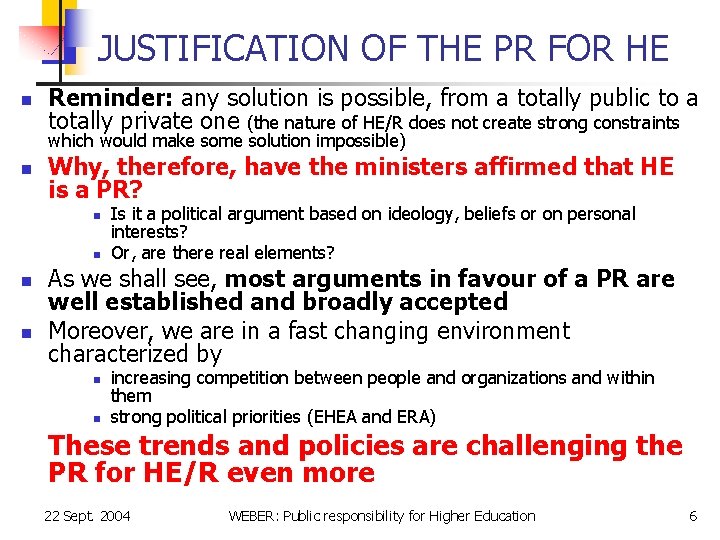
JUSTIFICATION OF THE PR FOR HE n Reminder: any solution is possible, from a totally public to a totally private one (the nature of HE/R does not create strong constraints which would make some solution impossible) n Why, therefore, have the ministers affirmed that HE is a PR? n n Is it a political argument based on ideology, beliefs or on personal interests? Or, are there real elements? As we shall see, most arguments in favour of a PR are well established and broadly accepted Moreover, we are in a fast changing environment characterized by n n increasing competition between people and organizations and within them strong political priorities (EHEA and ERA) These trends and policies are challenging the PR for HE/R even more 22 Sept. 2004 WEBER: Public responsibility for Higher Education 6
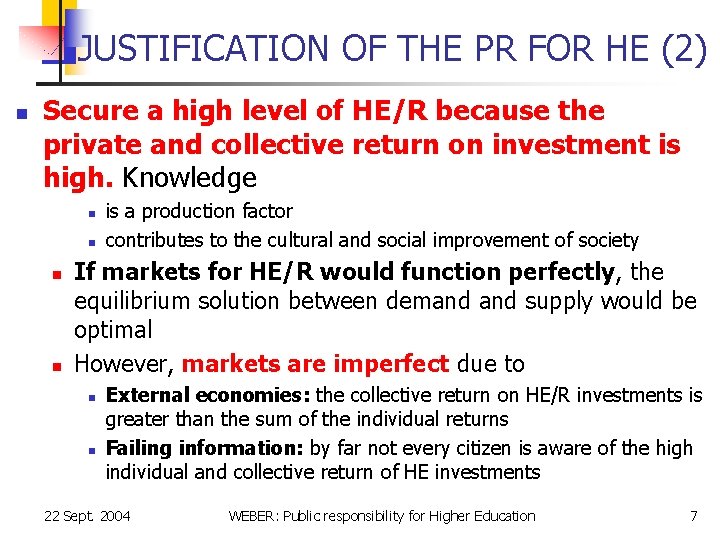
JUSTIFICATION OF THE PR FOR HE (2) n Secure a high level of HE/R because the private and collective return on investment is high. Knowledge n n is a production factor contributes to the cultural and social improvement of society If markets for HE/R would function perfectly, the equilibrium solution between demand supply would be optimal However, markets are imperfect due to n n External economies: the collective return on HE/R investments is greater than the sum of the individual returns Failing information: by far not every citizen is aware of the high individual and collective return of HE investments 22 Sept. 2004 WEBER: Public responsibility for Higher Education 7
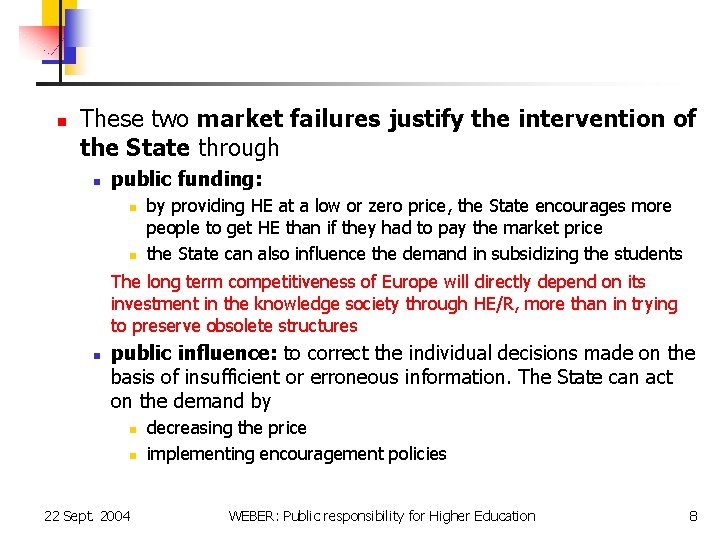
n These two market failures justify the intervention of the State through n public funding: n n by providing HE at a low or zero price, the State encourages more people to get HE than if they had to pay the market price the State can also influence the demand in subsidizing the students The long term competitiveness of Europe will directly depend on its investment in the knowledge society through HE/R, more than in trying to preserve obsolete structures n public influence: to correct the individual decisions made on the basis of insufficient or erroneous information. The State can act on the demand by n n 22 Sept. 2004 decreasing the price implementing encouragement policies WEBER: Public responsibility for Higher Education 8
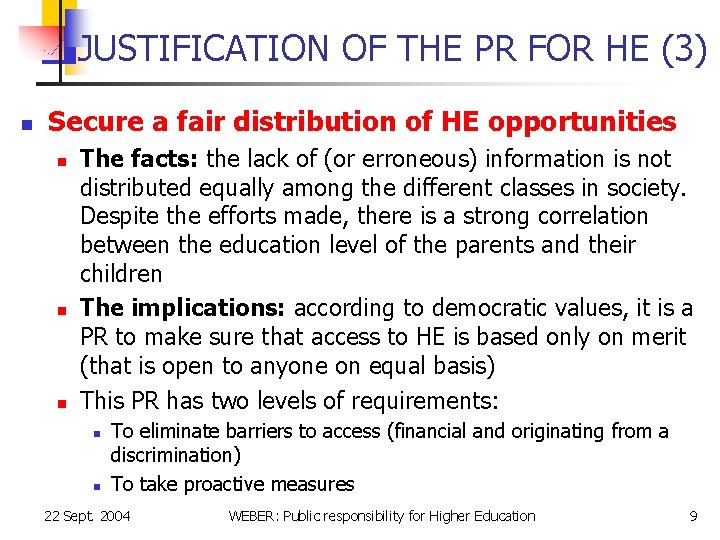
JUSTIFICATION OF THE PR FOR HE (3) n Secure a fair distribution of HE opportunities n n n The facts: the lack of (or erroneous) information is not distributed equally among the different classes in society. Despite the efforts made, there is a strong correlation between the education level of the parents and their children The implications: according to democratic values, it is a PR to make sure that access to HE is based only on merit (that is open to anyone on equal basis) This PR has two levels of requirements: n n To eliminate barriers to access (financial and originating from a discrimination) To take proactive measures 22 Sept. 2004 WEBER: Public responsibility for Higher Education 9
JUSTIFICATION OF THE PR FOR HE (4) n Secure a quality HE/R sector n The question of quality is gaining in importance because n n n The increasing struggle for state funds is forcing institutions to better manage themselves The creation of private institutions and the development of transborder education are creating a greater need for quality control This calls for State regulation. Two levels of exigency: n n 22 Sept. 2004 Minimum standard (licensing, accreditation) Quality assurance (improvement). This responsibility should be shared between the institutions themselves and independent quality assurance bodies WEBER: Public responsibility for Higher Education 10
LIMITS TO THE PR FOR HE n We have made a strong case in favour of a PR for HE. Does it mean that n n there is no limit to the State involvement? HE is a “public good” stricto sensu? The addition of the words “public good” would be acceptable if the ministers have in mind a loose definition, with sole purpose to reinforce the expression “public responsibility” by repeating it in using a different notion; nevertheless, it is confusing 22 Sept. 2004 WEBER: Public responsibility for Higher Education 11
LIMITS TO THE PR FOR HE (2) n HE is not a “public good” stricto sensu n For economists: n n n This means that HE is a “non rival” and “non excludable” good, which would impose a public provision and public funding (see contribution of Dr Schoenenberger) Best proof that it is not: private institutions can provide and finance HE/R without too much difficulty. The only – indeed important – qualification is that HE/R produces external benefits In terms of public administration: affirming that HE is a “public good” is a political value judgement which states that this service must be provided (perhaps also produced) by the public sector, in principle at no charge to the users. (The fact that, in reality, nothing makes it obligatory for HE/R to be provisioned and financed by the public sector shows that it is a political view, nothing else) n Moreover, public provision and financing of HE/R would be acceptable if the public sector was able to make and implement perfect decisions. This is not the case: there also government failures. 22 Sept. 2004 WEBER: Public responsibility for Higher Education 12
LIMITS TO THE PR FOR HE (3) n Dangers of considering HE/R a “public good” stricto sensu n n n European ambition: to become the most competitive economy by 2010, thanks to the promotion of the knowledge society Crucial question: how to realize it? More than that, has Europe any chance to succeed if it considers that HE/R is a “public good” stricto sensu, as it implies that the production and financing of HE/R should be exclusively the responsibility of the public sector According to most university leaders and economists: n n the attainment of this ambitious objective would be greatly hampered if the governments would aim at being even more present in the HE/R system The public sector should on the contrary reduce his degree of intervention and HE institutions should have a more entrepreneurial attitude to increase the effectiveness of the sector 22 Sept. 2004 WEBER: Public responsibility for Higher Education 13
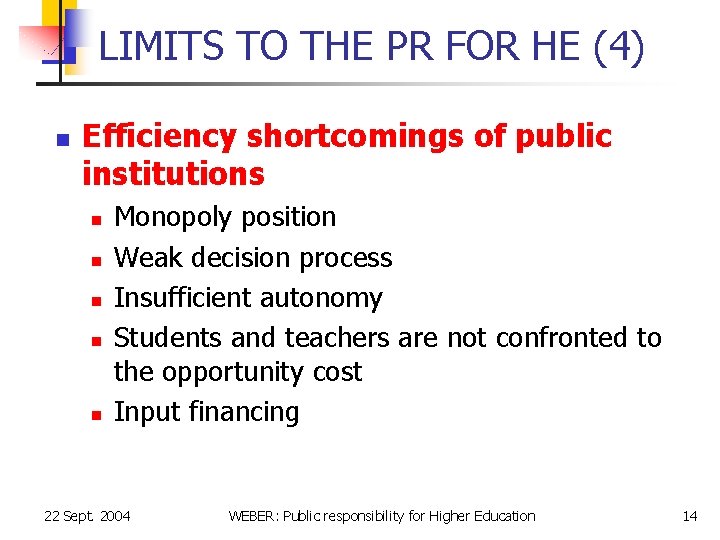
LIMITS TO THE PR FOR HE (4) n Efficiency shortcomings of public institutions n n n Monopoly position Weak decision process Insufficient autonomy Students and teachers are not confronted to the opportunity cost Input financing 22 Sept. 2004 WEBER: Public responsibility for Higher Education 14
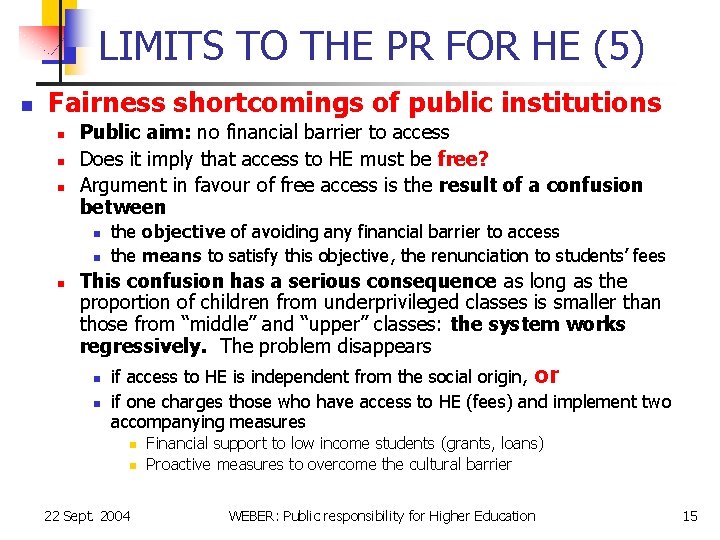
LIMITS TO THE PR FOR HE (5) n Fairness shortcomings of public institutions n n n Public aim: no financial barrier to access Does it imply that access to HE must be free? Argument in favour of free access is the result of a confusion between n the objective of avoiding any financial barrier to access the means to satisfy this objective, the renunciation to students’ fees This confusion has a serious consequence as long as the proportion of children from underprivileged classes is smaller than those from “middle” and “upper” classes: the system works regressively. The problem disappears n n if access to HE is independent from the social origin, or if one charges those who have access to HE (fees) and implement two accompanying measures n n 22 Sept. 2004 Financial support to low income students (grants, loans) Proactive measures to overcome the cultural barrier WEBER: Public responsibility for Higher Education 15
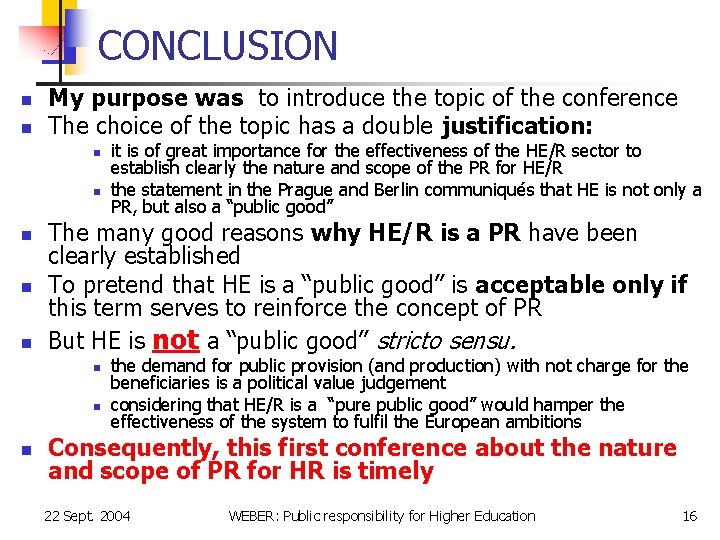
CONCLUSION n n My purpose was to introduce the topic of the conference The choice of the topic has a double justification: n n n The many good reasons why HE/R is a PR have been clearly established To pretend that HE is a “public good” is acceptable only if this term serves to reinforce the concept of PR But HE is not a “public good” stricto sensu. n n n it is of great importance for the effectiveness of the HE/R sector to establish clearly the nature and scope of the PR for HE/R the statement in the Prague and Berlin communiqués that HE is not only a PR, but also a “public good” the demand for public provision (and production) with not charge for the beneficiaries is a political value judgement considering that HE/R is a “pure public good” would hamper the effectiveness of the system to fulfil the European ambitions Consequently, this first conference about the nature and scope of PR for HR is timely 22 Sept. 2004 WEBER: Public responsibility for Higher Education 16
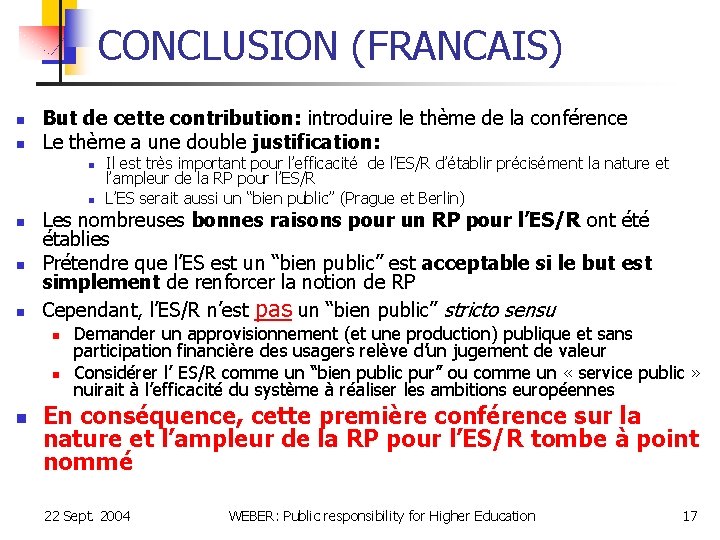
CONCLUSION (FRANCAIS) n n But de cette contribution: introduire le thème de la conférence Le thème a une double justification: n n n Les nombreuses bonnes raisons pour un RP pour l’ES/R ont été établies Prétendre que l’ES est un “bien public” est acceptable si le but est simplement de renforcer la notion de RP Cependant, l’ES/R n’est pas un “bien public” stricto sensu n n n Il est très important pour l’efficacité de l’ES/R d’établir précisément la nature et l’ampleur de la RP pour l’ES/R L’ES serait aussi un “bien public” (Prague et Berlin) Demander un approvisionnement (et une production) publique et sans participation financière des usagers relève d’un jugement de valeur Considérer l’ ES/R comme un “bien public pur” ou comme un « service public » nuirait à l’efficacité du système à réaliser les ambitions européennes En conséquence, cette première conférence sur la nature et l’ampleur de la RP pour l’ES/R tombe à point nommé 22 Sept. 2004 WEBER: Public responsibility for Higher Education 17
- Slides: 17