
Nature and Control of Water Pollution I Water


- Slides: 5
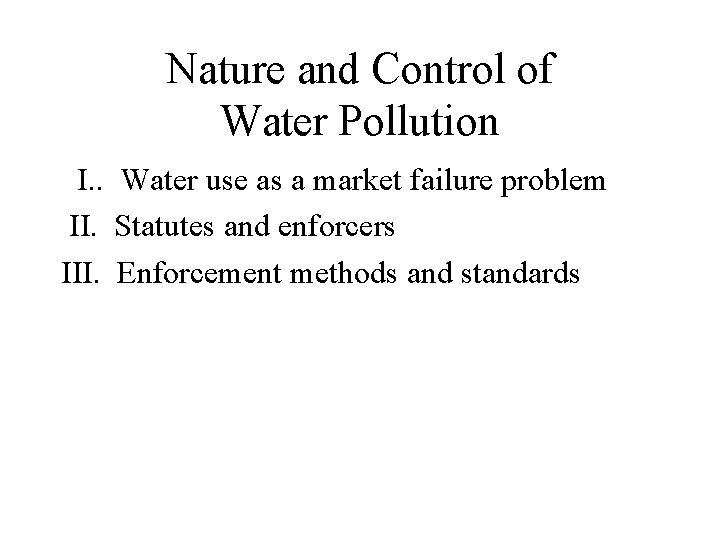
Nature and Control of Water Pollution I. . Water use as a market failure problem II. Statutes and enforcers III. Enforcement methods and standards
Control of Water Pollution I. Water use as a market failure problem A. Water as a private good / water rights and markets B. Why and when water pollution presents an economic problem 1. Pollution as external damage and cost 2. Lack of property rights as uses conflict 3. Lack of traceability and identifiablity C. Types of water pollution 1. Degradable waste and BOD overuse 2. Toxic chemicals and nondegradable waste 3. Point vs. nonpoint sources.
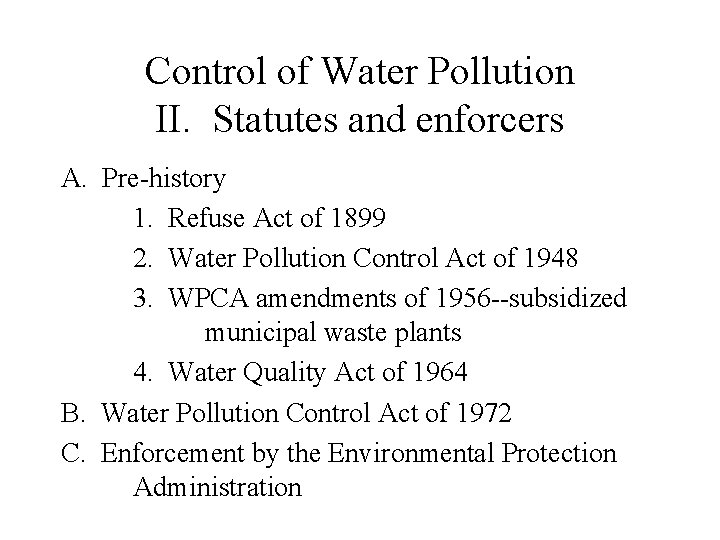
Control of Water Pollution II. Statutes and enforcers A. Pre-history 1. Refuse Act of 1899 2. Water Pollution Control Act of 1948 3. WPCA amendments of 1956 --subsidized municipal waste plants 4. Water Quality Act of 1964 B. Water Pollution Control Act of 1972 C. Enforcement by the Environmental Protection Administration
Control of Water Pollution III. Enforcement A. Broad standards 1. Objective: making (navigable) waterways fishable, swimmable, capable of sustaining life 2. Elimination of harmful discharges by 1985 3. Universal Best Practicable Control Technology by 1977 4. Universal Best Available Control Technology by 1983.
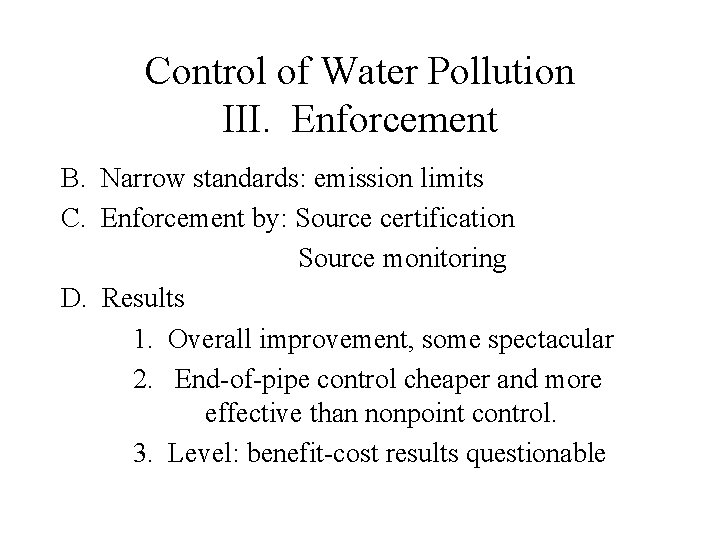
Control of Water Pollution III. Enforcement B. Narrow standards: emission limits C. Enforcement by: Source certification Source monitoring D. Results 1. Overall improvement, some spectacular 2. End-of-pipe control cheaper and more effective than nonpoint control. 3. Level: benefit-cost results questionable