
Natural Selection in Biology 7C Populations Natural Selection
Natural Selection in Biology 7(C) Populations
Natural Selection in Populations Learning Objectives • Analyze and evaluate how natural selection produces change in populations, not individuals
Natural Selection in Populations Population – group of organisms of the same species living together in a given region Natural Selection – process whereby organisms with favorable variations survive and produce more offspring than less well-adapted organisms • Proposed by Darwin • Key mechanism of evolution
Lamarck’s Theory Lamarck’s theory of evolution • Inheritance of acquired characteristics – the characteristics an organism develops over time can be passed on to offspring – Mouse gets its tail cut off, offspring should have no tails – Giraffe stretches its neck out to reach tall leaves, offspring should have longer necks • Incorrect, not supported by scientific evidence • Stimulated thought about evolution
Natural Selection in Populations No individual is capable of evolving • Natural selection produces changes in populations, not individual organisms • Organism may be born with a favorable mutation • Acquired traits are not passed on to offspring
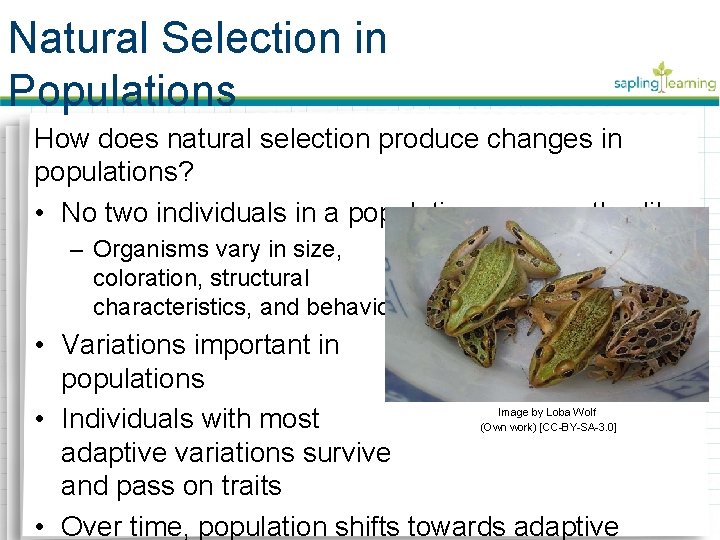
Natural Selection in Populations How does natural selection produce changes in populations? • No two individuals in a population are exactly alike – Organisms vary in size, coloration, structural characteristics, and behavior • Variations important in populations • Individuals with most adaptive variations survive and pass on traits • Over time, population shifts towards adaptive Image by Loba Wolf (Own work) [CC-BY-SA-3. 0]
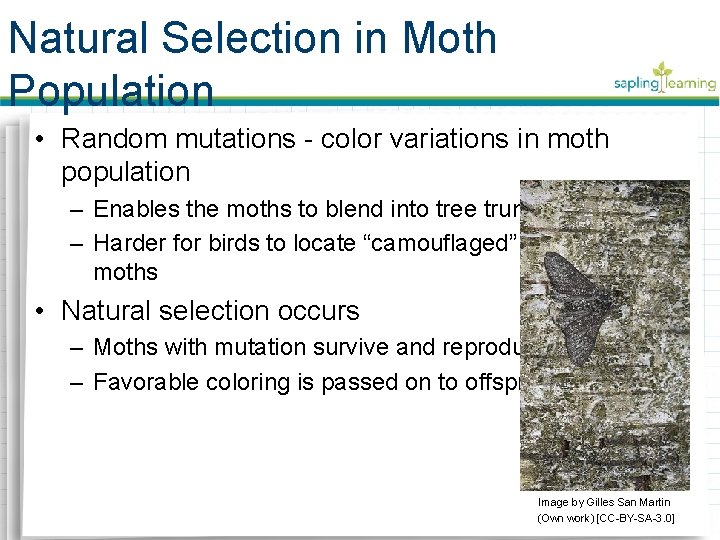
Natural Selection in Moth Population • Random mutations - color variations in moth population – Enables the moths to blend into tree trunks – Harder for birds to locate “camouflaged” moths • Natural selection occurs – Moths with mutation survive and reproduce – Favorable coloring is passed on to offspring Image by Gilles San Martin (Own work) [CC-BY-SA-3. 0]

Natural Selection in Giraffe Population Evolution of the modern day giraffe • Giraffe population had short necks and ate grass • Some had longer necks than others – – Could eat lower leaves of trees Could eat when grass was scarce More likely to survive Offspring would inherit favorable variation of a longer neck Image by Yann Fauché and Alma Mulalic (Own work) [CC-BY-SA-3. 0] • Over generations, average neck length in population increases
Natural Selection in Populations Genetic Equilibrium – the genetic makeup of a population will remain relatively stable unless something happens to make it change • Populations in genetic equilibrium do not change or evolve • Natural selection upsets genetic equilibrium and causes changes in populations
Natural Selection in Populations Learning Objectives • Analyze and evaluate how natural selection produces change in populations, not individuals
- Slides: 10