
Natural Selection Can Shape Populations in Many Ways
- Slides: 61
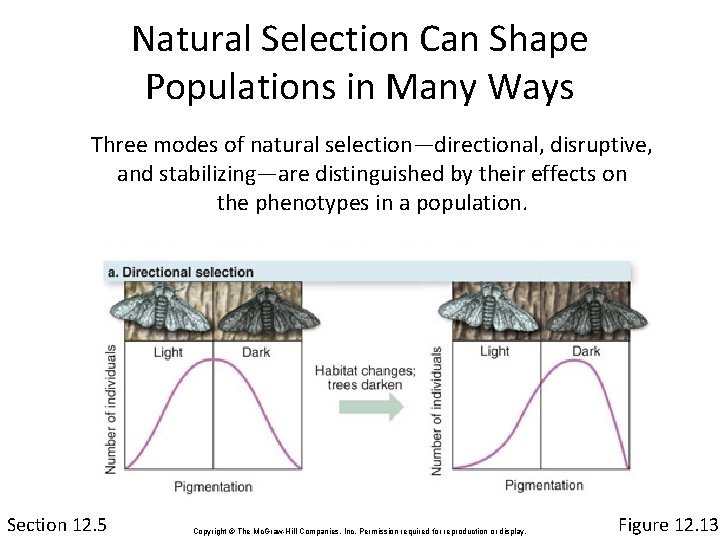
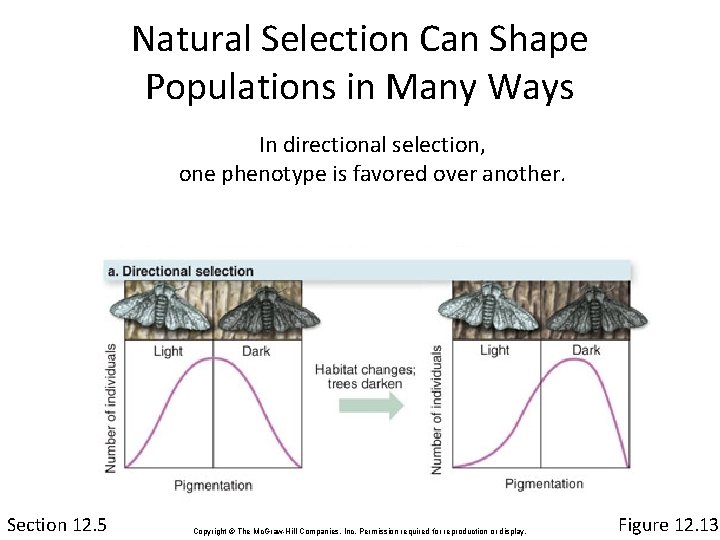
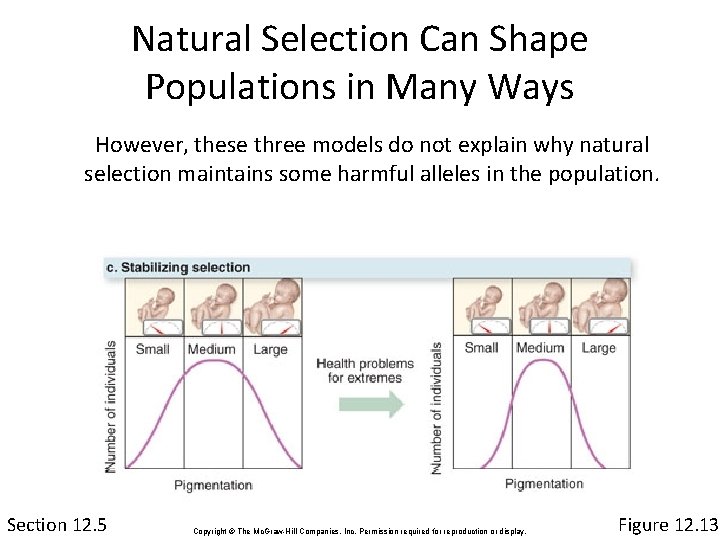
Natural Selection Can Shape Populations in Many Ways Three modes of natural selection—directional, disruptive, and stabilizing—are distinguished by their effects on the phenotypes in a population. Section 12. 5 Copyright © The Mc. Graw-Hill Companies, Inc. Permission required for reproduction or display. Figure 12. 13
Natural Selection Can Shape Populations in Many Ways In directional selection, one phenotype is favored over another. Section 12. 5 Copyright © The Mc. Graw-Hill Companies, Inc. Permission required for reproduction or display. Figure 12. 13
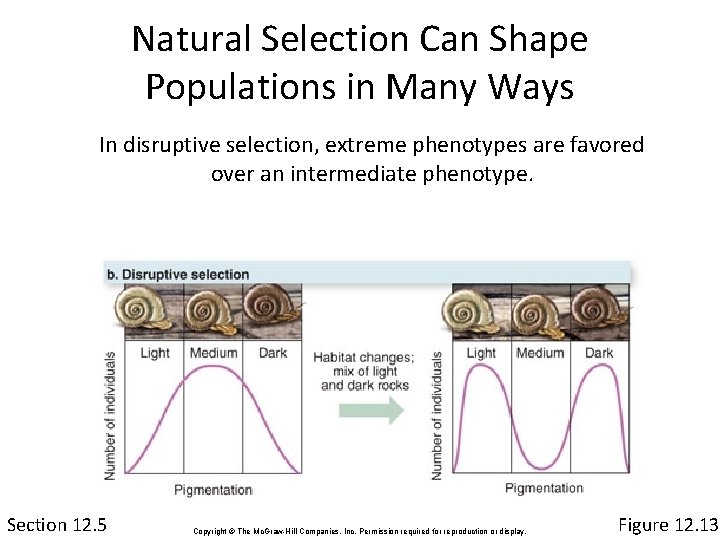
Natural Selection Can Shape Populations in Many Ways In disruptive selection, extreme phenotypes are favored over an intermediate phenotype. Section 12. 5 Copyright © The Mc. Graw-Hill Companies, Inc. Permission required for reproduction or display. Figure 12. 13
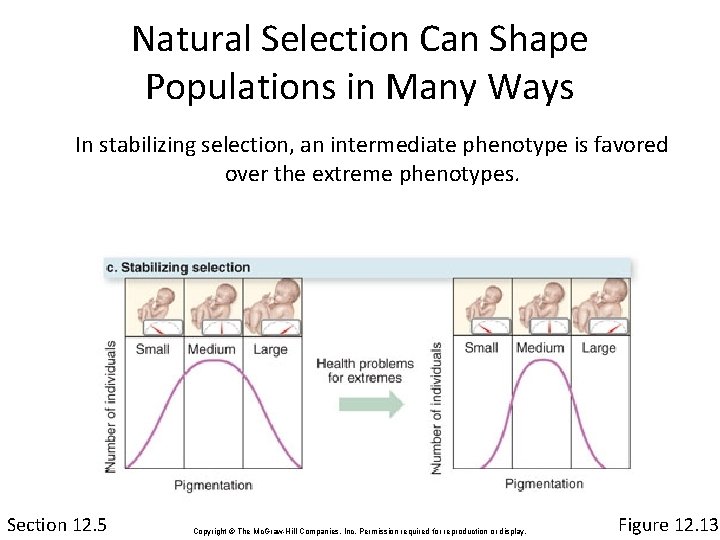
Natural Selection Can Shape Populations in Many Ways In stabilizing selection, an intermediate phenotype is favored over the extreme phenotypes. Section 12. 5 Copyright © The Mc. Graw-Hill Companies, Inc. Permission required for reproduction or display. Figure 12. 13
Natural Selection Can Shape Populations in Many Ways However, these three models do not explain why natural selection maintains some harmful alleles in the population. Section 12. 5 Copyright © The Mc. Graw-Hill Companies, Inc. Permission required for reproduction or display. Figure 12. 13
12. 5 Mastering Concepts Distinguish among directional, disruptive, and stabilizing selection. © 1996 Photo. Disc, Inc. /Getty Images/RF Copyright © The Mc. Graw-Hill Companies, Inc. Permission required for reproduction or display.
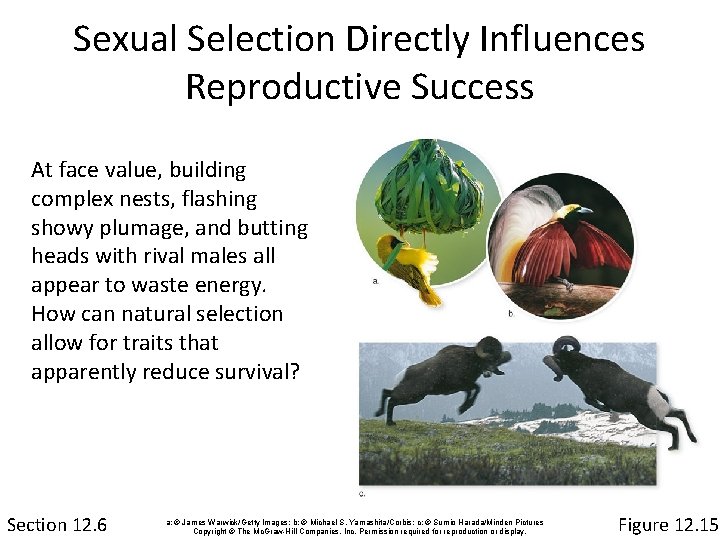
Sexual Selection Directly Influences Reproductive Success At face value, building complex nests, flashing showy plumage, and butting heads with rival males all appear to waste energy. How can natural selection allow for traits that apparently reduce survival? Section 12. 6 a: © James Warwick/Getty Images; b: © Michael S. Yamashita/Corbis; c: © Sumio Harada/Minden Pictures Copyright © The Mc. Graw-Hill Companies, Inc. Permission required for reproduction or display. Figure 12. 15
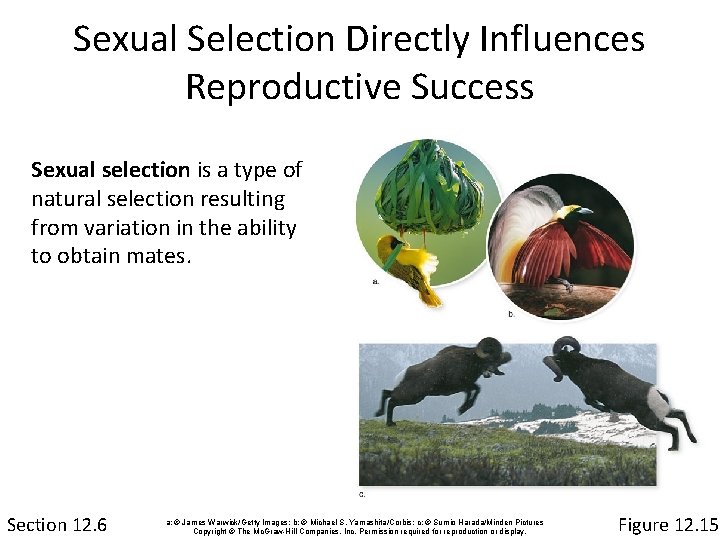
Sexual Selection Directly Influences Reproductive Success Sexual selection is a type of natural selection resulting from variation in the ability to obtain mates. Section 12. 6 a: © James Warwick/Getty Images; b: © Michael S. Yamashita/Corbis; c: © Sumio Harada/Minden Pictures Copyright © The Mc. Graw-Hill Companies, Inc. Permission required for reproduction or display. Figure 12. 15
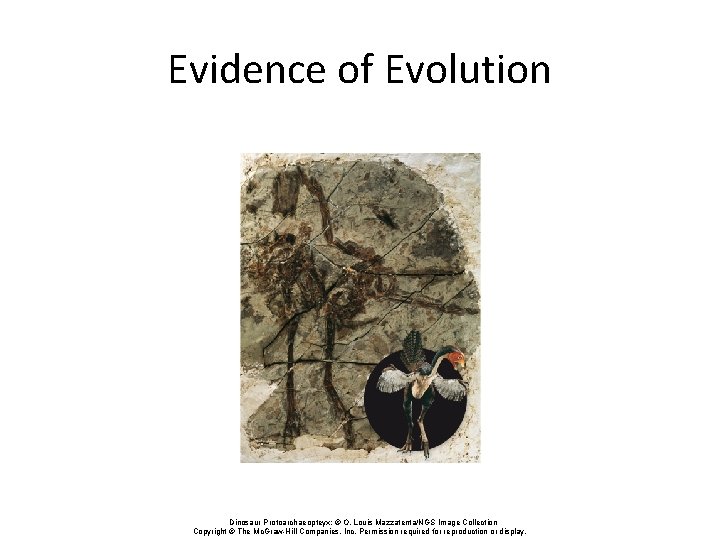
Evidence of Evolution Dinosaur Protoarchaeopteyx: © O. Louis Mazzatenta/NGS Image Collection Copyright © The Mc. Graw-Hill Companies, Inc. Permission required for reproduction or display.
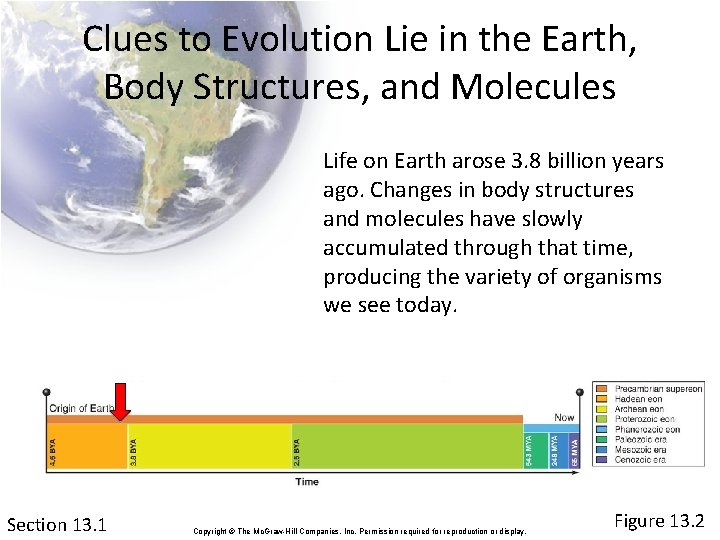
Clues to Evolution Lie in the Earth, Body Structures, and Molecules Life on Earth arose 3. 8 billion years ago. Changes in body structures and molecules have slowly accumulated through that time, producing the variety of organisms we see today. Section 13. 1 Copyright © The Mc. Graw-Hill Companies, Inc. Permission required for reproduction or display. Figure 13. 2
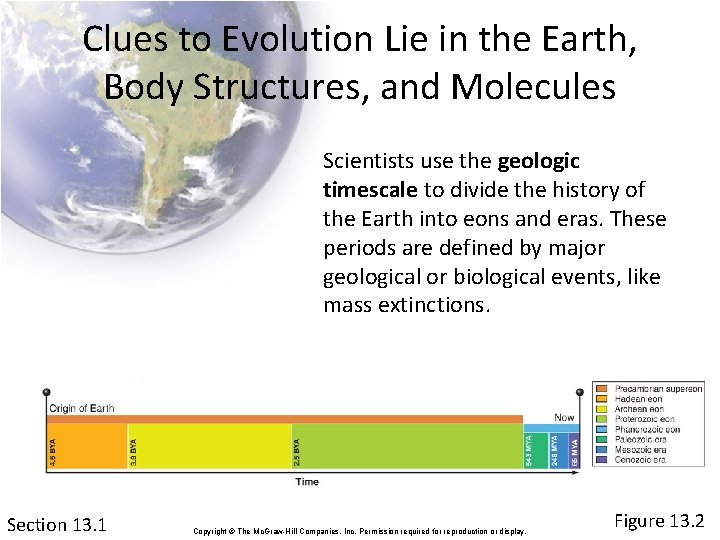
Clues to Evolution Lie in the Earth, Body Structures, and Molecules Scientists use the geologic timescale to divide the history of the Earth into eons and eras. These periods are defined by major geological or biological events, like mass extinctions. Section 13. 1 Copyright © The Mc. Graw-Hill Companies, Inc. Permission required for reproduction or display. Figure 13. 2
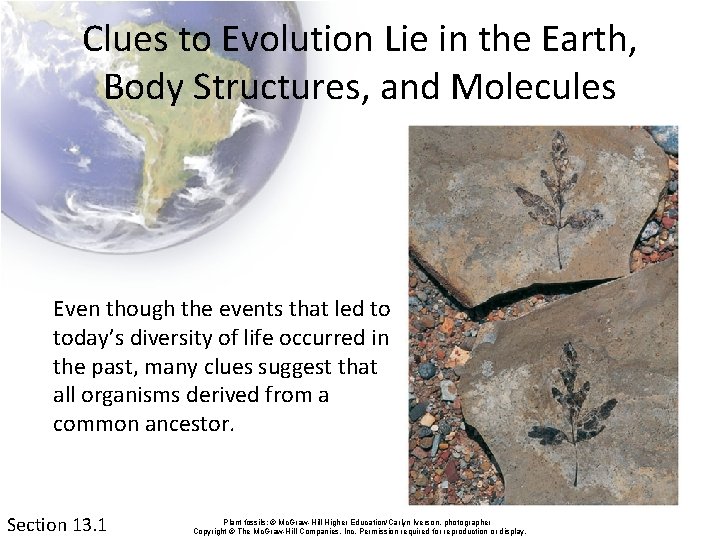
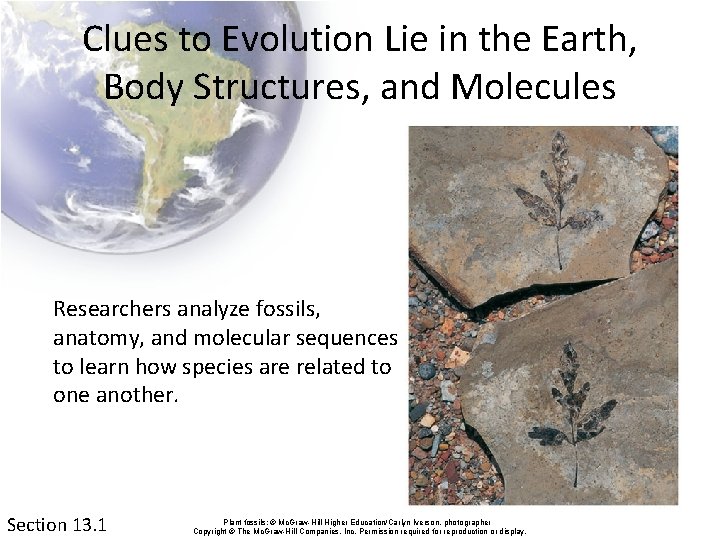
Clues to Evolution Lie in the Earth, Body Structures, and Molecules Even though the events that led to today’s diversity of life occurred in the past, many clues suggest that all organisms derived from a common ancestor. Section 13. 1 Plant fossils: © Mc. Graw-Hill Higher Education/Carlyn Iverson, photographer Copyright © The Mc. Graw-Hill Companies, Inc. Permission required for reproduction or display.
Clues to Evolution Lie in the Earth, Body Structures, and Molecules Researchers analyze fossils, anatomy, and molecular sequences to learn how species are related to one another. Section 13. 1 Plant fossils: © Mc. Graw-Hill Higher Education/Carlyn Iverson, photographer Copyright © The Mc. Graw-Hill Companies, Inc. Permission required for reproduction or display.
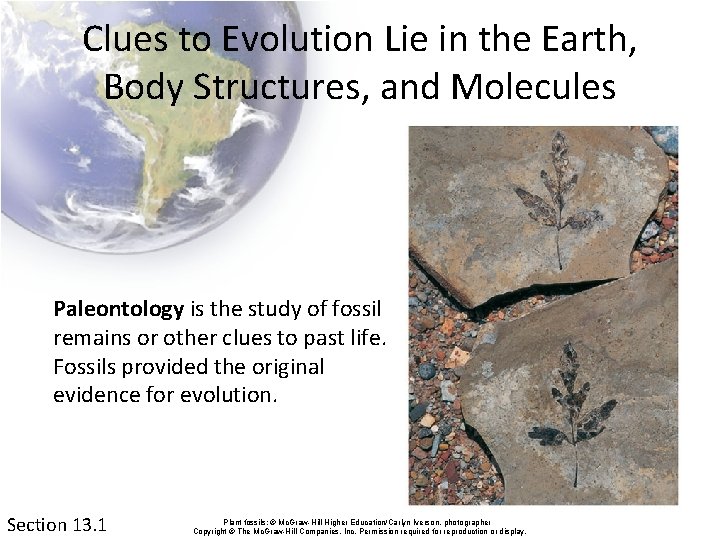
Clues to Evolution Lie in the Earth, Body Structures, and Molecules Paleontology is the study of fossil remains or other clues to past life. Fossils provided the original evidence for evolution. Section 13. 1 Plant fossils: © Mc. Graw-Hill Higher Education/Carlyn Iverson, photographer Copyright © The Mc. Graw-Hill Companies, Inc. Permission required for reproduction or display.
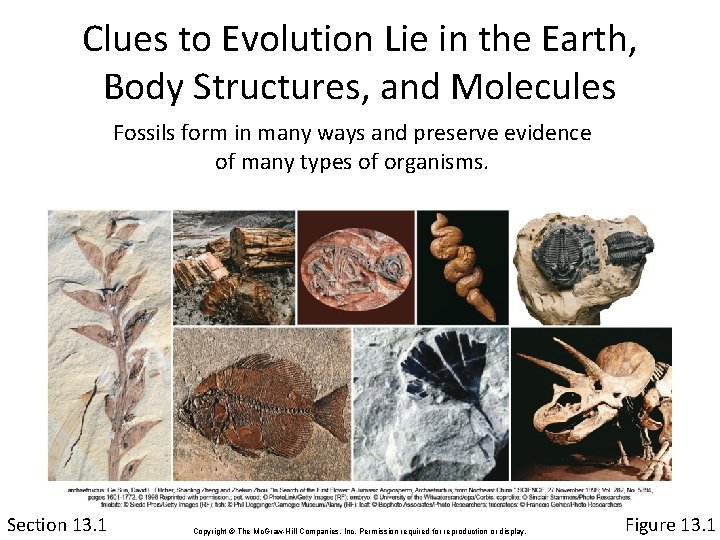
Clues to Evolution Lie in the Earth, Body Structures, and Molecules Fossils form in many ways and preserve evidence of many types of organisms. Section 13. 1 Copyright © The Mc. Graw-Hill Companies, Inc. Permission required for reproduction or display. Figure 13. 1
13. 1 Mastering Concepts What is the geologic timescale? © 1996 Photo. Disc, Inc. /Getty Images/RF Copyright © The Mc. Graw-Hill Companies, Inc. Permission required for reproduction or display.
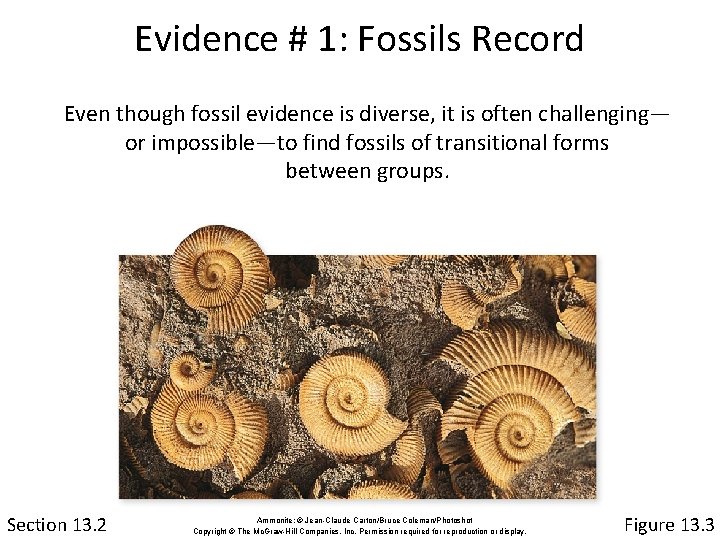
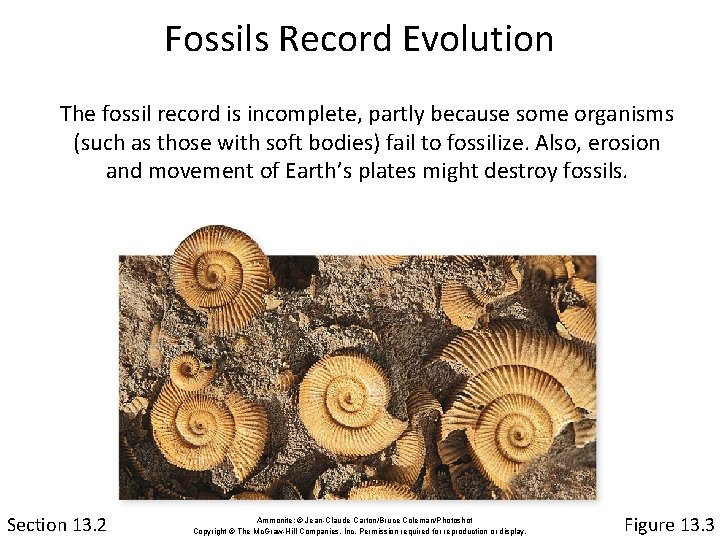
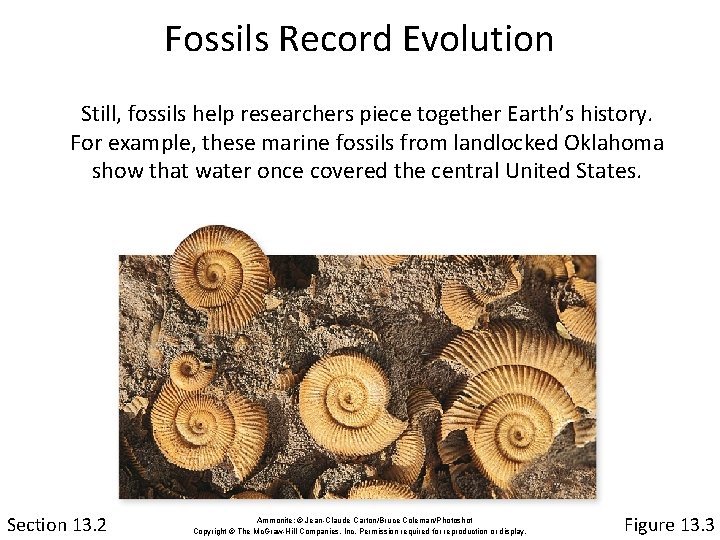
Evidence # 1: Fossils Record Even though fossil evidence is diverse, it is often challenging— or impossible—to find fossils of transitional forms between groups. Section 13. 2 Ammonite: © Jean-Claude Carton/Bruce Coleman/Photoshot Copyright © The Mc. Graw-Hill Companies, Inc. Permission required for reproduction or display. Figure 13. 3
Fossils Record Evolution The fossil record is incomplete, partly because some organisms (such as those with soft bodies) fail to fossilize. Also, erosion and movement of Earth’s plates might destroy fossils. Section 13. 2 Ammonite: © Jean-Claude Carton/Bruce Coleman/Photoshot Copyright © The Mc. Graw-Hill Companies, Inc. Permission required for reproduction or display. Figure 13. 3
Fossils Record Evolution Still, fossils help researchers piece together Earth’s history. For example, these marine fossils from landlocked Oklahoma show that water once covered the central United States. Section 13. 2 Ammonite: © Jean-Claude Carton/Bruce Coleman/Photoshot Copyright © The Mc. Graw-Hill Companies, Inc. Permission required for reproduction or display. Figure 13. 3
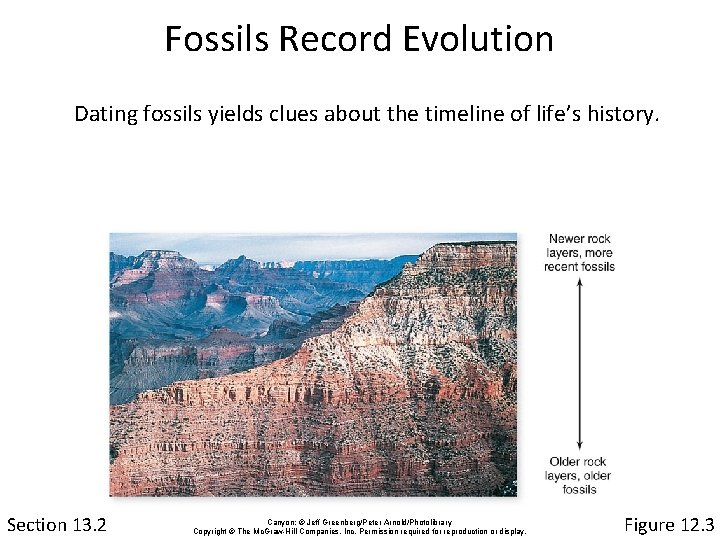
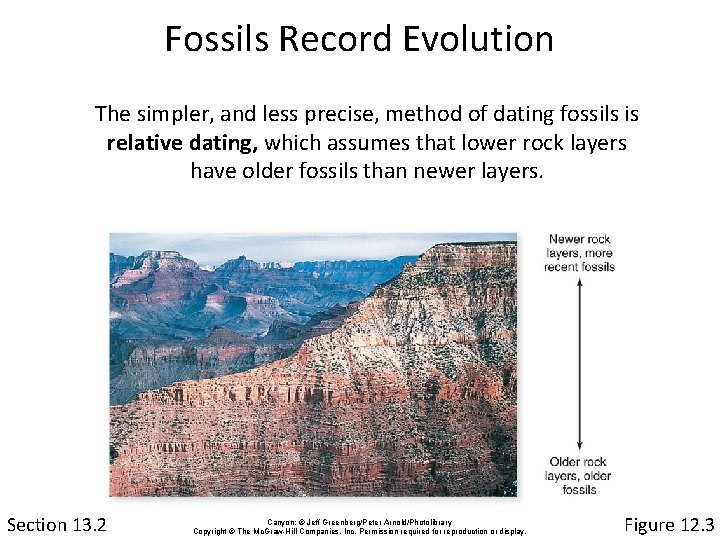
Fossils Record Evolution Dating fossils yields clues about the timeline of life’s history. Section 13. 2 Canyon: © Jeff Greenberg/Peter Arnold/Photolibrary Copyright © The Mc. Graw-Hill Companies, Inc. Permission required for reproduction or display. Figure 12. 3
Fossils Record Evolution The simpler, and less precise, method of dating fossils is relative dating, which assumes that lower rock layers have older fossils than newer layers. Section 13. 2 Canyon: © Jeff Greenberg/Peter Arnold/Photolibrary Copyright © The Mc. Graw-Hill Companies, Inc. Permission required for reproduction or display. Figure 12. 3
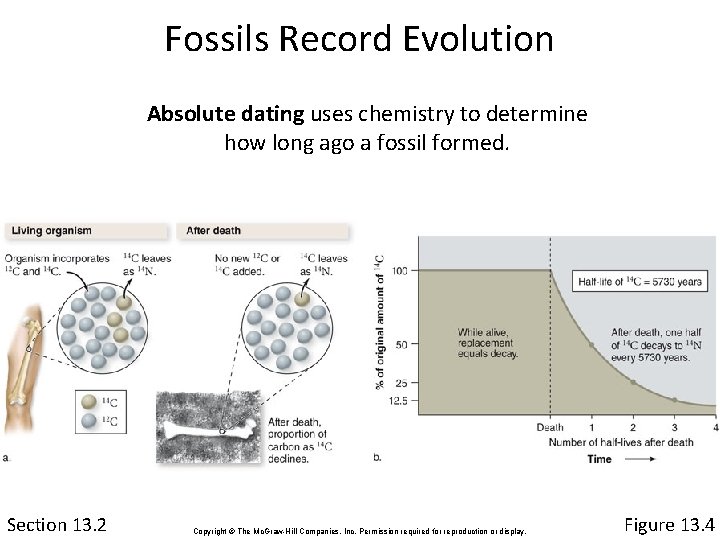
Fossils Record Evolution Absolute dating uses chemistry to determine how long ago a fossil formed. Section 13. 2 Copyright © The Mc. Graw-Hill Companies, Inc. Permission required for reproduction or display. Figure 13. 4
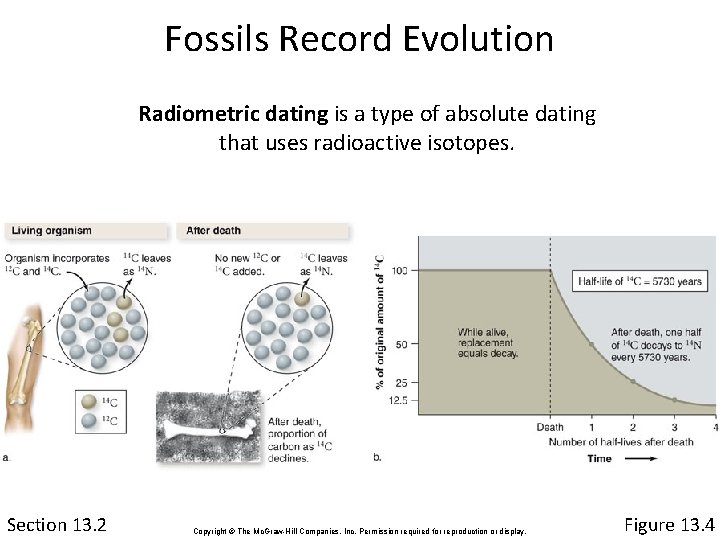
Fossils Record Evolution Radiometric dating is a type of absolute dating that uses radioactive isotopes. Section 13. 2 Copyright © The Mc. Graw-Hill Companies, Inc. Permission required for reproduction or display. Figure 13. 4
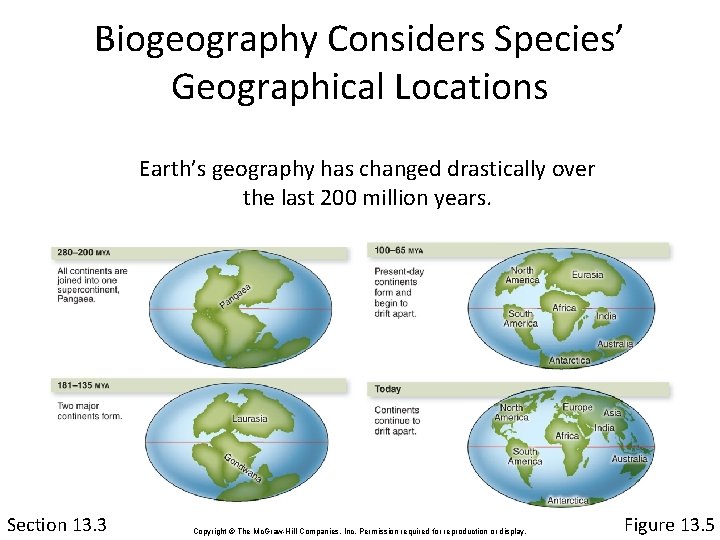
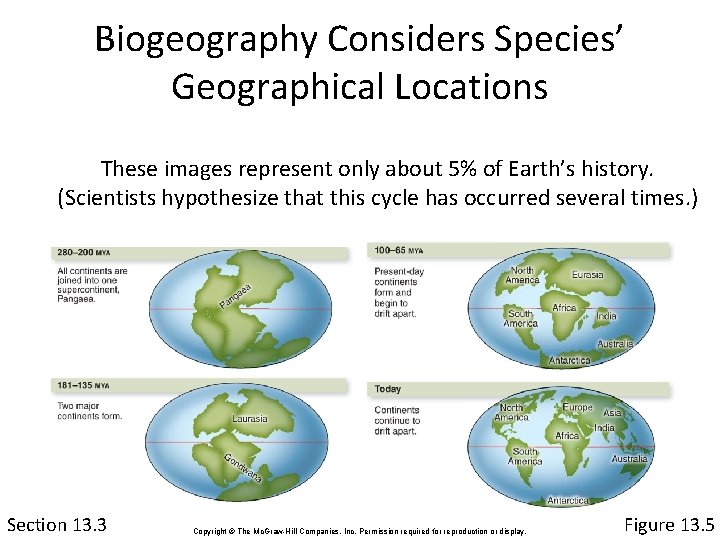
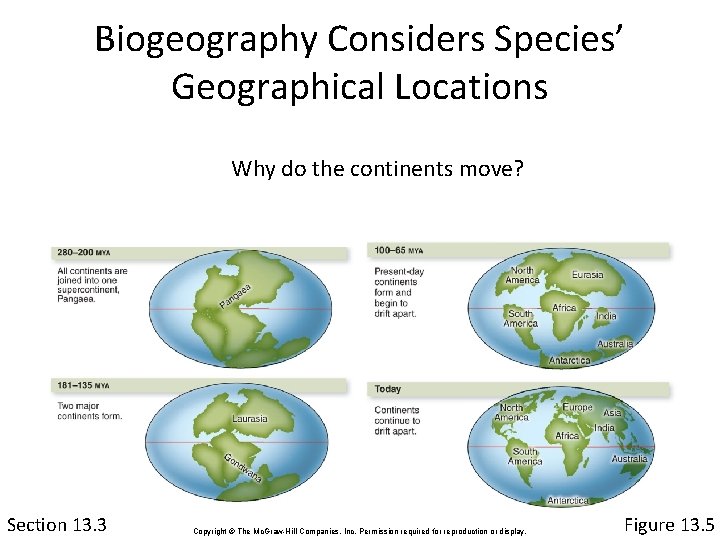
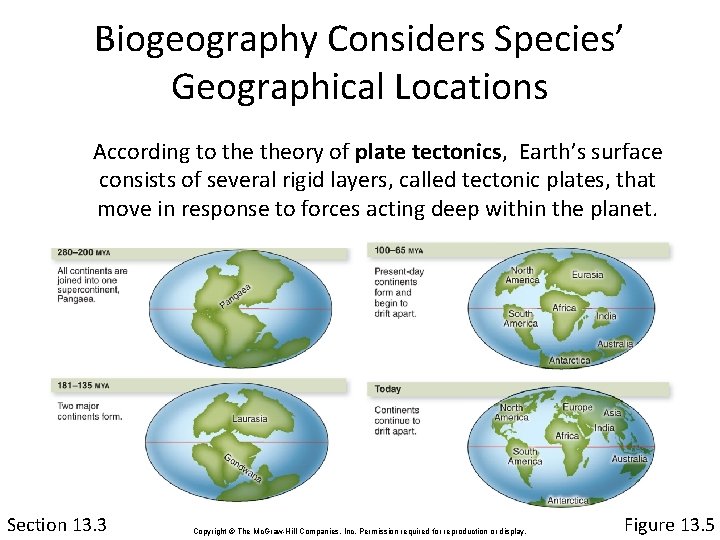
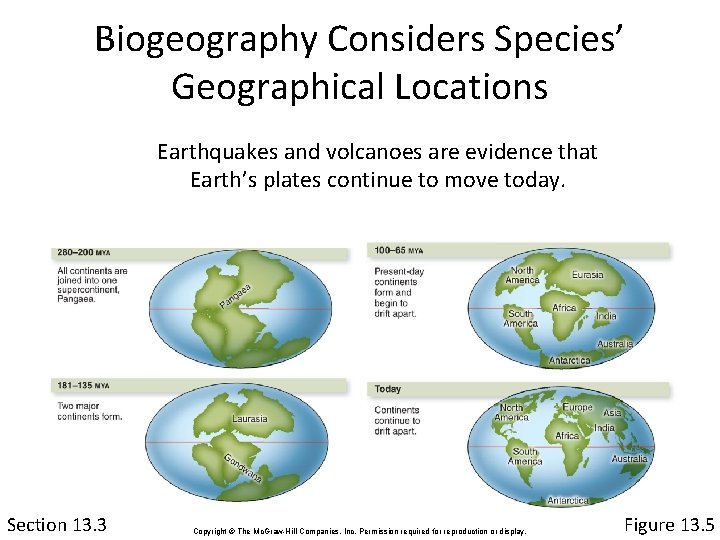
Biogeography Considers Species’ Geographical Locations Earth’s geography has changed drastically over the last 200 million years. Section 13. 3 Copyright © The Mc. Graw-Hill Companies, Inc. Permission required for reproduction or display. Figure 13. 5
Biogeography Considers Species’ Geographical Locations These images represent only about 5% of Earth’s history. (Scientists hypothesize that this cycle has occurred several times. ) Section 13. 3 Copyright © The Mc. Graw-Hill Companies, Inc. Permission required for reproduction or display. Figure 13. 5
Biogeography Considers Species’ Geographical Locations Why do the continents move? Section 13. 3 Copyright © The Mc. Graw-Hill Companies, Inc. Permission required for reproduction or display. Figure 13. 5
Biogeography Considers Species’ Geographical Locations According to theory of plate tectonics, Earth’s surface consists of several rigid layers, called tectonic plates, that move in response to forces acting deep within the planet. Section 13. 3 Copyright © The Mc. Graw-Hill Companies, Inc. Permission required for reproduction or display. Figure 13. 5
Biogeography Considers Species’ Geographical Locations Earthquakes and volcanoes are evidence that Earth’s plates continue to move today. Section 13. 3 Copyright © The Mc. Graw-Hill Companies, Inc. Permission required for reproduction or display. Figure 13. 5
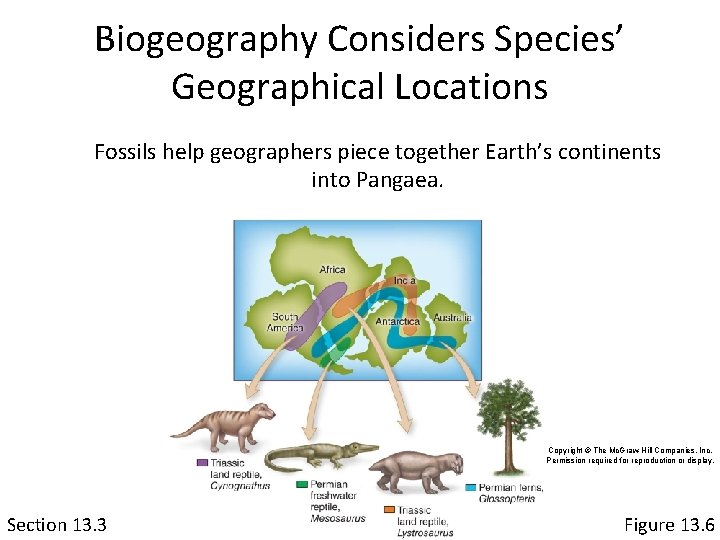
Biogeography Considers Species’ Geographical Locations Fossils help geographers piece together Earth’s continents into Pangaea. Copyright © The Mc. Graw-Hill Companies, Inc. Permission required for reproduction or display. Section 13. 3 Figure 13. 6
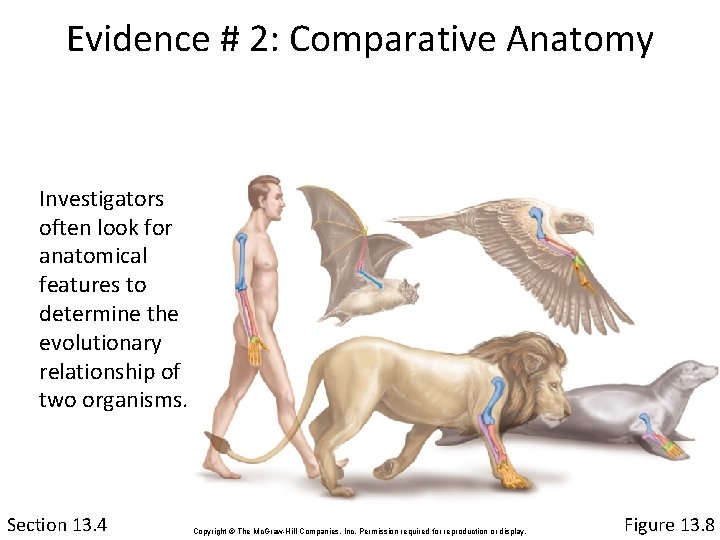
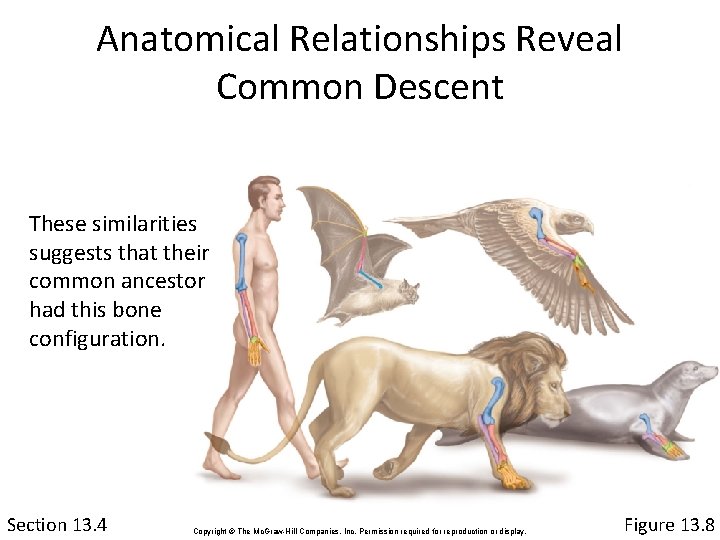
Evidence # 2: Comparative Anatomy Investigators often look for anatomical features to determine the evolutionary relationship of two organisms. Section 13. 4 Copyright © The Mc. Graw-Hill Companies, Inc. Permission required for reproduction or display. Figure 13. 8
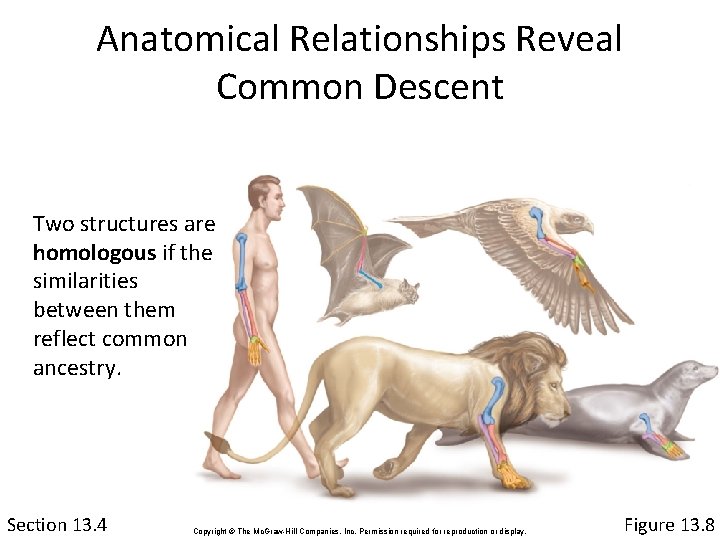
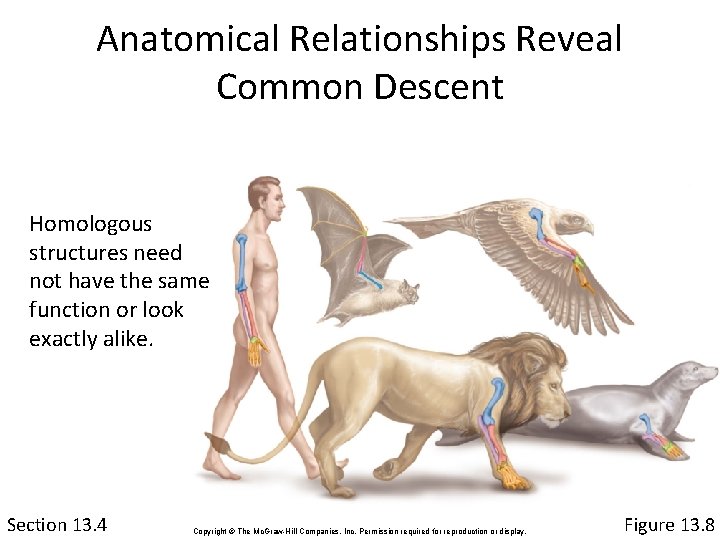
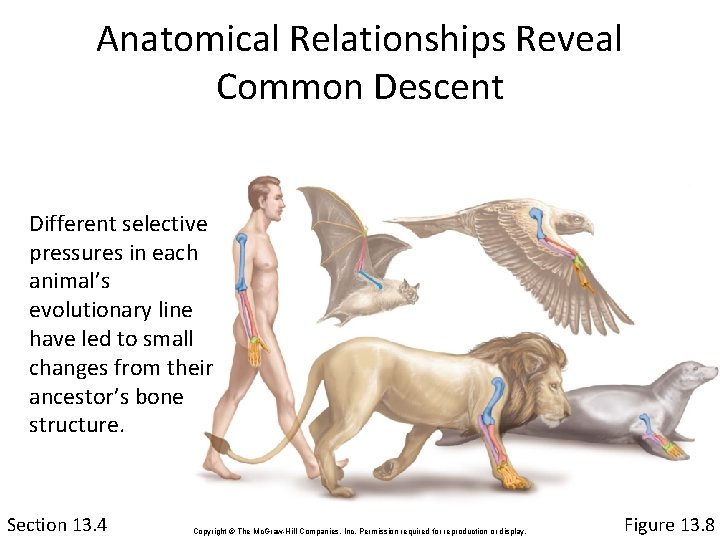
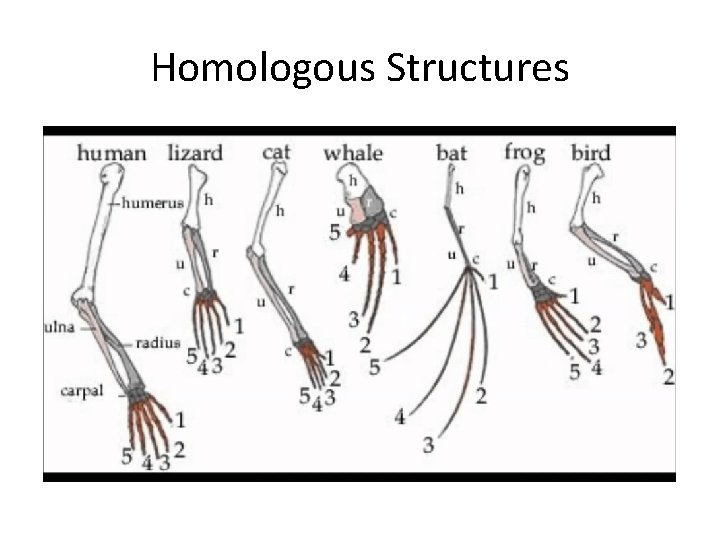
Anatomical Relationships Reveal Common Descent Two structures are homologous if the similarities between them reflect common ancestry. Section 13. 4 Copyright © The Mc. Graw-Hill Companies, Inc. Permission required for reproduction or display. Figure 13. 8
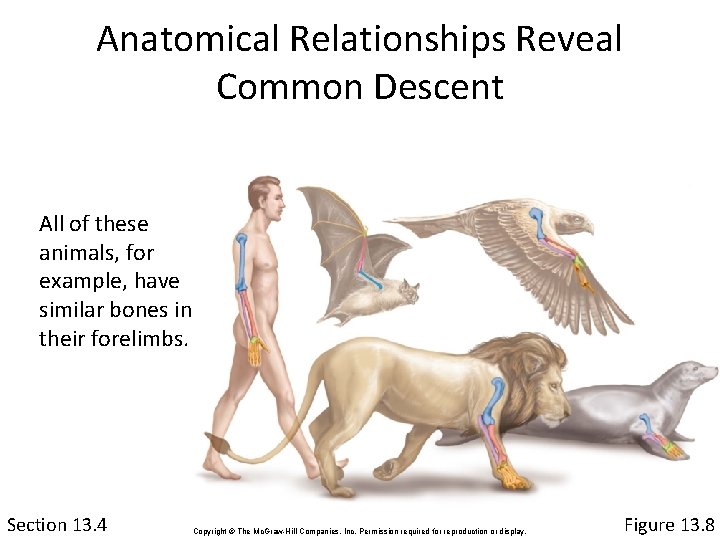
Anatomical Relationships Reveal Common Descent All of these animals, for example, have similar bones in their forelimbs. Section 13. 4 Copyright © The Mc. Graw-Hill Companies, Inc. Permission required for reproduction or display. Figure 13. 8
Anatomical Relationships Reveal Common Descent These similarities suggests that their common ancestor had this bone configuration. Section 13. 4 Copyright © The Mc. Graw-Hill Companies, Inc. Permission required for reproduction or display. Figure 13. 8
Anatomical Relationships Reveal Common Descent Homologous structures need not have the same function or look exactly alike. Section 13. 4 Copyright © The Mc. Graw-Hill Companies, Inc. Permission required for reproduction or display. Figure 13. 8
Anatomical Relationships Reveal Common Descent Different selective pressures in each animal’s evolutionary line have led to small changes from their ancestor’s bone structure. Section 13. 4 Copyright © The Mc. Graw-Hill Companies, Inc. Permission required for reproduction or display. Figure 13. 8
Homologous Structures
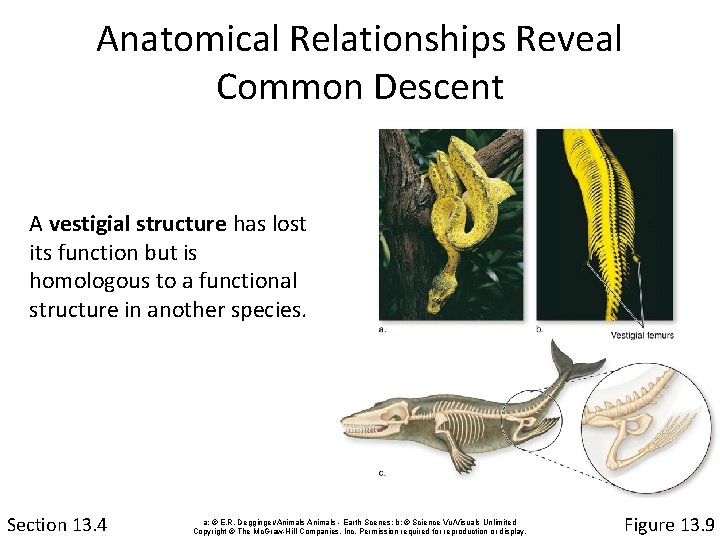
Anatomical Relationships Reveal Common Descent A vestigial structure has lost its function but is homologous to a functional structure in another species. Section 13. 4 a: © E. R. Degginger/Animals - Earth Scenes; b: © Science Vu/Visuals Unlimited Copyright © The Mc. Graw-Hill Companies, Inc. Permission required for reproduction or display. Figure 13. 9
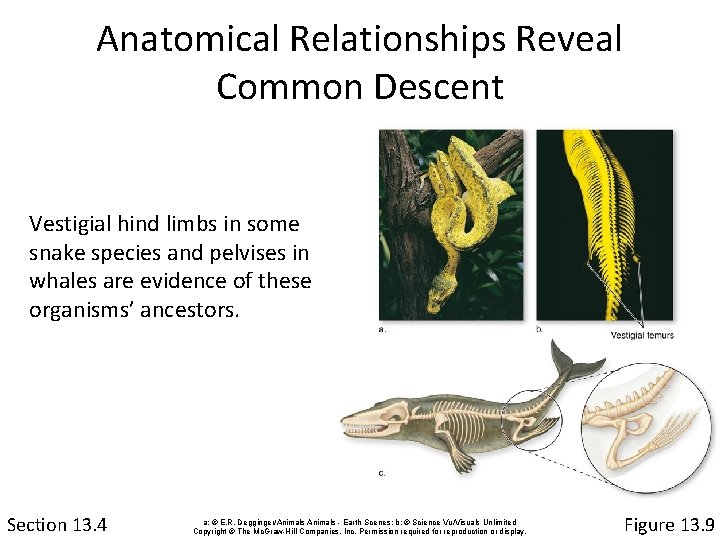
Anatomical Relationships Reveal Common Descent Vestigial hind limbs in some snake species and pelvises in whales are evidence of these organisms’ ancestors. Section 13. 4 a: © E. R. Degginger/Animals - Earth Scenes; b: © Science Vu/Visuals Unlimited Copyright © The Mc. Graw-Hill Companies, Inc. Permission required for reproduction or display. Figure 13. 9
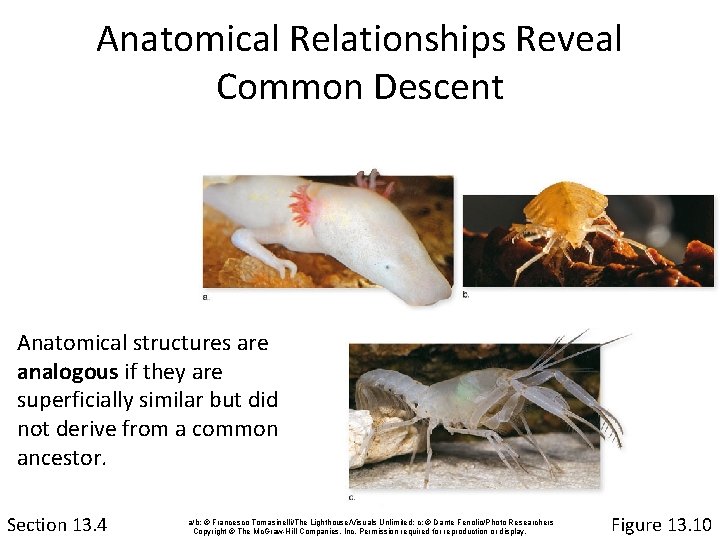
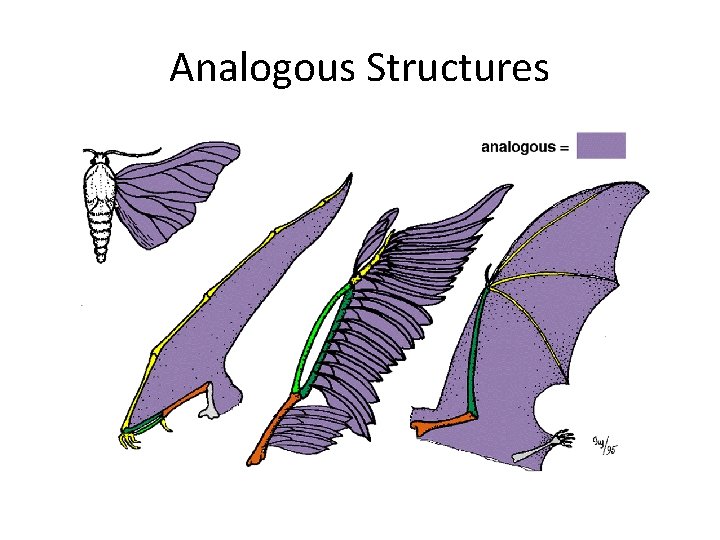
Anatomical Relationships Reveal Common Descent Anatomical structures are analogous if they are superficially similar but did not derive from a common ancestor. Section 13. 4 a/b: © Francesco Tomasinelli/The Lighthouse/Visuals Unlimited; c: © Dante Fenolio/Photo Researchers Copyright © The Mc. Graw-Hill Companies, Inc. Permission required for reproduction or display. Figure 13. 10
Analogous Structures
Clicker Question #3 The streamlined shapes of dolphins and sharks evolved independently. The body plan of these two animals are A. homologous. B. vestigial. C. analogous. D. a product of convergent evolution. E. Both C and D are correct. © 1996 Photo. Disc, Inc. /Getty Images/RF Copyright © The Mc. Graw-Hill Companies, Inc. Permission required for reproduction or display.
13. 4 Mastering Concepts What can homologies reveal about evolution? © 1996 Photo. Disc, Inc. /Getty Images/RF Copyright © The Mc. Graw-Hill Companies, Inc. Permission required for reproduction or display.
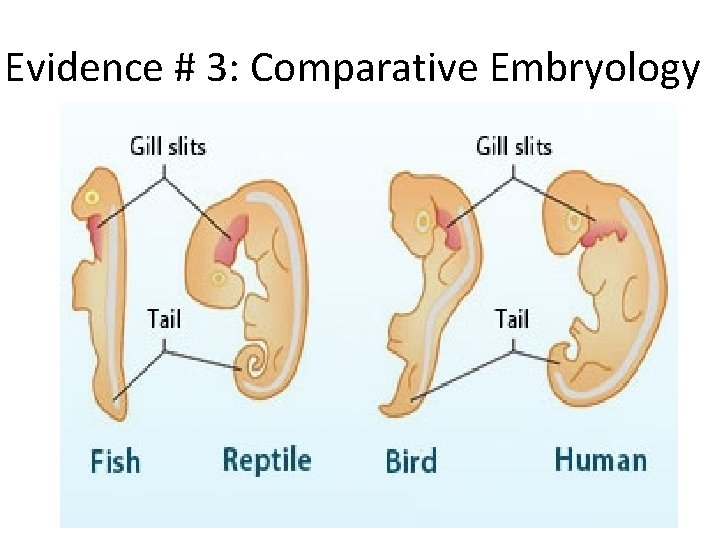
Evidence # 3: Comparative Embryology
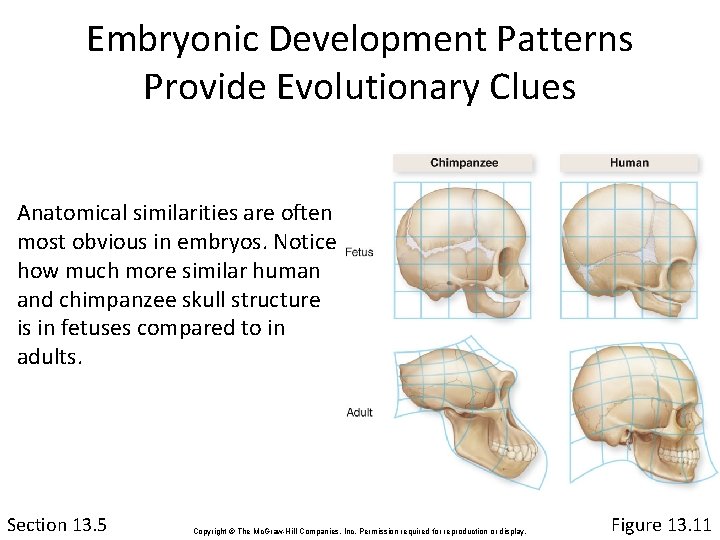
Embryonic Development Patterns Provide Evolutionary Clues Anatomical similarities are often most obvious in embryos. Notice how much more similar human and chimpanzee skull structure is in fetuses compared to in adults. Section 13. 5 Copyright © The Mc. Graw-Hill Companies, Inc. Permission required for reproduction or display. Figure 13. 11
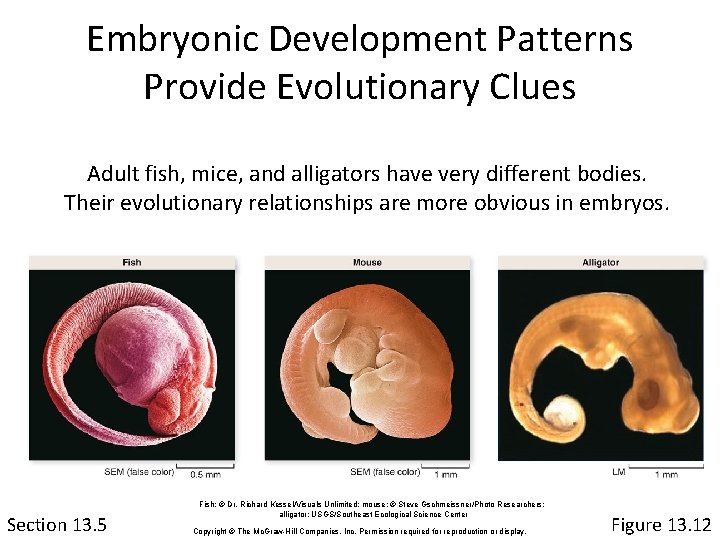
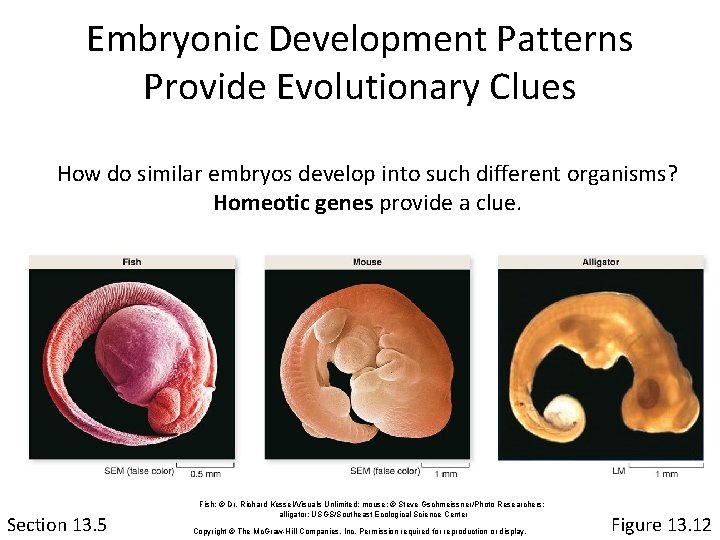
Embryonic Development Patterns Provide Evolutionary Clues Adult fish, mice, and alligators have very different bodies. Their evolutionary relationships are more obvious in embryos. Section 13. 5 Fish: © Dr. Richard Kessel/Visuals Unlimited; mouse: © Steve Gschmeissner/Photo Researchers; alligator: USGS/Southeast Ecological Science Center Copyright © The Mc. Graw-Hill Companies, Inc. Permission required for reproduction or display. Figure 13. 12
Embryonic Development Patterns Provide Evolutionary Clues How do similar embryos develop into such different organisms? Homeotic genes provide a clue. Section 13. 5 Fish: © Dr. Richard Kessel/Visuals Unlimited; mouse: © Steve Gschmeissner/Photo Researchers; alligator: USGS/Southeast Ecological Science Center Copyright © The Mc. Graw-Hill Companies, Inc. Permission required for reproduction or display. Figure 13. 12
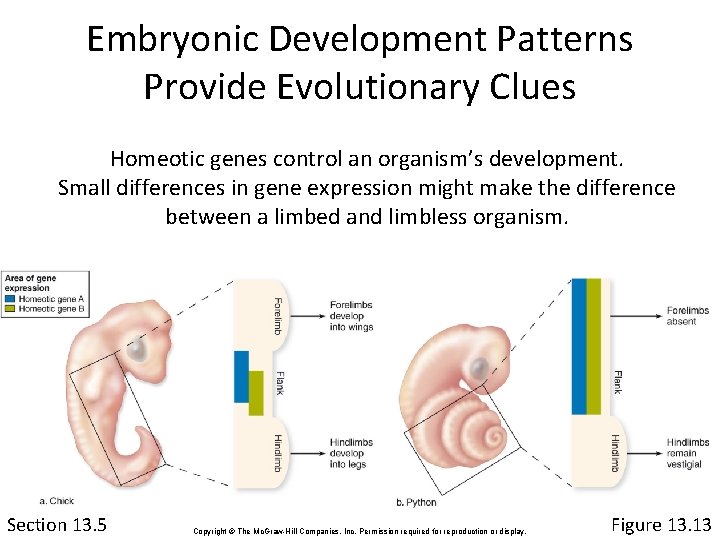
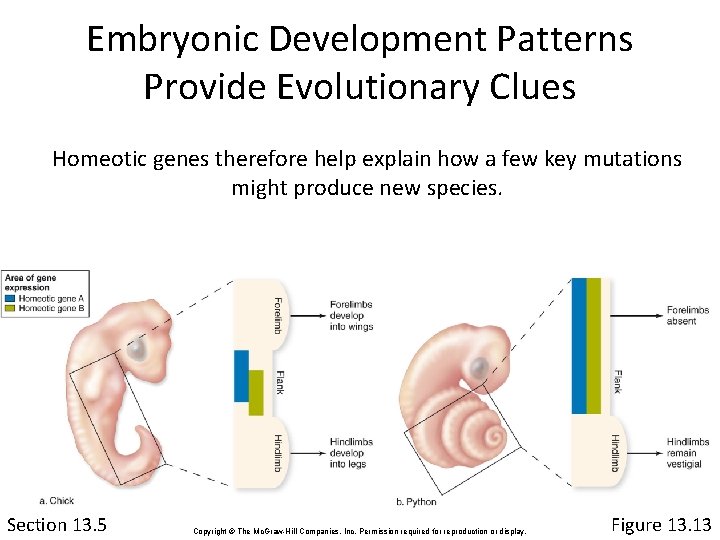
Embryonic Development Patterns Provide Evolutionary Clues Homeotic genes control an organism’s development. Small differences in gene expression might make the difference between a limbed and limbless organism. Section 13. 5 Copyright © The Mc. Graw-Hill Companies, Inc. Permission required for reproduction or display. Figure 13. 13
Embryonic Development Patterns Provide Evolutionary Clues Homeotic genes therefore help explain how a few key mutations might produce new species. Section 13. 5 Copyright © The Mc. Graw-Hill Companies, Inc. Permission required for reproduction or display. Figure 13. 13
13. 5 Mastering Concepts How does the study of embryonic development reveal clues to a shared evolutionary history? © 1996 Photo. Disc, Inc. /Getty Images/RF Copyright © The Mc. Graw-Hill Companies, Inc. Permission required for reproduction or display.
Evidence # 4: Genetics Molecular structure of DNA discovered in April, 1953. Human Genome Project (began October 1990) was completed in April, 2003. Comparing DNA and protein sequences determines evolutionary relationships in unprecedented detail. Section 13. 6 Copyright © The Mc. Graw-Hill Companies, Inc. Permission required for reproduction or display.
Molecules Reveal Relatedness It is highly unlikely that two unrelated species would evolve precisely the same DNA and protein sequences by chance. Section 13. 6 Copyright © The Mc. Graw-Hill Companies, Inc. Permission required for reproduction or display.
Molecules Reveal Relatedness It is more likely that the similarities were inherited from a common ancestor and that differences arose by mutation after the species diverged from the ancestral type. Section 13. 6 Copyright © The Mc. Graw-Hill Companies, Inc. Permission required for reproduction or display.
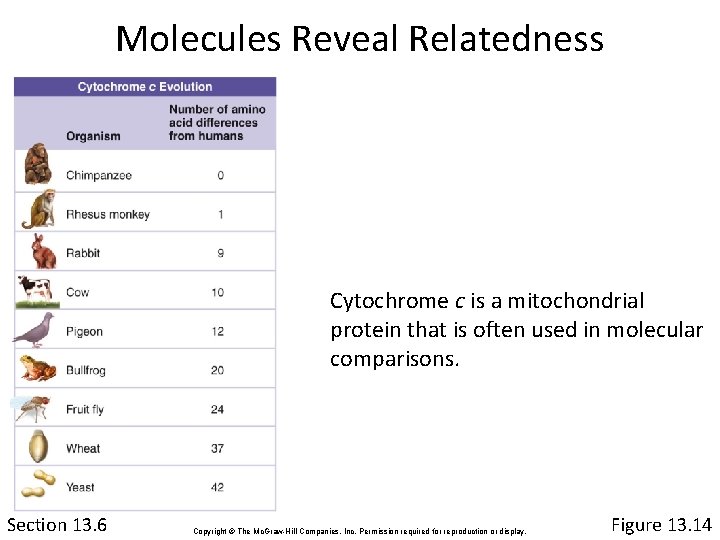
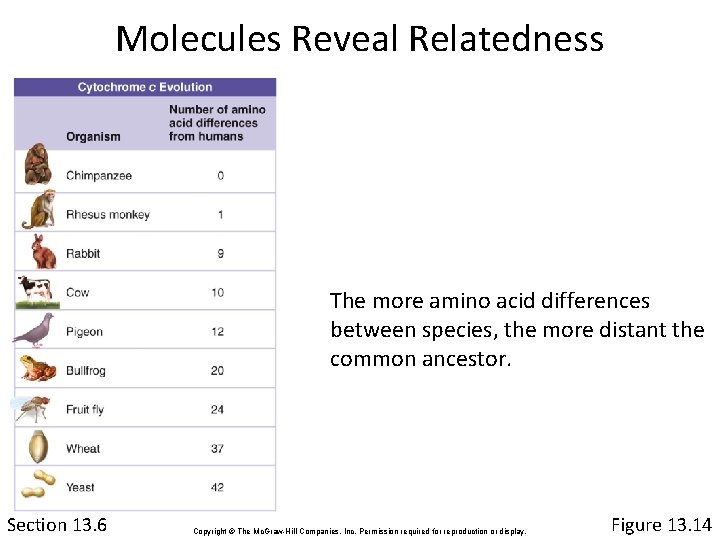
Molecules Reveal Relatedness Cytochrome c is a mitochondrial protein that is often used in molecular comparisons. Section 13. 6 Copyright © The Mc. Graw-Hill Companies, Inc. Permission required for reproduction or display. Figure 13. 14
Molecules Reveal Relatedness The more amino acid differences between species, the more distant the common ancestor. Section 13. 6 Copyright © The Mc. Graw-Hill Companies, Inc. Permission required for reproduction or display. Figure 13. 14
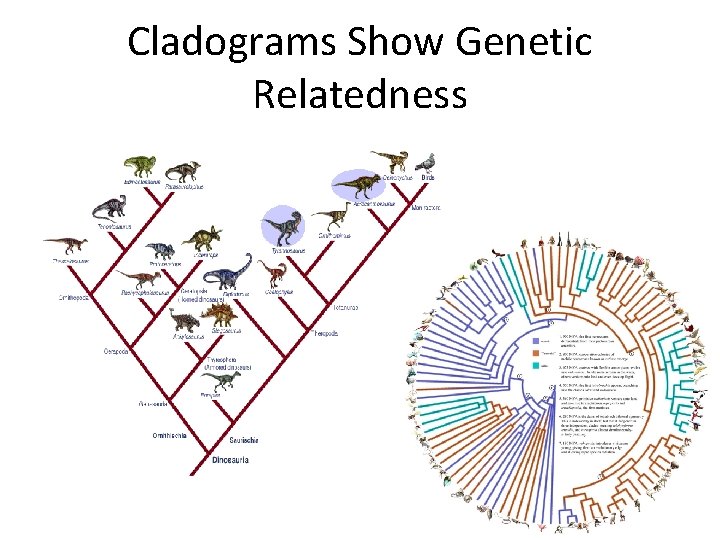
Cladograms Show Genetic Relatedness
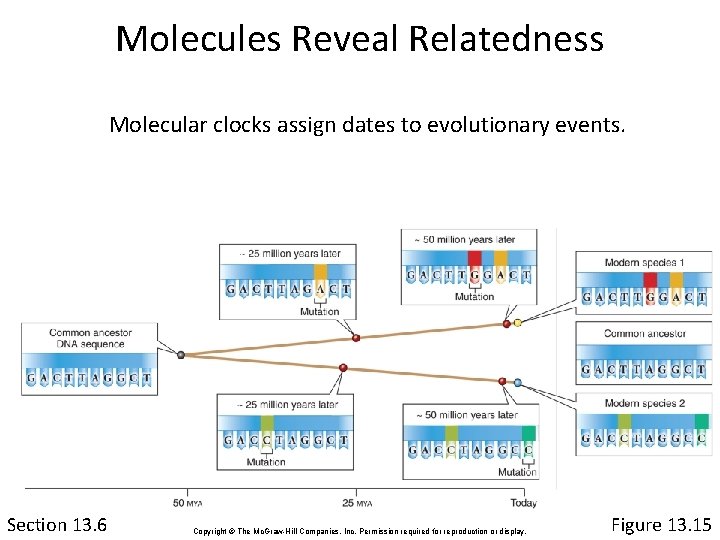
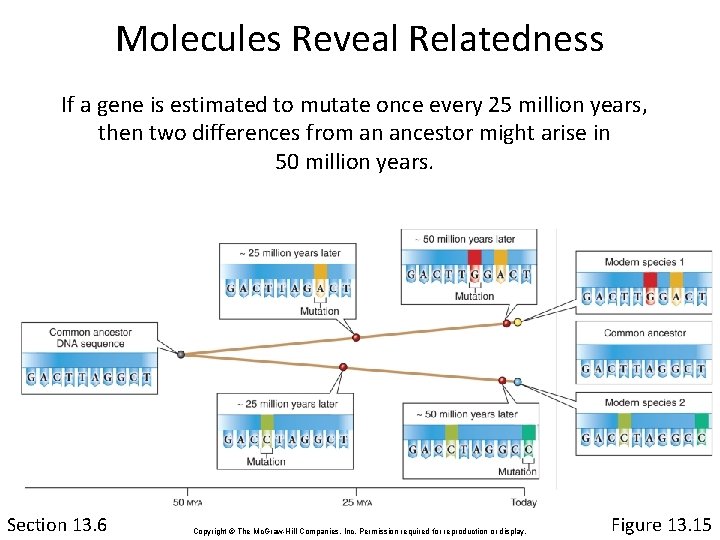
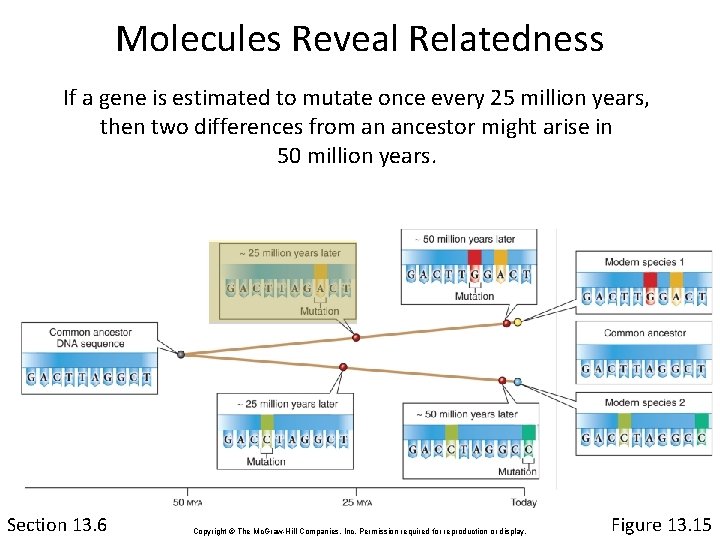
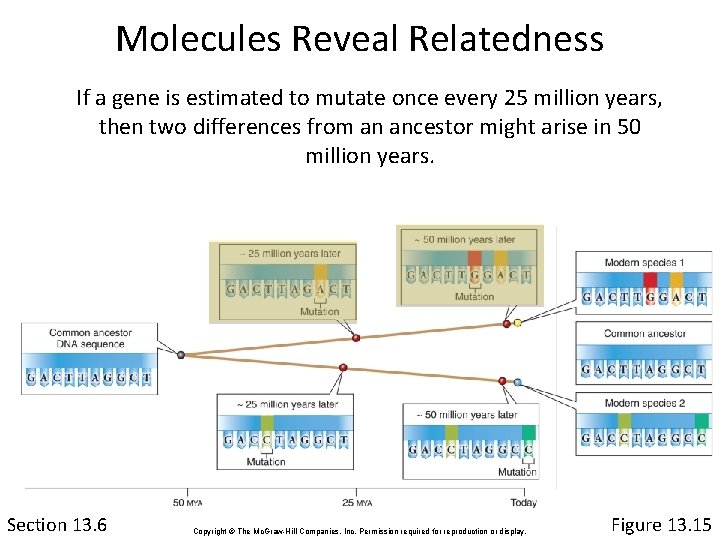
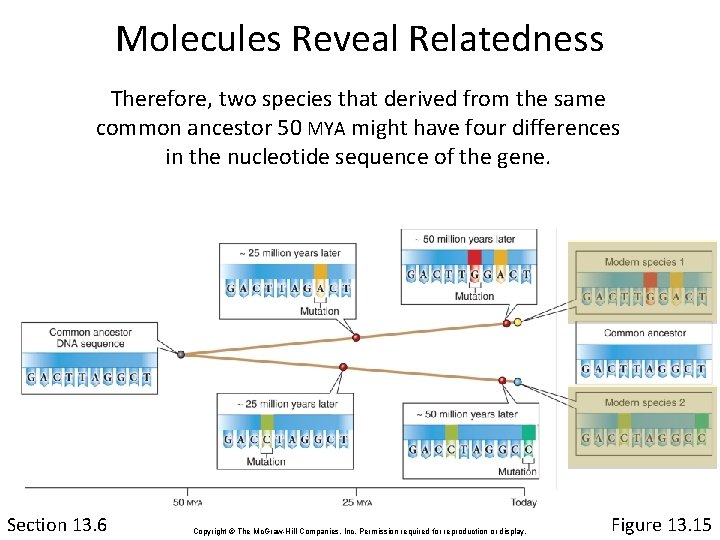
Molecules Reveal Relatedness Molecular clocks assign dates to evolutionary events. Section 13. 6 Copyright © The Mc. Graw-Hill Companies, Inc. Permission required for reproduction or display. Figure 13. 15
Molecules Reveal Relatedness If a gene is estimated to mutate once every 25 million years, then two differences from an ancestor might arise in 50 million years. Section 13. 6 Copyright © The Mc. Graw-Hill Companies, Inc. Permission required for reproduction or display. Figure 13. 15
Molecules Reveal Relatedness If a gene is estimated to mutate once every 25 million years, then two differences from an ancestor might arise in 50 million years. Section 13. 6 Copyright © The Mc. Graw-Hill Companies, Inc. Permission required for reproduction or display. Figure 13. 15
Molecules Reveal Relatedness If a gene is estimated to mutate once every 25 million years, then two differences from an ancestor might arise in 50 million years. Section 13. 6 Copyright © The Mc. Graw-Hill Companies, Inc. Permission required for reproduction or display. Figure 13. 15
Molecules Reveal Relatedness Therefore, two species that derived from the same common ancestor 50 MYA might have four differences in the nucleotide sequence of the gene. Section 13. 6 Copyright © The Mc. Graw-Hill Companies, Inc. Permission required for reproduction or display. Figure 13. 15
13. 6 Mastering Concepts How does analysis of DNA and proteins support other evidence for evolution? © 1996 Photo. Disc, Inc. /Getty Images/RF Copyright © The Mc. Graw-Hill Companies, Inc. Permission required for reproduction or display.