
NATURAL SELECTION AT THE MOLECULAR LEVEL Cynthia Couto



- Slides: 87
NATURAL SELECTION AT THE MOLECULAR LEVEL Cynthia Couto (based on Prof. Dilvan Moreira presentation that was based on Prof. André Carvalho presentation)
Reading • Introduction to Computational Genomics: A Case Studies Approach • Chapter 6
03/10/2020 André de Carvalho - ICMC/USP Content • Motivation – A mysterious disease • Evolution and Natural Selection • HIV x Human Immune System • Quantifying natural selection • Synonymous and non-synonymous regions • Case Study 3
9 gag. com parenthesis
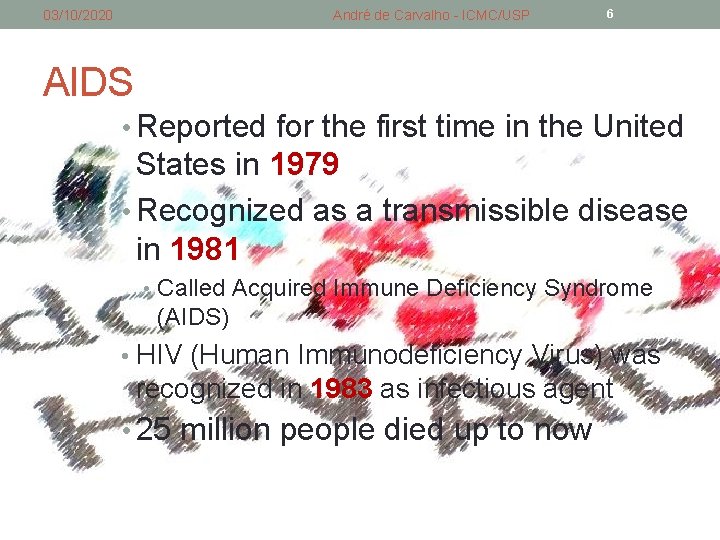
03/10/2020 André de Carvalho - ICMC/USP 6 AIDS • Reported for the first time in the United States in 1979 • Recognized as a transmissible disease in 1981 • Called Acquired Immune Deficiency Syndrome (AIDS) • HIV (Human Immunodeficiency Virus) was recognized in 1983 as infectious agent • 25 million people died up to now
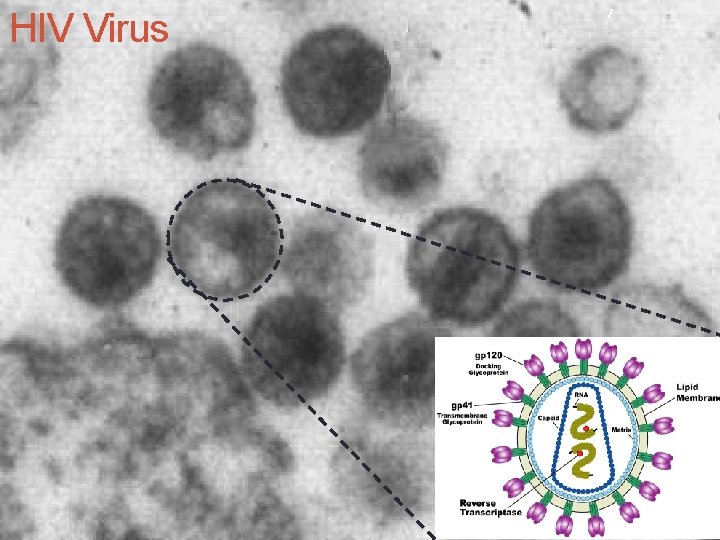
HIV Virus 7
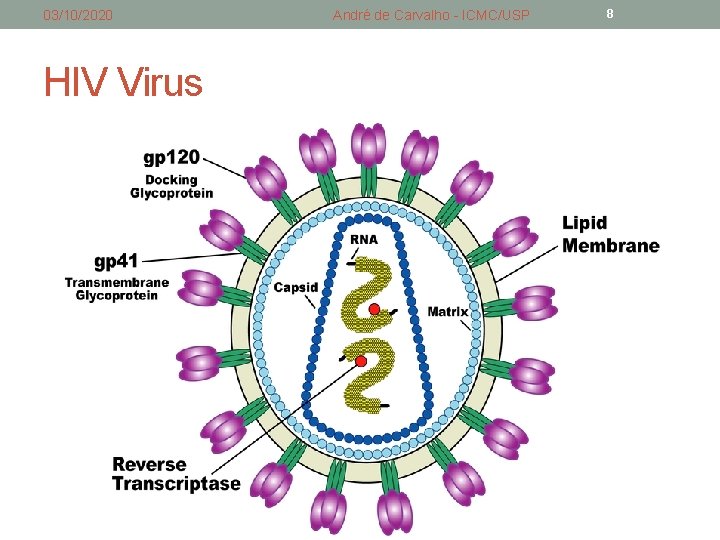
03/10/2020 HIV Virus André de Carvalho - ICMC/USP 8
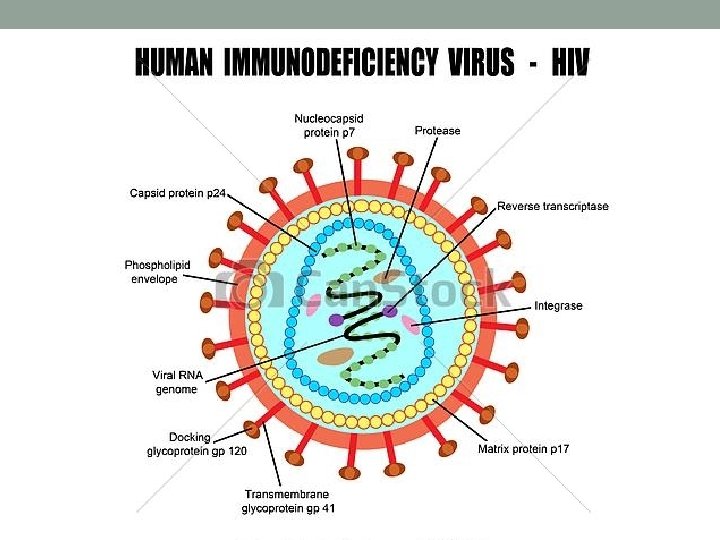
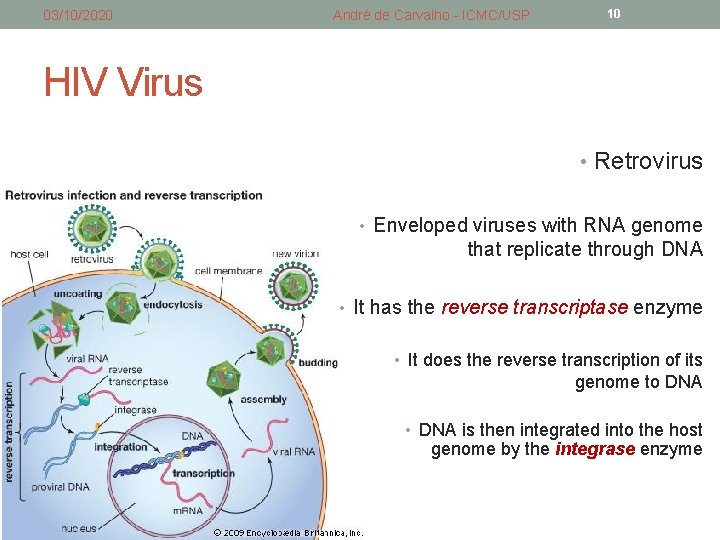
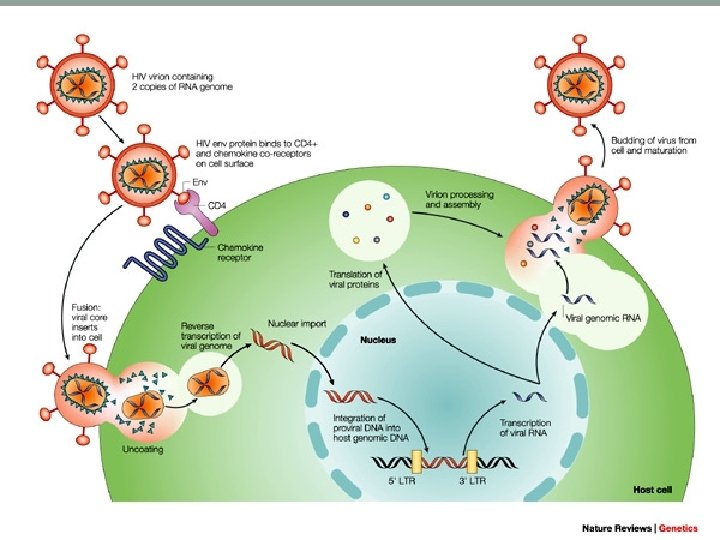
03/10/2020 André de Carvalho - ICMC/USP 10 HIV Virus • Retrovirus • Enveloped viruses with RNA genome that replicate through DNA • It has the reverse transcriptase enzyme • It does the reverse transcription of its genome to DNA • DNA is then integrated into the host genome by the integrase enzyme
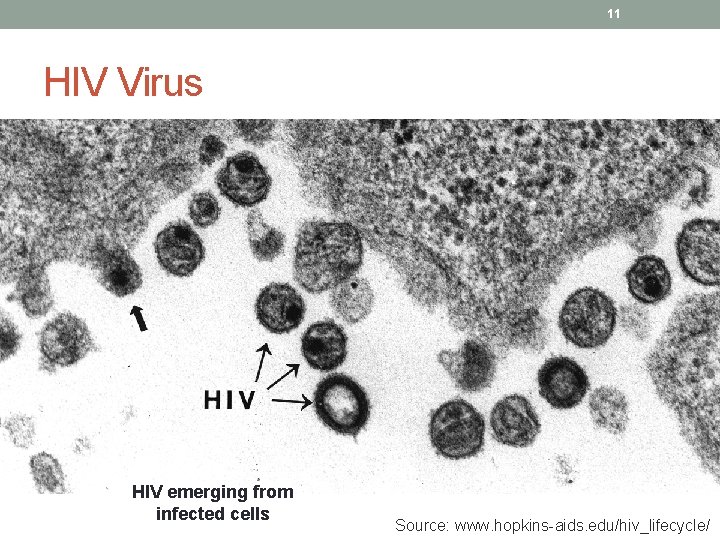
11 HIV Virus HIV emerging from infected cells Source: www. hopkins-aids. edu/hiv_lifecycle/
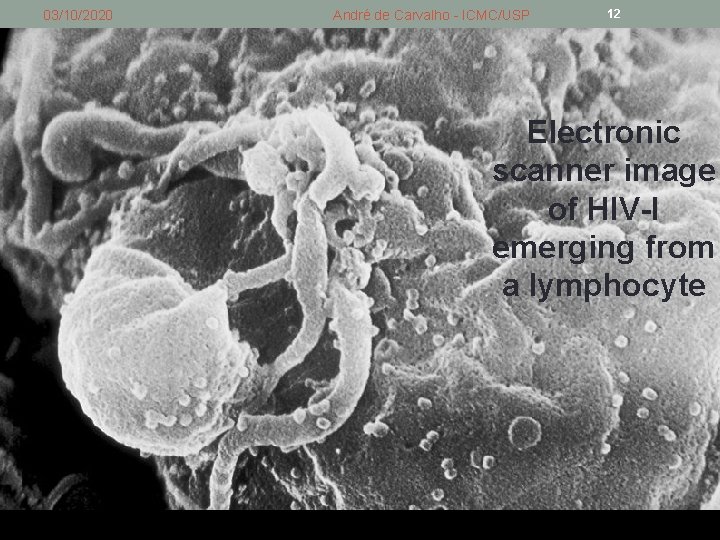
03/10/2020 André de Carvalho - ICMC/USP 12 Electronic scanner image of HIV-I emerging from a lymphocyte
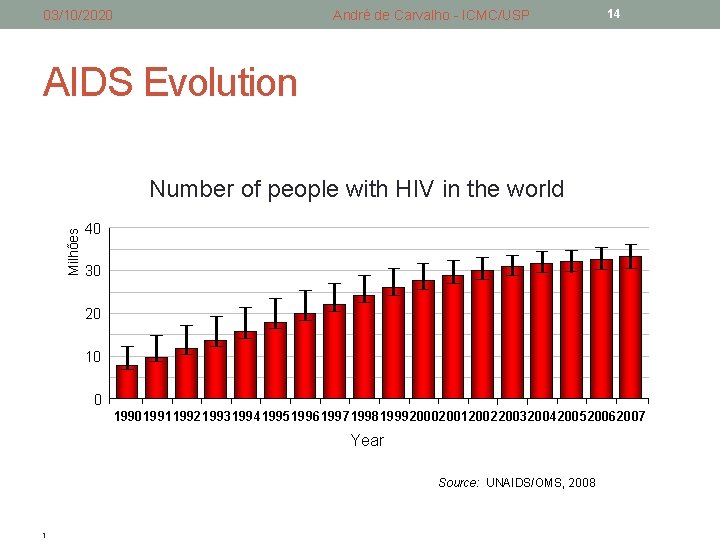
03/10/2020 André de Carvalho - ICMC/USP 14 AIDS Evolution Milhões Number of people with HIV in the world 40 30 20 10 0 1991 1992 1993 1994 1995 1996 1997 1998 1999 2000 2001 2002 2003 2004 2005 2006 2007 Year Source: UNAIDS/OMS, 2008 1
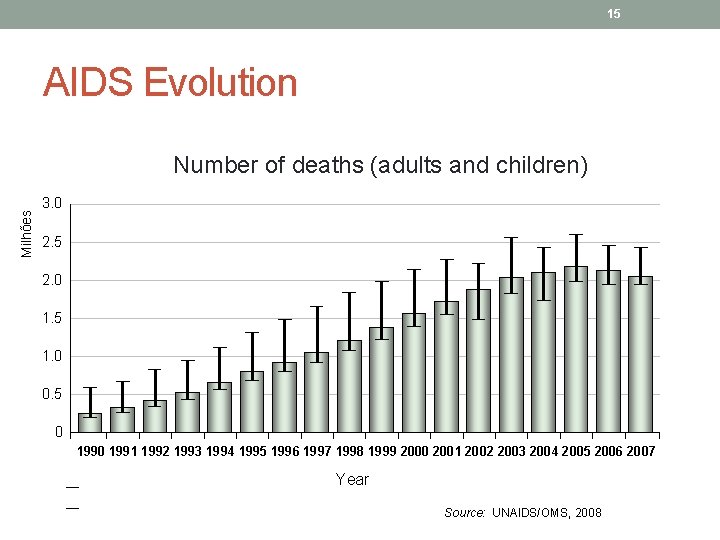
15 AIDS Evolution Milhões Number of deaths (adults and children) 3. 0 2. 5 2. 0 1. 5 1. 0 0. 5 0 1991 1992 1993 1994 1995 1996 1997 1998 1999 2000 2001 2002 2003 2004 2005 2006 2007 Year Source: UNAIDS/OMS, 2008
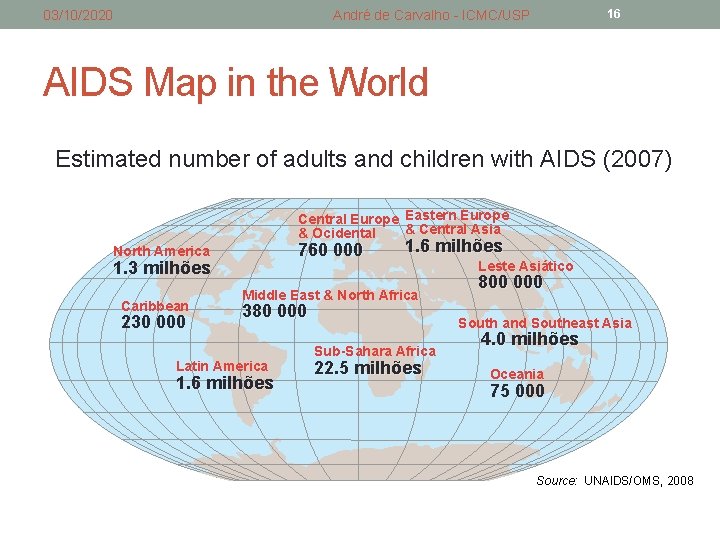
03/10/2020 André de Carvalho - ICMC/USP 16 AIDS Map in the World Estimated number of adults and children with AIDS (2007) Central Europe Eastern Europe & Central Asia & Ocidental 760 000 North America 1. 3 milhões Caribbean 230 000 1. 6 milhões Middle East & North Africa 380 000 Latin America 1. 6 milhões Leste Asiático 800 000 South and Southeast Asia Sub-Sahara Africa 22. 5 milhões 4. 0 milhões Oceania 75 000 Source: UNAIDS/OMS, 2008
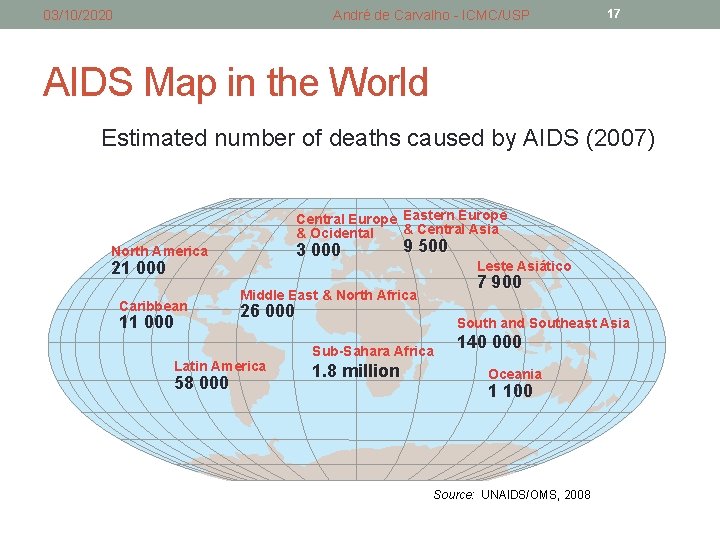
03/10/2020 André de Carvalho - ICMC/USP 17 AIDS Map in the World Estimated number of deaths caused by AIDS (2007) Central Europe Eastern Europe & Central Asia & Ocidental 3 000 North America 21 000 Caribbean 11 000 Leste Asiático 7 900 Middle East & North Africa 26 000 Latin America 58 000 9 500 South and Southeast Asia Sub-Sahara Africa 1. 8 million 140 000 Oceania 1 100 Source: UNAIDS/OMS, 2008
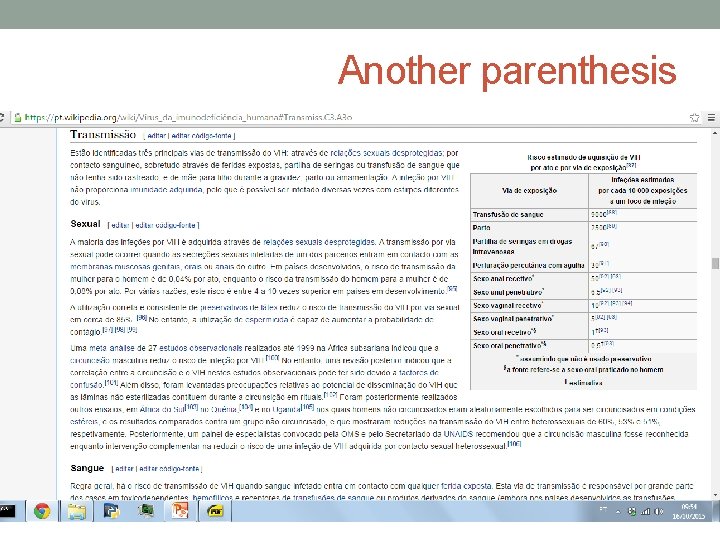
Another parenthesis
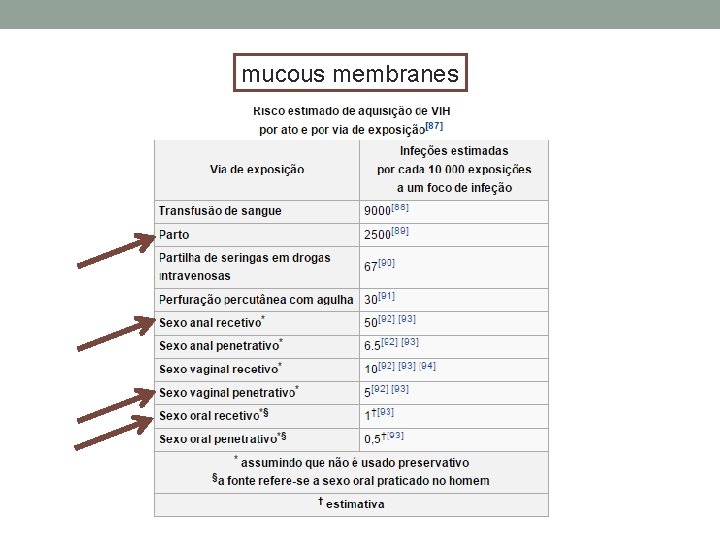
mucous membranes
† 1990 septic shock
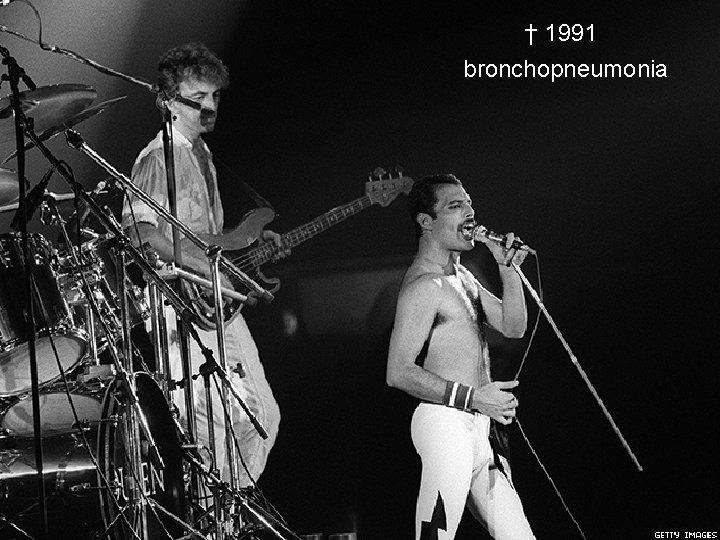
† 1991 bronchopneumonia
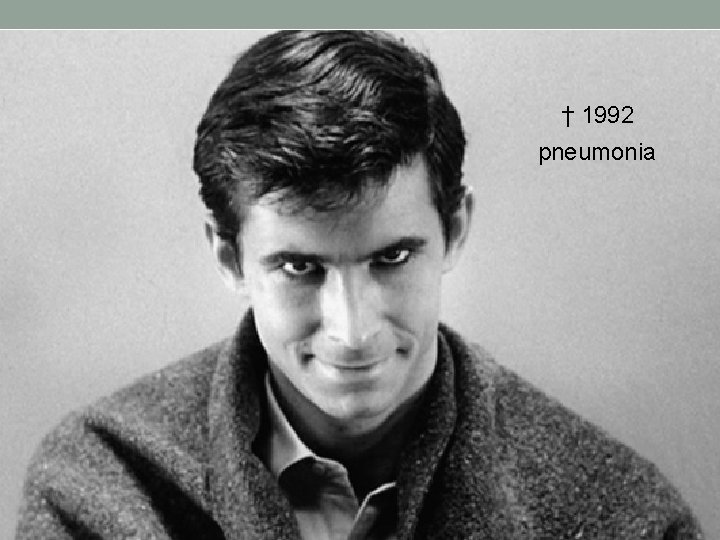
† 1992 pneumonia
† 1996 Several complications
† 1994 Died a few weeks after the diagnostics
03/10/2020 André de Carvalho - ICMC/USP 26 AIDS • There is no cure or effective vaccine • There are drugs to keep the virus under control • They are expensive (for your pocket and for your health) • Mechanisms to destroy a virus : • Immune system • Medications • How HIV escapes from attempts to destroy it?
03/10/2020 André de Carvalho - ICMC/USP 27 AIDS • Evolving (by modifying their genome) in a very short period of time • Virus that kills the patient virus that infected it • Virus has: • Very high mutation rates • Doubling time (generation) very short Several opportunities to evolve
03/10/2020 André de Carvalho - ICMC/USP • Motivation – A mysterious disease • Evolution and Natural Selection • HIV x Human Immune System • Quantifying natural selection • Synonymous and non-synonymous regions • Case Study 28
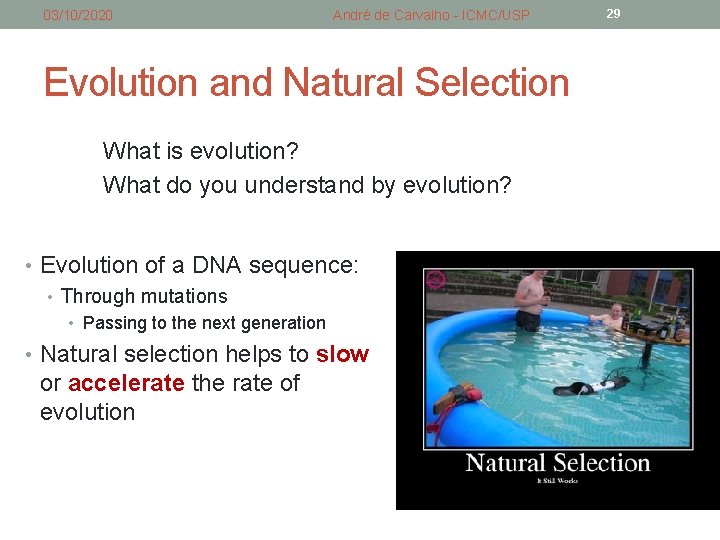
03/10/2020 André de Carvalho - ICMC/USP Evolution and Natural Selection What is evolution? What do you understand by evolution? • Evolution of a DNA sequence: • Through mutations • Passing to the next generation • Natural selection helps to slow or accelerate the rate of evolution 29
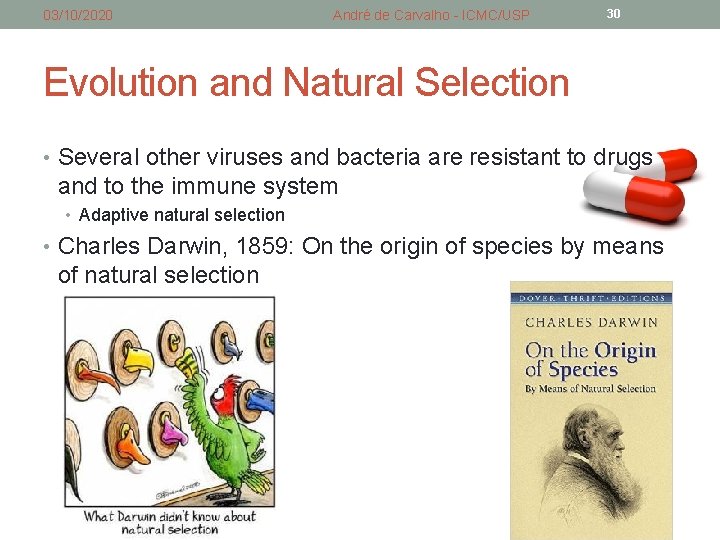
03/10/2020 André de Carvalho - ICMC/USP 30 Evolution and Natural Selection • Several other viruses and bacteria are resistant to drugs and to the immune system • Adaptive natural selection • Charles Darwin, 1859: On the origin of species by means of natural selection
03/10/2020 André de Carvalho - ICMC/USP 31 Evolution and Natural Selection • Natural selection at the level of organisms: • Best adapted individuals will survive, reproduce and generate more offspring to the next generation • Natural selection at the molecular level: • Remove harmful mutations • Negative selection or purifying • Favors the spread of advantageous mutations • Positive selection
03/10/2020 André de Carvalho - ICMC/USP 32 Evolution and Natural Selection • For evolution to occur it is necessary: • That individuals of the population have genetically controlled characteristics that varies a lot • That these characteristics affect the survivability or reproduction of individuals
03/10/2020 André de Carvalho - ICMC/USP • Motivation – A mysterious disease • Evolution and Natural Selection • HIV x Human Immune System • Quantifying natural selection • Synonymous and non-synonymous regions • Case Study 33
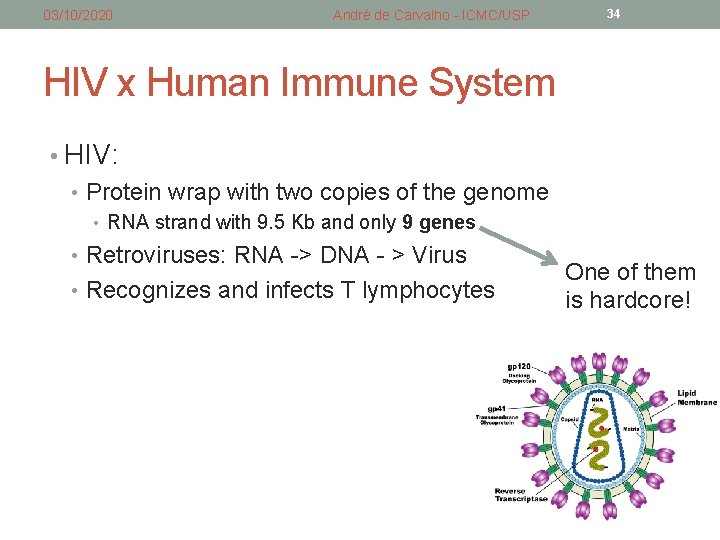
03/10/2020 André de Carvalho - ICMC/USP 34 HIV x Human Immune System • HIV: • Protein wrap with two copies of the genome • RNA strand with 9. 5 Kb and only 9 genes • Retroviruses: RNA -> DNA - > Virus • Recognizes and infects T lymphocytes One of them is hardcore!
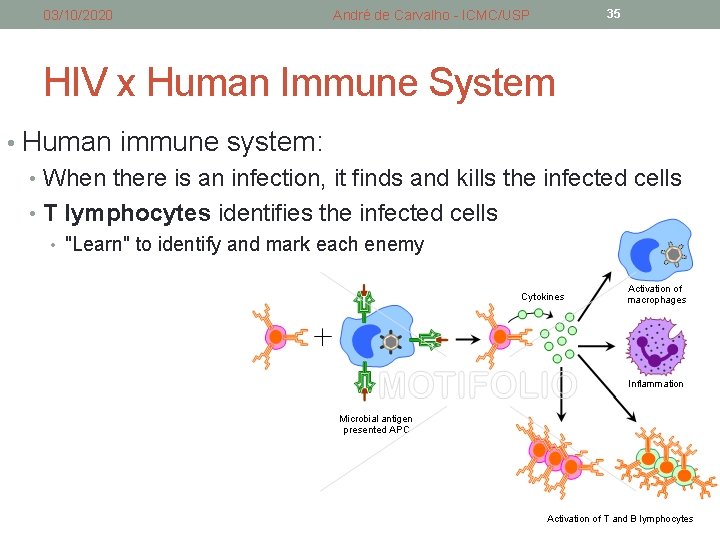
03/10/2020 André de Carvalho - ICMC/USP 35 HIV x Human Immune System • Human immune system: • When there is an infection, it finds and kills the infected cells • T lymphocytes identifies the infected cells • "Learn" to identify and mark each enemy
03/10/2020 André de Carvalho - ICMC/USP 36 HIV x Human Immune System • HIV attacks the cells that just should identify it to be destroyed • How it works: • Infected cells are marked with virus protein extracts (epitopes) • That are visible in the cell membrane • If T lymphocytes recognize a specific epitope, the cell can be destroyed • Otherwise, the virus reproduces
03/10/2020 André de Carvalho - ICMC/USP 37 HIV x Human Immune System • How does it work? • HIV generates new individuals with new versions of epitopes: • The virus epitopes that make it "invisible" survive • Very advantageous mutations • Immune system "learns" to identify new epitopes • It takes a few days
03/10/2020 André de Carvalho - ICMC/USP 38 HIV x Human Immune System • How does it work? • HIV reproduces extremely fast: • 1. 5 days • Replication in virus is very error-prone, tending to make or cause errors: • Error rate: 5 mutations per 100, 000 bp each generation • 1000 times greater than in humans • Result: a lot of genetic variation in a few generations and shortly
03/10/2020 André de Carvalho - ICMC/USP 39 HIV x Human Immune System • How does it work? Speed the immune system can recognize new epitopes < Speed HIV progresses generating ‘invisible’ individuals Result: There is no permanent immunity (as with other viruses and bacteria)
03/10/2020 André de Carvalho - ICMC/USP 40 HIV x Human Immune System • Positive natural selection acted when: • Recognized epitopes reduce fitness of an individual • Mutations that make the virus invisible increase that fitness • Virus with such mutations survive and produce more offspring to the next generation
03/10/2020 André de Carvalho - ICMC/USP • Motivation – A mysterious disease • Evolution and Natural Selection • HIV x Human Immune System • Quantifying natural selection • Synonymous and non-synonymous regions • Case Study 41
Natural Pause
03/10/2020 André de Carvalho - ICMC/USP • Motivation – A mysterious disease • Evolution and Natural Selection • HIV x Human Immune System • Quantifying natural selection • Synonymous and non-synonymous regions • Case Study 43
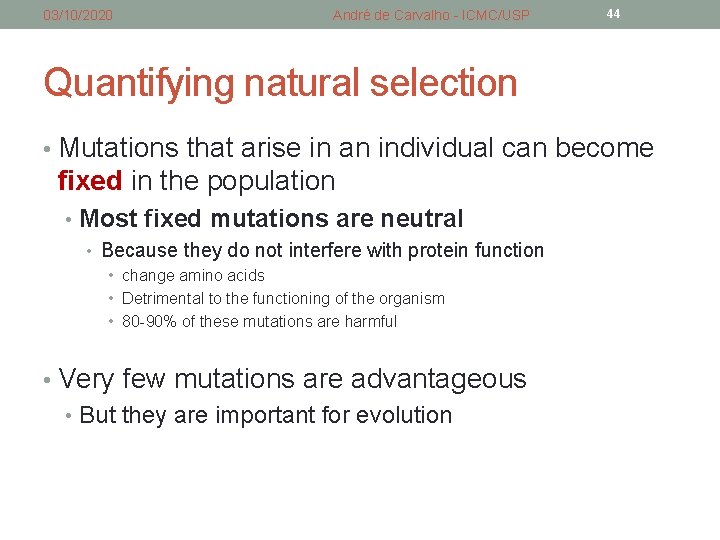
03/10/2020 André de Carvalho - ICMC/USP 44 Quantifying natural selection • Mutations that arise in an individual can become fixed in the population • Most fixed mutations are neutral • Because they do not interfere with protein function • change amino acids • Detrimental to the functioning of the organism • 80 -90% of these mutations are harmful • Very few mutations are advantageous • But they are important for evolution
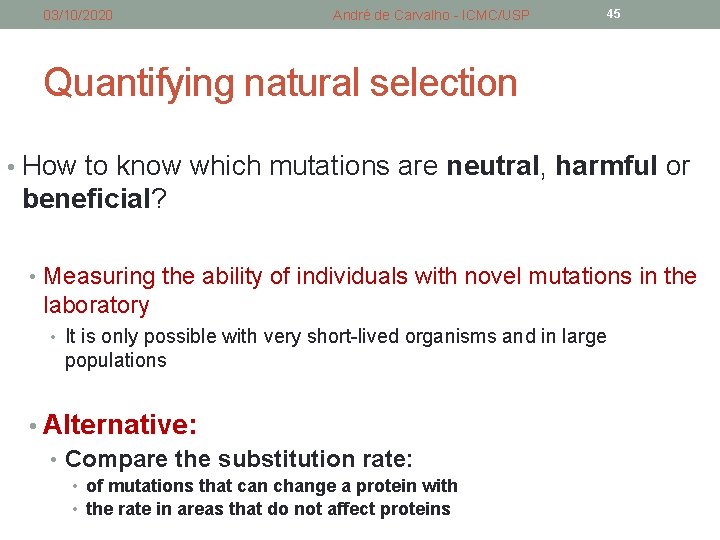
03/10/2020 André de Carvalho - ICMC/USP 45 Quantifying natural selection • How to know which mutations are neutral, harmful or beneficial? • Measuring the ability of individuals with novel mutations in the laboratory • It is only possible with very short-lived organisms and in large populations • Alternative: • Compare the substitution rate: • of mutations that can change a protein with • the rate in areas that do not affect proteins
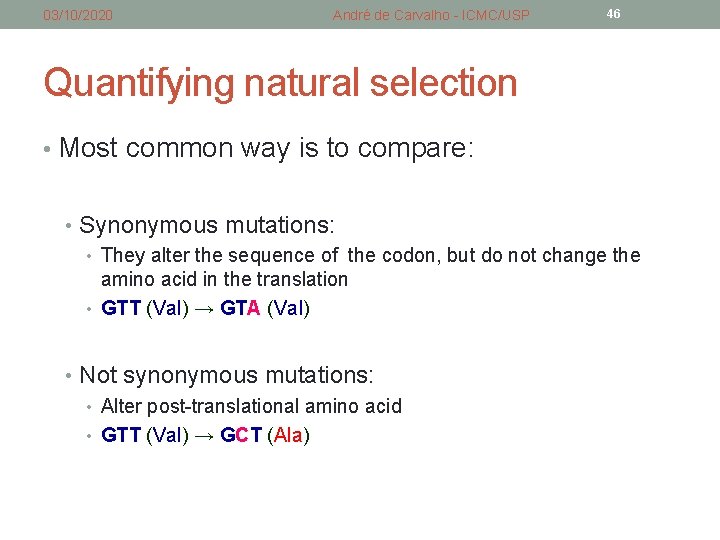
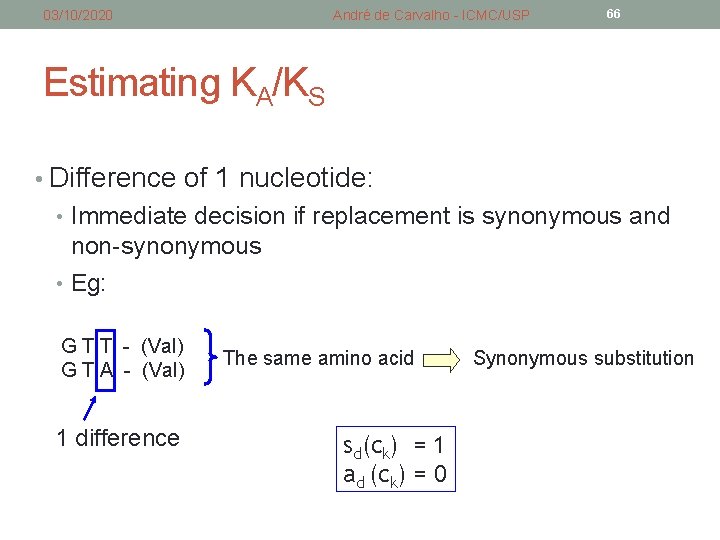
03/10/2020 André de Carvalho - ICMC/USP 46 Quantifying natural selection • Most common way is to compare: • Synonymous mutations: • They alter the sequence of the codon, but do not change the amino acid in the translation • GTT (Val) → GTA (Val) • Not synonymous mutations: • Alter post-translational amino acid • GTT (Val) → GCT (Ala)
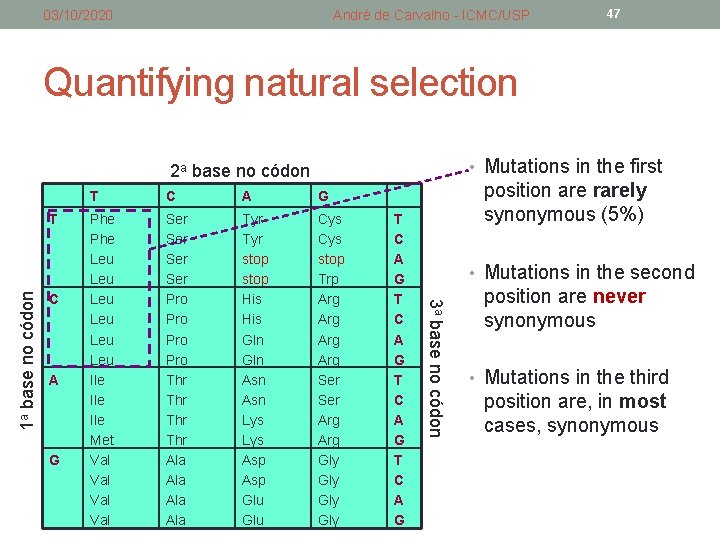
03/10/2020 André de Carvalho - ICMC/USP 47 Quantifying natural selection • Mutations in the first 2 a base no códon C A G Phe Leu Leu Leu Ile Ile Met Val Val Ser Ser Pro Pro Thr Thr Ala Ala Tyr stop His Gln Asn Lys Asp Glu Cys stop Trp Arg Arg Ser Arg Gly Gly T C A G position are rarely synonymous (5%) • Mutations in the second 3 a base no códon 1 a base no códon T T position are never synonymous • Mutations in the third position are, in most cases, synonymous
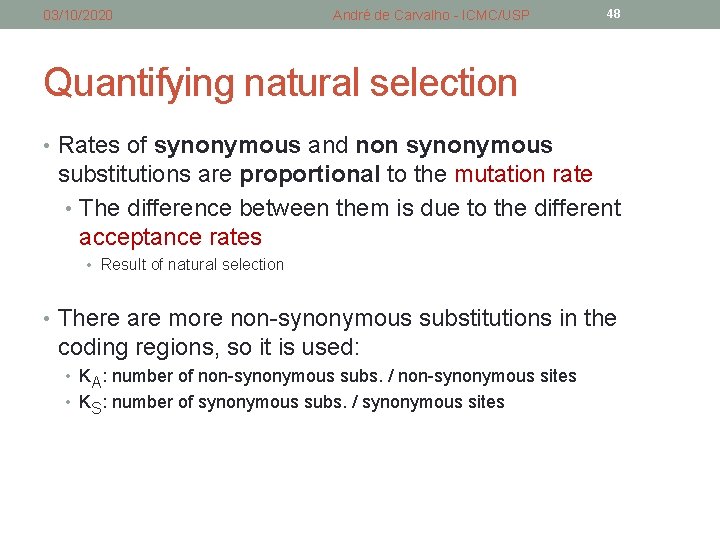
03/10/2020 André de Carvalho - ICMC/USP 48 Quantifying natural selection • Rates of synonymous and non synonymous substitutions are proportional to the mutation rate • The difference between them is due to the different acceptance rates • Result of natural selection • There are more non-synonymous substitutions in the coding regions, so it is used: • KA: number of non-synonymous subs. / non-synonymous sites • KS: number of synonymous subs. / synonymous sites
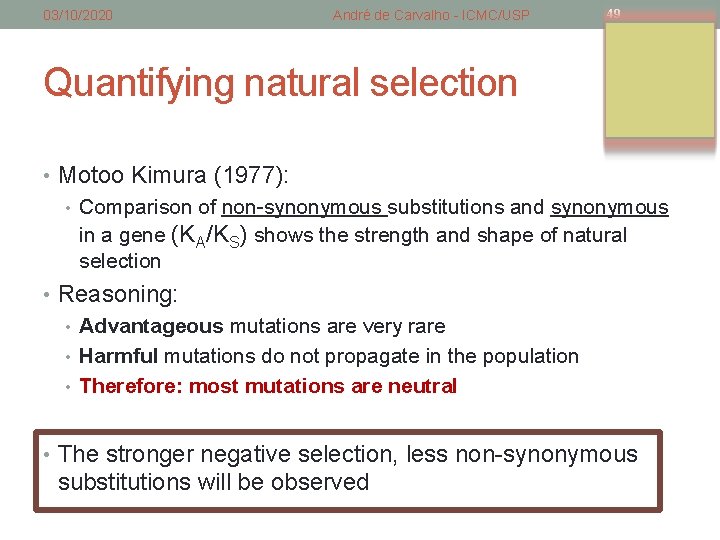
03/10/2020 André de Carvalho - ICMC/USP 49 Quantifying natural selection • Motoo Kimura (1977): • Comparison of non-synonymous substitutions and synonymous in a gene (KA/KS) shows the strength and shape of natural selection • Reasoning: • Advantageous mutations are very rare • Harmful mutations do not propagate in the population • Therefore: most mutations are neutral • The stronger negative selection, less non-synonymous substitutions will be observed
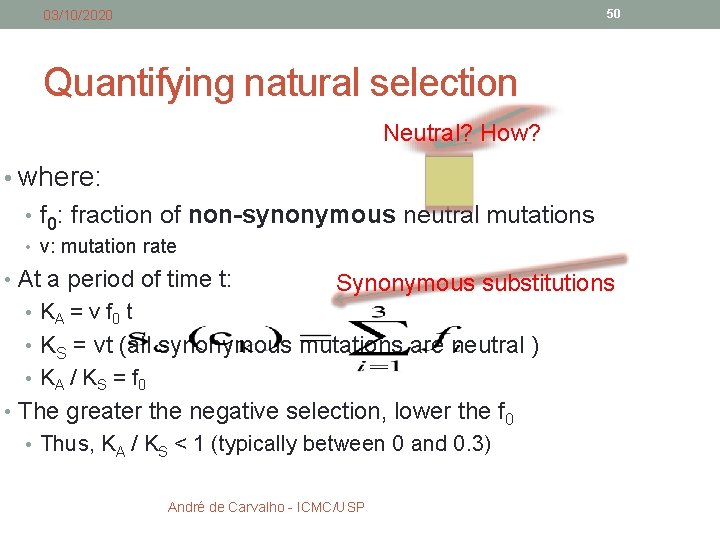
03/10/2020 50 Quantifying natural selection Neutral? How? • where: • f 0: fraction of non-synonymous neutral mutations • v: mutation rate • At a period of time t: Synonymous substitutions • KA = v f 0 t • KS = vt (all synonymous mutations are neutral ) • KA / K S = f 0 • The greater the negative selection, lower the f 0 • Thus, KA / KS < 1 (typically between 0 and 0. 3) André de Carvalho - ICMC/USP
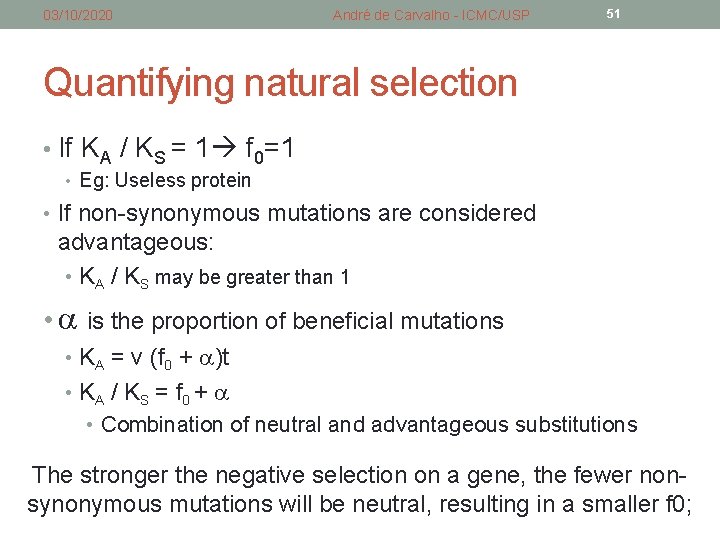
03/10/2020 André de Carvalho - ICMC/USP 51 Quantifying natural selection • If KA / KS = 1 f 0=1 • Eg: Useless protein • If non-synonymous mutations are considered advantageous: • KA / KS may be greater than 1 • is the proportion of beneficial mutations • KA = v (f 0 + )t • KA / K S = f 0 + • Combination of neutral and advantageous substitutions The stronger the negative selection on a gene, the fewer nonsynonymous mutations will be neutral, resulting in a smaller f 0;
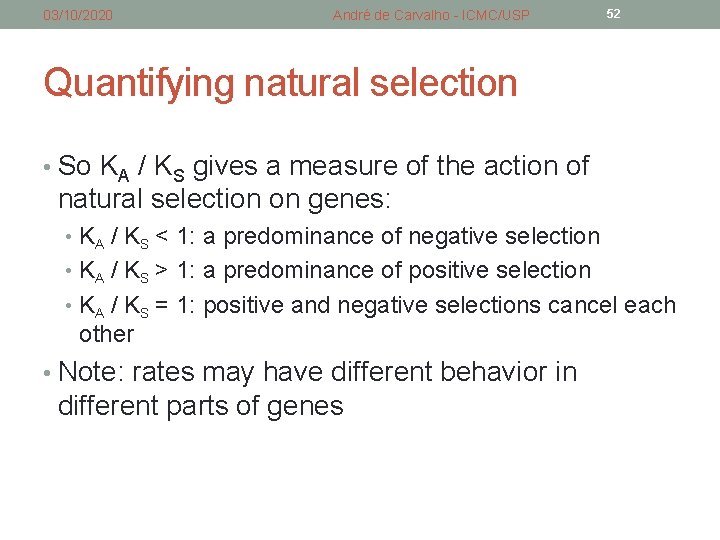
03/10/2020 André de Carvalho - ICMC/USP 52 Quantifying natural selection • So KA / KS gives a measure of the action of natural selection on genes: • KA / KS < 1: a predominance of negative selection • KA / KS > 1: a predominance of positive selection • KA / KS = 1: positive and negative selections cancel each other • Note: rates may have different behavior in different parts of genes
03/10/2020 André de Carvalho - ICMC/USP • Motivation – A mysterious disease • Evolution and Natural Selection • HIV x Human Immune System • Quantifying natural selection • Synonymous and non-synonymous regions • Case Study 53
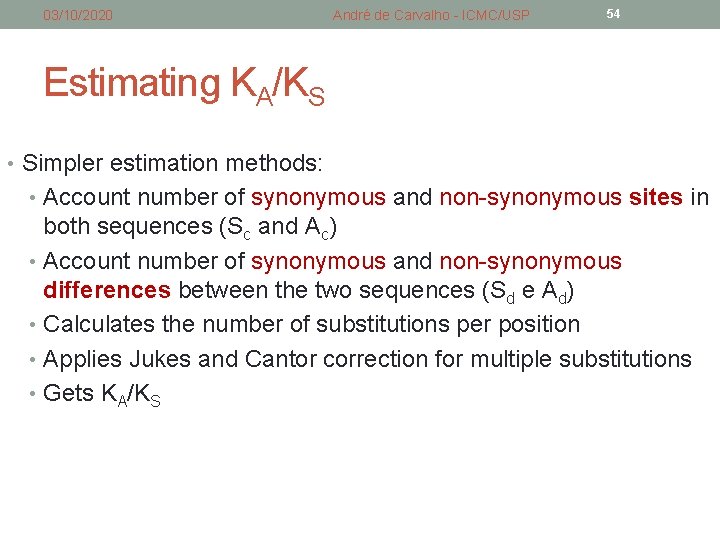
03/10/2020 André de Carvalho - ICMC/USP 54 Estimating KA/KS • Simpler estimation methods: • Account number of synonymous and non-synonymous sites in both sequences (Sc and Ac) • Account number of synonymous and non-synonymous differences between the two sequences (Sd e Ad) • Calculates the number of substitutions per position • Applies Jukes and Cantor correction for multiple substitutions • Gets KA/KS
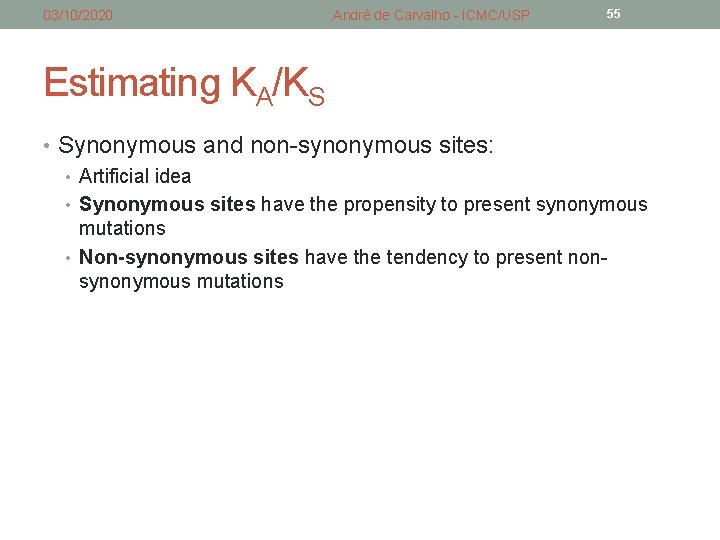
03/10/2020 André de Carvalho - ICMC/USP 55 Estimating KA/KS • Synonymous and non-synonymous sites: • Artificial idea • Synonymous sites have the propensity to present synonymous mutations • Non-synonymous sites have the tendency to present nonsynonymous mutations
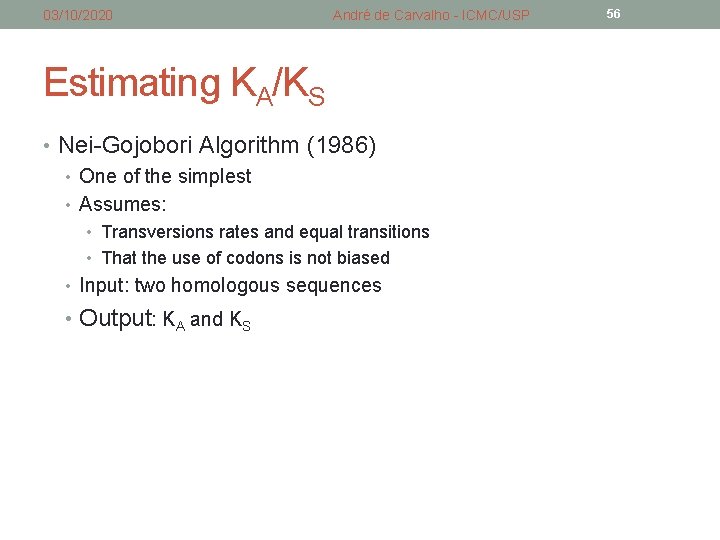
03/10/2020 André de Carvalho - ICMC/USP Estimating KA/KS • Nei-Gojobori Algorithm (1986) • One of the simplest • Assumes: • Transversions rates and equal transitions • That the use of codons is not biased • Input: two homologous sequences • Output: KA and KS 56
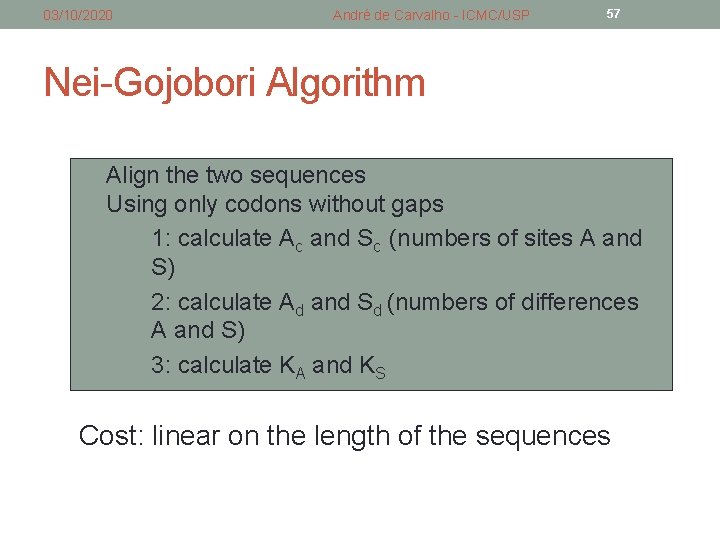
03/10/2020 André de Carvalho - ICMC/USP 57 Nei-Gojobori Algorithm Align the two sequences Using only codons without gaps 1: calculate Ac and Sc (numbers of sites A and S) 2: calculate Ad and Sd (numbers of differences A and S) 3: calculate KA and KS Cost: linear on the length of the sequences
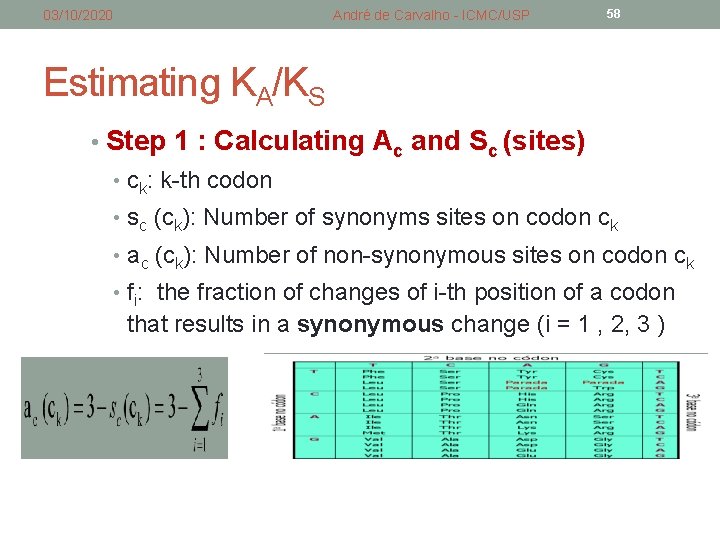
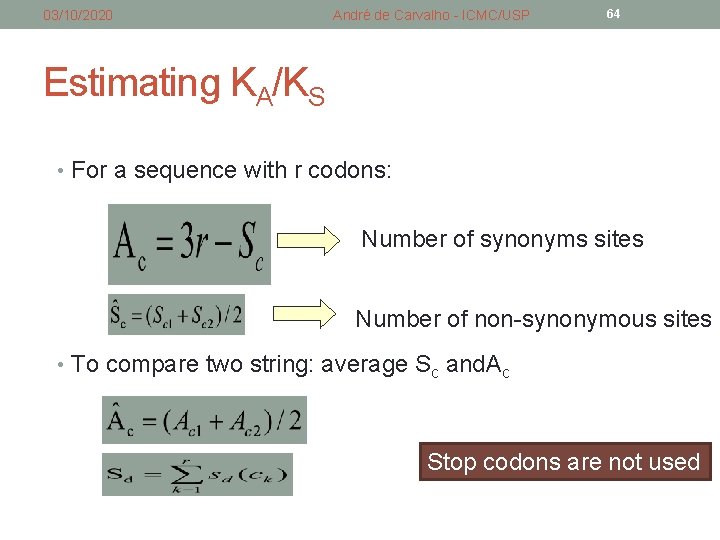
03/10/2020 André de Carvalho - ICMC/USP 58 Estimating KA/KS • Step 1 : Calculating Ac and Sc (sites) • ck: k-th codon • sc (ck): Number of synonyms sites on codon ck • ac (ck): Number of non-synonymous sites on codon ck • fi: the fraction of changes of i-th position of a codon that results in a synonymous change (i = 1 , 2, 3 )
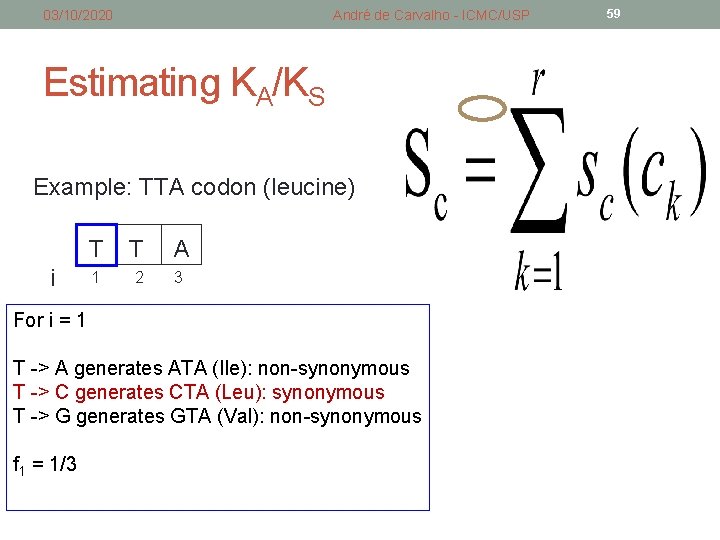
03/10/2020 André de Carvalho - ICMC/USP Estimating KA/KS Example: TTA codon (leucine) i T T A 1 2 3 For i = 1 T -> A generates ATA (Ile): non-synonymous T -> C generates CTA (Leu): synonymous T -> G generates GTA (Val): non-synonymous f 1 = 1/3 59
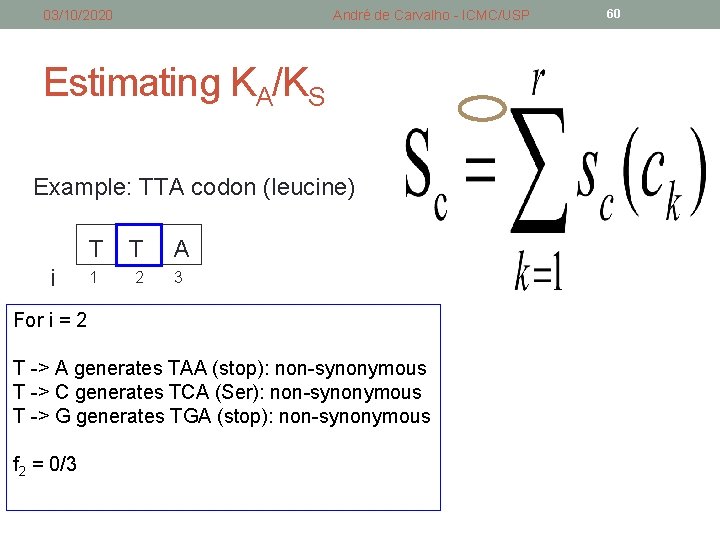
03/10/2020 André de Carvalho - ICMC/USP Estimating KA/KS Example: TTA codon (leucine) i T T A 1 2 3 For i = 2 T -> A generates TAA (stop): non-synonymous T -> C generates TCA (Ser): non-synonymous T -> G generates TGA (stop): non-synonymous f 2 = 0/3 60
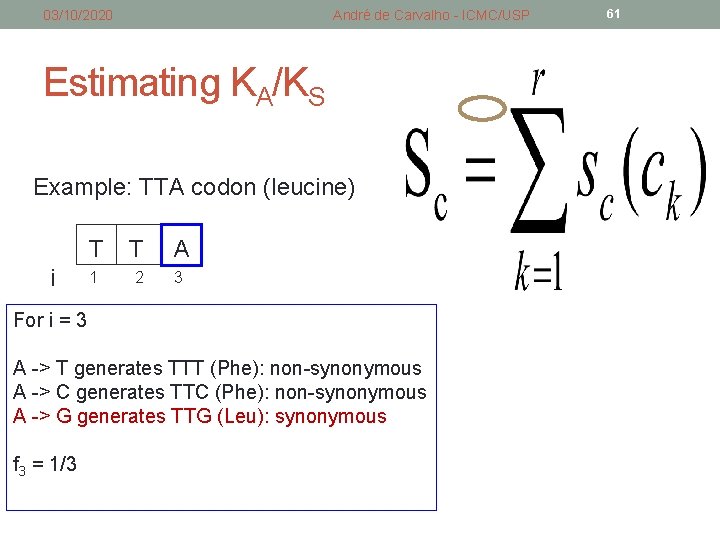
03/10/2020 André de Carvalho - ICMC/USP Estimating KA/KS Example: TTA codon (leucine) i T T A 1 2 3 For i = 3 A -> T generates TTT (Phe): non-synonymous A -> C generates TTC (Phe): non-synonymous A -> G generates TTG (Leu): synonymous f 3 = 1/3 61
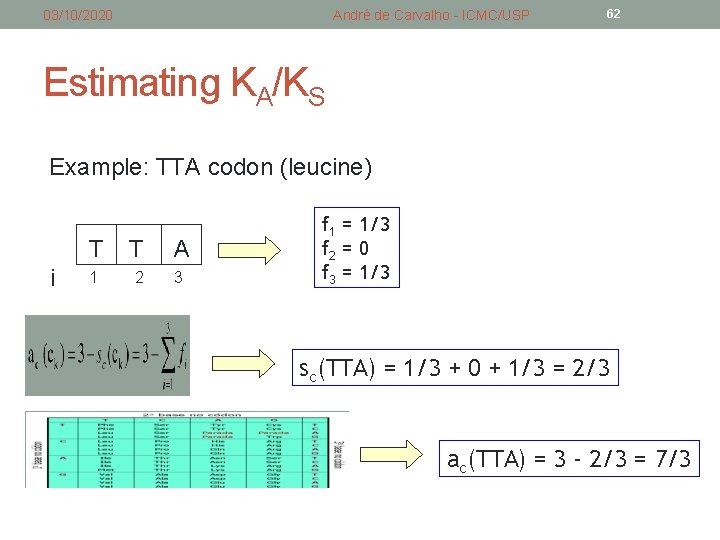
03/10/2020 André de Carvalho - ICMC/USP 62 Estimating KA/KS Example: TTA codon (leucine) i T T A 1 2 3 f 1 = 1/3 f 2 = 0 f 3 = 1/3 sc(TTA) = 1/3 + 0 + 1/3 = 2/3 ac(TTA) = 3 - 2/3 = 7/3
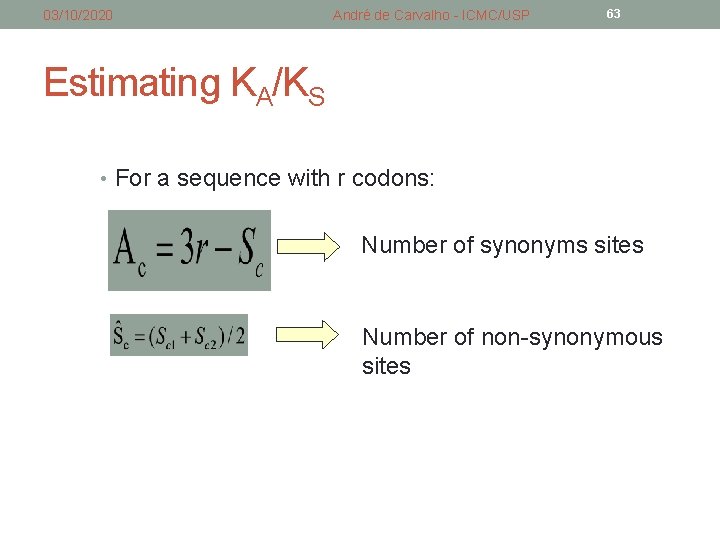
03/10/2020 André de Carvalho - ICMC/USP 63 Estimating KA/KS • For a sequence with r codons: Number of synonyms sites Number of non-synonymous sites
03/10/2020 André de Carvalho - ICMC/USP 64 Estimating KA/KS • For a sequence with r codons: Number of synonyms sites Number of non-synonymous sites • To compare two string: average Sc and. Ac Stop codons are not used
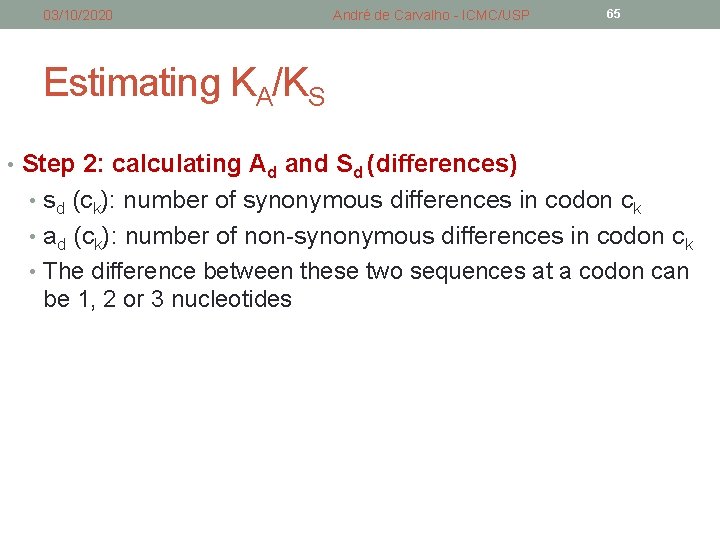
03/10/2020 André de Carvalho - ICMC/USP 65 Estimating KA/KS • Step 2: calculating Ad and Sd (differences) • sd (ck): number of synonymous differences in codon ck • ad (ck): number of non-synonymous differences in codon ck • The difference between these two sequences at a codon can be 1, 2 or 3 nucleotides
03/10/2020 André de Carvalho - ICMC/USP 66 Estimating KA/KS • Difference of 1 nucleotide: • Immediate decision if replacement is synonymous and non-synonymous • Eg: G T T - (Val) G T A - (Val) 1 difference The same amino acid sd(ck) = 1 ad (ck) = 0 Synonymous substitution
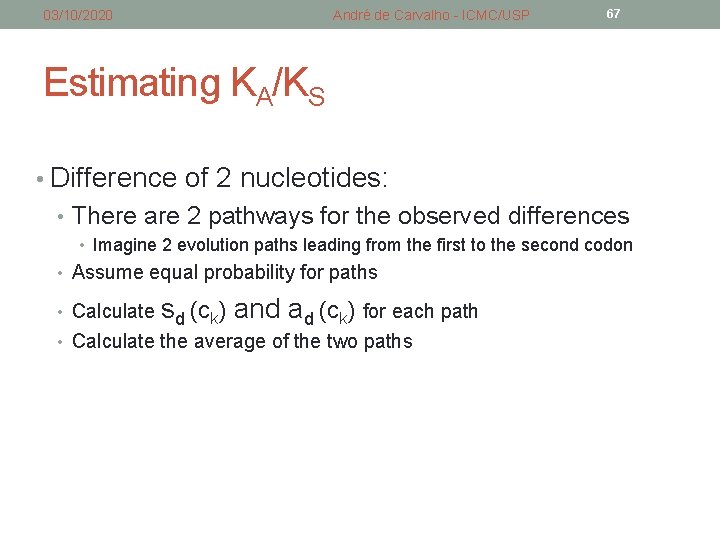
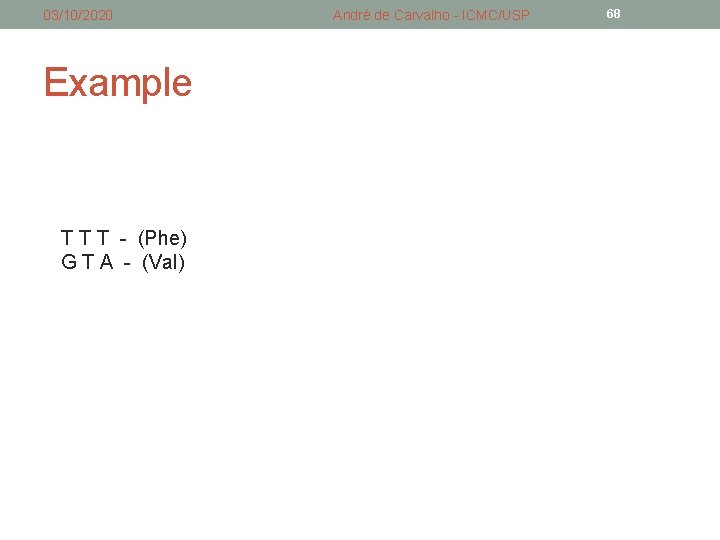
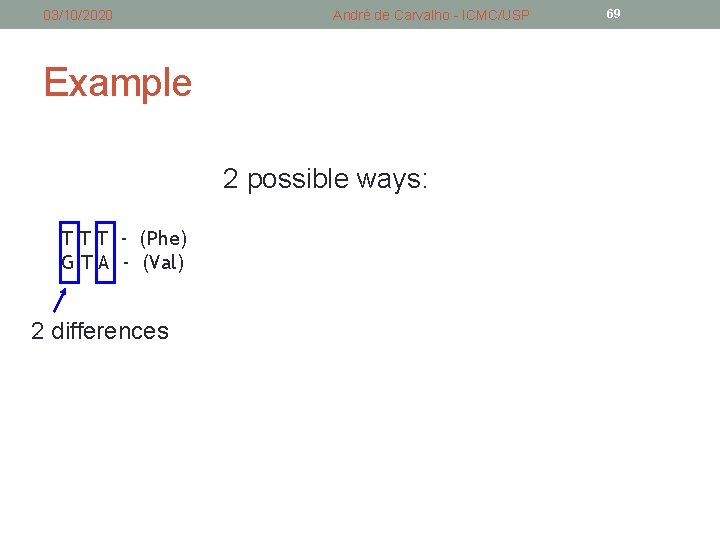
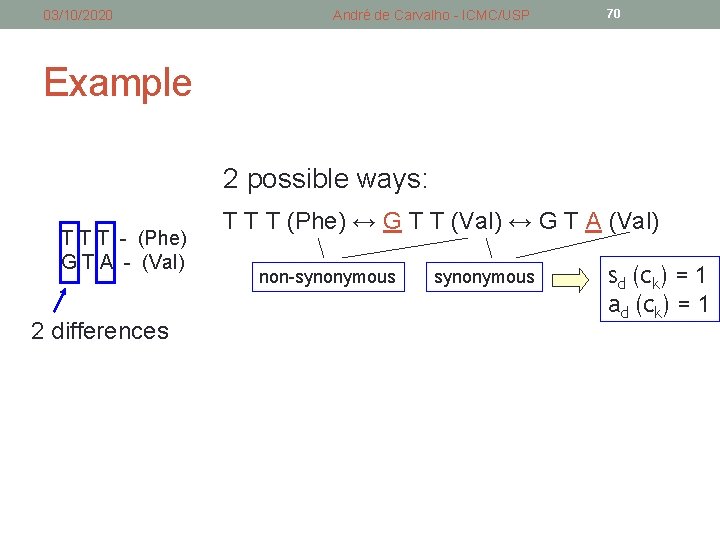
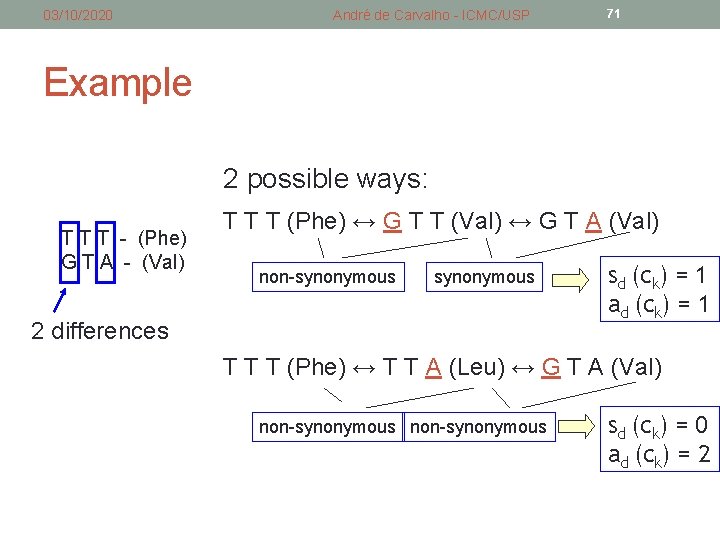
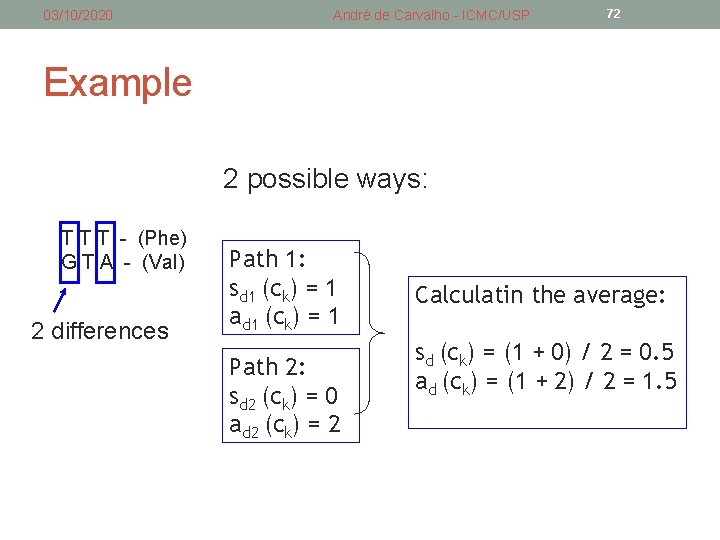
03/10/2020 André de Carvalho - ICMC/USP 67 Estimating KA/KS • Difference of 2 nucleotides: • There are 2 pathways for the observed differences • Imagine 2 evolution paths leading from the first to the second codon • Assume equal probability for paths • Calculate sd (ck) and ad (ck) for each path • Calculate the average of the two paths
03/10/2020 Example T T T - (Phe) G T A - (Val) André de Carvalho - ICMC/USP 68
03/10/2020 André de Carvalho - ICMC/USP Example 2 possible ways: T T T - (Phe) G T A - (Val) 2 differences 69
03/10/2020 André de Carvalho - ICMC/USP 70 Example 2 possible ways: T T T - (Phe) G T A - (Val) 2 differences T T T (Phe) ↔ G T T (Val) ↔ G T A (Val) non-synonymous sd (ck) = 1 ad (ck) = 1
03/10/2020 André de Carvalho - ICMC/USP 71 Example 2 possible ways: T T T - (Phe) G T A - (Val) T T T (Phe) ↔ G T T (Val) ↔ G T A (Val) non-synonymous 2 differences sd (ck) = 1 ad (ck) = 1 T T T (Phe) ↔ T T A (Leu) ↔ G T A (Val) non-synonymous sd (ck) = 0 ad (ck) = 2
03/10/2020 André de Carvalho - ICMC/USP 72 Example 2 possible ways: T T T - (Phe) G T A - (Val) 2 differences Path 1: sd 1 (ck) = 1 ad 1 (ck) = 1 Path 2: sd 2 (ck) = 0 ad 2 (ck) = 2 Calculatin the average: sd (ck) = (1 + 0) / 2 = 0. 5 ad (ck) = (1 + 2) / 2 = 1. 5
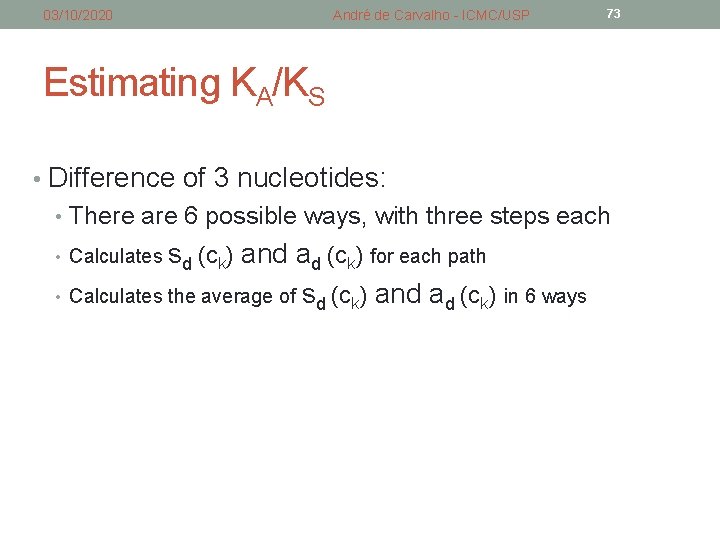
03/10/2020 André de Carvalho - ICMC/USP 73 Estimating KA/KS • Difference of 3 nucleotides: • There are 6 possible ways, with three steps each sd (ck) and ad (ck) for each path • Calculates the average of sd (ck) and ad (ck) in 6 ways • Calculates
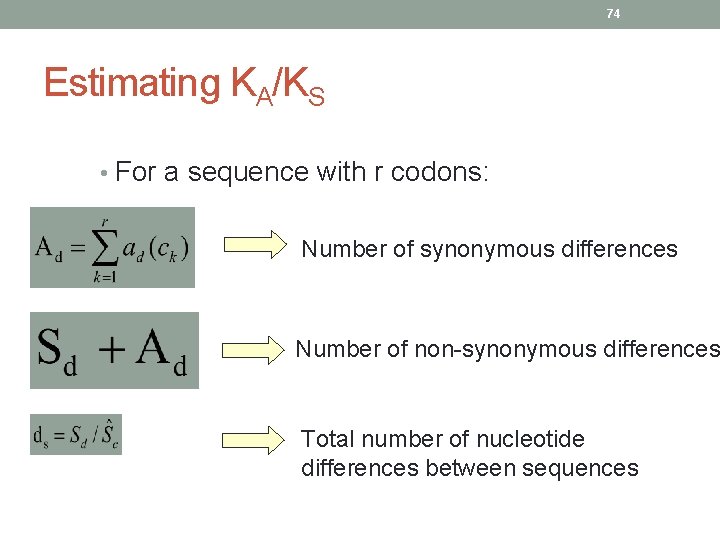
74 Estimating KA/KS • For a sequence with r codons: Number of synonymous differences Number of non-synonymous differences Total number of nucleotide differences between sequences
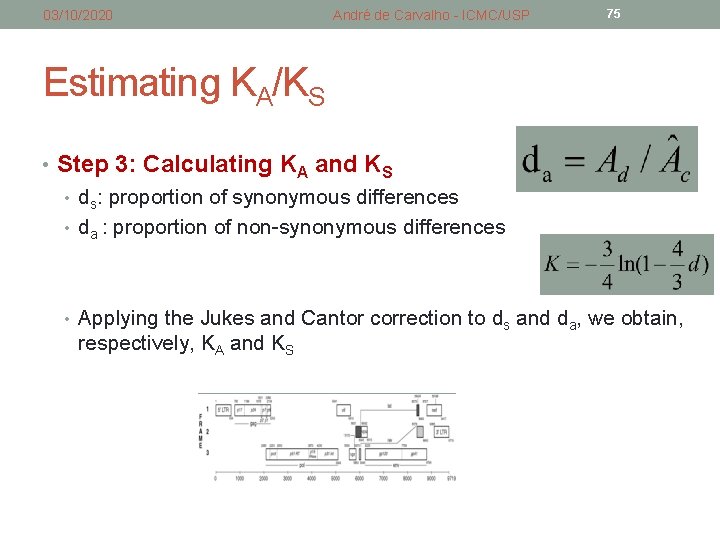
03/10/2020 André de Carvalho - ICMC/USP 75 Estimating KA/KS • Step 3: Calculating KA and KS • ds: proportion of synonymous differences • da : proportion of non-synonymous differences • Applying the Jukes and Cantor correction to ds and da, we obtain, respectively, KA and KS
03/10/2020 André de Carvalho - ICMC/USP • Motivation – A mysterious disease • Evolution and Natural Selection • HIV x Human Immune System • Quantifying natural selection • Synonymous and non-synonymous regions • Case Study 76
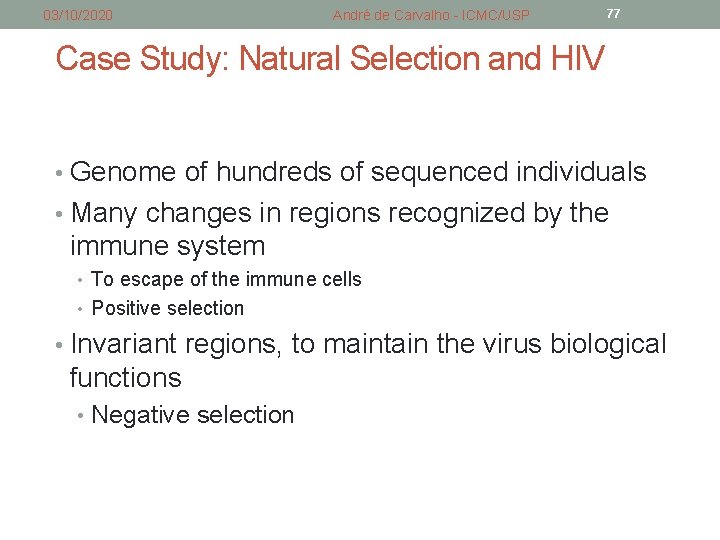
03/10/2020 André de Carvalho - ICMC/USP 77 Case Study: Natural Selection and HIV • Genome of hundreds of sequenced individuals • Many changes in regions recognized by the immune system • To escape of the immune cells • Positive selection • Invariant regions, to maintain the virus biological functions • Negative selection
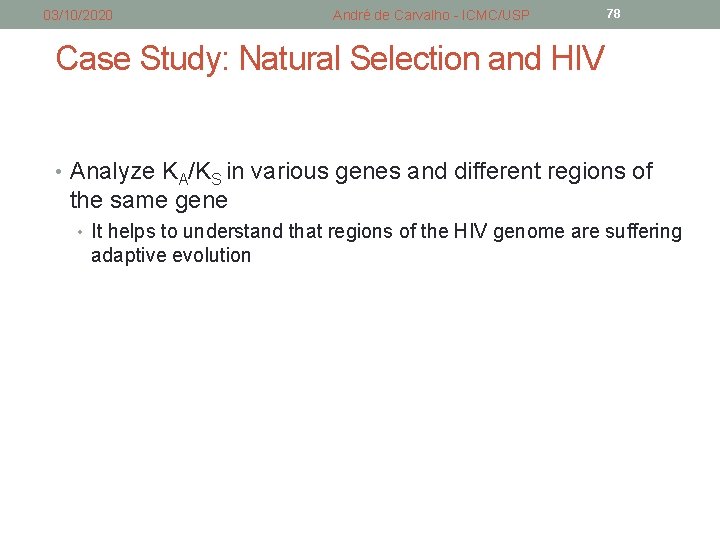
03/10/2020 André de Carvalho - ICMC/USP 78 Case Study: Natural Selection and HIV • Analyze KA/KS in various genes and different regions of the same gene • It helps to understand that regions of the HIV genome are suffering adaptive evolution
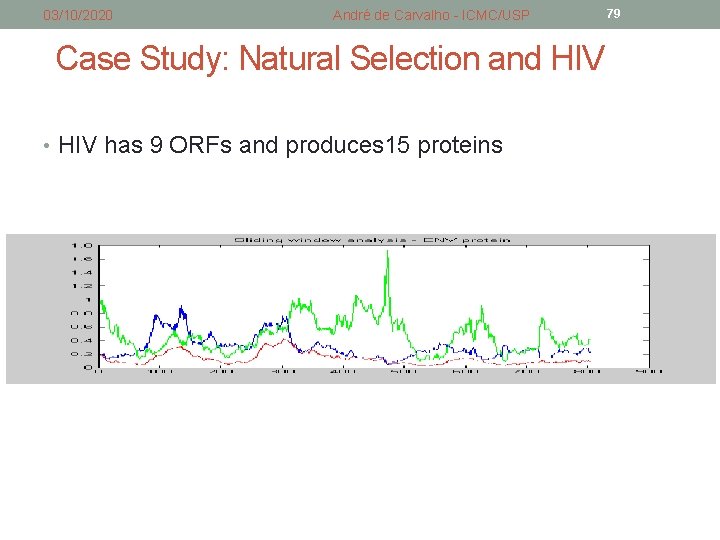
03/10/2020 André de Carvalho - ICMC/USP Case Study: Natural Selection and HIV • HIV has 9 ORFs and produces 15 proteins 79
03/10/2020 André de Carvalho - ICMC/USP Case Study: Natural Selection and HIV • Analysis: • Step 1: find the ORFs • Step 2: Calculate KA/KS • Use 2 sequences • Align the corresponding ORFs in the two sequences • Calculate the ratio for each ORF 80
03/10/2020 André de Carvalho - ICMC/USP 81 Case Study: Natural Selection and HIV • Natural selection in epitopes: Gene ENV • Codes the glycoprotein gp 160 (viruses wrap) - precursor protein: • gp 41 • gp 120: • Binds to receptors on T lymphocytes (helps the virus to recognize the host) • Recognized by the immune system to indicate virus infection
André de Carvalho - ICMC/USP Case Study: Natural Selection and HIV • The selection in gp 120 needs: • Maintaining the recognition capability of the host • To avoid detection by the immune system • Measuring KA/KS in the whole gene • Hides both processes, giving an average value 03/10/2020 82
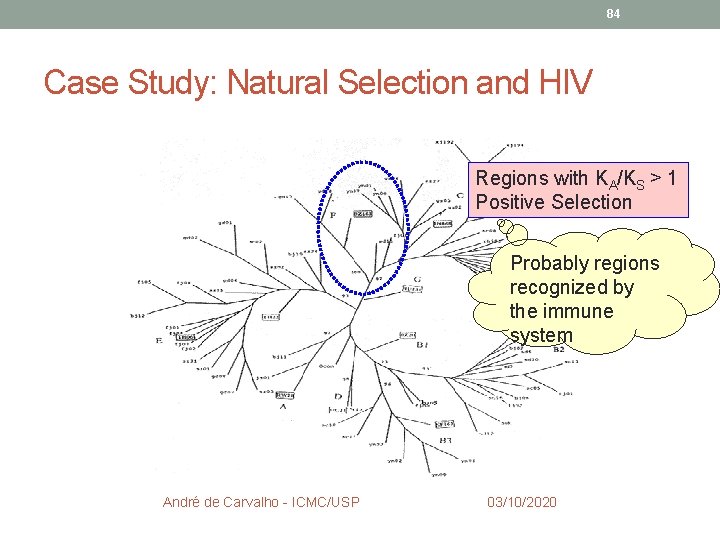
03/10/2020 André de Carvalho - ICMC/USP 83 Case Study: Natural Selection and HIV • To see what happens in each part of the gene: • Use small windows to go throughout the gene and calculate at a stretch KA/KS • Sliding window throughout the entire gene • You can notice the different levels of selection pressure in different parts of the gene
84 Case Study: Natural Selection and HIV Regions with KA/KS > 1 Positive Selection Probably regions recognized by the immune system André de Carvalho - ICMC/USP 03/10/2020
03/10/2020 Case Study: Natural Selection and HIV • View of the rapid evolution of HIV using phylogenetic tree 85
03/10/2020 André de Carvalho - ICMC/USP Conclusion • AIDS and HIV • Evolution and Natural Selection • HIV x Human Immune System • Quantifying natural selection • Synonymous and non-synonymous regions • Case Study 86
Questions?