
NATURAL SELECTION A Mechanism for Evolutionary Change Evolution





- Slides: 19
NATURAL SELECTION A Mechanism for Evolutionary Change
Evolution Change in the genes of a population over time. Evidence: � includes fossil record, DNA and protein studies and direct observation. � indicates that living things on the earth change over time. � Example – Increasing bacterial resistance to antibiotics. We have directly observed this change.
Charles Darwin � � Natural selection is the cause evolutionary change. AKA “survival of the fittest”
Natural Selection (4 points) 1. 2. 3. 4. Genetic variation (differences) exists in all populations. Some variations are favorable Not all young produced in each generation can survive Individuals with favorable variations have a greater chance of reproducing and passing on their variations (genes/traits).
Which variation is favorable? What will the next generations look like? � w
Gypsy Moths
Gypsy Moths
Gypsy Moths in England � � Factories spewed out massive amounts of air pollutants. With the change in the environment the tree trunks were darker in color. Moths with dark coloration (camouflage) survived to reproduce…passing on their genes for dark color to next generation. This change in the genes of the population over time = evolution.
• How do the Peacock’s large brightly colored feathers help it survive? • Do you think these feathers help it evade predators or find food? • Obviously not!
What does “survival of the fittest ” really mean? � The fittest member of a population is the individual that produces the most offspring…passes on the most copies of its genes.
Selective Pressures � 1. 2. 3. 4. Factors that result in selection of specific variations/phenotype: Predation Changes in climate or other environmental factors Disease Competition for food, space, reproductive resources…survival means passing on genes.
So why the funky feathers? Do they help it fly faster?
� � The feathers help the peacock attract a mate and thus, pass on its genes. Survival fittest…not necessarily the strongest/fastest…
Why/how did the giraffe get such a long neck? � Explain this using what you have learned about natural selection ( the 4 points).
Adaptations � � � Characteristics that help an organism to survive and reproduce. Are the results of evolution by natural selection Giraffe… neck Peacock… flamboyant feathers Bacteria… resistance to antibiotics Human…?
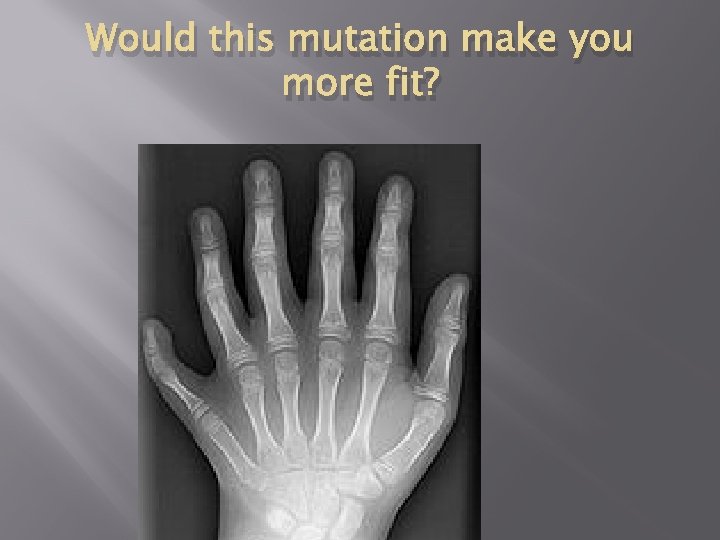
Mutations � Mutations are random changes in the DNA (genes) of an organism. � Most mutations are unfavorable… occasionally, they may be beneficial and lead to evolutionary changes.
Would this mutation make you more fit?