
Natural Selection A Mechanism for Evolutionary Change Evolution



- Slides: 30
Natural Selection A Mechanism for Evolutionary Change
Evolution Change in the genes of a population over time. Evidence: • includes fossil record, DNA and protein studies and direct observation. • indicates that living things on the earth change over time. • Example – Increasing bacterial resistance to antibiotics. We have directly observed this change.
What is Evolution? • The processes that have transformed life on earth from it’s earliest forms to the vast diversity that characterizes it today. A change in the genes over time!! (What does this mean? What will cause this? ) MUTATIONS!
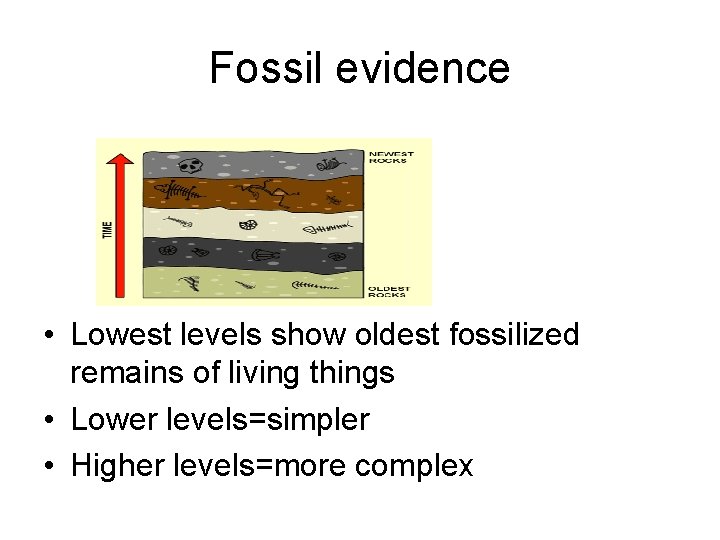
Fossil evidence • Lowest levels show oldest fossilized remains of living things • Lower levels=simpler • Higher levels=more complex
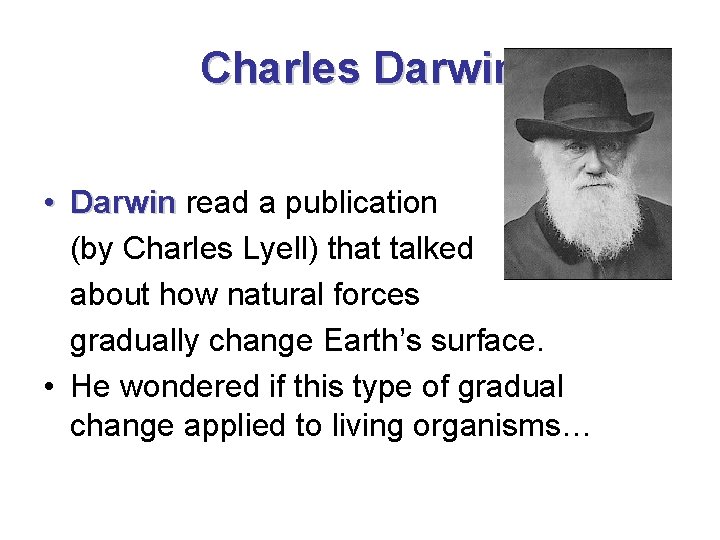
Charles Darwin • Darwin read a publication (by Charles Lyell) that talked about how natural forces gradually change Earth’s surface. • He wondered if this type of gradual change applied to living organisms…
Charles Darwin • In 1859, he wrote: wrote – “On the Origin of Species by Means of Natural Selection” Two main points in the article: 1. Species were not created in their present form, but evolved from ancestral species. 2. He proposed that NATURAL SELECTION is the mechanism for evolution
Charles Darwin • Proposed that Natural Selection is the cause of evolutionary change in 1859. • Concept of Natural Selection is AKA “Survival of the fittest” • In order for Natural Selection to occur, population must include diversity (genetic differences)!
Natural Selection (4 points) 1. Genetic variation (differences) exists in all populations. 2. Some variations are favorable 3. Not all young produced in each generation can survive 4. Individuals with favorable variations have a greater chance of reproducing and passing on their variations (genes/traits).
Natural Selection is sometimes referred to as “Survival of the fittest” - What does this mean? • The fittest member of a population is the individual that produces the most offspring…passes on the most copies of its genes.
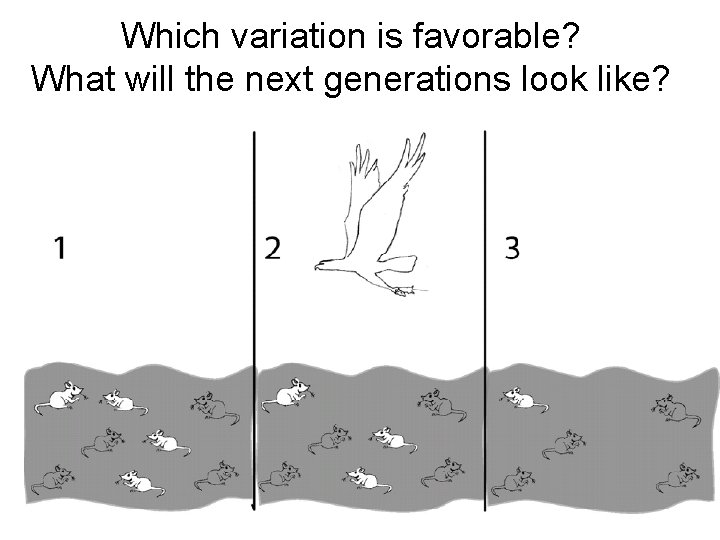
Which variation is favorable? What will the next generations look like? • w
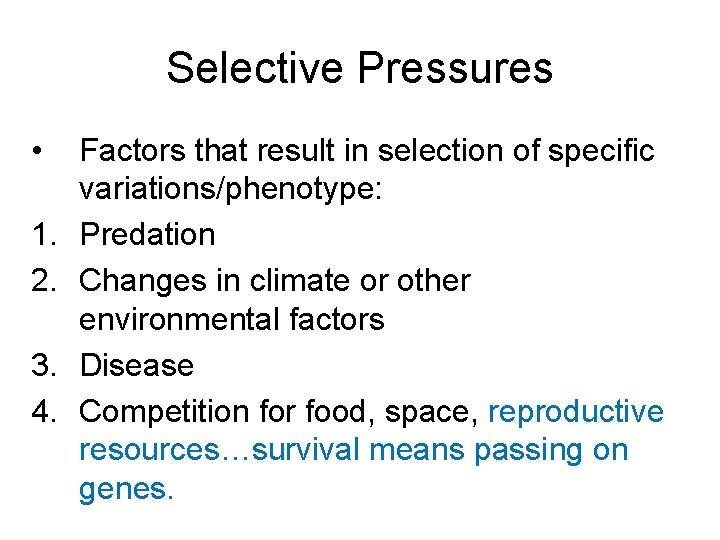
Selective Pressures • 1. 2. 3. 4. Factors that result in selection of specific variations/phenotype: Predation Changes in climate or other environmental factors Disease Competition for food, space, reproductive resources…survival means passing on genes.
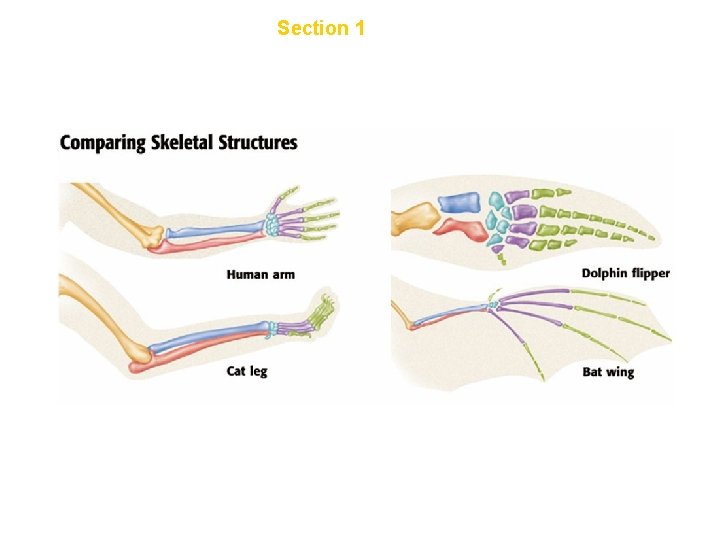
Evidence of Evolution 1. Fossil Record: Fossils and the order in which they appear in layers of sedimentary rock (strongest evidence). Which is older- lower or higher in the rocks? 2. Homologous structures: Structures that are similar because of common ancestry (comparative anatomy)
Chapter 7 Section 1 Change over Time
Evidence of Evolution 3. Molecular biology: Sequence comparison of DNA and proteins (amino acids) 4. Taxonomy: Classification of life forms- how they compare & relate to other organisms.
Mutations • Mutations are random nucleotide changes in the DNA (genes) of an organism. • Some mutations are silent (no change in the protein), some are unfavorable and occasionally, they may be beneficial and lead to evolutionary changes. • Mutations result in the DIVERSITY in a population!
Adaptation • Characteristic that helps an organism to survive and reproduce. • a BETTER fit between the organism and its environment! • The result of evolution by natural selection! • Giraffe… neck • Peacock… flamboyant feathers • Bacteria… resistance to antibiotics • Human…?
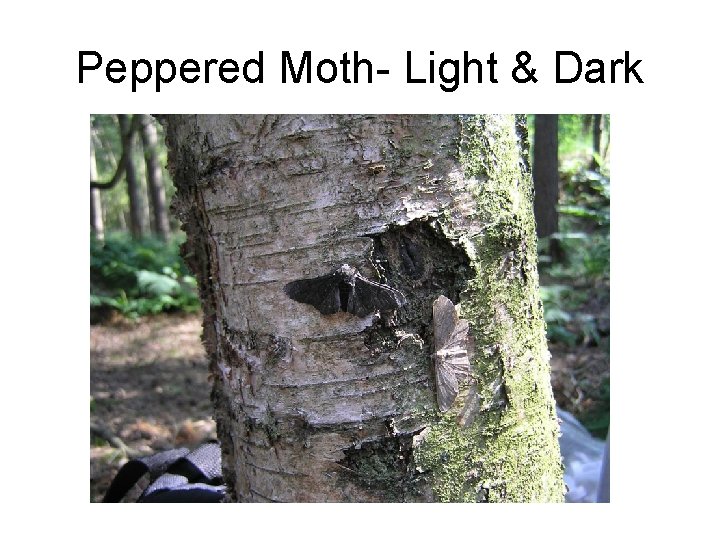
Peppered Moth- Light & Dark
Peppered Moths in England • Majority of moths were white on light trees. • Factories spewed out massive amounts of air pollutants which darkened the tree trunks. • Moths with dark coloration (camouflage) survived to reproduce…passing on their genes for dark color to next generation. • Over time, population became mainly DARK moths; This change in the genes of the population over time = EVOLUTION!
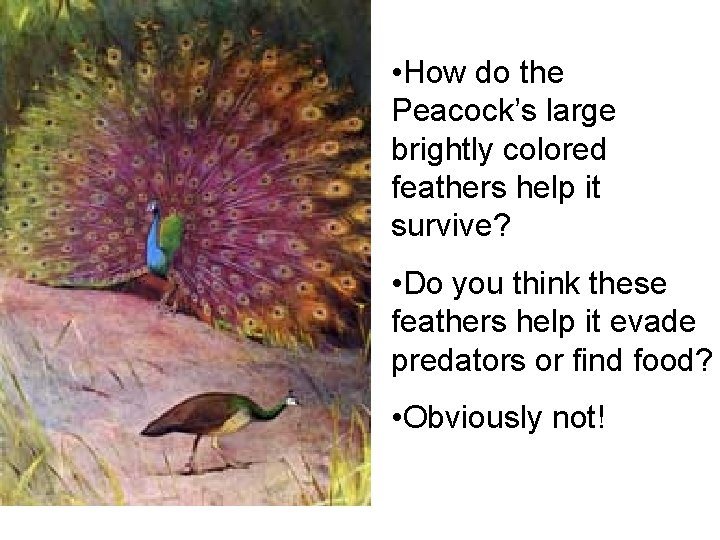
• How do the Peacock’s large brightly colored feathers help it survive? • Do you think these feathers help it evade predators or find food? • Obviously not!
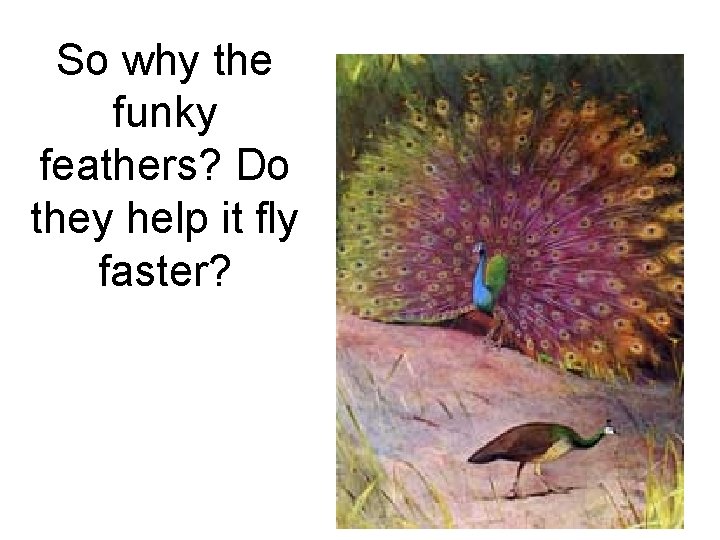
So why the funky feathers? Do they help it fly faster?
• The feathers help the peacock attract a mate and thus, pass on its genes. • Survival fittest…not necessarily the strongest/fastest…
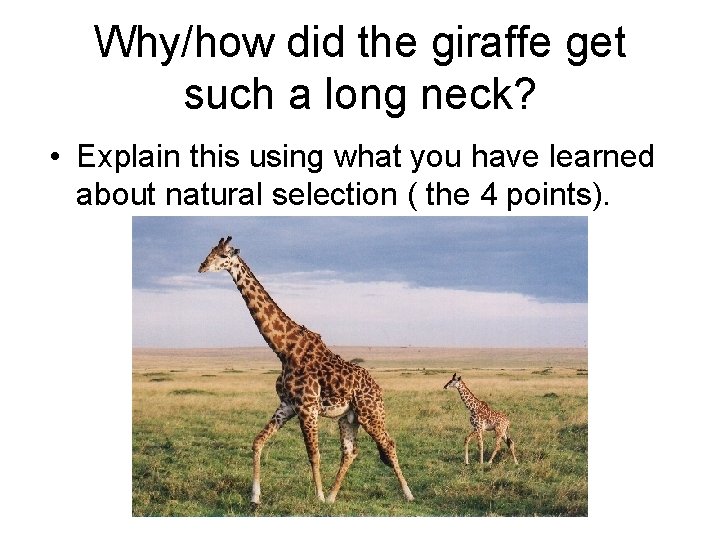
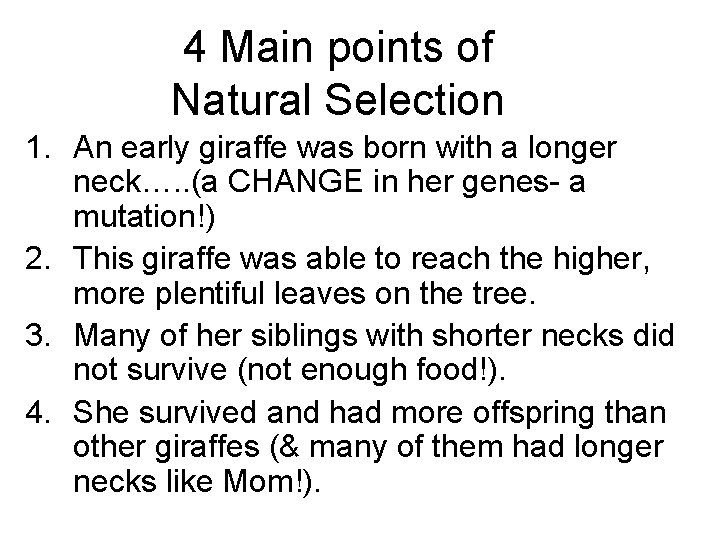
Why/how did the giraffe get such a long neck? • Explain this using what you have learned about natural selection ( the 4 points).
4 Main points of Natural Selection 1. An early giraffe was born with a longer neck…. . (a CHANGE in her genes- a mutation!) 2. This giraffe was able to reach the higher, more plentiful leaves on the tree. 3. Many of her siblings with shorter necks did not survive (not enough food!). 4. She survived and had more offspring than other giraffes (& many of them had longer necks like Mom!).
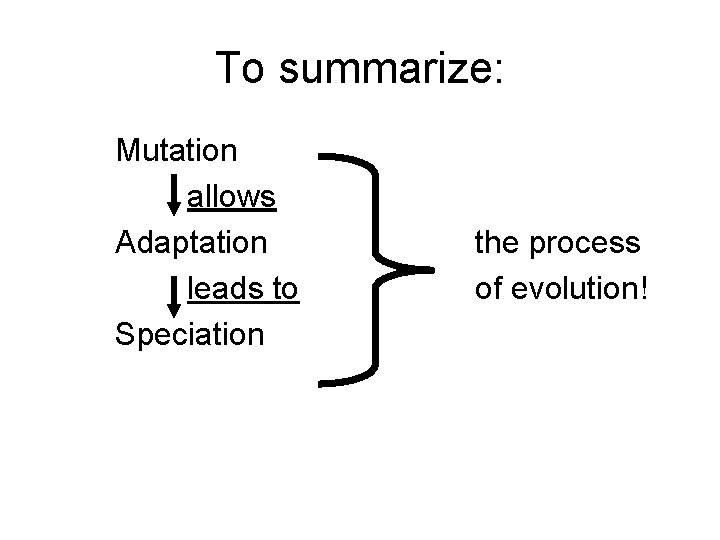
To summarize: Mutation allows Adaptation leads to Speciation the process of evolution!
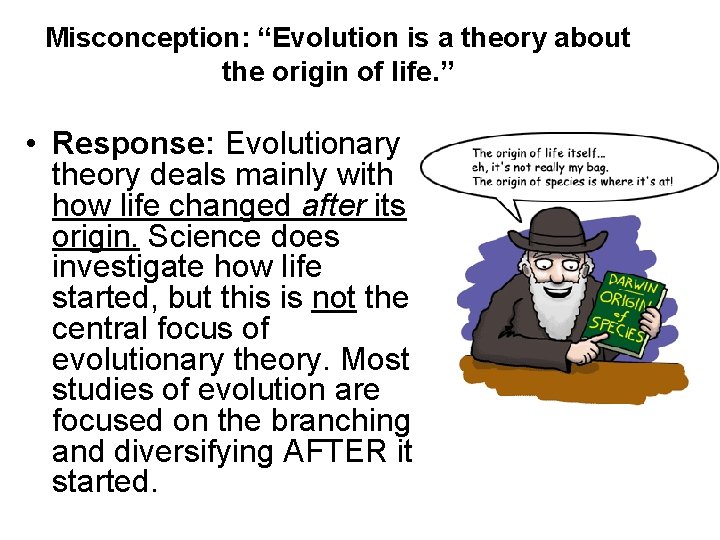
Misconception: “Evolution is a theory about the origin of life. ” • Response: Evolutionary theory deals mainly with how life changed after its origin. Science does investigate how life started, but this is not the central focus of evolutionary theory. Most studies of evolution are focused on the branching and diversifying AFTER it started.
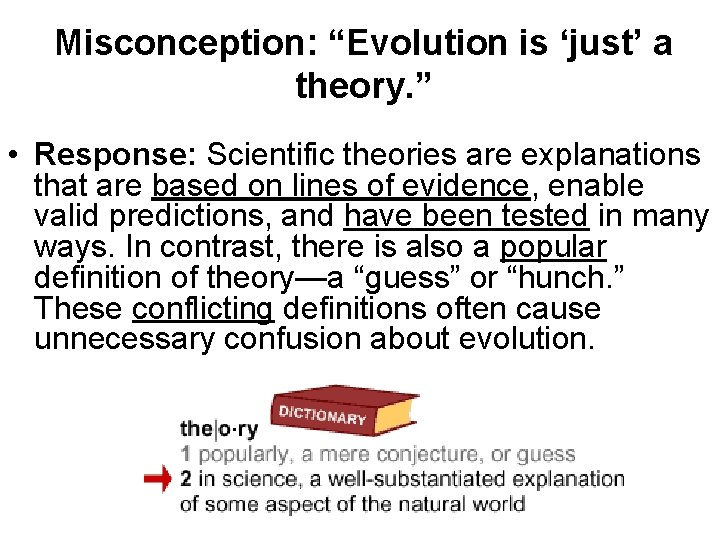
Misconception: “Evolution is ‘just’ a theory. ” • Response: Scientific theories are explanations that are based on lines of evidence, enable valid predictions, and have been tested in many ways. In contrast, there is also a popular definition of theory—a “guess” or “hunch. ” These conflicting definitions often cause unnecessary confusion about evolution.
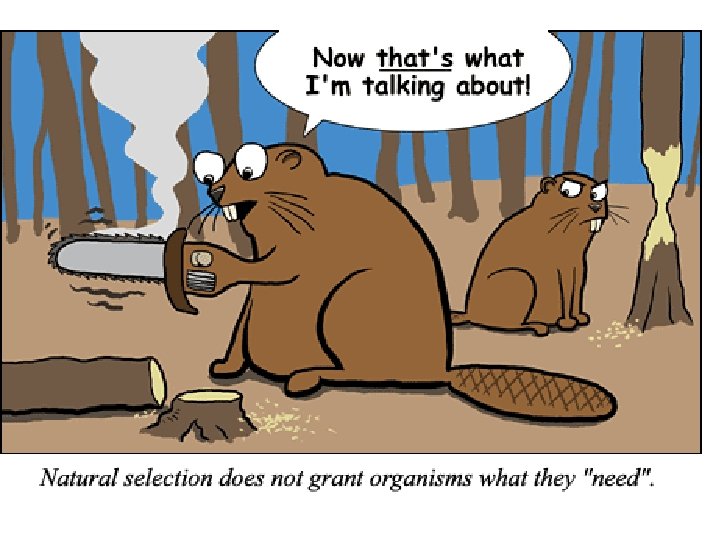
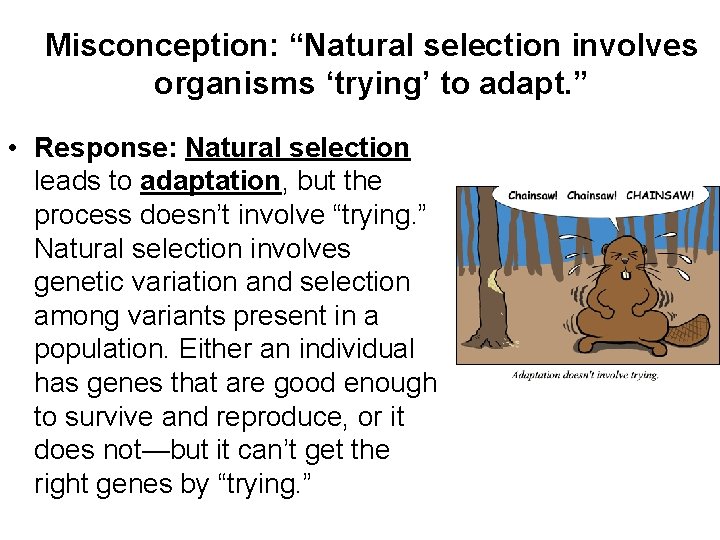
Misconception: “Natural selection involves organisms ‘trying’ to adapt. ” • Response: Natural selection leads to adaptation, but the process doesn’t involve “trying. ” Natural selection involves genetic variation and selection among variants present in a population. Either an individual has genes that are good enough to survive and reproduce, or it does not—but it can’t get the right genes by “trying. ”
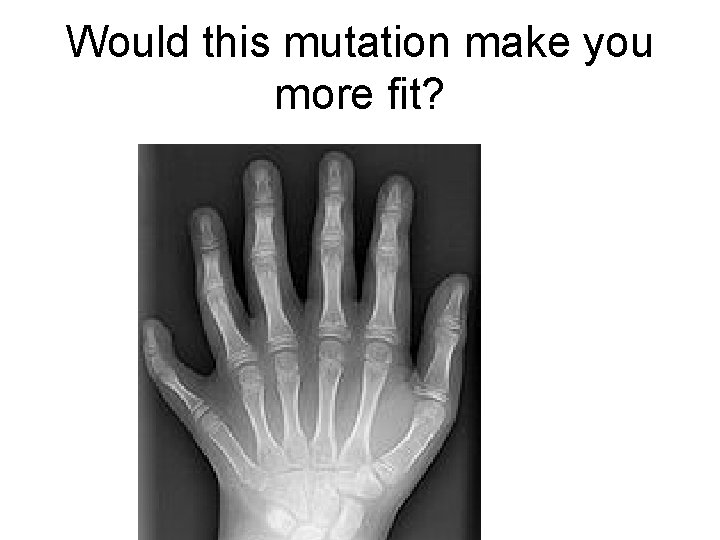
Would this mutation make you more fit?
• http: //www. techapps. net/interactives/pepp er. Moths. swf