
natural sciences and science education TSOI Hybrid Learning
natural sciences and science education TSOI Hybrid Learning Model: Collaborative Blended Learning Mun Fie TSOI, Ph. D National Institute of Education Singapore, Nanyang Technological University raymond. tsoi@nie. edu. sg teacher education ▪ research ▪ outreach
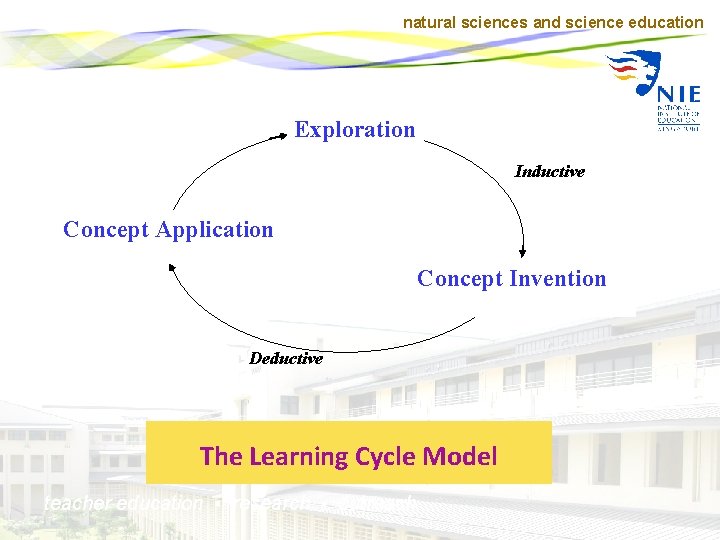
natural sciences and science education Exploration Inductive Concept Application Concept Invention Deductive The Learning Cycle Model teacher education ▪ research ▪ outreach
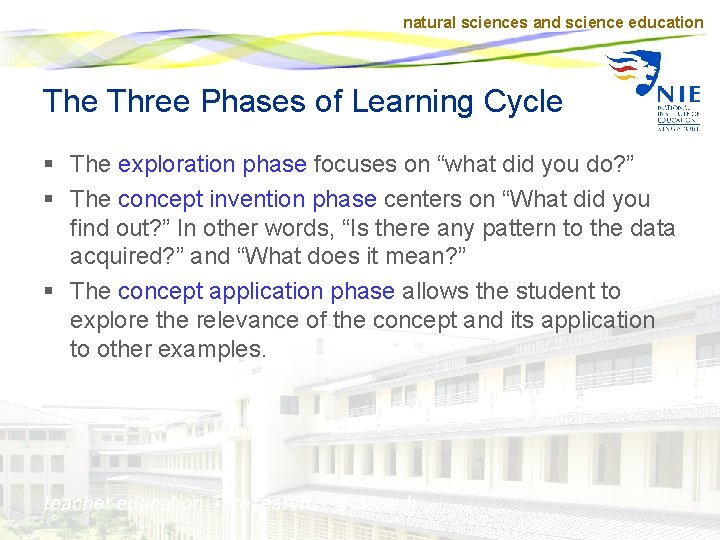
natural sciences and science education The Three Phases of Learning Cycle § The exploration phase focuses on “what did you do? ” § The concept invention phase centers on “What did you find out? ” In other words, “Is there any pattern to the data acquired? ” and “What does it mean? ” § The concept application phase allows the student to explore the relevance of the concept and its application to other examples. teacher education ▪ research ▪ outreach
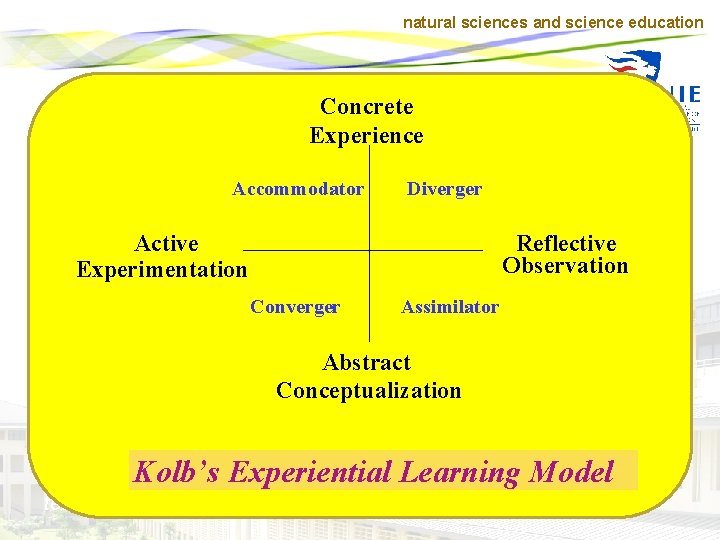
natural sciences and science education Concrete Experience Accommodator Diverger Active Experimentation Reflective Observation Converger Assimilator Abstract Conceptualization Kolb’s Experiential Learning Model teacher education ▪ research ▪ outreach
natural sciences and science education Converger § The left-half of the brain is predominantly used for problem solving, decision making, and the practical uses of ideas and theories. § works best when there is a single correct answer or solution to a question or problem. § prefers dealing with technical tasks and problems rather than interpersonal and social issues. teacher education ▪ research ▪ outreach
natural sciences and science education Diverger § the opposite of convergers. § viewing concrete situations from many points of view and organizing many relationships. § greatest strength lies in gathering information and brainstorming ideas to solve problems. § tend to be people-oriented, imaginative and emotional. teacher education ▪ research ▪ outreach
natural sciences and science education Assimilator § learn through inductive reasoning and the ability to create theoretical models from the assimilation of information. § consider logical soundness and preciseness of theory more important than the practical value. § are more concerned with ideas and abstract concepts and are less people-oriented. teacher education ▪ research ▪ outreach
natural sciences and science education Accommodator § greatest strength lies in “hands-on” experience i. e. doing things, in carrying out plans or tasks, and in getting directly involved in new and challenging situations. § are opposite from that of assimilative learning style in that action, opportunity seeking and risk taking are usually determined by “gut” feelings or intuition rather than on logical analysis and people are relied upon for information. teacher education ▪ research ▪ outreach
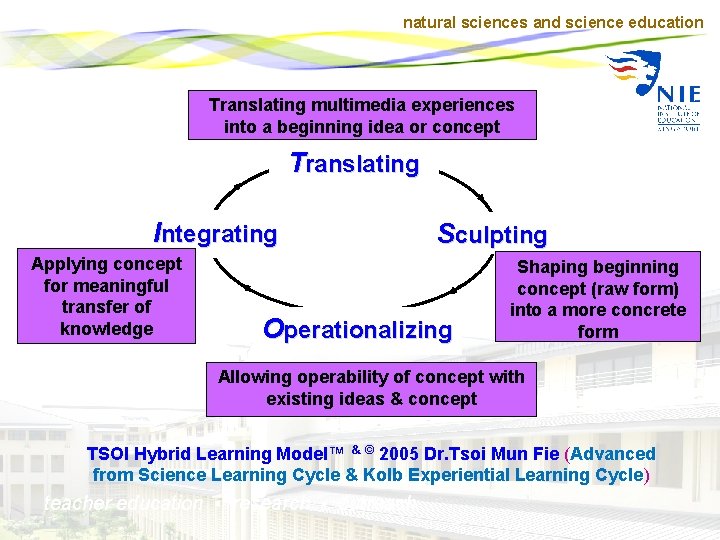
natural sciences and science education Translating multimedia experiences into a beginning idea or concept Translating Integrating Applying concept for meaningful transfer of knowledge Sculpting Operationalizing Shaping beginning concept (raw form) into a more concrete form Allowing operability of concept with existing ideas & concept TSOI Hybrid Learning Model™ & © 2005 Dr. Tsoi Mun Fie (Advanced from Science Learning Cycle & Kolb Experiential Learning Cycle) teacher education ▪ research ▪ outreach
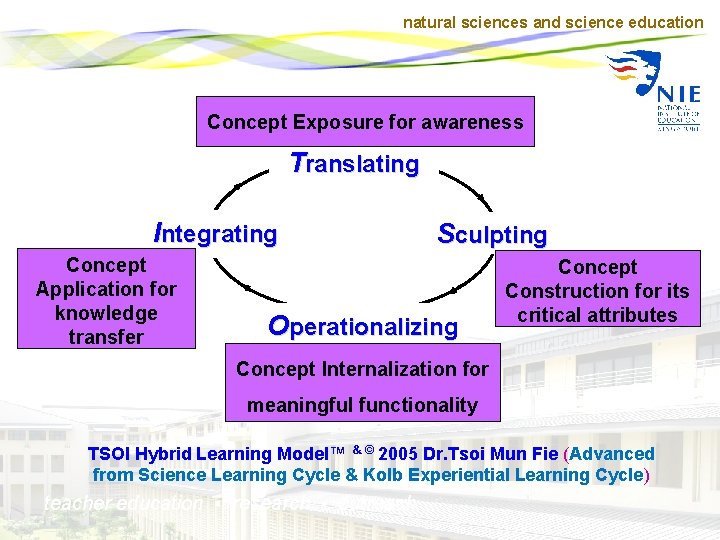
natural sciences and science education Concept Exposure for awareness Translating Integrating Concept Application for knowledge transfer Sculpting Operationalizing Concept Construction for its critical attributes Concept Internalization for meaningful functionality TSOI Hybrid Learning Model™ & © 2005 Dr. Tsoi Mun Fie (Advanced from Science Learning Cycle & Kolb Experiential Learning Cycle) teacher education ▪ research ▪ outreach
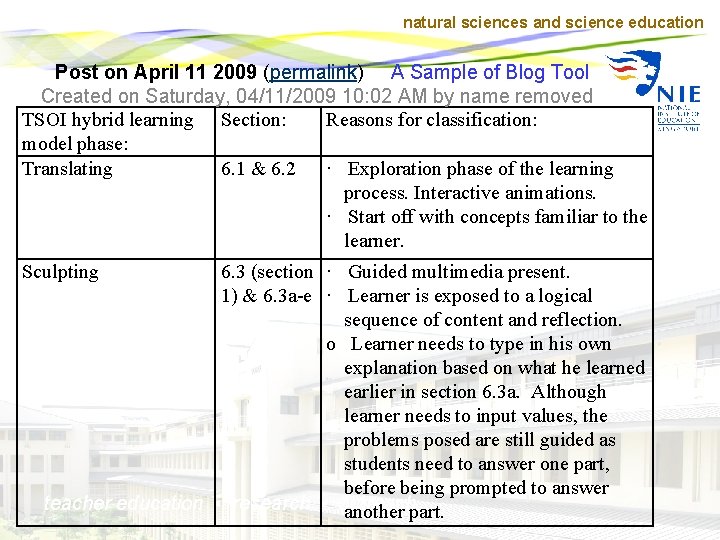
natural sciences and science education Post on April 11 2009 (permalink) A Sample of Blog Tool Created on Saturday, 04/11/2009 10: 02 AM by name removed TSOI hybrid learning Section: Reasons for classification: model phase: Translating 6. 1 & 6. 2 · Exploration phase of the learning process. Interactive animations. · Start off with concepts familiar to the learner. Sculpting 6. 3 (section · Guided multimedia present. 1) & 6. 3 a-e · Learner is exposed to a logical sequence of content and reflection. o Learner needs to type in his own explanation based on what he learned earlier in section 6. 3 a. Although learner needs to input values, the problems posed are still guided as students need to answer one part, before being prompted to answer teacher education ▪ research ▪ outreach another part.
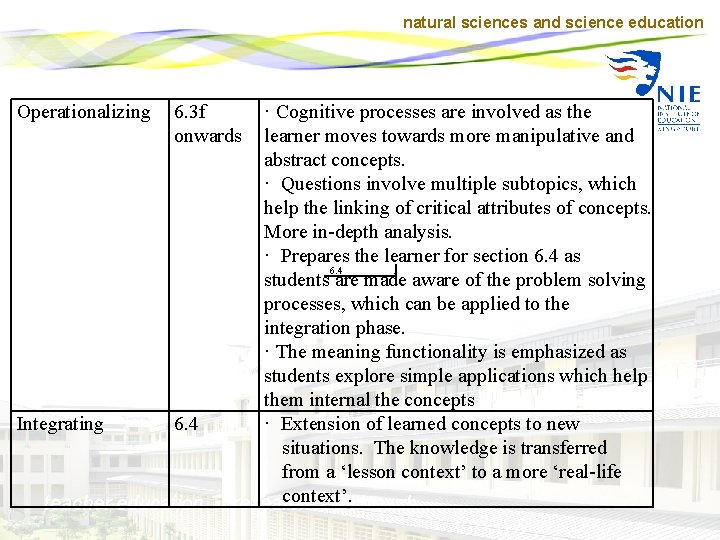
natural sciences and science education Operationalizing 6. 3 f onwards · Cognitive processes are involved as the learner moves towards more manipulative and abstract concepts. · Questions involve multiple subtopics, which help the linking of critical attributes of concepts. More in-depth analysis. · Prepares the learner for section 6. 4 as 6. 4 students are made aware of the problem solving processes, which can be applied to the integration phase. · The meaning functionality is emphasized as students explore simple applications which help them internal the concepts Integrating 6. 4 · Extension of learned concepts to new situations. The knowledge is transferred from a ‘lesson context’ to a more ‘real-life context’. teacher education ▪ research ▪ outreach
natural sciences and science education A Sample of Wiki Tool Name removed's Reflection and Application (CS 2) (permalink) last edited by name removed on Tuesday, 04/16/2009 1: 02 AM Reflect & provide up to 6 points on its implications on teaching and learning of chemistry: It provides an organised way of teaching chemistry, which will help students to learn in a systematic manner as well. Prior knowledge of students is taken into consideration so as to help link the new knowledge with the old one. This also allows the teacher to correct any mis-conceptions the students may have. Teachers can make use of familiar problems that can help students begin their learning during the Translating phase so as to ease their learning. Animations can be brought in to engage the students. The teacher can introduce real-world problems for students to solve, so that they can link the knowledge they obtained to real-world scenarios. This can help them see the relevance of what they are learning. teacher education ▪ research ▪ outreach
natural sciences and science education Activities planned for students are less teacher-centred, providing learning environments which encourages “teach less, learn more” during chemistry lessons. - Think & describe briefly of how you as a teacher can apply this hybrid learning model as a practice framework to guide you in your teaching of chemistry concepts. This hybrid model can help me to organise my lesson plan in a systematic manner: I will start from simple concept teaching, during which I will ask questions to help students reflect and recall their prior knowledge. Next, I will bring in animations of the concept, which can introduce the students to the concept at a slightly difficult level. This animation will also help engage the students and interest them to learn more about the ▪concept. teacher education ▪ research outreach
natural sciences and science education Cont. of a sample of Wiki Tool Intermediate learning can then be executed whereby students learn more about the concept and apply to simple problems. Next, I will move onto posing higher-order thinking questions whereby students can apply the knowledge learnt to questions which may be more relevant and real to them. Lastly, I will allow students to reflect upon what they have learnt to ensure that they have thought through and assimilated the new knowledge with the old one. Assessment can be done by them coming up with a concept map to link all their ideas, old and new, together, as well as link to other concepts, if possible. Comments - teacher education ▪ research ▪ outreach
natural sciences and science education APPLICATIONS • Designing for Multimedia Learning in Science & Chemistry Education • Designing for Enhancing Public Scientific Literacy e. g global warming & Experiential Learning • Designing for Multimedia Learning in Chinese Language under MOE LEAD ICT@Schools Scheme • Designing for Blended Learning • Designing for Lesson Planning teacher education ▪ research ▪ outreach
natural sciences and science education teacher education ▪ research ▪ outreach
- Slides: 17