
NATURAL SCIENCE 1 BDD WHAT ARE NATURAL SCIENCES
NATURAL SCIENCE 1 BDD
WHAT ARE NATURAL SCIENCES? empirical sciences (based on experiences) try to explain or predict nature's phenomena Astronomy Biology Chemistry Earth sciences Physics collaborates experimental/observational and 2
OTHER EMPIRICAL SCIENCES cognitive sciences like artificial intelligence behavioral sciences like psychology social sciences like economics - directly focus on human and, in similitude, robotic functions and experiences 3
SCIENCES RELY ON the empirical and natural sciences - formal sciences such as mathematics and logic—which concern abstract truths via relations among ideas history and humanities - empirical and natural sciences empirical sciences relying more on qualitative research such "soft science“ natural sciences emphasize on quantifiable data produced, tested, and confirmed through the scientific method are called "hard science" 4
NATURAL SCIENCE SUCCEEDS natural philosophy Galileo gave an experimental turn Descartes gave a mathematical turn Newton gave a mechanical turn 5
CRITERIA Karl Popper's controversial falsifiability criterion - to help them differentiate scientific endeavors from a non-scientific ones validity accuracy social mechanisms ensuring quality control, such as peer review and repeatability of findings 6
BIOLOGY encompasses a set of disciplines that examines phenomena related to living organisms biophysics up to complex ecologies concerned with the characteristics, classification and beha viors of organisms, how species were formed and their interactions with each other and the environment botany, zoology, and medicine 7
DEVELOPMENTS IN BIOLOGY discovery of genetics Darwin’s theory of evolution through natural selection germ theory of disease and the application of the techniques of chemistry and physics at the level of the cell or organic molecule 8

MAJOR DISCIPLINES Molecular Biology is the study of the fundamental chemistry of life Cellular Biology is the examination of the cell; the basic building block of all life Physiology looks at the internal structure of organism Ecology looks at how various organisms interrelate 9
CHEMISTRY scientific study of matter at the atomic and molecular scale deals primarily with collections of atoms, composition, statistical properties, transformations and reactions of these materials involves understanding the properties and interactions of individual atoms and molecules for use in larger-scale 10 applications
CHEMISTRY central science roots in the system of Alchemy, a set of beliefs combining mysticism with physical experiments began to develop with the work of Robert Boyle, discoverer of gas, and Antoine Lavoisier, (theory of the conservation of mass) discovery of the chemical elements and atomic theory began to systematize chemistry and developed a basic understanding of states of matter, ions, chemical bonds and chemical 11
PHYSICS study of the fundamental constituents of the universe, the forces and interactions they exert on one another fundamental science - all other natural sciences use and obey the principles and laws set down relies heavily on mathematics as the logical framework formulation and 12 quantification of principles
PHYSICS key historical developments Isaac Newton's theory of universal gravitation and classical mechanics, an understanding of electricity and its relation to magnetism Einstein's theories of special and general relativity development of thermodynamics quantum mechanical model of atomic and 13 subatomic physics
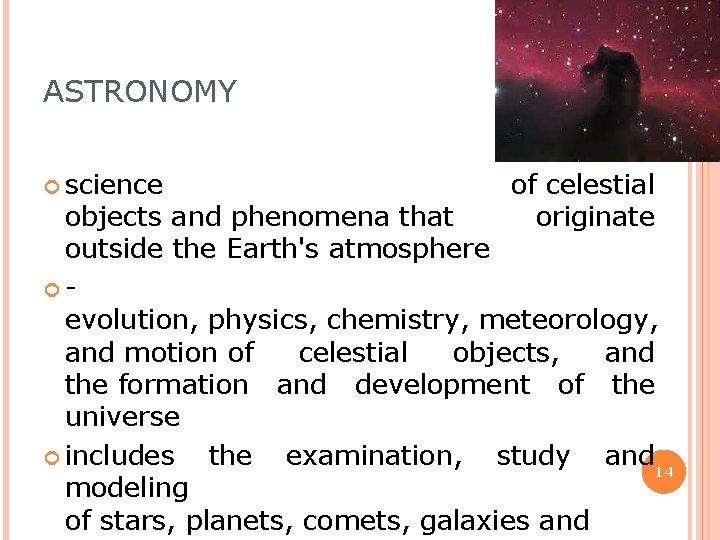
ASTRONOMY science of celestial originate objects and phenomena that outside the Earth's atmosphere evolution, physics, chemistry, meteorology, and motion of celestial objects, and the formation and development of the universe includes the examination, study and 14 modeling of stars, planets, comets, galaxies and
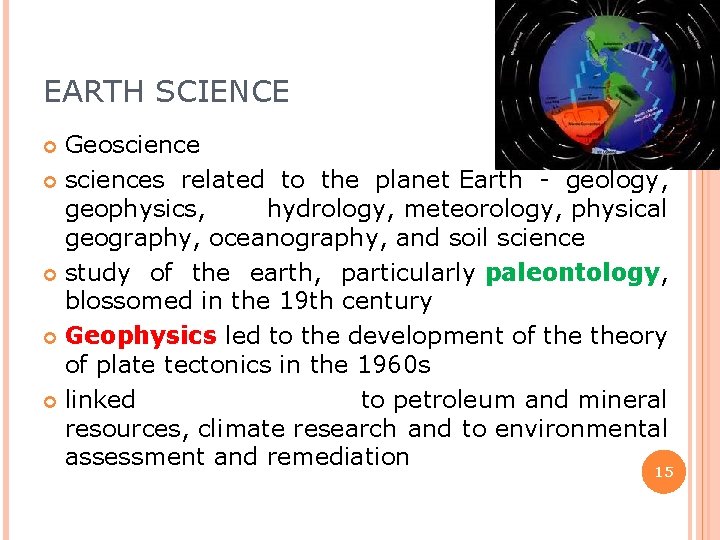
EARTH SCIENCE Geoscience sciences related to the planet Earth - geology, geophysics, hydrology, meteorology, physical geography, oceanography, and soil science study of the earth, particularly paleontology, blossomed in the 19 th century Geophysics led to the development of theory of plate tectonics in the 1960 s linked to petroleum and mineral resources, climate research and to environmental assessment and remediation 15
- Slides: 15