
NATURAL RESOURCES STUDY OBJECTIVE 7 Natural resources consists
NATURAL RESOURCES STUDY OBJECTIVE 7 • Natural resources – consists of standing timber and underground deposits of oil, gas, and minerals • These long-lived productive assets have two distinguishing characteristics: 1 They are physically extracted in operations. 2 They are replaceable only by an act of nature.
DEPLETION • Allocation of the cost of natural resources to expense in a rational and systematic manner over the resource’s useful life. • Units-of-activity method is generally used to compute depletion. – depletion generally is a function of the units extracted during the year

FORMULA TO COMPUTE DEPLETION EXPENSE Total Cost minus Salvage Value Total Estimated Units Depletion Cost per Unit Number of Units Extracted and Sold Depletion Cost per Unit Annual Depletion Expense Helpful hint: This computation for depletion is similar to the computation for depreciation using the units-of-activity method of depreciation.

RECORDING DEPLETION The Lane Coal Company invests $5 million in a mine estimated to have 10 million tons of coal and no salvage value. In the first year, 800, 000 tons of coal are extracted and sold. Using the formulas, the calculations are as follows: $5, 000 ÷ 10, 000 = $. 50 depletion cost per ton $. 50 X 800, 000 = $400, 000 depletion expense The entry to record depletion expense for the first year of operations is as follows:
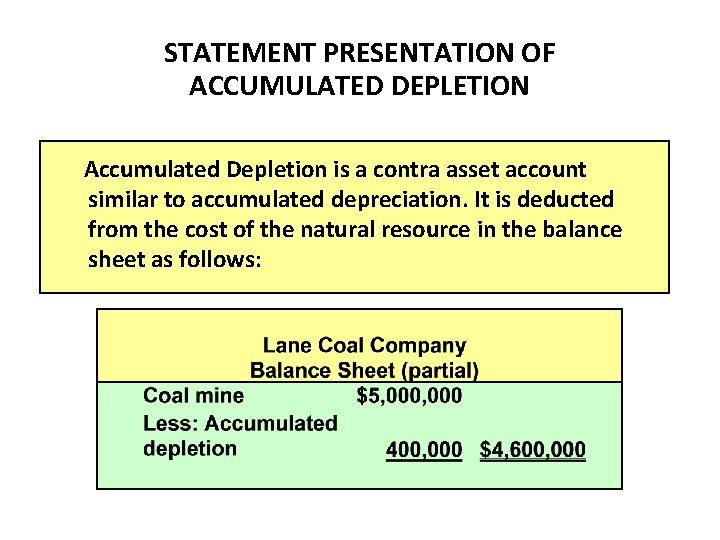
STATEMENT PRESENTATION OF ACCUMULATED DEPLETION Accumulated Depletion is a contra asset account similar to accumulated depreciation. It is deducted from the cost of the natural resource in the balance sheet as follows:

INTANGIBLE ASSETS Study Objective 8 • Intangible assets – Rights, privileges, and competitive advantages that result from the ownership of long lived assets that do not possess physical substance – May arise from government grants, acquisition of another business, and private monopolistic arrangements
- Slides: 6