
Natural Resources Environment of Appalachia Introducing Appalachian Studies
- Slides: 12
Natural Resources & Environment of Appalachia Introducing Appalachian Studies
Age/Formation ●The Appalachian Mountain range is roughly 480 million years old ●Once rivaled peaks of Alps and Rockies, but they are smaller now due to erosion
Appalachian Mountain Topography ●Four Principal Areas: ○ Blue Ridge ○ Great Smoky Mountains ○ Black Mountains (Mount Mitchell in the Black Mountains is the highest point in the Appalachians) ○ Cumberland Mountains and plateau - Big Stone Gap is located here
Rivers ●Most important single resource ●Functions of rivers: ○Source of drinking water ○Transportation ○Fish and game ○Tourist attractions ○Valleys formed by rivers good for agriculture ●Impact of industrialization on rivers ○Stripping of trees has caused buildup of silt on river bottoms -->leads to flooding ○Release of chemicals has made fish unfit for consumption in certain areas ●Few natural lakes (glaciers of last ice age didn't affect much of Appalachia); many human-made lakes (TVA) ●Interestingly enough, Virginia has only two natural lakes, one of which is in the Appalachian Mountains (Mountain Lake of Giles County)
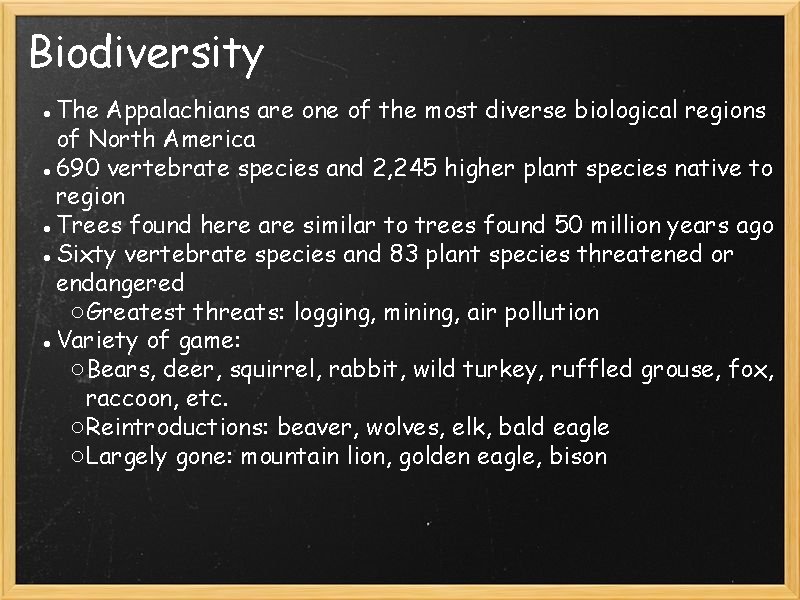
Biodiversity ●The Appalachians are one of the most diverse biological regions of North America ● 690 vertebrate species and 2, 245 higher plant species native to region ●Trees found here are similar to trees found 50 million years ago ●Sixty vertebrate species and 83 plant species threatened or endangered ○Greatest threats: logging, mining, air pollution ●Variety of game: ○Bears, deer, squirrel, rabbit, wild turkey, ruffled grouse, fox, raccoon, etc. ○Reintroductions: beaver, wolves, elk, bald eagle ○Largely gone: mountain lion, golden eagle, bison
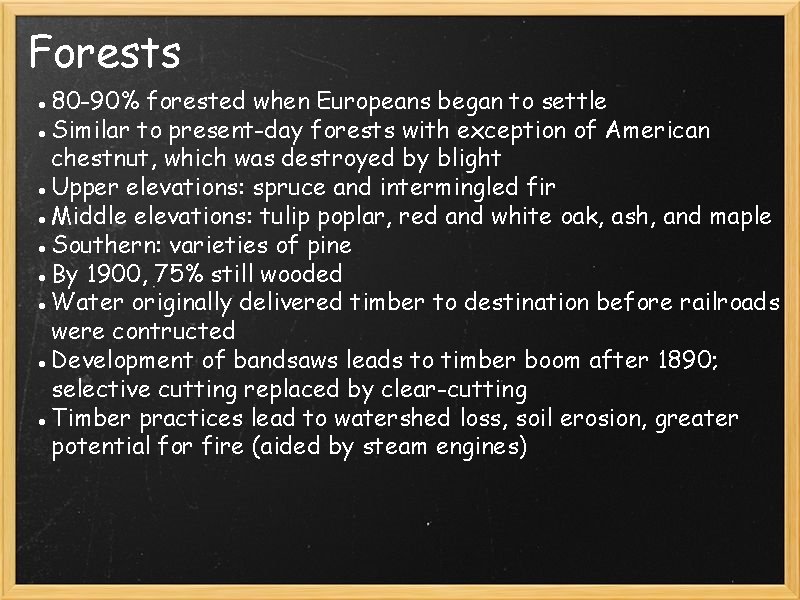
Forests ● 80 -90% forested when Europeans began to settle ●Similar to present-day forests with exception of American chestnut, which was destroyed by blight ●Upper elevations: spruce and intermingled fir ●Middle elevations: tulip poplar, red and white oak, ash, and maple ●Southern: varieties of pine ●By 1900, 75% still wooded ●Water originally delivered timber to destination before railroads were contructed ●Development of bandsaws leads to timber boom after 1890; selective cutting replaced by clear-cutting ●Timber practices lead to watershed loss, soil erosion, greater potential for fire (aided by steam engines)
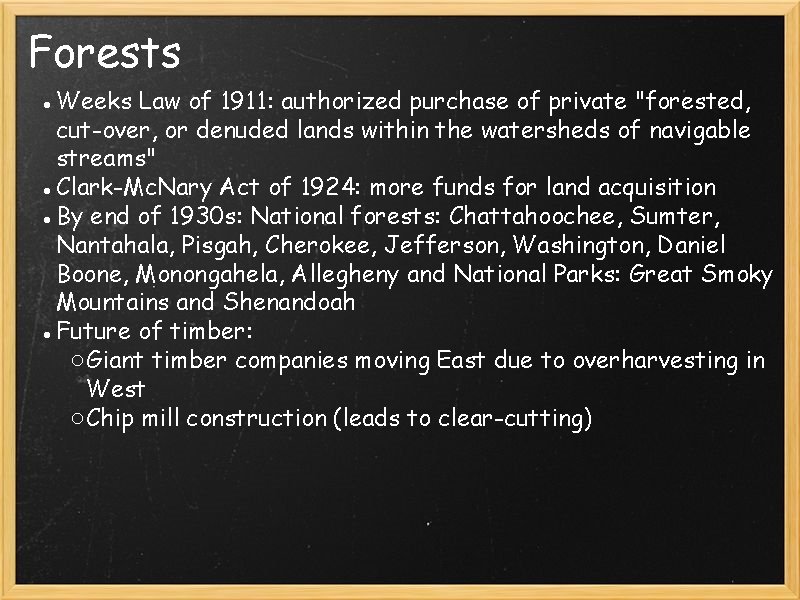
Forests ●Weeks Law of 1911: authorized purchase of private "forested, cut-over, or denuded lands within the watersheds of navigable streams" ●Clark-Mc. Nary Act of 1924: more funds for land acquisition ●By end of 1930 s: National forests: Chattahoochee, Sumter, Nantahala, Pisgah, Cherokee, Jefferson, Washington, Daniel Boone, Monongahela, Allegheny and National Parks: Great Smoky Mountains and Shenandoah ●Future of timber: ○Giant timber companies moving East due to overharvesting in West ○Chip mill construction (leads to clear-cutting)
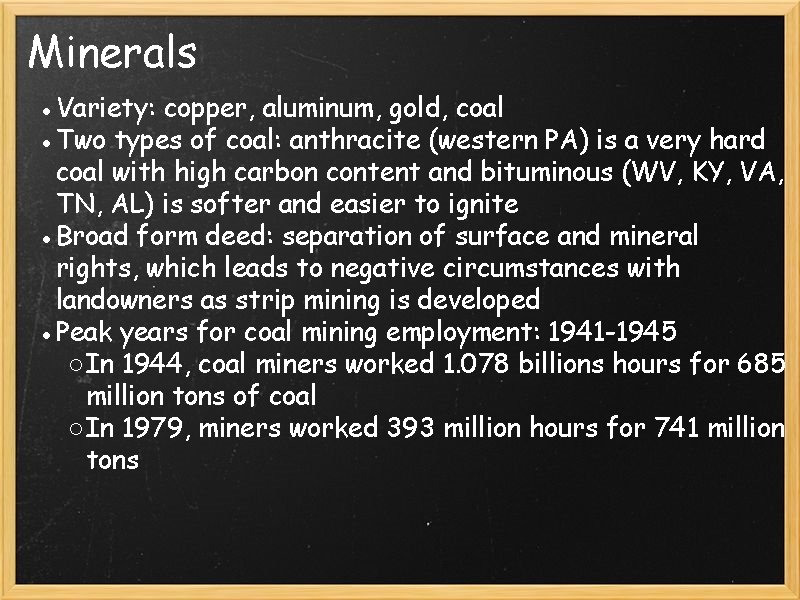
Minerals ●Variety: copper, aluminum, gold, coal ●Two types of coal: anthracite (western PA) is a very hard coal with high carbon content and bituminous (WV, KY, VA, TN, AL) is softer and easier to ignite ●Broad form deed: separation of surface and mineral rights, which leads to negative circumstances with landowners as strip mining is developed ●Peak years for coal mining employment: 1941 -1945 ○ In 1944, coal miners worked 1. 078 billions hours for 685 million tons of coal ○ In 1979, miners worked 393 million hours for 741 million tons
Mechanization ●Coal mining's early years: pick, shovel, and blasting powder ●Technological developments ○Mechanical loader: coal pulled onto belt ○Continuous miner: cuts coal from seam ○Longwall: like giant circular saw ●New methods create more dust ○Black lung ○Explosions ●Acid mine drainage from low-grade iron ore oxidizing and producing sulfuric acid ●Mine water blow outs and flash-flooding ●Surface changes due to structural issues ● 1977: Surface Mine Control and Reclamation Act ○Five-year bond to transform land to "higher and better use" ○Non-native species and few of them often used to reclaim lands previously used
Mechanization ●Soil compaction ●Mountaintop removal ●Coal refuse ○ Dry, can ignite and burn for years ○ Wet, can form sludge: October of 2001, Massey Coal Company released 2. 5 million gallons of coal sludge into Big Sandy River
Agriculture ●Agriculture dominated region prior to timber and coal ●Tobacco, sorghum molasses, Christmas tree farms, gardens ●Appalachian Sustainable Development in Abingdon, VA
Development ●Some areas experiencing population loss, others experiencing rapid growth ●Vacation homes have become a hot-button issue in many areas ●How to control development? ●Prisons as economic development