
Natural Resources and the Environment I The Environment
- Slides: 16
Natural Resources and the Environment
I. The Environment • All of the resources and the condition of the earth. • Resources – Air, Water, Land, Sun • Renewable – can be replaced – Trees, water, air • Nonrenewable – Can’t be replaced • Air – Metals, Energy Sources (fossil fuels) – 21% Oxygen, 78% Nitrogen, 1% Other – Cellular Respiration (animals) – Photosynthesis (Plants)
Land Soil • 29% of Earth is land • Uses of land – – – Agricultural Urbanization Tree Harvesting (renewable? ) – – Minerals and organic matter Soil Fertility – ability to grow Different soils grow different crops Can soil be renewed? • Soil
Problems with land soil use • Erosion – Removal of topsoil by water or wind – Tough to renew – Few inches / 1000 yrs • Soil Depletion – – – Soil is renewed by dead plants Harvesting removes nutrients Need to rest fields (rotation) • Salinization – Evaporation of water – Leaves behind minerals (salt)
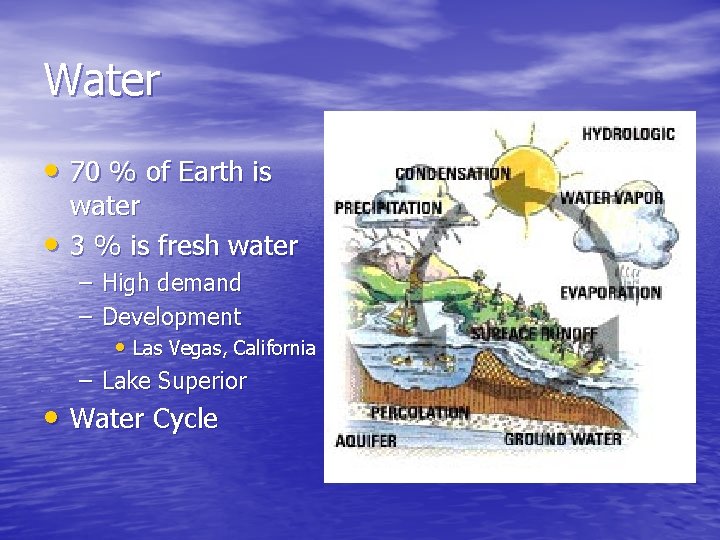
Water • 70 % of Earth is • water 3 % is fresh water – High demand – Development • Las Vegas, California – Lake Superior • Water Cycle
II. Pollution • Harming of the environment • Types – Air Pollution – Water Pollution – Land Pollution
Air Pollution • Air pollution is the accumulation in the atmosphere of substances that, in • sufficient concentrations, endanger human health or produce other measured effects on living matter and other materials. Six major types of pollutants – – – carbon monoxide hydrocarbons nitrogen oxides particulates sulfur dioxide photochemical oxidants – – – Noise Tobacco smoke Exhaust (smog) Coal Combustion (sulfur and nitrogen oxides) Acid Rain • Examples
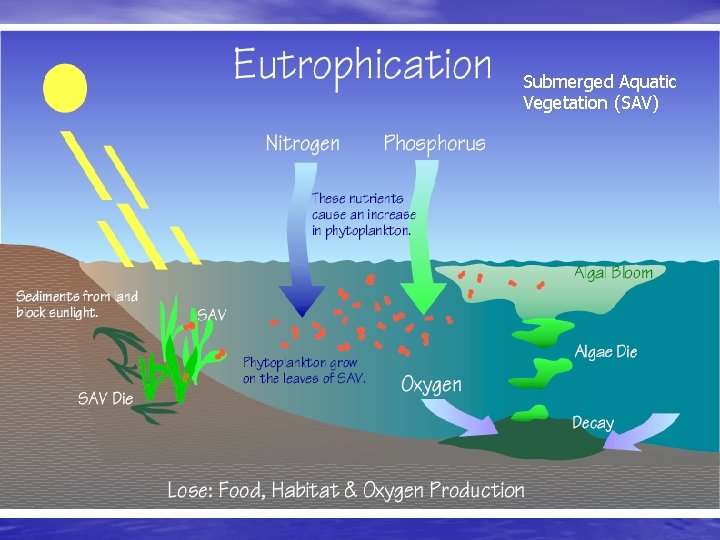
Water Pollution • Water pollution is the introduction into fresh or ocean waters of chemical, physical, or biological material that degrades the quality of the water and affects the organisms living in it. • Examples – – Industrial Discharge Mining and Agricultural Waste • Phosphates and Nitrates • Use up all oxygen (Eutrophication) – Sewage disposal and domestic waste
Submerged Aquatic Vegetation (SAV)
Land Pollution • Land pollution is the degradation of the Earth's • land surface through misuse of the soil by poor agricultural practices, mineral exploitation, industrial waste dumping, and indiscriminate disposal of urban wastes. Examples – Soil Pollution – Waste Disposal
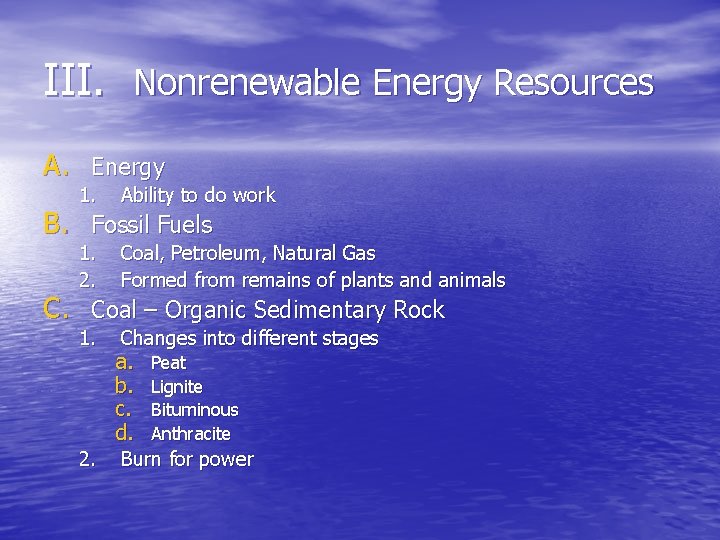
III. Nonrenewable Energy Resources A. Energy 1. Ability to do work 1. 2. Coal, Petroleum, Natural Gas Formed from remains of plants and animals 1. Changes into different stages B. Fossil Fuels C. Coal – Organic Sedimentary Rock 2. a. b. c. d. Peat Lignite Bituminous Anthracite Burn for power
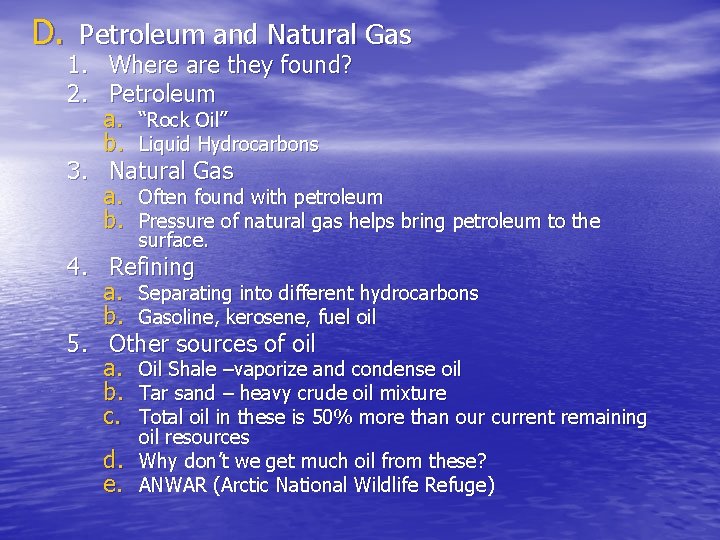
D. Petroleum and Natural Gas 1. Where are they found? 2. Petroleum a. “Rock Oil” b. Liquid Hydrocarbons 3. Natural Gas a. Often found with petroleum b. Pressure of natural gas helps bring petroleum to the surface. 4. Refining a. Separating into different hydrocarbons b. Gasoline, kerosene, fuel oil 5. Other sources of oil a. Oil Shale –vaporize and condense oil b. Tar sand – heavy crude oil mixture c. Total oil in these is 50% more than our current remaining d. e. oil resources Why don’t we get much oil from these? ANWAR (Arctic National Wildlife Refuge)
E. Gasohol (E 10) 1. 2. 3. 4. 5. 6. 90% gasoline, 10% ethanol Reduces amount of gasoline consumption Costs more Greater fuel economy Not great for cars. E 85 1. 85% ethanol, 15 % gasoline 2. “Flexfuel” from Corn 3. Reduced fuel economy, costs a little less
F. Uranium 1. 2. 3. 4. Energy source for nuclear reactors Electricity Atomic Fission of 1 gram U = Burning 3 tons of coal; or 14 barrels of oil 5. Nuclear Reactor How a Reactor works 6. Radioactive Waste a. Product of broken down atoms b. May cause cellular mutations (cancer) c. Chernobyl
G. Conserving Nonrenewables 1. 2. 3. Recycling of used materials Developing substitute materials. Eliminating Waste
IV. Renewable Energy Resources A. Water Power 1. Hydroelectric power 1. Windmill Farms 1. Passive solar heating (store heat) Active solar heating (moving heat) Solar Cells (Sunlight Electricity) B. Wind Power C. Solar Energy 2. 3. D. Geothermal Power 1. 2. 3. Steam and Hot water Geysers Convert to electricity E. Biomass 1. Burning wood 2. Garbage F. Alternative Fuels 1. Hydrogen Fuel Cells 2. Biofuels