
Natural Organic Matter in Water Formation in Watersheds
![Aquatic sources: Algae From: Plummer & Edzwald, 2001 [ES&T: 35: 3661] ~25% from EOM](https://slidetodoc.com/presentation_image_h2/6855a65cd9a8558be6d1a658f39a8f1a/image-13.jpg "Aquatic sources: Algae From: Plummer & Edzwald, 2001 [ES&T: 35: 3661] ~25% from EOM")
- Slides: 53
Natural Organic Matter in Water Formation in Watersheds and Removal in Water Treatment 1 David A. Reckhow University of Massachusetts Dave Reckhow
Exposure to Environmental Contaminants? You are what you drink
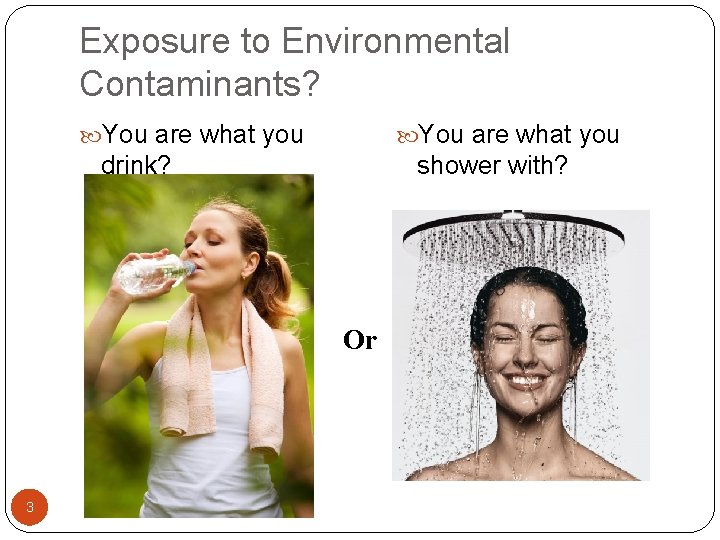
Exposure to Environmental Contaminants? You are what you drink? shower with? Or 3
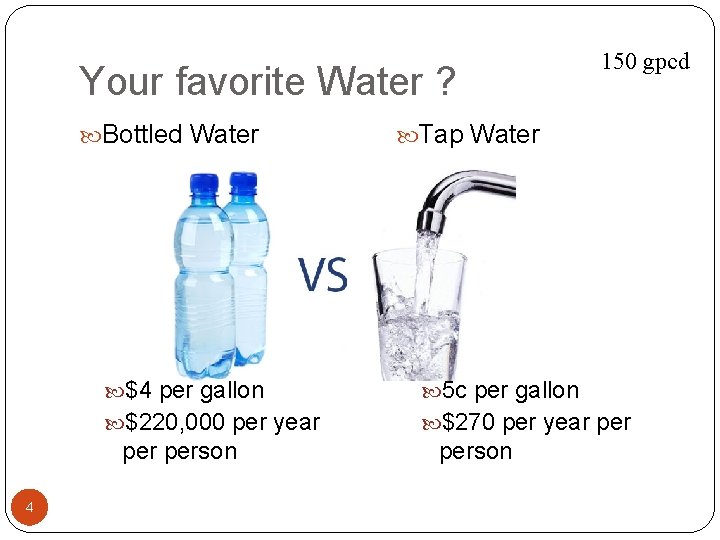
Your favorite Water ? Bottled Water Tap Water $4 per gallon 5 c per gallon $220, 000 per year $270 per year per person 4 150 gpcd person
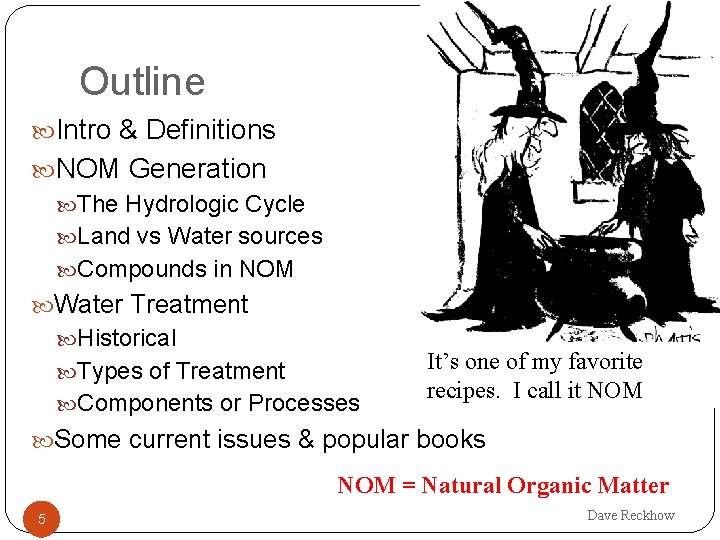
Outline Intro & Definitions NOM Generation The Hydrologic Cycle Land vs Water sources Compounds in NOM Water Treatment Historical Types of Treatment Components or Processes It’s one of my favorite recipes. I call it NOM Some current issues & popular books NOM = Natural Organic Matter 5 5 Dave Reckhow
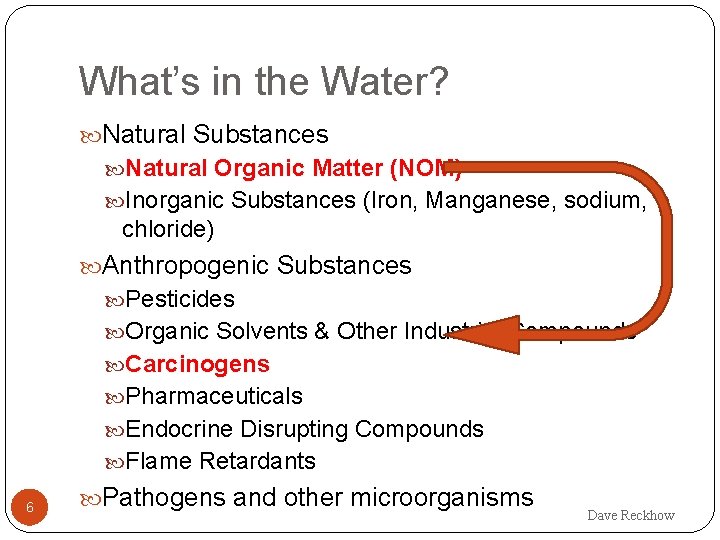
What’s in the Water? Natural Substances Natural Organic Matter (NOM) Inorganic Substances (Iron, Manganese, sodium, chloride) Anthropogenic Substances Pesticides Organic Solvents & Other Industrial Compounds Carcinogens Pharmaceuticals Endocrine Disrupting Compounds Flame Retardants 6 Pathogens and other microorganisms Dave Reckhow
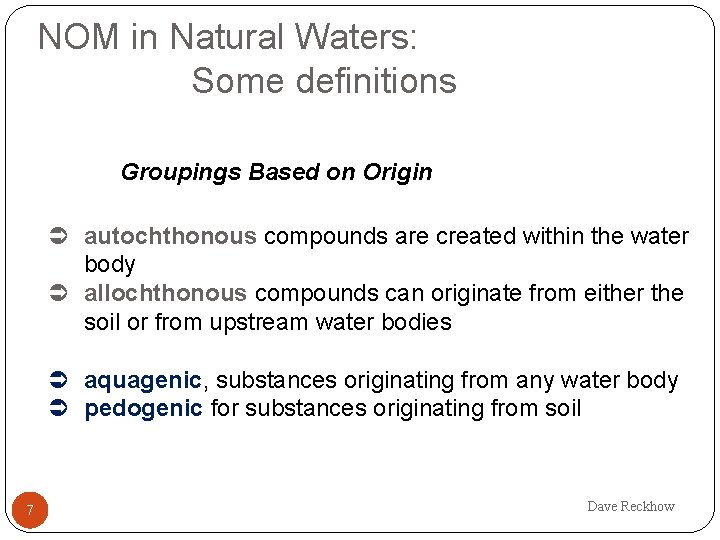
NOM in Natural Waters: Some definitions Groupings Based on Origin Ü autochthonous compounds are created within the water body Ü allochthonous compounds can originate from either the soil or from upstream water bodies Ü aquagenic, substances originating from any water body Ü pedogenic for substances originating from soil 7 7 Dave Reckhow
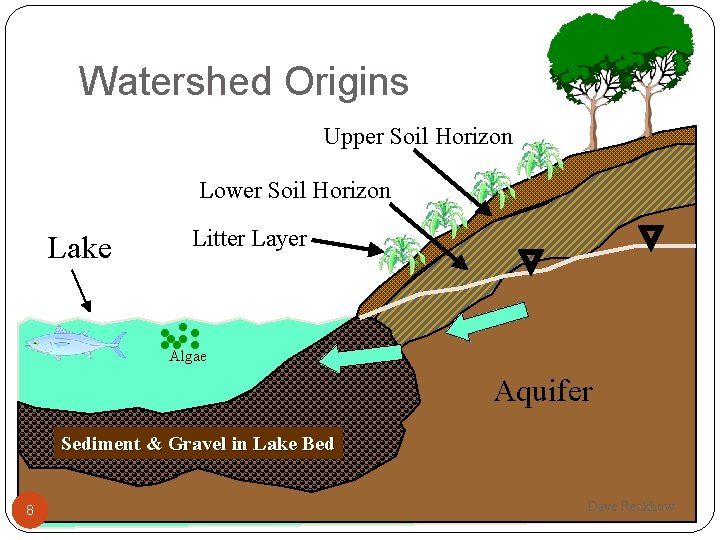
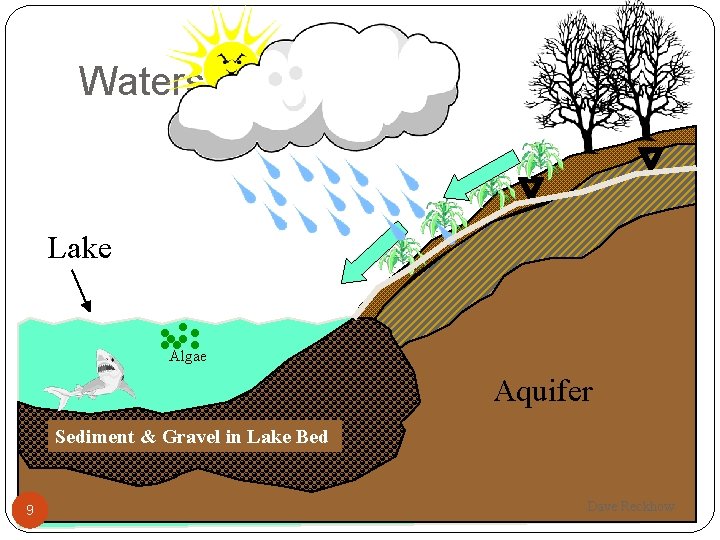
Watershed Origins Upper Soil Horizon Lower Soil Horizon Lake Litter Layer Algae Aquifer Sediment & Gravel in Lake Bed 8 8 Dave Reckhow
Watershed Origins Lake Algae Aquifer Sediment & Gravel in Lake Bed 9 9 Dave Reckhow
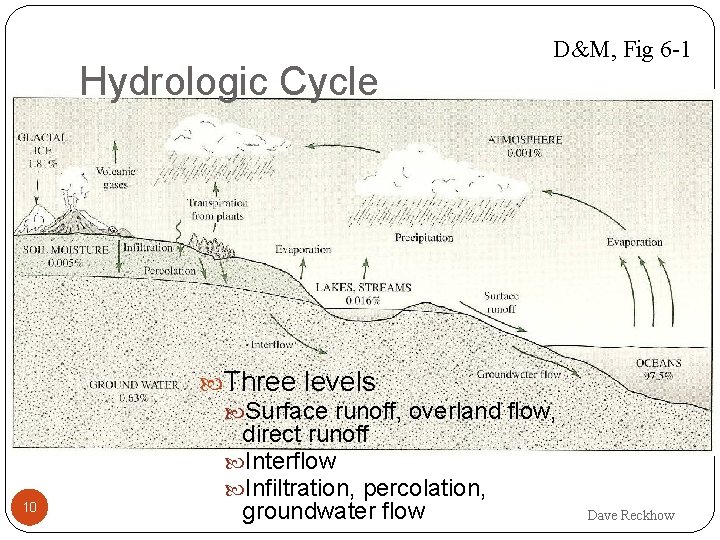
Hydrologic Cycle 10 D&M, Fig 6 -1 Three levels Surface runoff, overland flow, direct runoff Interflow Infiltration, percolation, groundwater flow Dave Reckhow
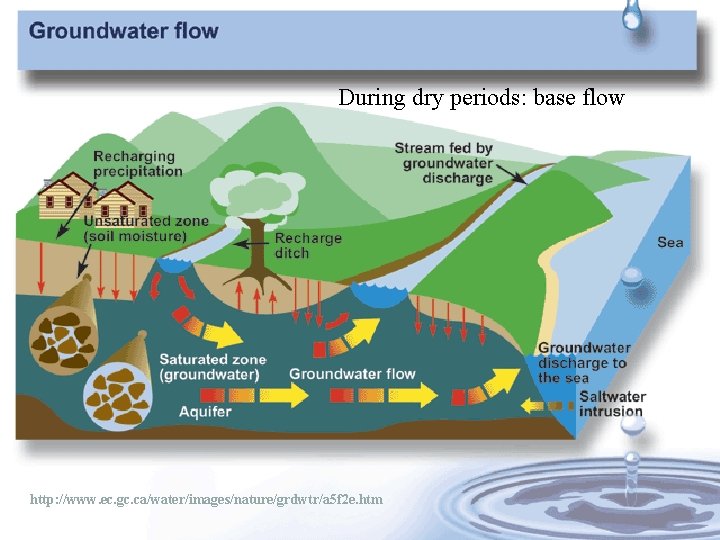
During dry periods: base flow http: //www. ec. gc. ca/water/images/nature/grdwtr/a 5 f 2 e. htm 11 Dave Reckhow
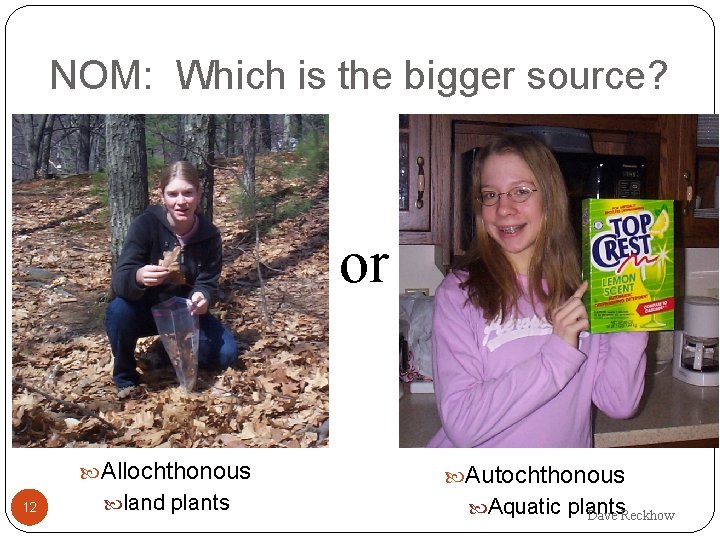
NOM: Which is the bigger source? or Allochthonous 12 land plants Autochthonous Aquatic plants Dave Reckhow
Aquatic sources: Algae From: Plummer & Edzwald, 2001 [ES&T: 35: 3661] ~25% from EOM Scenedesmus quadricauda Cyclotella sp. Algae 13 Dave Reckhow p. H 7, 20 -24ºC, chlorine excess
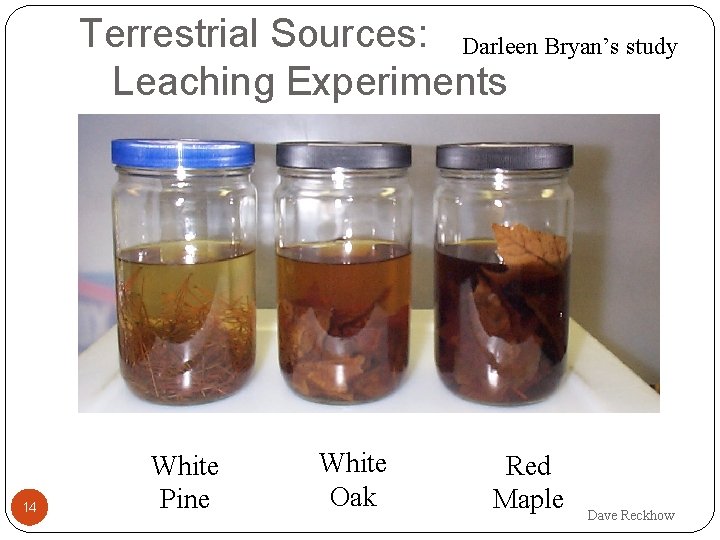
Terrestrial Sources: Darleen Bryan’s study Leaching Experiments 14 White Pine White Oak Red Maple Dave Reckhow
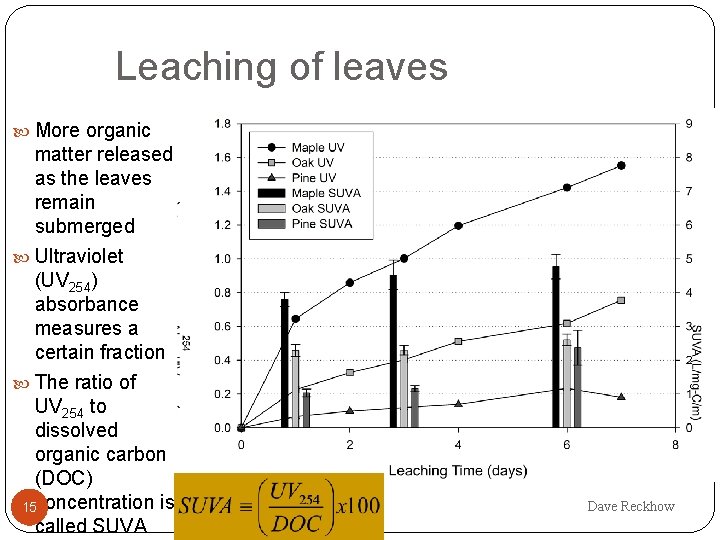
Leaching of leaves More organic matter released as the leaves remain submerged Ultraviolet (UV 254) absorbance measures a certain fraction The ratio of UV 254 to dissolved organic carbon (DOC) 15 concentration is called SUVA Dave Reckhow
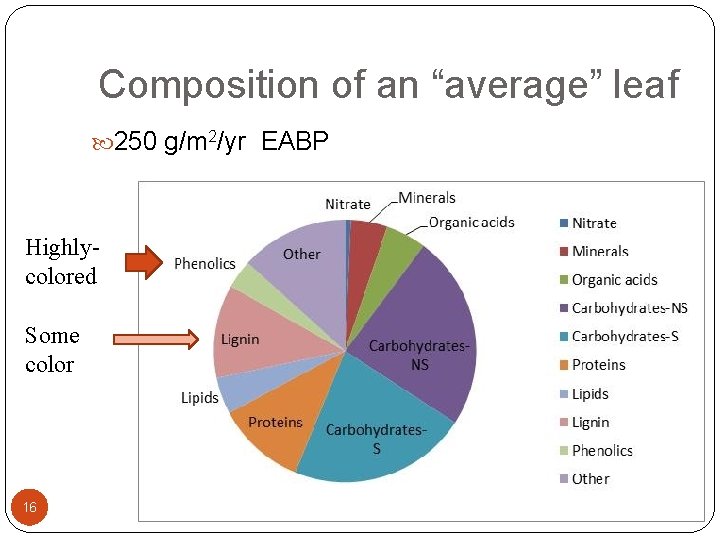
Composition of an “average” leaf 250 g/m 2/yr EABP Highlycolored Some color 16 Dave Reckhow
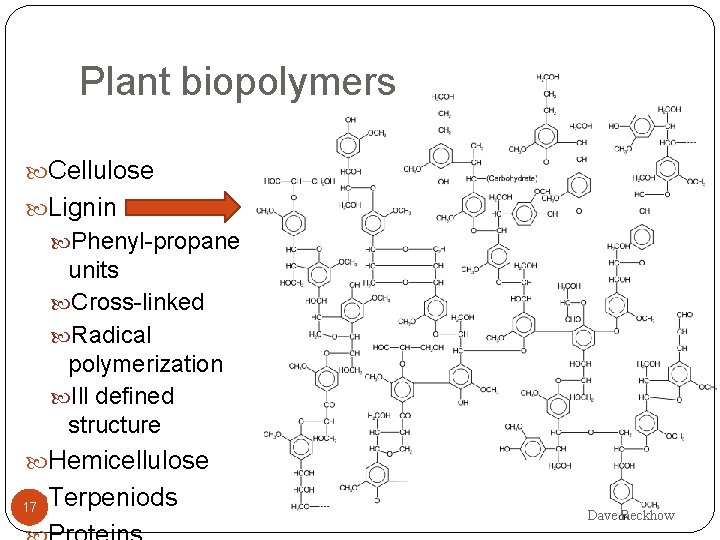
Plant biopolymers Cellulose Lignin Phenyl-propane units Cross-linked Radical polymerization Ill defined structure Hemicellulose Terpeniods 17 Dave Reckhow
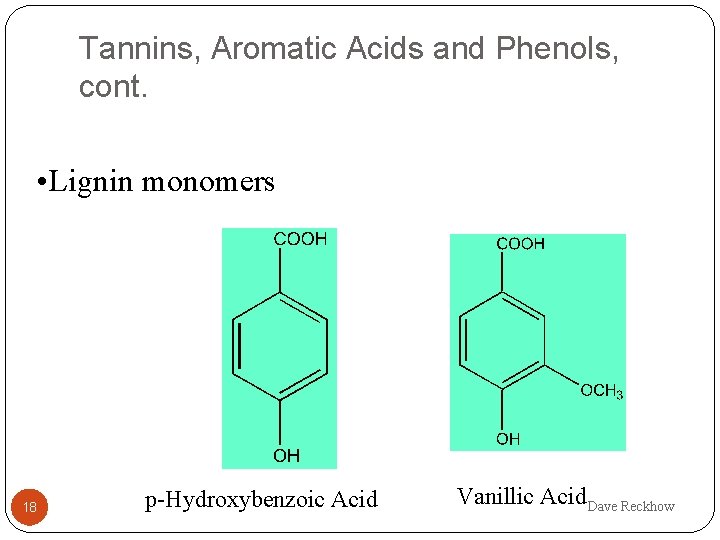
Tannins, Aromatic Acids and Phenols, cont. • Lignin monomers 18 p-Hydroxybenzoic Acid Vanillic Acid Dave Reckhow
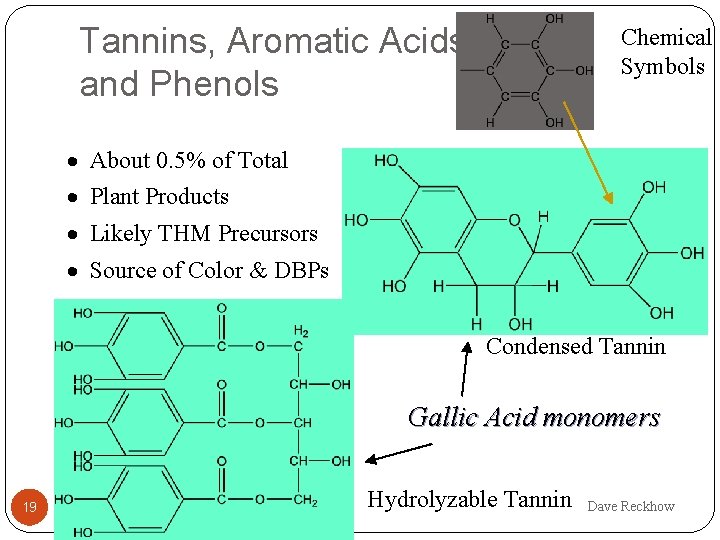
Tannins, Aromatic Acids and Phenols Chemical Symbols · About 0. 5% of Total · Plant Products · Likely THM Precursors · Source of Color & DBPs Condensed Tannin Gallic Acid monomers 19 Hydrolyzable Tannin Dave Reckhow
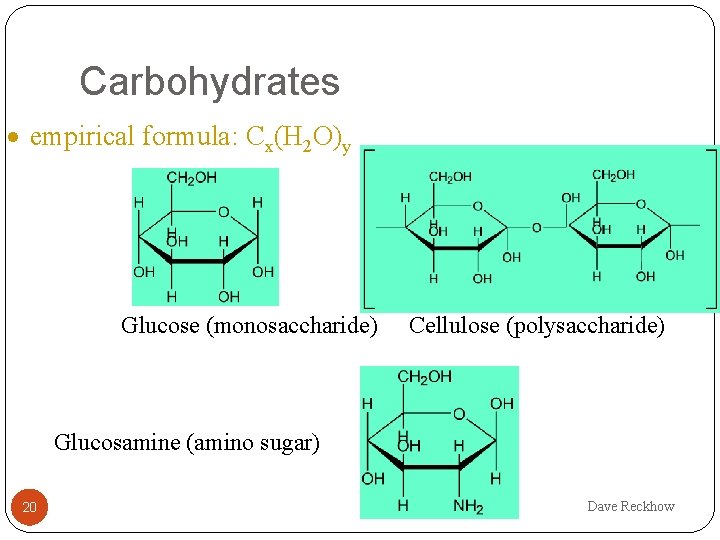
Carbohydrates · empirical formula: Cx(H 2 O)y Glucose (monosaccharide) Cellulose (polysaccharide) Glucosamine (amino sugar) 20 Dave Reckhow
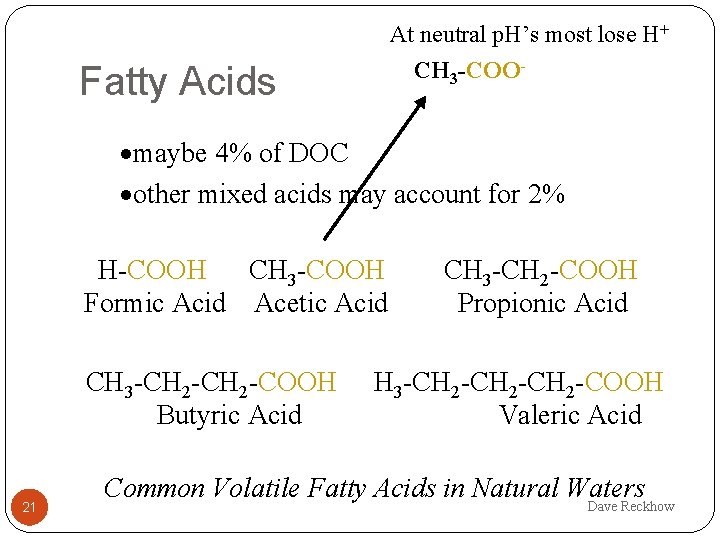
At neutral p. H’s most lose H+ CH 3 -COO- Fatty Acids ·maybe 4% of DOC ·other mixed acids may account for 2% H-COOH CH 3 -COOH Formic Acid Acetic Acid CH 3 -CH 2 -COOH Butyric Acid 21 CH 3 -CH 2 -COOH Propionic Acid H 3 -CH 2 -CH 2 -COOH Valeric Acid Common Volatile Fatty Acids in Natural Waters Dave Reckhow
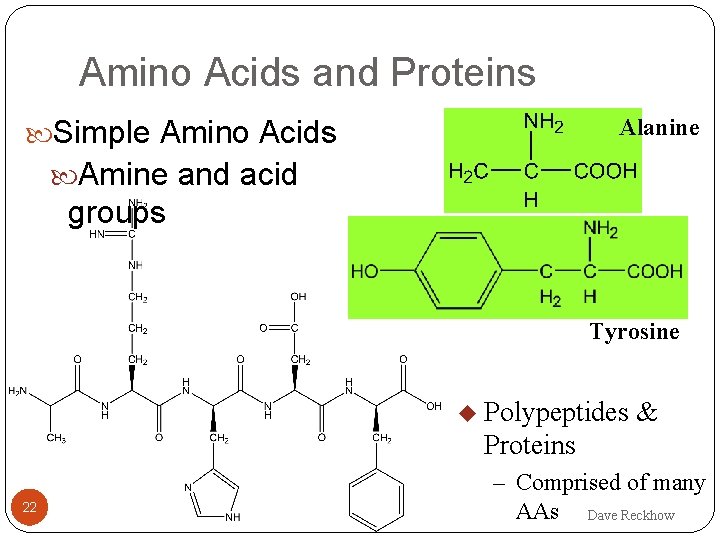
Amino Acids and Proteins Alanine Simple Amino Acids Amine and acid groups Tyrosine u Polypeptides & Proteins 22 – Comprised of many AAs Dave Reckhow
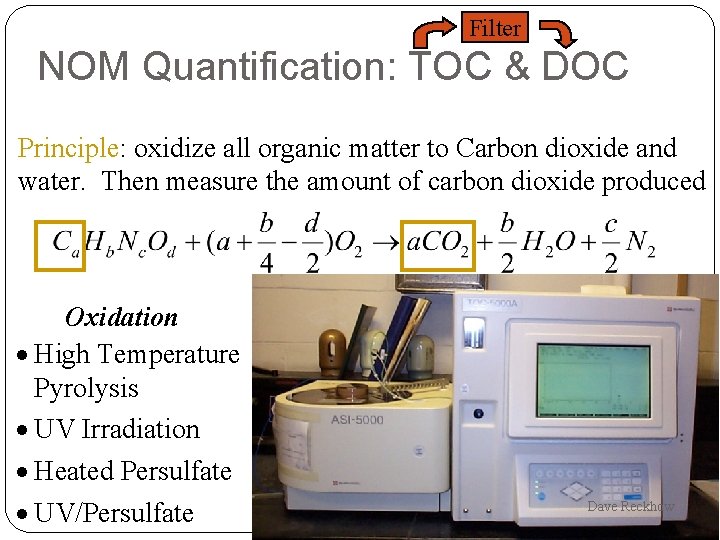
Filter NOM Quantification: TOC & DOC Principle: Principle oxidize all organic matter to Carbon dioxide and water. Then measure the amount of carbon dioxide produced Oxidation · High Temperature Pyrolysis · UV Irradiation · Heated Persulfate · 23 UV/Persulfate Dave Reckhow
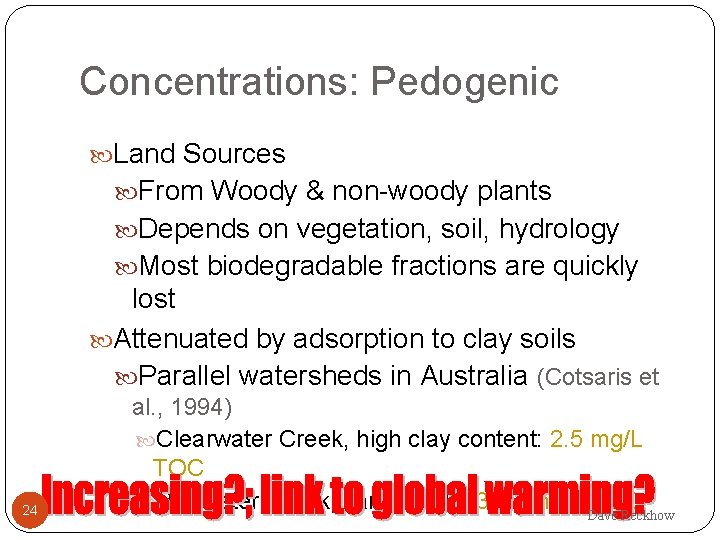
Concentrations: Pedogenic Land Sources From Woody & non-woody plants Depends on vegetation, soil, hydrology Most biodegradable fractions are quickly lost Attenuated by adsorption to clay soils Parallel watersheds in Australia (Cotsaris et 24 24 al. , 1994) Clearwater Creek, high clay content: 2. 5 mg/L TOC Redwater Creek, sandy soil: 31. 7 mg/L TOC Dave Reckhow
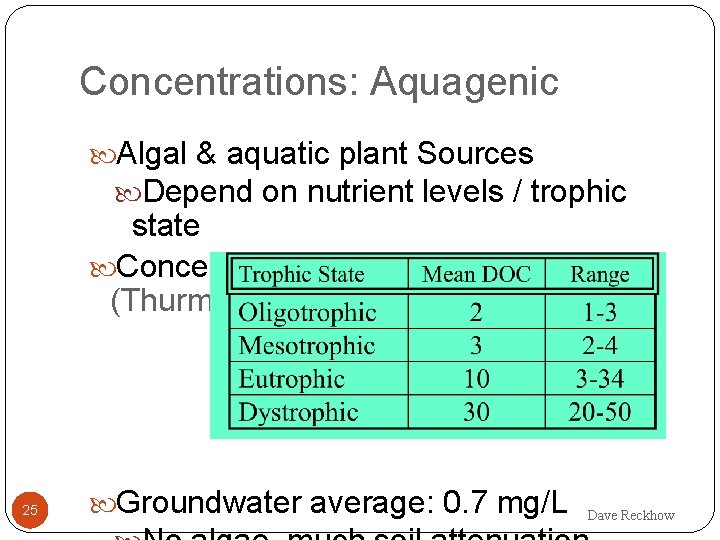
Concentrations: Aquagenic Algal & aquatic plant Sources Depend on nutrient levels / trophic state Concentrations in Lakes (mg/L) (Thurman, 1985) 25 25 Groundwater average: 0. 7 mg/L Dave Reckhow
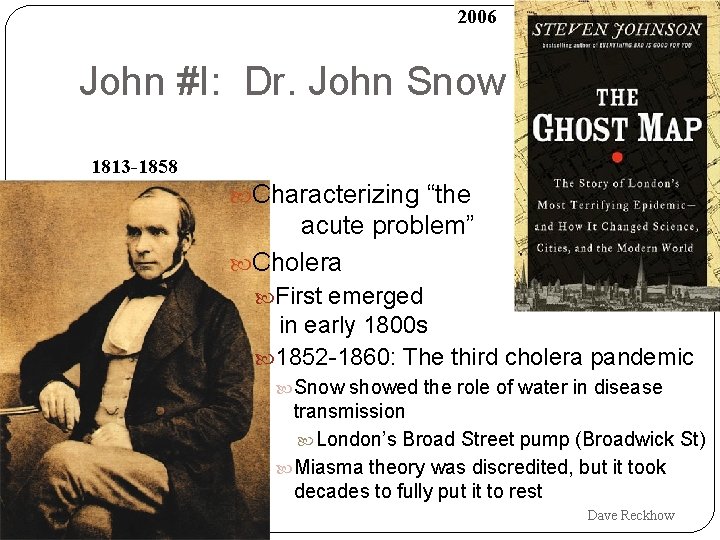
2006 John #I: Dr. John Snow 1813 -1858 Characterizing “the acute problem” Cholera First emerged in early 1800 s 1852 -1860: The third cholera pandemic Snow showed the role of water in disease 26 transmission London’s Broad Street pump (Broadwick St) Miasma theory was discredited, but it took decades to fully put it to rest Dave Reckhow
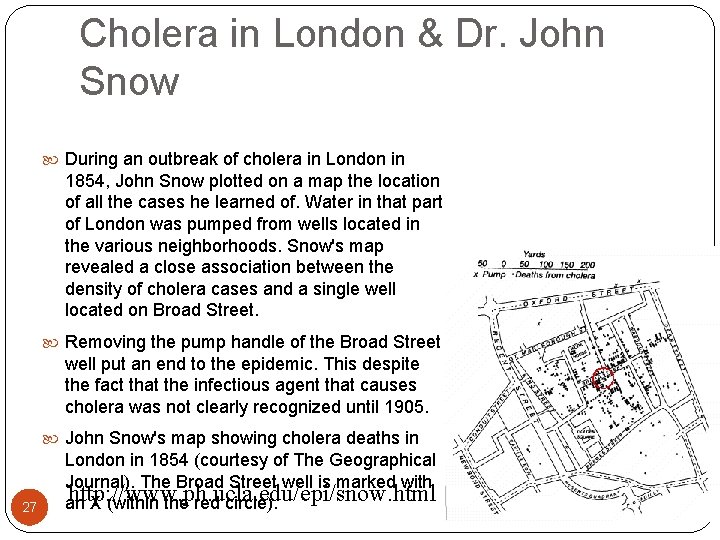
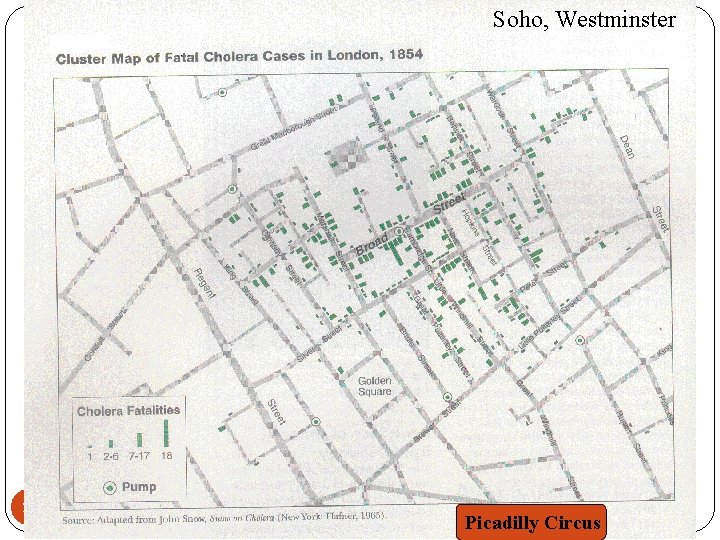
Cholera in London & Dr. John Snow During an outbreak of cholera in London in 1854, John Snow plotted on a map the location of all the cases he learned of. Water in that part of London was pumped from wells located in the various neighborhoods. Snow's map revealed a close association between the density of cholera cases and a single well located on Broad Street. Removing the pump handle of the Broad Street well put an end to the epidemic. This despite the fact that the infectious agent that causes cholera was not clearly recognized until 1905. John Snow's map showing cholera deaths in 27 London in 1854 (courtesy of The Geographical Journal). The Broad Street well is marked with http: //www. ph. ucla. edu/epi/snow. html an X (within the red circle). Dave Reckhow
Soho, Westminster 28 Picadilly Circus
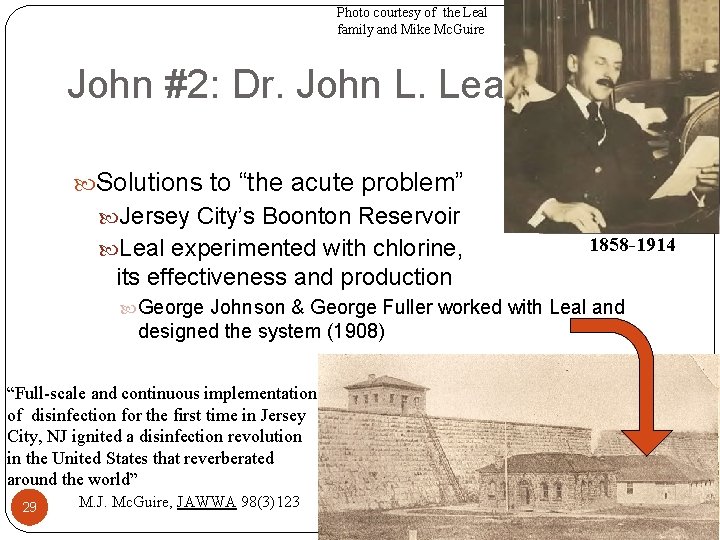
Photo courtesy of the Leal family and Mike Mc. Guire John #2: Dr. John L. Leal Solutions to “the acute problem” Jersey City’s Boonton Reservoir Leal experimented with chlorine, 1858 -1914 its effectiveness and production George Johnson & George Fuller worked with Leal and designed the system (1908) “Full-scale and continuous implementation of disinfection for the first time in Jersey City, NJ ignited a disinfection revolution in the United States that reverberated around the world” 29 M. J. Mc. Guire, JAWWA 98(3)123
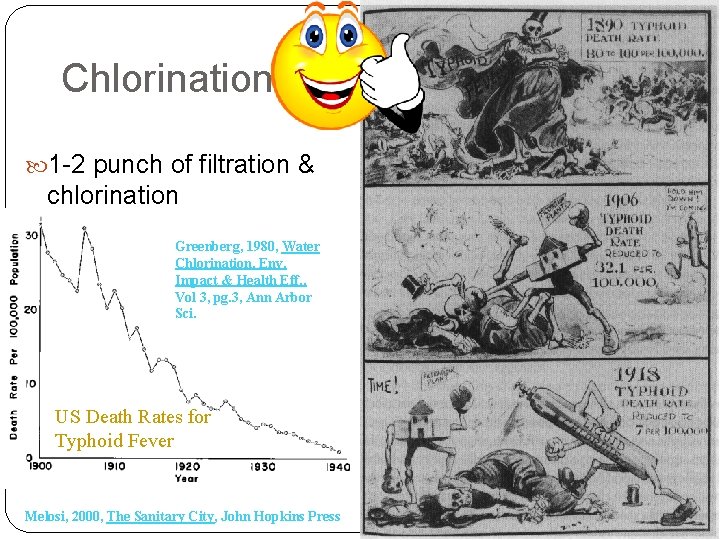
Chlorination 1 -2 punch of filtration & chlorination Greenberg, 1980, Water Chlorination, Env. Impact & Health Eff. , Vol 3, pg. 3, Ann Arbor Sci. US Death Rates for Typhoid Fever 30 Melosi, 2000, The Sanitary City, John Hopkins Press
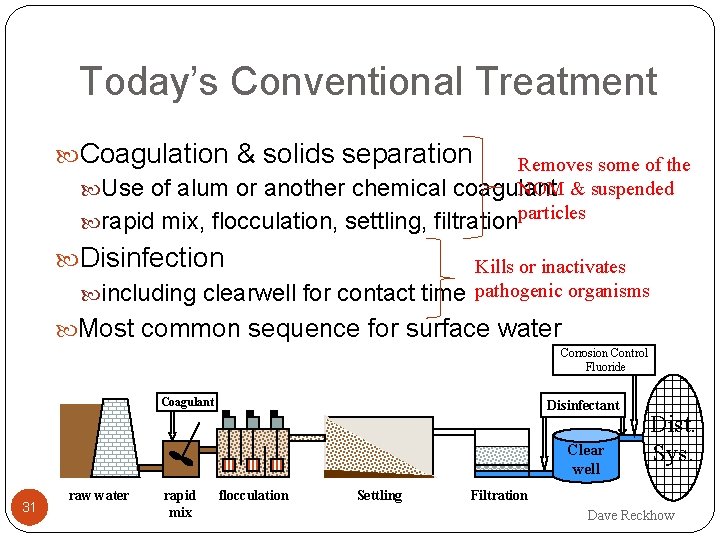
Today’s Conventional Treatment Coagulation & solids separation Removes some of the NOM & suspended Use of alum or another chemical coagulant rapid mix, flocculation, settling, filtrationparticles Disinfection Kills or inactivates including clearwell for contact time pathogenic organisms Most common sequence for surface water Corrosion Control Fluoride Coagulant Disinfectant Clear well 31 raw water rapid mix flocculation Settling Dist. Sys. Filtration Dave Reckhow
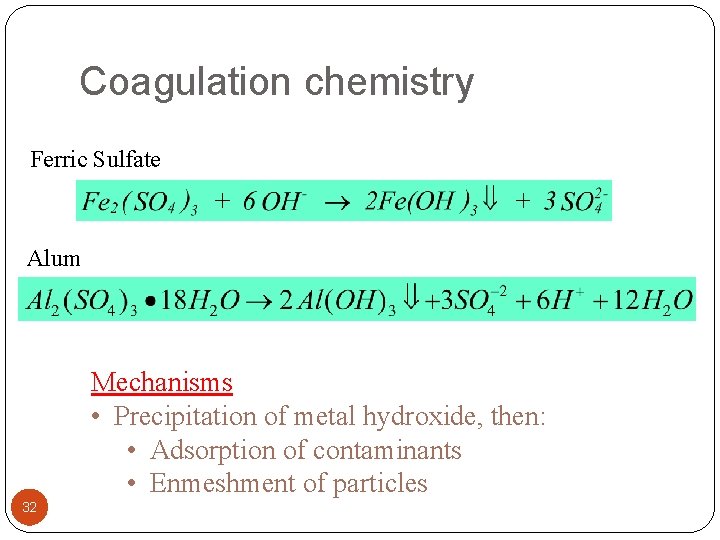
Coagulation chemistry Ferric Sulfate Alum Mechanisms • Precipitation of metal hydroxide, then: • Adsorption of contaminants • Enmeshment of particles 32
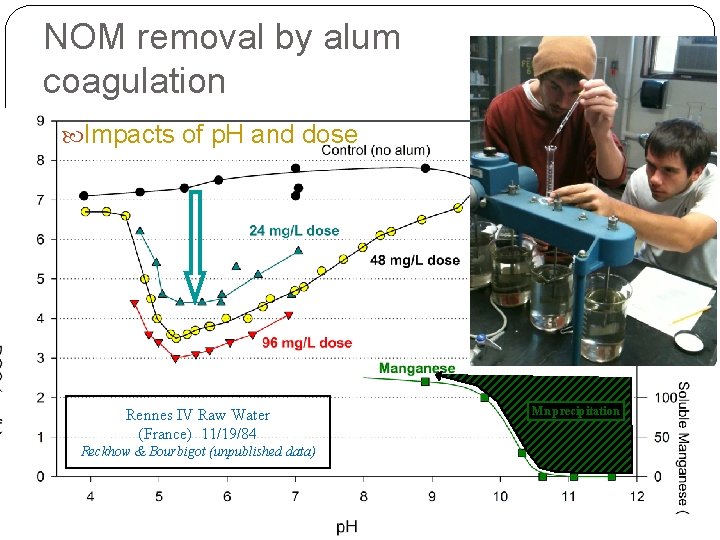
NOM removal by alum coagulation Impacts of p. H and dose Rennes IV Raw Water (France) 11/19/84 Reckhow & Bourbigot (unpublished data) 33 Mn precipitation
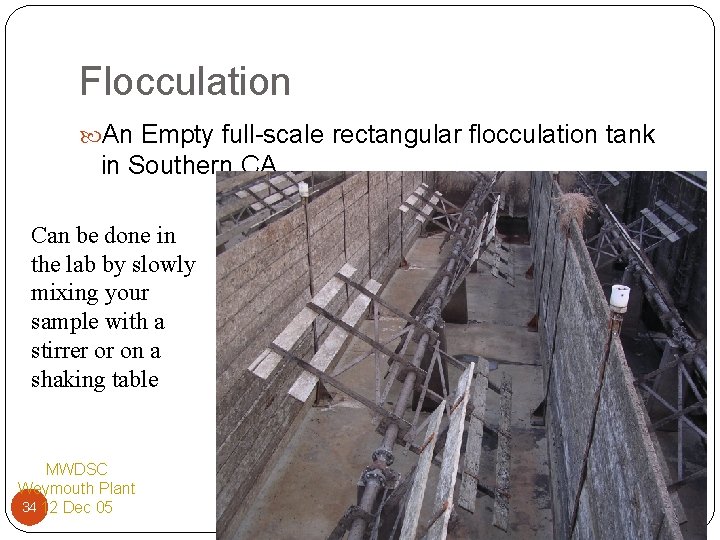
Flocculation An Empty full-scale rectangular flocculation tank in Southern CA Can be done in the lab by slowly mixing your sample with a stirrer or on a shaking table MWDSC Weymouth Plant 34 12 Dec 05 Dave Reckhow
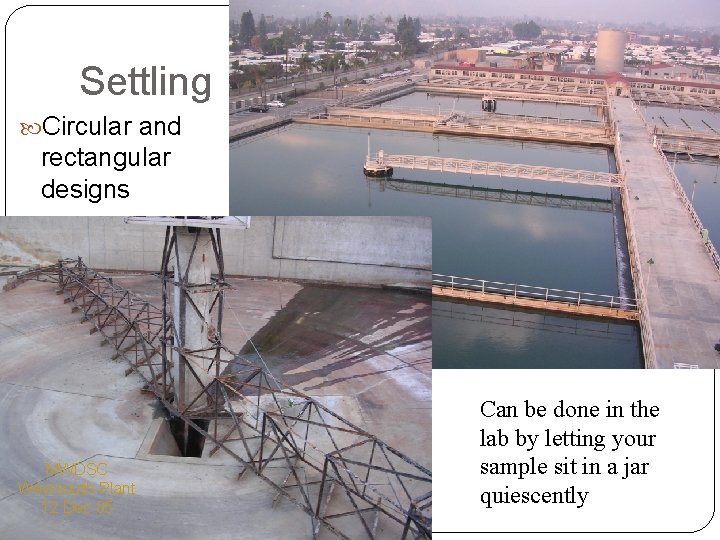
Settling Circular and rectangular designs MWDSC Weymouth Plant 35 12 Dec 05 Can be done in the lab by letting your sample sit in a jar quiescently
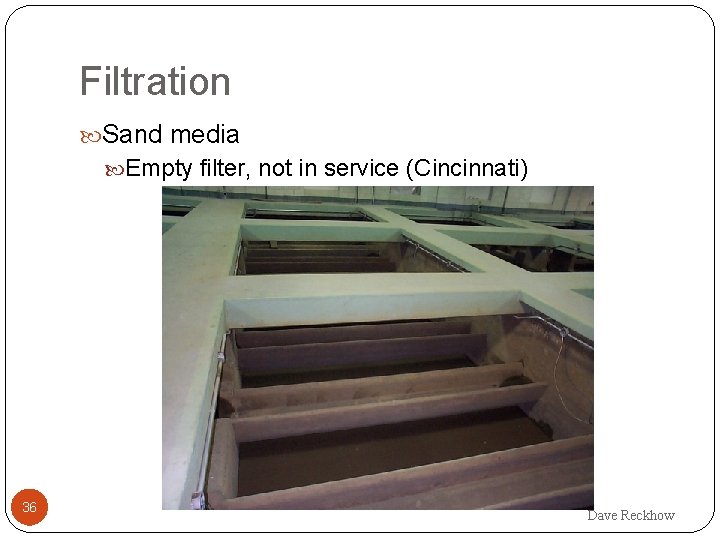
Filtration Sand media Empty filter, not in service (Cincinnati) 36 Dave Reckhow
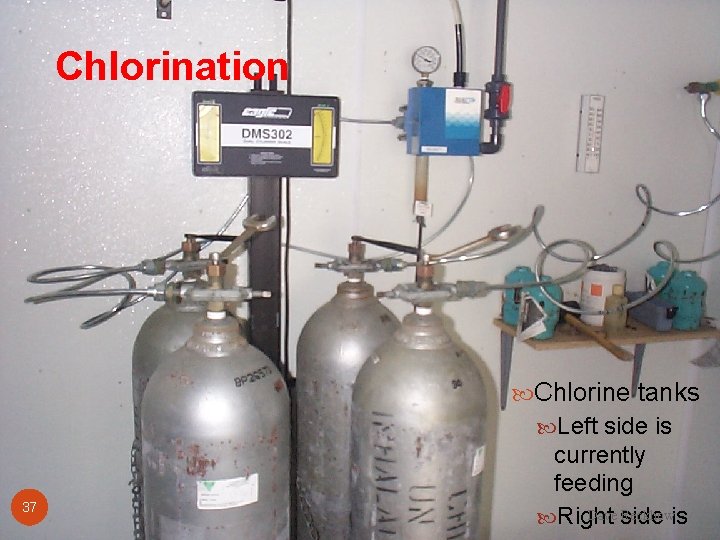
Chlorination Chlorine tanks Left side is 37 currently feeding Dave side Reckhowis Right
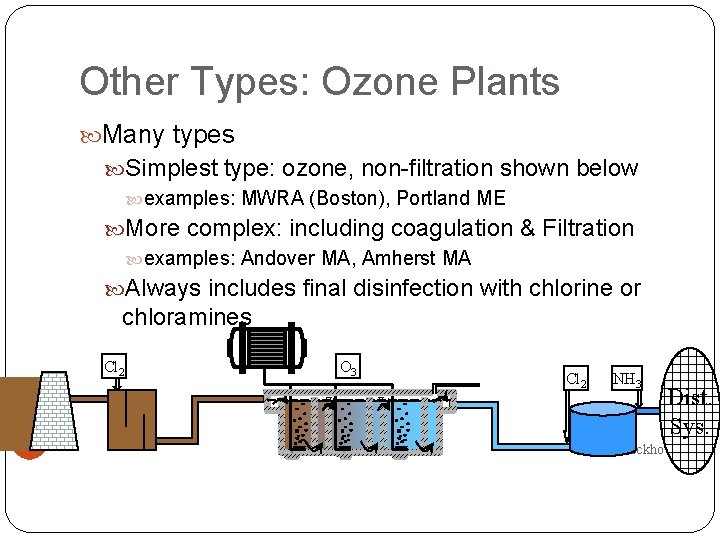
Other Types: Ozone Plants Many types Simplest type: ozone, non-filtration shown below examples: MWRA (Boston), Portland ME More complex: including coagulation & Filtration examples: Andover MA, Amherst MA Always includes final disinfection with chlorine or chloramines Cl 2 38 O 3 Cl 2 NH 3 Dist. Sys. Dave Reckhow
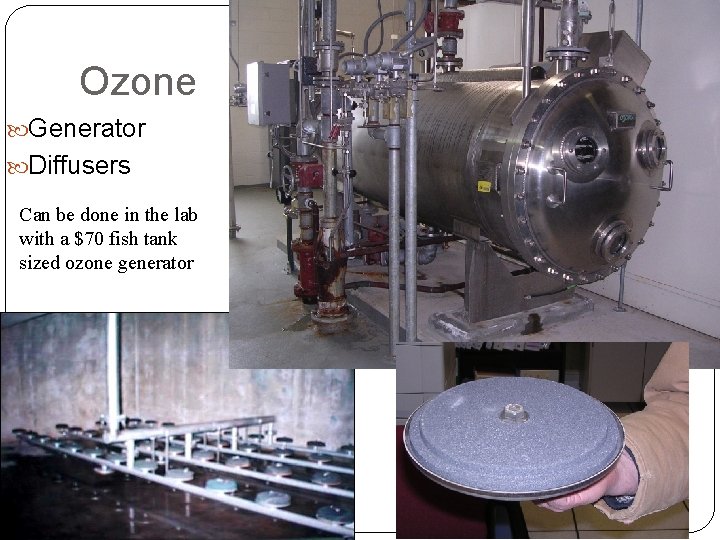
Ozone Generator Diffusers Can be done in the lab with a $70 fish tank sized ozone generator 39
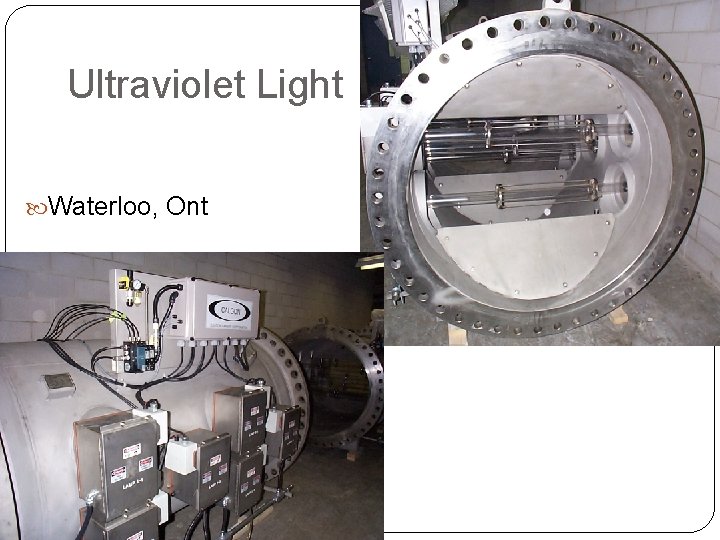
Ultraviolet Light Waterloo, Ont 40
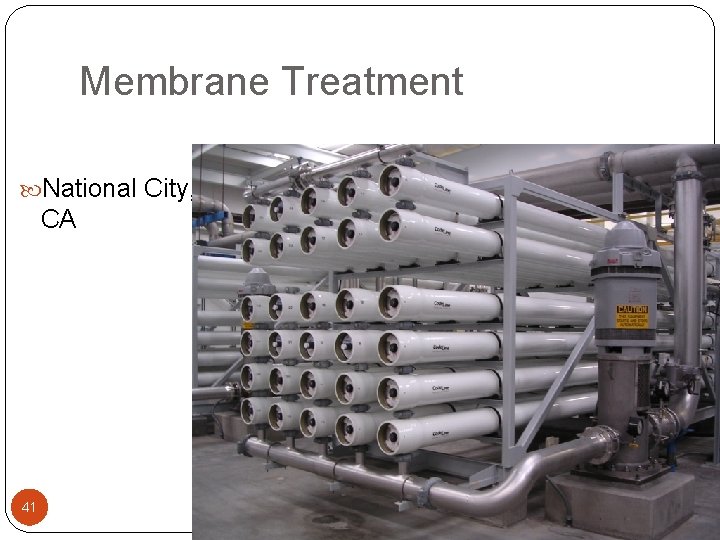
Membrane Treatment National City, CA 41
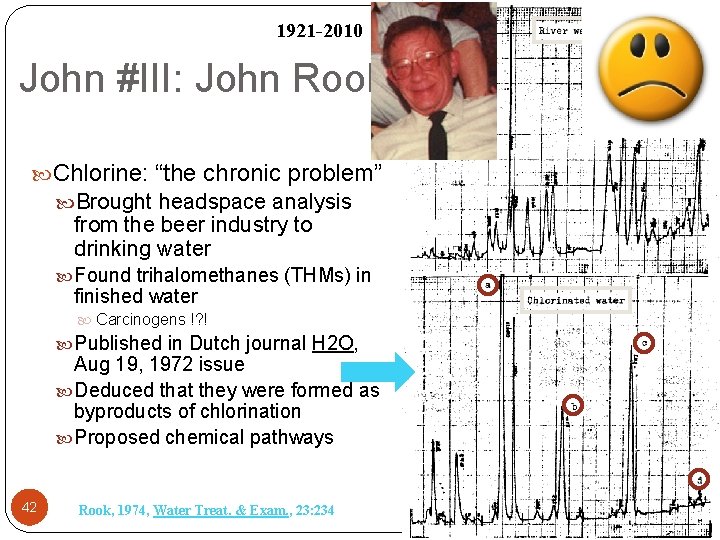
1921 -2010 John #III: John Rook Chlorine: “the chronic problem” Brought headspace analysis from the beer industry to drinking water Found trihalomethanes (THMs) in finished water Carcinogens !? ! Published in Dutch journal H 2 O, Aug 19, 1972 issue Deduced that they were formed as byproducts of chlorination Proposed chemical pathways 42 Rook, 1974, Water Treat. & Exam. , 23: 234
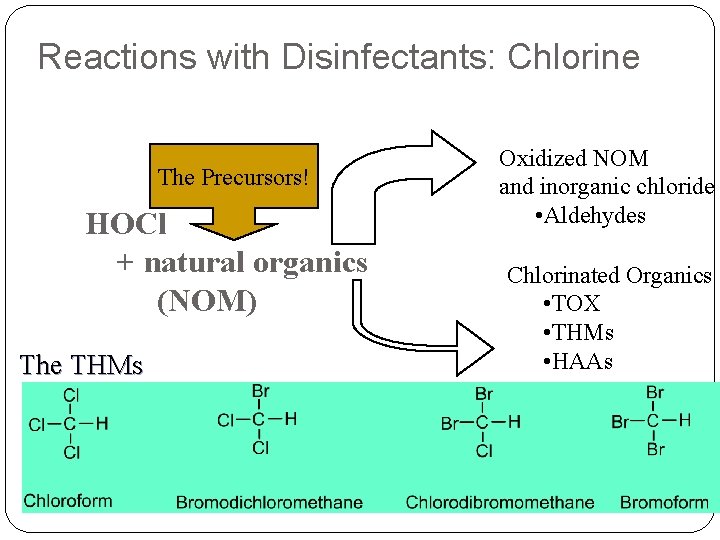
Reactions with Disinfectants: Chlorine The Precursors! HOCl + natural organics (NOM) The THMs 43 Oxidized NOM and inorganic chloride • Aldehydes Chlorinated Organics • TOX • THMs • HAAs
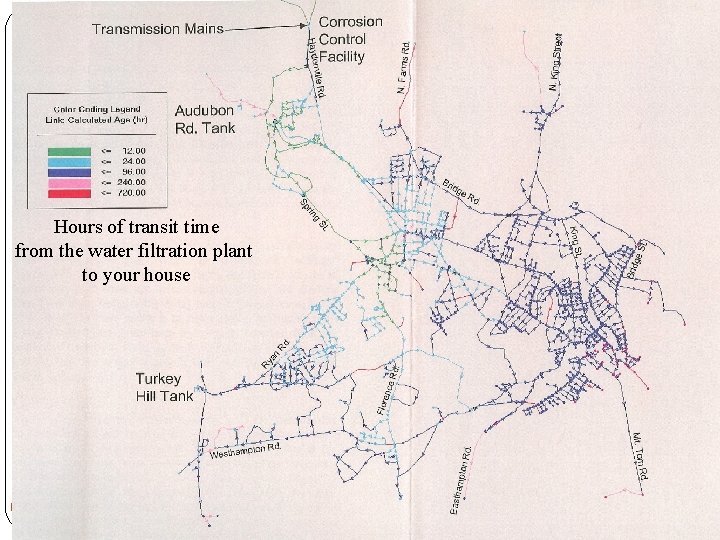
a Hours of transit time from the water filtration plant to your house 44
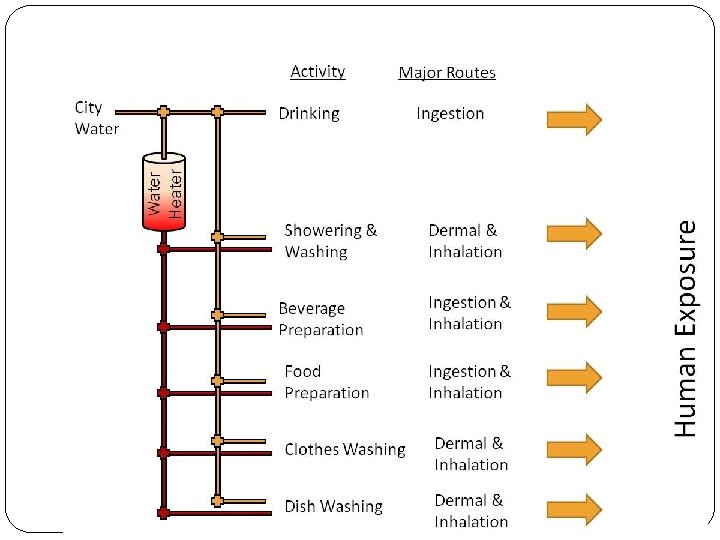
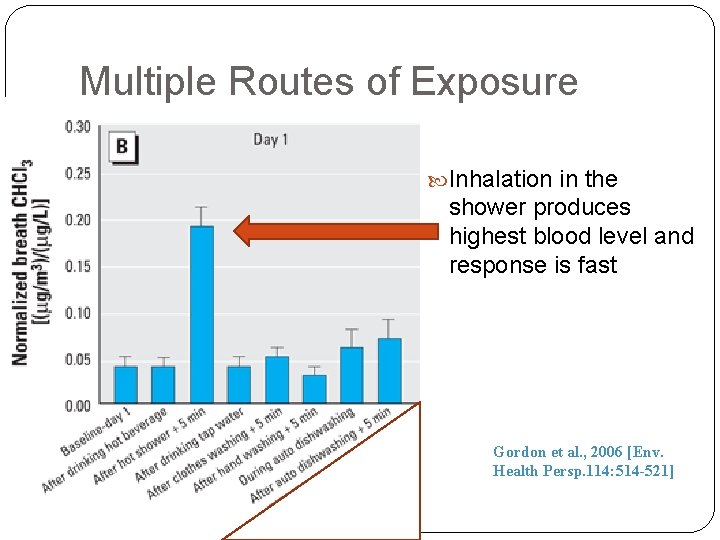
Multiple Routes of Exposure Inhalation in the shower produces highest blood level and response is fast Gordon et al. , 2006 [Env. Health Persp. 114: 514 -521] 46
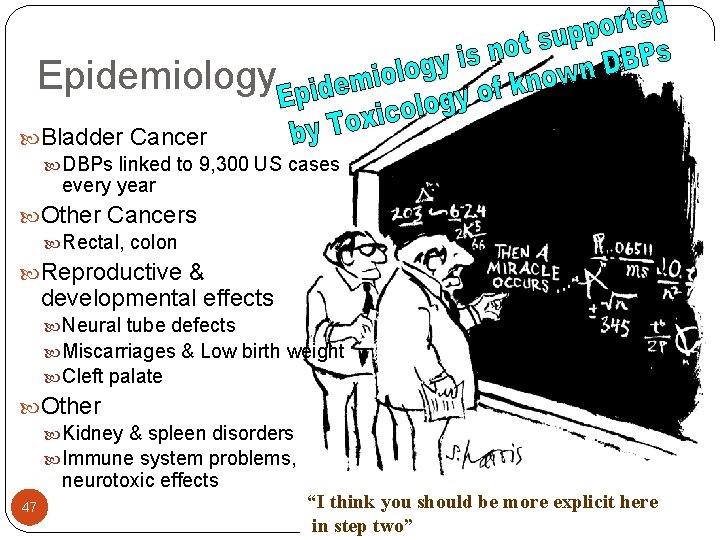
Epidemiology Bladder Cancer DBPs linked to 9, 300 US cases every year Other Cancers Rectal, colon Reproductive & developmental effects Neural tube defects Miscarriages & Low birth weight Cleft palate Other Kidney & spleen disorders Immune system problems, neurotoxic effects 47 137, 000 at risk in US? “I think you should be more explicit here in step two”
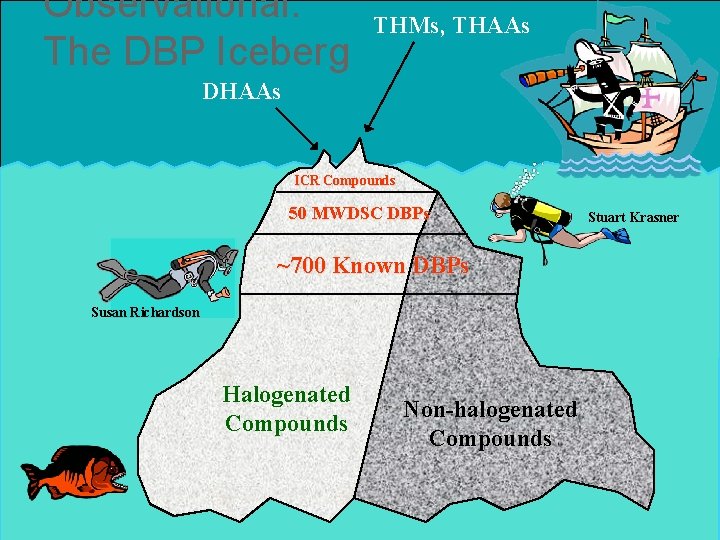
Observational: The DBP Iceberg THMs, THAAs DHAAs ICR Compounds 50 MWDSC DBPs ~700 Known DBPs Susan Richardson Halogenated Compounds Non-halogenated Compounds Stuart Krasner
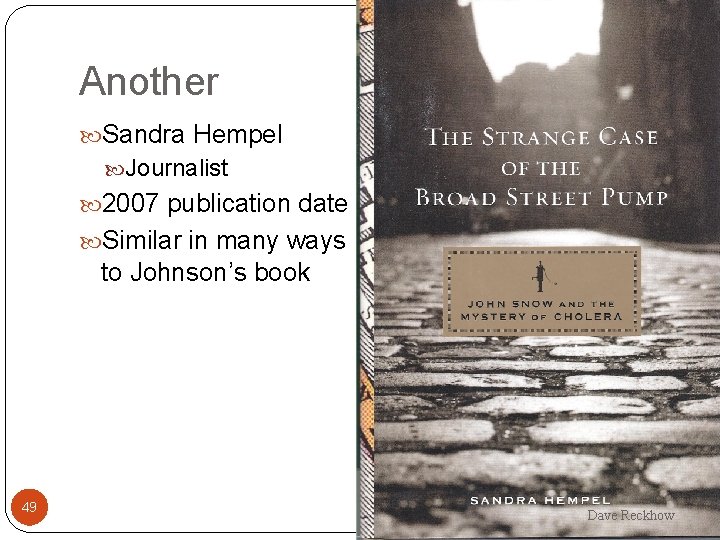
Another Sandra Hempel Journalist 2007 publication date Similar in many ways to Johnson’s book 49 Dave Reckhow
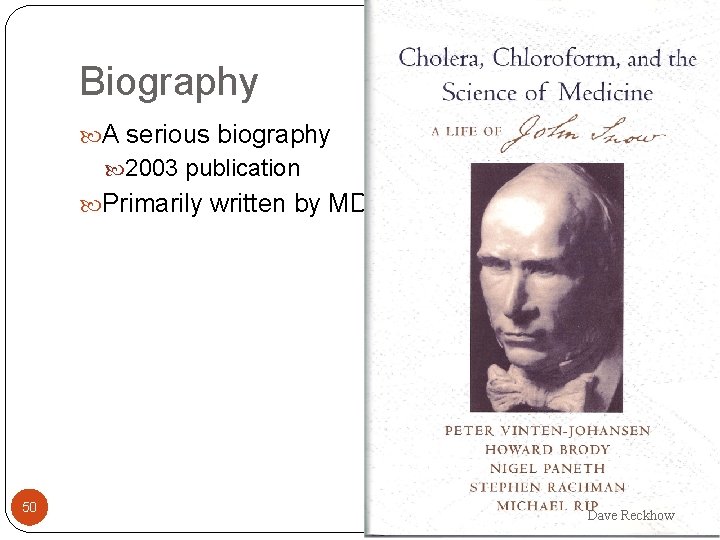
Biography A serious biography 2003 publication Primarily written by MDs 50 Dave Reckhow
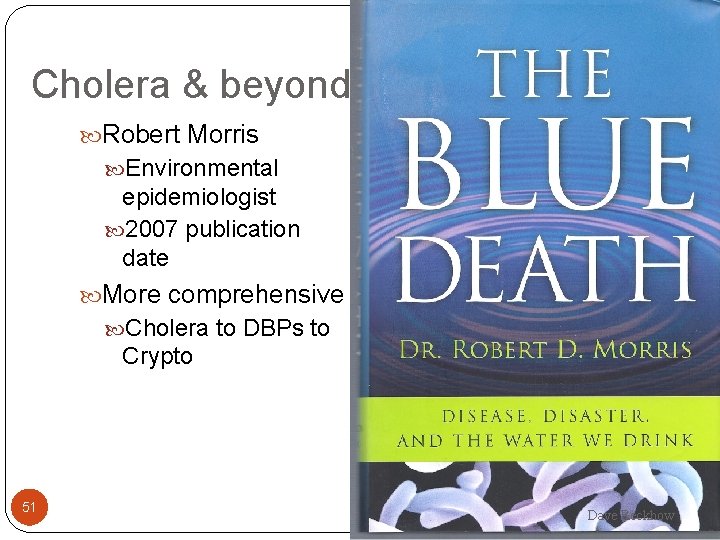
Cholera & beyond Robert Morris Environmental epidemiologist 2007 publication date More comprehensive Cholera to DBPs to Crypto 51 Dave Reckhow
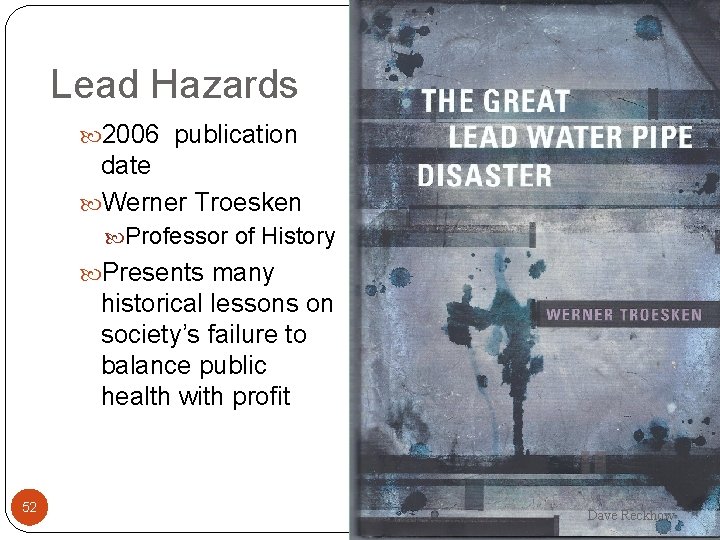
Lead Hazards 2006 publication date Werner Troesken Professor of History Presents many historical lessons on society’s failure to balance public health with profit 52 Dave Reckhow
The End 53 53 Dave Reckhow