
Natural Oil Polythiols and Polyols A Life Cycle
- Slides: 21
Natural Oil Polythiols and Polyols– A Life Cycle Comparison Thomas A. Upshaw, William J. Fisher, Eric J. Netemeyer Chevron Phillips Chemical Co. , LP ACS Green Chemistry & Engineering Conference June 25, 2008 6/25/2008 ACS Green Chemistry and Engineering Conference 2008
Outline • Study objectives • Modeling tools and information sources • Modeled systems and assumptions – – Mercaptanized soybean oil (MSO) Petrochemical (flexible polyether) polyol Castor oil Soy-based polyol • LCA Methodology • Impact category results • Conclusions 6/25/2008 ACS Green Chemistry and Engineering Conference 2008
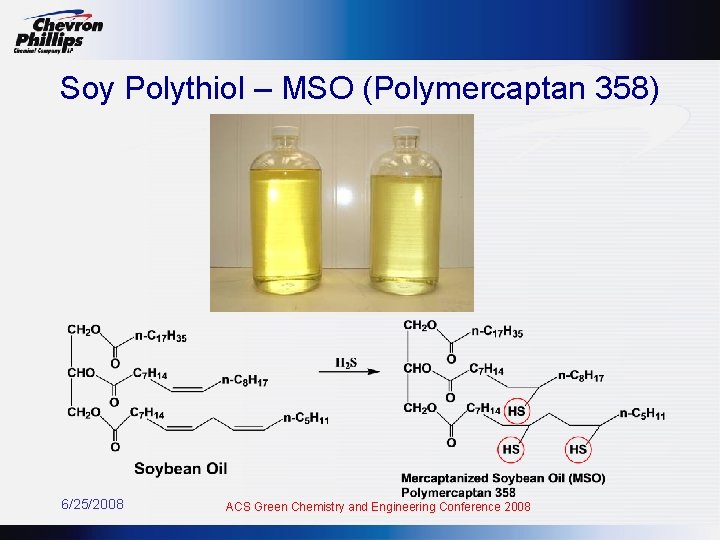
Soy Polythiol – MSO (Polymercaptan 358) 6/25/2008 ACS Green Chemistry and Engineering Conference 2008
Objectives • Develop a soy polythiol life cycle inventory (LCI) platform for product life cycle assessment through the product manufacturing stage (cradle-to-customer) • Compare life cycle environmental impacts using updated LCI data for vegetable oil and petrochemical (polyether) polyols to quantify the benefit of using a renewable oil as raw material • Future: assess process changes and new process technology for reduced environmental impact 6/25/2008 ACS Green Chemistry and Engineering Conference 2008
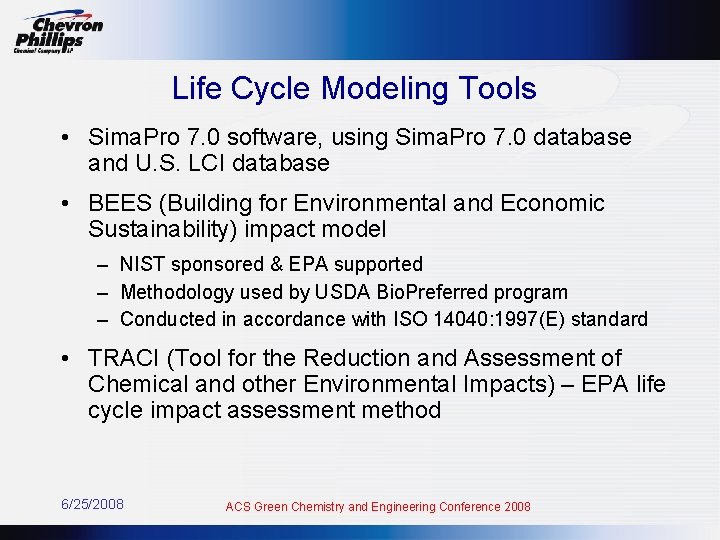
Life Cycle Modeling Tools • Sima. Pro 7. 0 software, using Sima. Pro 7. 0 database and U. S. LCI database • BEES (Building for Environmental and Economic Sustainability) impact model – NIST sponsored & EPA supported – Methodology used by USDA Bio. Preferred program – Conducted in accordance with ISO 14040: 1997(E) standard • TRACI (Tool for the Reduction and Assessment of Chemical and other Environmental Impacts) – EPA life cycle impact assessment method 6/25/2008 ACS Green Chemistry and Engineering Conference 2008
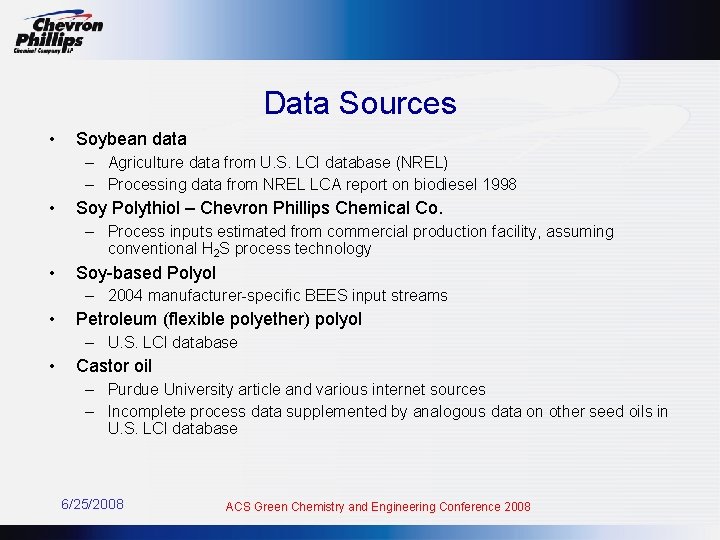
Data Sources • Soybean data – Agriculture data from U. S. LCI database (NREL) – Processing data from NREL LCA report on biodiesel 1998 • Soy Polythiol – Chevron Phillips Chemical Co. – Process inputs estimated from commercial production facility, assuming conventional H 2 S process technology • Soy-based Polyol – 2004 manufacturer-specific BEES input streams • Petroleum (flexible polyether) polyol – U. S. LCI database • Castor oil – Purdue University article and various internet sources – Incomplete process data supplemented by analogous data on other seed oils in U. S. LCI database 6/25/2008 ACS Green Chemistry and Engineering Conference 2008
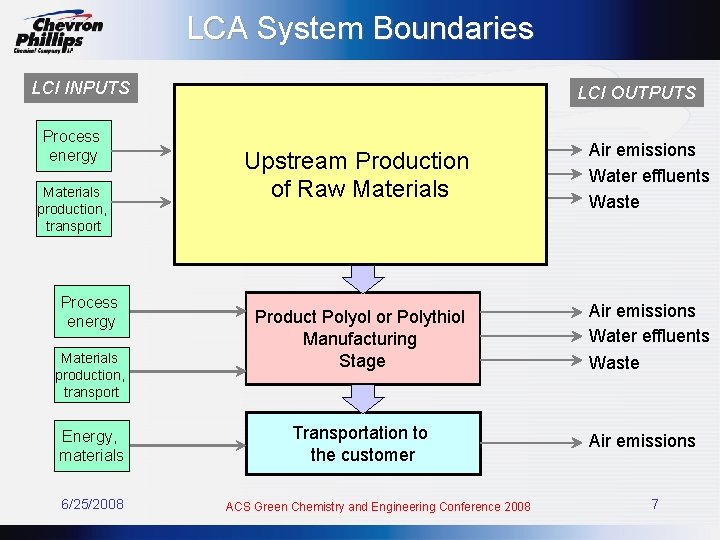
LCA System Boundaries LCI INPUTS Process energy Materials production, transport Energy, materials 6/25/2008 Crop oil Feedstocks Petroleum Feedstocks Agricultural production Upstream Production Raw materials production of Raw Materials Vegetable oil production & refining Product Polyol or Polythiol Manufacturing Stage Transportation to the customer ACS Green Chemistry and Engineering Conference 2008 LCI OUTPUTS Air emissions Water effluents Waste Air emissions 7
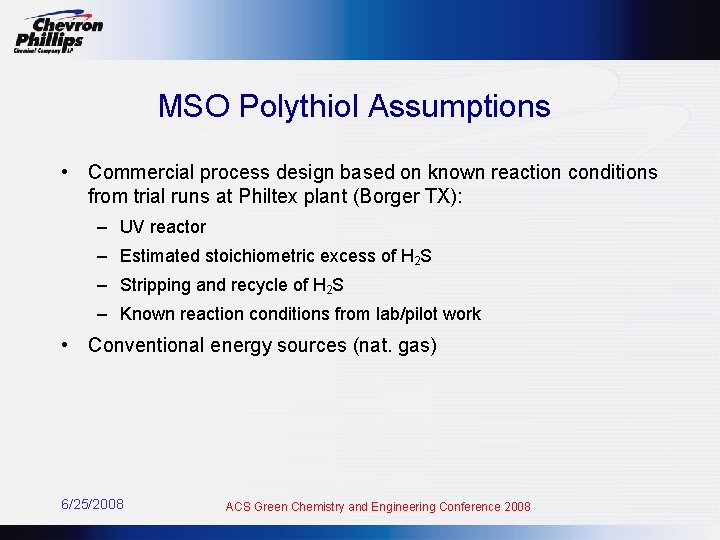
MSO Polythiol Assumptions • Commercial process design based on known reaction conditions from trial runs at Philtex plant (Borger TX): – UV reactor – Estimated stoichiometric excess of H 2 S – Stripping and recycle of H 2 S – Known reaction conditions from lab/pilot work • Conventional energy sources (nat. gas) 6/25/2008 ACS Green Chemistry and Engineering Conference 2008
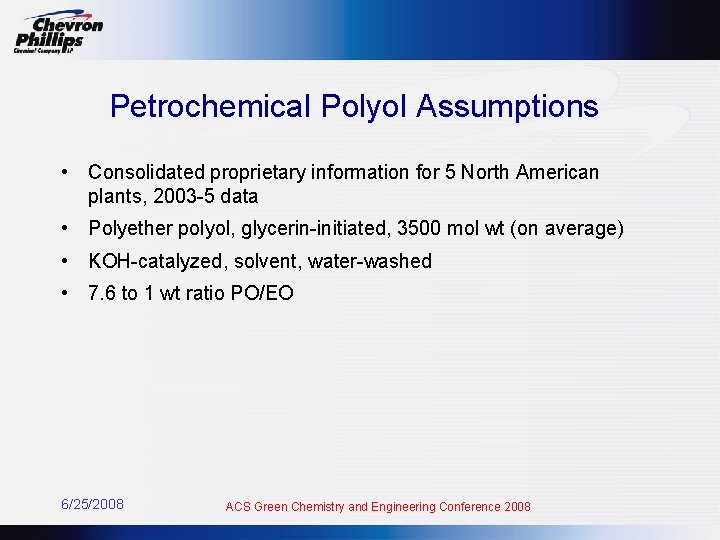
Petrochemical Polyol Assumptions • Consolidated proprietary information for 5 North American plants, 2003 -5 data • Polyether polyol, glycerin-initiated, 3500 mol wt (on average) • KOH-catalyzed, solvent, water-washed • 7. 6 to 1 wt ratio PO/EO 6/25/2008 ACS Green Chemistry and Engineering Conference 2008
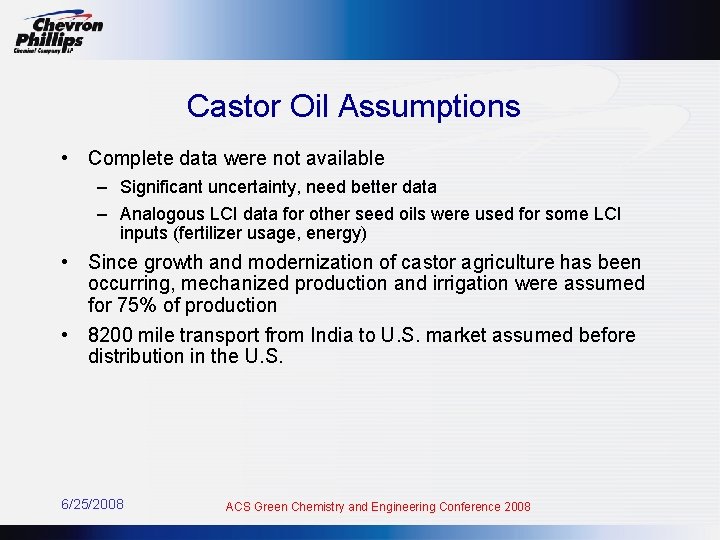
Castor Oil Assumptions • Complete data were not available – Significant uncertainty, need better data – Analogous LCI data for other seed oils were used for some LCI inputs (fertilizer usage, energy) • Since growth and modernization of castor agriculture has been occurring, mechanized production and irrigation were assumed for 75% of production • 8200 mile transport from India to U. S. market assumed before distribution in the U. S. 6/25/2008 ACS Green Chemistry and Engineering Conference 2008
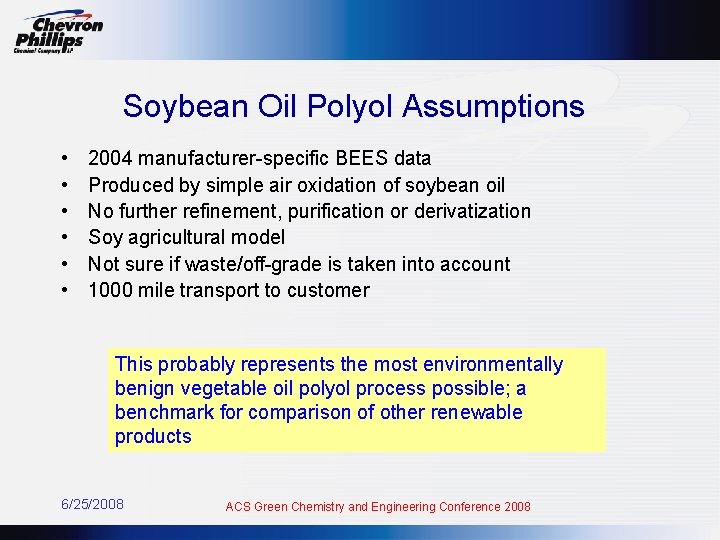
Soybean Oil Polyol Assumptions • • • 2004 manufacturer-specific BEES data Produced by simple air oxidation of soybean oil No further refinement, purification or derivatization Soy agricultural model Not sure if waste/off-grade is taken into account 1000 mile transport to customer This probably represents the most environmentally benign vegetable oil polyol process possible; a benchmark for comparison of other renewable products 6/25/2008 ACS Green Chemistry and Engineering Conference 2008
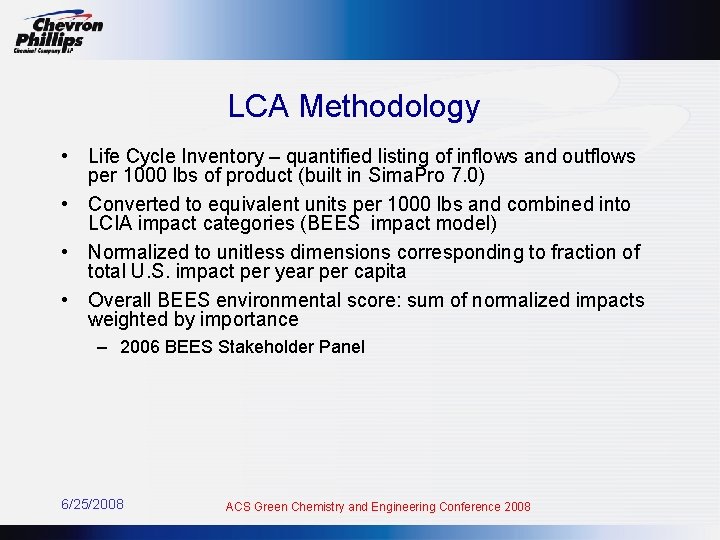
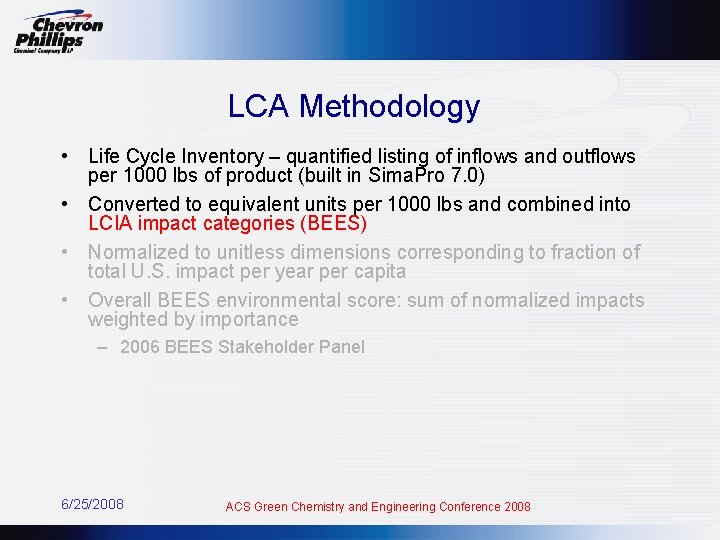
LCA Methodology • Life Cycle Inventory – quantified listing of inflows and outflows per 1000 lbs of product (built in Sima. Pro 7. 0) • Converted to equivalent units per 1000 lbs and combined into LCIA impact categories (BEES impact model) • Normalized to unitless dimensions corresponding to fraction of total U. S. impact per year per capita • Overall BEES environmental score: sum of normalized impacts weighted by importance – 2006 BEES Stakeholder Panel 6/25/2008 ACS Green Chemistry and Engineering Conference 2008
LCA Methodology • Life Cycle Inventory – quantified listing of inflows and outflows per 1000 lbs of product (built in Sima. Pro 7. 0) • Converted to equivalent units per 1000 lbs and combined into LCIA impact categories (BEES) • Normalized to unitless dimensions corresponding to fraction of total U. S. impact per year per capita • Overall BEES environmental score: sum of normalized impacts weighted by importance – 2006 BEES Stakeholder Panel 6/25/2008 ACS Green Chemistry and Engineering Conference 2008
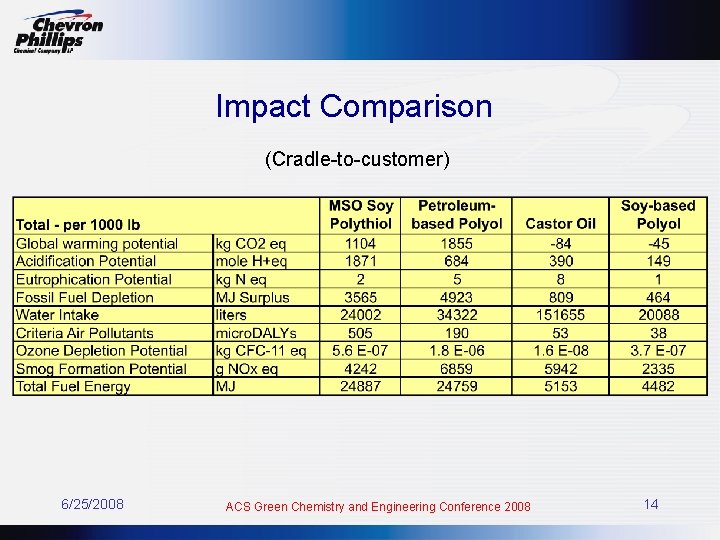
Impact Comparison (Cradle-to-customer) 6/25/2008 ACS Green Chemistry and Engineering Conference 2008 14
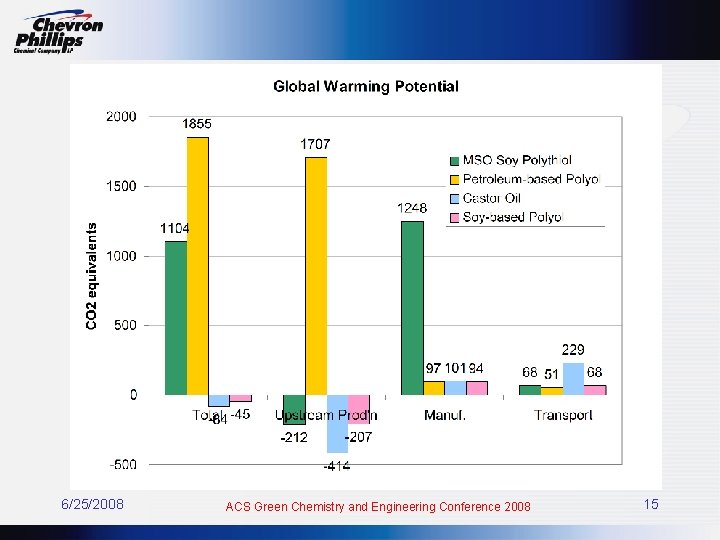
6/25/2008 ACS Green Chemistry and Engineering Conference 2008 15
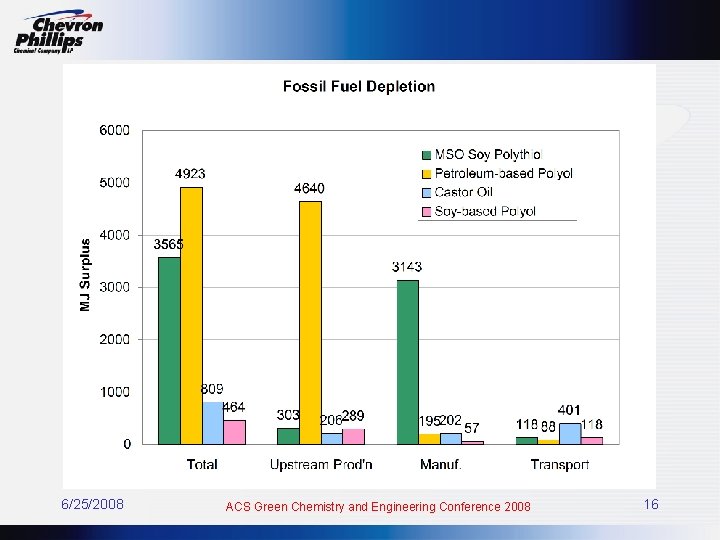
6/25/2008 ACS Green Chemistry and Engineering Conference 2008 16
6/25/2008 ACS Green Chemistry and Engineering Conference 2008 17
6/25/2008 ACS Green Chemistry and Engineering Conference 2008 18
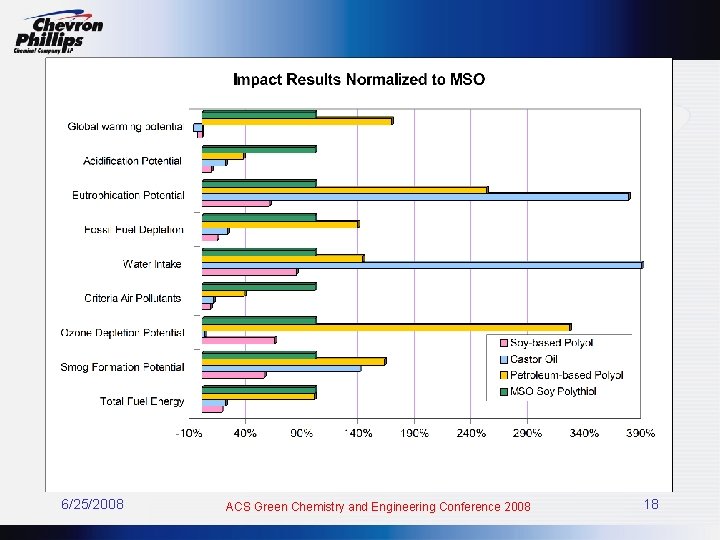
Conclusions • LCA is a valuable tool to help assess environmental impact of products and processes at a more detailed level. – more standards and complete, up-to-date publicly available data are needed to improve general utility and consistency. • Global warming potential and fossil fuel use of MSO and vegetable oil polyols are significantly lower than for the petroleum-based polyether polyol due to the crop oil raw material source. • Agricultural practices, oil extraction methods and shipping also have a significant impact. • Future use of renewable energy for MSO production would result in a significant reduction in global warming potential (GWP) and fossil fuel consumption. 6/25/2008 ACS Green Chemistry and Engineering Conference 2008
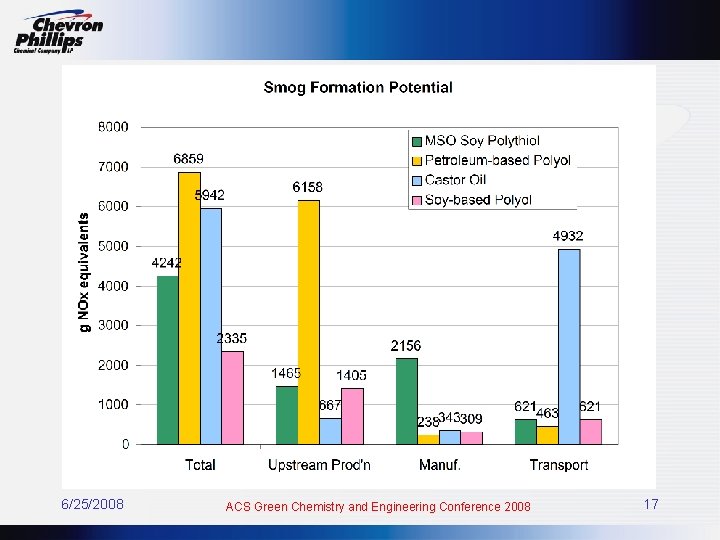
Conclusions • Next generation process technology currently under development may significantly reduce energy consumption, GWP and SOx generation (i. e. , criteria air pollutant and acidification impacts). • Castor oil was comparable to MSO overall (BEES), but better life cycle input data for castor oil is needed – Castor suffered from the use of the solvent extraction process and (probably high) estimated water and fertilizer use (vs MSO) and eutrophication and smog potential were high vs soybean oil polyol. • A best case soy oil based polyol showed less than 16% the overall impact relative to a petroleum-based polyol – But: best case (simple) process does not necessarily give a product with acceptable end-use properties 6/25/2008 ACS Green Chemistry and Engineering Conference 2008
Acknowledgements • • American Chemical Society Jim Pollack, Omni. Tech International Ltd. Anne Landfield Greig, Four Elements Consulting, LLC Chevron Phillips Chemical Company, LP 6/25/2008 ACS Green Chemistry and Engineering Conference 2008