
Natural Moral Law SPECIFICATION The origins of Aquinas
- Slides: 48
Natural Moral Law
SPECIFICATION • The origins of Aquinas' Natural Law in Aristotle's idea of telos and how Aquinas developed this. • The use of reason to discover Natural Law • The four tiers of law • The synderesis principle • The primary and secondary precepts • Strengths and weaknesses of theory
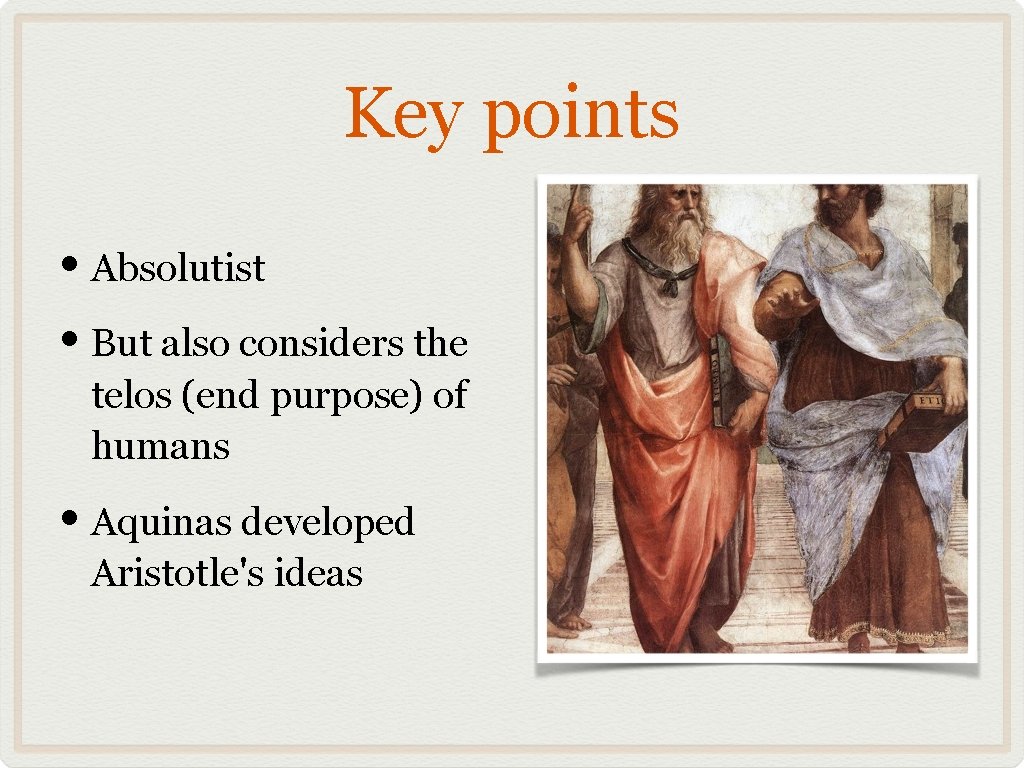
Key points • Absolutist • But also considers the telos (end purpose) of humans • Aquinas developed Aristotle's ideas
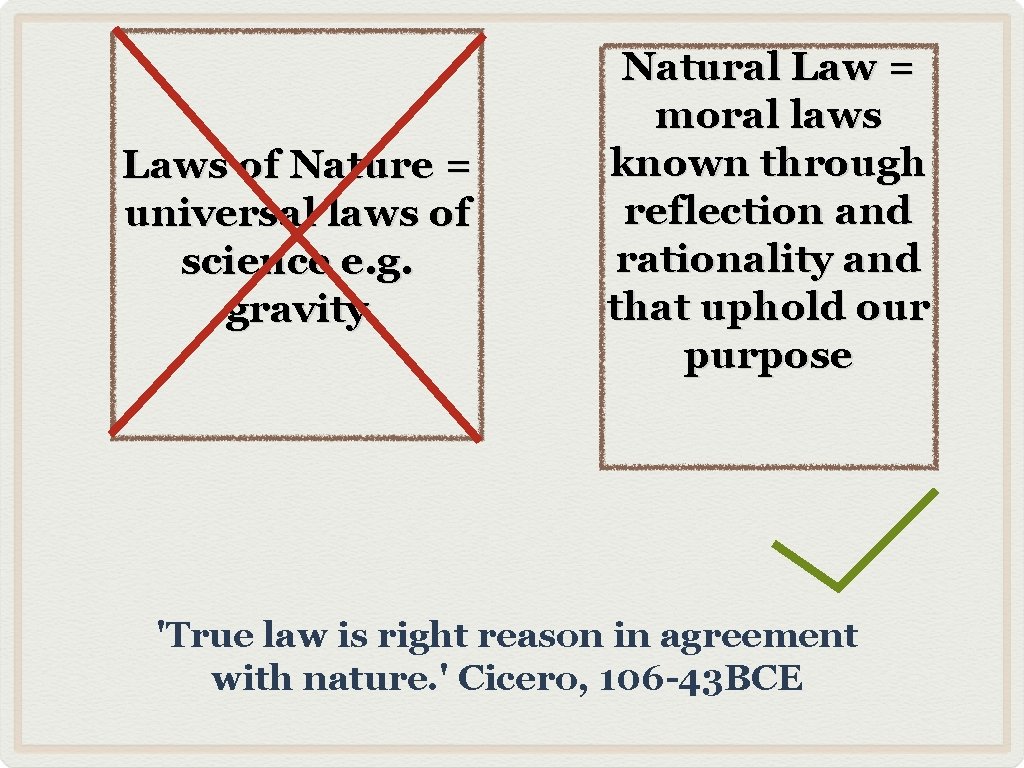
Laws of Nature = universal laws of science e. g. gravity Natural Law = moral laws known through reflection and rationality and that uphold our purpose 'True law is right reason in agreement with nature. ' Cicero, 106 -43 BCE
But what is natural? Is there a natural 'good'? • Is it natural to be homosexual? • Is it natural to be prejudice? • Is it natural to be violent? • Is it natural to be monogamous? • Is it natural to commit suicide? • Is it natural to eat meat? • Is it natural to use contraception?
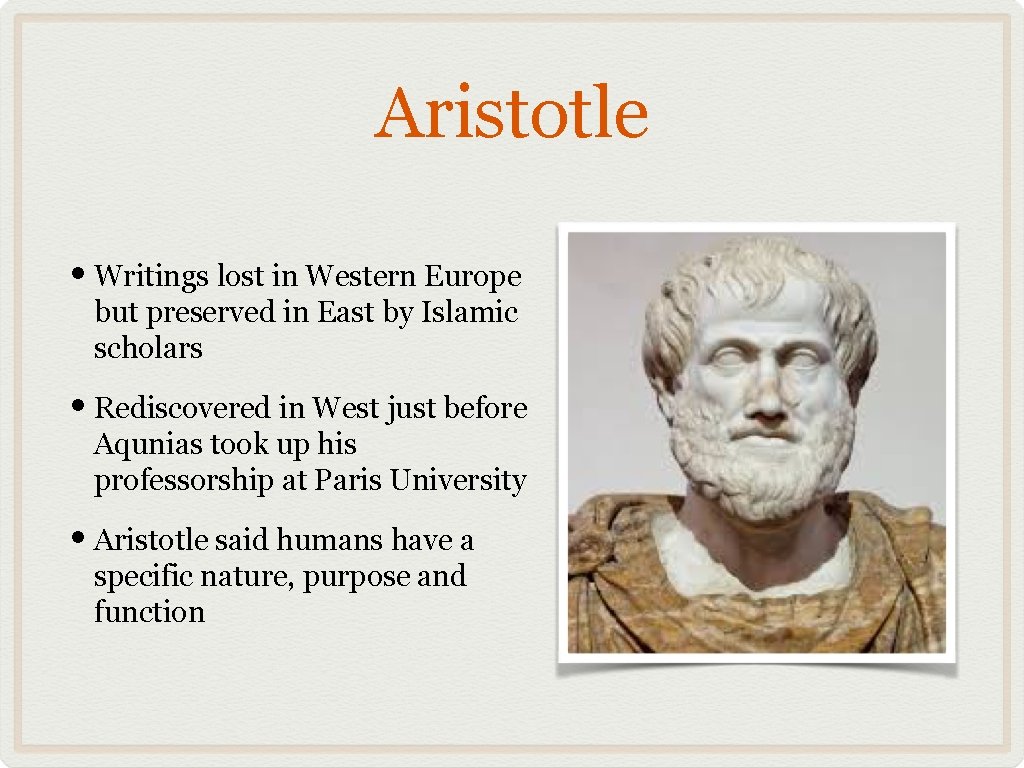
Aristotle • Writings lost in Western Europe but preserved in East by Islamic scholars • Rediscovered in West just before Aqunias took up his professorship at Paris University • Aristotle said humans have a specific nature, purpose and function
Aristotle - causes • His theory of causes is concerned with the essence of something • When considering why an object exists he asks 'how did it happen? ' - this is called the efficient cause and usually the answer is. . . ? ? • He then asks 'what's it for? ' - this is called the final cause and is the most important question as it relates to its purpose. • Perfection is reached when the object does exactly what it is invented to do/it fulfills its telos (purpose)
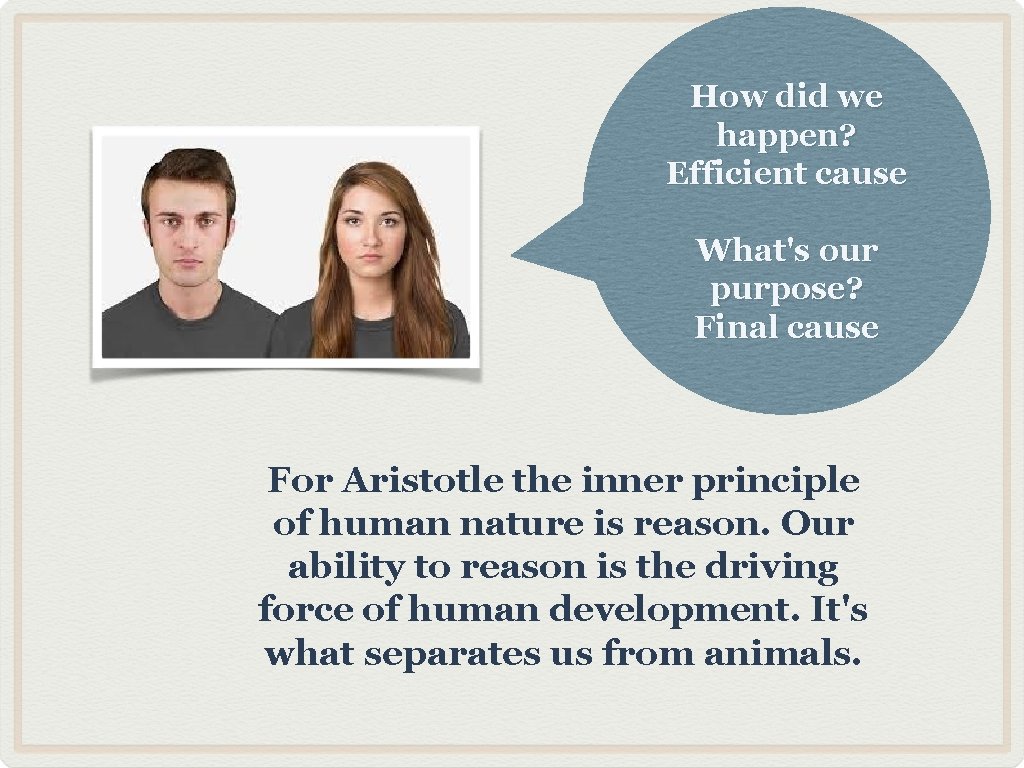
How did we happen? Efficient cause What's our purpose? Final cause For Aristotle the inner principle of human nature is reason. Our ability to reason is the driving force of human development. It's what separates us from animals.
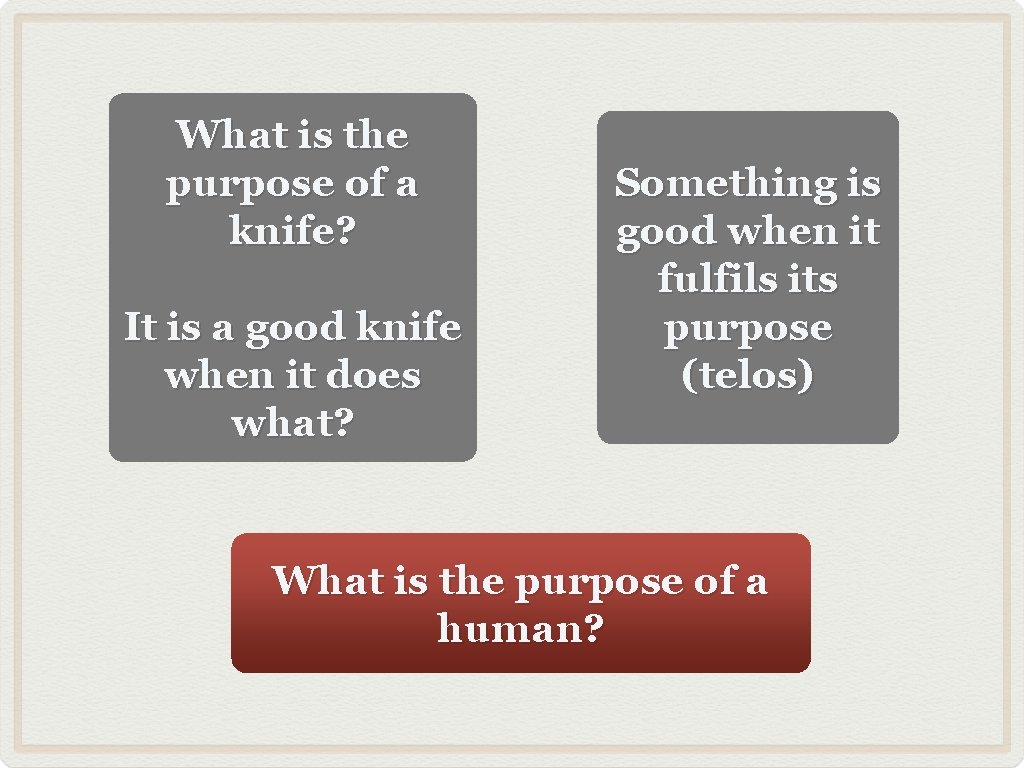
What is the purpose of a knife? It is a good knife when it does what? Something is good when it fulfils its purpose (telos) What is the purpose of a human?
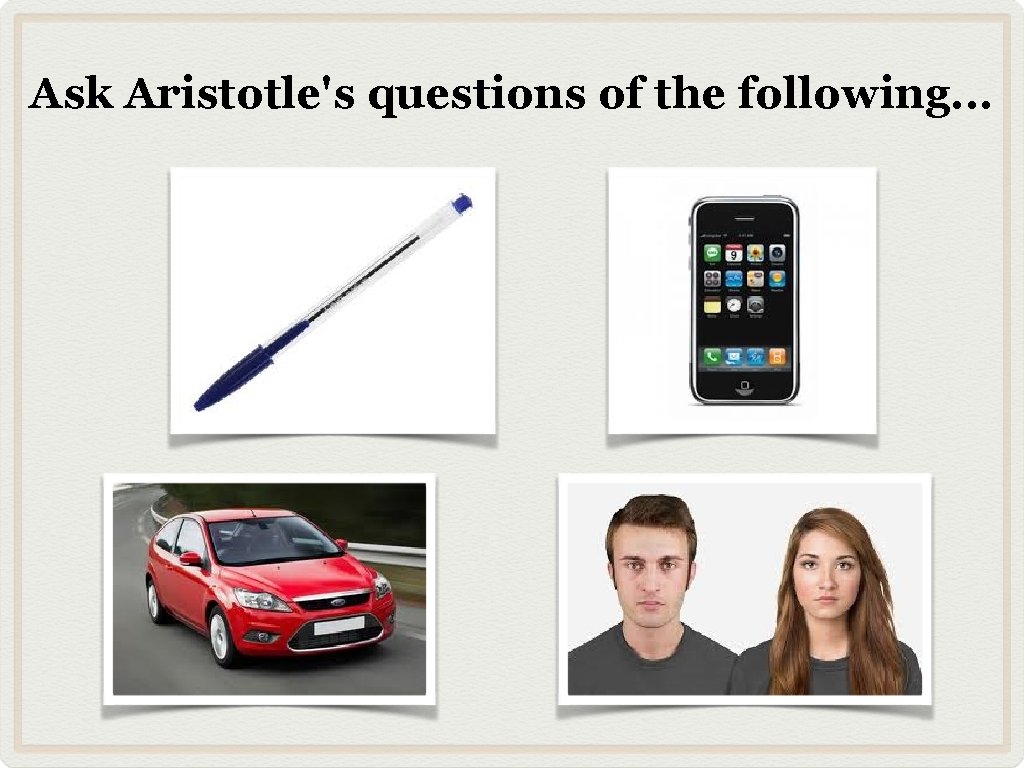
Ask Aristotle's questions of the following. . .
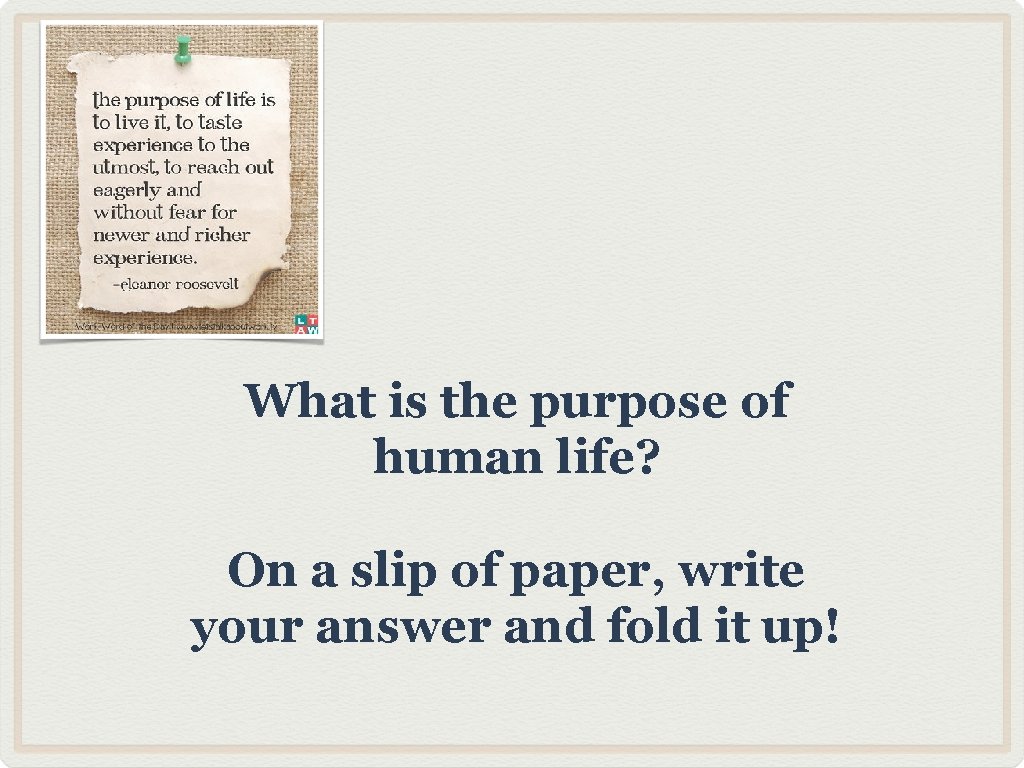
What is the purpose of human life? On a slip of paper, write your answer and fold it up!
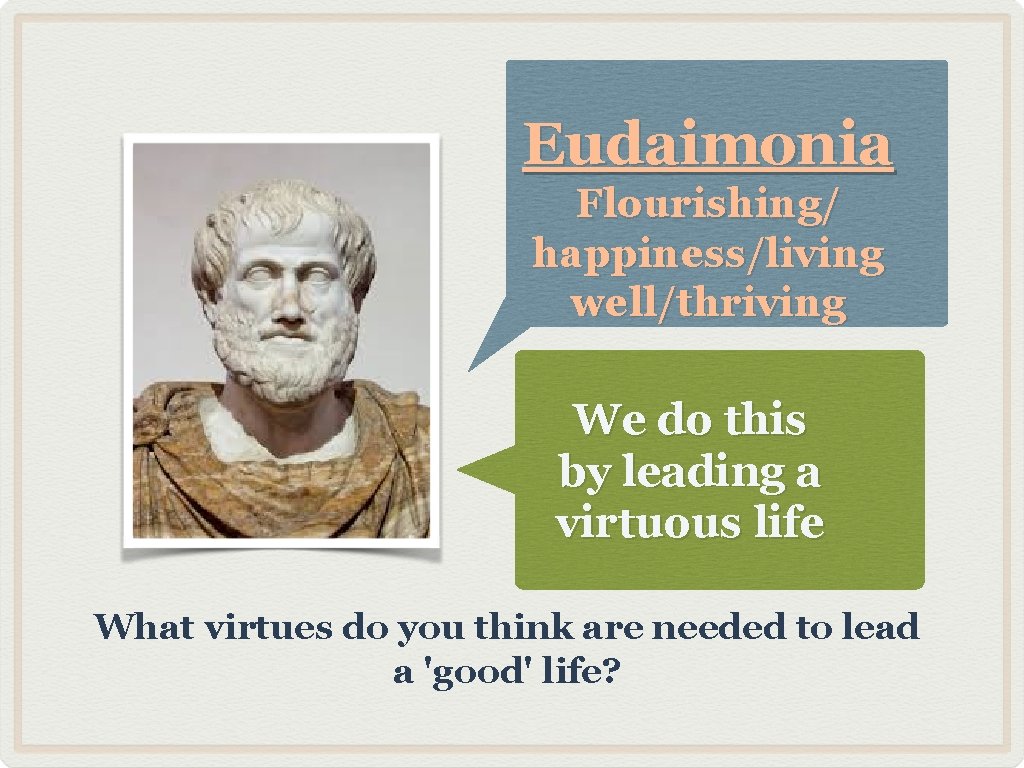
Eudaimonia Flourishing/ happiness/living well/thriving We do this by leading a virtuous life What virtues do you think are needed to lead a 'good' life?
One thing leads to another. . • 'I am sitting in this lesson studying Aristotle in order to. . . . • Make the reason the beginning of your next question • Keep going. . • Do you agree with Aristotle's idea about the purpose of our lives?
Quick Review • Who are the 2 scholars that propose natural law? • What are the 2 causes? Give an example • What is the purpose of life according to the first scholar? • Something is. . . when it fulfils its purpose
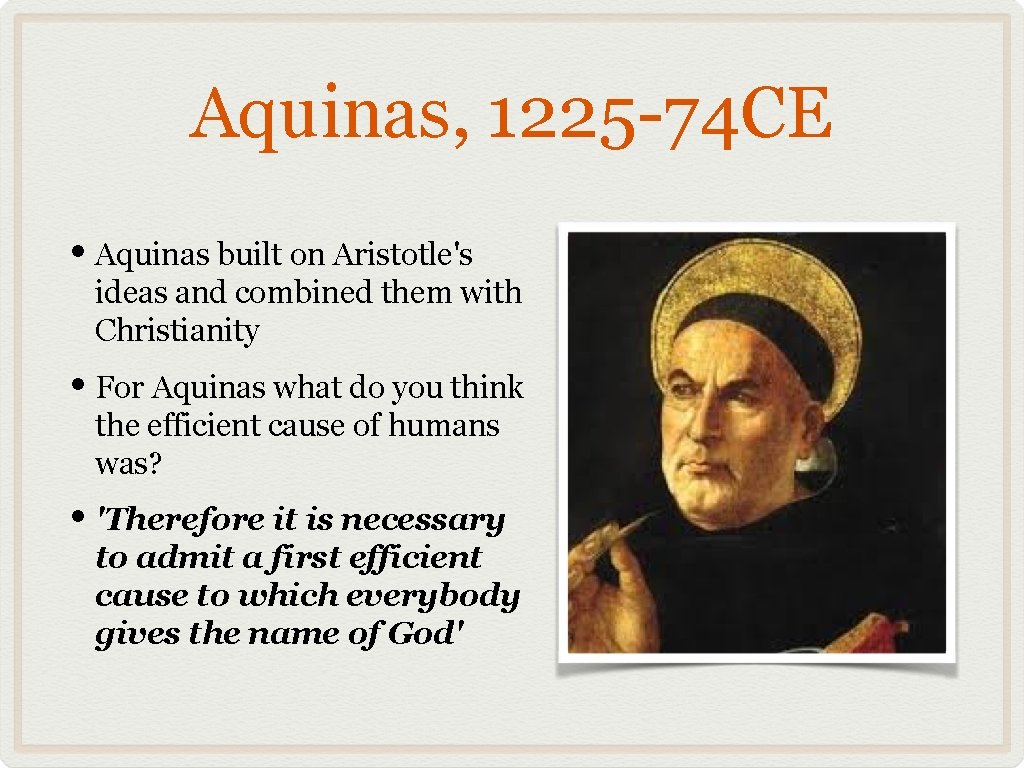
Aquinas, 1225 -74 CE • Aquinas built on Aristotle's ideas and combined them with Christianity • For Aquinas what do you think the efficient cause of humans was? • 'Therefore it is necessary to admit a first efficient cause to which everybody gives the name of God'
Aquinas - purpose and perfection • An object achieves its final cause (it's telos) when it does what God intends it to do • For humans 'made in the image of God' means seeking union with God • Happiness in this life and in particular spiritual happiness in the afterlife are the goals!
Aquinas, 1225 -74 CE • NL centres around this idea that humans have a natural purpose and this can determine what's right and wrong
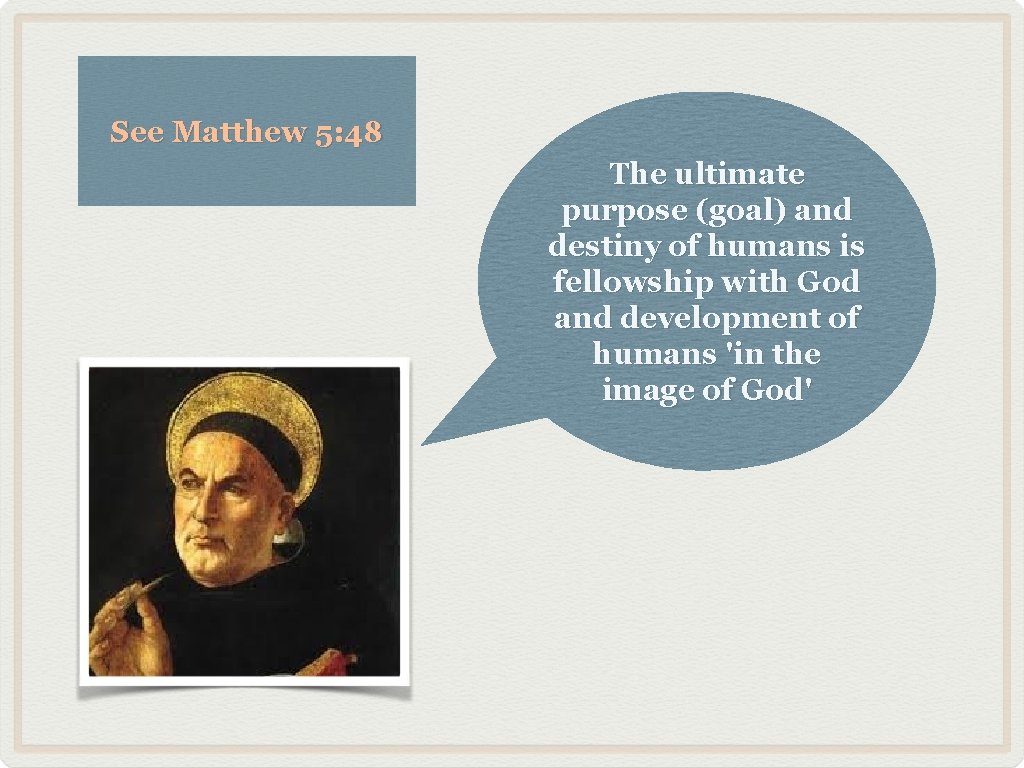
See Matthew 5: 48 The ultimate purpose (goal) and destiny of humans is fellowship with God and development of humans 'in the image of God'
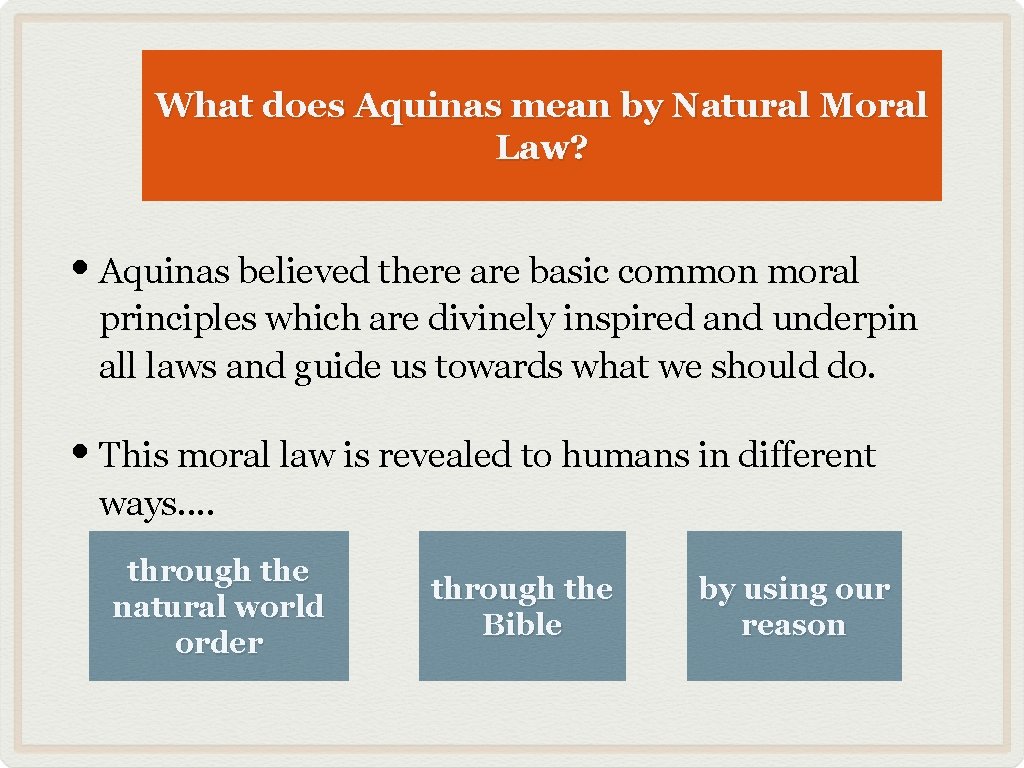
What does Aquinas mean by Natural Moral Law? • Aquinas believed there are basic common moral principles which are divinely inspired and underpin all laws and guide us towards what we should do. • This moral law is revealed to humans in different ways. . through the natural world order through the Bible by using our reason
Task • Give some examples of moral beliefs held by many people which might indicate common principles? (or we might say a 'common moral law') • Can you give come examples of differing moral beliefs that counter the suggestion of a common moral law?
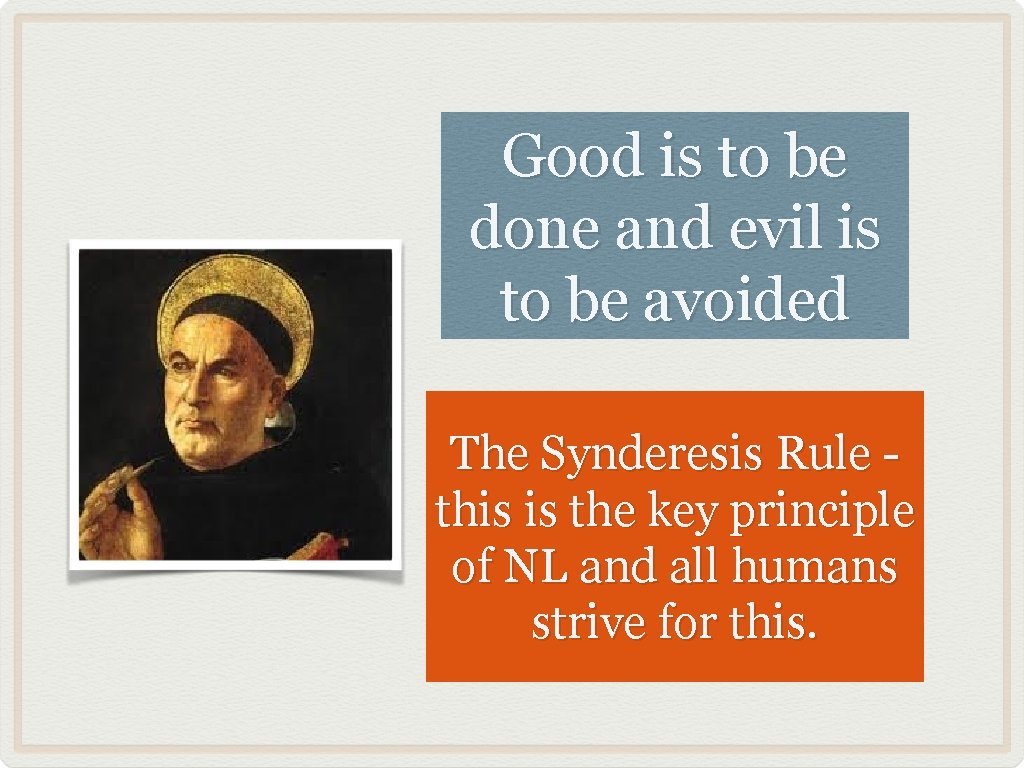
Good is to be done and evil is to be avoided The Synderesis Rule this is the key principle of NL and all humans strive for this.
So. . . according to Aquinas • The universe was created by God • Everything has a design and purpose • This purpose can be known through examining the natural world, studying the Bible and using our reason • NML = the rational understanding and following of God's final purpose (to become virtuous people and achieve harmonious relationship with God)
What gives law its authority? • Eternal Law - the principles by which God made and controls the universe and which are only fully known to God • Divine Law - the law of God revealed in Scripture - particularly the 10 commandments and sermon on the mount • Natural Law - the moral law of God within human nature that is discoverable through the use of reason • Human Law - the above becomes established in human, civic laws through the use of practical reasoning and experienced judgement (PHRONESIS). Just laws are rooted in NL.
The Primary Precepts • Aquinas believed that there were certain 'ends' or purposes for which all humans had been created. . . By living in a way • To preserve life that fulfills these purposes, we will • To live in an ordered and harmonious in society fulfil the ultimate purpose of union • To reproduce with God. Living in this way leads • To learn and seek truth and educate to human • To worship God flourishing • If you live your life in a way that fulfills these 'ends' then you are living a good life e. g. providing food to someone who is hungry, having sex with your spouse to have children, praying to God, studying philosophy!
Should humans seek to follow these primary goods? • What would you add to the list? • What would you take away? • Why?
• The Roman Catholic Church bases it's theology on Natural Law • Based on Aquinas' ideas certain actions are not acceptable, as they are thought to go against the principle of Natural Law e. g. • Homosexuality • Contraception • Why do you think this is?
• Therefore some actions, because they are contrary to these fundamental principles will always be wrong even if done for the greater good.
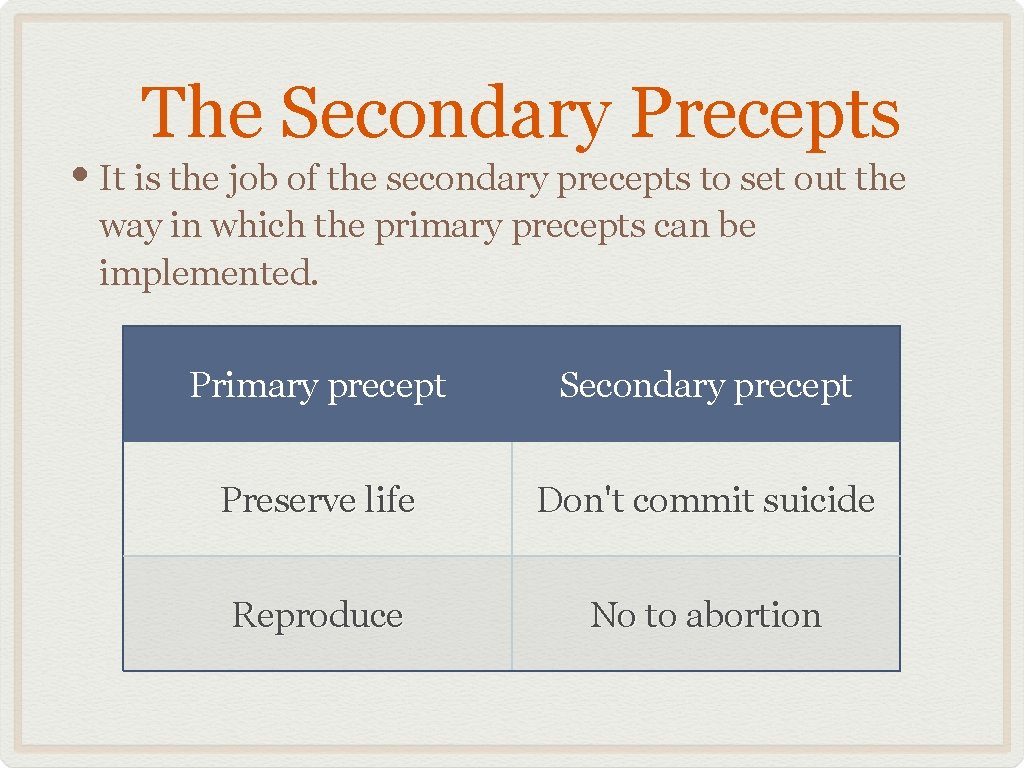
The Secondary Precepts • It is the job of the secondary precepts to set out the way in which the primary precepts can be implemented. Primary precept Secondary precept Preserve life Don't commit suicide Reproduce No to abortion
Applying Natural Law • If the purpose of humans is to reproduce (the primary precept), what conclusions can we come to about the what is right and wrong within sexual practices?
Make a table of the primary precepts and come up with as many secondary precepts as you can Are there any issues?
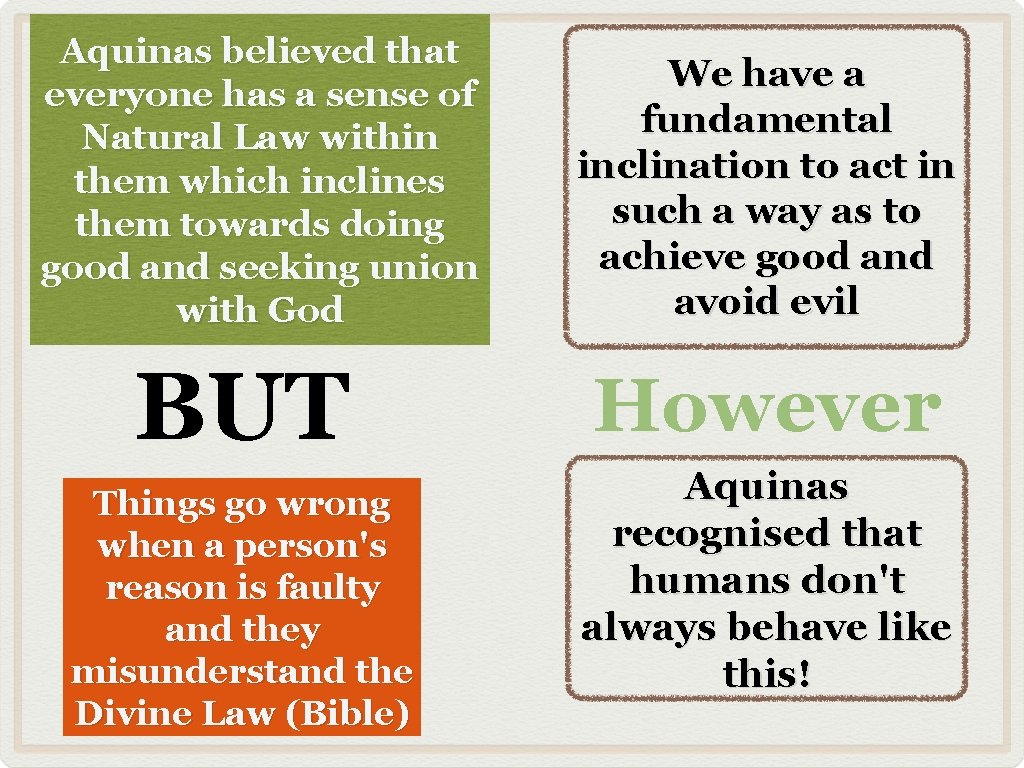
Aquinas believed that everyone has a sense of Natural Law within them which inclines them towards doing good and seeking union with God BUT Things go wrong when a person's reason is faulty and they misunderstand the Divine Law (Bible) We have a fundamental inclination to act in such a way as to achieve good and avoid evil However Aquinas recognised that humans don't always behave like this!
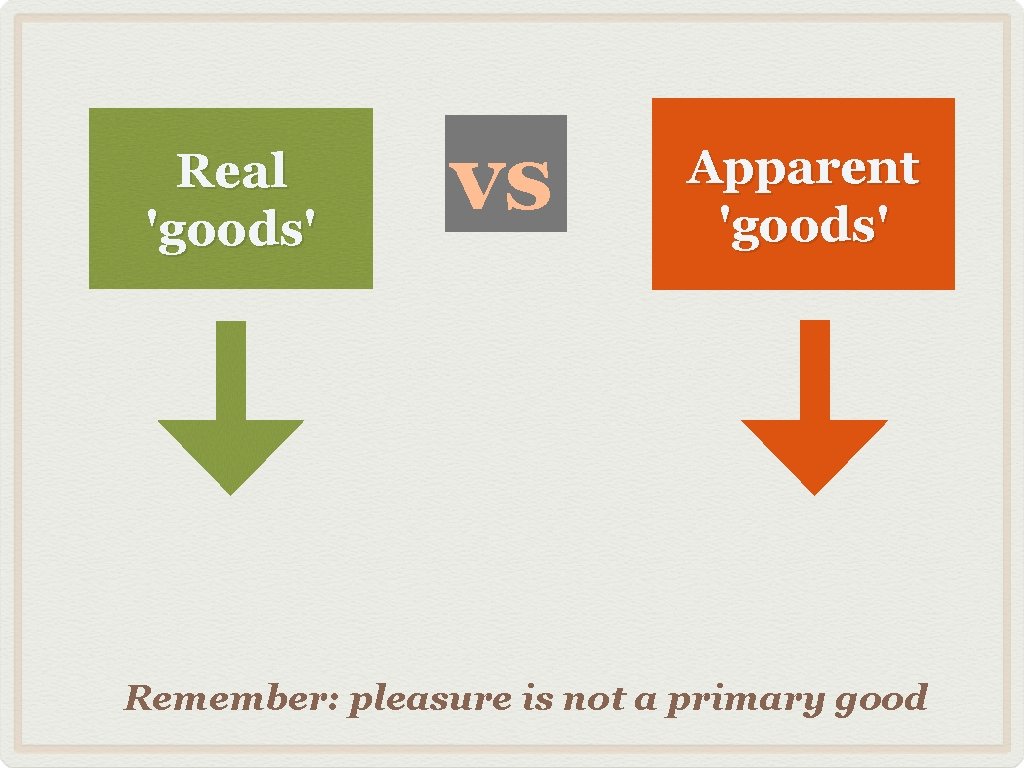
Real 'goods' vs Apparent 'goods' Remember: pleasure is not a primary good
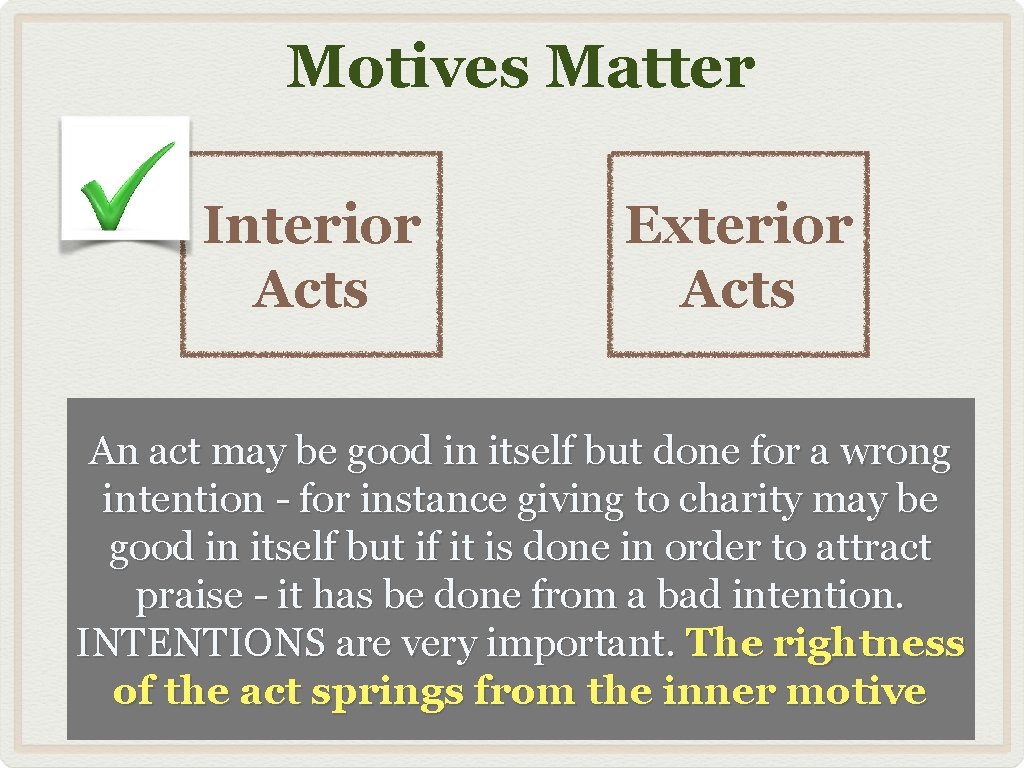
Motives Matter Interior Acts Exterior Acts An act may be good in itself but done for a wrong intention - for instance giving to charity may be good in itself but if it is done in order to attract praise - it has be done from a bad intention. INTENTIONS are very important. The rightness of the act springs from the inner motive
• What would Aquinas say to the leader of a country that introduced a law forbidding a particular tribe from receiving higher education? • What would Aquinas say about Hitler or IS?
Aquinas and Reason • For Aquinas an action is good if it furthers God's purposes for creation • If we observe the world around us and consult scripture, we can work out what behaviour most closely fits God's purposes • We need our reason to work out these natural laws!
• If we use our reason correctly we can decide on the right course of action when confronted with a moral dilemma • By employing reason, a human is putting themselves in touch with NL • For Aquinas our conscience is using our reasons in the right way to make right judgements
What if you don't know God? • Human's rational nature is given by God so that we can flourish • Even if you don't know God, Aquinas says that human reason can discover the natural laws and thus it is possible to lead a good life. But it's easiest if you are a Christian! Why? • Romans 2: 12 -16 • The Natural Laws are universal and unchangeable
The Doctrine of Double Effect • This importance of interior acts has led to the acceptance of the doctrine of double effect in the Catholic Church. • If you do something with a good intention and there is an unintended secondary outcome then that act is acceptable.
DDE - criteria • The bad effect must not be intended for itself, only permitted • There must be a proportionately grave reason for permitting the bad effect • How could the DDE justify the removal of a cancerous womb if the women is pregnant? Try it for deciding to go to war
The Virtues • Aquinas believed that there were certain characteristics that helped people become virtuous: • Fortitude • Temperance • Justice • Prudence • What are the 7 'deadly sins'?
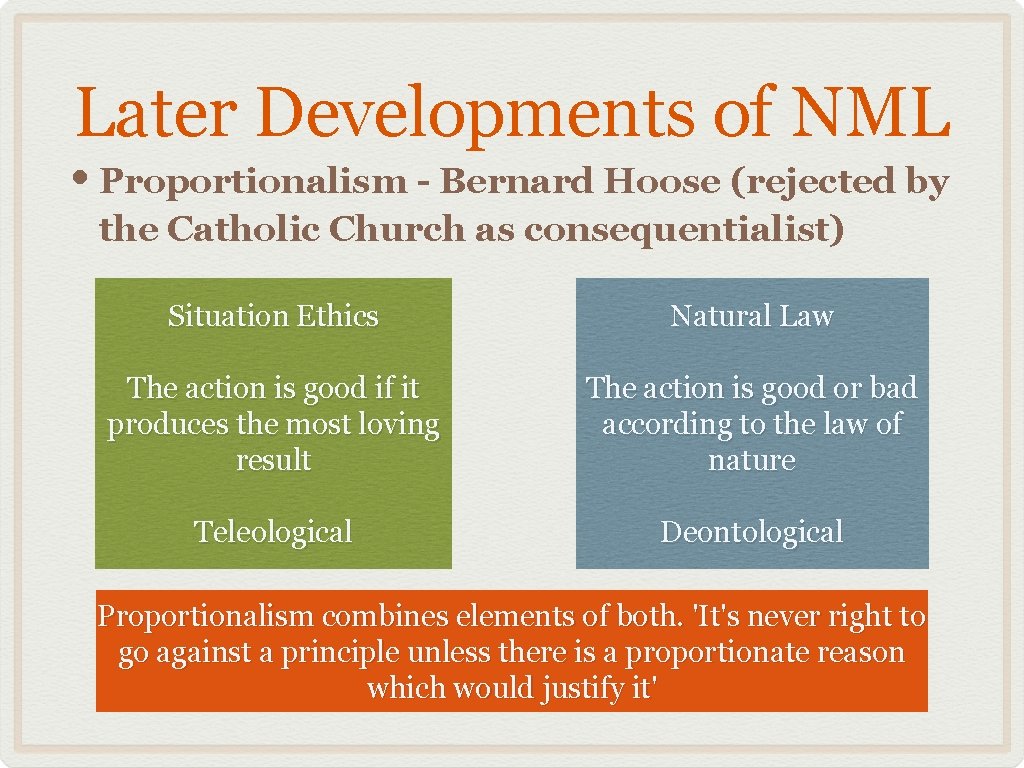
Later Developments of NML • Proportionalism - Bernard Hoose (rejected by the Catholic Church as consequentialist) Situation Ethics Natural Law The action is good if it produces the most loving result The action is good or bad according to the law of nature Teleological Deontological Proportionalism combines elements of both. 'It's never right to go against a principle unless there is a proportionate reason which would justify it'
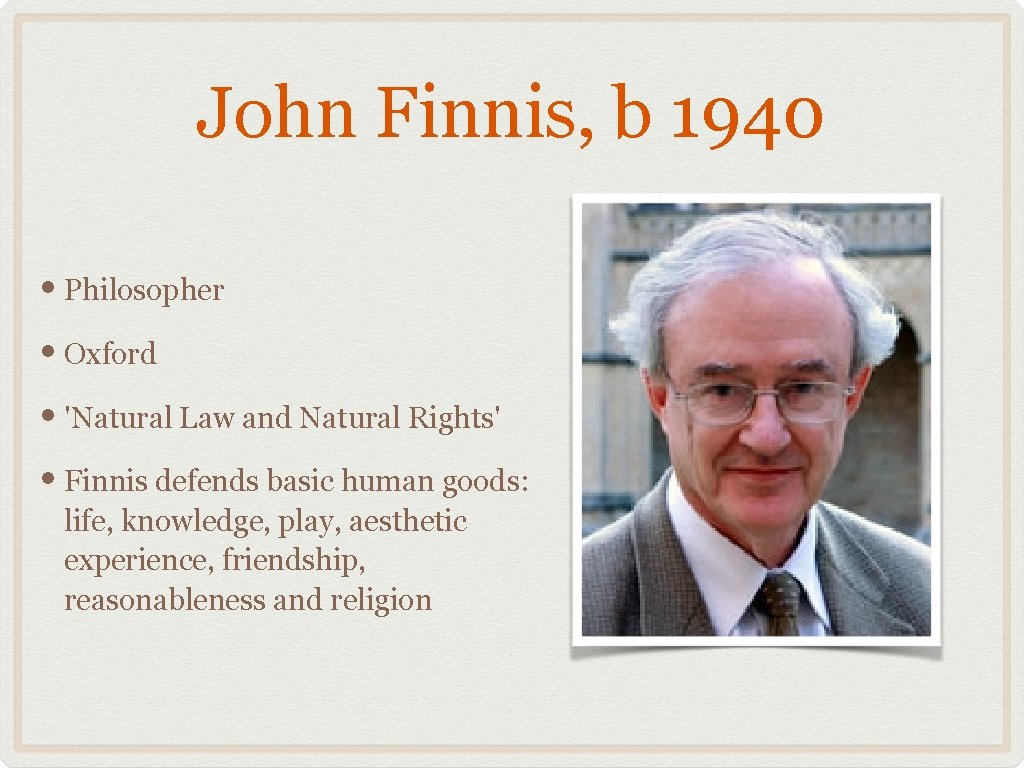
John Finnis, b 1940 • Philosopher • Oxford • 'Natural Law and Natural Rights' • Finnis defends basic human goods: life, knowledge, play, aesthetic experience, friendship, reasonableness and religion
Strengths • NL is universal and absolutist - therefore it is clear and easy to follow - it lets people know where they stand. It also gives clear grounds for punishment • It emphasises a common human nature which stresses equality • It emphasises the importance and value of human life • It makes sense to say there are common goods e. g. UN Declaration of Human Rights. It is the basis for a society with strong standards and a good way of life which brings happiness to people.
Strengths • It allows us to judge one culture over another - we don't need to say we accept FGM! • Even if we say Aquinas got the primary precepts wrong - that does not mean NL must be wrong! The principle could be right. • Newer versions of NL are more flexible e. g. Proportionalism
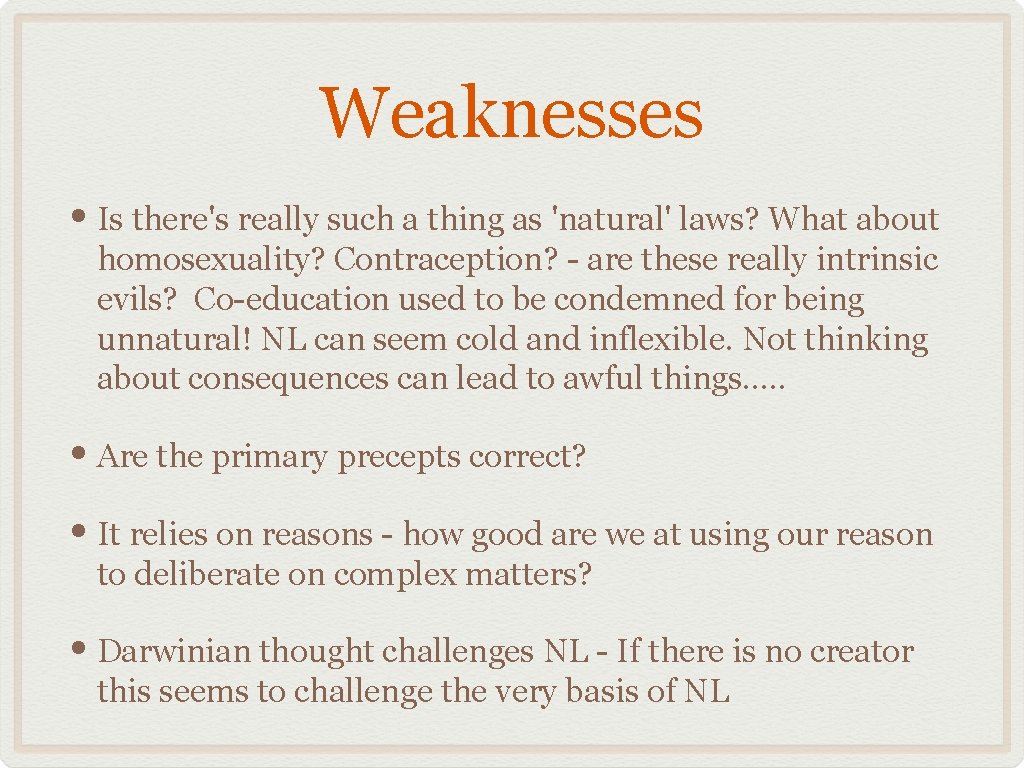
Weaknesses • Is there's really such a thing as 'natural' laws? What about homosexuality? Contraception? - are these really intrinsic evils? Co-education used to be condemned for being unnatural! NL can seem cold and inflexible. Not thinking about consequences can lead to awful things. . . • Are the primary precepts correct? • It relies on reasons - how good are we at using our reason to deliberate on complex matters? • Darwinian thought challenges NL - If there is no creator this seems to challenge the very basis of NL
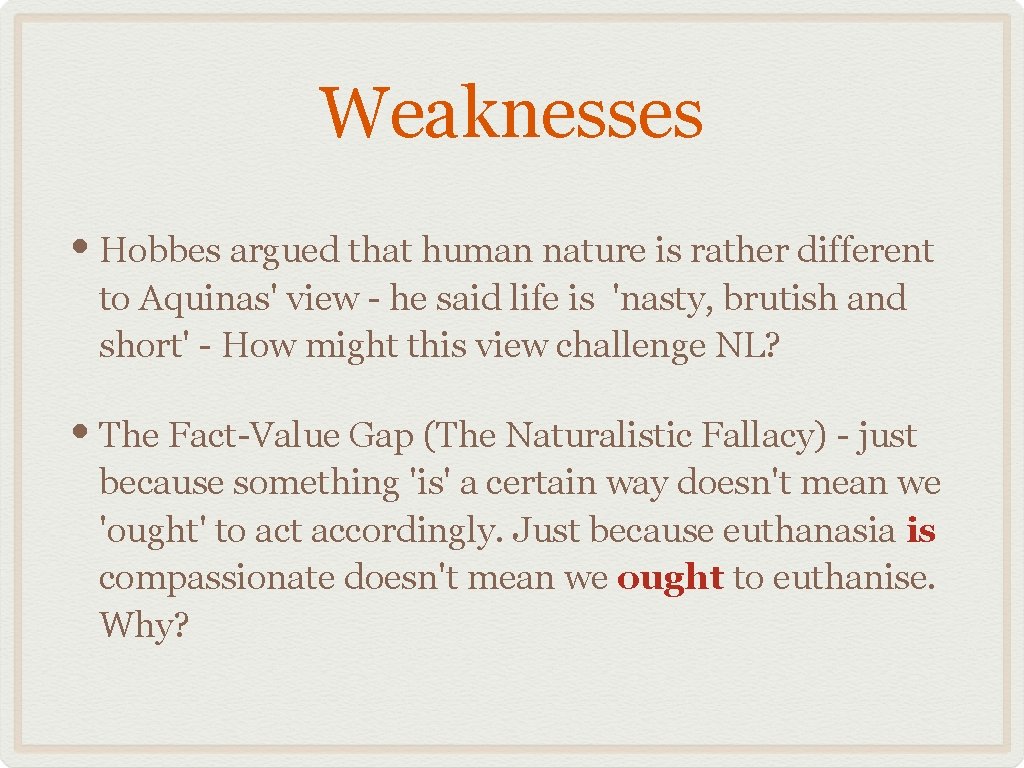
Weaknesses • Hobbes argued that human nature is rather different to Aquinas' view - he said life is 'nasty, brutish and short' - How might this view challenge NL? • The Fact-Value Gap (The Naturalistic Fallacy) - just because something 'is' a certain way doesn't mean we 'ought' to act accordingly. Just because euthanasia is compassionate doesn't mean we ought to euthanise. Why?
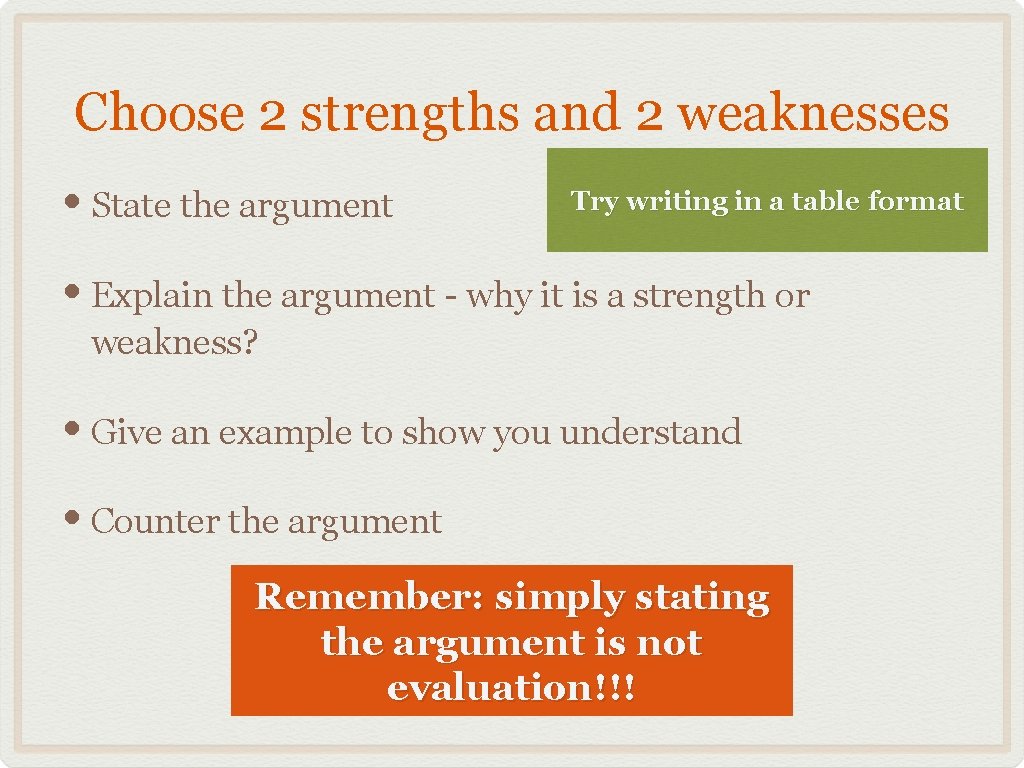
Choose 2 strengths and 2 weaknesses • State the argument Try writing in a table format • Explain the argument - why it is a strength or weakness? • Give an example to show you understand • Counter the argument Remember: simply stating the argument is not evaluation!!!
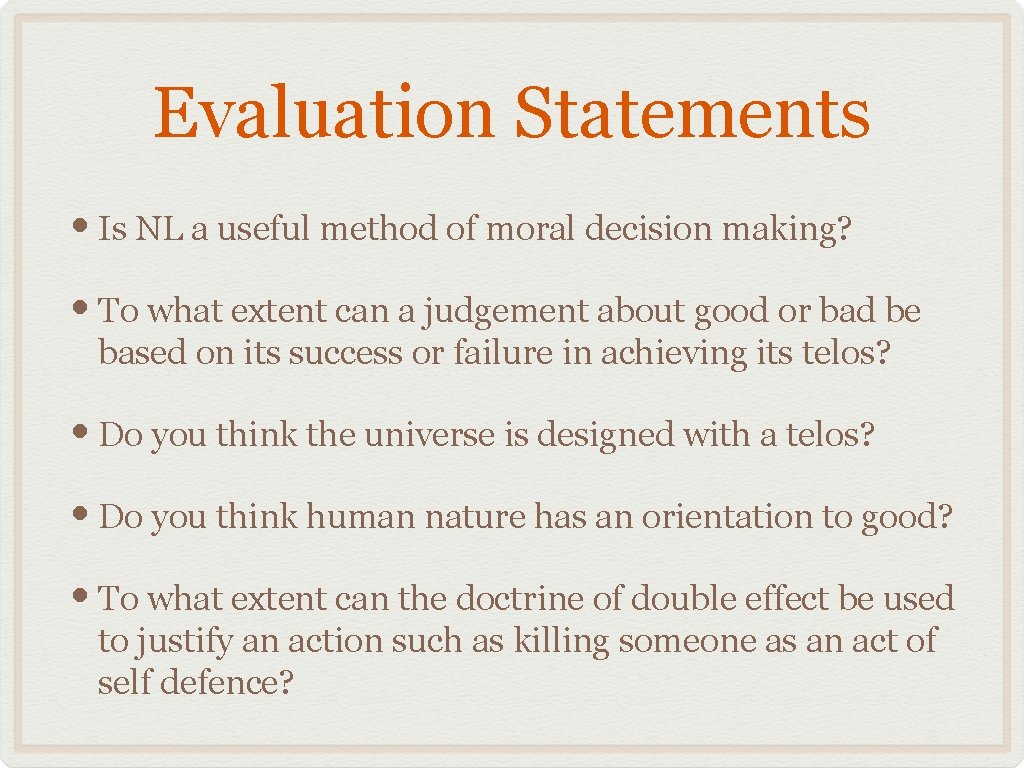
Evaluation Statements • Is NL a useful method of moral decision making? • To what extent can a judgement about good or bad be based on its success or failure in achieving its telos? • Do you think the universe is designed with a telos? • Do you think human nature has an orientation to good? • To what extent can the doctrine of double effect be used to justify an action such as killing someone as an act of self defence?