
Natural Language Processing Part 1 Aspects of language
![Semantic analysis john eats proper_noun v [person: john] λYλX eat(X, Y) an apple. det](https://slidetodoc.com/presentation_image_h2/d75961dd70c2ce1c36ee27fe2bc28fd3/image-8.jpg "Semantic analysis john eats proper_noun v [person: john] λYλX eat(X, Y) an apple. det")
- Slides: 20
Natural Language Processing Part 1
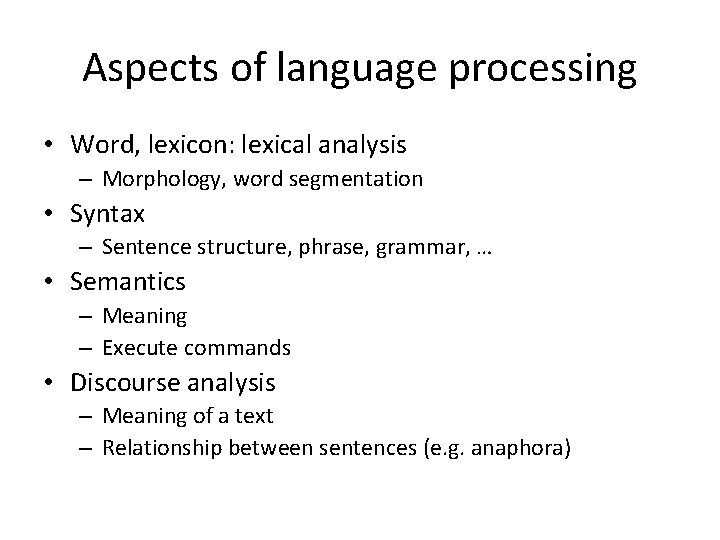
Aspects of language processing • Word, lexicon: lexical analysis – Morphology, word segmentation • Syntax – Sentence structure, phrase, grammar, … • Semantics – Meaning – Execute commands • Discourse analysis – Meaning of a text – Relationship between sentences (e. g. anaphora)
Applications • • • Detect new words Language learning Machine translation NL interface Information retrieval …
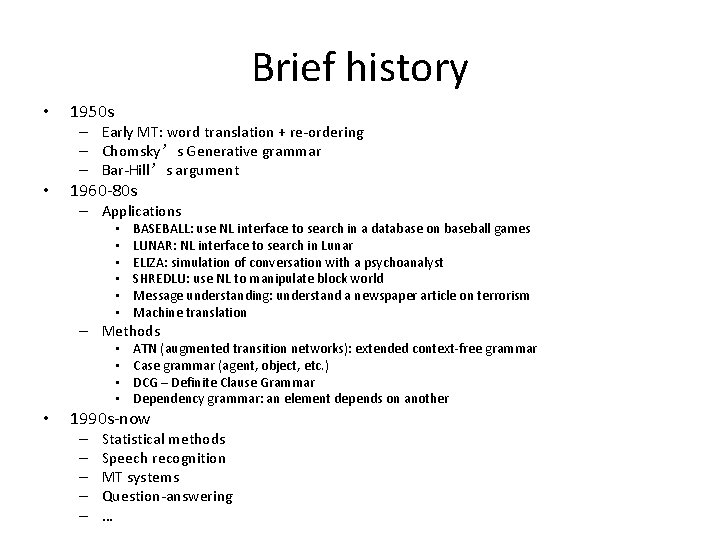
Brief history • 1950 s – Early MT: word translation + re-ordering – Chomsky’s Generative grammar – Bar-Hill’s argument • 1960 -80 s – Applications • • • BASEBALL: use NL interface to search in a database on baseball games LUNAR: NL interface to search in Lunar ELIZA: simulation of conversation with a psychoanalyst SHREDLU: use NL to manipulate block world Message understanding: understand a newspaper article on terrorism Machine translation – Methods • • • ATN (augmented transition networks): extended context-free grammar Case grammar (agent, object, etc. ) DCG – Definite Clause Grammar Dependency grammar: an element depends on another 1990 s-now – – – Statistical methods Speech recognition MT systems Question-answering …
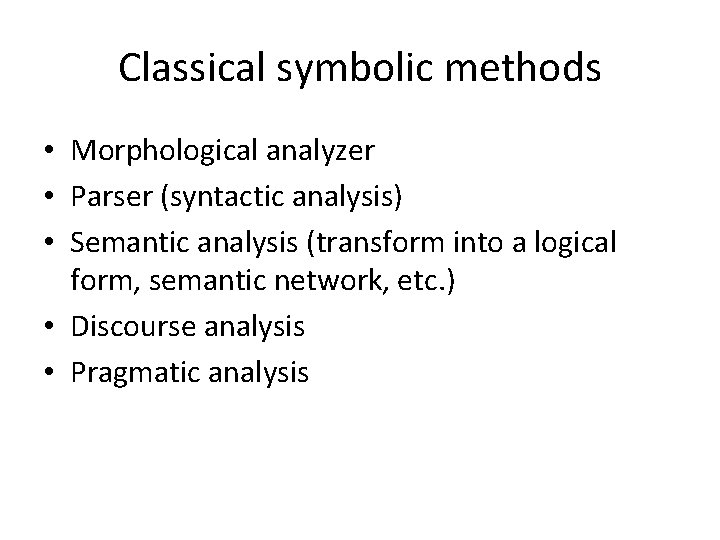
Classical symbolic methods • Morphological analyzer • Parser (syntactic analysis) • Semantic analysis (transform into a logical form, semantic network, etc. ) • Discourse analysis • Pragmatic analysis
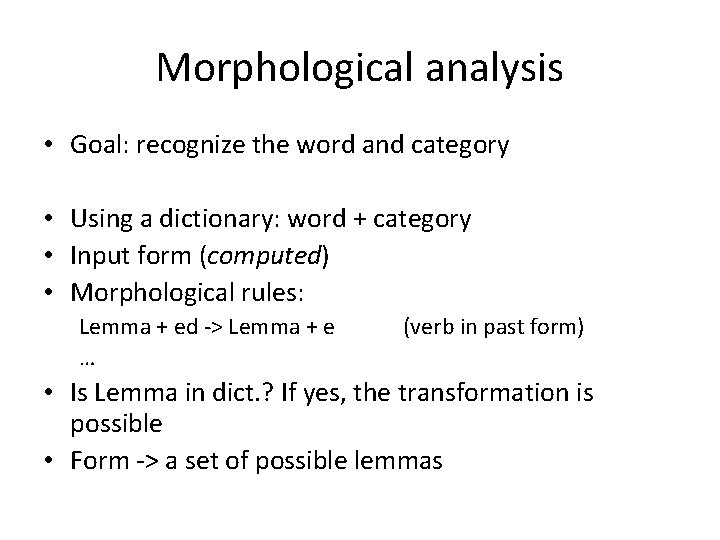
Morphological analysis • Goal: recognize the word and category • Using a dictionary: word + category • Input form (computed) • Morphological rules: Lemma + ed -> Lemma + e … (verb in past form) • Is Lemma in dict. ? If yes, the transformation is possible • Form -> a set of possible lemmas
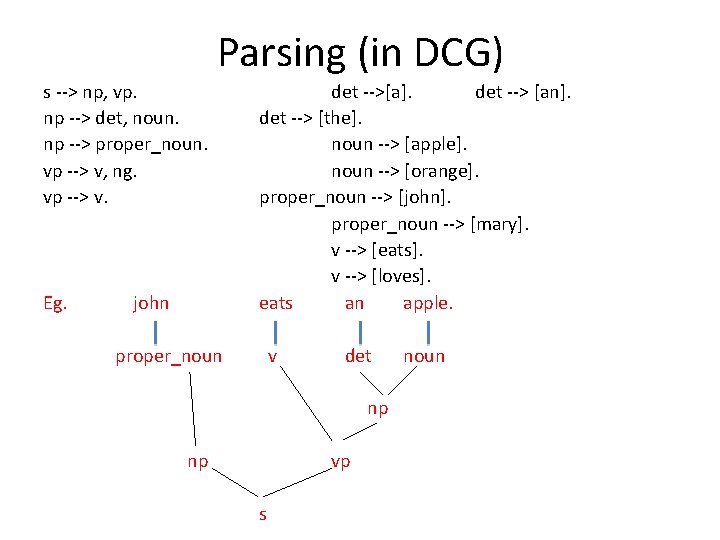
Parsing (in DCG) s --> np, vp. np --> det, noun. np --> proper_noun. vp --> v, ng. vp --> v. Eg. john det -->[a]. det --> [an]. det --> [the]. noun --> [apple]. noun --> [orange]. proper_noun --> [john]. proper_noun --> [mary]. v --> [eats]. v --> [loves]. eats an apple. proper_noun v det np np vp s noun
Semantic analysis john eats proper_noun v [person: john] λYλX eat(X, Y) an apple. det noun [apple] np [person: john] vp eat(X, [apple]) s eat([person: john], [apple]) Sem. Cat (Ontology) object animated non-anim person animal food … vertebral … fruit … apple …
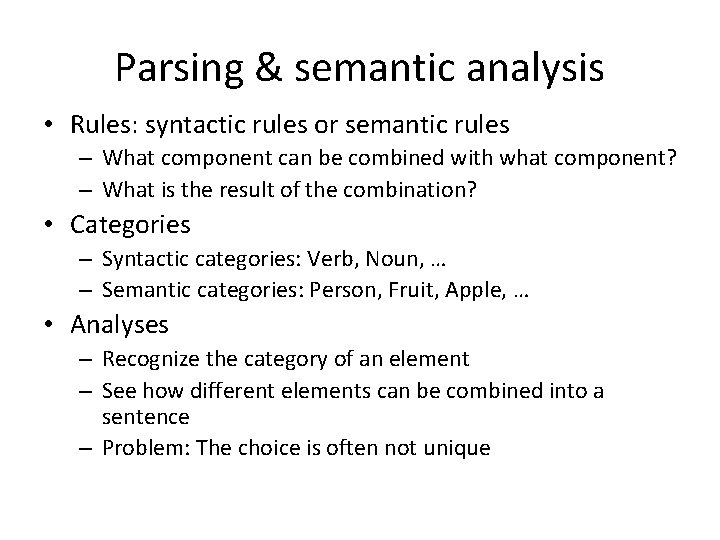
Parsing & semantic analysis • Rules: syntactic rules or semantic rules – What component can be combined with what component? – What is the result of the combination? • Categories – Syntactic categories: Verb, Noun, … – Semantic categories: Person, Fruit, Apple, … • Analyses – Recognize the category of an element – See how different elements can be combined into a sentence – Problem: The choice is often not unique
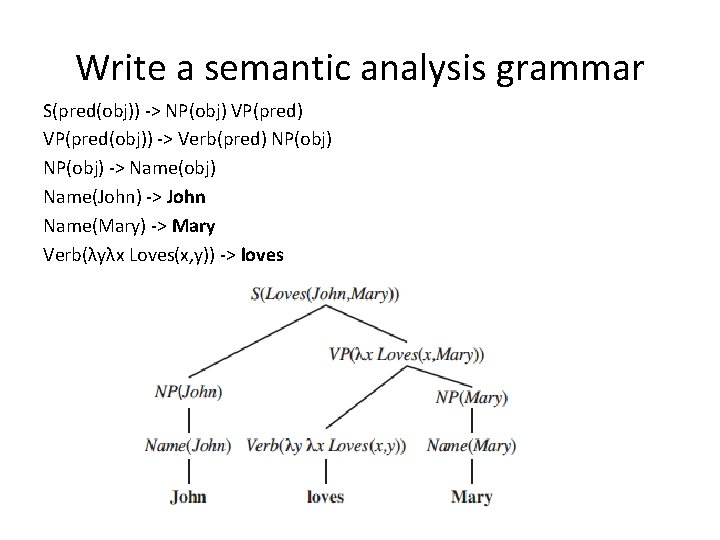
Write a semantic analysis grammar S(pred(obj)) -> NP(obj) VP(pred(obj)) -> Verb(pred) NP(obj) -> Name(obj) Name(John) -> John Name(Mary) -> Mary Verb(λyλx Loves(x, y)) -> loves
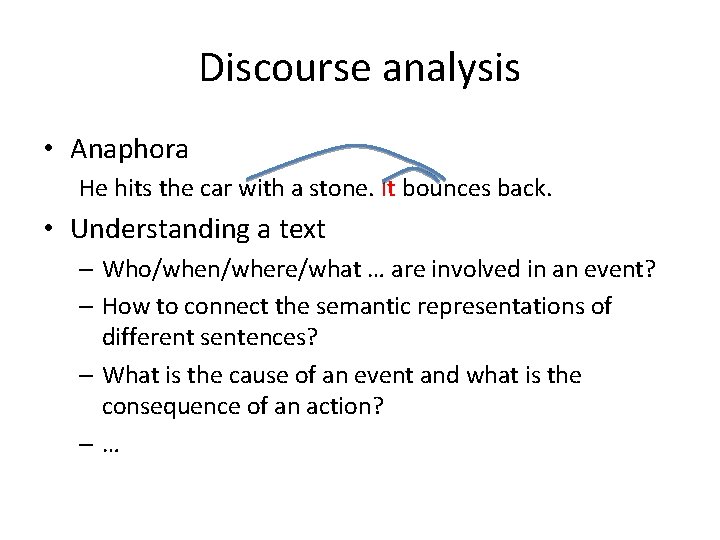
Discourse analysis • Anaphora He hits the car with a stone. It bounces back. • Understanding a text – Who/when/where/what … are involved in an event? – How to connect the semantic representations of different sentences? – What is the cause of an event and what is the consequence of an action? –…
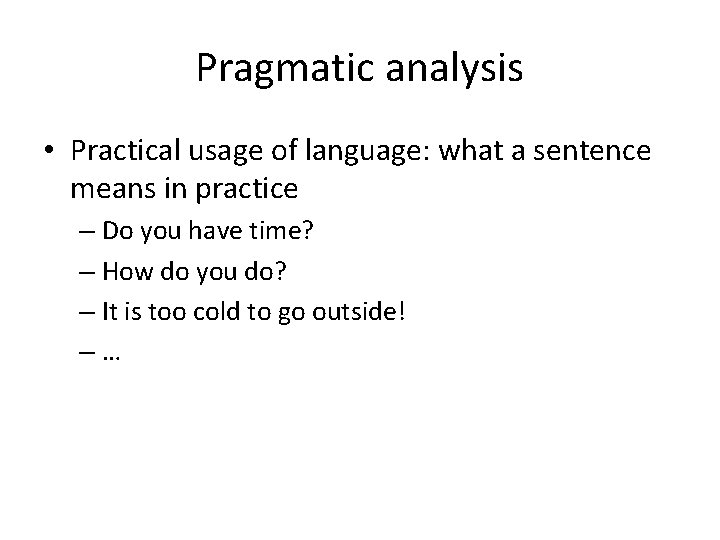
Pragmatic analysis • Practical usage of language: what a sentence means in practice – Do you have time? – How do you do? – It is too cold to go outside! –…
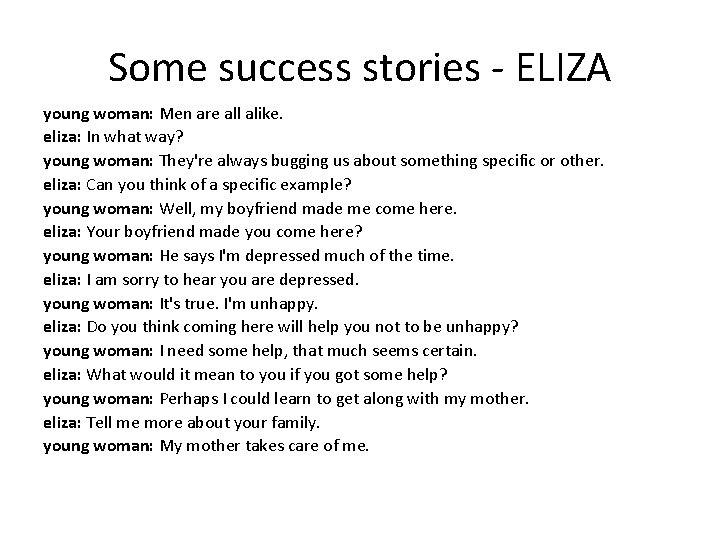
Some success stories - ELIZA young woman: Men are all alike. eliza: In what way? young woman: They're always bugging us about something specific or other. eliza: Can you think of a specific example? young woman: Well, my boyfriend made me come here. eliza: Your boyfriend made you come here? young woman: He says I'm depressed much of the time. eliza: I am sorry to hear you are depressed. young woman: It's true. I'm unhappy. eliza: Do you think coming here will help you not to be unhappy? young woman: I need some help, that much seems certain. eliza: What would it mean to you if you got some help? young woman: Perhaps I could learn to get along with my mother. eliza: Tell me more about your family. young woman: My mother takes care of me.
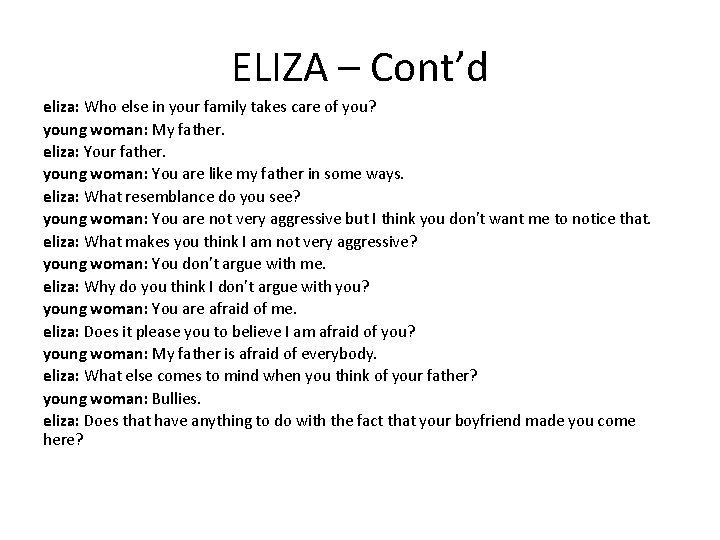
ELIZA – Cont’d eliza: Who else in your family takes care of you? young woman: My father. eliza: Your father. young woman: You are like my father in some ways. eliza: What resemblance do you see? young woman: You are not very aggressive but I think you don't want me to notice that. eliza: What makes you think I am not very aggressive? young woman: You don't argue with me. eliza: Why do you think I don't argue with you? young woman: You are afraid of me. eliza: Does it please you to believe I am afraid of you? young woman: My father is afraid of everybody. eliza: What else comes to mind when you think of your father? young woman: Bullies. eliza: Does that have anything to do with the fact that your boyfriend made you come here?
Methods used in Eliza • Find a trigger in the input of the user (e. g. father) • Evoke a possible candidate pattern (e. g. family or mother) (~limited parsing) • Compose a sentence by filling in the slots of the pattern (picking some elements from the user input) • If no appropriate pattern is found, ask a general question, possibly related to the user input
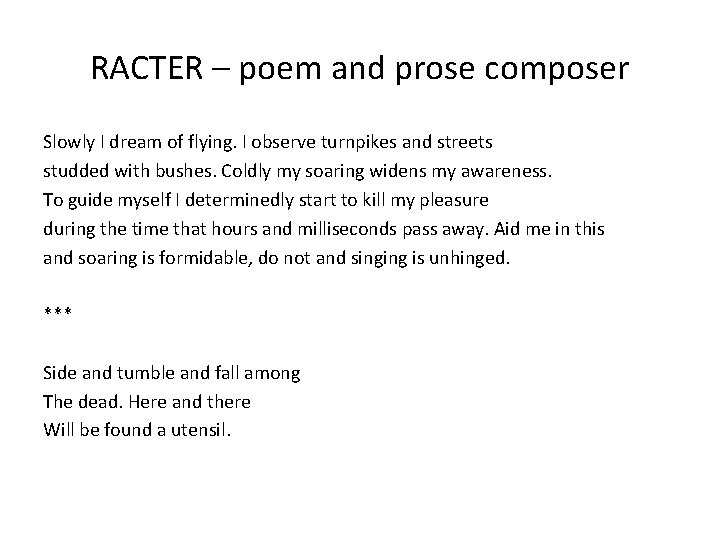
RACTER – poem and prose composer Slowly I dream of flying. I observe turnpikes and streets studded with bushes. Coldly my soaring widens my awareness. To guide myself I determinedly start to kill my pleasure during the time that hours and milliseconds pass away. Aid me in this and soaring is formidable, do not and singing is unhinged. *** Side and tumble and fall among The dead. Here and there Will be found a utensil.
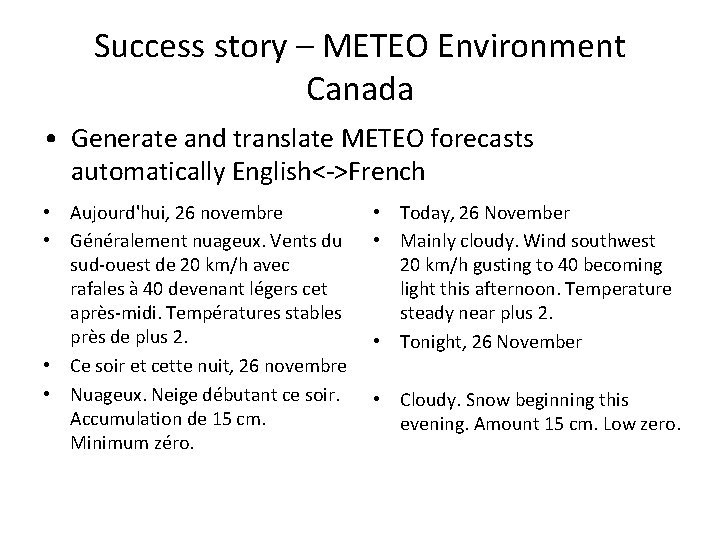
Success story – METEO Environment Canada • Generate and translate METEO forecasts automatically English<->French • Aujourd'hui, 26 novembre • Généralement nuageux. Vents du sud-ouest de 20 km/h avec rafales à 40 devenant légers cet après-midi. Températures stables près de plus 2. • Ce soir et cette nuit, 26 novembre • Nuageux. Neige débutant ce soir. Accumulation de 15 cm. Minimum zéro. • Today, 26 November • Mainly cloudy. Wind southwest 20 km/h gusting to 40 becoming light this afternoon. Temperature steady near plus 2. • Tonight, 26 November • Cloudy. Snow beginning this evening. Amount 15 cm. Low zero.
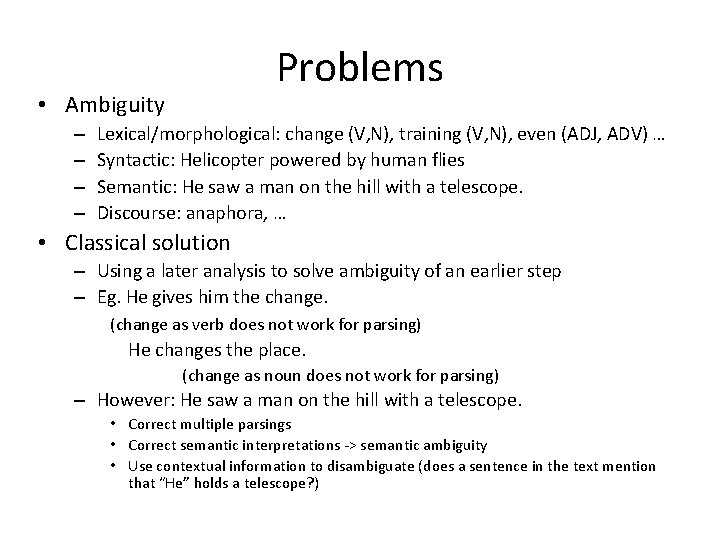
Problems • Ambiguity – – Lexical/morphological: change (V, N), training (V, N), even (ADJ, ADV) … Syntactic: Helicopter powered by human flies Semantic: He saw a man on the hill with a telescope. Discourse: anaphora, … • Classical solution – Using a later analysis to solve ambiguity of an earlier step – Eg. He gives him the change. (change as verb does not work for parsing) He changes the place. (change as noun does not work for parsing) – However: He saw a man on the hill with a telescope. • Correct multiple parsings • Correct semantic interpretations -> semantic ambiguity • Use contextual information to disambiguate (does a sentence in the text mention that “He” holds a telescope? )
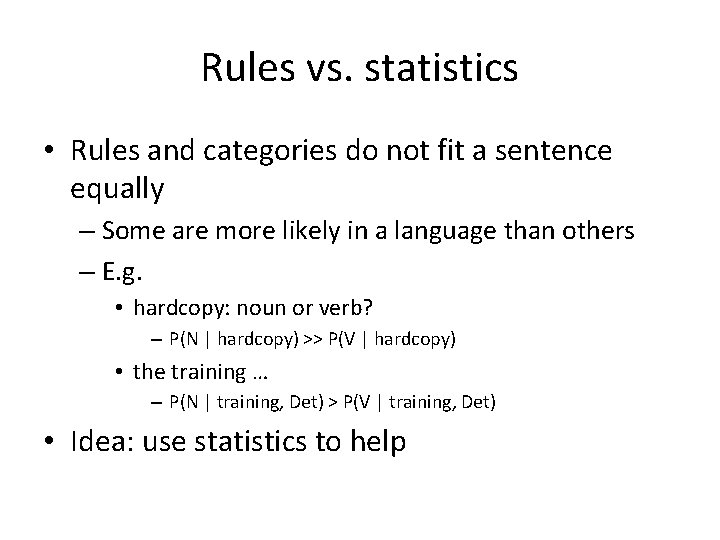
Rules vs. statistics • Rules and categories do not fit a sentence equally – Some are more likely in a language than others – E. g. • hardcopy: noun or verb? – P(N | hardcopy) >> P(V | hardcopy) • the training … – P(N | training, Det) > P(V | training, Det) • Idea: use statistics to help
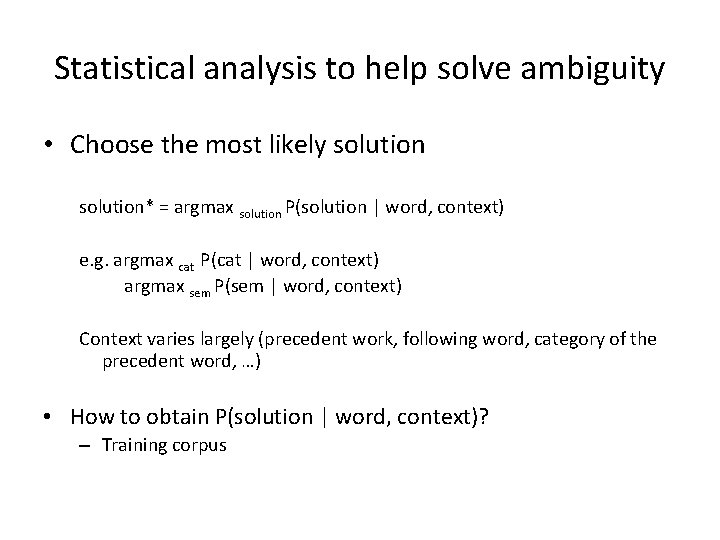
Statistical analysis to help solve ambiguity • Choose the most likely solution* = argmax solution P(solution | word, context) e. g. argmax cat P(cat | word, context) argmax sem P(sem | word, context) Context varies largely (precedent work, following word, category of the precedent word, …) • How to obtain P(solution | word, context)? – Training corpus