
Natural Gas Distribution Overview and Safety MISSOURI ONE
Natural Gas Distribution Overview and Safety MISSOURI ONE CALL SYSTEM OPERATING COMMITTEE MEETING DECEMBER 19, 2013 THE LACLEDE GROUP 1
Agenda • Laclede System Overview • Natural Gas Properties • Natural Gas Safety • Natural Gas Home Safety Tips THE LACLEDE GROUP 2
LACLEDE SYSTEM OVERVIEW THE LACLEDE GROUP 3
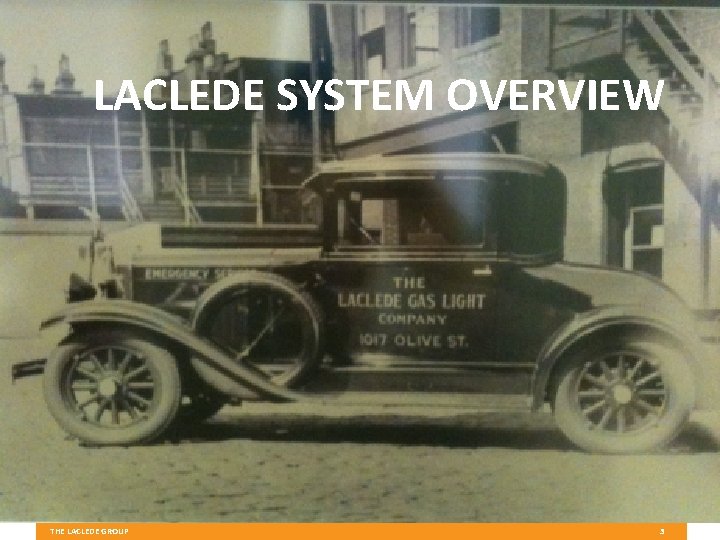
Background on Laclede Gas Company • Company was created in 1857, and named in honor of St Louis founder, Pierre Laclede Linquest. • For the first 90 years, Laclede manufactured and distributed gas, this gas was derived from burning coal in the absence of oxygen. • Starting in 1932, natural gas was introduced into the distribution system. • In 1942, Union Electric and Laclede Gas exchanged gas and electric customers. • In 1949 the distribution system began using 100% natural gas. • St Charles Gas was acquired in 1963. • MGE joins the Laclede Group in 2013. THE LACLEDE GROUP 4

Laclede Group Service Area THE LACLEDE GROUP 5

Laclede Group System Overview • Natural Gas Transmission Lines – 276 miles • Natural Gas Distribution Mains – 17, 069 miles ⁻ Steel mains: 51% ⁻ Plastic mains: 42% ⁻ Cast iron mains: 7% • Natural Gas Distribution Service Line – 1, 118, 0734 services ⁻ Steel services: 14% ⁻ Plastic services: 80% ⁻ Hard copper services: 6% • Highly Volatile Liquid Line (HVL) – 39 miles (Propane and Butane) Note: All values based on CY 2012 reporting. THE LACLEDE GROUP 6
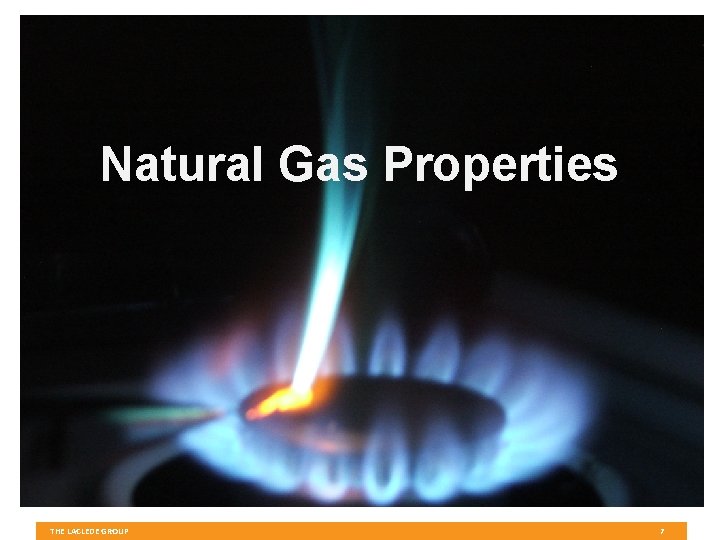
Natural Gas Properties THE LACLEDE GROUP 7
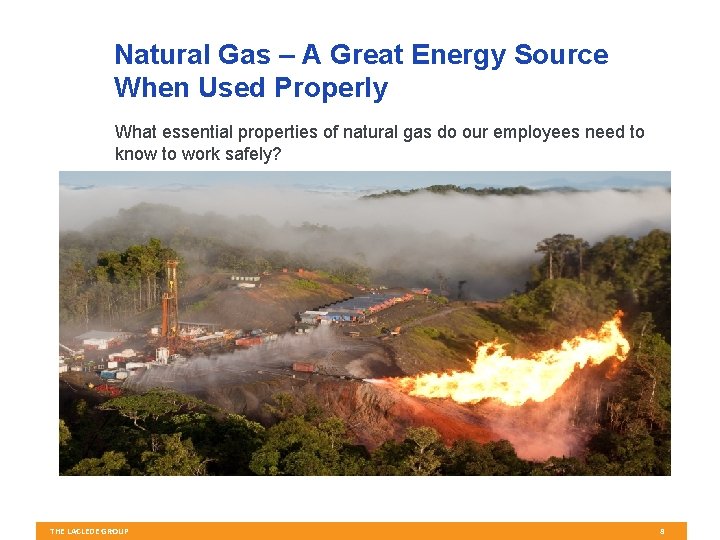
Natural Gas – A Great Energy Source When Used Properly What essential properties of natural gas do our employees need to know to work safely? THE LACLEDE GROUP 8
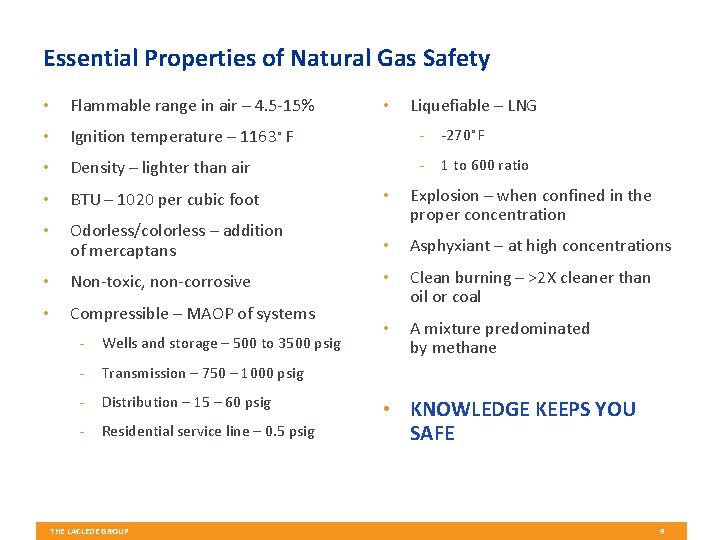
Essential Properties of Natural Gas Safety • Flammable range in air – 4. 5 -15% • Ignition temperature – 1163◦ F - -270◦ F • Density – lighter than air - 1 to 600 ratio • BTU – 1020 per cubic foot • • Odorless/colorless – addition of mercaptans Explosion – when confined in the proper concentration • Asphyxiant – at high concentrations • Non-toxic, non-corrosive • • Compressible – MAOP of systems Clean burning – >2 X cleaner than oil or coal • A mixture predominated by methane - Wells and storage – 500 to 3500 psig - Transmission – 750 – 1000 psig - Distribution – 15 – 60 psig - Residential service line – 0. 5 psig THE LACLEDE GROUP • Liquefiable – LNG • KNOWLEDGE KEEPS YOU SAFE 9
NATURAL GAS SAFETY THE LACLEDE GROUP 10
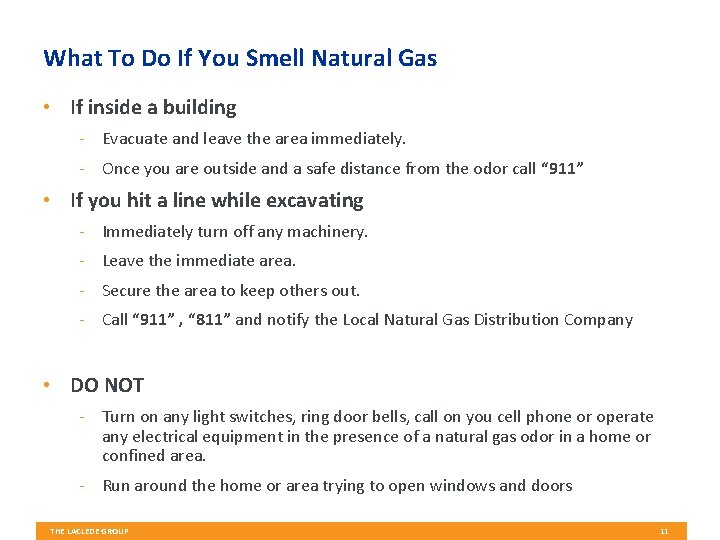
What To Do If You Smell Natural Gas • If inside a building - Evacuate and leave the area immediately. - Once you are outside and a safe distance from the odor call “ 911” • If you hit a line while excavating - Immediately turn off any machinery. - Leave the immediate area. - Secure the area to keep others out. - Call “ 911” , “ 811” and notify the Local Natural Gas Distribution Company • DO NOT - Turn on any light switches, ring door bells, call on you cell phone or operate any electrical equipment in the presence of a natural gas odor in a home or confined area. - Run around the home or area trying to open windows and doors THE LACLEDE GROUP 11
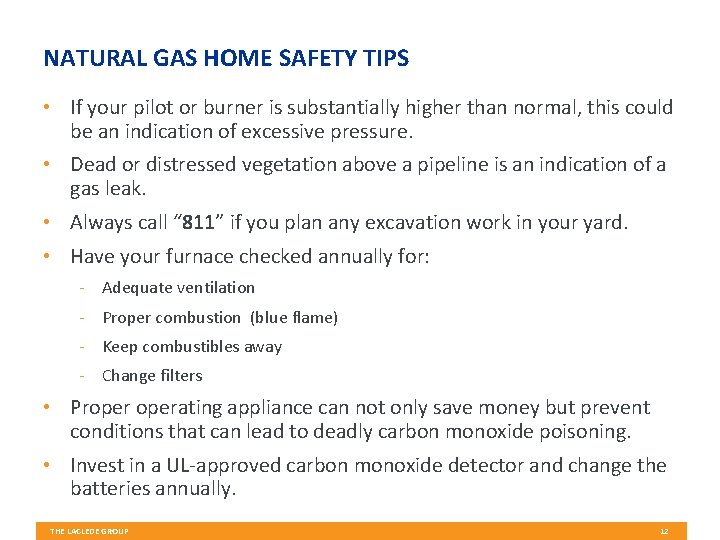
NATURAL GAS HOME SAFETY TIPS • If your pilot or burner is substantially higher than normal, this could be an indication of excessive pressure. • Dead or distressed vegetation above a pipeline is an indication of a gas leak. • Always call “ 811” if you plan any excavation work in your yard. • Have your furnace checked annually for: - Adequate ventilation - Proper combustion (blue flame) - Keep combustibles away - Change filters • Properating appliance can not only save money but prevent conditions that can lead to deadly carbon monoxide poisoning. • Invest in a UL-approved carbon monoxide detector and change the batteries annually. THE LACLEDE GROUP 12
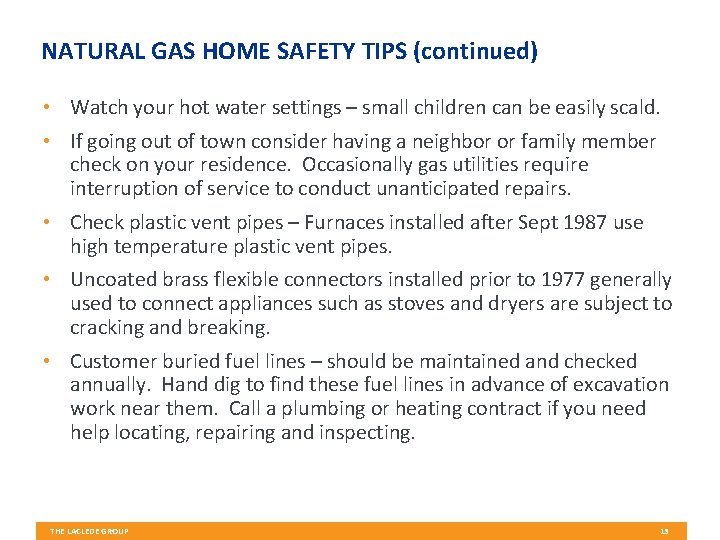
NATURAL GAS HOME SAFETY TIPS (continued) • Watch your hot water settings – small children can be easily scald. • If going out of town consider having a neighbor or family member check on your residence. Occasionally gas utilities require interruption of service to conduct unanticipated repairs. • Check plastic vent pipes – Furnaces installed after Sept 1987 use high temperature plastic vent pipes. • Uncoated brass flexible connectors installed prior to 1977 generally used to connect appliances such as stoves and dryers are subject to cracking and breaking. • Customer buried fuel lines – should be maintained and checked annually. Hand dig to find these fuel lines in advance of excavation work near them. Call a plumbing or heating contract if you need help locating, repairing and inspecting. THE LACLEDE GROUP 13

Q&A
- Slides: 14