
Natural fibres as reinforcements for composites Richard Cullen
Natural fibres as reinforcements for composites Richard Cullen and John Summerscales Flax Field, Providence by Hazel Barker From http: //www. art. com/asp/sp-asp/_/pd--10125356/Flax_Field_Providence. htm
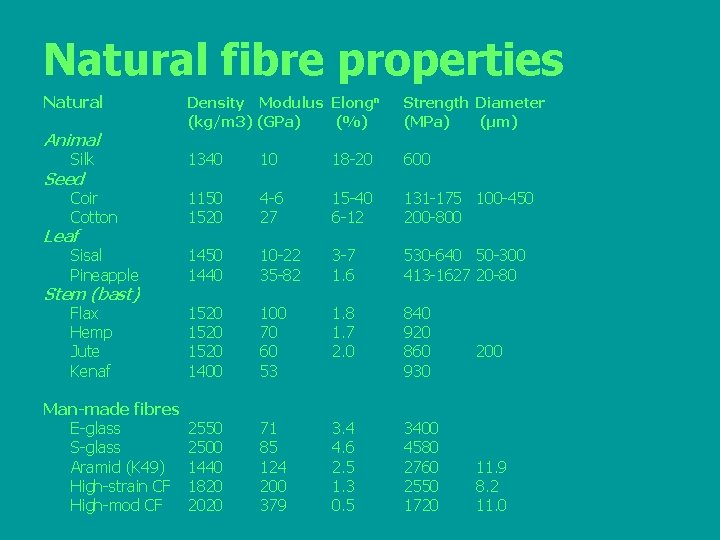
Natural fibre properties Natural Density Modulus Elongn (kg/m 3) (GPa) (%) Strength Diameter (MPa) (μm) Silk 1340 10 18 -20 600 Coir Cotton 1150 1520 4 -6 27 15 -40 6 -12 131 -175 100 -450 200 -800 Sisal Pineapple 1450 1440 10 -22 35 -82 3 -7 1. 6 530 -640 50 -300 413 -1627 20 -80 Flax Hemp Jute Kenaf 1520 1400 100 70 60 53 1. 8 1. 7 2. 0 840 920 860 930 2550 2500 1440 1820 2020 71 85 124 200 379 3. 4 4. 6 2. 5 1. 3 0. 5 3400 4580 2760 2550 1720 Animal Seed Leaf Stem (bast) Man-made fibres E-glass S-glass Aramid (K 49) High-strain CF High-mod CF 200 11. 9 8. 2 11. 0
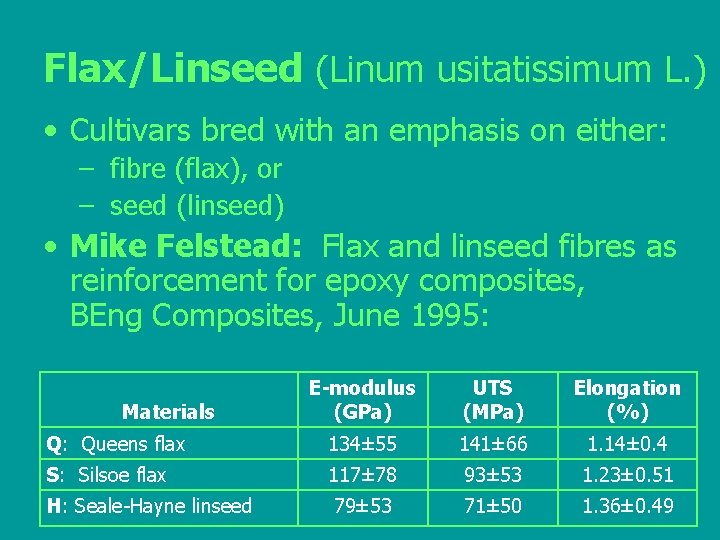
Flax/Linseed (Linum usitatissimum L. ) • Cultivars bred with an emphasis on either: – fibre (flax), or – seed (linseed) • Mike Felstead: Flax and linseed fibres as reinforcement for epoxy composites, BEng Composites, June 1995: E-modulus (GPa) UTS (MPa) Elongation (%) Q: Queens flax 134± 55 141± 66 1. 14± 0. 4 S: Silsoe flax 117± 78 93± 53 1. 23± 0. 51 H: Seale-Hayne linseed 79± 53 71± 50 1. 36± 0. 49 Materials
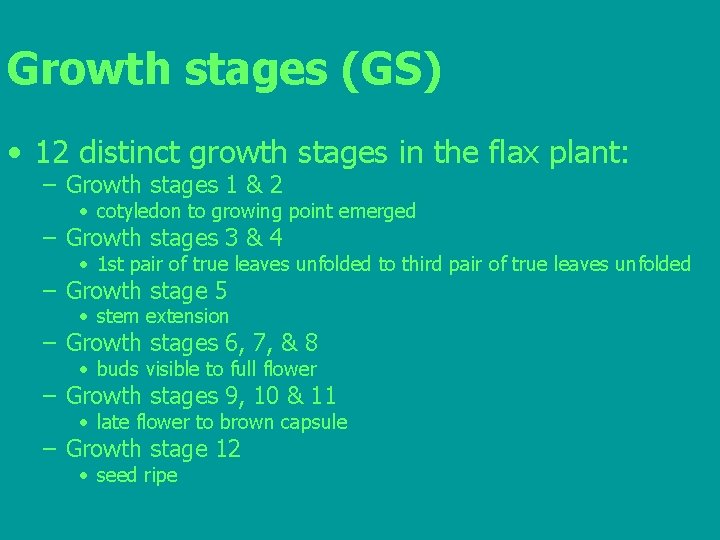
Growth stages (GS) • 12 distinct growth stages in the flax plant: – Growth stages 1 & 2 • cotyledon to growing point emerged – Growth stages 3 & 4 • 1 st pair of true leaves unfolded to third pair of true leaves unfolded – Growth stage 5 • stem extension – Growth stages 6, 7, & 8 • buds visible to full flower – Growth stages 9, 10 & 11 • late flower to brown capsule – Growth stage 12 • seed ripe
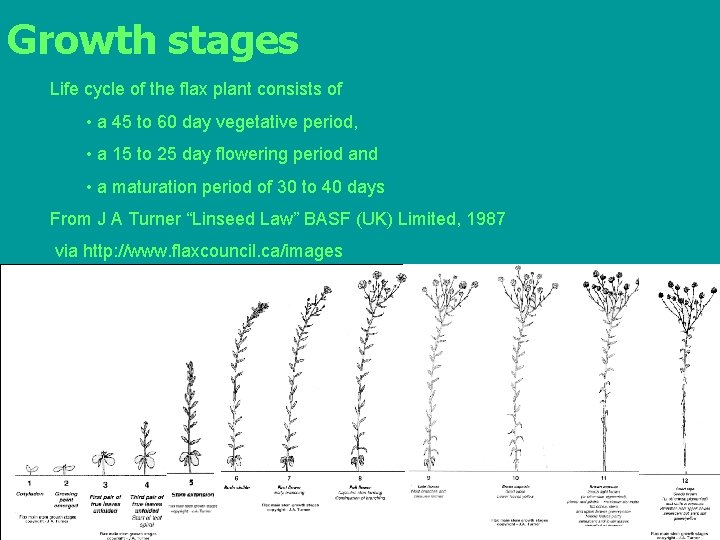
Growth stages Life cycle of the flax plant consists of • a 45 to 60 day vegetative period, • a 15 to 25 day flowering period and • a maturation period of 30 to 40 days From J A Turner “Linseed Law” BASF (UK) Limited, 1987 via http: //www. flaxcouncil. ca/images
Key resources • Flax Council of Canada http: //www. flaxcouncil. ca/ • Interactive European Network for Industrial Crops and their Applications http: //www. ienica. net/crops/flax. pdf http: //www. ienica. net/crops/linseed. pdf • Flax (Linen) http: //www. swicofil. com/products/003 flax. html
Hemp (Cannabis sativa L. ) • Physical , Chemical and Pulping Characteristics of Hemp http: //www. forestry. utoronto. ca/wood/fatima. htm • Michael Karus: European hemp industry 2001: cultivation, processing, and product lines http: //www. chanvre-info. ch/info/en/article 581. html • Marianne Leupin: New processing with hemp http: //www. texma. org/hemp 1. pdf
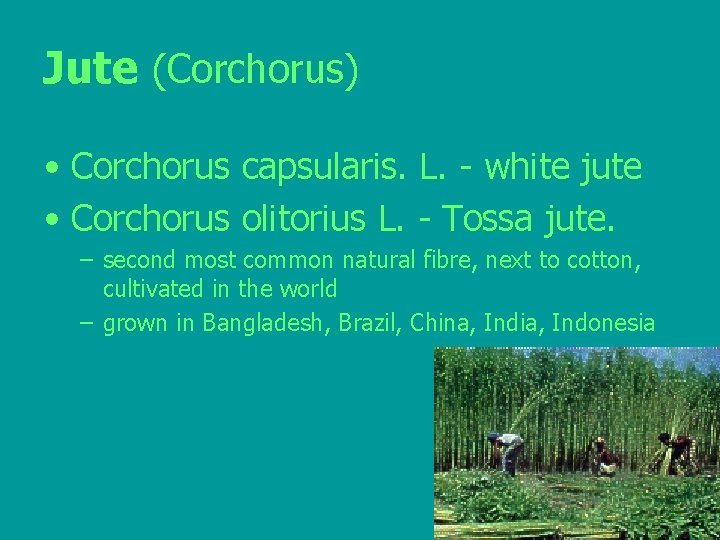
Jute (Corchorus) • Corchorus capsularis. L. - white jute • Corchorus olitorius L. - Tossa jute. – second most common natural fibre, next to cotton, cultivated in the world – grown in Bangladesh, Brazil, China, India, Indonesia
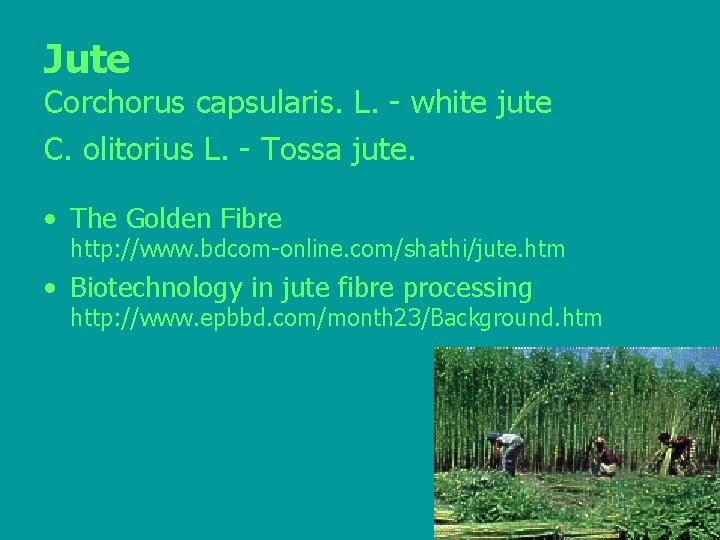
Jute Corchorus capsularis. L. - white jute C. olitorius L. - Tossa jute. • The Golden Fibre http: //www. bdcom-online. com/shathi/jute. htm • Biotechnology in jute fibre processing http: //www. epbbd. com/month 23/Background. htm
Kenaf (Hibiscus cannabinus L. ) • fibre plant native to east-central Africa. • common wild plant of tropical and subtropical Africa and Asia • grown for several thousand years for food and fibre • unique combination of long bast and short core fibres • two crops/year in Malaysia
Kenaf • PJ Le. Mahieu, ES Oplinger and DH Putnam Alternative Field Crops Manual: Kenaf, April 1991 http: //corn. agronomy. wisc. edu/alternativecrops/Kenaf. htm • Charles S Taylor Kenaf: an emerging new crop industry, 1993 (in New Crops, 1993) http: //www. hort. purdue. edu/newcrop/proceedings/v 2 -402. html • Daniel E Kugler Kenaf commercialisation: 1986 -1995 (in Progress in New Crops, 1996) http: //www. hort. purdue. edu/newcrop/proceedings 1996/v 3 -129. html • T Sellers, GD Miller, MJ Fuller, JG Broder and RR. Loper Lignocellulosic-Based Composites Made of Core From Kenaf: An Annual Agricultural Crop http: //www. ersac. umn. edu/iufronet/d 5/wu 50501/pu 50501. htm
Nettle (Urtica dioica) • Nettles yield ~ 8 -10 tonnes fibre/acre http: //jacksonsrow. topcities. com/tikun_olam/nettle. html • far stronger than cotton but is finer than other bast fibres such as hemp • much more environmentally friendly fibre crop than cotton, which requires more irrigation and agrochemical input
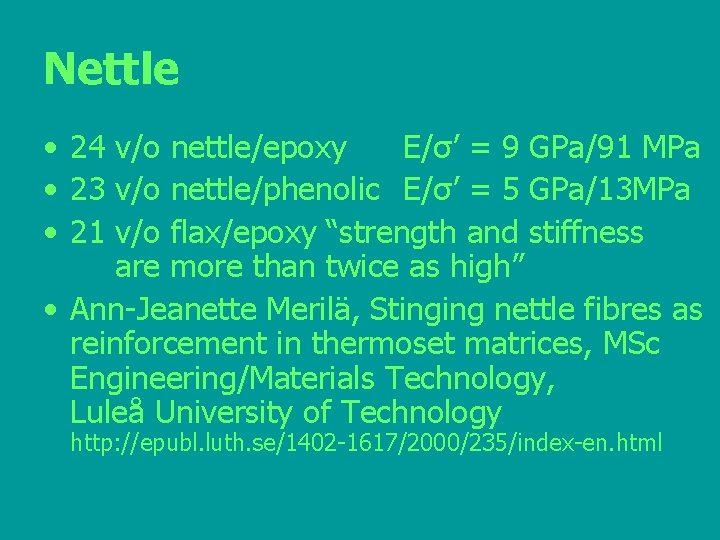
Nettle • 24 v/o nettle/epoxy E/σ’ = 9 GPa/91 MPa • 23 v/o nettle/phenolic E/σ’ = 5 GPa/13 MPa • 21 v/o flax/epoxy “strength and stiffness are more than twice as high” • Ann-Jeanette Merilä, Stinging nettle fibres as reinforcement in thermoset matrices, MSc Engineering/Materials Technology, Luleå University of Technology http: //epubl. luth. se/1402 -1617/2000/235/index-en. html
STING • Sustainable Technology In Nettle Growing • STING is a three and a half year LINK project sponsored by Defra through the Sustainable Technologies Initiative • Co-ordinated by De Montfort University
Crop Index • Purdue University Center for New Crops and Plant Products crops are listed alphabetically by genus and common name http: //www. hort. purdue. edu/newcrop/Indices/index_ab. html
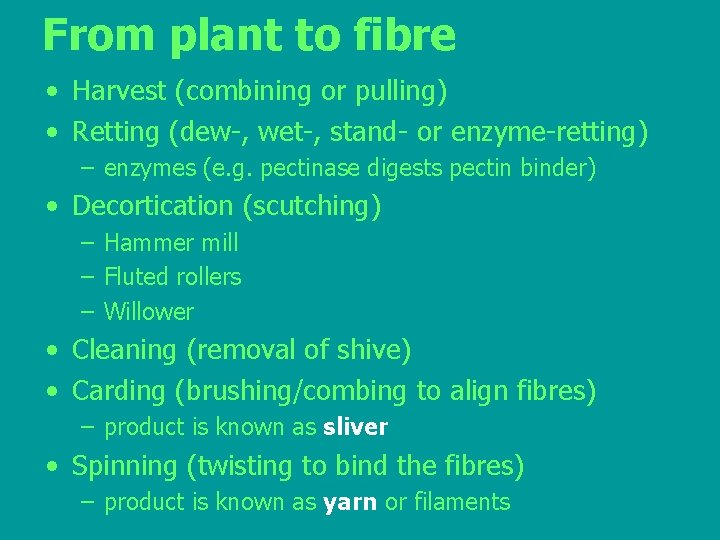
From plant to fibre • Harvest (combining or pulling) • Retting (dew-, wet-, stand- or enzyme-retting) – enzymes (e. g. pectinase digests pectin binder) • Decortication (scutching) – Hammer mill – Fluted rollers – Willower • Cleaning (removal of shive) • Carding (brushing/combing to align fibres) – product is known as sliver • Spinning (twisting to bind the fibres) – product is known as yarn or filaments
Environmental issues • Depletion of soil nutrients/fertiliser • Competition from weeds/herbicides • Competition from animals/pesticides Economic issues • Agricultural subsidies • Dependence on weather • Market price vs other producers
The future ? • Extracting fibre without damage • Effective coupling agents – cellulose chemistry instead of silanes • Environmental durability – barriers to prevent moisture absorption – sterilise fibres to prevent biodeterioration • Other issues ?
- Slides: 18