
Natural exponential functions Filling of bath is a
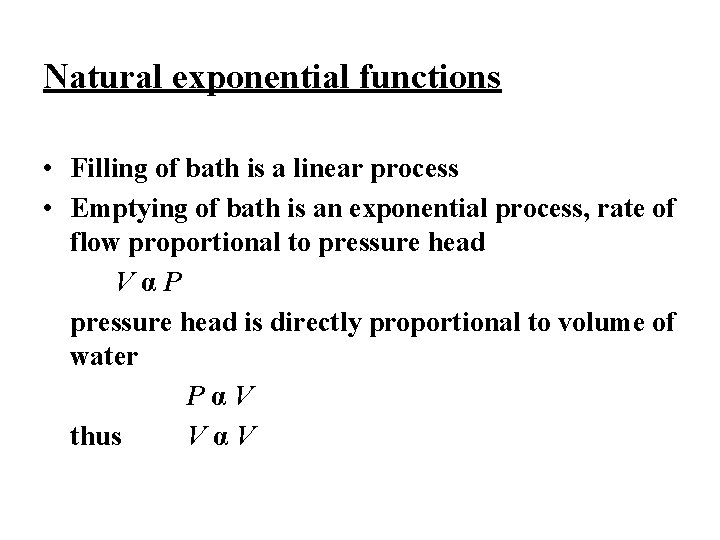
Natural exponential functions • Filling of bath is a linear process • Emptying of bath is an exponential process, rate of flow proportional to pressure head VαP pressure head is directly proportional to volume of water PαV thus VαV
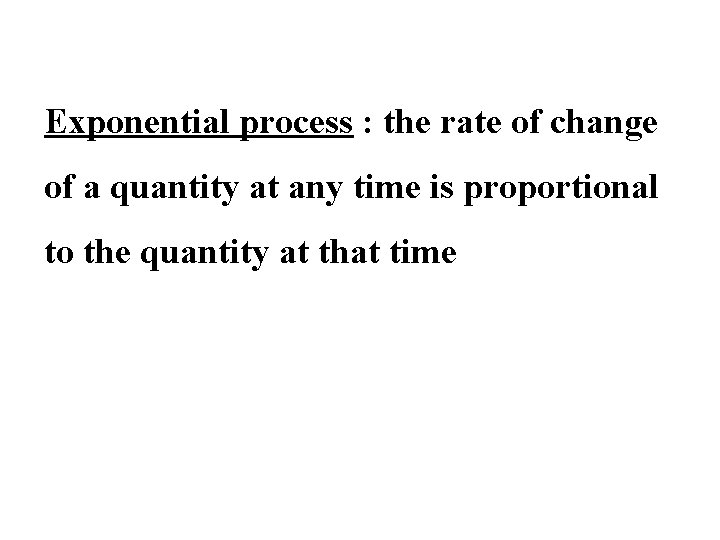
Exponential process : the rate of change of a quantity at any time is proportional to the quantity at that time
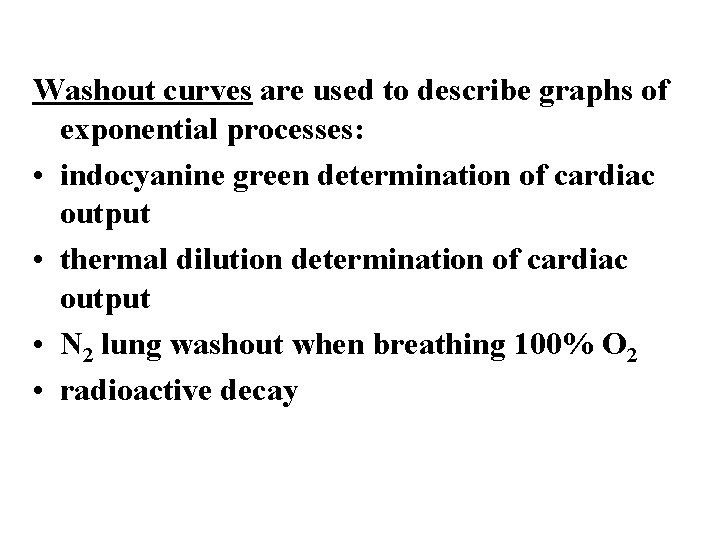
Washout curves are used to describe graphs of exponential processes: • indocyanine green determination of cardiac output • thermal dilution determination of cardiac output • N 2 lung washout when breathing 100% O 2 • radioactive decay
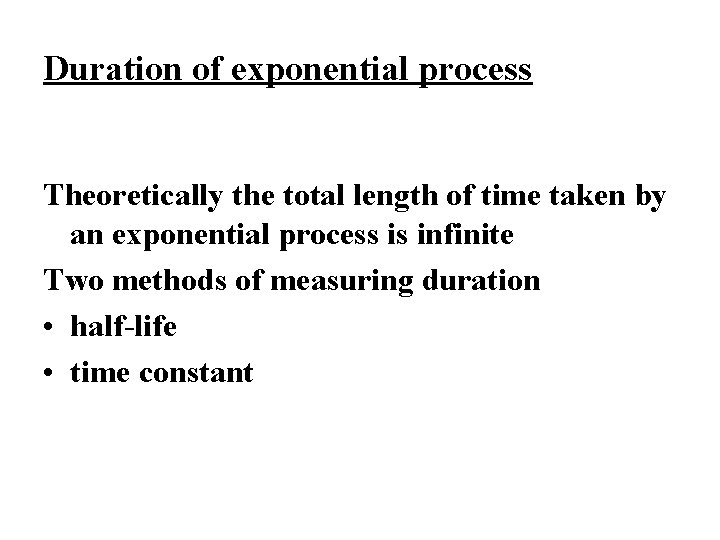
Duration of exponential process Theoretically the total length of time taken by an exponential process is infinite Two methods of measuring duration • half-life • time constant
Half-life is the time taken for the quantity to fall to half its initial value Time constant is the time at which the process would have been complete had the initial rate of change continued
Time constant τ (tau) After one time constant the quantity has fallen to 37% of its value Thus τ is longer than the half-life
Time constant for expiration is 0. 3 sec • after 0. 3 sec 37% tidal volume left • after 0. 6 sec 13. 7% tidal volume left • after 0. 9 sec 5. 1% tidal volume left Expiration 95% complete after 3 time constants
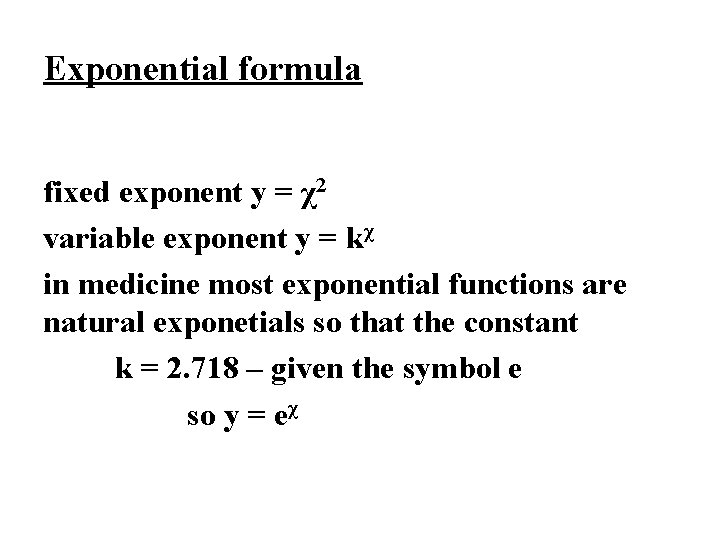
Exponential formula fixed exponent y = χ2 variable exponent y = kχ in medicine most exponential functions are natural exponetials so that the constant k = 2. 718 – given the symbol e so y = eχ
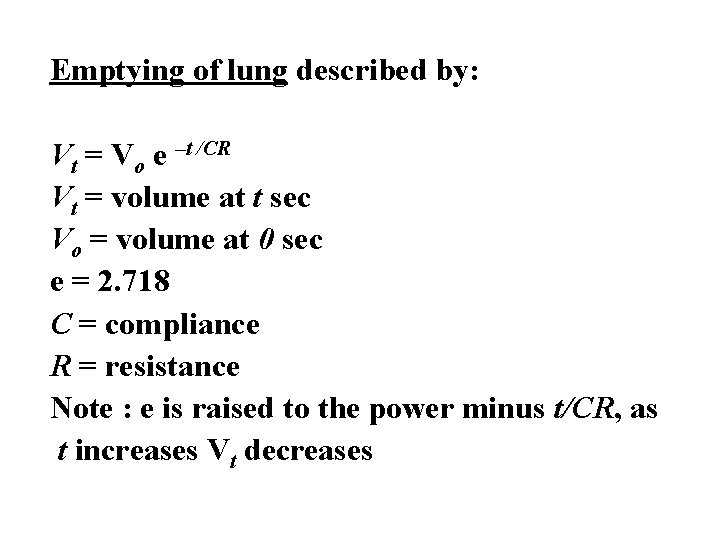
Emptying of lung described by: Vt = Vo e –t /CR Vt = volume at t sec Vo = volume at 0 sec e = 2. 718 C = compliance R = resistance Note : e is raised to the power minus t/CR, as t increases Vt decreases
Positive exponential process is not the same as the build-up exponential process • inflation of lungs by constant – pressure generator is a build-up exponential • build-up exponentials sometimes known as “washin” curves
Gas solubility For a liquid in a closed container, at equilibrium, the partial pressure exerted by the vapour is known as the saturated vapour pressure (SVP)
Henry’s law states that the amount of gas dissolved in a liquid is proportional to the partial pressure of the gas in equilibrium with the liquid at constant temperature
Factors determining solubility of a gas in liquid: • partial pressure of gas • temperature (↓ solubility with increased To) • gas • liquid concerned
Solubility coefficients • Bunsen solubility coefficient is the volume of gas, corrected to STP, which dissolves in a unit volume of liquid at temperature concerned, when the partial pressure of the gas is one standard atmosphere
• Ostwald solubility coefficient is the volume of gas which dissolves in a unit volume of liquid at temperature concerned Independent of pressure, because volume of gas is not corrected to STP
• Partition coefficient is defined as the ratio of the amount of substance present in one phase compared with another, the two phases of equal volume and in equilibrium
Partition coefficient • • phases stated temperature specified can be applied to two liquids “tension” is often used in place of partial pressure for gases in solution
Solubility and uptake of anaesthetics • inhalational agents of low solubility show rapid uptake • alveolar concentration approaches inspired concentration • alveolar concentration ≡ blood concentration • blood concentration ≡ brain concentrations
Work, energy and power Work is done, or energy expended, when the point of application of a force moves in the direction of the force One joule of work is done when a force of one newton (102 g) moves its point of application by one metre • Work done by constant pressure ventilator is the area within the P – V loop
Power is the rate of work and is measured in watts 1 watt = 1 joule/sec • power of breathing depends on type of flow. laminar flow varies with square of flow rate turbulent flow varies with cube of flow rate
- Slides: 20