
Natural Exponential Function Natural Exponential Function The base
Natural Exponential Function
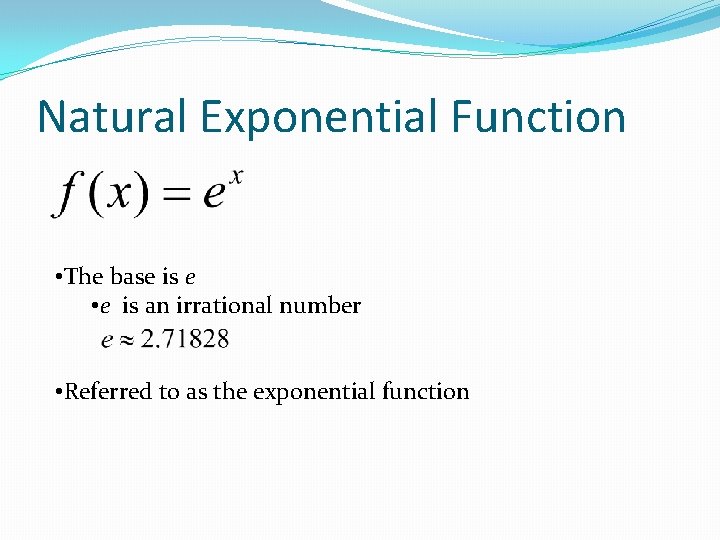
Natural Exponential Function • The base is e • e is an irrational number • Referred to as the exponential function
Graphing Natural Exponential Functions �Similar to graphing exponential functions �Create a table of values and graph the points �Find the horizontal asymptotes �Transformations occur the same way for natural exponential functions as exponential functions

Ex: graph f(x)=ex -x graph f(x)=e x y -3 . 049 -3 20. 086 -2 . 135 -2 7. 389 -1 . 368 -1 2. 718 0 1 1 2. 718 1 . 368 2 7. 389 2 . 135 3 20. 086 3 . 049
Compound Interest �Represented by a exponential function �A(t)=P(1+r/n)nt �A(t) is amount after t years �P is principal �R is interest rate (as a decimal) �n is number of times interest is compounded per year �t is number of years
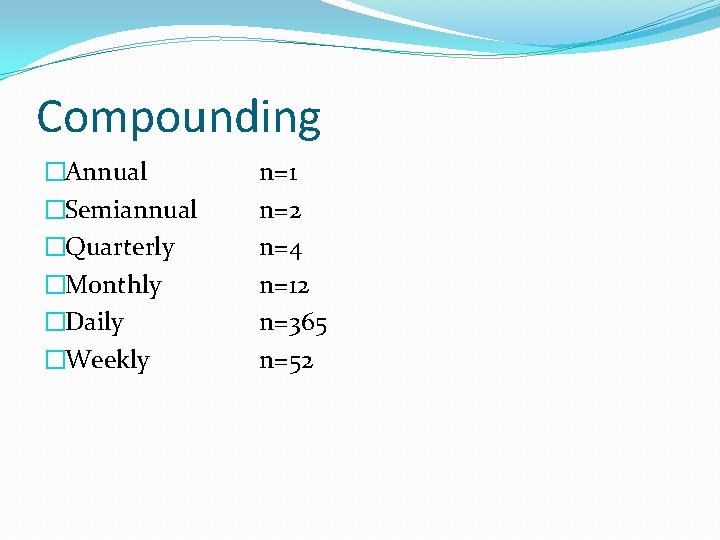
Compounding �Annual �Semiannual �Quarterly �Monthly �Daily �Weekly n=1 n=2 n=4 n=12 n=365 n=52
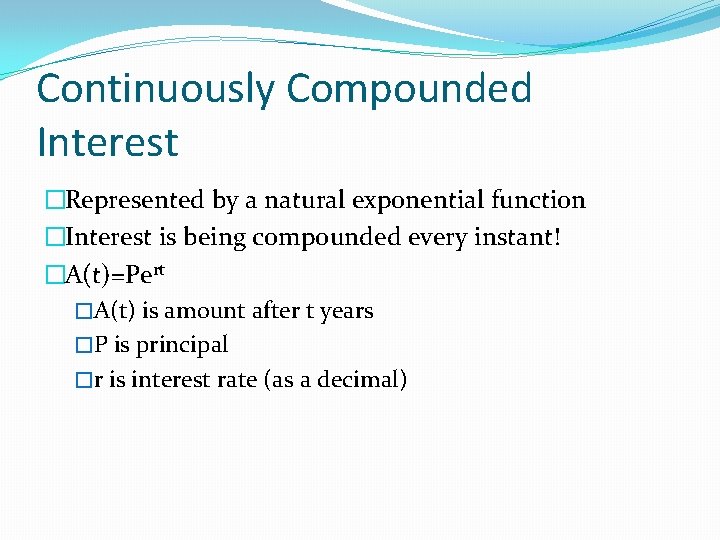
Continuously Compounded Interest �Represented by a natural exponential function �Interest is being compounded every instant! �A(t)=Pert �A(t) is amount after t years �P is principal �r is interest rate (as a decimal)
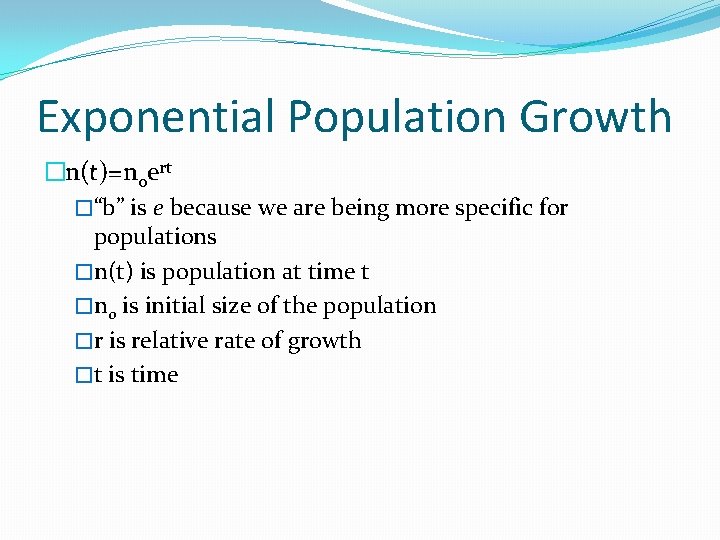
Exponential Population Growth �n(t)=n 0 ert �“b” is e because we are being more specific for populations �n(t) is population at time t �n 0 is initial size of the population �r is relative rate of growth �t is time
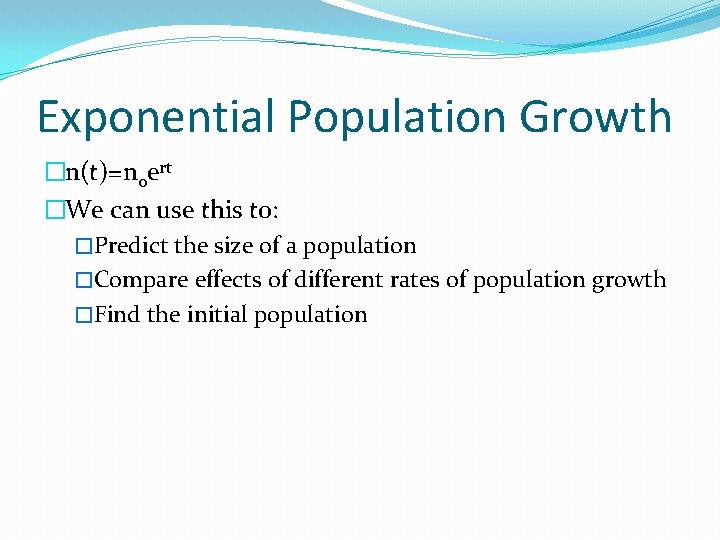
Exponential Population Growth �n(t)=n 0 ert �We can use this to: �Predict the size of a population �Compare effects of different rates of population growth �Find the initial population

Practice/Hw �p. 394 #1, 11 -14 � 8. 8 � 1 -3 all � 6 -8 a, c
- Slides: 10