
Natural Environment air weather climate water rivers lakes
- Slides: 13
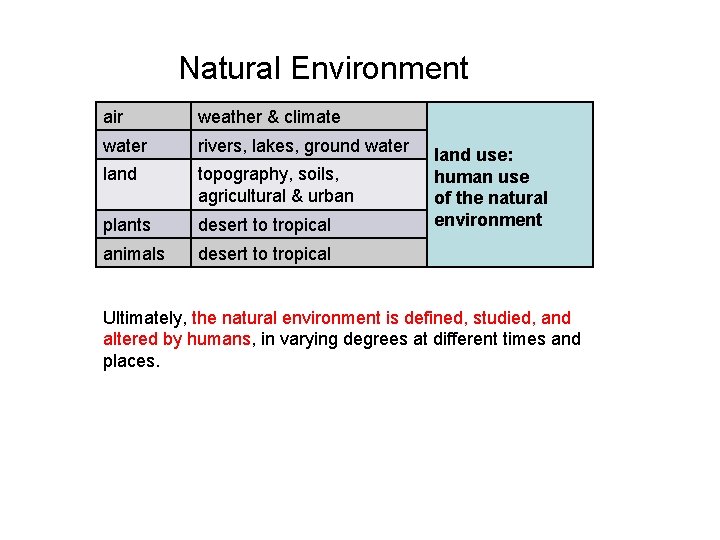
Natural Environment air weather & climate water rivers, lakes, ground water land topography, soils, agricultural & urban plants desert to tropical animals desert to tropical land use: human use of the natural environment Ultimately, the natural environment is defined, studied, and altered by humans, in varying degrees at different times and places.
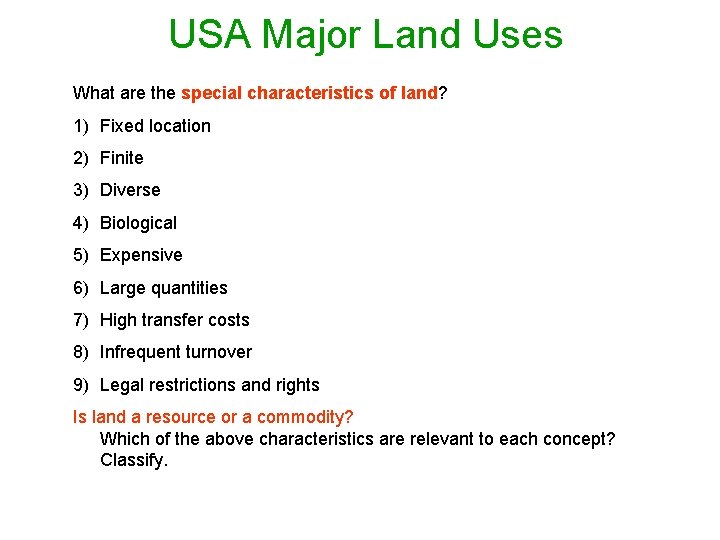
USA Major Land Uses What are the special characteristics of land? 1) Fixed location 2) Finite 3) Diverse 4) Biological 5) Expensive 6) Large quantities 7) High transfer costs 8) Infrequent turnover 9) Legal restrictions and rights Is land a resource or a commodity? Which of the above characteristics are relevant to each concept? Classify.
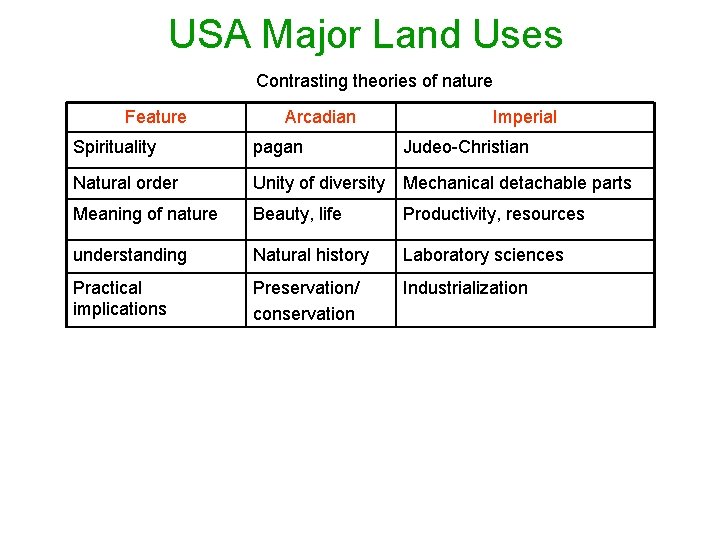
USA Major Land Uses Contrasting theories of nature Feature Arcadian Imperial Spirituality pagan Judeo-Christian Natural order Unity of diversity Mechanical detachable parts Meaning of nature Beauty, life Productivity, resources understanding Natural history Laboratory sciences Practical implications Preservation/ conservation Industrialization
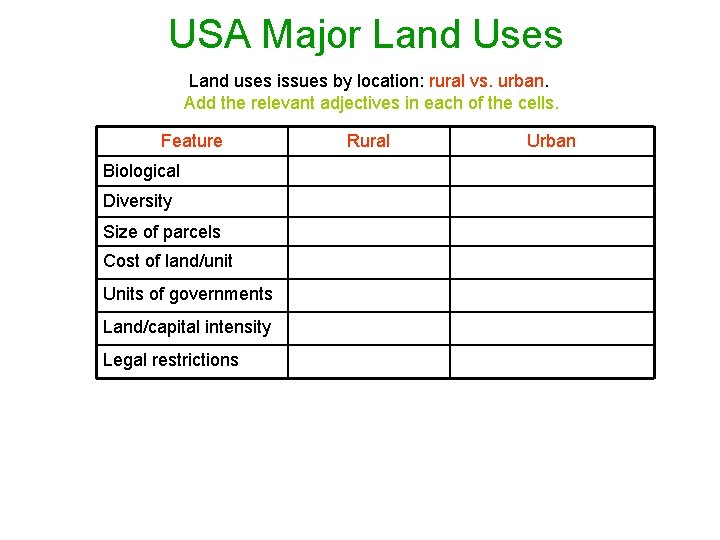
USA Major Land Uses Land uses issues by location: rural vs. urban. Add the relevant adjectives in each of the cells. Feature Biological Diversity Size of parcels Cost of land/unit Units of governments Land/capital intensity Legal restrictions Rural Urban
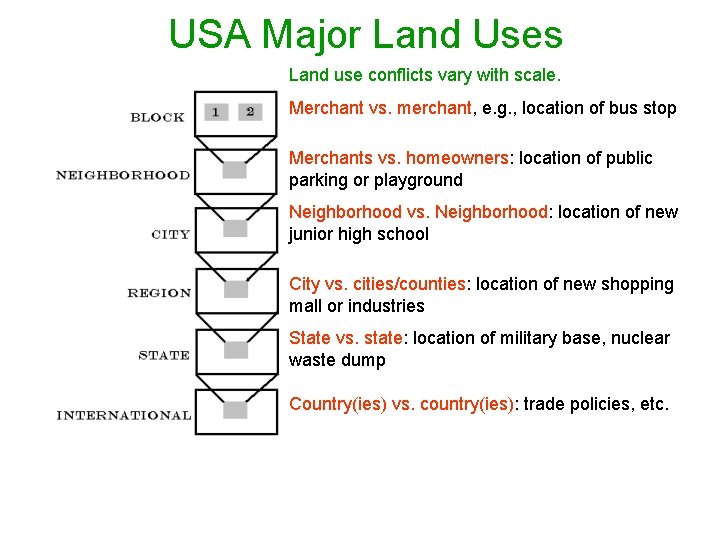
USA Major Land Uses Land use conflicts vary with scale. Merchant vs. merchant, e. g. , location of bus stop Merchants vs. homeowners: location of public parking or playground Neighborhood vs. Neighborhood: location of new junior high school City vs. cities/counties: location of new shopping mall or industries State vs. state: location of military base, nuclear waste dump Country(ies) vs. country(ies): trade policies, etc.
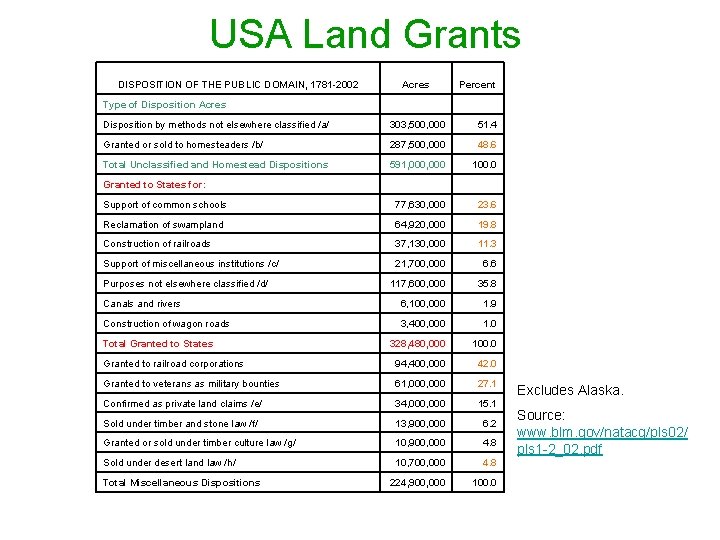
USA Land Grants DISPOSITION OF THE PUBLIC DOMAIN, 1781 -2002 Acres Percent Type of Disposition Acres Disposition by methods not elsewhere classified /a/ 303, 500, 000 51. 4 Granted or sold to homesteaders /b/ 287, 500, 000 48. 6 Total Unclassified and Homestead Dispositions 591, 000 100. 0 Support of common schools 77, 630, 000 23. 6 Reclamation of swampland 64, 920, 000 19. 8 Construction of railroads 37, 130, 000 11. 3 Support of miscellaneous institutions /c/ 21, 700, 000 6. 6 117, 600, 000 35. 8 Canals and rivers 6, 100, 000 1. 9 Construction of wagon roads 3, 400, 000 1. 0 328, 480, 000 100. 0 Granted to railroad corporations 94, 400, 000 42. 0 Granted to veterans as military bounties 61, 000 27. 1 Confirmed as private land claims /e/ 34, 000 15. 1 Sold under timber and stone law /f/ 13, 900, 000 6. 2 Granted or sold under timber culture law /g/ 10, 900, 000 4. 8 Sold under desert land law /h/ 10, 700, 000 4. 8 224, 900, 000 100. 0 Granted to States for: Purposes not elsewhere classified /d/ Total Granted to States Total Miscellaneous Dispositions Excludes Alaska. Source: www. blm. gov/natacq/pls 02/ pls 1 -2_02. pdf
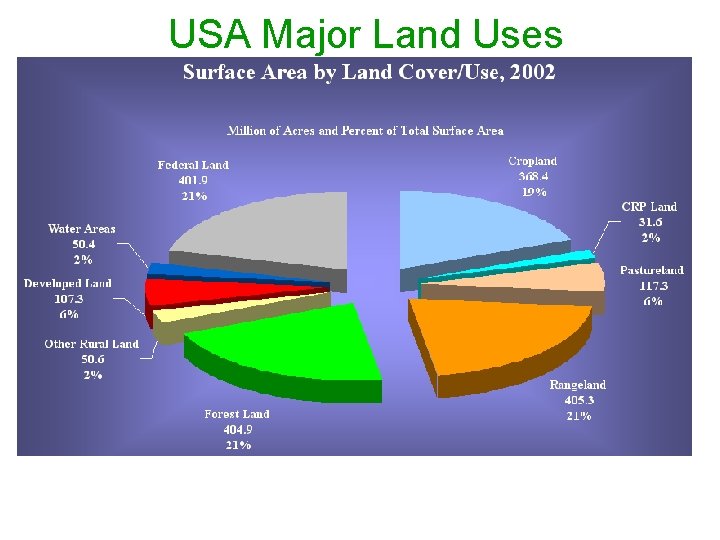
USA Major Land Uses The contiguous 48 states cover nearly 1. 9 billion acres. • The majority of this area (74 percent) is in nonfederal, rural land uses -- nearly 1. 4 billion acres, which is composed of rangeland, forest land, cropland, pastureland, other rural land. • A subset of these lands is defined as prime farmland -- those lands with the best combination of physical and chemical characteristics for producing food, fiber, and oilseeds. In 2001, there were about 330 million acres of prime farmland (24%) in the contiguous United States.
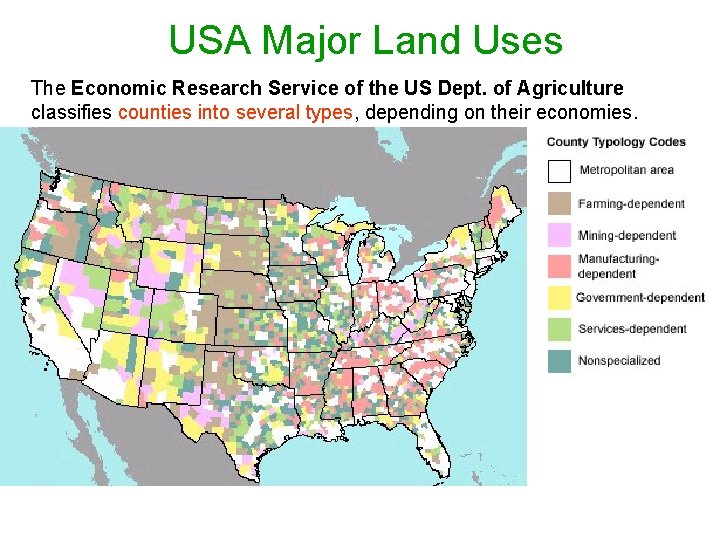
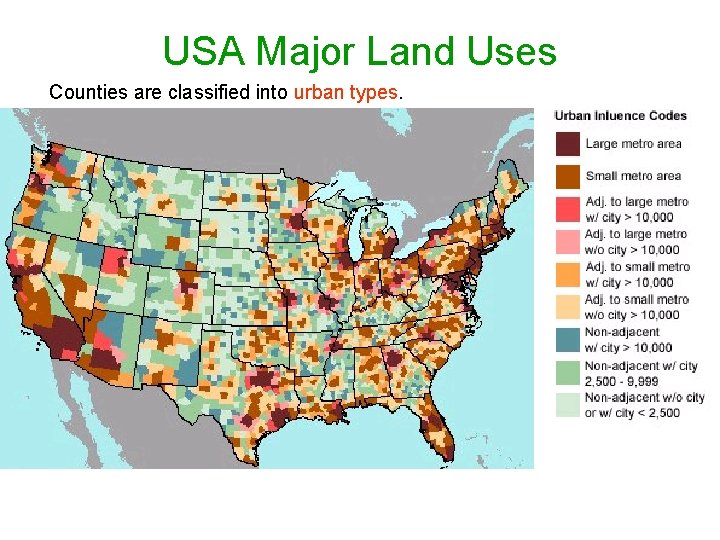
USA Major Land Uses The Economic Research Service of the US Dept. of Agriculture classifies counties into several types, depending on their economies.
USA Major Land Uses Counties are classified into urban types.
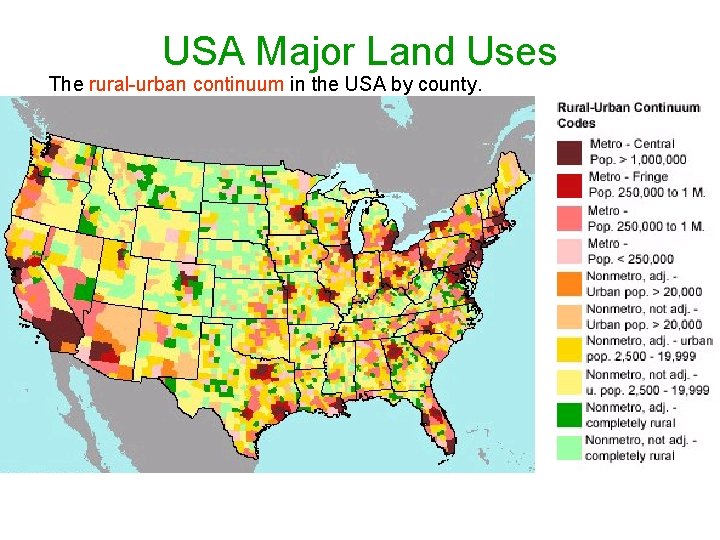
USA Major Land Uses The rural-urban continuum in the USA by county.
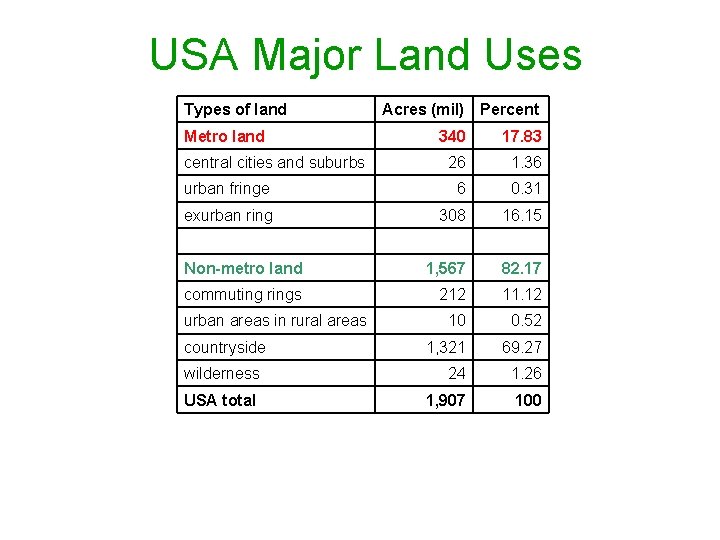
USA Major Land Uses Types of land Metro land Acres (mil) Percent 340 17. 83 26 1. 36 urban fringe 6 0. 31 exurban ring 308 16. 15 Non-metro land 1, 567 82. 17 commuting rings 212 11. 12 10 0. 52 1, 321 69. 27 wilderness 24 1. 26 USA total 1, 907 100 central cities and suburbs urban areas in rural areas countryside
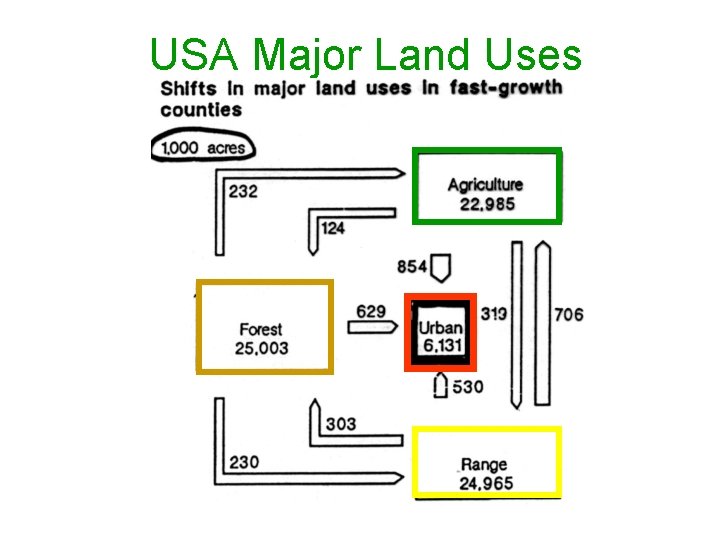
USA Major Land Uses
USA Major Land Uses Reasons for buying land: 1) Agricultural production: food and fiber 2) Recreational uses: lakeshores, ski huts, hobby farms and ranches 3) Hedge against inflation: 1950 -1980 average land prices rose 900%. 2012 was the third consecutive year of big jumps in agricultural land values since the 1970 s. In 2013 land prices in the Midwest rose 16%. 4) Tax dodge: capital gain taxes have historically been lower than income tax brackets (commonly by 50%) The trend to buy rural land for recreational uses has resulted in land divisions. Over 20 million acres are now owned in parcel sizes smaller than 50 acres. “Parcellation” severely limits future commodity production on these lands.