
Natural DISTRIBUTION OF NATURAL VEGETATION Temperature and moisture
Natural

DISTRIBUTION OF NATURAL VEGETATION � Temperature and moisture determine the growth of vegetation in a particular region. Forests, grasslands, scrubs and tundra are the major vegetation types in the world. � Huge trees can thrive in areas of heavy rainfall. Thus, dense forests are present in areas which have abundant supply of water. The size and density of trees decreases with relative decrease in moisture. � Short stunted trees and grasses grow in the regions of moderate rainfall. Thorny shrubs and scrubs grow in dry areas which get low or negligible rainfall. The Tundra vegetation is found in cold Polar Regions and comprises of mosses and lichens. � Evergreen Forests: Trees of evergreen forests do not shed their leaves at a particular time in a year. Evergreen forests are found in tropical regions which get plenty of sunshine and rainfall. � Deciduous Forests: Trees of deciduous forests shed their leaves at a particular time in a year. Deciduous forests are found in subtropical regions which get moderate sunshine and rainfall.
CONSERVATION OF NATURAL VEGETATION AND WILDLIFE � Deforestation, soil erosion, construction activities, forest fires, tsunami and � � � landslides are some of the factors which are causing extinction of forest and wildlife resources. Poaching is another concern which is leading to extinction of valuable wildlife. The government has made national parks, wildlife sanctuaries, and biosphere reserves to protect the natural vegetation and wildlife. Many awareness programmes; like social forestry and Vanamahotsava are also encouraged to conserve the wildlife and forests. Many laws have been passed to make poaching an illegal and punishable offence. In India, killing of lions, tigers, deer, etc. have been banned. An international convention CITES has been established that lists several species of animals and birds in which trade is prohibited. CITES stands for Convention on International Trade in Endangered Species of Wild Fauna and Flora. About 5, 000 animal species and 28, 000 plant species are being protected under the CITES.

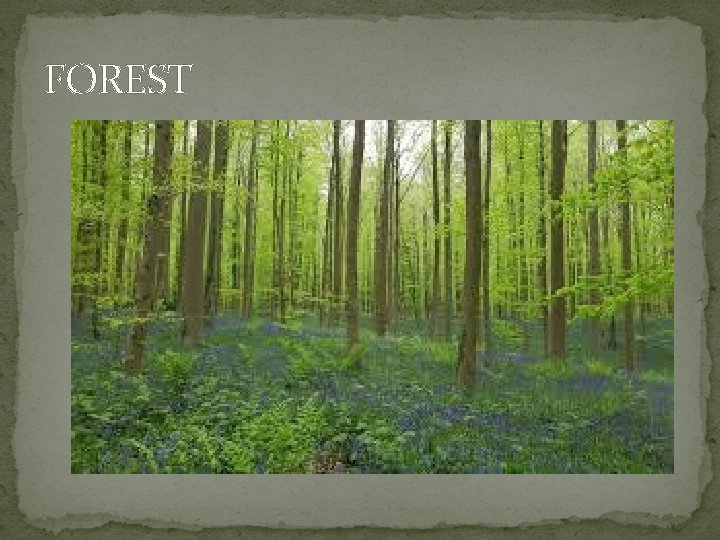
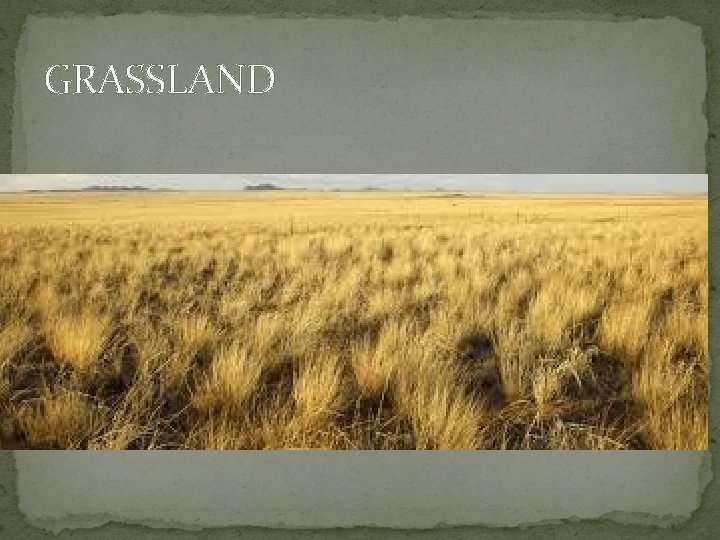
Classification of Natural vegetation �Forest: -Land that has a dense cover of trees and shrubs is called forest. Forest grow well in regions where there is abundant sunlight, temperatureand rainfall. �Grass land: -Land where grass and grass like plants are the dominant form of plant life is called grassland. Grassland grow in regions of moderate rainfall. �Shrubs: -Shrubs are low woody perennial plants. Thorny shrubs and scrubs grow in the dry regions of the world, like the desert.
FOREST
GRASSLAND
�What Is Deforestation? �Deforestation refers to the decrease in forest areas across the world that are lost for other uses such as agricultural croplands, urbanization, or mining activities. Greatly accelerated by human activities since 1960, deforestation has been negatively affecting natural ecosystems, biodiversity, and the climate. The UN’s Food and Agriculture Organization estimates the annual rate of deforestation to be around 1. 3 million km 2 per decade.
The Causes of Deforestation: Why Is Deforestation Happening? �Multiple factors, either of human or natural origin, cause deforestation. Natural factors include natural forest fires or parasite-caused diseases which can result in deforestation. Nevertheless, human activities are among the main causes of global deforestation. According to the Food and Agriculture Organization (FAO), the expansion of agriculture caused nearly 80% of global deforestation, with the construction of infrastructures such as roads or dams, together with mining activities and urbanization, making up the remaining causes of deforestation. �Related: How Is Coffee Related To Deforestation?
� 1. Agriculture is the Number 1 Cause of Deforestation : � Why is deforestation happening? According to the FAO, agriculture causes around 80% of deforestation. And how does agriculture cause so much deforestation? According to the same report, 33% of agriculture-caused deforestation is a consequence of subsistence agriculture – such as local peasant agriculture in developing countries. � Commercial or industrial agriculture (field crops and livestock) cause around 40% of forest loss – in the search for space to grow food, fibers or biofuel (such as soybeans, palm oil, beef, rice, maize, cotton and sugar cane). It is also particularly interesting to note livestock is believed to be responsible for about 14% of global deforestation. The main reasons why have to do with the large areas require both to raise livestock but also to grow its (soy-based) food.
� 2. Deforestation Caused By New Constructions (~15%) � The construction of human infrastructures has also been driving deforestation. More specifically, 10% of deforestation can be attributed to new infrastructures that serve the current human lifestyle in four main ways: transportation, transformation and energy generation. � On one hand, roads, rails, ports or airports have been built to move all sorts of goods – from cereals and fruits to spices, minerals or fossil fuels – either directly to trade centers or to transformation sites. So while at first there were only fruit trees, roads soon arrived to allow transporting fruit to other regions. And while some goods were and are collected manually, others such as coal, oil, natural gas, biomass, but also meat, dairy or spirits, required the construction of large extraction, transportation and/or transformation infrastructures.
� 3. How Urbanization Is Causing Deforestation (~5%) �The populational shift that is leading people to move from rural areas to urban areas is also contributing to deforestation (5%, according to FAO). This urban growth – in which 68% of the world’s population is expected to live in cities by 2050 – is leading to an exponential growth of housing and consumption sites. And as cities become larger so they can host more people, they challenge the natural boundaries surrounding them, often leading to deforestation. This is one of the reasons why deforestation is happening
EFFECT OF DEFORESTRATION � Loss of Habitat � One of the most dangerous and unsettling effects of deforestation is the loss of animal � � � and plant species due to their loss of habitat. 70% of land animals and plant species live in forests. Not only does deforestation threaten species known to us, but also those unknown. The trees of the rainforest that provide shelter for some species also provide the canopy that regulates the temperature. Deforestation results in a more drastic temperature variation from day to night, much like a desert, which could prove fatal for many inhabitants. Increased Greenhouse Gases In addition to the loss of habitat, the lack of trees also allows a greater amount of greenhouse gases to be released into the atmosphere. Healthy forests absorb carbon dioxide from the atmosphere, acting as valuable carbon sinks. Deforested areas lose that ability and release more carbon. Water in the Atmosphere The trees also help control the level of water in the atmosphere by helping to regulate the water cycle. In deforested areas, there is less water in the air to be returned to the soil. This then causes dryer soil and the inability to grow crops.
�Soil Erosion and Flooding �Further effects of deforestation include soil erosion and coastal flooding. Trees help the land to retain water and topsoil, which provides the rich nutrients to sustain additional forest life. �Without forests, the soil erodes and washes away, causing farmers to move on and perpetuate the cycle. The barren land which is left behind in the wake of these unsustainable agricultural practices is then more susceptible to flooding, specifically in coastal regions.
�Destruction of Homelands �As large amounts of forests are cleared away, allowing exposed earth to whither and die and the habitats of innumerable species to be destroyed, the indigenous communities who live there and depend on the forest to sustain their way of life are also under threat. �The loss of forests has an immediate and direct effect on their lifestyle that we in the highly industrialized parts of the world, despite our own dependency on what the rainforest provides, will never know. The level of immediacy is exponentially greater for indigenous peoples.
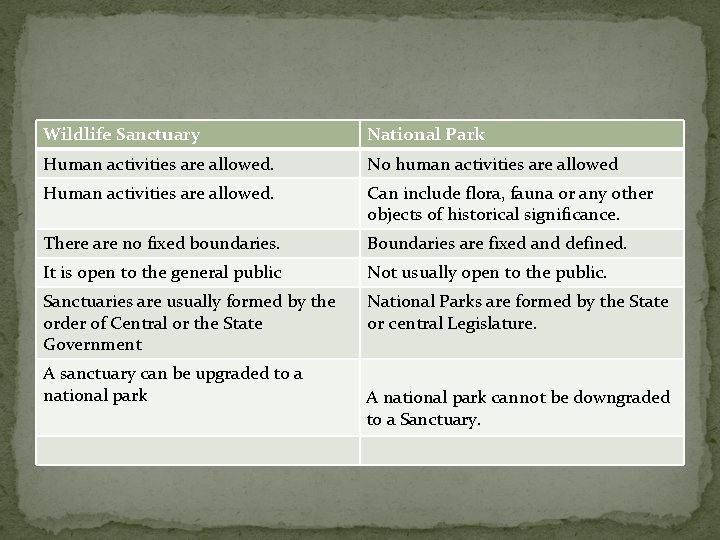
Wildlife Sanctuary National Park Human activities are allowed. No human activities are allowed Human activities are allowed. Can include flora, fauna or any other objects of historical significance. There are no fixed boundaries. Boundaries are fixed and defined. It is open to the general public Not usually open to the public. Sanctuaries are usually formed by the order of Central or the State Government National Parks are formed by the State or central Legislature. A sanctuary can be upgraded to a national park A national park cannot be downgraded to a Sanctuary.
- Slides: 16