
NATS 1311 From the Cosmos to Earth Our
- Slides: 36
NATS 1311 - From the Cosmos to Earth Our second exam will be next Thursday, October 30 at the regular class time. We will have a review Tuesday (Oct. 28) - at a time to be determined in class today - in the room next to where the regular lab is held. The exams will cover everything that we have covered in class up to the end of class Tuesday.
NATS 1311 - From the Cosmos to Earth Lenses and Mirrors
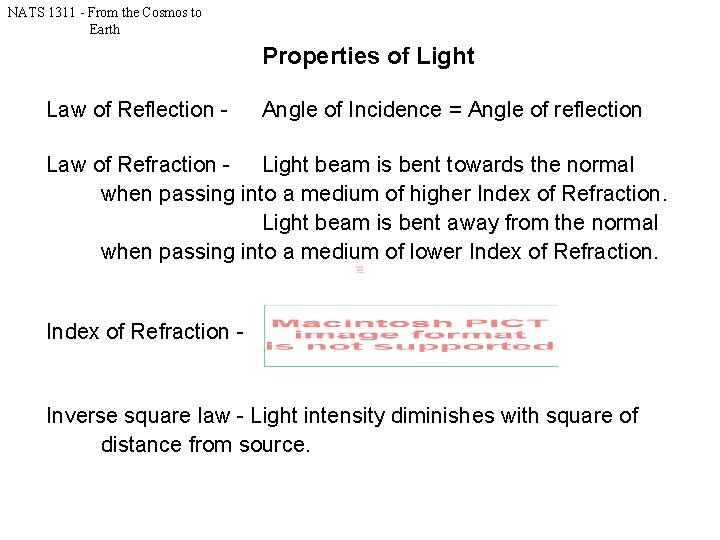
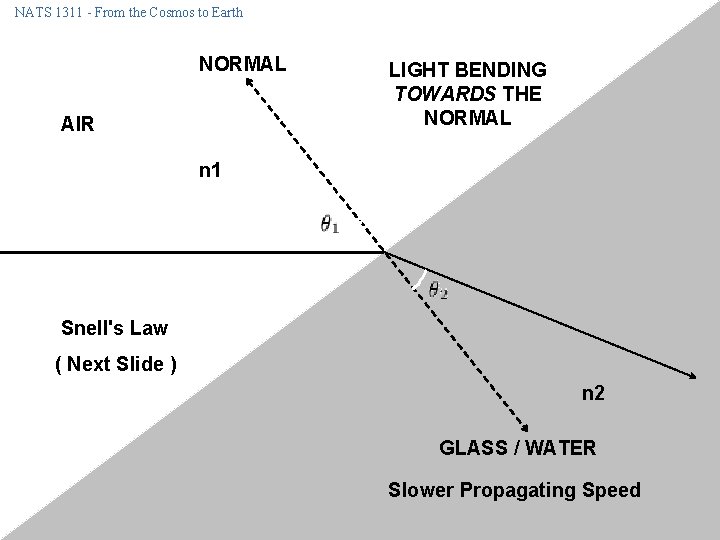
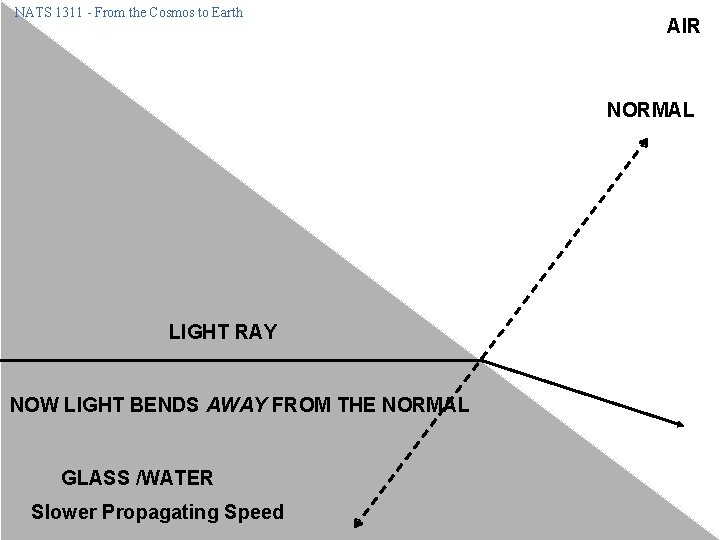
NATS 1311 - From the Cosmos to Earth Properties of Light Law of Reflection - Angle of Incidence = Angle of reflection Law of Refraction - Light beam is bent towards the normal when passing into a medium of higher Index of Refraction. Light beam is bent away from the normal when passing into a medium of lower Index of Refraction - Inverse square law - Light intensity diminishes with square of distance from source.
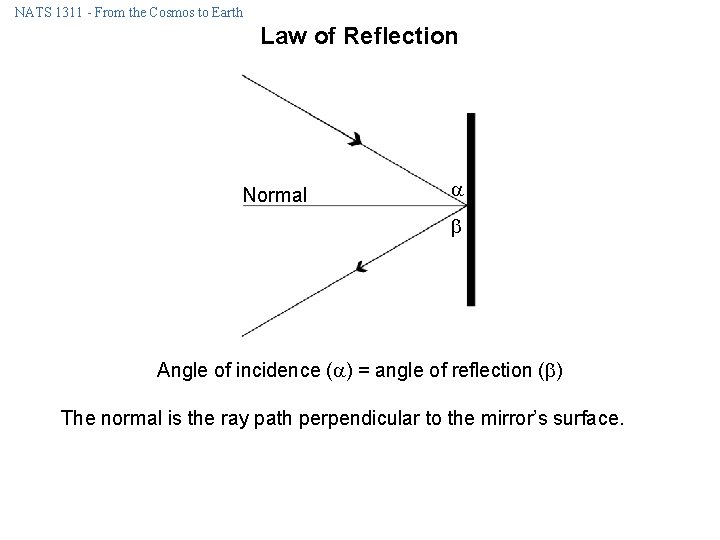
NATS 1311 - From the Cosmos to Earth Law of Reflection Normal Angle of incidence ( ) = angle of reflection ( ) The normal is the ray path perpendicular to the mirror’s surface.
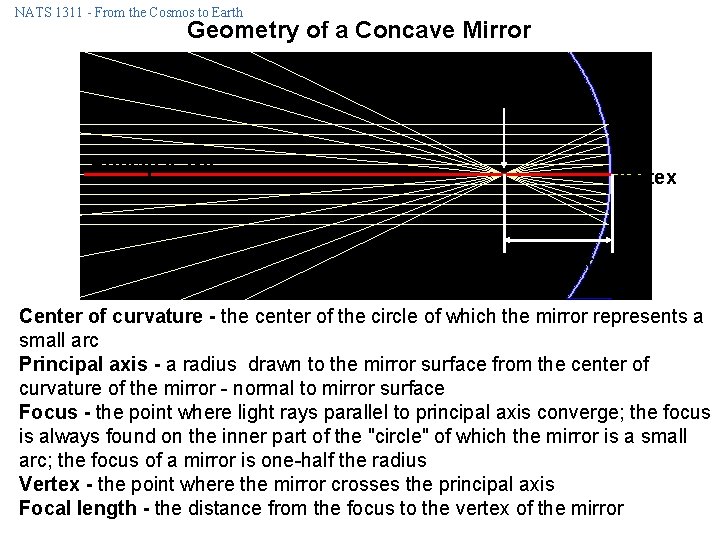
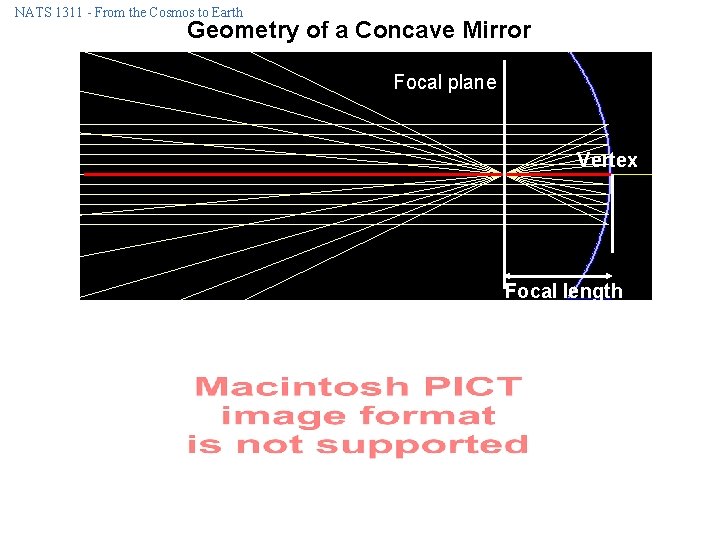
NATS 1311 - From the Cosmos to Earth Geometry of a Concave Mirror Focus Principal axis Vertex Focal length Center of curvature - the center of the circle of which the mirror represents a small arc Principal axis - a radius drawn to the mirror surface from the center of curvature of the mirror - normal to mirror surface Focus - the point where light rays parallel to principal axis converge; the focus is always found on the inner part of the "circle" of which the mirror is a small arc; the focus of a mirror is one-half the radius Vertex - the point where the mirror crosses the principal axis Focal length - the distance from the focus to the vertex of the mirror
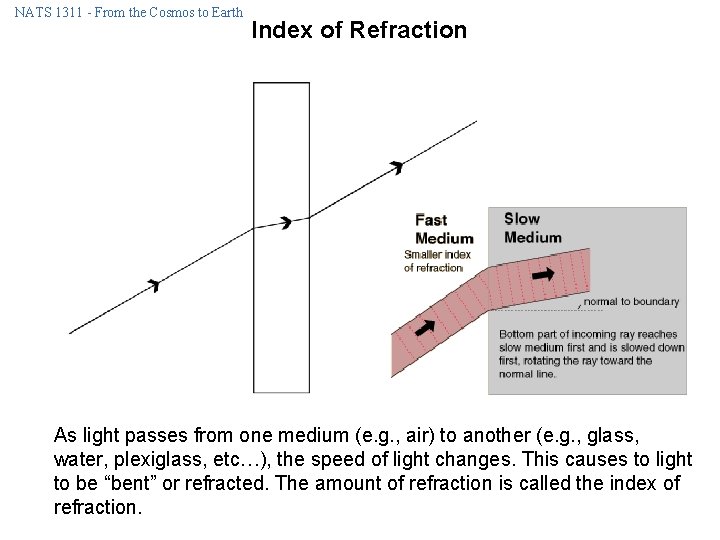
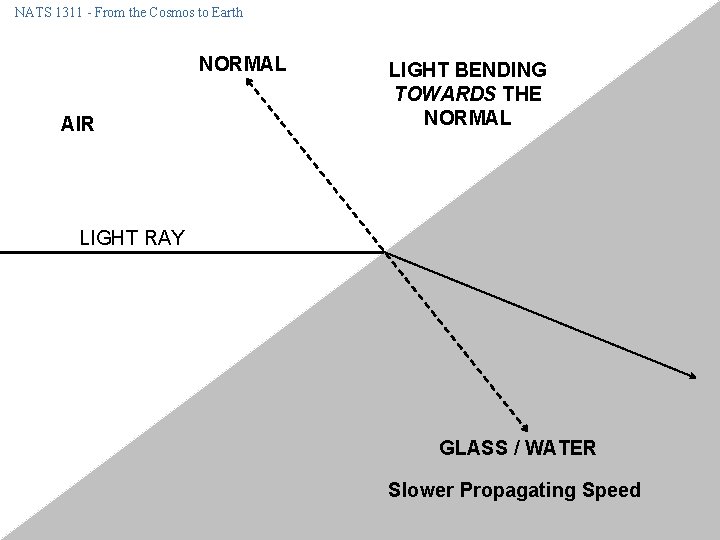
NATS 1311 - From the Cosmos to Earth Index of Refraction As light passes from one medium (e. g. , air) to another (e. g. , glass, water, plexiglass, etc…), the speed of light changes. This causes to light to be “bent” or refracted. The amount of refraction is called the index of refraction.
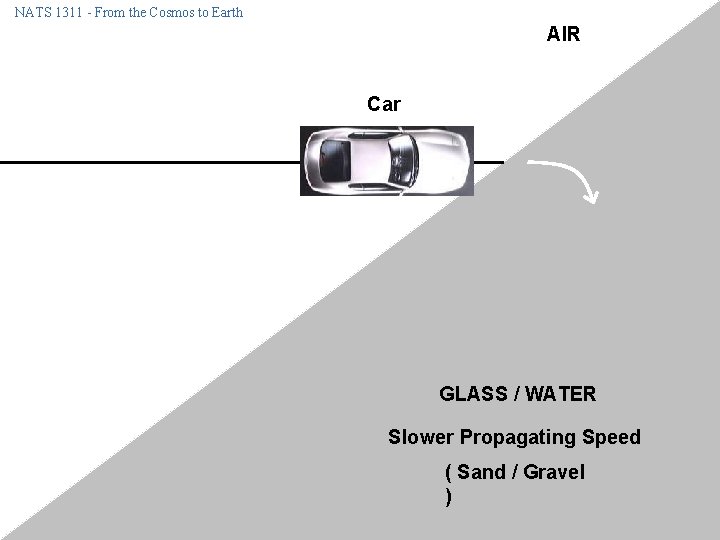
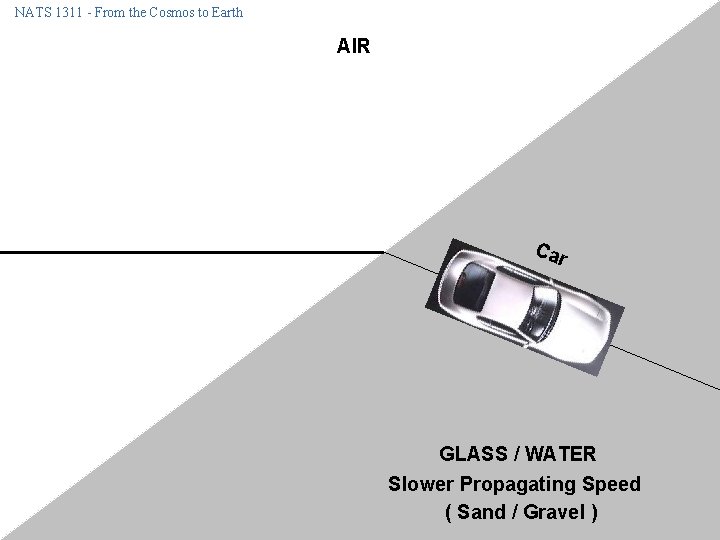
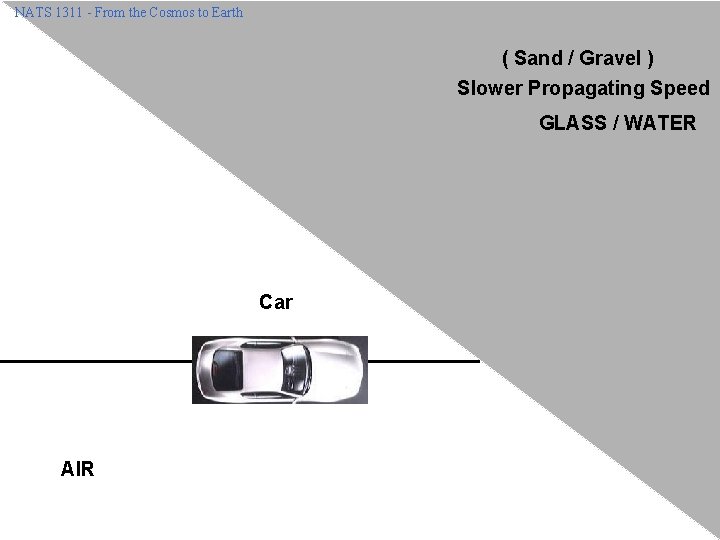
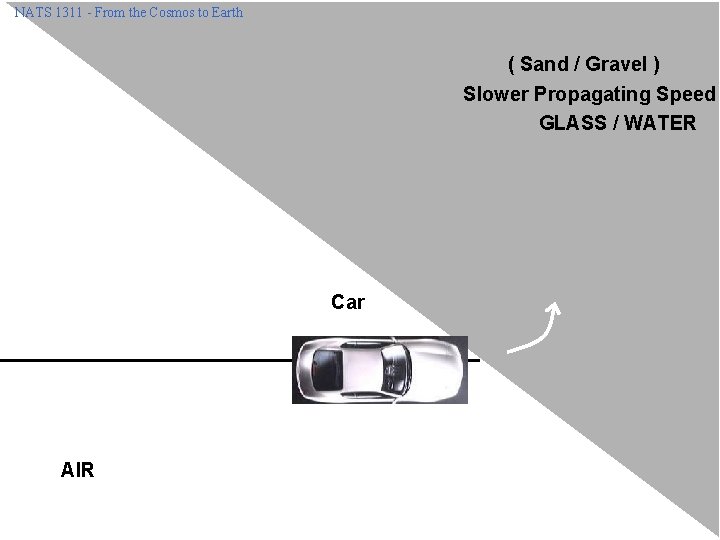
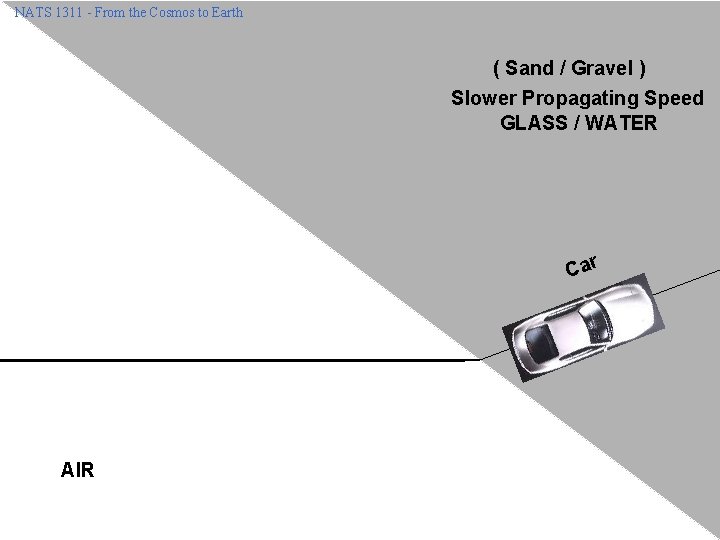
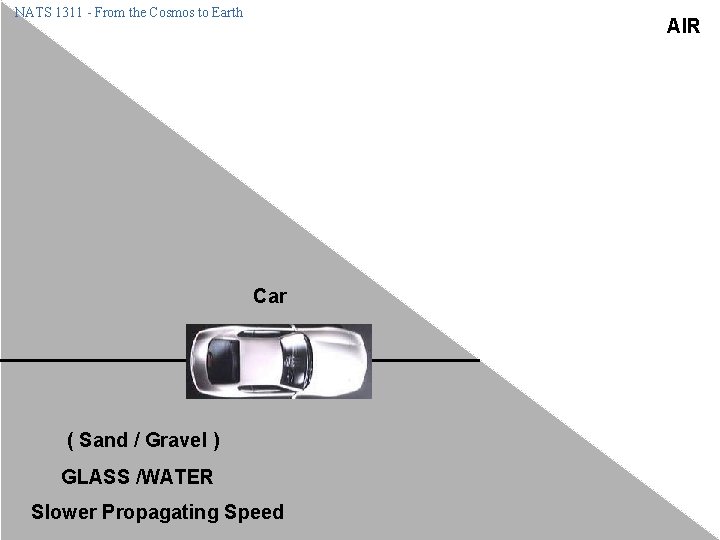
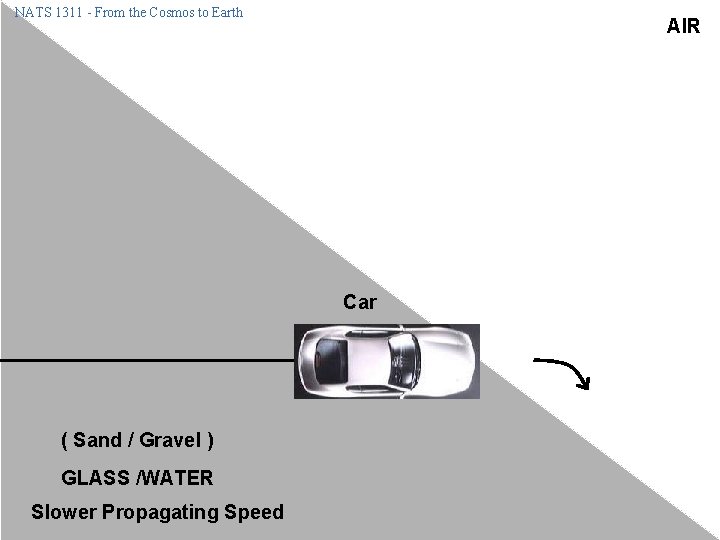
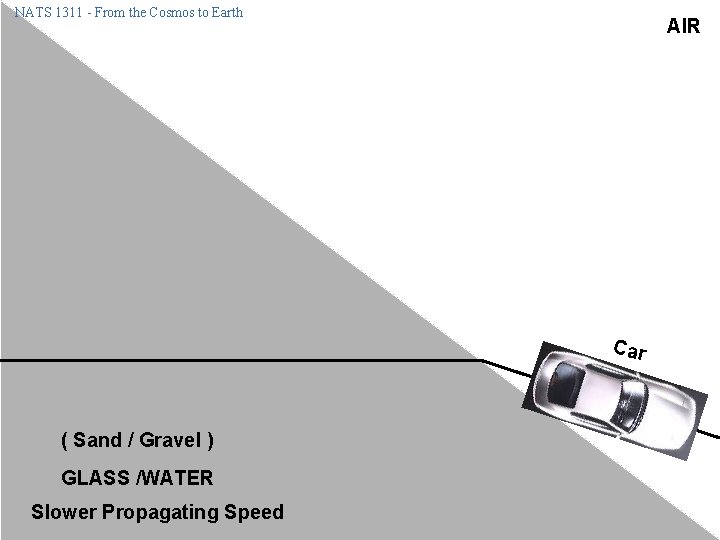
NATS 1311 - From the Cosmos to Earth Refraction Imagine that the axles of a car represent wave fronts. If the car crosses from a smooth to a rough surface at an angle, one tire of the axle will slow down first while the other continues at normal speed. With one tire traveling faster the other, the car will turn in the direction of the slow tire. This is how refraction works.
NATS 1311 - From the Cosmos to Earth AIR Car GLASS / WATER Slower Propagating Speed ( Sand / Gravel )
NATS 1311 - From the Cosmos to Earth AIR Car GLASS / WATER Slower Propagating Speed ( Sand / Gravel )
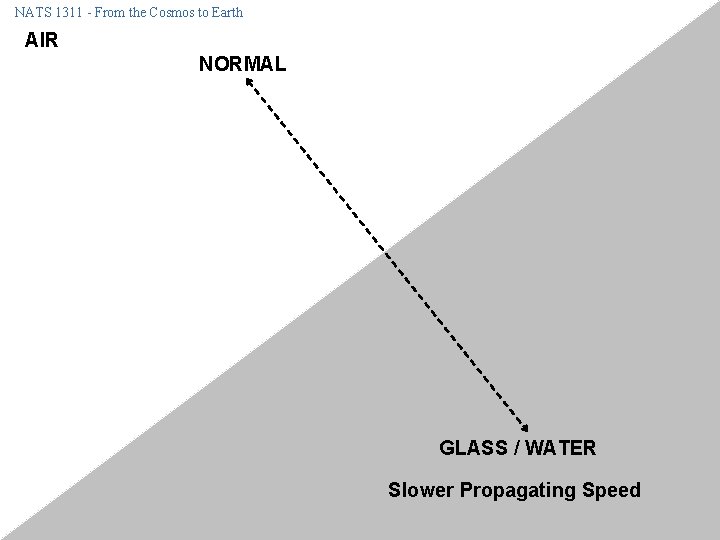
NATS 1311 - From the Cosmos to Earth AIR NORMAL GLASS / WATER Slower Propagating Speed
NATS 1311 - From the Cosmos to Earth NORMAL AIR LIGHT BENDING TOWARDS THE NORMAL LIGHT RAY GLASS / WATER Slower Propagating Speed
NATS 1311 - From the Cosmos to Earth NORMAL AIR LIGHT BENDING TOWARDS THE NORMAL n 1 Snell's Law ( Next Slide ) n 2 GLASS / WATER Slower Propagating Speed
NATS 1311 - From the Cosmos to Earth ( Sand / Gravel ) Slower Propagating Speed GLASS / WATER Car AIR
NATS 1311 - From the Cosmos to Earth ( Sand / Gravel ) Slower Propagating Speed GLASS / WATER Car AIR
NATS 1311 - From the Cosmos to Earth ( Sand / Gravel ) Slower Propagating Speed GLASS / WATER Car AIR
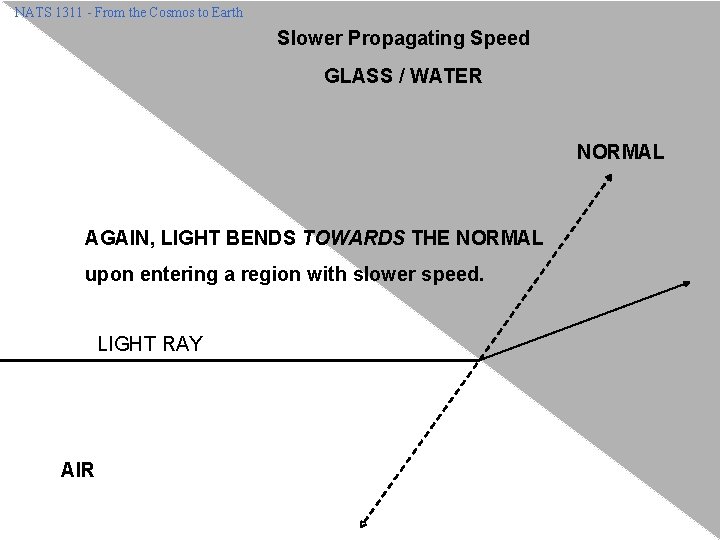
NATS 1311 - From the Cosmos to Earth Slower Propagating Speed GLASS / WATER NORMAL AGAIN, LIGHT BENDS TOWARDS THE NORMAL upon entering a region with slower speed. LIGHT RAY AIR
NATS 1311 - From the Cosmos to Earth AIR Car ( Sand / Gravel ) GLASS /WATER Slower Propagating Speed
NATS 1311 - From the Cosmos to Earth AIR Car ( Sand / Gravel ) GLASS /WATER Slower Propagating Speed
NATS 1311 - From the Cosmos to Earth AIR Car ( Sand / Gravel ) GLASS /WATER Slower Propagating Speed
NATS 1311 - From the Cosmos to Earth AIR LIGHT RAY NOW LIGHT BENDS AWAY FROM THE NORMAL GLASS /WATER Slower Propagating Speed NORMAL
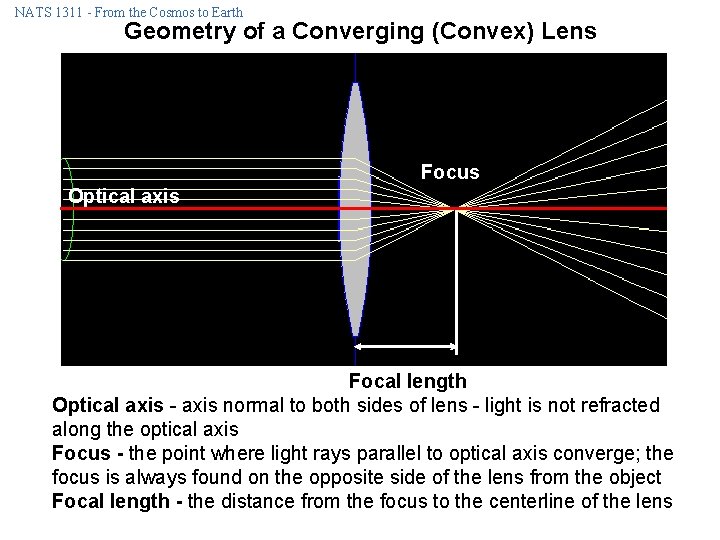
NATS 1311 - From the Cosmos to Earth Geometry of a Converging (Convex) Lens Focus Optical axis Focal length Optical axis - axis normal to both sides of lens - light is not refracted along the optical axis Focus - the point where light rays parallel to optical axis converge; the focus is always found on the opposite side of the lens from the object Focal length - the distance from the focus to the centerline of the lens
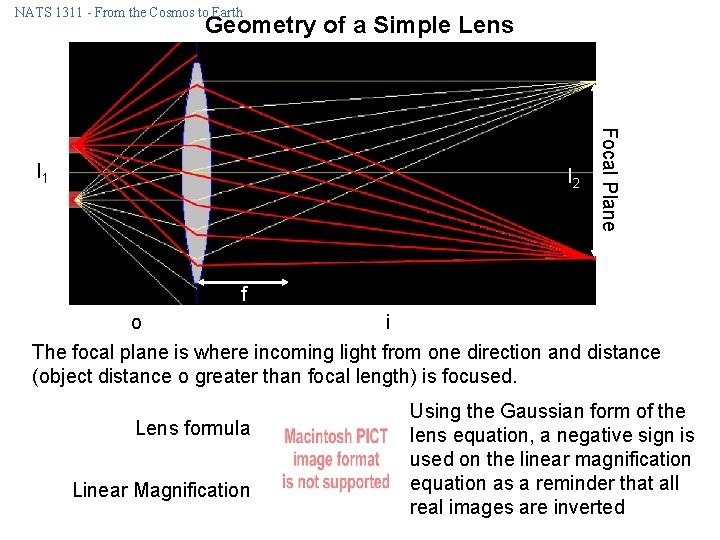
NATS 1311 - From the Cosmos to Earth Geometry of a Simple Lens l 2 Focal Plane l 1 f o i The focal plane is where incoming light from one direction and distance (object distance o greater than focal length) is focused. Lens formula Linear Magnification Using the Gaussian form of the lens equation, a negative sign is used on the linear magnification equation as a reminder that all real images are inverted
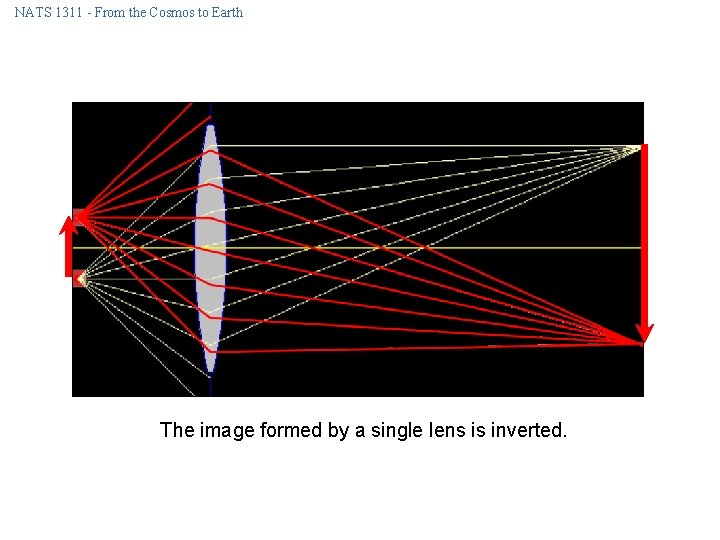
NATS 1311 - From the Cosmos to Earth The image formed by a single lens is inverted.
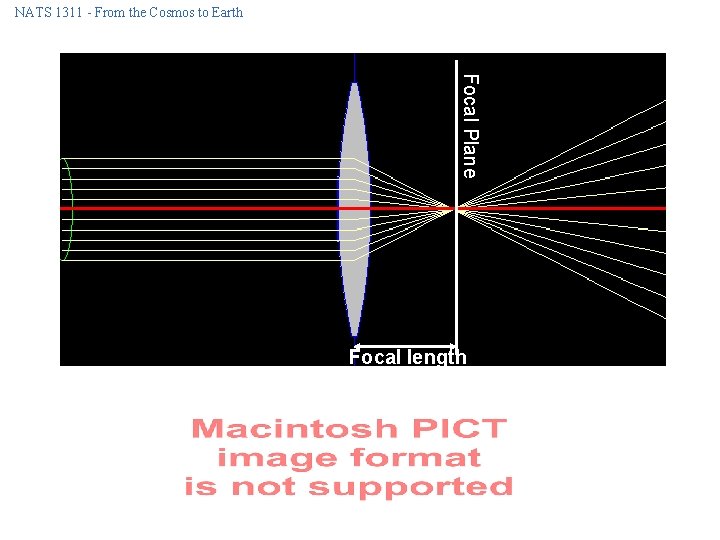
NATS 1311 - From the Cosmos to Earth Focal Plane Focal length
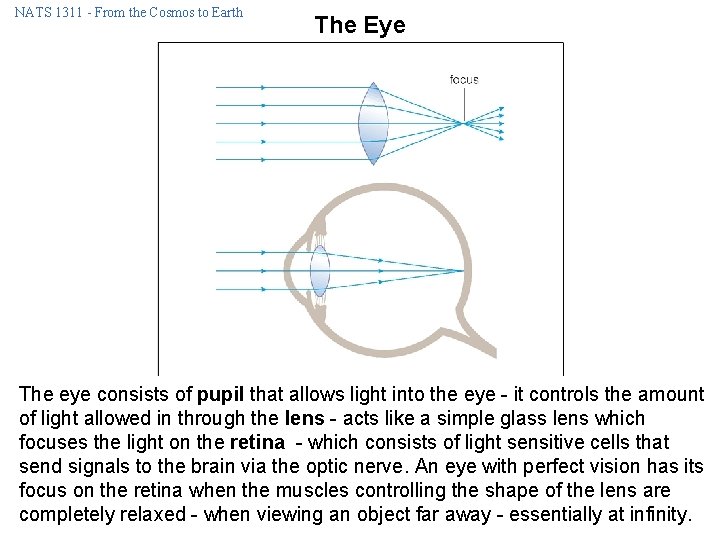
NATS 1311 - From the Cosmos to Earth The Eye The eye consists of pupil that allows light into the eye - it controls the amount of light allowed in through the lens - acts like a simple glass lens which focuses the light on the retina - which consists of light sensitive cells that send signals to the brain via the optic nerve. An eye with perfect vision has its focus on the retina when the muscles controlling the shape of the lens are completely relaxed - when viewing an object far away - essentially at infinity.
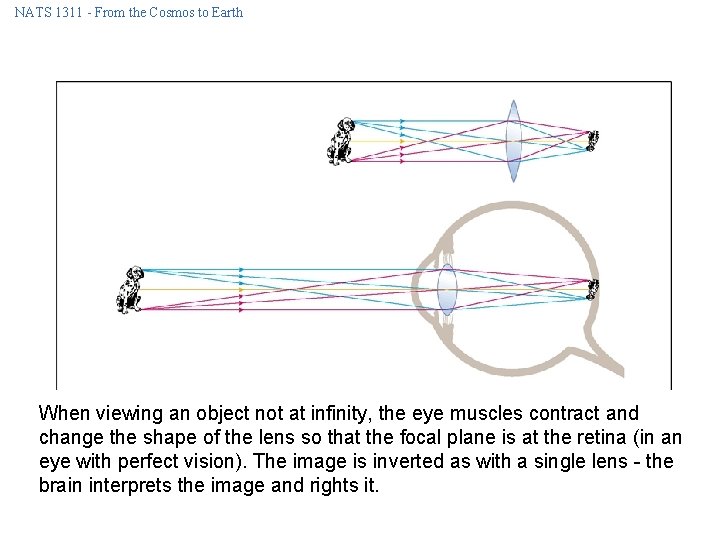
NATS 1311 - From the Cosmos to Earth When viewing an object not at infinity, the eye muscles contract and change the shape of the lens so that the focal plane is at the retina (in an eye with perfect vision). The image is inverted as with a single lens - the brain interprets the image and rights it.
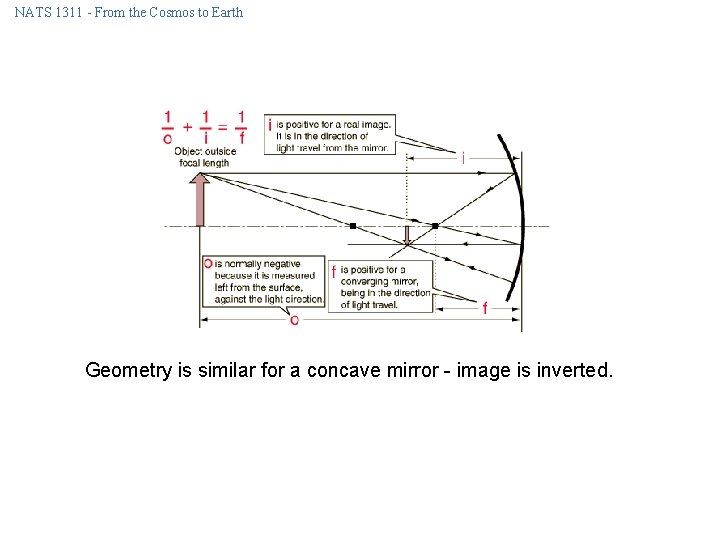
NATS 1311 - From the Cosmos to Earth Geometry is similar for a concave mirror - image is inverted.
NATS 1311 - From the Cosmos to Earth Geometry of a Concave Mirror Focal plane Vertex Focal length
NATS 1311 - From the Cosmos to Earth Types of Optical Telescopes
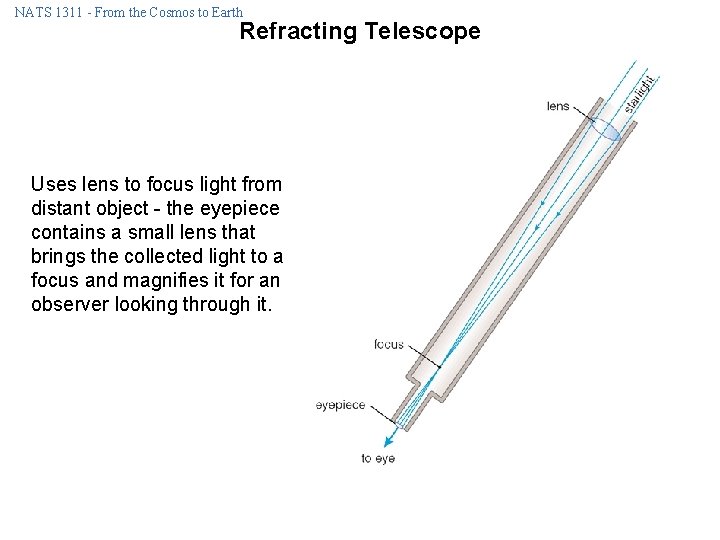
NATS 1311 - From the Cosmos to Earth Refracting Telescope Uses lens to focus light from distant object - the eyepiece contains a small lens that brings the collected light to a focus and magnifies it for an observer looking through it.
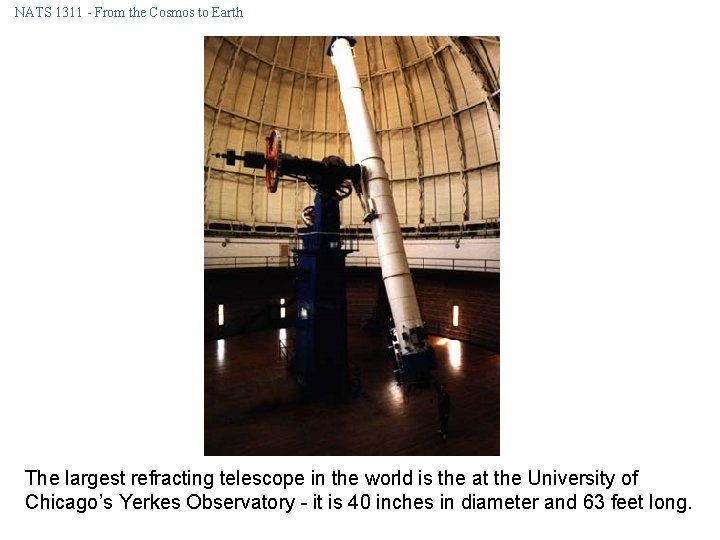
NATS 1311 - From the Cosmos to Earth The largest refracting telescope in the world is the at the University of Chicago’s Yerkes Observatory - it is 40 inches in diameter and 63 feet long.
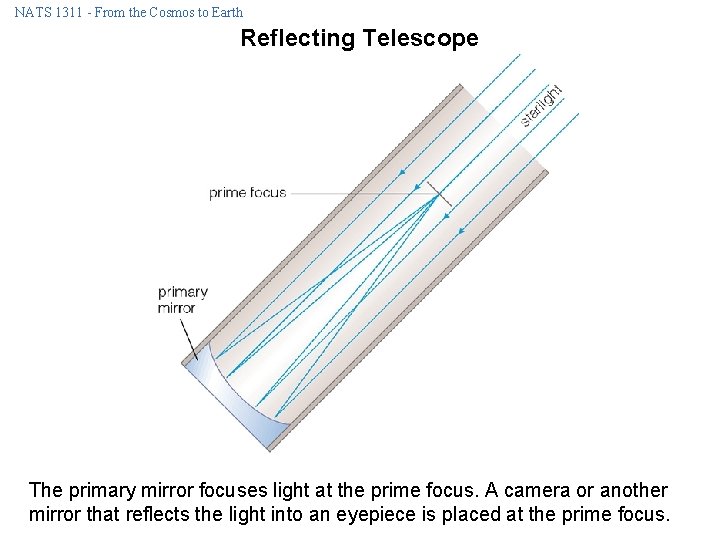
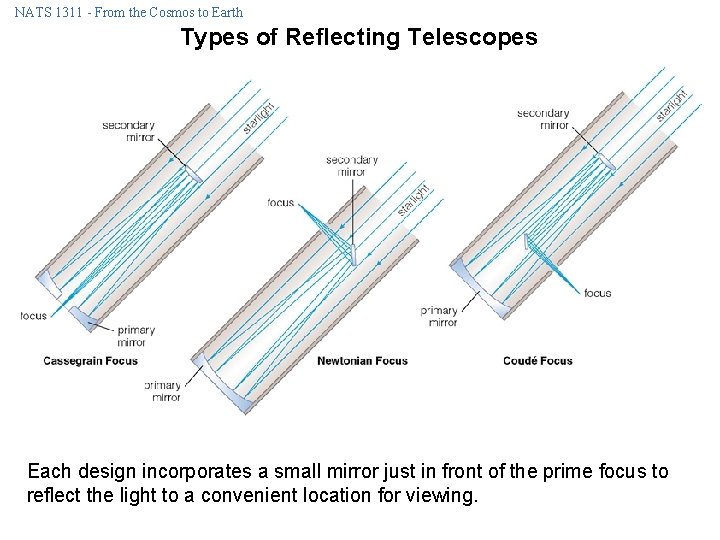
NATS 1311 - From the Cosmos to Earth Reflecting Telescope The primary mirror focuses light at the prime focus. A camera or another mirror that reflects the light into an eyepiece is placed at the prime focus.
NATS 1311 - From the Cosmos to Earth Types of Reflecting Telescopes Each design incorporates a small mirror just in front of the prime focus to reflect the light to a convenient location for viewing.
NATS 1311 - From the Cosmos to Earth The image from reflecting and refracting telescopes is inverted. Focus Inversion Animation The focus is adjusted by changing the secondary mirror position. Mirror Position and Focus Animation
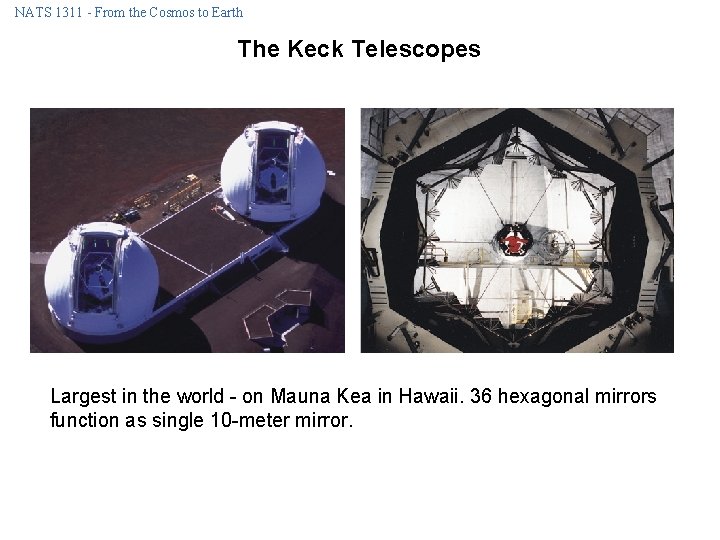
NATS 1311 - From the Cosmos to Earth The Keck Telescopes Largest in the world - on Mauna Kea in Hawaii. 36 hexagonal mirrors function as single 10 -meter mirror.
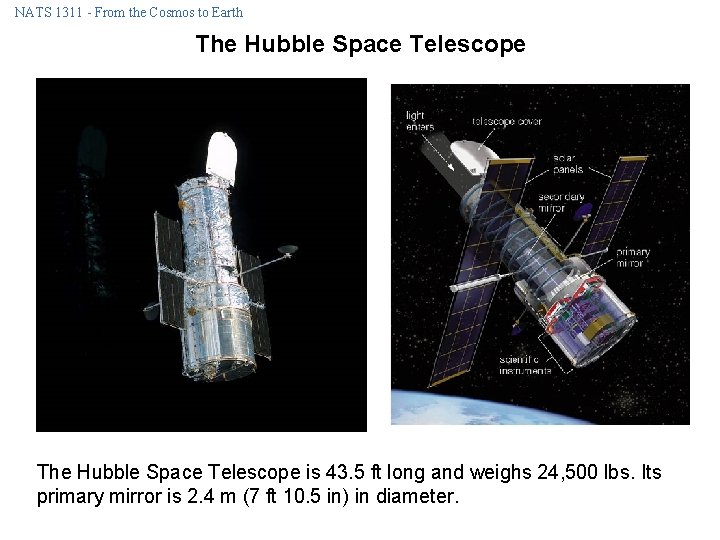
NATS 1311 - From the Cosmos to Earth The Hubble Space Telescope is 43. 5 ft long and weighs 24, 500 lbs. Its primary mirror is 2. 4 m (7 ft 10. 5 in) in diameter.