
NATS 101 Section 13 Lecture 6 The Greenhouse
- Slides: 33
NATS 101 Section 13: Lecture 6 The Greenhouse Effect and Earth-Atmosphere Energy Balance
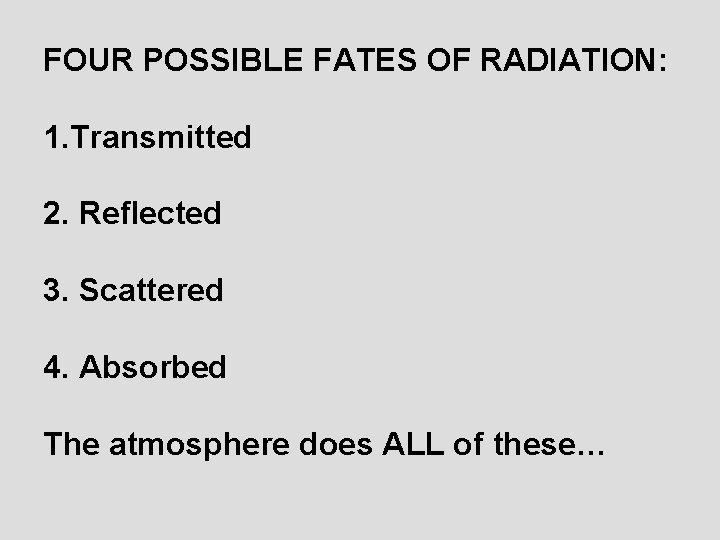
FOUR POSSIBLE FATES OF RADIATION: 1. Transmitted 2. Reflected 3. Scattered 4. Absorbed The atmosphere does ALL of these…
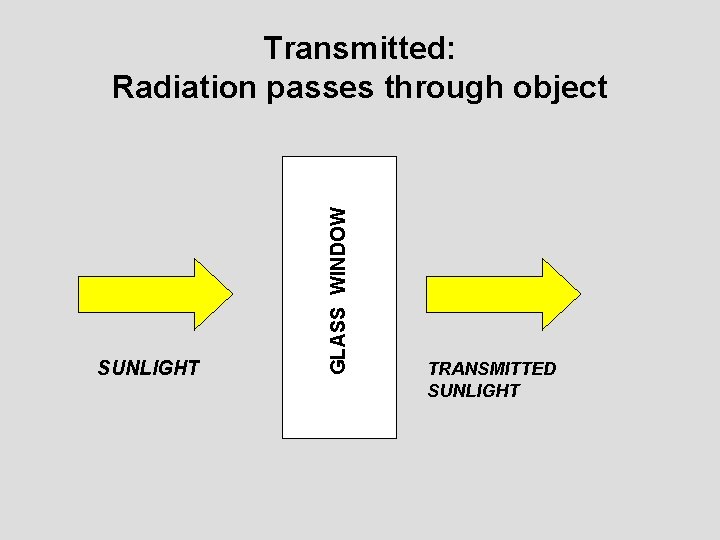
SUNLIGHT GLASS WINDOW Transmitted: Radiation passes through object TRANSMITTED SUNLIGHT
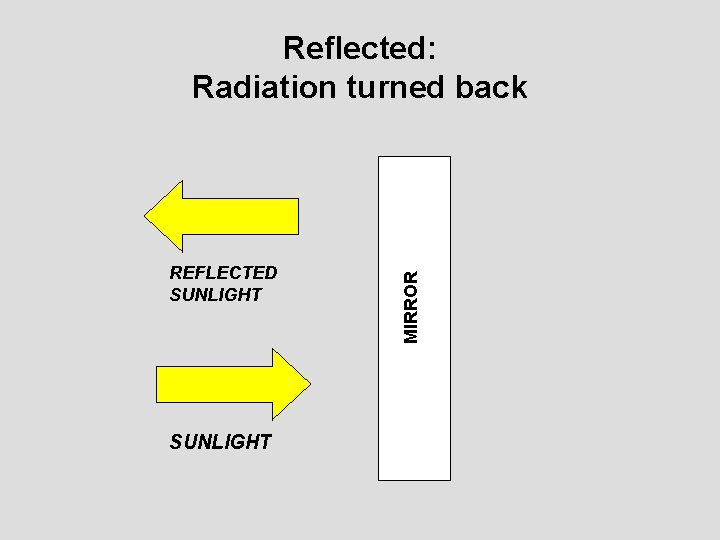
REFLECTED SUNLIGHT MIRROR Reflected: Radiation turned back
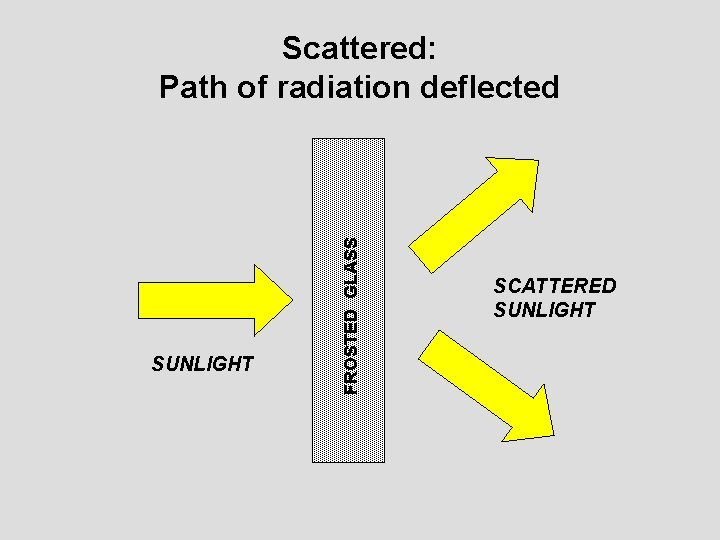
SUNLIGHT FROSTED GLASS Scattered: Path of radiation deflected SCATTERED SUNLIGHT
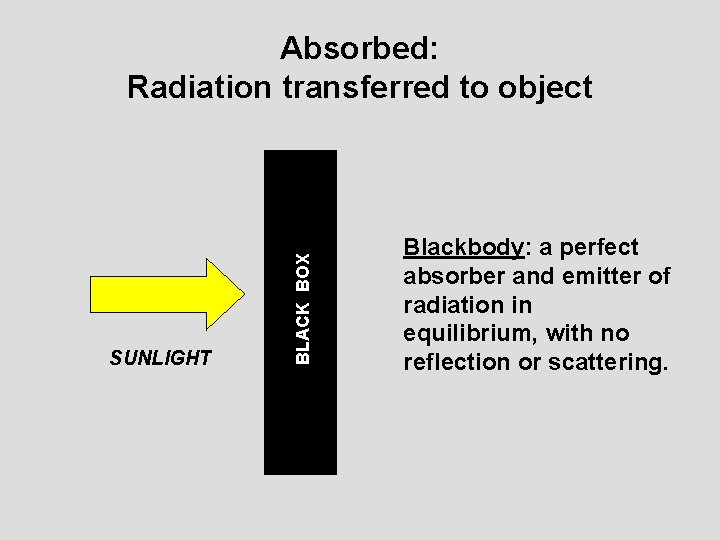
SUNLIGHT BLACK BOX Absorbed: Radiation transferred to object Blackbody: a perfect absorber and emitter of radiation in equilibrium, with no reflection or scattering.
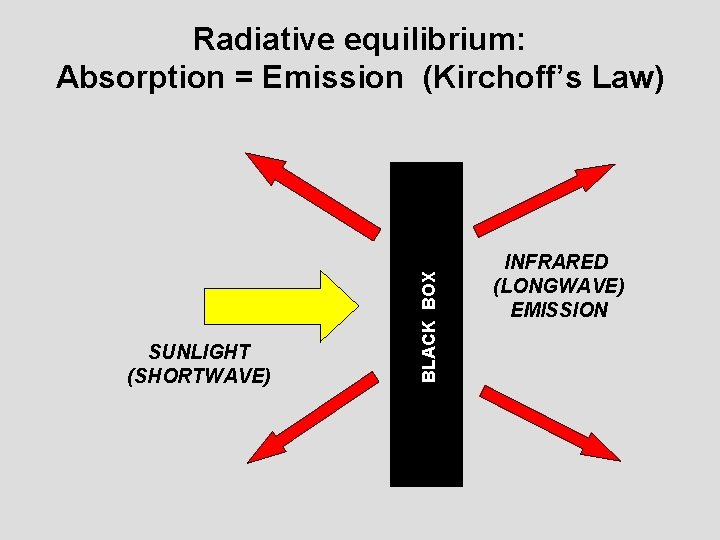
SUNLIGHT (SHORTWAVE) BLACK BOX Radiative equilibrium: Absorption = Emission (Kirchoff’s Law) INFRARED (LONGWAVE) EMISSION
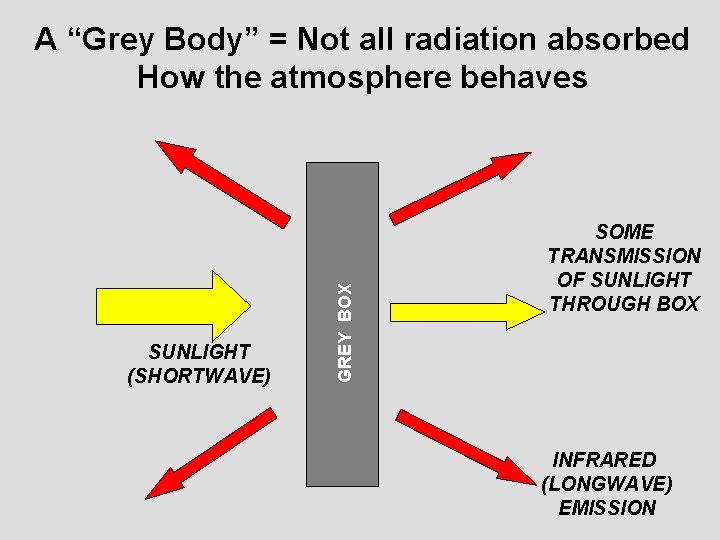
SUNLIGHT (SHORTWAVE) GREY BOX A “Grey Body” = Not all radiation absorbed How the atmosphere behaves SOME TRANSMISSION OF SUNLIGHT THROUGH BOX INFRARED (LONGWAVE) EMISSION
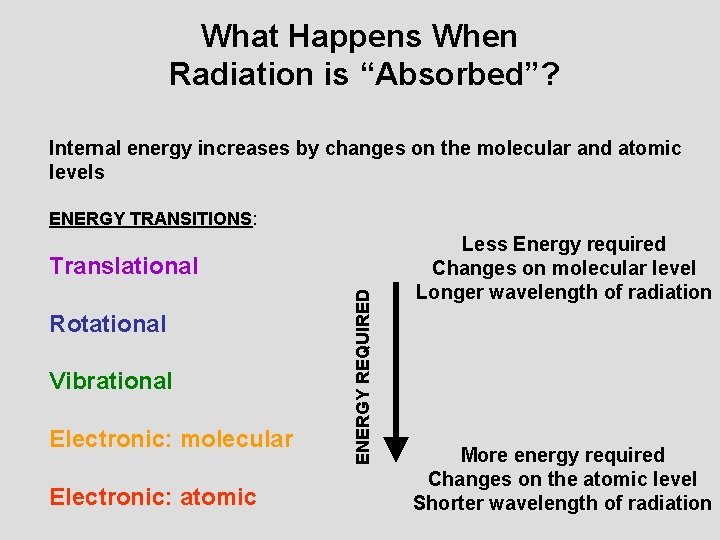
What Happens When Radiation is “Absorbed”? Internal energy increases by changes on the molecular and atomic levels ENERGY TRANSITIONS: Rotational Vibrational Electronic: molecular Electronic: atomic ENERGY REQUIRED Translational Less Energy required Changes on molecular level Longer wavelength of radiation More energy required Changes on the atomic level Shorter wavelength of radiation
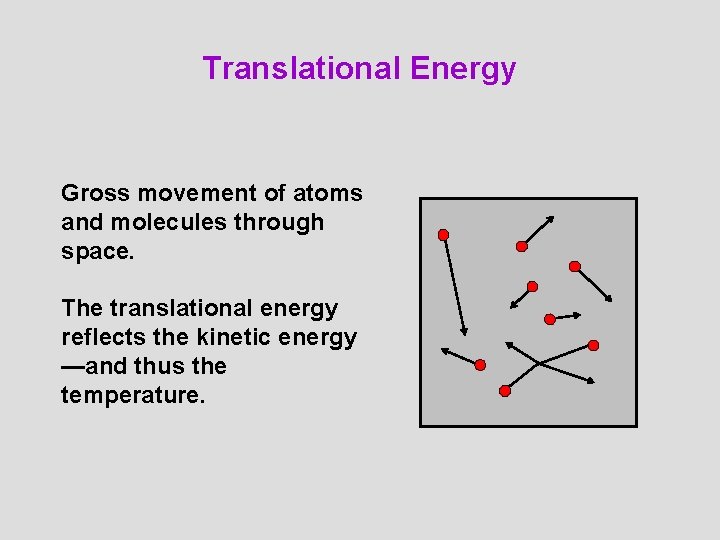
Translational Energy Gross movement of atoms and molecules through space. The translational energy reflects the kinetic energy —and thus the temperature.
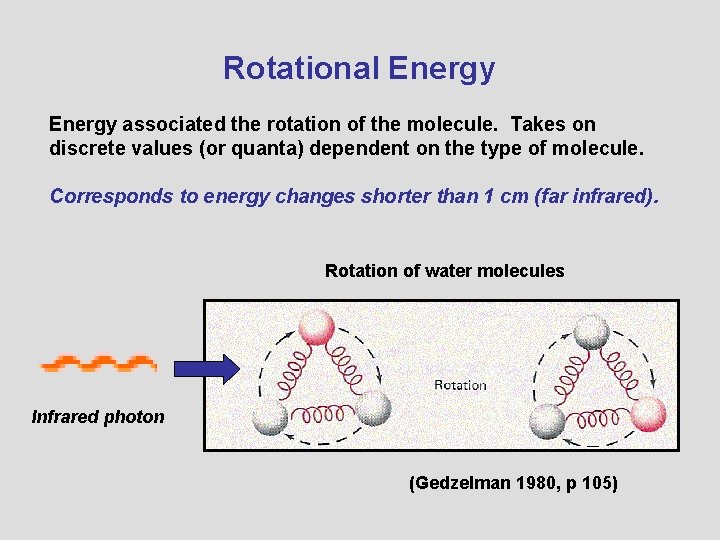
Rotational Energy associated the rotation of the molecule. Takes on discrete values (or quanta) dependent on the type of molecule. Corresponds to energy changes shorter than 1 cm (far infrared). Rotation of water molecules Infrared photon (Gedzelman 1980, p 105)
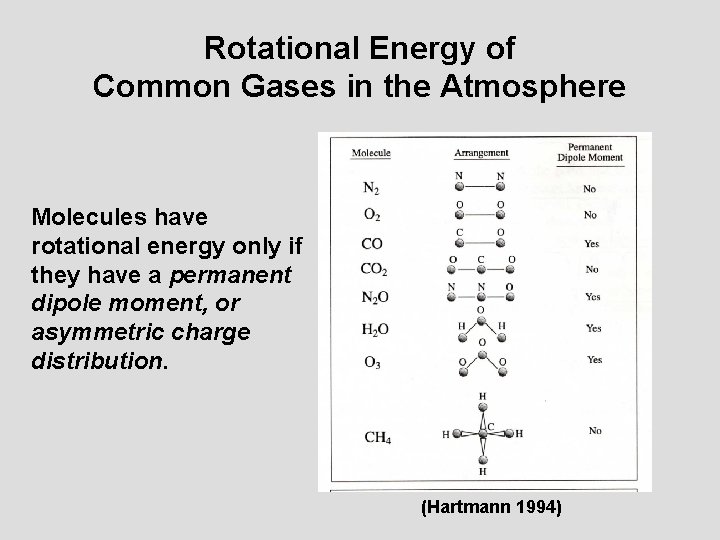
Rotational Energy of Common Gases in the Atmosphere Molecules have rotational energy only if they have a permanent dipole moment, or asymmetric charge distribution. (Hartmann 1994)
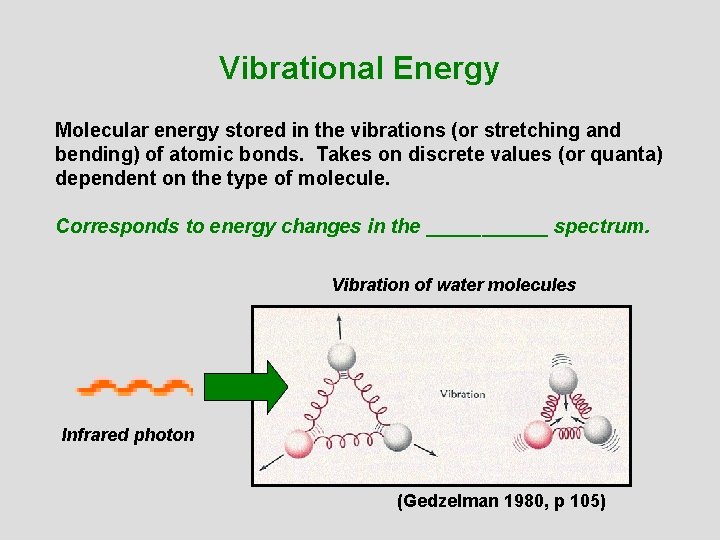
Vibrational Energy Molecular energy stored in the vibrations (or stretching and bending) of atomic bonds. Takes on discrete values (or quanta) dependent on the type of molecule. Corresponds to energy changes in the ______ spectrum. Vibration of water molecules Infrared photon (Gedzelman 1980, p 105)
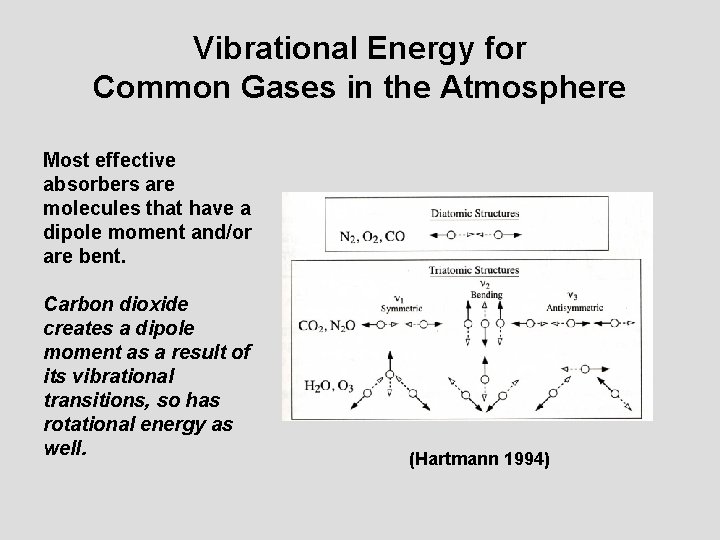
Vibrational Energy for Common Gases in the Atmosphere Most effective absorbers are molecules that have a dipole moment and/or are bent. Carbon dioxide creates a dipole moment as a result of its vibrational transitions, so has rotational energy as well. (Hartmann 1994)
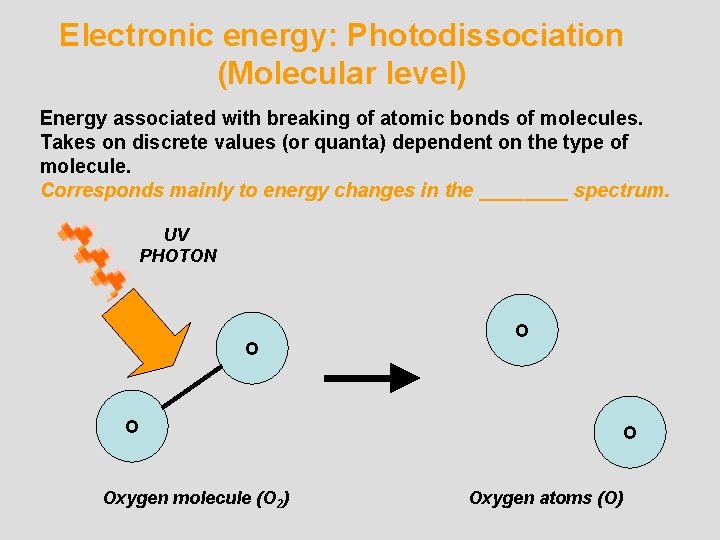
Electronic energy: Photodissociation (Molecular level) Energy associated with breaking of atomic bonds of molecules. Takes on discrete values (or quanta) dependent on the type of molecule. Corresponds mainly to energy changes in the ____ spectrum. UV PHOTON O Oxygen molecule (O 2) O Oxygen atoms (O)
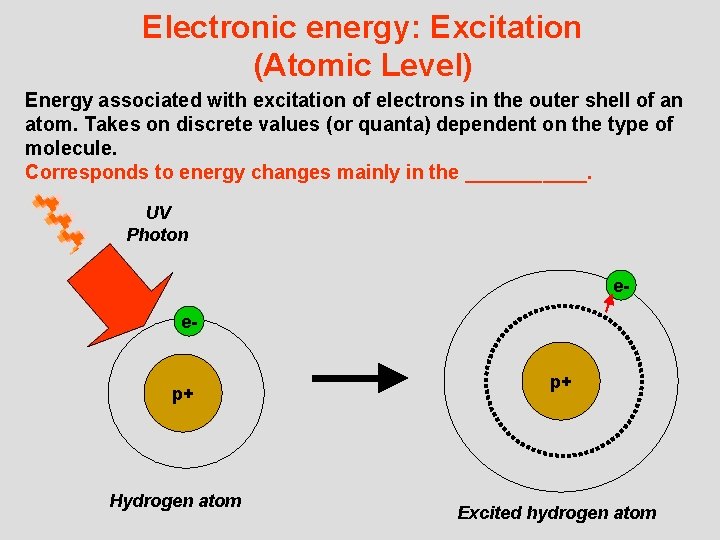
Electronic energy: Excitation (Atomic Level) Energy associated with excitation of electrons in the outer shell of an atom. Takes on discrete values (or quanta) dependent on the type of molecule. Corresponds to energy changes mainly in the ______. UV Photon ee- p+ Hydrogen atom p+ Excited hydrogen atom
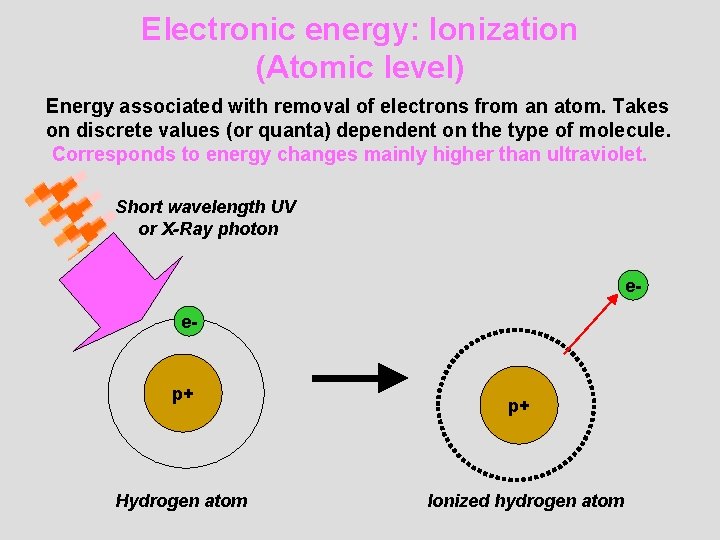
Electronic energy: Ionization (Atomic level) Energy associated with removal of electrons from an atom. Takes on discrete values (or quanta) dependent on the type of molecule. Corresponds to energy changes mainly higher than ultraviolet. Short wavelength UV or X-Ray photon ee- p+ Hydrogen atom p+ Ionized hydrogen atom
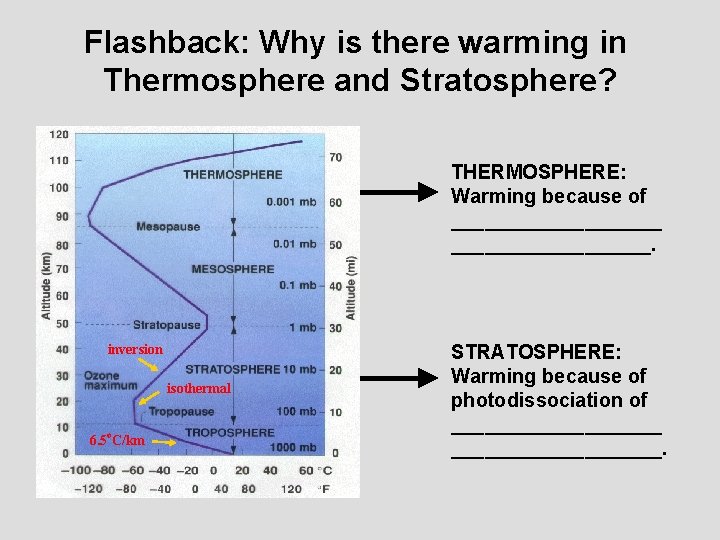
Flashback: Why is there warming in Thermosphere and Stratosphere? THERMOSPHERE: Warming because of __________. inversion isothermal 6. 5 o. C/km STRATOSPHERE: Warming because of photodissociation of ___________________.
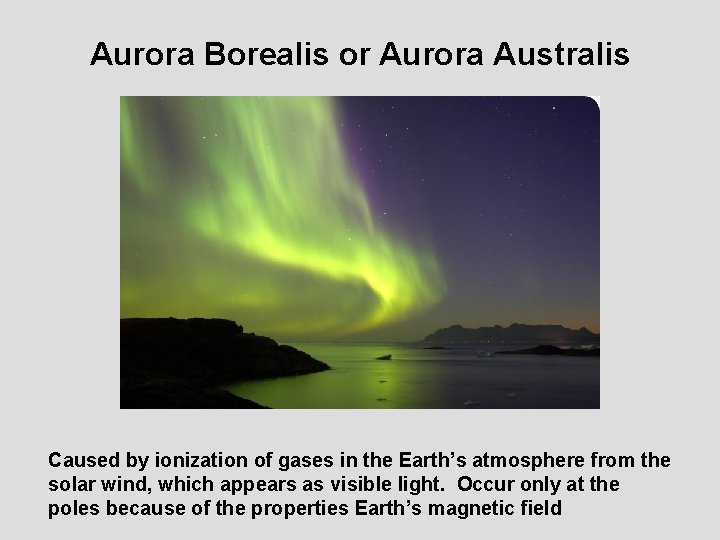
Aurora Borealis or Aurora Australis Caused by ionization of gases in the Earth’s atmosphere from the solar wind, which appears as visible light. Occur only at the poles because of the properties Earth’s magnetic field
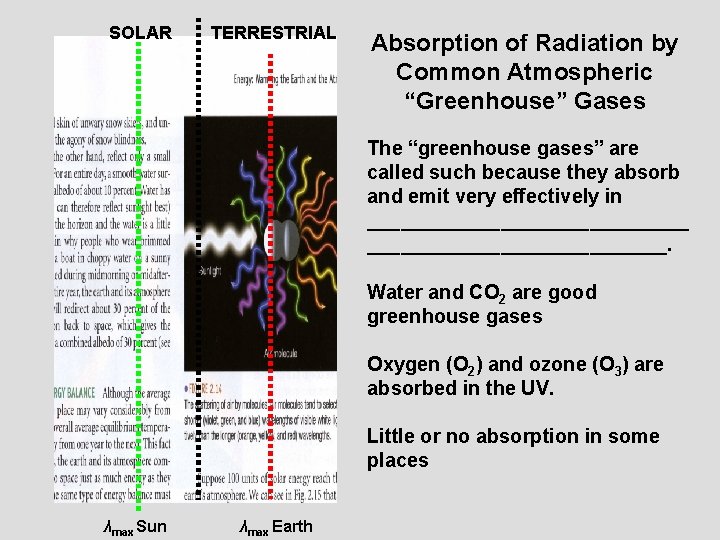
SOLAR TERRESTRIAL Absorption of Radiation by Common Atmospheric “Greenhouse” Gases The “greenhouse gases” are called such because they absorb and emit very effectively in _______________. Water and CO 2 are good greenhouse gases Oxygen (O 2) and ozone (O 3) are absorbed in the UV. Little or no absorption in some places λmax Sun λmax Earth
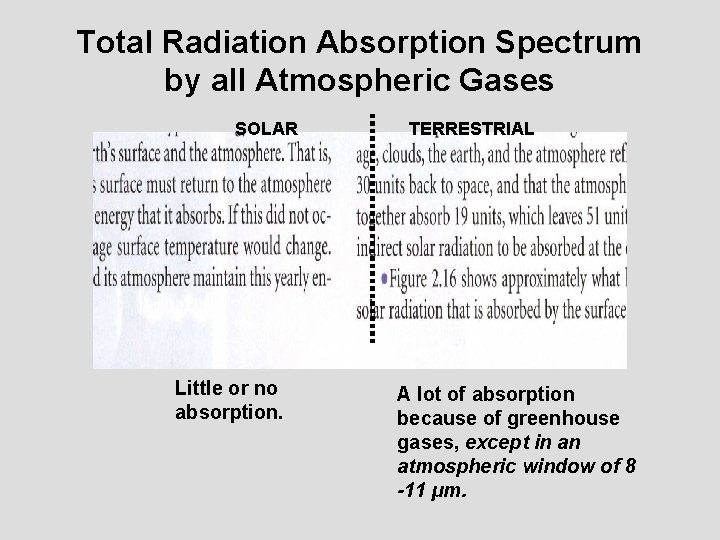
Total Radiation Absorption Spectrum by all Atmospheric Gases SOLAR Little or no absorption. TERRESTRIAL A lot of absorption because of greenhouse gases, except in an atmospheric window of 8 -11 µm.
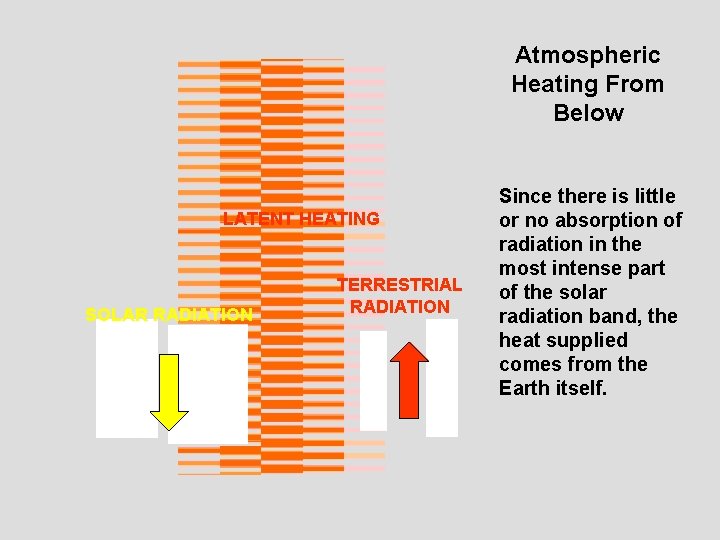
Atmospheric Heating From Below LATENT HEATING SOLAR RADIATION TERRESTRIAL RADIATION Since there is little or no absorption of radiation in the most intense part of the solar radiation band, the heat supplied comes from the Earth itself.
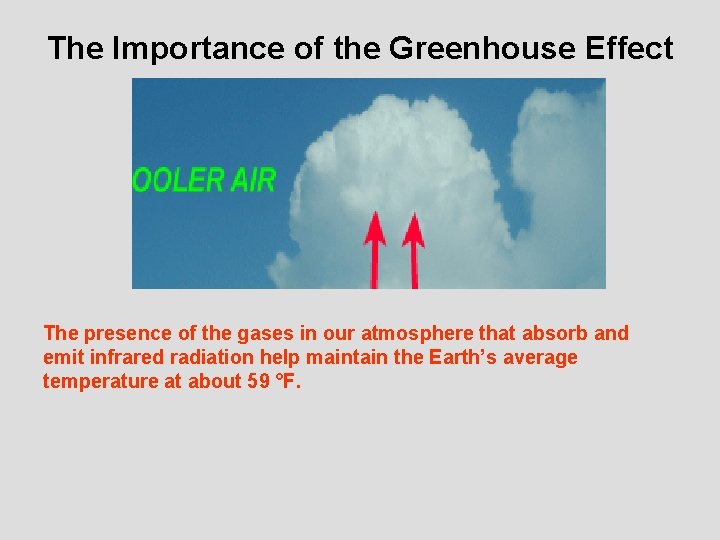
The Importance of the Greenhouse Effect The presence of the gases in our atmosphere that absorb and emit infrared radiation help maintain the Earth’s average temperature at about 59 °F.
The Greenhouse Effect DOES NOT EQUAL Global Warming or Climate Change! Global warming: The increase in Earth’s mean temperature that would result because of the increase in greenhouse gases due to human activities. This would enhance the greenhouse effect. Climate change: Long-term change in global, regional, or local climate resulting from both enhanced greenhouse gases and/or other human activities.
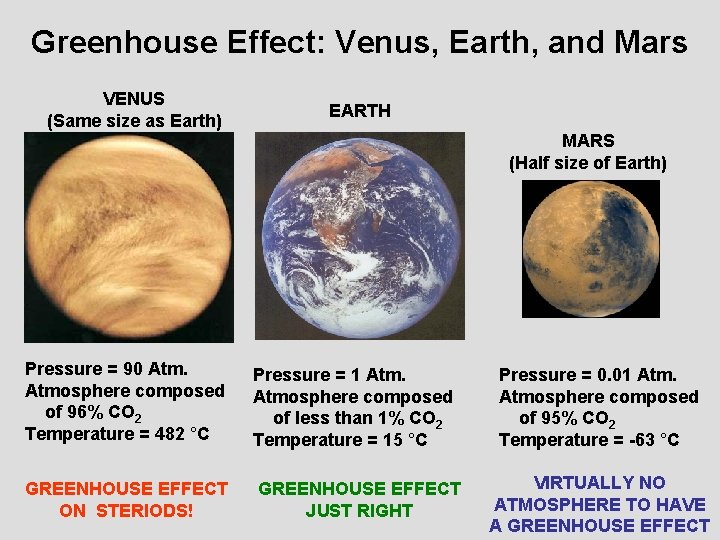
Greenhouse Effect: Venus, Earth, and Mars VENUS (Same size as Earth) EARTH MARS (Half size of Earth) Pressure = 90 Atmosphere composed of 96% CO 2 Temperature = 482 °C Pressure = 1 Atmosphere composed of less than 1% CO 2 Temperature = 15 °C GREENHOUSE EFFECT ON STERIODS! GREENHOUSE EFFECT JUST RIGHT Pressure = 0. 01 Atmosphere composed of 95% CO 2 Temperature = -63 °C VIRTUALLY NO ATMOSPHERE TO HAVE A GREENHOUSE EFFECT
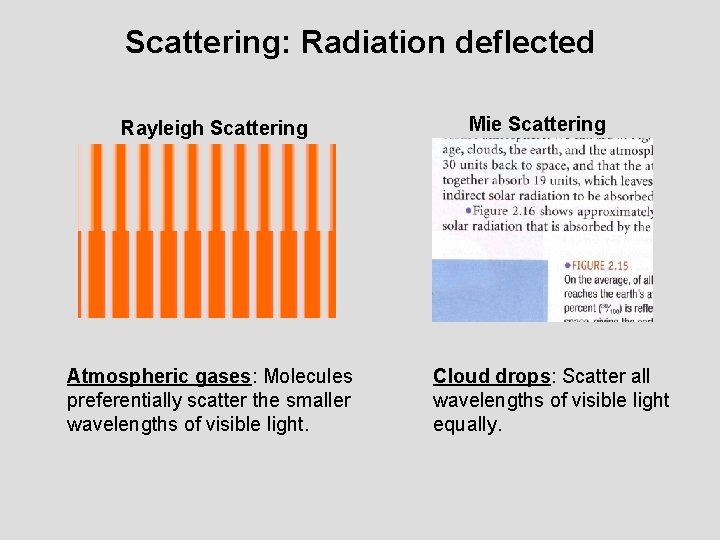
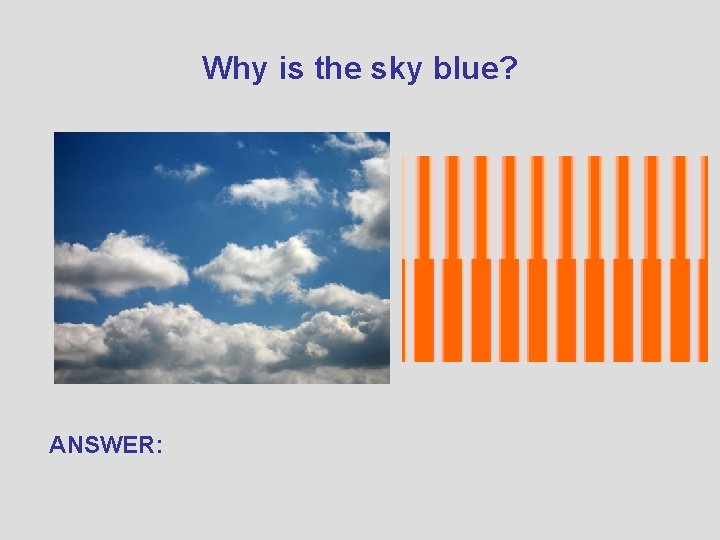
Scattering: Radiation deflected Rayleigh Scattering Atmospheric gases: Molecules preferentially scatter the smaller wavelengths of visible light. Mie Scattering Cloud drops: Scatter all wavelengths of visible light equally.
Why is the sky blue? ANSWER:
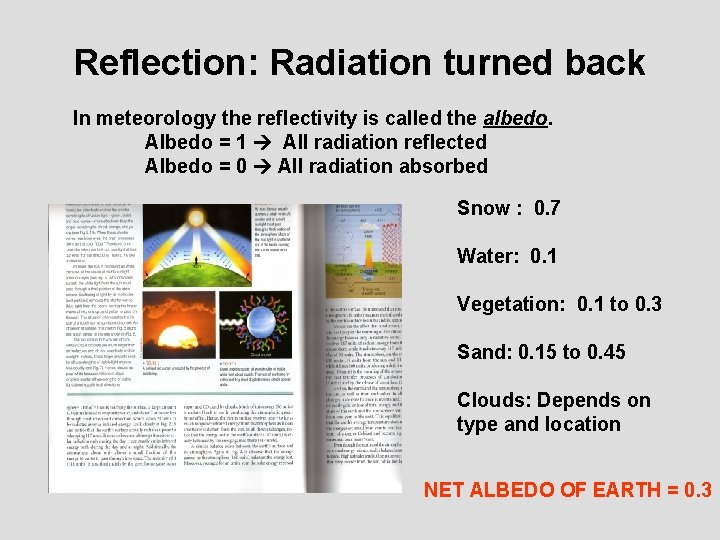
Reflection: Radiation turned back In meteorology the reflectivity is called the albedo. Albedo = 1 All radiation reflected Albedo = 0 All radiation absorbed Snow : 0. 7 Water: 0. 1 Vegetation: 0. 1 to 0. 3 Sand: 0. 15 to 0. 45 Clouds: Depends on type and location NET ALBEDO OF EARTH = 0. 3
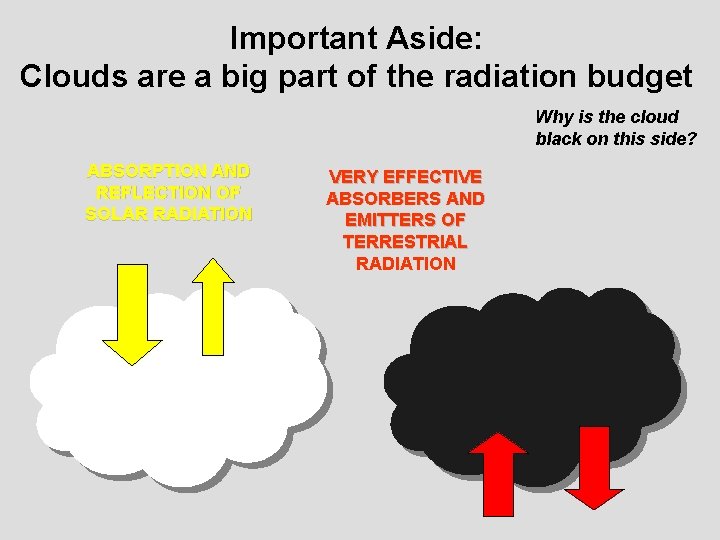
Important Aside: Clouds are a big part of the radiation budget Why is the cloud black on this side? ABSORPTION AND REFLECTION OF SOLAR RADIATION VERY EFFECTIVE ABSORBERS AND EMITTERS OF TERRESTRIAL RADIATION
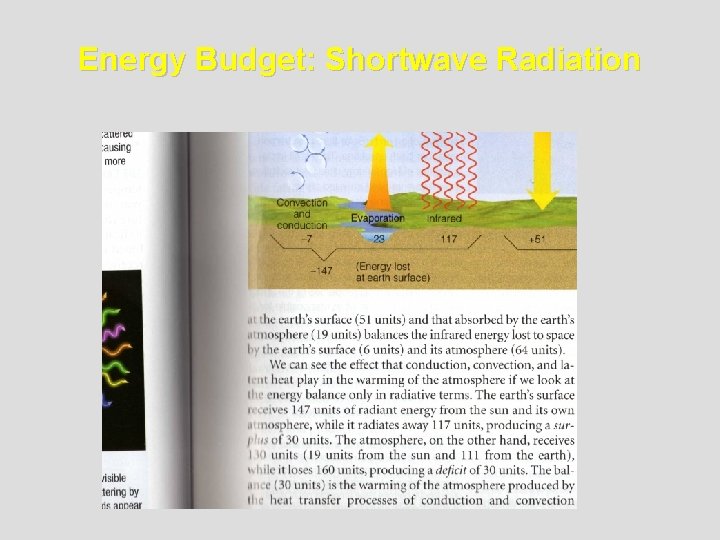
Energy Budget: Shortwave Radiation
Energy Budget: Longwave radiation and Sensible and Latent Heating
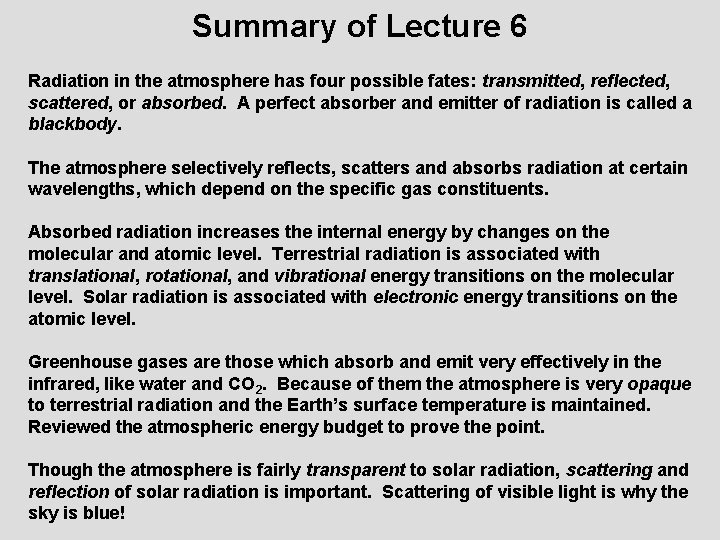
Summary of Lecture 6 Radiation in the atmosphere has four possible fates: transmitted, reflected, scattered, or absorbed. A perfect absorber and emitter of radiation is called a blackbody. The atmosphere selectively reflects, scatters and absorbs radiation at certain wavelengths, which depend on the specific gas constituents. Absorbed radiation increases the internal energy by changes on the molecular and atomic level. Terrestrial radiation is associated with translational, rotational, and vibrational energy transitions on the molecular level. Solar radiation is associated with electronic energy transitions on the atomic level. Greenhouse gases are those which absorb and emit very effectively in the infrared, like water and CO 2. Because of them the atmosphere is very opaque to terrestrial radiation and the Earth’s surface temperature is maintained. Reviewed the atmospheric energy budget to prove the point. Though the atmosphere is fairly transparent to solar radiation, scattering and reflection of solar radiation is important. Scattering of visible light is why the sky is blue!
Reading Assignment and Review Questions Ahrens, Chapter 3, pp. 55 -63 (8 th ed. ) pp. 57 - 65 (9 th ed. )