
NATS 101 Lecture 13 Curved Flow and Friction


- Slides: 46
NATS 101 Lecture 13 Curved Flow and Friction Local Diurnal Winds Mullen’s 1 st Law of NATS 101 Clicker=Points RUC surface analysis for 1800 UTC Mar 01, 2010 that shows winds blowing from high to low pressure
Last time we talked about two of the force terms in the simplified equation for horizontal air motion Geostrophic Balance: PRESSURE GRADIENT = CORIOLIS
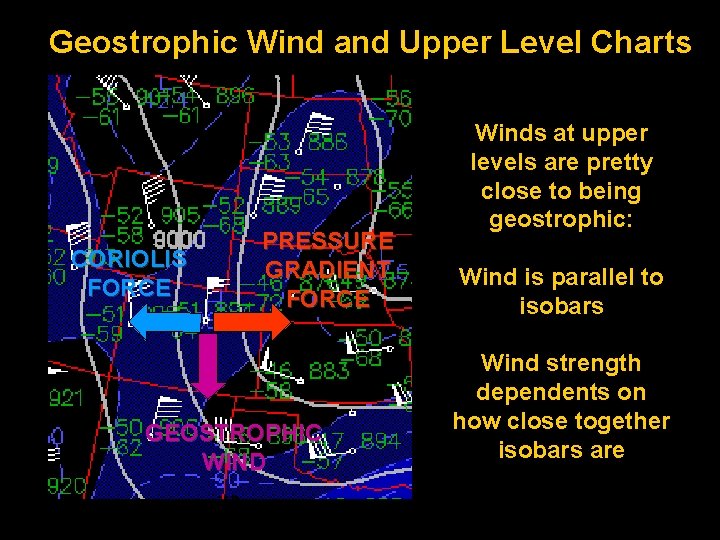
Geostrophic Wind and Upper Level Charts CORIOLIS FORCE PRESSURE GRADIENT FORCE GEOSTROPHIC WIND Winds at upper levels are pretty close to being geostrophic: Wind is parallel to isobars Wind strength dependents on how close together isobars are
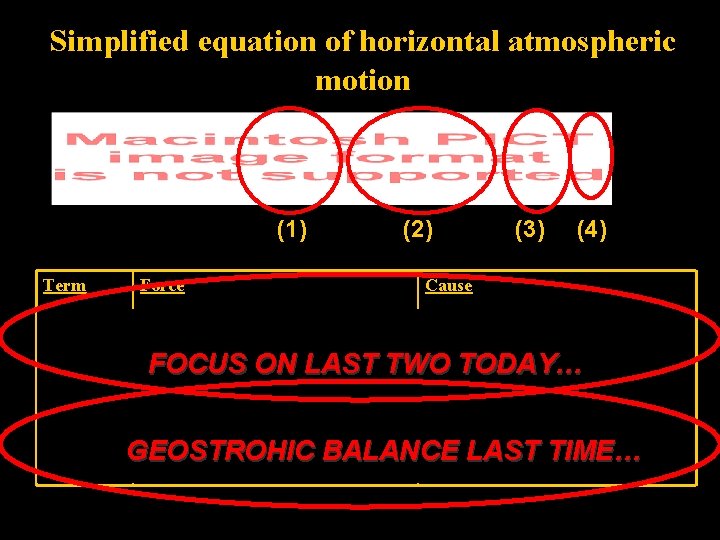
Simplified equation of horizontal atmospheric motion (1) (2) (3) (4) Term Force Cause 1 Pressure gradient force Spatial differences in pressure 2 FOCUS Coriolis force 3 Centripetal force 4 ON LAST TWO TODAY… Rotation of the Earth Curvature of the flow Friction force Acts against direction of motion GEOSTROHIC BALANCE LAST TIME… due to interaction with surface
The centripetal force and friction force are typically much smaller, but they are very important for two reasons: 1. Cause mass divergence and convergence 2. Can be relatively large in special cases that are meteorologically important (i. e. cool)
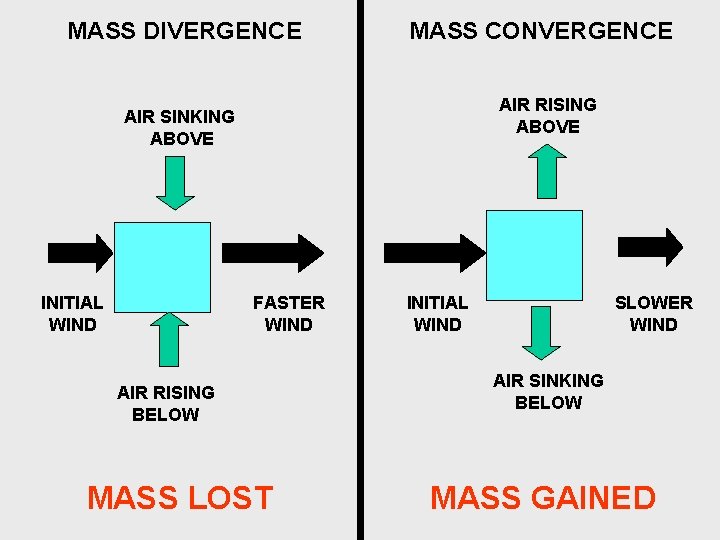
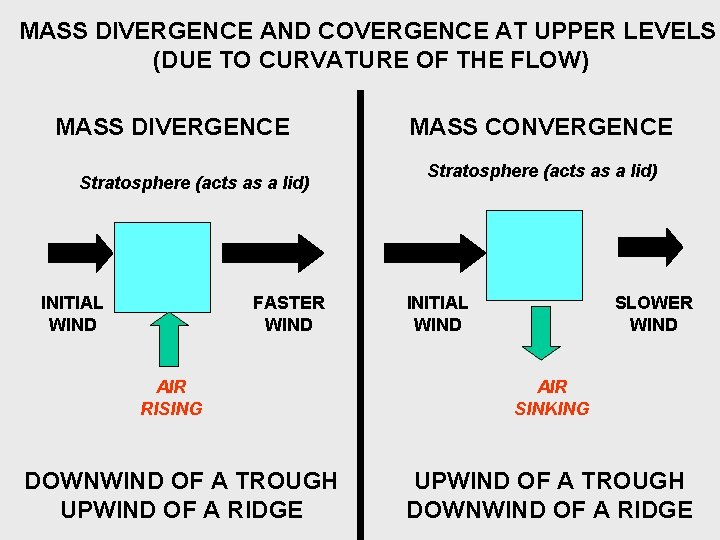
MASS DIVERGENCE MASS CONVERGENCE AIR RISING ABOVE AIR SINKING ABOVE INITIAL WIND FASTER WIND AIR RISING BELOW MASS LOST INITIAL WIND SLOWER WIND AIR SINKING BELOW MASS GAINED
To begin a discussion of centripetal force, let’s address the popular belief about how water goes down the drain…
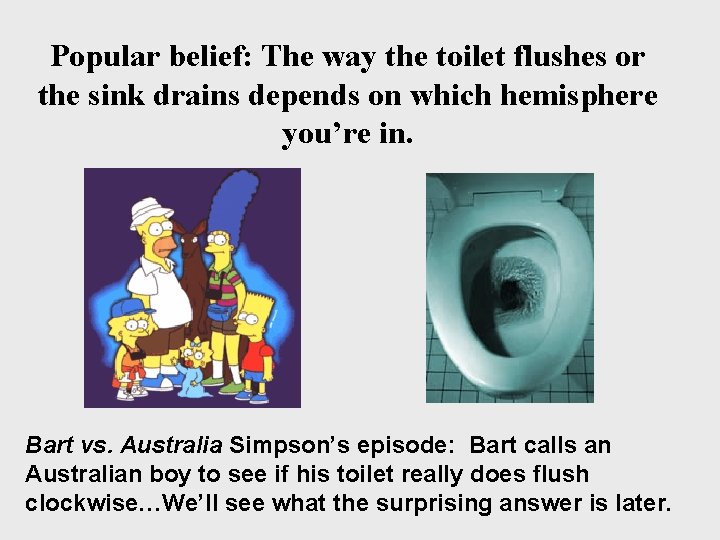
Popular belief: The way the toilet flushes or the sink drains depends on which hemisphere you’re in. Bart vs. Australia Simpson’s episode: Bart calls an Australian boy to see if his toilet really does flush clockwise…We’ll see what the surprising answer is later.
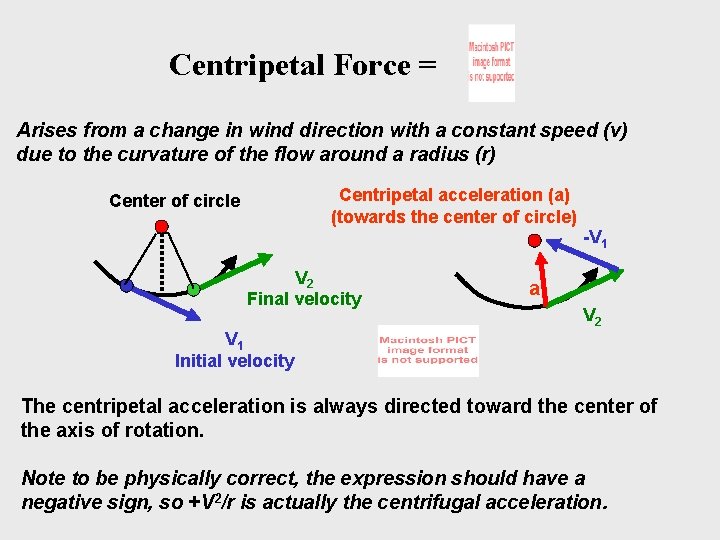
Centripetal Force = Arises from a change in wind direction with a constant speed (v) due to the curvature of the flow around a radius (r) Centripetal acceleration (a) (towards the center of circle) Center of circle -V 1 V 2 Final velocity a V 2 V 1 Initial velocity The centripetal acceleration is always directed toward the center of the axis of rotation. Note to be physically correct, the expression should have a negative sign, so +V 2/r is actually the centrifugal acceleration.
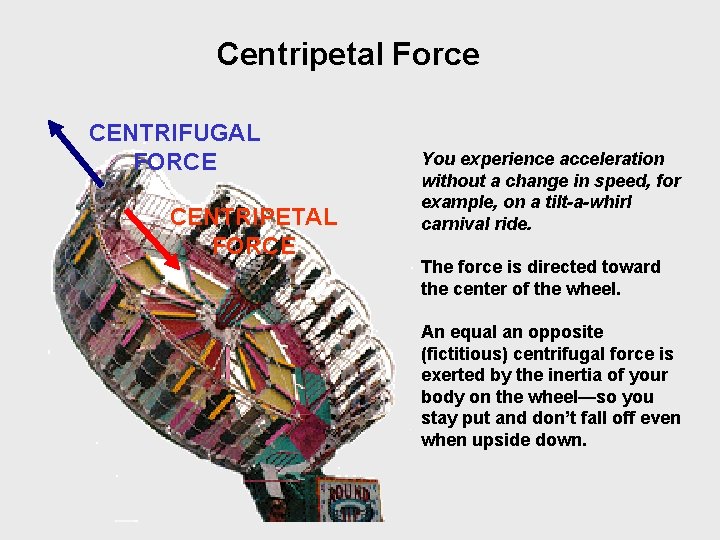
Centripetal Force CENTRIFUGAL FORCE CENTRIPETAL FORCE You experience acceleration without a change in speed, for example, on a tilt-a-whirl carnival ride. The force is directed toward the center of the wheel. An equal an opposite (fictitious) centrifugal force is exerted by the inertia of your body on the wheel—so you stay put and don’t fall off even when upside down.
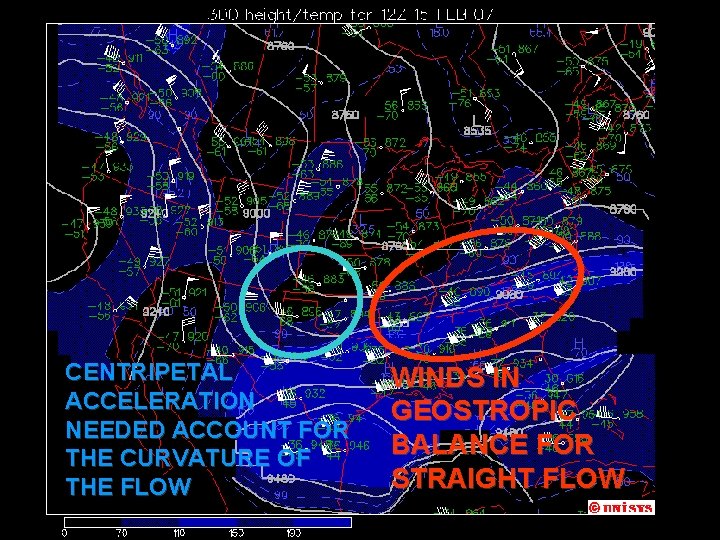
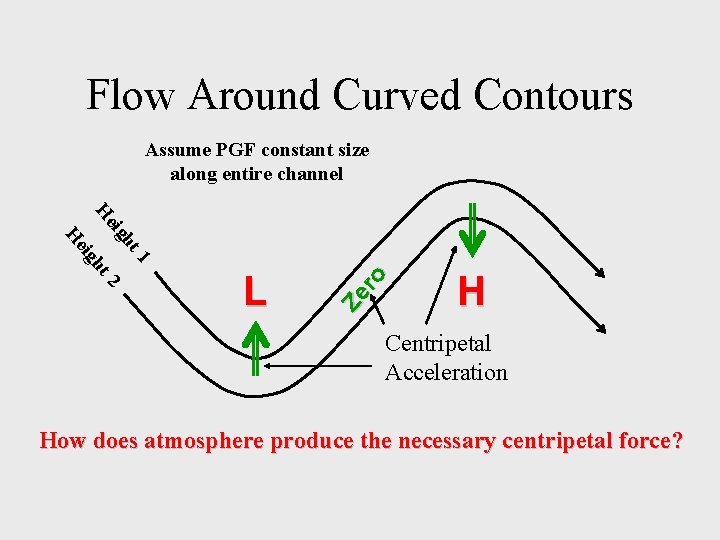
CENTRIPETAL ACCELERATION NEEDED ACCOUNT FOR THE CURVATURE OF THE FLOW WINDS IN GEOSTROPIC BALANCE FOR STRAIGHT FLOW
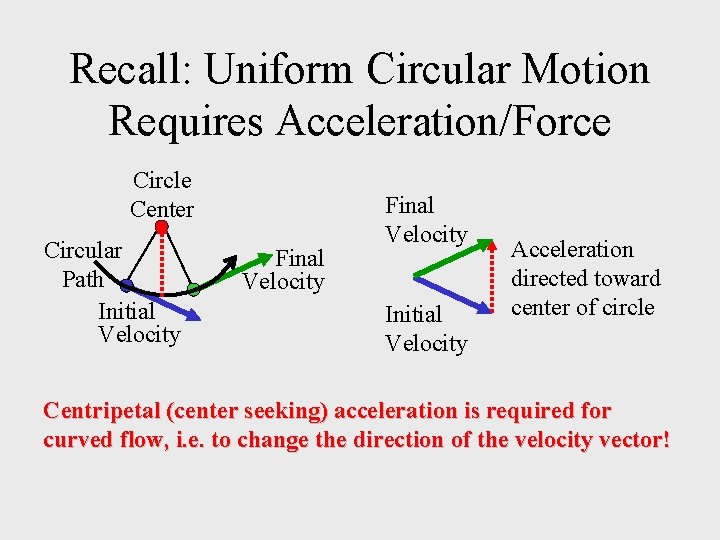
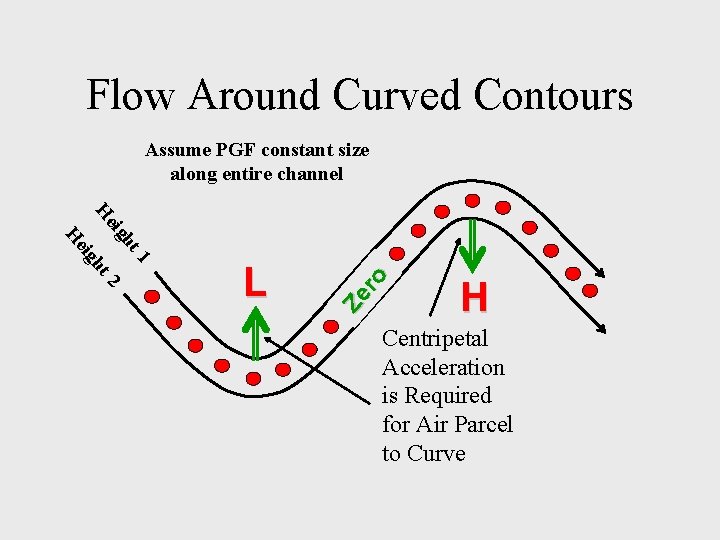
Recall: Uniform Circular Motion Requires Acceleration/Force Circle Center Circular Path Initial Velocity Final Velocity Initial Velocity Acceleration directed toward center of circle Centripetal (center seeking) acceleration is required for curved flow, i. e. to change the direction of the velocity vector!
Flow Around Curved Contours tm 1 4 h 0 e 6 ig tm 2 H 5 0 h 0 e 7 ig H 5 L Ze ro Assume PGF constant size along entire channel H Centripetal Acceleration is Required for Air Parcel to Curve
Flow Around Curved Contours tm 1 4 h 0 e 6 ig tm 2 H 5 0 h 0 e 7 ig H 5 L Ze ro Assume PGF constant size along entire channel H Centripetal Acceleration How does atmosphere produce the necessary centripetal force?
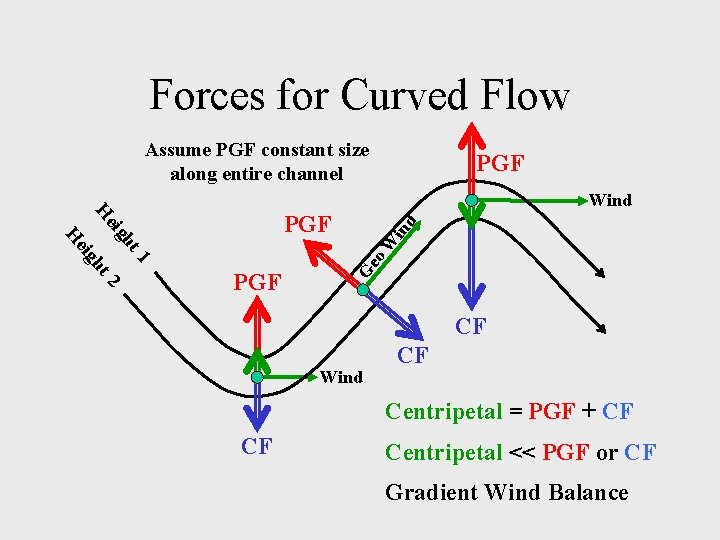
Forces for Curved Flow Assume PGF constant size along entire channel PGF eo W in d PGF G tm 1 4 h 0 e 6 ig tm 2 H 5 0 h 0 e 7 ig H 5 Wind CF Centripetal = PGF + CF CF Centripetal << PGF or CF Gradient Wind Balance
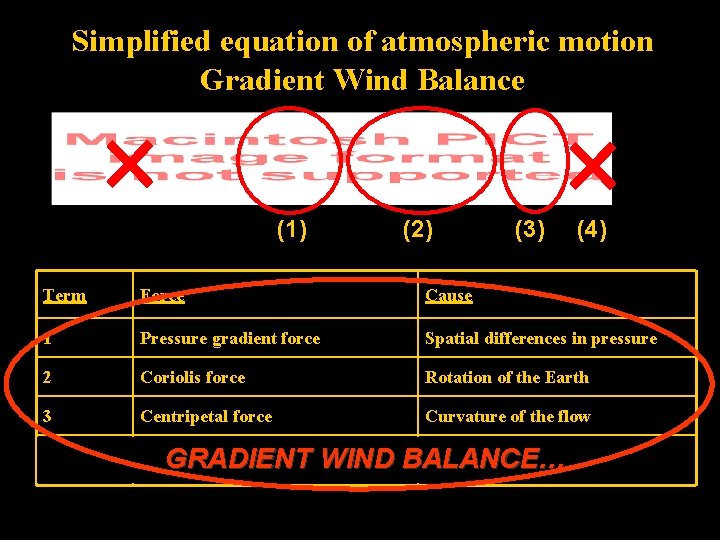
Simplified equation of atmospheric motion Gradient Wind Balance (1) (2) (3) (4) Term Force Cause 1 Pressure gradient force Spatial differences in pressure 2 Coriolis force Rotation of the Earth 3 Centripetal force Curvature of the flow 4 Friction force Acts against direction of motion GRADIENT WIND BALANCE… due to interaction with surface
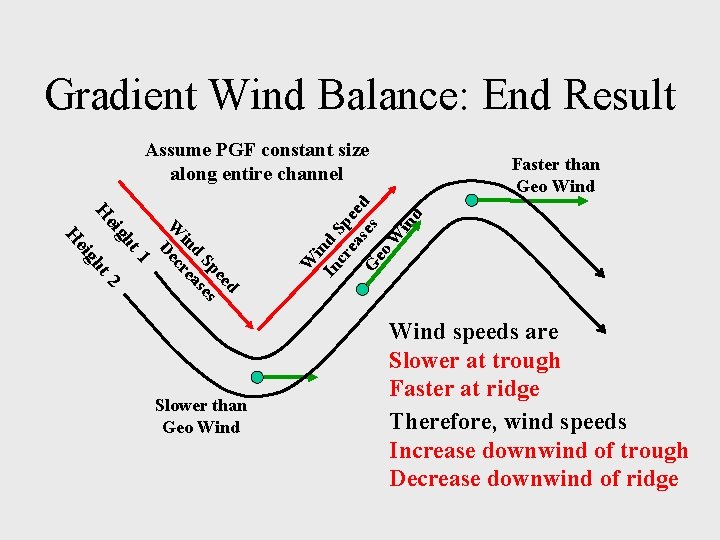
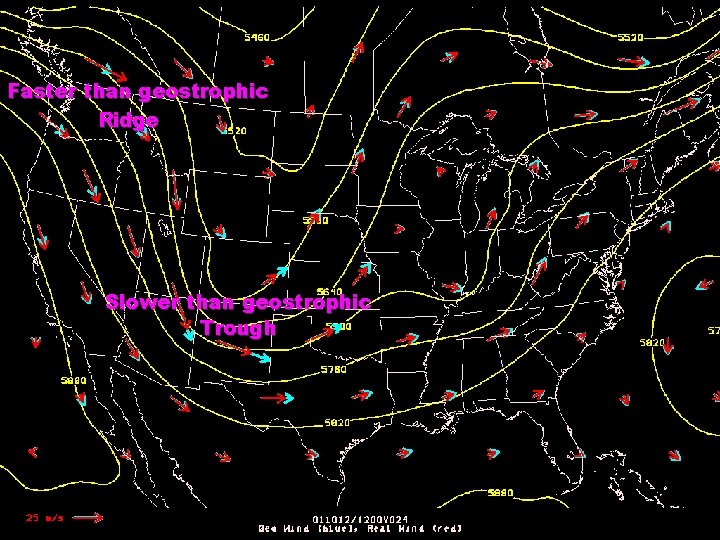
Gradient Wind Balance: End Result Assume PGF constant size along entire channel i In nd S cr p ea ee G ses d eo W in d W d ee Sp es d as in re W ec D tm 1 4 h 0 e 6 ig tm 2 H 5 0 h 0 e 7 ig H 5 Slower than Geo Wind Faster than Geo Wind speeds are Slower at trough Faster at ridge Therefore, wind speeds Increase downwind of trough Decrease downwind of ridge
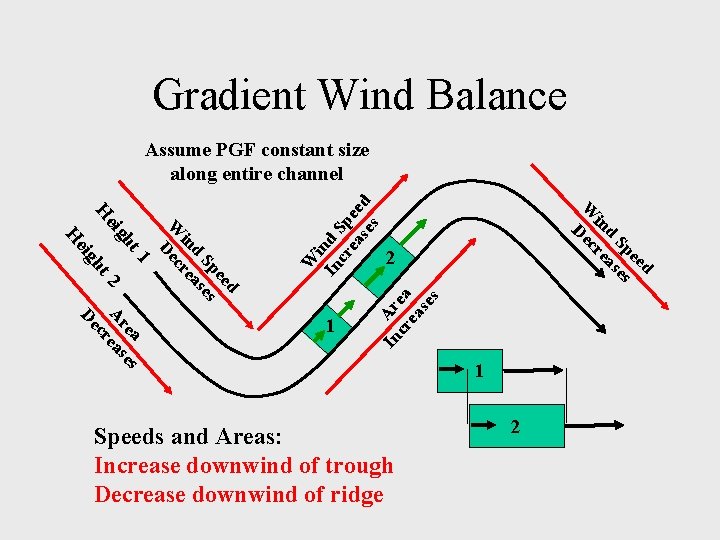
Gradient Wind Balance W 2 ea es Ar eas cr In Ar cr ea ea se s 2 De 1 d ee Sp es d as in re W ec D 1 ht d ee Sp es d as in re W ec D ht eig H i In nd S cr p ea ee se d s Assume PGF constant size along entire channel Speeds and Areas: Increase downwind of trough Decrease downwind of ridge 1 2
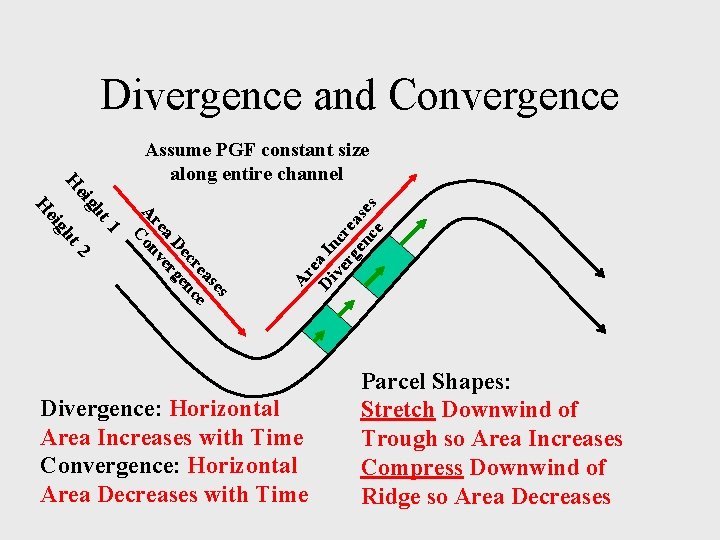
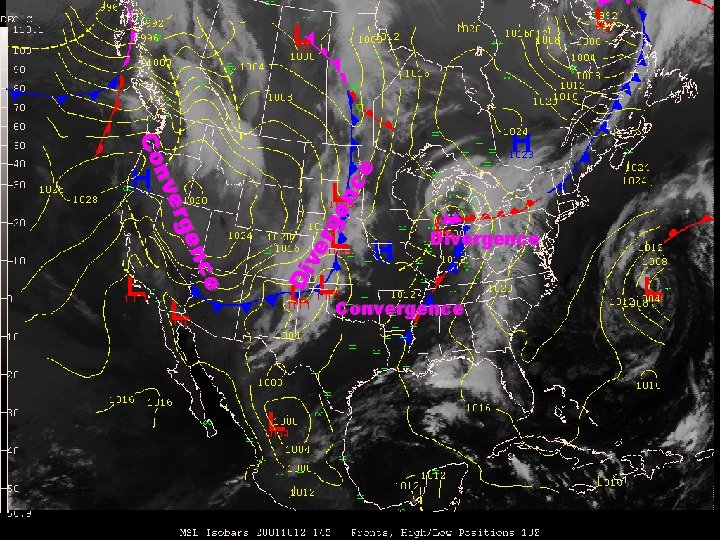
Divergence and Convergence Ar e Di a In ve cr rg ea en se ce s 1 2 s se ea e cr nc De rge ea ve Ar on C ht ht eig H Assume PGF constant size along entire channel Divergence: Horizontal Area Increases with Time Convergence: Horizontal Area Decreases with Time Parcel Shapes: Stretch Downwind of Trough so Area Increases Compress Downwind of Ridge so Area Decreases
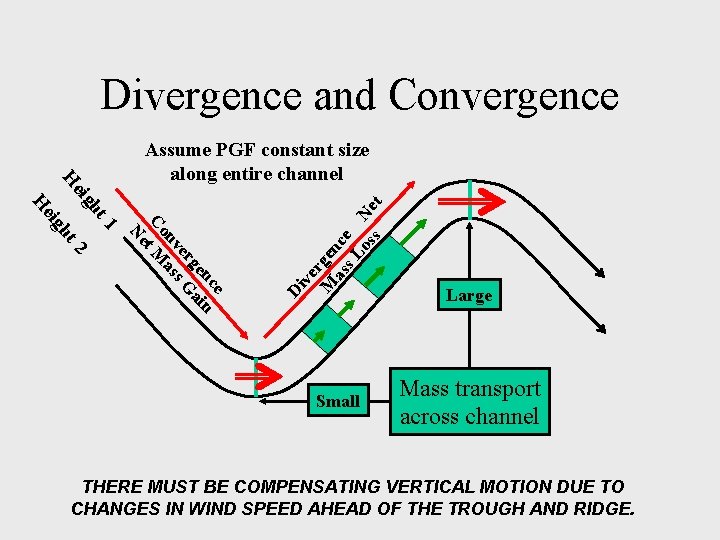
Divergence and Convergence e nc n ge ai er G nv ass Co t M Ne 1 2 Di ve r M gen as ce s. L os Ne s t ht ht eig H Assume PGF constant size along entire channel Small Large Mass transport across channel THERE MUST BE COMPENSATING VERTICAL MOTION DUE TO CHANGES IN WIND SPEED AHEAD OF THE TROUGH AND RIDGE.
MASS DIVERGENCE AND COVERGENCE AT UPPER LEVELS (DUE TO CURVATURE OF THE FLOW) MASS DIVERGENCE Stratosphere (acts as a lid) INITIAL WIND FASTER WIND AIR RISING DOWNWIND OF A TROUGH UPWIND OF A RIDGE MASS CONVERGENCE Stratosphere (acts as a lid) INITIAL WIND SLOWER WIND AIR SINKING UPWIND OF A TROUGH DOWNWIND OF A RIDGE
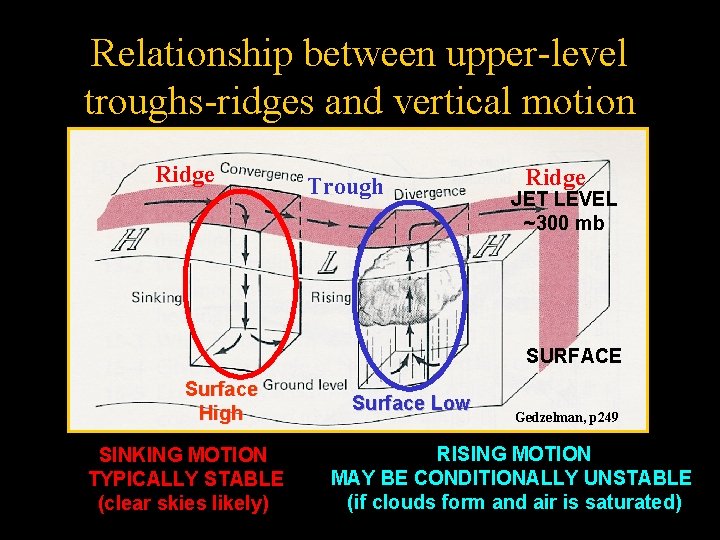
Relationship between upper-level troughs-ridges and vertical motion Ridge Trough Ridge JET LEVEL ~300 mb SURFACE Surface High SINKING MOTION TYPICALLY STABLE (clear skies likely) Surface Low Gedzelman, p 249 RISING MOTION MAY BE CONDITIONALLY UNSTABLE (if clouds form and air is saturated)
Faster than geostrophic Ridge Slower than geostrophic Trough
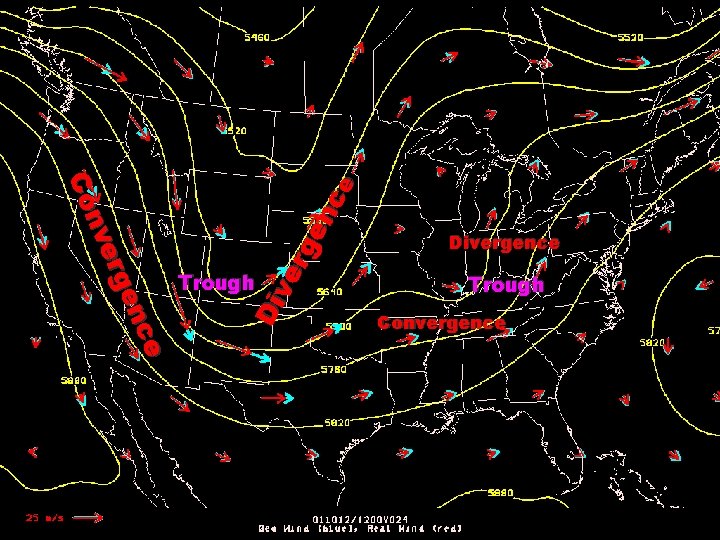
Di ve rg en ce ce en erg nv Co Trough Divergence Trough Convergence
Di ve rg en ce ce en erg nv Co Divergence Convergence
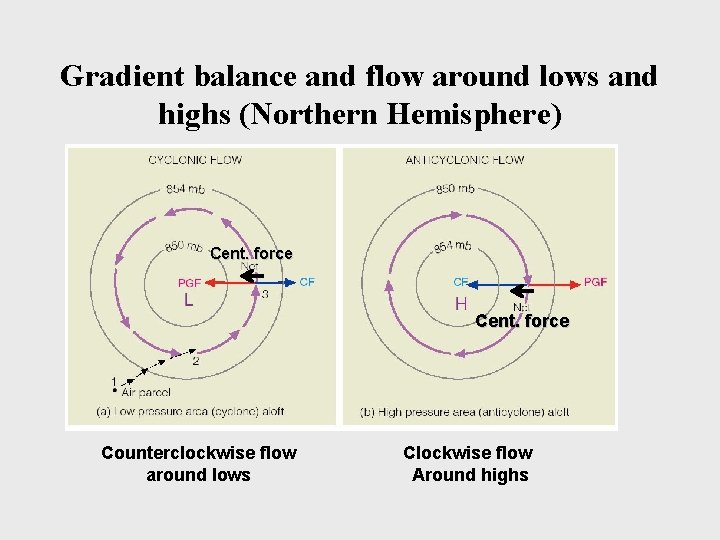
Gradient balance and flow around lows and highs (Northern Hemisphere) Cent. force Counterclockwise flow around lows Clockwise flow Around highs
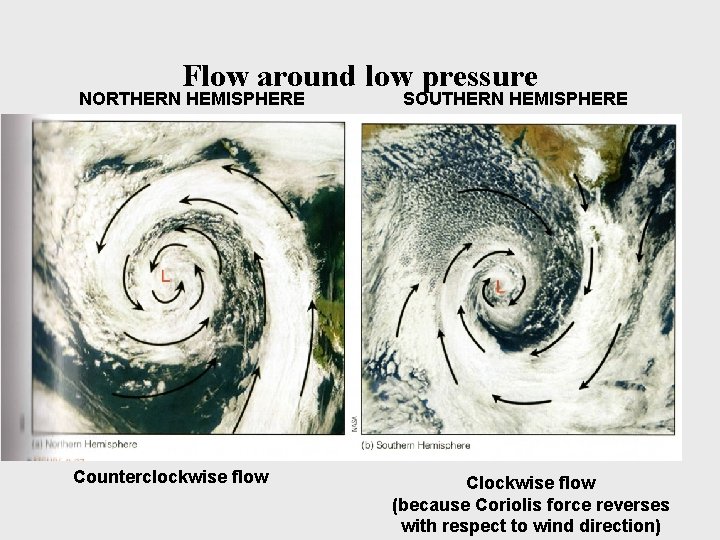
Flow around low pressure NORTHERN HEMISPHERE Counterclockwise flow SOUTHERN HEMISPHERE Clockwise flow (because Coriolis force reverses with respect to wind direction)
There is another force balance possible if the Coriolis force is very small or zero, so it’s negligible. In that case, the pressure gradient force would balance the centripetal force.
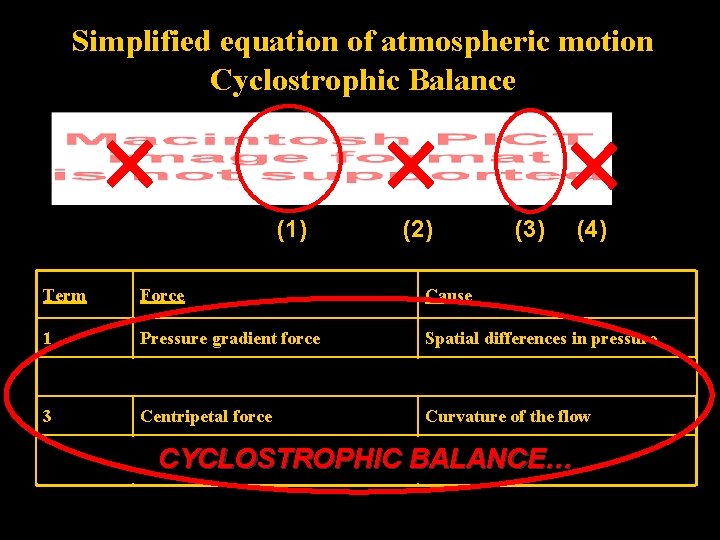
Simplified equation of atmospheric motion Cyclostrophic Balance (1) (2) (3) (4) Term Force Cause 1 Pressure gradient force Spatial differences in pressure 2 Coriolis force Rotation of the Earth 3 Centripetal force Curvature of the flow 4 Friction force Acts against direction of motion CYCLOSTROPHIC BALANCE… due to interaction with surface
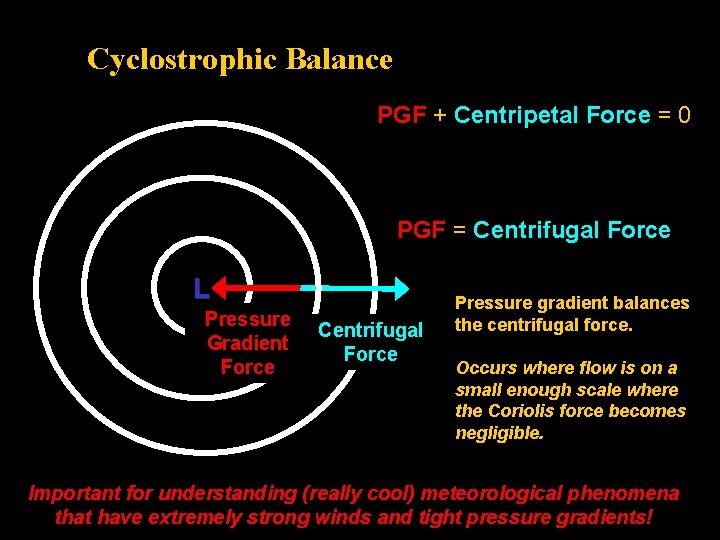
Cyclostrophic Balance PGF + Centripetal Force = 0 OR PGF = Centrifugal Force L Pressure Gradient Force Centrifugal Force Pressure gradient balances the centrifugal force. Occurs where flow is on a small enough scale where the Coriolis force becomes negligible. Important for understanding (really cool) meteorological phenomena that have extremely strong winds and tight pressure gradients!
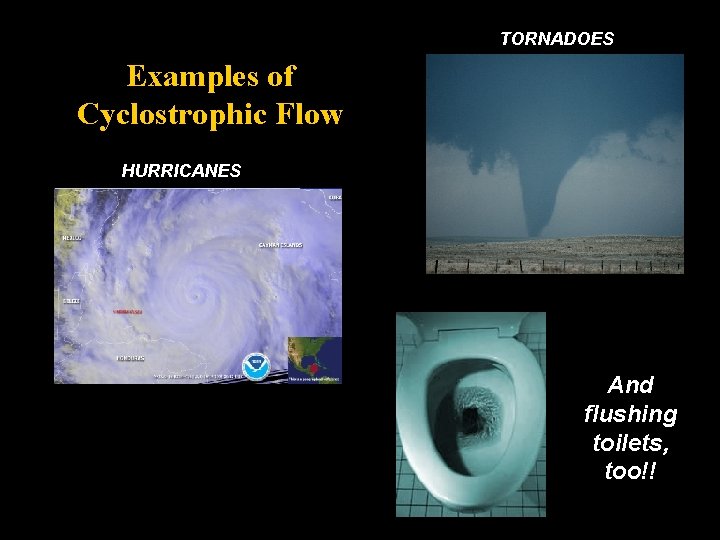
TORNADOES Examples of Cyclostrophic Flow HURRICANES And flushing toilets, too!!
The Unsolved Mystery of the Flushing Toilet Solved! PGF Centrifugal force To Bart and Lisa: “A swirling, flushing toilet is in cyclostrophic balance, so the way it flushes depends more on the shape of the drain—and nothing to do with whether you’re in Australia or not!”
One last force to consider… Friction
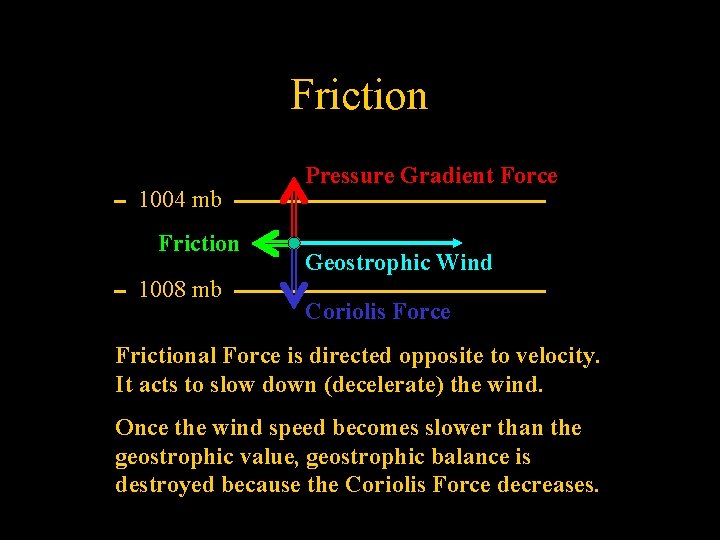
Friction 1004 mb Friction 1008 mb Pressure Gradient Force Geostrophic Wind Coriolis Force Frictional Force is directed opposite to velocity. It acts to slow down (decelerate) the wind. Once the wind speed becomes slower than the geostrophic value, geostrophic balance is destroyed because the Coriolis Force decreases.
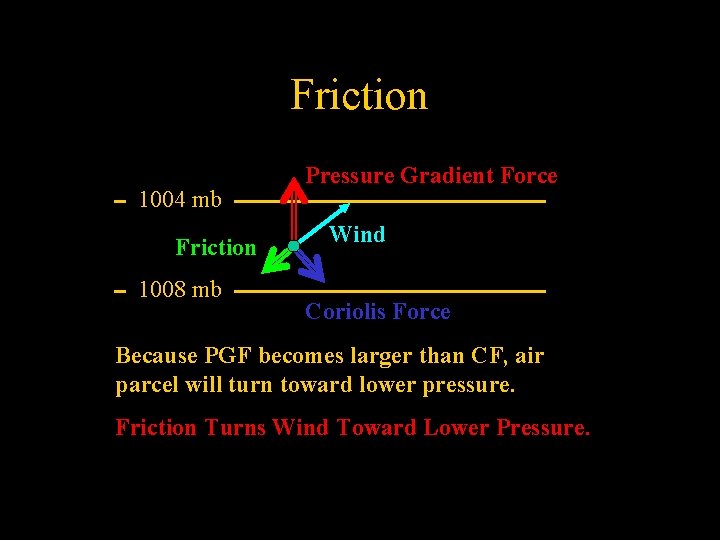
Friction 1004 mb Friction 1008 mb Pressure Gradient Force Wind Coriolis Force Because PGF becomes larger than CF, air parcel will turn toward lower pressure. Friction Turns Wind Toward Lower Pressure.
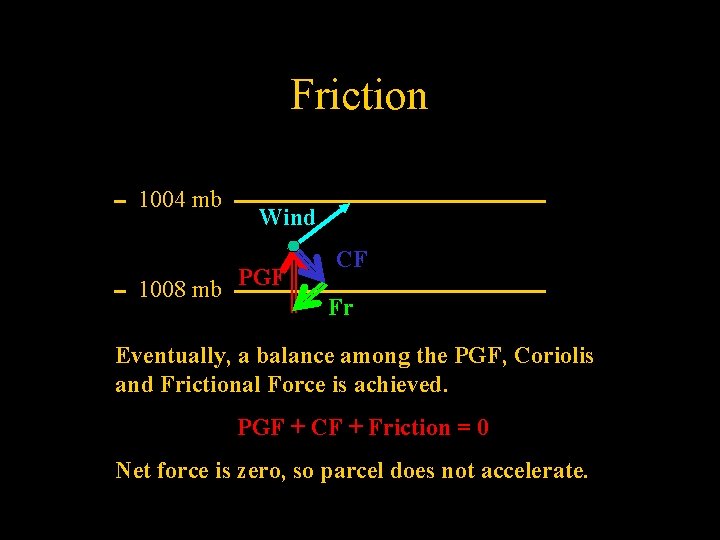
Friction 1004 mb Wind 1008 mb PGF CF Fr Eventually, a balance among the PGF, Coriolis and Frictional Force is achieved. PGF + CF + Friction = 0 Net force is zero, so parcel does not accelerate.
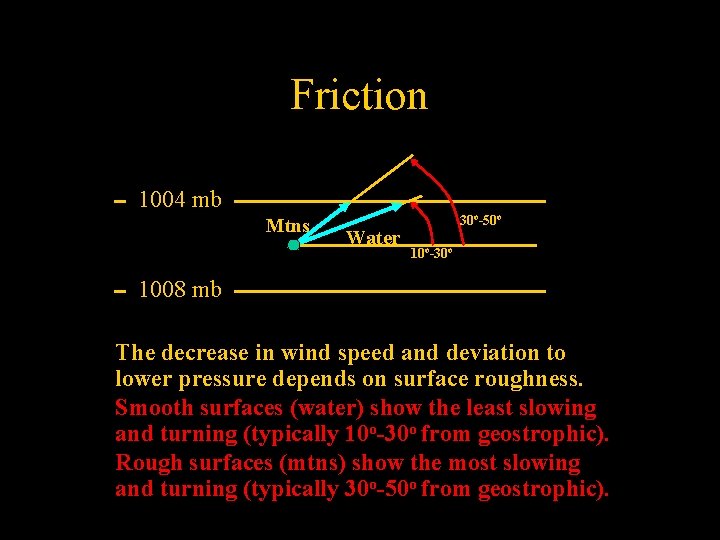
Friction 1004 mb Mtns Water 30 o-50 o 10 o-30 o 1008 mb The decrease in wind speed and deviation to lower pressure depends on surface roughness. Smooth surfaces (water) show the least slowing and turning (typically 10 o-30 o from geostrophic). Rough surfaces (mtns) show the most slowing and turning (typically 30 o-50 o from geostrophic).
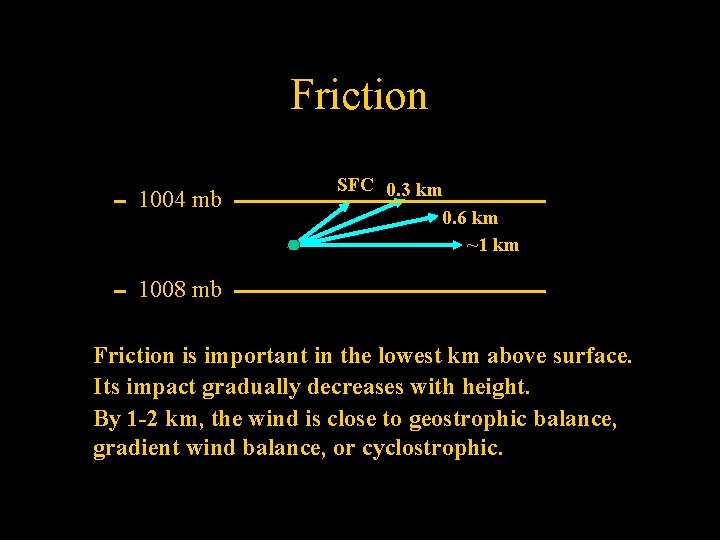
Friction 1004 mb SFC 0. 3 km 0. 6 km ~1 km 1008 mb Friction is important in the lowest km above surface. Its impact gradually decreases with height. By 1 -2 km, the wind is close to geostrophic balance, gradient wind balance, or cyclostrophic.
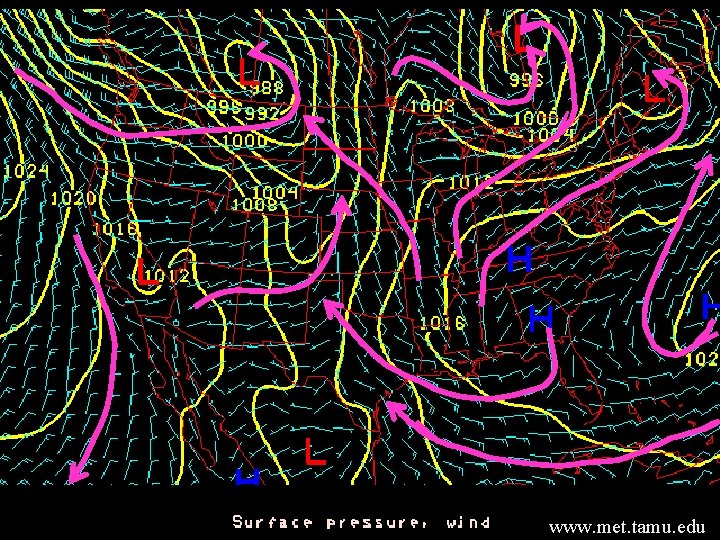
www. met. tamu. edu
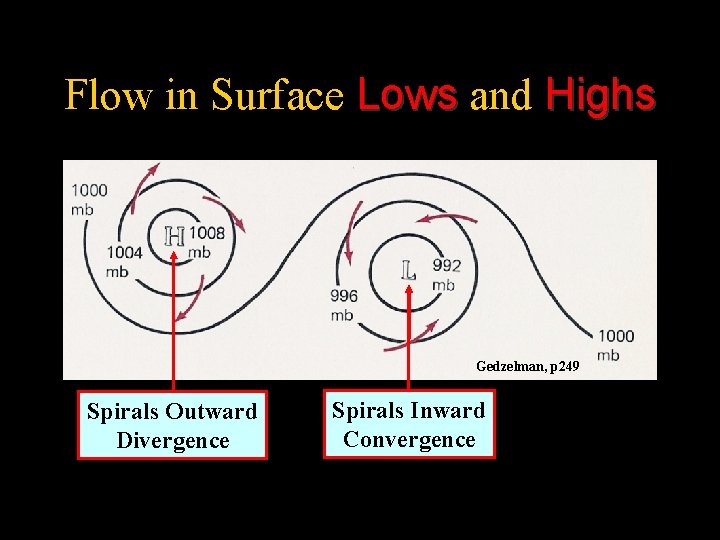
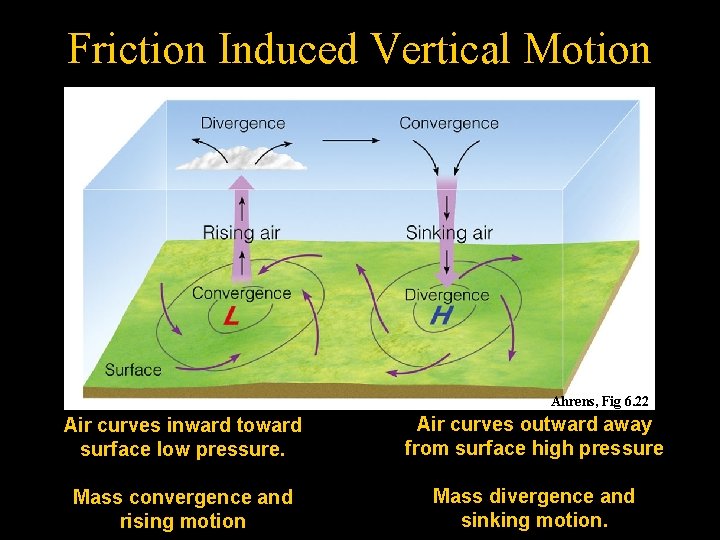
Flow in Surface Lows and Highs Gedzelman, p 249 Spirals Outward Divergence Spirals Inward Convergence
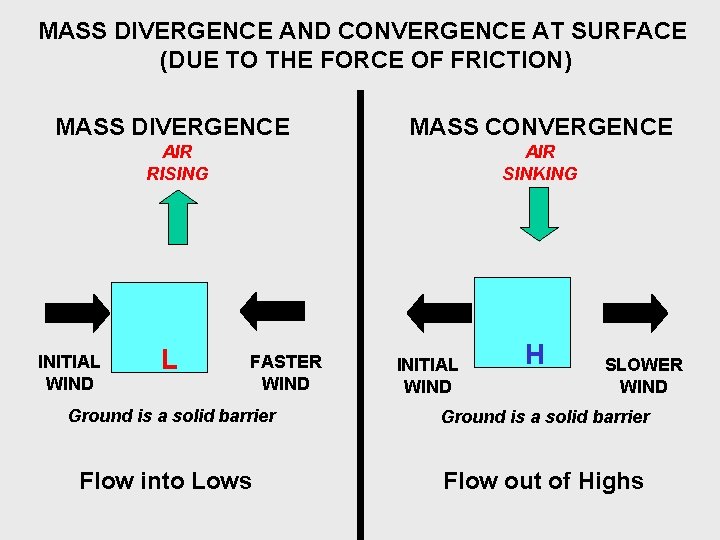
MASS DIVERGENCE AND CONVERGENCE AT SURFACE (DUE TO THE FORCE OF FRICTION) MASS DIVERGENCE MASS CONVERGENCE AIR RISING AIR SINKING INITIAL WIND L FASTER WIND INITIAL WIND H SLOWER WIND Ground is a solid barrier Flow into Lows Flow out of Highs
Friction Induced Vertical Motion Ahrens, Fig 6. 22 Air curves inward toward surface low pressure. Air curves outward away from surface high pressure Mass convergence and rising motion Mass divergence and sinking motion.
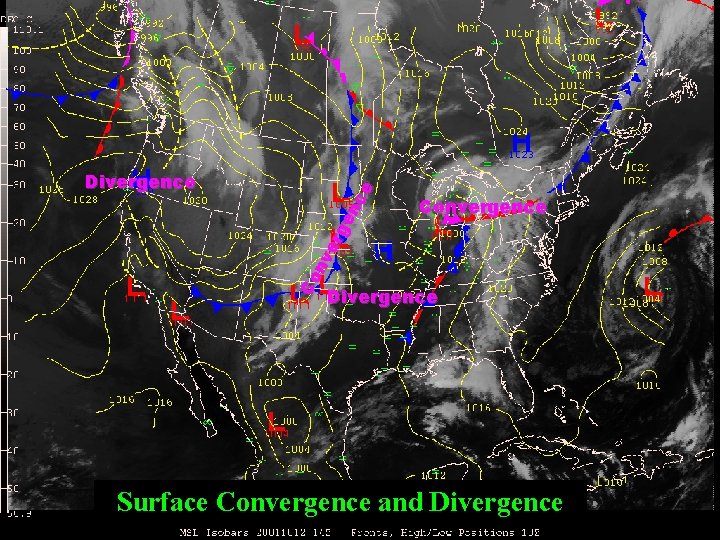
Co nv er ge nc e Divergence Convergence Divergence Surface Convergence and Divergence
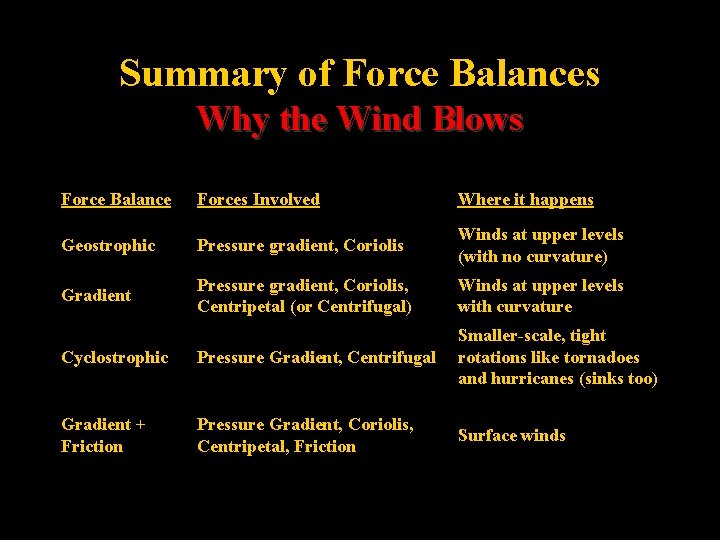
Summary of Force Balances Why the Wind Blows Force Balance Forces Involved Where it happens Geostrophic Pressure gradient, Coriolis Winds at upper levels (with no curvature) Gradient Pressure gradient, Coriolis, Centripetal (or Centrifugal) Winds at upper levels with curvature Cyclostrophic Pressure Gradient, Centrifugal Smaller-scale, tight rotations like tornadoes and hurricanes (sinks too) Gradient + Friction Pressure Gradient, Coriolis, Centripetal, Friction Surface winds
Assignment for Next Lecture Local Winds, Monsoons • Reading - Ahrens 3 rd: Pg 165 -178 4 th: Pg 167 -181 5 th: Pg 169 -184 • Homework 06 - D 2 L (Due Monday Mar. 22) 3 rd-Pg 194: 7. 3, 4, 5 4 th-Pg 198: 7. 3, 4, 5 5 th-Pg 200: 7. 3, 4, 5 Do Not Hand in 7. 3
Assignment for Next Lecture • QUIZ 2 this Thursday D 2 L only Similar format as before 7 am -12 pm time period for the exam 70 minutes to finish test