
NATO RTO 2004 Free for Public Release Information
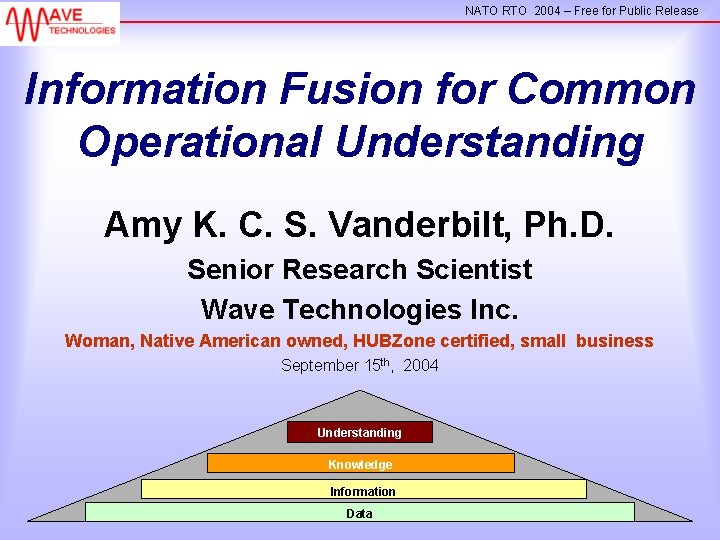
NATO RTO 2004 – Free for Public Release Information Fusion for Common Operational Understanding Amy K. C. S. Vanderbilt, Ph. D. Senior Research Scientist Wave Technologies Inc. Woman, Native American owned, HUBZone certified, small business September 15 th, 2004 Understanding Knowledge Information Data
NATO RTO 2004 – Free for Public Release The Goal Assist, mimic and analyze human reasoning
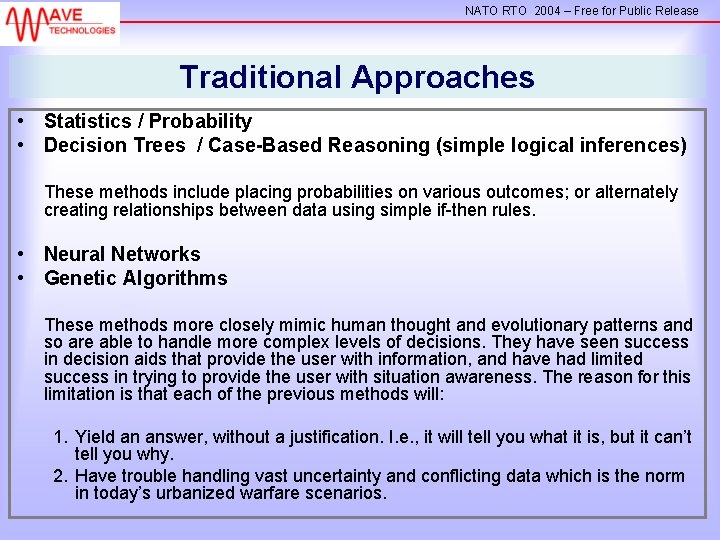
NATO RTO 2004 – Free for Public Release Traditional Approaches • Statistics / Probability • Decision Trees / Case-Based Reasoning (simple logical inferences) These methods include placing probabilities on various outcomes; or alternately creating relationships between data using simple if-then rules. • Neural Networks • Genetic Algorithms These methods more closely mimic human thought and evolutionary patterns and so are able to handle more complex levels of decisions. They have seen success in decision aids that provide the user with information, and have had limited success in trying to provide the user with situation awareness. The reason for this limitation is that each of the previous methods will: 1. Yield an answer, without a justification. I. e. , it will tell you what it is, but it can’t tell you why. 2. Have trouble handling vast uncertainty and conflicting data which is the norm in today’s urbanized warfare scenarios.
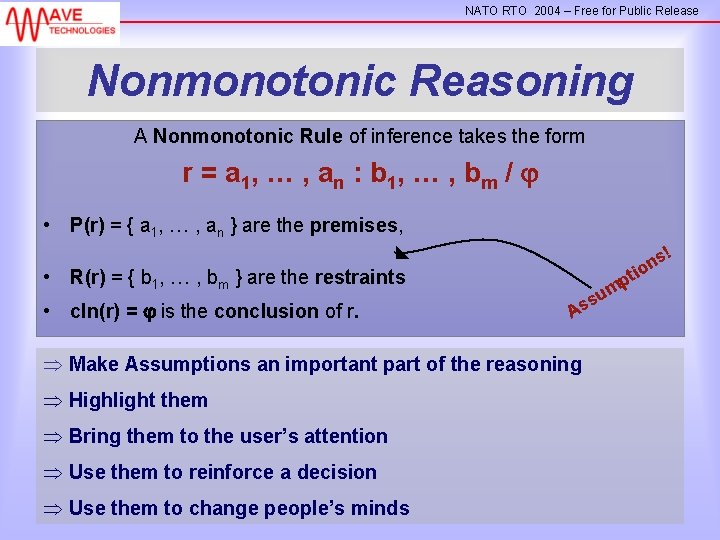
NATO RTO 2004 – Free for Public Release Nonmonotonic Reasoning A Nonmonotonic Rule of inference takes the form r = a 1, … , a n : b 1, … , b m / • P(r) = { a 1, … , an } are the premises, ! t • R(r) = { b 1, … , bm } are the restraints • cln(r) = is the conclusion of r. Þ Bring them to the user’s attention Þ Use them to reinforce a decision Þ Use them to change people’s minds p m u ss A Þ Make Assumptions an important part of the reasoning Þ Highlight them s ion
NATO RTO 2004 – Free for Public Release Blended Approaches Probability with Nonmonotonic Reasoning Ideal for information, and simple situation understanding, and to determine how a set of humans comes to a particular decision. This blending accurately returns information about why that decision was made, how to encourage that decision and how to change their minds. This method is known as “Nonmonotonic Analysis” Neural networks with Nonmonotonic Reasoning Handles complex decisions efficiently and returns a justification along with the answer. This method is known as “formula augmented networks”. Genetic Algorithms with Nonmonotonic Reasoning Can handle highly complex decisions that may involve vast uncertainty and conflicting data. It will handle them efficiently and yield and explanation along with an answer. This method is yet undeveloped, but holds great potential. Custom Algorithms Customizing each layer to the least complex method needed may reduce computation time and make the overall tool more efficient.
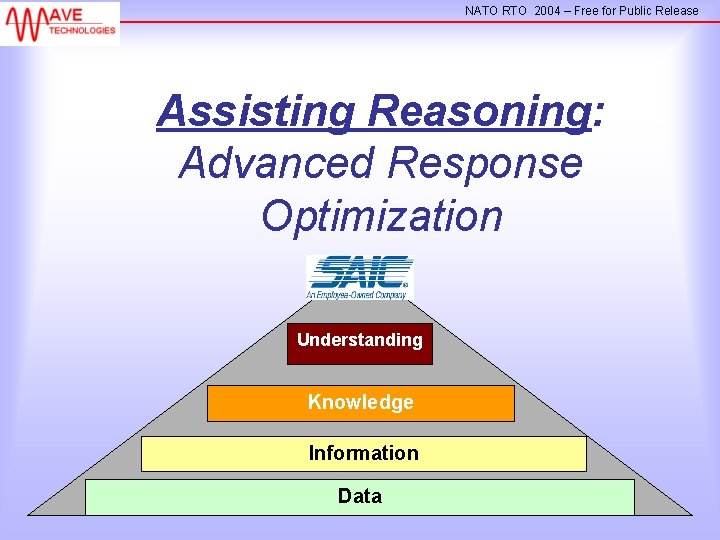
NATO RTO 2004 – Free for Public Release Assisting Reasoning: Advanced Response Optimization Understanding Knowledge Information Data

NATO RTO 2004 – Free for Public Release What is Advanced Response Optimization? • The next generation of decision support • Turning data into action • Providing constant situation understanding and optimal response
NATO RTO 2004 – Free for Public Release How We Can Help • Intelligence – Knowledge Development and Situation Awareness • First Responders – nuclear, biological, chemical scenarios, civil unrest scenarios. • Military - battlespace awareness, network-centric warfare, training/simulation, FCS • Special Operations • Anyone, Anywhere with a need for situation awareness and a desire for optimal response.
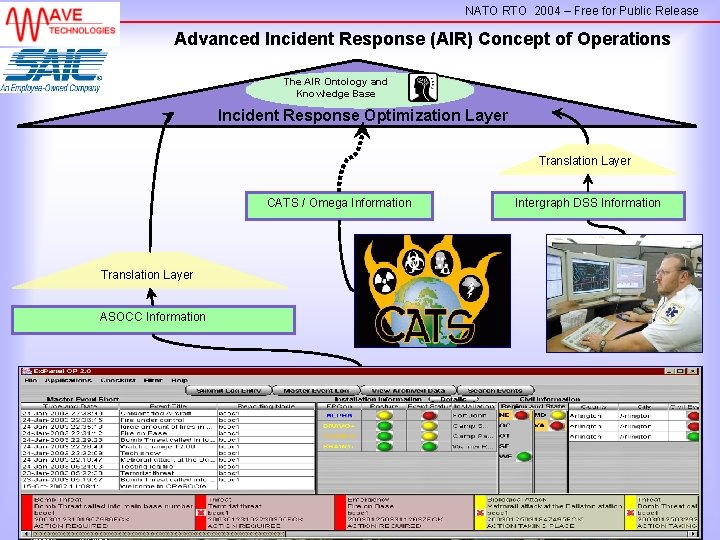
NATO RTO 2004 – Free for Public Release Advanced Incident Response (AIR) Concept of Operations The AIR Ontology and Knowledge Base Incident Response Optimization Layer Translation Layer CATS / Omega Information Translation Layer ASOCC Information Intergraph DSS Information
NATO RTO 2004 – Free for Public Release How We Did It • A DAML based ontology structure for related event and asset information was created. • Nonmonotonic Rules were embedded into the ontology structure as elements of a class of rules. • Rules and command options were given priorities to reduce the computability time and to make the final recommendations easier to follow. • A parser was written that takes the DAML code and converts it to a database format in which the truth or falsity of each piece of each rule is assessed and the nonmonotonic algorithms are carried out. – This parser can do the same for any DAML structure with associated embedded rules! – We can quickly and easily convert or expand the current code to tailor it to the needs of anyone!
NATO RTO 2004 – Free for Public Release How We Did It • Data extraction and translation methods were developed and implemented to ensure that the data and information from the included applications would reliably update to ours and arrive in the right format and vocabulary. • A visualization was developed with XYZ Solutions (Alpharetta, GA) that would express event and asset information in a way that conveyed understanding to the commander and bolstered his confidence in the decisions being made.
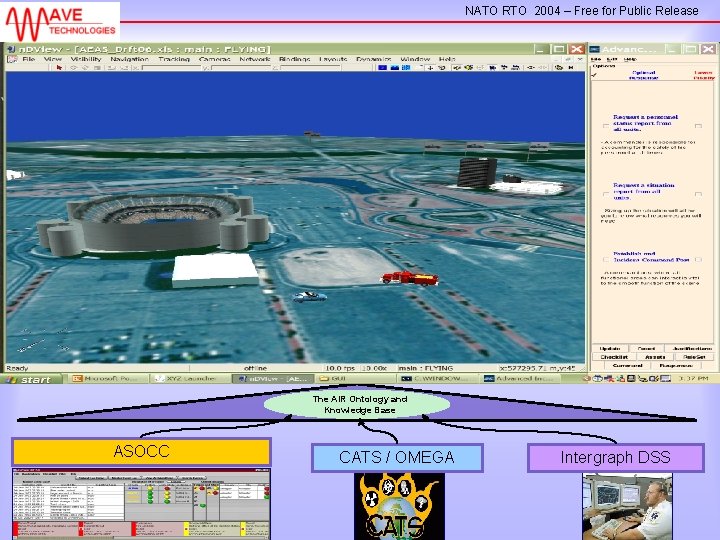
NATO RTO 2004 – Free for Public Release The AIR Ontology and Knowledge Base ASOCC CATS / OMEGA Intergraph DSS
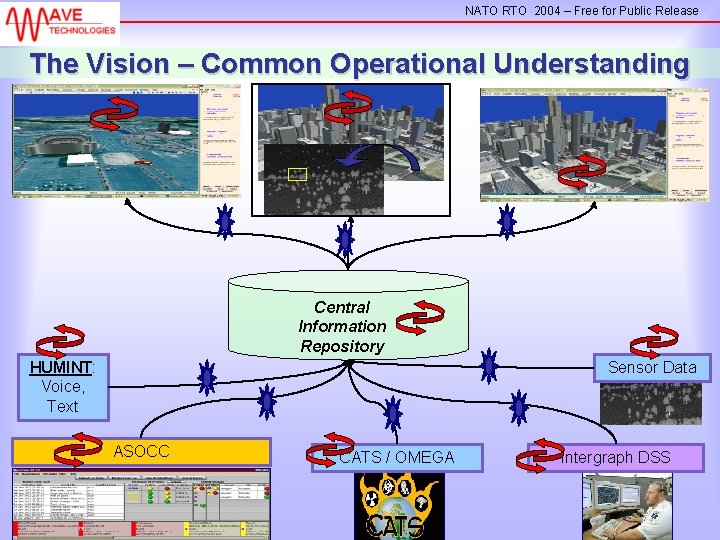
NATO RTO 2004 – Free for Public Release The Vision – Common Operational Understanding Central Information Repository HUMINT: Voice, Text Sensor Data ASOCC CATS / OMEGA Intergraph DSS
NATO RTO 2004 – Free for Public Release Scaling This System • Incorporate other sources of information: – – Video and still imagery Voice Text Latent Semantic Indexing and other models • More substantial integration of the Intergraph Dispatch System. • The AIR system currently focuses on the Respond stage only. Extension can include focus on the stages of Prevent, Detect, Alert and Recover. • Focus on Emergent Threat Detection
NATO RTO 2004 – Free for Public Release Decision Support and Analysis at Wave Tech • Highly-trained experts • Years of experience • Probability, Inference methods, Neural Networks, Genetic Algorithms, Nonmonotonic Reasoning, Human-Computer Interaction, Networking and Software Development. • Led by Dr. Amy K. C. S. Vanderbilt, Ph. D. who developed the concepts of Nonmonotonic Analysis, and Nonmonotonic Transformations and is dedicated to the application of Nonmonotonic Reasoning to industrial, Incident and Military decision-making. Contact Amy K. C. S. Vanderbilt, Ph. D. Office: 301 -394 -1840 Mobile: 571 -723 -5645 Email: avanderbilt@wvtec. com
NATO RTO 2004 – Free for Public Release Backup Slides
NATO RTO 2004 – Free for Public Release Assisting Reasoning: FCS Detection Metrics • Objective: provide mission and program support for the Army Night Vision and Electronic Sensors Directorate’s role in Future Combat Systems (FCS) • We want to close the feedback loop for FCS designers so they can get immediate feedback on their design changes. • Provide them with a metric to judge detectivity of their designs RELATIVE TO current vehicles and previous designs. • This metric will aid the reasoning of FCS designers in their quest to minimize the infrared signature of FCS vehicles.
NATO RTO 2004 – Free for Public Release Analyzing Reasoning: Nonmonotonic Decision Analysis • See how the a decision can be strengthened by aiding the assumptions of the deciding group, and at the same time, counteract a negative decision by contradicting the assumptions of another group. • Send a single message (in a media campaign or otherwise) that will both assure the desired decision and possibly counteract the undesirable decision. A model and strategy can be developed for ANY conclusion made by ANY group of people.
NATO RTO 2004 – Free for Public Release Mimicking Reasoning: Swarm Specifications • Projects on behalf of NASA have found our team studying existing formal specification methods for swarms of agents and using that knowledge to create new formal specification methods to specify a swarm of one thousand spacecraft designed for autonomous exploration of the asteroid belt as part of the ANTS mission. Emergent Threat Detection • Blended Nonmonotonic Methods can be used to detect emerging threats to homeland or other strategic locations, by taking in information from sensors, patrol briefings, and other disparate sources. Improved Electro-Optical Sensors • Nonmonotonic Reasoning and Formula Augmented Neural Nets can be used to improve the resolution of LADAR imagery and improve existing aided target recognition systems. The possibilities are endless. . .
- Slides: 19