
Native Studies Aboriginal Stereotypes Stereotype A simplified and
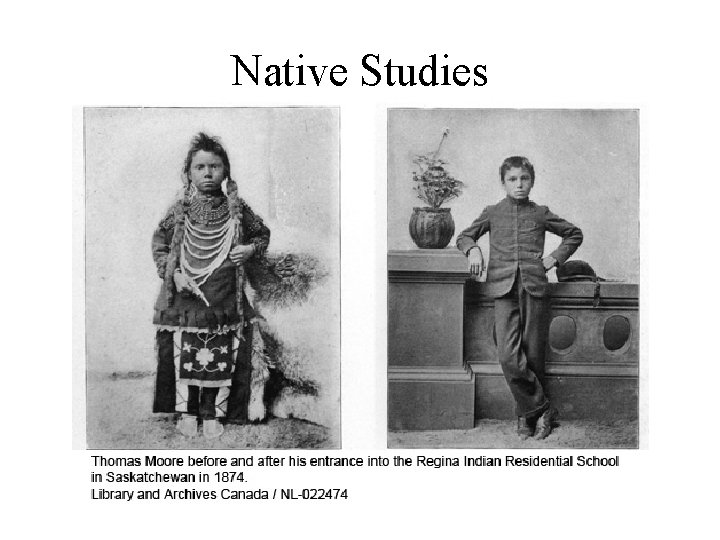
Native Studies
Aboriginal Stereotypes Stereotype: • A simplified and standardized conception or image invested with special meaning and held in common by members of a group. • A thought that can be adopted about specific types of individuals or certain ways of doing things. These thoughts or beliefs may or may not accurately reflect reality. Discussion questions - • What are some Aboriginal stereotypes? • Is your list of Aboriginal stereotypes a positive or negative reflection of Aboriginal people? • How do these stereotypes impact or impression of Aboriginal people? Wab Kinew on Native Stereotypes in Canada: https: //www. youtube. com/watch? v=l. IGo 8 lt. W 9 Ho
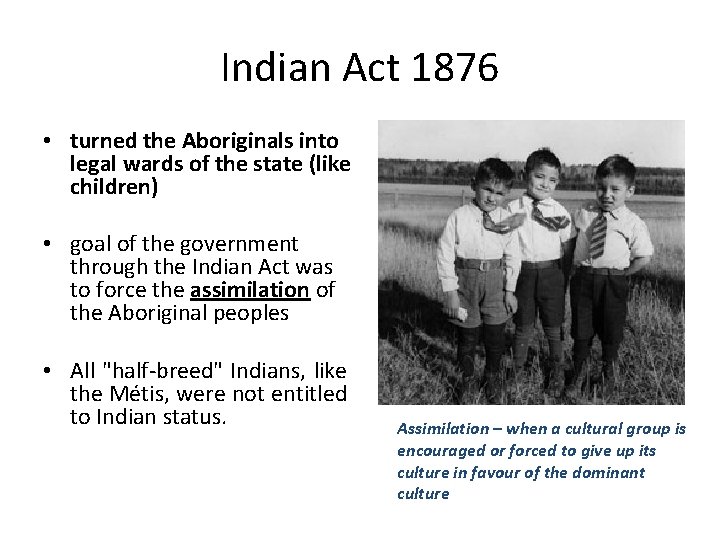
Indian Act 1876 • turned the Aboriginals into legal wards of the state (like children) • goal of the government through the Indian Act was to force the assimilation of the Aboriginal peoples • All "half-breed" Indians, like the Métis, were not entitled to Indian status. Assimilation – when a cultural group is encouraged or forced to give up its culture in favour of the dominant culture
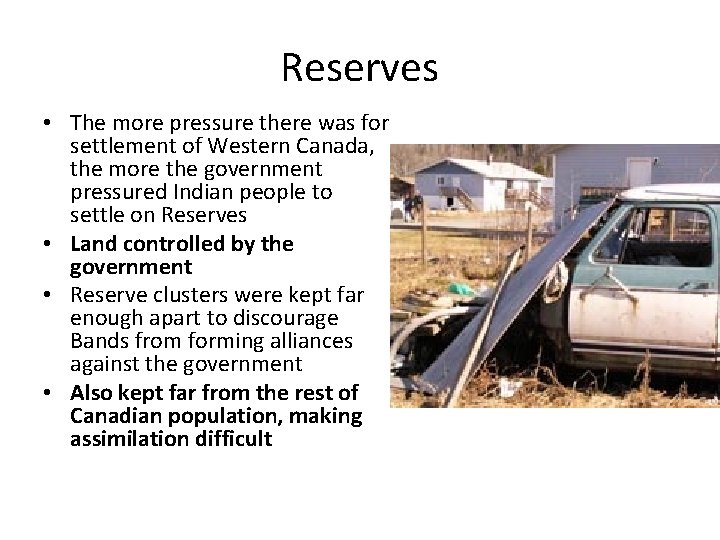
Reserves • The more pressure there was for settlement of Western Canada, the more the government pressured Indian people to settle on Reserves • Land controlled by the government • Reserve clusters were kept far enough apart to discourage Bands from forming alliances against the government • Also kept far from the rest of Canadian population, making assimilation difficult
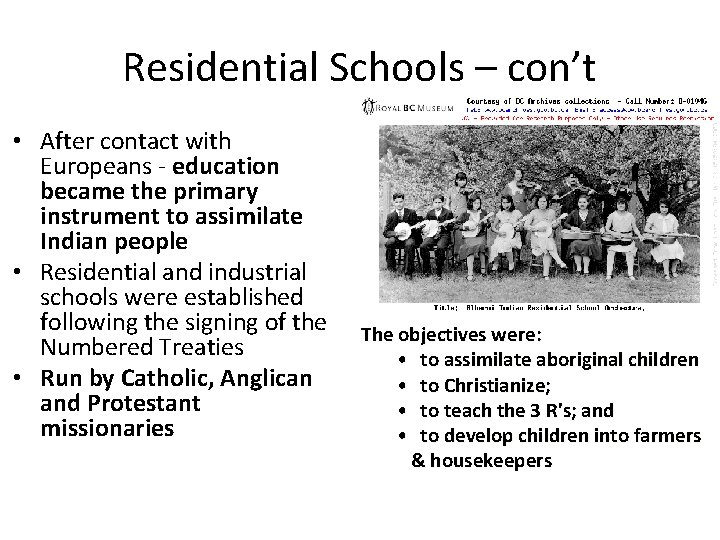
Residential Schools – con’t • After contact with Europeans - education became the primary instrument to assimilate Indian people • Residential and industrial schools were established following the signing of the Numbered Treaties • Run by Catholic, Anglican and Protestant missionaries The objectives were: • to assimilate aboriginal children • to Christianize; • to teach the 3 R's; and • to develop children into farmers & housekeepers
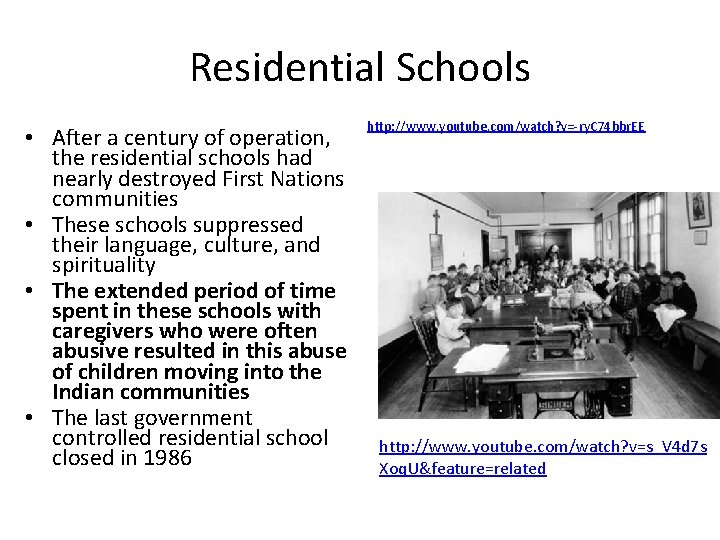
Residential Schools • After a century of operation, the residential schools had nearly destroyed First Nations communities • These schools suppressed their language, culture, and spirituality • The extended period of time spent in these schools with caregivers who were often abusive resulted in this abuse of children moving into the Indian communities • The last government controlled residential school closed in 1986 http: //www. youtube. com/watch? v=-ry. C 74 bbr. EE http: //www. youtube. com/watch? v=s_V 4 d 7 s Xoq. U&feature=related
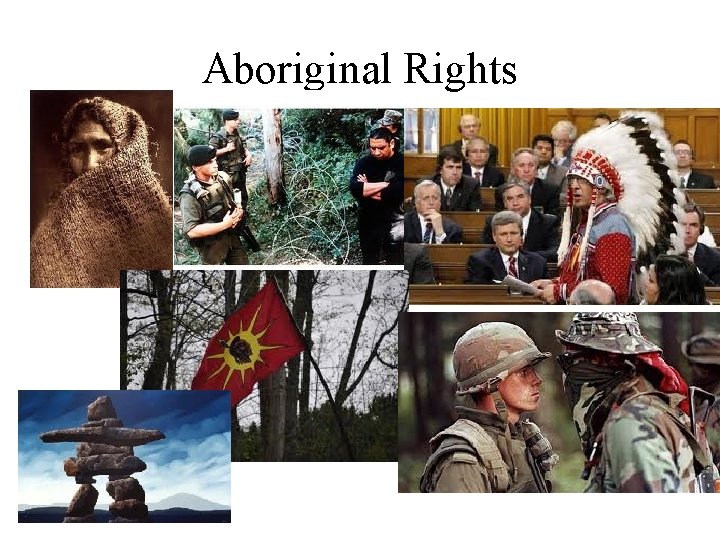
Aboriginal Rights
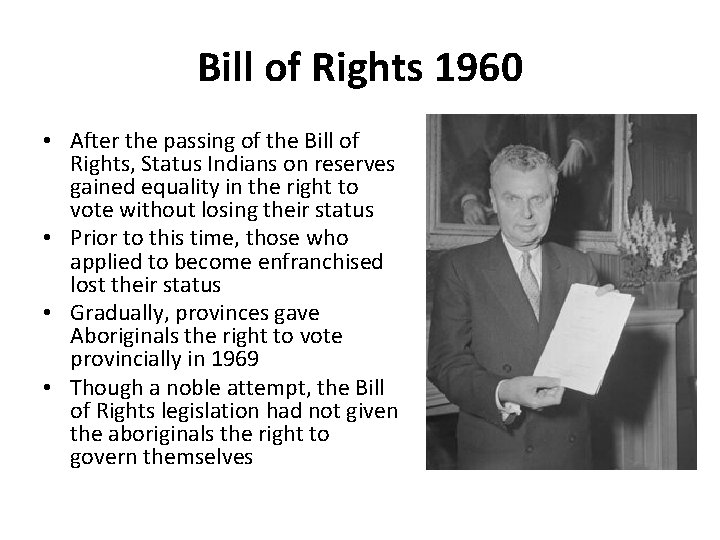
Bill of Rights 1960 • After the passing of the Bill of Rights, Status Indians on reserves gained equality in the right to vote without losing their status • Prior to this time, those who applied to become enfranchised lost their status • Gradually, provinces gave Aboriginals the right to vote provincially in 1969 • Though a noble attempt, the Bill of Rights legislation had not given the aboriginals the right to govern themselves
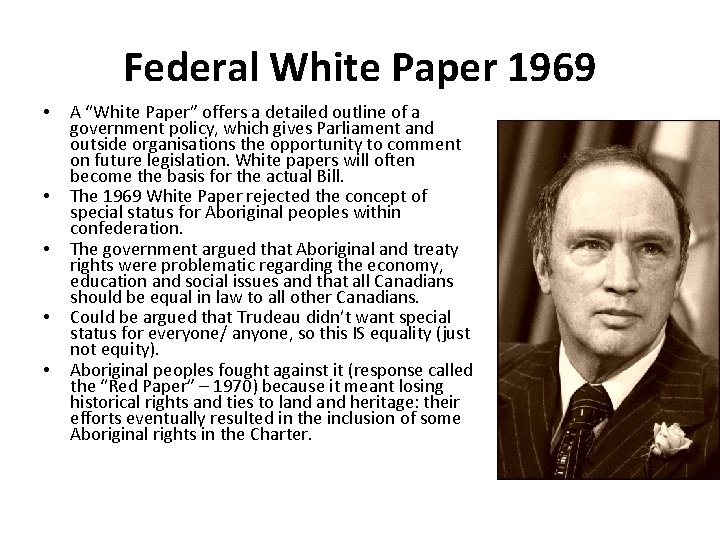
Federal White Paper 1969 • • • A “White Paper” offers a detailed outline of a government policy, which gives Parliament and outside organisations the opportunity to comment on future legislation. White papers will often become the basis for the actual Bill. The 1969 White Paper rejected the concept of special status for Aboriginal peoples within confederation. The government argued that Aboriginal and treaty rights were problematic regarding the economy, education and social issues and that all Canadians should be equal in law to all other Canadians. Could be argued that Trudeau didn’t want special status for everyone/ anyone, so this IS equality (just not equity). Aboriginal peoples fought against it (response called the “Red Paper” – 1970) because it meant losing historical rights and ties to land heritage: their efforts eventually resulted in the inclusion of some Aboriginal rights in the Charter.
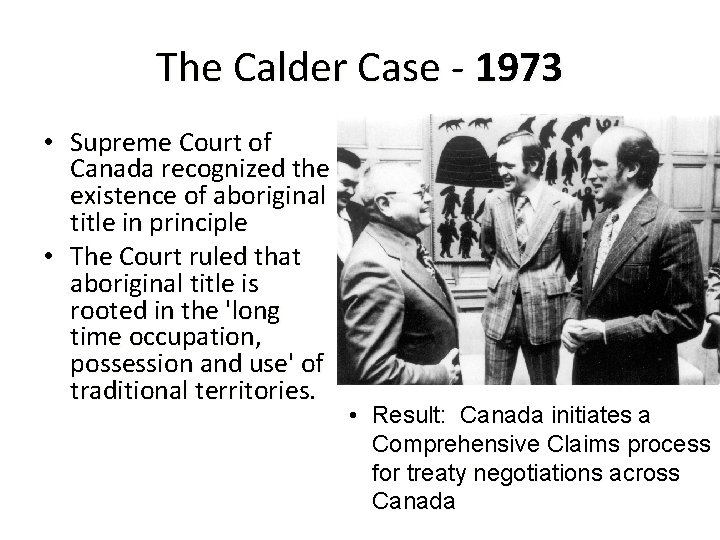
The Calder Case - 1973 • Supreme Court of Canada recognized the existence of aboriginal title in principle • The Court ruled that aboriginal title is rooted in the 'long time occupation, possession and use' of traditional territories. • Result: Canada initiates a Comprehensive Claims process for treaty negotiations across Canada
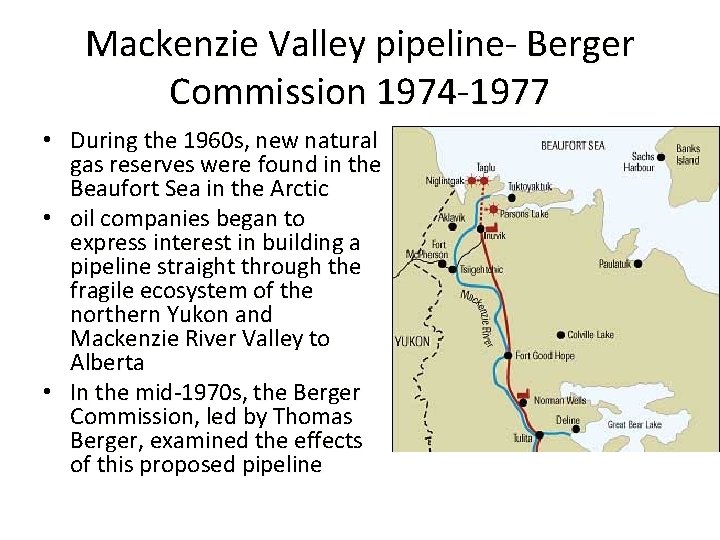
Mackenzie Valley pipeline- Berger Commission 1974 -1977 • During the 1960 s, new natural gas reserves were found in the Beaufort Sea in the Arctic • oil companies began to express interest in building a pipeline straight through the fragile ecosystem of the northern Yukon and Mackenzie River Valley to Alberta • In the mid-1970 s, the Berger Commission, led by Thomas Berger, examined the effects of this proposed pipeline
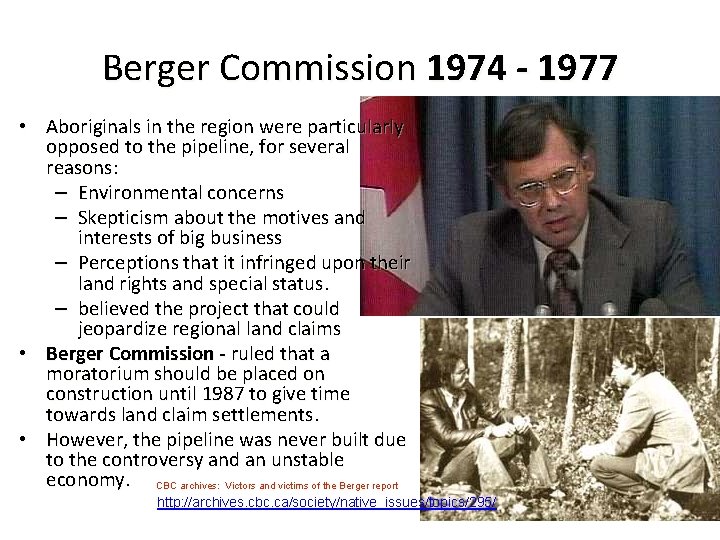
Berger Commission 1974 - 1977 • Aboriginals in the region were particularly opposed to the pipeline, for several reasons: – Environmental concerns – Skepticism about the motives and interests of big business – Perceptions that it infringed upon their land rights and special status. – believed the project that could jeopardize regional land claims • Berger Commission - ruled that a moratorium should be placed on construction until 1987 to give time towards land claim settlements. • However, the pipeline was never built due to the controversy and an unstable economy. CBC archives: Victors and victims of the Berger report http: //archives. cbc. ca/society/native_issues/topics/295/
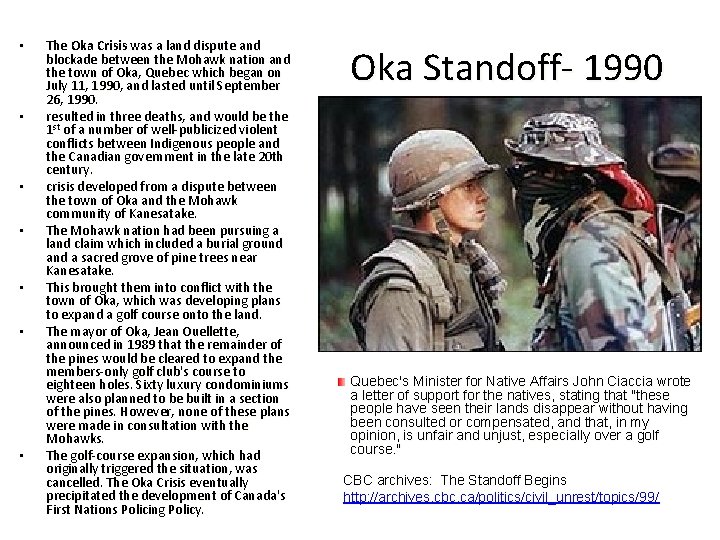
• • The Oka Crisis was a land dispute and blockade between the Mohawk nation and the town of Oka, Quebec which began on July 11, 1990, and lasted until September 26, 1990. resulted in three deaths, and would be the 1 st of a number of well-publicized violent conflicts between Indigenous people and the Canadian government in the late 20 th century. crisis developed from a dispute between the town of Oka and the Mohawk community of Kanesatake. The Mohawk nation had been pursuing a land claim which included a burial ground a sacred grove of pine trees near Kanesatake. This brought them into conflict with the town of Oka, which was developing plans to expand a golf course onto the land. The mayor of Oka, Jean Ouellette, announced in 1989 that the remainder of the pines would be cleared to expand the members-only golf club's course to eighteen holes. Sixty luxury condominiums were also planned to be built in a section of the pines. However, none of these plans were made in consultation with the Mohawks. The golf-course expansion, which had originally triggered the situation, was cancelled. The Oka Crisis eventually precipitated the development of Canada's First Nations Policing Policy. Oka Standoff- 1990 Quebec's Minister for Native Affairs John Ciaccia wrote a letter of support for the natives, stating that "these people have seen their lands disappear without having been consulted or compensated, and that, in my opinion, is unfair and unjust, especially over a golf course. " CBC archives: The Standoff Begins http: //archives. cbc. ca/politics/civil_unrest/topics/99/
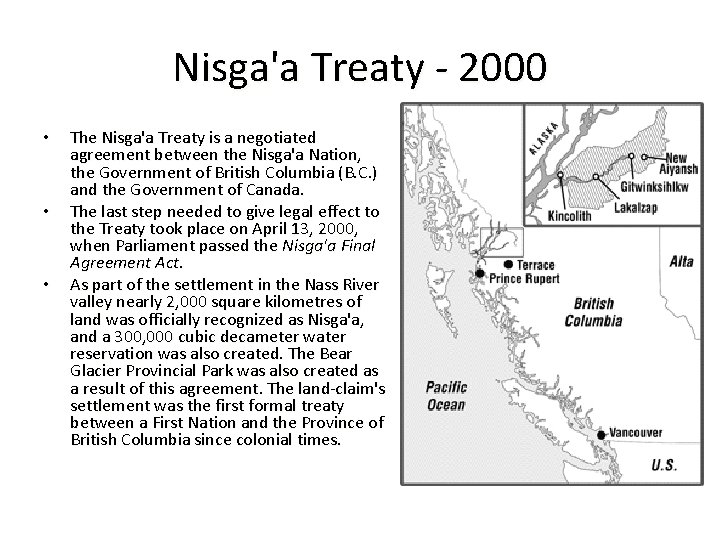
Nisga'a Treaty - 2000 • • • The Nisga'a Treaty is a negotiated agreement between the Nisga'a Nation, the Government of British Columbia (B. C. ) and the Government of Canada. The last step needed to give legal effect to the Treaty took place on April 13, 2000, when Parliament passed the Nisga'a Final Agreement Act. As part of the settlement in the Nass River valley nearly 2, 000 square kilometres of land was officially recognized as Nisg a'a, and a 300, 000 cubic decameter water reservation was also created. The Bear Glacier Provincial Park was also created as a result of this agreement. The land-claim's settlement was the first formal treaty between a First Nation and the Province of British Columbia since colonial times.
- Slides: 14