
Native Art Forms of the Americas A Web
Native Art Forms of the Americas A Web. Quest for 4 th and 5 th Grade Artists Designed by Francella Smith fasmith@naz. edu Next Introduction / Task / Map of Territories / Internet Resources / Process / Evaluation / Conclusion / Credits / Sources
Introduction You've been asked by the Board of Directors of the Museum of Indigenous Art to help design an exhibit about Environmental Influences on Native American Art Forms! The Board feels that people don't know enough about or appreciate all the different art forms practiced by Native Americans, and they're hoping that you can pull together an exhibit to educate the audience about all the ways the environment influenced what they madelike what materials were available, what kinds of animals and plants they encountered, and climate. Hom e Next
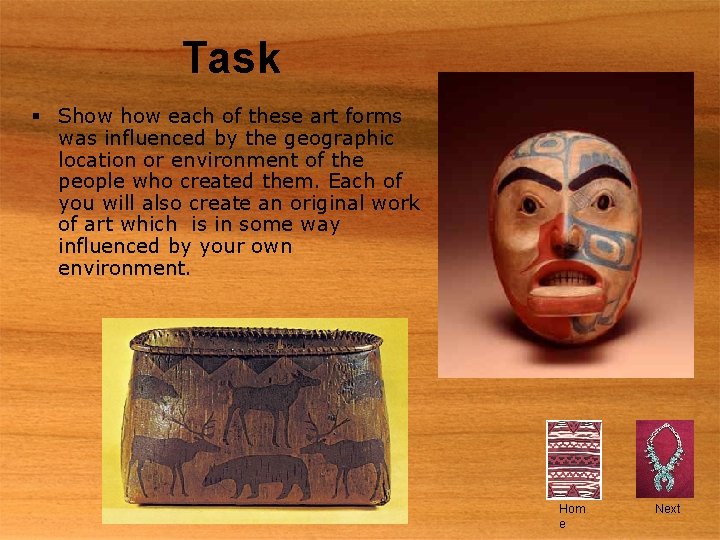
Task § Show each of these art forms was influenced by the geographic location or environment of the people who created them. Each of you will also create an original work of art which is in some way influenced by your own environment. Hom e Next
Map of Territories Next Hom e http: //lajhsslab. com/Native_Americans/map_native_american. gif § The exhibit will address each of the major Native American groups separately. These groups include: Eastern Woodland, Western Woodland, Great Plains, Plateau, Southeast, Southwest, Great Basin, Northwest Coast, California, Subarctic, and Inuit (Arctic).
Internet Resources Visit the following sites to gather the information you will need to create your presentation. § http: //www. nmai. si. edu/subpage. cfm? subpage=sitemap § http: //encarta. msn. com/encyclopedia_701509021_4/Native_American_Art. html § http: //americanhistory. si. edu/ § http: //www. native-languages. org/art. htm § http: //witcombe. sbc. edu/ARTHamericasoceania. html#mesoamerica § http: //www. nativetech. org/content/index. php § http: //www. tiscali. co. uk/reference/encyclopaedia/hutchinson/m 0039822. html § http: //www. nativeamericans. com/Indian. Nations. A-Z. htm § Google. See full-size image. lajhsslab. com/. . . / map_native_american. gif Hom e Next
Process Hom e Next 1. First, explore these sites to get an overview of the kinds of artwork each native group produced. 2. Within your team, develop some rules for selecting the specific items for your exhibit. What qualities does something need to have? What should you be sure to include because it will interest your audience? 3. Now, divide up the task of finding objects based on your criteria. Each member of the team should investigate a different native group’s work, and draw connections between their work and their environment. The connections may be through the materials they use or the subject matter they portray. There may not be enough people on your team to investigate all the native groups. 4. Decide together as a team on a final set of objects to display by each Native Group. Prepare your exhibit using Power. Point. Be sure to include in your presentation how the piece relates to the environment of the artist that created it. 5. Each of you will create a work of art that is influenced by your own environment, either through your culture, your geographic location, your material choice, or the image you portray. Your work may be two-or-three-dimensional, and it must be accompanied by a written description which clearly describes it’s connection to your environment. 6. You will submit your presentation to the class in four weeks.
Evaluation This rubric will be used to evaluate your work. The first four categories will be averaged to make up half of your grade, the 5 th and 6 th categories will be averaged to make up the other half. Hom Next

Conclusion § Congratulations! You have learned a great deal about the way indigenous artists are influenced by their environments. In addition, you have successfully used the web to expand your research skills and provided a valuable resource for your classmates. § If you would like to learn more about the art work of other indigenous peoples around the world, check out these websites, and see if you can figure out how their work is influenced by their environments. http: //www. metmuseum. org/TOAH/ht/05/caa/ht 05 caa. htm http: //www. metmuseum. org/Works_of_Art/arts_of_africa_oceania_and_the_a mericas http: //www. aboriginalart. com. au/ http: //www. dorsetfinearts. com/althome. html http: //www. historylink 101. com/1/aztec/ancient_aztec. htm http: //www. coffeetimes. com/tattoos. htm Hom e http: //www. historyworld. net/wrldhis/Plain. Text. Histories. asp? historyid=aa 39 Next
Credits & References Special thanks to “The Web. Quest Page” for the template this webquest was created from. To Create your own webquest, visit The Web. Quest Page and the Design Patterns page to acquire the latest version of this template and training materials. We all benefit by being generous with our work. Permission is hereby granted for other educators to copy this Web. Quest, update or otherwise modify it, and post it elsewhere provided that the original author's name is retained along with a link back to the original URL of this Web. Quest. On the line after the original author's name, you may add Modified by (your name) on (date). If you do modify it, please let me know and provide the new URL. Next Hom e
Image Sources § § § http: //z. about. com/d/phoenix/1/0/v/R/NAArts. Fest 04. jpg http: //www. nmai. si. edu/subpage. cfm? subpage=exhibitions&second=ny&third=current http: //www. kahnawakelonghouse. com/images/content/wampum. jpg http: //www. tfaoi. com/cm/4 cm 80. jpg http: //cache. eb. com/eb/image? id=42189&rend. Type. Id=4 http: //naci. oregonstate. edu/images/music. jpg http: //www. totem-pole. net/images/totem_poles. jpg http: //cache. eb. com/eb/image? id=42268&rend. Type. Id=4 http: //www. wsu. edu/~fa 308310/fa 308/i 42. jpg http: //mcclungmuseum. utk. edu/specex/singclay/si-p 23. jpg http: //www. next 1000. com/family/EC/petroglyph 25. jpg http: //www. crowneagle. com/images/squashblossom. jpg Hom e
- Slides: 10